Few artists made a bigger splash than David Hockney, who has died at 88
Across a seven-decade career, the Yorkshireman was always vibrant, always innovative and absolutely never boring.
Everyone loved David Hockney. Directors of institutions loved him for his genius and ticket-selling popularity. Curators who had devoted their lives to the study of Renaissance mark-making saw something of Leonardo in his confident hand. Countless art lovers from across the globe would buy a postcard of “Mr and Mrs Clark and Percy” (1970-71) from the Tate Britain giftshop, having stood before the real thing a few minutes earlier. And fellow artists? Well, Hockney must have been doing something right if Francis Bacon and Lucian Freud were made haughtier still by his success.
People love his portraiture, landscapes, use of colour, exuberance, accessibility and mastery of styles. They love his modernity, public persona, wardrobe, ordinariness, extraordinariness and naughtiness. Hockney was always doing two things: smoking and painting. He loved a gasper and it’s satisfying for libertarians everywhere that he lived to just a month shy of his 89th birthday after lighting up many a day. But it’s his practice of sketching and painting, of making lines and shade, that was his job, his greatness and his glory.
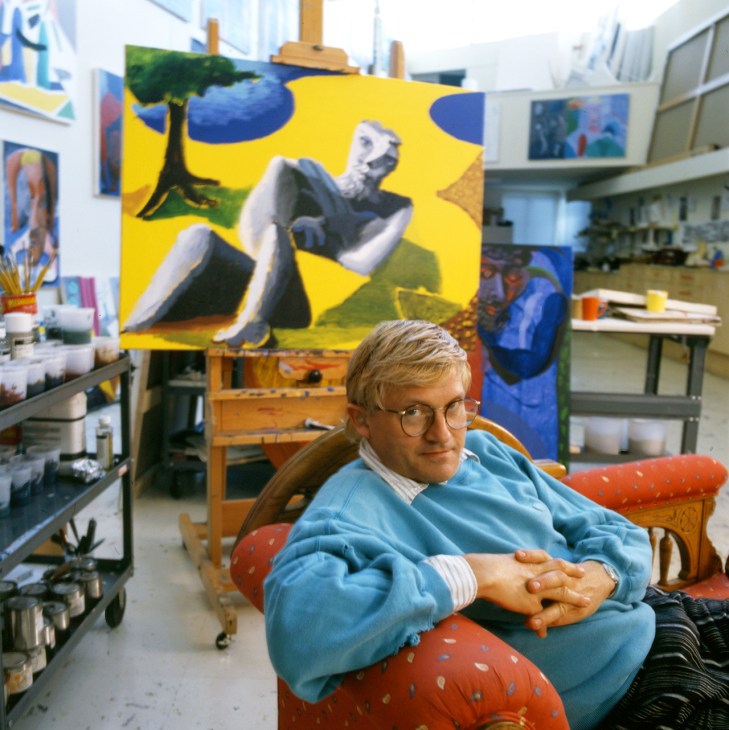
Things could have turned out differently for Hockney. He grew up in a working-class, non-artistic household in the north of England; a job in a factory or a shop was far more likely than an art career. Hockney once described how, as an eight-year-old in his hometown of Bradford, he used to help his father renovate old bikes. He recalled how he had loved “a thick brush full of paint coating something”. At the time, the young Hockney assumed that artworks were “done in the evenings when the artists had finished painting the signs or the Christmas cards”. Perhaps the way that he saw painting as a job, rather than a purely aesthetic endeavour, shaped his approach to his own work.
At the Royal College of Art in London, Hockney experimented with abstract expressionism. In “The Third Love Painting” (1960), he explored queer desire, reproducing graffiti found in the Earl’s Court Tube station toilets. He offered glimpses of confession in “We Two Boys Together Clinging” and “Doll Boy” (both 1961). Hockney’s coming out as gay was made easier by his move to Southern California in 1964, where he painted abstracted landscapes and figurative pool-scapes – the bright milieu of people, parties and private views to which he now half-belonged. “Beverly Hills Housewife” (1966) and “A Bigger Splash” (1967) are masterclasses in sun-drenched psychological detachment. In Los Angeles, Hockney bleached his hair a shocking blonde, embraced colourful suits, stripes and glasses, and became a spectacle himself: the apotheosis of the contemporary artist in the popular imagination (and rich too). Then he spoke and was northern English, charming, funny and fey.
For Hockney, the 1970s and 1980s were full of painting and photography, and a fascination with art history and perspective. Perhaps most enjoyably for the artist, he immersed himself in designs for the theatre and opera. Igor Stravinsky’s The Rake’s Progress at Glyndebourne and Giacomo Puccini’s Turandot for the LA Opera were creative landmarks. Not intimidated by working at a large scale, Hockney began making huge canvases, landscapes made from panels that could absorb gargantuan subjects. “A Closer Grand Canyon” (1998) tallied with his vast photographic collages of the 1980s.
These set the scene for his return in the early 2000s to Yorkshire, where he embraced the landscape and seasons in canvases great enough to cover walls of the Royal Academy of Arts and small enough to almost be the postcard that millions would take home. While a personal tragedy unsettled the artist, his tireless spirit returned. He later painted in Normandy, freshly excited by the landscape, art, history, colour and doing something useful every day. Hockney contained multitudes but could see clearly and paint beautifully because of his seven decades of study and practice.
Hockney was a sexy, sun-kissed buccaneer, a glamorous success, an éminence gris and a Yorkshireman in a cloth cap in the rain of the Dales. For many years, he was the world’s greatest living painter and his works, his unmistakable style, live forever behind the eyes.