South American literature is having a moment – and women are at the forefront
Latin American literature in translation is continuing to find success, especially works by women writers. Charco Press is leading the charge. Monocle speaks with Carolina Orloff, its founder, about the phenomenon.
South American literature is enjoying some well-earned attention right now. Die My Love, a film starring Jennifer Lawrence and Robert Pattinson that graced cinema screens at the end of last year, is based on the 2012 novel Matate, amor by Argentine author Ariana Harwicz. But before a translated version of the book was published in 2017 (and then picked up by the Scottish filmmaker Lynne Ramsay), the story was inaccessible to the English-speaking world.
There are several publishers bringing contemporary South American literature to fresh audiences – Fitzcarraldo Editions and New Directions among them – but perhaps the most stylish is Charco Press. The tight-knit publishing house, comprising just five people, is a global affair: founders Carolina Orloff and her husband, Sam McDowell, hail from Argentina and New Zealand respectively, though they currently live and work in Edinburgh. They have made room for themselves in the competitive publishing arena by identifying which untranslated works will do well in front of new audiences – a mission that began back in 2016. “Our first catalogue consisted of only five titles, all from Argentina,” Orloff tells Monocle. “We wanted to make an immediate impact and show just how many styles, aesthetics and tones could be offered from the contemporary literature of a single country in the region.”
Now, Charco has a growing roster of nearly 50 writers from across the continent and an output of eight to 12 books a year. Their determination is finding success. Within the first two years of starting the press, Charco was longlisted for the International Booker Prize – one of the leading awards for global works in translation – with Die, My Love. It was then shortlisted in 2022 with Claudia Piñero’s Elena Knows and once more in 2024, for Not a River by Selva Almada.
That year was something of a watershed for literature from the region; in total, four South American titles featured on the International Booker longlist. But bringing the right titles to English-speaking audiences at the right time is no easy task. Orloff and McDowell’s respective disciplines help them to identify gaps in the market, blending taste with the mechanics of the industry. “I’m more obsessed with the academic side of things,” says Orloff. “The translation, the literature, the words. Sam comes from a different background. He’s concerned with marketing and getting projects off the ground, bringing them to life. It’s a good combination.”
In publishing, books are – for better or worse – judged by their covers. The striking, figurative façades of Charco Press novels are also South American exports. Pablo Font, Charco’s in-house artist and designer, works remotely from Argentina – and the connection with Orloff’s homeland isn’t taken for granted. “I don’t know how other designers are but I work closely with him and he gets very involved,” she says. “We have long discussions about the themes and what we want to evoke at first glance.”
With a growing presence of the region’s writing in English-language markets, it’s becoming easier to identify burgeoning trends. In South America, there is a wealth of Narco-literature: books devoted to (and perhaps romanticising) its problems with crime. While these dark novels are often written by men, there are plenty penned by women. The key difference is that the latter rarely garner the same attention nationally.
Both of Charco’s works that graced the Booker’s shortlist are written by women. As these violent and often abrasive novels journey up into North America or hop over the Atlantic Ocean, they begin to tell a slightly different story. In translation, there seems to be more scope for work by female writers to be lauded than in South America.
The differences are language and labelling. As the novels cross the pond, they also move across genres, becoming “translated fiction”. Perhaps this primes readers for a different experience, imbuing the titles with an exotic allure and reeling in audiences who might not have gravitated towards the original genre. But this, Orloff thinks, fails to properly credit the standalone merits of the text. “Those books weren’t chosen because we thought that they were doing something niche and unseen. We choose books that we think are brilliant – and that need to exist in English,” she says. “As an editor, there’s a feeling that almost transcends commerciality. I feel as though we have an ethical responsibility to get these books read.”
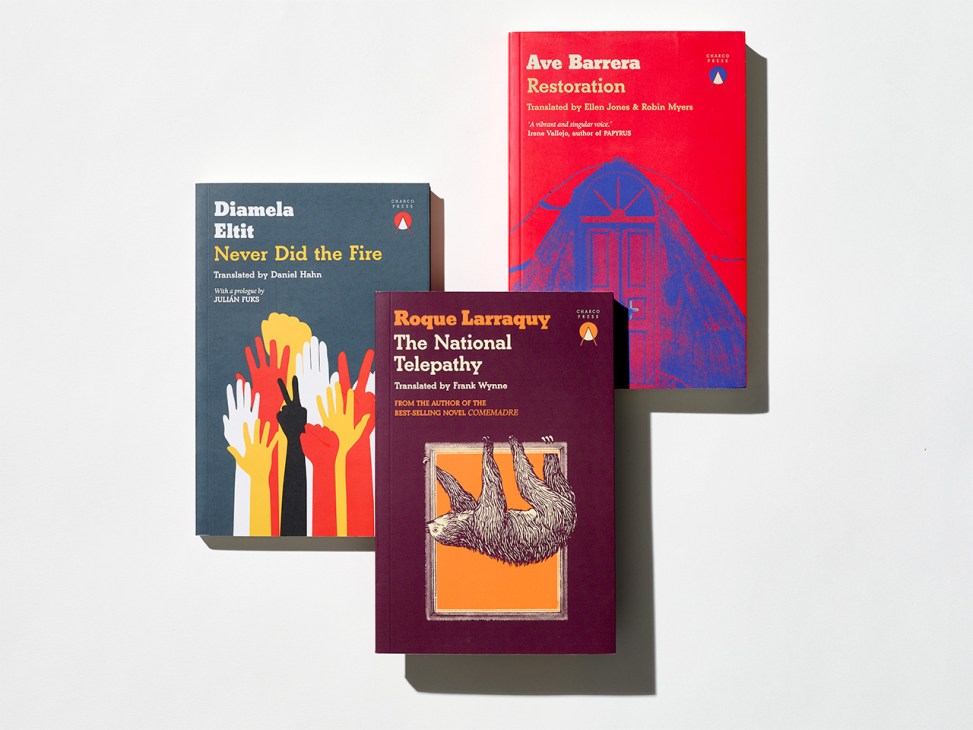
Three recommendations from Charco’s catalogue:
1.
‘The National Telepathy’ by Roque Larraquy (tr. Frank Wynne)
Buenos Aires-born Roque Larraquy is no stranger to having his work published in English. His first translated novel, La Comemadre (The Mother Eater) was longlisted for the 2018 USA National Book Award for Translated Literature. Larraquy’s latest novel is a kaleidoscopic and provocative tale about an early 20th-century Peruvian rubber company, which transports human cargo and attempts to establish Argentina’s first ethnographic theme park.
2.
‘Restoration’ by Ave Barrera (tr. Ellen Jones & Robin Myers)
The premise of Restoration is simple – Jasmina, a young woman, is hired to restore her maybe-boyfriend’s abandoned family home. But the depth of Mexican-born writer and editor Ave Barrera’s narration creates a powerful story about the female experience that raises as many questions as it provides answers.
3.
‘Never Did the Fire’ by Diamela Eltit (tr. Daniel Hahn)
Chilean writer Diamela Eltit is as daring on page as she is in real life (in the 1970s she staged artistic anti-Pinochet protests). This novel is inspired by some of those activities and is a culturally wrought story that centres on an elderly couple – survivors of Pinochet’s regime – and the ever-present ghosts of the past.
Read next: Five thought-provoking books that will challenge the way you think