France’s next dining revolution might start before lunch
The ‘bouillon’ revival has proved that old traditions can bring back purpose to eating out. Could ‘mâchon’, a historic Lyonnaise feast, now do the same for the morning meal?
“And here, sir, is your pastis.”
It’s 10.00 and I’m already on the high-proof aniseed apéritifs. It’s concerning not least because I could be turning into my dad but also because I’m in Farringdon, blinking into a day that’s hardly begun.
And the pastis is barely the half of it because rapidly expanding in front of me is a spread so far removed from the usual Sunday morning fare that my brain is struggling to make sense of it. There’s the unmistakable whiff of andouillette, pungently foreboding beside a plate upon which golden chicken thighs collapse into the buttery embrace of gravy and beans. A waiter brings out even more food: a bowl of tripe (of which I will say no more), a soft Saint-Marcellin cheese, torn chunks of baguette, something resembling fishy rillettes and a scattering of radishes, presumably for health reasons.
The food teeters on excess – not a limp poached egg in sight – but the warmth emanating from the long communal tables makes the whole thing feel oddly domestic, as though this herculean act of consumption might be taking place in someone’s kitchen. That faintly disorientating contrast, I soon learn, is the beauty of a mâchon.
“It’s a kind of cultural dining club really,” chef Henry Harris tells me, who is thankfully on hand as our guide. His presence is apt, as few have done more to bring serious French cooking into British restaurants than Harris: first at Racine and now, two decades later, here at Bouchon Racine, which recently published its debut cookbook, The Racine Effect.
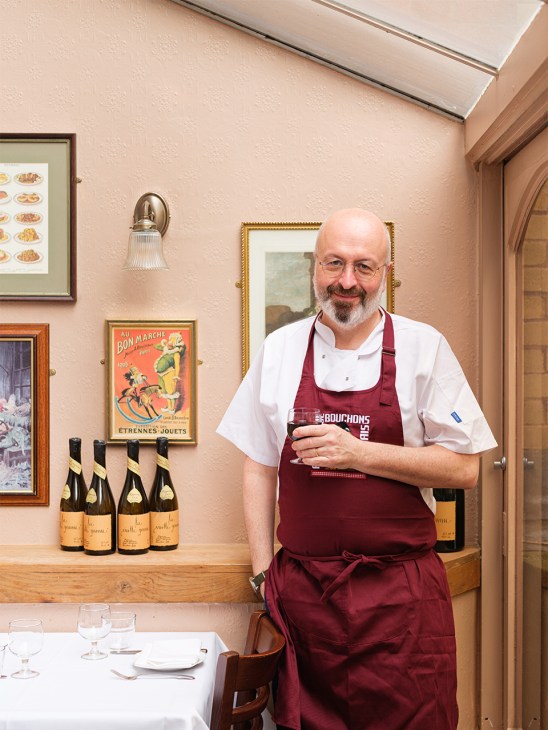
“A mâchon is a very fraternal thing,” he says. “It’s a group of people with a common sense of purpose, meeting to eat in a particular place at a particular time.” Traditionally, that meant early- to mid-morning at a Lyonnais bouchon, where silk workers would gather after a long shift and eat a savoury feast of offal, cheese and bread, often with wine. As we talk, I find a comparison with the polished vagueness of brunch increasingly hard to resist.
“The thing is, with brunch you’re kind of missing the best of both,” says Harris. “Whereas with a mâchon, you’re having a proper savoury meal first thing and there’s a real purpose to that.”
That a niche, 19th-century Lyonnais dining ritual could pack out one of London’s top restaurants is enough to ask whether its arrival is a sign of something bigger. In France, that something is already taking shape: a glorious re-emulsification of old-world tradition and modern appetite, breaking up the sterile, fine-dining monotony that has had European cities in a chokehold for the best part of two decades.
Many point to the bouillon revival as the clearest example of this shift. Since 2017, France has seen the return of no-frills, canteen-style restaurants historically associated with the Parisian working class. Often housed in grand 19th-century dining rooms, bouillons have been embraced not just for serving traditional dishes at democratic prices but because they’ve restored a clarity of purpose to the bistro: rejecting the Michelin-chasing fuss that has made many cities’ top restaurants feel increasingly indistinguishable in favour of the French ideal of feeding people generously and convivially.
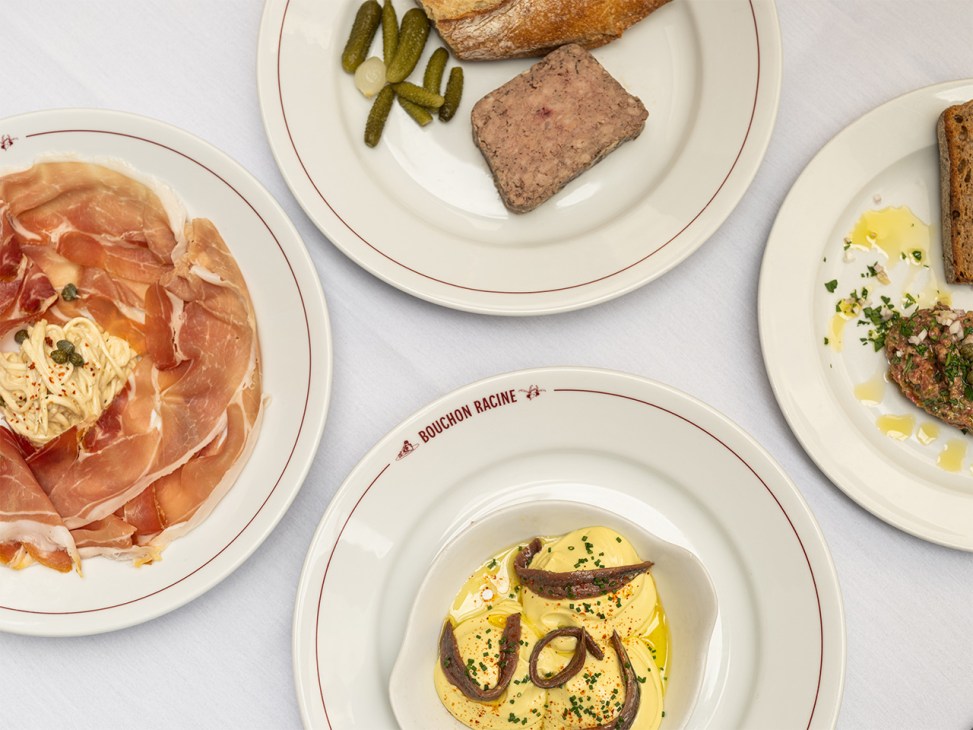
With reports suggesting that bouillons are proliferating at a rate of one a month, the question now is whether mâchon might stage a similar rescue act for the no-man’s land between breakfast and lunch. That, at least, is what La Confrérie des Francs-Mâchons, which curates a national network of vetted bouchons, is working towards, arguing for the wider adoption of mâchon as a righteous alternative to brunch.
“We are absolutely seeing a renewed interest,” says Bruno Bouteraud, maître restaurateur at Café des Fédérations, a Lyon institution that’s part of the Francs-Mâchons network. “At a time when restaurants can tend towards a certain uniformity, more and more people are looking for experiences full of identity. It’s not a transformation of the morning meal per se but rather a rediscovery of its fundamental values of simplicity, generosity and human connection.”
There are signs too that in the UK, after a period of small-plate hegemony, diners are looking to enjoy food that belongs to a genuine gastronomic tradition. Many of the most sought-after reservations are now in timber-panelled pubs that are capitalising on the enduring nostalgia of a pint and a pie, though the pastry is a far cry from the beloved Pukka. This leveraging of heritage is also seeping into menus, which increasingly fetishise British seasonality through asparagus banquets, game feasts and wild-garlic suppers.
“On Beaujolais Nouveau day, we opened at quarter to eight in the morning, serving red wine and bacon baguettes, and there was a queue of people waiting outside,” says Harris. “People came in saying, ‘I’m having a glass of beaujolais and a baguette before I go to work.’ Though some did forget to go to work.”
Whether we’ll all be eating offal and drinking wine at dawn remains to be seen. But the growing interest in mâchon on both sides of the Channel offers clues as to where our taste might be heading. Away from the sameness of gastronomic monoculture, of which the genericism of brunch could be the bleakest expression, and towards, as Bouteraud puts it, food that “embodies the generous ideals of sharing, sincerity and the pleasure of gathering.” If bouillons brought that instinct back to lunch and dinner, mâchon might prove that the morning meal is ready for a revolution of its own.