How Nayla de Freige saved ‘L’Orient-Le Jour’ and reinvented Lebanese media
In a landscape of politically aligned news outlets, this Lebanese newspaper’s independence is ensured by its reader-funded pay model, with about 70 per cent of its budget coming from subscribers.
Recent years in Lebanon have been tumultuous, not least for the country’s media organisations. One publication has thrived thanks to its spirited boss and her bold decision-making. Here we meet the CEO of ‘L’Orient-Le Jour’, Nayla de Freige.
“Every morning we’d have our newspaper with our coffee, as the French say,” says Nayla de Freige. The CEO of Lebanon’s leading French-language newspaper grew up with L’Orient-Le Jour, in which her father was a shareholder. Little did the young De Freige know that decades later, she’d be at the helm, having saved the print paper from the brink and successfully brought the publication’s esteemed journalism into the digital sphere.
Long a mainstay of Beirut’s literati, L’Orient-Le Jour became a legend during the Lebanese civil war. As other journalists and publications retreated to the mountains, L’Orient-Le Jour reporters stayed in their offices in west Beirut, churning out the daily paper under heavy bombardment. “Some of the team were crossing the demarcation line every day,” says De Freige. “Our editor was killed by sniper fire. It was a local resistance paper. Salaries were meaningless; it was about a dedication to the cause.”
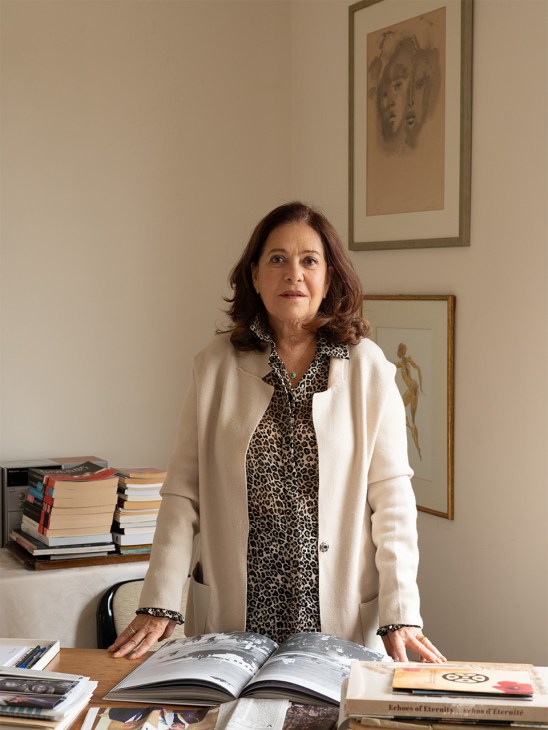
Meanwhile De Freige, having graduated from the American University of Beirut, was living between Beirut and Paris, raising her young daughter. She came on board at L’Orient-Le Jour to create Génération Kalachnikov, a series in which she and film producer Maroun Bagdadi interviewed Lebanon’s youth about their lives during the war. The experience inspired De Freige’s next project, a weekly supplement for young people called Les Copains. “For 10 years we were a young team explaining to the youth what was happening in the region,” she says. “During the war, people in Lebanon were living in ghettos and not going to other areas. We wanted to create a link between them [and the world].”
When her supplement came to an end, De Freige moved on to economic magazine Le Commerce du Levant. But in the postwar boom of the 1990s, it became clear that L’Orient-Le Jour was in trouble – it needed a financial and staffing overhaul. De Freige stepped in as CEO in 2000.
After the first few years of tough decisions and “reinvigoration”, as she calls it, came another challenge: digitalisation. In 2014, L’Orient-Le Jour launched the region’s first paid-for news website. A paywall was a risk but De Freige was certain that it would work. “Fifty five per cent of our revenue was coming from advertising,” she says. “We were in crisis, with advertising dropping. I knew we could count on the readers. We had to build a model to help us stay alive.”
In a field where most outlets are politically aligned and funded, L’Orient-Le Jour has maintained its independence thanks to its pay model – about 70 per cent of its budget comes from subscribers. That has allowed the paper to blossom even as competitors folded. “We were becoming not just a local paper but also a regional one, talking more and more to diaspora and the whole world.”
In 2020, as Lebanon’s economy crashed, De Freige launched the paper’s English-language edition, L’Orient Today. Now it is the first port of call for foreigners wanting to understand Lebanon. De Freige’s goal is clear: to elevate Arab voices and give international readers a perspective they won’t find in Western media. “The form might change but the mission to make a new Middle East will continue,” she says.
De Freige has big plans for the paper, including an Arabic edition. “This job requires creativity, experimentation and risk-taking,” she says. “We believe that we can be part of building something new.” If reinvigoration was the goal, L’Orient-Le Jour has the right woman at the helm.
lorientlejour.com
This article is from Monocle’s March issue, The Monocle 100, which features our editors’ favourite 100 figures, destinations, objects and ideas.
Read the rest of the issue here.