How a 25-metre-long beached whale made its way from Canada to the UAE
Canada had a dead whale. The Natural History Museum Abu Dhabi wanted it. This is how it made its epic move.
When the Natural History Museum Abu Dhabi (NHMAD) agreed to take on a 25-metre blue whale that had washed up on the Canadian coastline, it set in motion one of the most ambitious international relocations that any museum has attempted. NHMAD opened in November 2025 and for project manager Judith McAlester (pictured), who has stewarded the project since its earliest sketches, the timing of the whale’s journey was uncanny. “For me, the whale is particularly special,” she says.
McAlester is a blue-whale fanatic (she keeps a small figurine of one on her desk) and is unfailingly enthusiastic. “I joined this project when it was just drawings and plans. I feel like myself and the whale have been on the same journey.” The female whale was killed after a suspected ship strike and discovered in June 2021 on Nova Scotia’s remote Crystal Crescent beach. She was transferred to the region’s marine protection agency, before the case was taken up by Research Casting International (RCI), a Canadian family firm that specialises in fossil preparation and the salvage of large marine mammals. RCI approached one of the NHMAD’s early consultants, Professor Phil Manning (now the museum’s director of science), with an unusual question: would Abu Dhabi like a blue whale? “A dream come true for any museum,” says McAlester.
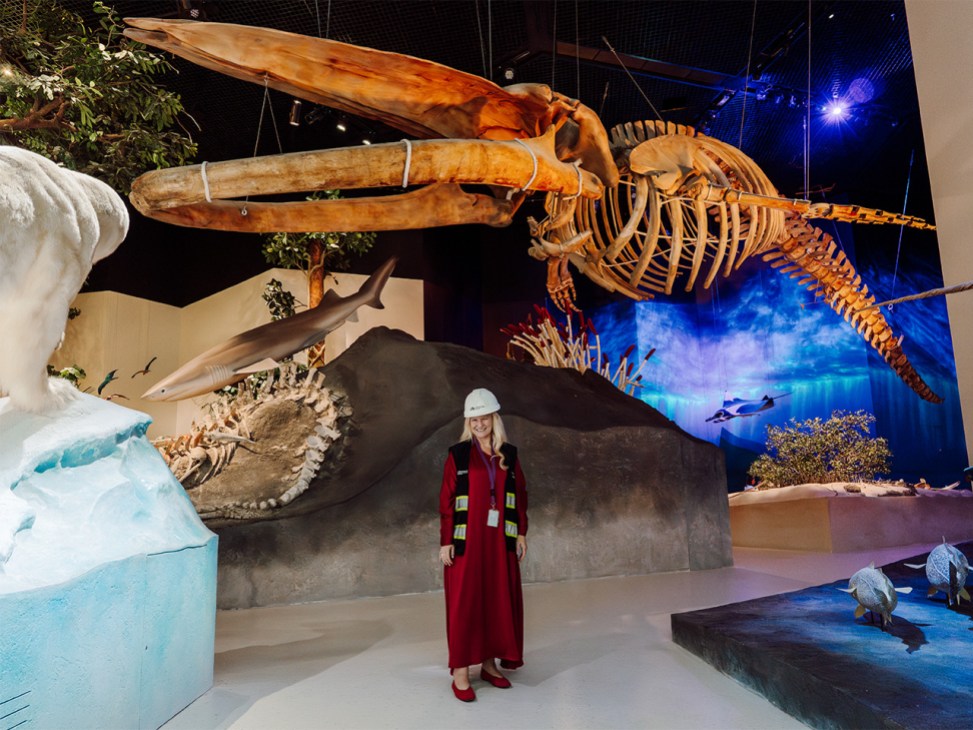
Meanwhile, the museum building was rising at speed. RCI cautioned that preparing a whale of this size normally takes five or six years. Abu Dhabi had a little more than two. There was also a pressing architectural dilemma. “The skull of the whale is so huge that it’s bigger than the opening of any of our doors,” says McAlester. “We had to get the whale into the building before we put up the final wall.”
RCI treated the bones in giant tanks to extract the oil that might otherwise seep out for decades. At the same time, 16 specially designed crates were built, one devoted to the immense skull. Under normal circumstances, such a specimen travels by sea but the three month voyage did not fit the museum’s construction schedule. It would need to go by air. “We reckon she is probably the only whale that has ever flown halfway across the world,” says McAlester.
Even then, the plan nearly fell apart. Flying a protected specimen requires permits from every country where the aircraft lands. The team secured approval to drive the crates across the US border and fly from there, until customs officials revoked clearance the day before departure. Now the only option was a refuelling stop in Azerbaijan, one of the few countries that allows such protected cargo to remain airside. “For that entire 36-hour journey I was awake, watching,” says McAlester. “I watched the whale fly over Ireland, where I’m from, over Europe and land in Azerbaijan. Until she got on that last flight, everybody was holding their breath.”
When the whale landed in Abu Dhabi, McAlester was waiting on the tarmac. The crates were moved to temporary storage where everything was unwrapped, registered and photographed “bone by bone by bone”, says McAlester. Then came the installation. A complex metal mounting structure went up first, resembling a second spine. While some bones were reproduced – sections that were beyond recovery – most are original, restored and positioned based on calculations prepared long before the whale arrived.
Now suspended in the museum’s soaring ‘Our World’ gallery, the whale has become both anchor and emblem for the institution. When McAlester brings visitors to see it, she stands beneath the vast skeleton with pride. For her, the project represents the ideal combination of science, logistics and purpose. “It was the biggest challenge,” she says. “But also the highlight of my career.”
nhmad.ae