It’s time to bring the literary café back to the heart of European society
“Most interesting cultural things emanate from restaurants,” Jeremy King told Monocle when he showed us around his newest project in London – the revitalisation of the beloved Simpson’s in the Strand. Yet today, hospitality isn’t geared around cooking up clever cultural concepts. Instead, the clattering of keyboards, zoom calls and menus downloaded anonymously via QR codes increasingly make us closed off to chance encounters.
But this hasn’t always been the case. In the 19th and 20th centuries, a ritual emerged in Europe’s metropolitan brasseries and coffee houses, where spirited intellectual artistic exchanges took place and fostered new ideas. Collectively known as literary cafés, these venues had three things in common: they offered a politically neutral space, were in central locations and served simple but reliable fare: a Comté omelette in Paris or goulash soup in Vienna.
In October this year Rome’s Antico Caffè Greco, which predates Italy’s unification, closed its doors. Its illustrious patrons included Charles Baudelaire, Federico Fellini and Sophia Loren. A month later, Café Gijón, Madrid’s last remaining literary café, was quietly sold to a chain. Founded in 1888, this bastion of old Spanish hospitality hosted tertulias – clandestine get-togethers where the likes of poet Federico García Lorca, playwright Antonio Buero Vallejo and novelist Francisco Umbral gathered to seek shelter from the Franco regime. More than just a pit stop for a reasonably priced café con leche, the space was a crucible of radical ideas that would shape artistic thought for decades to come.
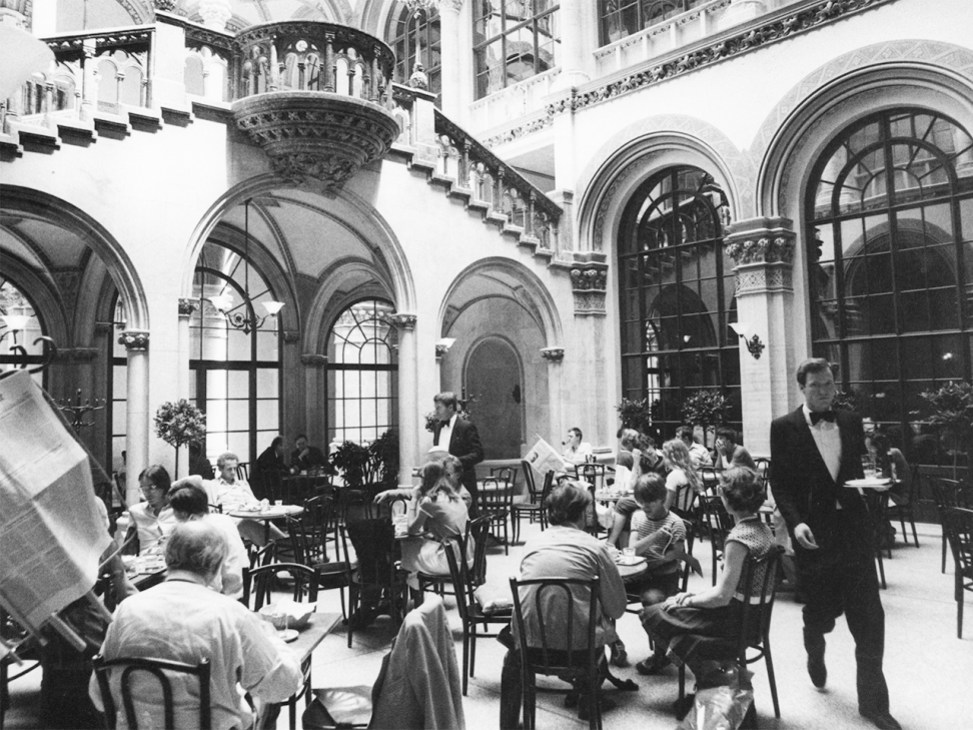
Today’s patrons need spaces like these in which to ruminate or meet new people. After all, there’s little inspiration to be found in a congealed burger delivered via Uber Eats. Yet many of the remaining institutions trade off their heritage, using it as cultural leverage to justify average coffee and kitschy desserts. Guests dine out on lacklustre pillars of nostalgia, while ghosts of the intellectual elite are mere status symbols. Takeaway culture and slapdash lunch breaks have also eaten away at the romantic, languid meals of hospitality’s golden era.
So how do we revive the literary café? A cluster of new-wave chef-restaurateurs has the right idea, with well-designed, multi-hyphenated hospitality spots that engage with neighbouring artistic programmes. Turkish chef Maksut Aşkar introduces Anatolian flavours within Rotterdam’s newest cultural venue, Fenix, a museum dedicated to migration in a city now home to 170 nationalities. In Tanzhaus, Zürich’s brutalist contemporary dance centre, Café Nude is a fitting hub for a cultural movement; patrons can glimpse the performers warming up on the upper levels. And in London, chef José Pizarro’s restaurant, Keeper’s House in the Royal Academy of Arts, boasts walls laden with canvases, inviting patrons to dine with fellow art lovers.
Some emblematic haunts remain. In Vienna in 1913, Austro-Hungarian foreign minister Count Leopold Berchtold predicted that Leon Trotsky, a regular at Café Central, would one day lead the Russian Revolution (or so the story goes). And in wartime Paris, Jean-Paul Sartre patronised Café de Flore, formulating the embryonic notion of existentialism. But these surviving literary cafés need to work harder to bring patrons together rather than luring in tourists over a parody of a bygone literary heyday.
Some of the most extraordinary ideas have been thought up over a croque-monsieur and a glass of sancerre. In Europe, solo dining now accounts for roughly one in six restaurant visits, so why not follow the crowd and book a table for one or chance a bar stool? Linger a while in a convivial café, bistro or pub – you might just find yourself in good company.
Claudia Jacob is a Monocle writer. For more opinion and analysis, subscribe to Monocle today.
Read next: How high-end tech misses the point in hospitality