Mönchspoint in Tengling: the farmhouse renovation you’ll want to move into
When Andreas Müller committed to the restoration of a centuries-old farmhouse, he came up against the harsh realities of historic redevelopment. After years of work, he has finally brought it back to life.
“I’ve always had good memories of this place,” says architect Andreas Müller of Mönchspoint, a farmhouse in the Upper Bavarian village of Tengling. It was here – amid the vineyard-dotted, gently rolling hills – that Müller mowed his neighbours’ lawns as a child. In 2004 he moved to Münich to study, later establishing his practice there. Some 12 years later he heard that the farmhouse’s longtime owner had died. “A call came from my best friend, who grew up next door,” Müller tells Monocle. “He told me that the caretaker wanted it to go to someone from the area, who would understand and care for it. It was never officially put on the market, only quietly shared within the village.”
In the vacated building, which originally served as a base for Benedictine monks from the nearby Törrig Castle, Müller saw childhood memories, a sense of home and an architectural challenge. “The emotional connection was immediate,” he says of his decision to buy the property. “I felt a big responsibility. Several other potential buyers planned to tear it down. I wanted to preserve it.” So, with creative strategist and frequent collaborator Eva Rosenberger, Müller set about the farmhouse’s renovation.
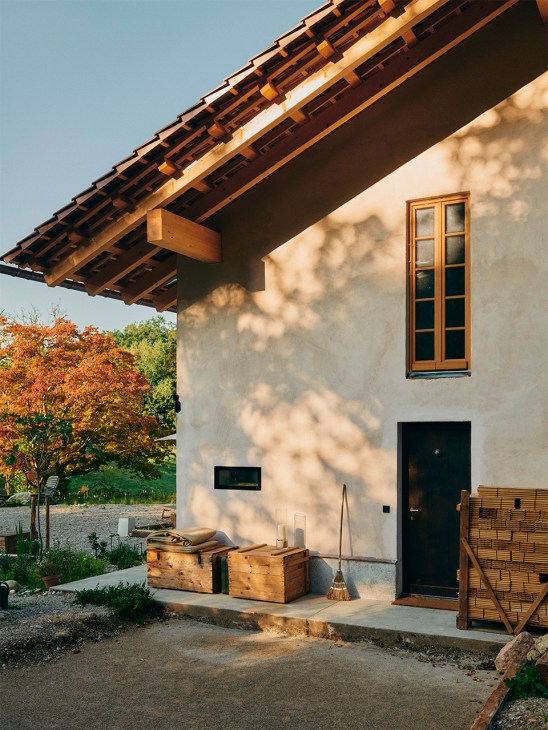
What followed was a crash course in the realities of historic redevelopment. First, the consultation period lasted five years, finally ending in 2021. The property’s location outside the official settlement area of Bavaria meant that it had a special classification, which prohibited making changes to the farmhouse’s exterior; any such alteration was deemed detrimental to the landscape and the cultural heritage of the region. “Keeping the elongated form, the pitched roof with traditional clay tiles and the original proportions were non-negotiables,” says Rosenberger. The interiors, however, could be redesigned.
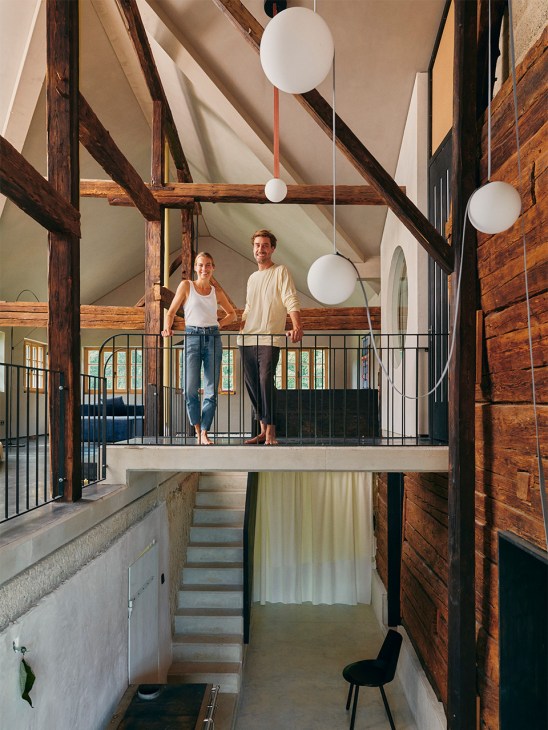
Then it became apparent that the existing exterior walls could not support a new internal structure. So a “house within a house” concept was implemented, with Müller and Rosenberger installing an internal structure that was independent of the log walls. “We managed to keep the old beams where they were but Andy had to rethink the whole building,” says Rosenberger. As a bracing element, a rammed-concrete wall was built along the old timber wall that once separated the farmhouse from the stable.
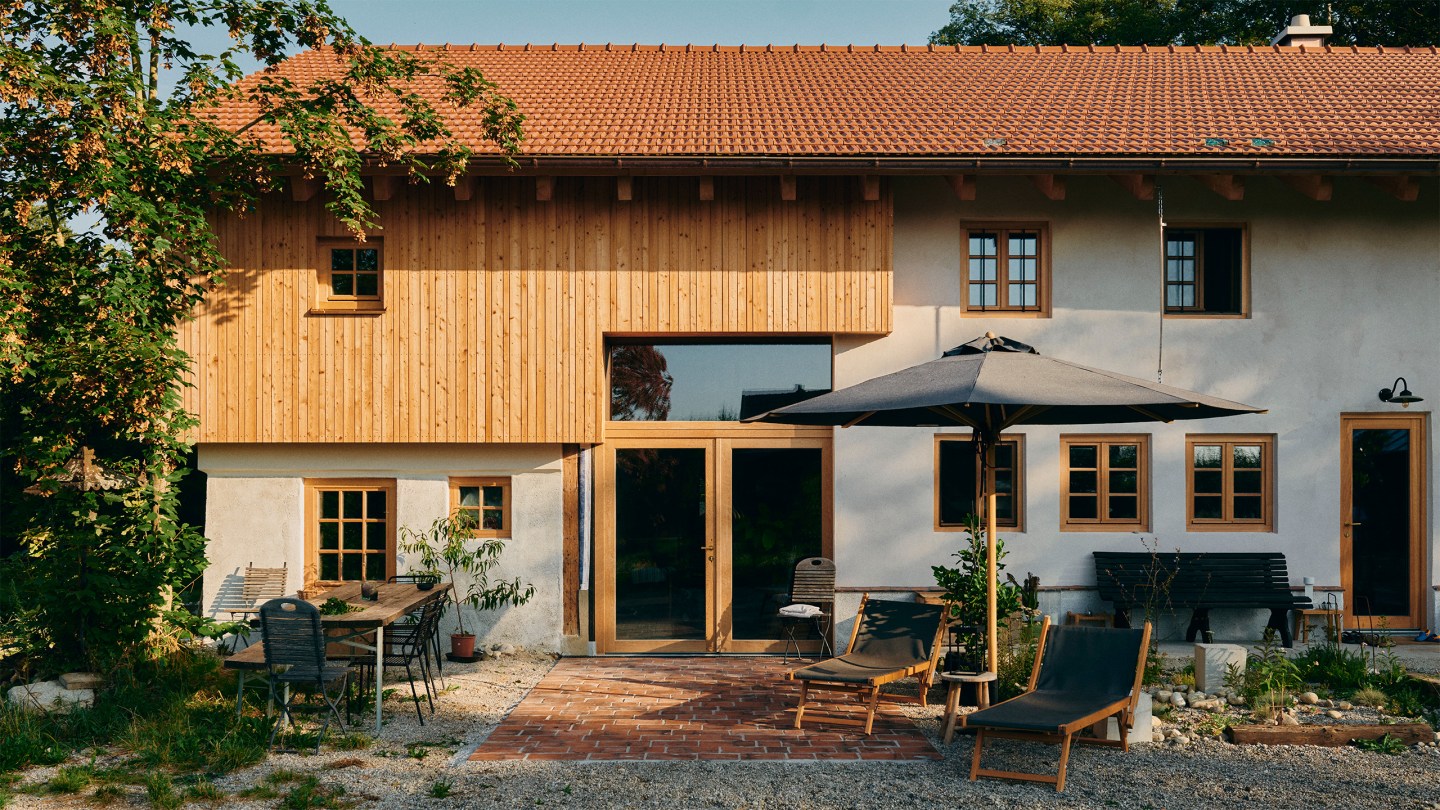
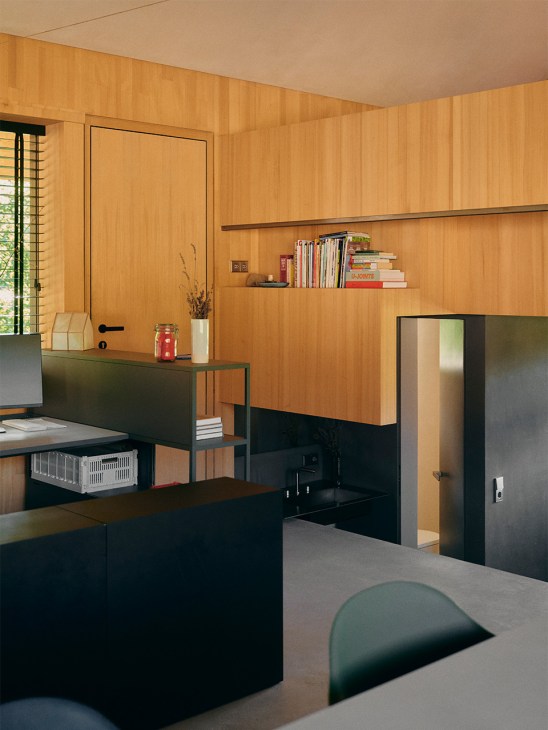
The result is a unique hybrid. Seen from outside, it looks like a typical utilitarian structure of larch and stone that blends into the Bavarian landscape. Inside, though, it’s a rustic-industrial home with exposed stone and beams, natural materials and moulded concrete stairs. “We wanted to keep the cosiness and grain of the old structure but also support how people live today – shared cooking, light, room for friends,” says Rosenberger. A big, convivial kitchen was central to this ethos, with the main table made from a block of spruce left over from the construction of an ancillary home office. “The office building covers the footprint of the former sheep barn,” says Rosenberger. “It’s clad in dark timber with a simple standing-seam metal roof. It deliberately remains understated.” The space is furnished with Herman Miller Fulds chairs organised around a New Order shelving and desk system by Hay, providing enough room for a small team of creatives to work.
Economic necessity drove the design and build of the simple modular kitchen, which features open-top timber draws, wafer-thin stainless-steel countertops and a two-burner cooktop. It’s a combination that gives that space a considered, contemporary feel.

There are also nods to the building’s history: the exterior of the former agricultural section is timber-clad while the residential part is rendered, a traditional distinction that was consciously preserved. Parts of the interior reveal the rough-hewn, original walls. Mönchspoint’s timber structure had been renovated several times over the centuries, with castle rubble upcycled and integrated into the farmhouse following an older building’s demolition in 1421. Under Müller’s watch, the beams were brushed by hand, cleaned and treated with linseed oil; they are now a striking counterpoint to the polished concrete flooring and walls finished in ClayTec, an earthy product that naturally regulates humidity and provides thermal insulation. The internal woodwork was handled by South Tyrol carpentry firms Schreinerei Walzmühle and Ewos, and treated with Oli Natura products.
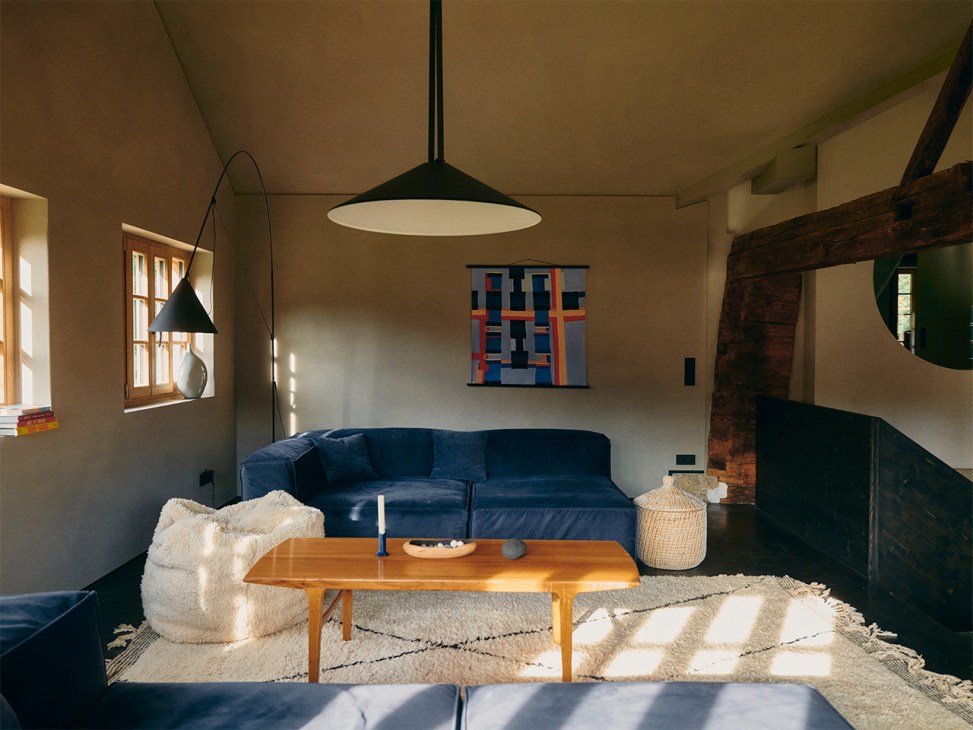
Müller and Rosenberger looked up the historical plans for the house in Münich’s state archives and learned that its windows had been installed according to late-19th century requirements. As a result of their relatively small size, installing additional lighting was crucial. Today a suspended Plusminus system by Spanish firm Vibia and Ayno lamps by Hamburg-based Midgard illuminate the home. Rechargeable Times lamps by From Lighting dot the garden, while all of the switches and sockets are by Germany’s Jung. The small hammam room is by Roca and finished in a microcement that recalls the lime-based Moroccan tadelakt plaster. There’s ample seating in the living spaces, including a Ligne Roset Togo sofa and E15 Houdini chairs, alongside vintage pieces.
“The real transformation happened within the home,” says Rosenberger but, she adds, consideration was given to how the residence sits on its expansive lot and the broader agricultural landscape. “The plot consists of open meadows, a gentle depression in the landscape, a small edge of mature woodland, a courtyard, a boules court and a gravelled access road,” she says. The setting feels expansive yet protected.
Because the property lies beyond the reach of the municipal grid, a plant-based wastewater treatment system was installed and a rainwater reservoir irrigates the verdant garden. “I originally wanted it to be quite classically German, with neatly divided hedges and clear sightlines,” says Rosenberger. “Instead, we let the surrounding wild nature back in.”
High-quality soil supports the growth of tomatoes in the vegetable patch and a sense of abundance now defines the building’s everyday life. “It was designed to be a home for two households,” says Müller, adding that a family with a three-year-old daughter now also lives here. An open-door policy means that friends and family members are constantly dropping in, enjoying communal cooking and swims in the lake. “From the beginning, this was meant to be shared,” he adds. “This place isn’t supposed to be fenced off. It was made for people.”
It’s a sentiment that Rosenberger agrees with. “It’s about community, not concept. Mönchspoint is most alive when you have 40 adults and 40 kids playing here. There is so much space that it still feels peaceful.” Both are frank about the scale and realities of a project such as this. “It took all of our energy, physically and emotionally – it wouldn’t be possible in this lifetime to do it again,” says Müller. “But we don’t regret a thing. The process shaped us. We are deeply proud and grateful for what it has become.”
Rosenberger tells Monocle that her next task isn’t to renovate somewhere else but to observe how Mönchspoint develops – both the building and the people who love it. “Guests, friends, friends of friends – they keep coming back and feel at home,” she says. “The work was immense but it was worth every moment.
Exterior and landscape
Plot size: 8,500 sq m
Key materials: Clay-tiled pitch roof, mineral lime-based plaster, larch-timber cladding
Drawing inspiration from vernacular architecture, parts of the structure feature traditional timber block construction with masonry from the destroyed Törring Castle incorporated into the walls. Reclaimed materials were used in the gardens, including former roof rafters that now define path edges.
Living spaces
Size: 65 sq m
Key materials: Regional timber, stone, mineral – and clay-based plasters, concrete
The main living space occupies the former barn. The original structure combines traditional timber-block construction with historic masonry. Exposed log walls, visible beams of mixed regional timbers, raw concrete and mineral-washed surfaces create a calming atmosphere.
Kitchen and dining
Size: 70 sq m
Key materials: Concrete, solid timber, lime plaster, stainless steel
The kitchen functions as both a workspace and place for gathering. While the agricultural origins of the building remain visible, a rammed-concrete wall adds an industrial atmosphere. The kitchen also features a stainless-steel frame, which is combined with maple sourced from local storm-felled trees.


Office
Size: 75 sq m
Key materials: White fir interior cladding, stone flooring, clay ceiling, metal roof
The office, a split-level space, is in dialogue with the surrounding landscape. Two large horizontal windows run along the building, framing views to the forest and driveway on one side and open landscape on the other. It’s a combination that creates an atmosphere that is conducive to calm, focused work.