Trump weaponises architecture ahead of the US’s 250th birthday
Donald Trump is busily attempting to recast the US capital in his own image – but why does that image seem to resemble the ‘Germania’ envisioned by the Nazis?
As the US celebrates its 250th birthday, an architectural playbook is being deployed in Washington. It’s one that we’ve seen before. A few months after the 1936 Berlin Olympics, Adolf Hitler and architect Albert Speer revealed a masterplan to reconceive Berlin, even renaming it “Germania”. The plan was political and spatial, to represent the new metropole of a vast global empire. Its cornerstone investments? An enormous gathering hall, named The Volkshalle, linked by a grand boulevard via a 100-metre-tall Triumphal Arch, the largest ever to be proposed.
Denizens of Washington might find this historical account eerily familiar. US president Donald Trump proposed erecting a 76-metre triumphal arch that straddles the capital’s Potomac River last year. But there’s more: a new ballroom in the East Wing of the White House, the Mar-a-Lagoifying of the Lincoln Memorial Reflecting Pool and even the renaming of the Kennedy Center. All appear to be visible acts of the president rebranding the US capital as an imperial power centre. It is a battle enacted through narrative, the built environment and its architectural spaces. To understand Trump’s agenda, we must understand this architectural playbook.
The first play is disparagement and erasure. The Trump administration posits its work as a necessary act of renewing degraded places and infrastructure. This is a classic exercise that uses deprecating characterisations to justify reconstruction: the East Wing, for example, has always been seen by Trump as decrepit, while downtowns are garbage, Palestine could be a new riviera and other countries are “shitholes”. This language of sanitising cities is a common refrain among burgeoning dictators.
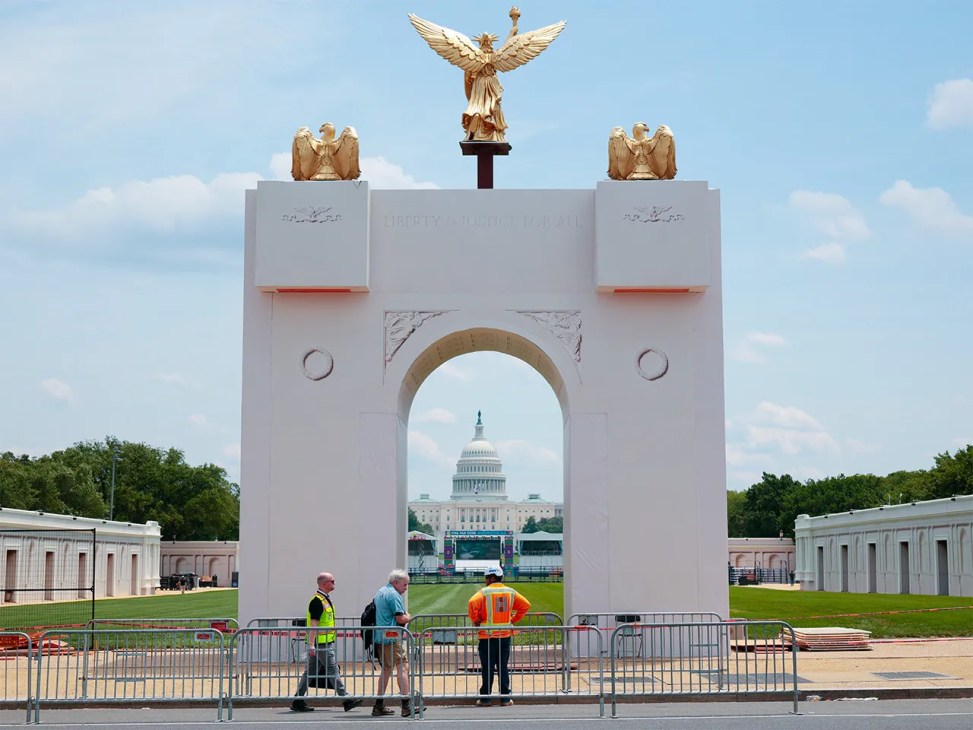
The second play is the construction of monuments. The spectre of the Trumpian arch will certainly not be the last effort aimed at feeding the ego of the US’s most vainglorious commander-in-chief. That it must be the largest ever, or 250ft (76 metres) tall to commemorate the 250th anniversary, only reveals the conceptual vacuity of monuments writ large. But this one feels particularly empty.
The danger of Trump’s arch is that once built, it will be almost impossible to remove – hence its real purpose. The monument can turn insecurity into permanence, frailty into symbolism. This is architecture’s gravest flirtation – the idea of generational immortality. And so the monument works as a weapon, not a commemoration; it disguises its historical raison d’être. The dependence on historical forms and styles to allude to permanence is no accident. Its effect is to fade into the background, as if it has always been there. Taken together, the intent is to profess a false historical record and entomb an image of immutability.
The final tactic is to construct in a historically inaccurate architectural style. Much has been written about Trump’s gaudy, gold-wrapped monuments and policies; the so-called “traditional” classicism. But we should inquire as to why it is in this style. Architects such as Speer used classical architecture as means through which to channel the ideology of autocracy. With Trump, the agenda tends to be anti-modern and anti-design.
If left unchallenged, the destruction, renaming and rebuilding of public architecture around one man’s image and tastes could reshape the national narrative. Imagine the violence, ICE detentions and occupations of this era being recast as monuments of strength and success. To resist, we must recover a democratic understanding of architecture: as a shared structure through which the public can recognise itself.
As the US celebrates its 250th anniversary, we must consider not what the nation should build but what its buildings should ask of us. Perhaps we should look less to arches or gilded rooms and more to the infrastructure of common life: the places of worship, labour halls, train stations, libraries, schools, parks and, yes, memorials where all Americans can find common ground. Such monuments have nothing to do with praising power and everything to do with enacting citizenship.
Michael Murphy is an architect, lead designer of The National Memorial for Peace & Justice and the author of ‘Our World in Ten Buildings’.