The 10 best shows from Paris Fashion Week spring/summer 2027
Shows from some of the industry’s best-known brands and up-and-coming designers set the tone for a bright seasonal showcase in the City of Light.
The spring/summer 2027 edition of Paris Fashion Week offered the usual standout shows from the city’s major maisons – notably Dior, Chanel and Hermès – as well as collections from emerging names such as Torishéju Dumi and Marie Adam-Leenaerdt. Here are our 10 favourite shows.
1.
Torishéju
For London-based designer Torishéju Dumi, contemporary life is something of a circus – one that provides distraction from deeper issues. “There’s something off-kilter about the world today,” said Dumi backstage after the show. “It’s bizarre, it’s uncanny. You can’t really put your finger on it.”
Titled “Panem et Circenses” (after Roman poet and satirist Juvenal’s quip about bread and circuses), the designer’s collection demonstrated her expertise in menswear. From the line-up’s double-breasted jackets and bar jackets to hourglass jackets and blousons with Peter Pan collars and pagoda shoulders, it’s clear why Dumi received the 2025 LVMH Savoir-Faire Prize.
Compared to previous collections, this season also demonstrated a willingness to play with colours and patterns, from leopard print to romantic florals. “I’m really excited about the world I’m building right now,” added Dumi. “Everything has a funny element to it. If you don’t laugh, you’ll cry.”
torisheju.com


2.
Dries Van Noten
The invitation for the Dries Van Noten show took the form of a movie poster that could have been plucked straight out of the 1950s film-noir era. It hinted at what to expect this season from Belgian creative director Julian Klausner, who is fast emerging as a favourite among editors and buyers on the Paris Fashion Week calendar. “I had in mind this character, an actress in between scenes like Grace Kelly,” said Klausner after the show. On the runway, models wore knee-length skirts, boxy blazers and classic peep-toe heels. The palette was kept light and seductive, with lingerie tones of jade green, lilac, baby blue, lemon and blush pink.
There was something a little Margaritaville about Klausner’s choice of patterns this season (think flamingos, martini glasses and kisses) and the accessories, particularly the oversized jewellery and brooches. “A brooch can make something old in your wardrobe feel glamorous,” added Klausner. “I love the idea of dressing up for cocktail hour with cocktail jewellery.”
driesvannoten.com


3.
Dior
Fashion-show invitations range from the wacky to the impressively ornate but Dior offered something that, at first glance, left guests bemused: a pair of walnuts. They were wénwán nuts, made to be played with and rolled in the hand until, over time, take on a jade-like patina. Creative director Jonathan Anderson was clearly concerned with touch, time and imperfection – fittingly so for a designer still figuring out how to make one of fashion’s most storied houses feel like his own.
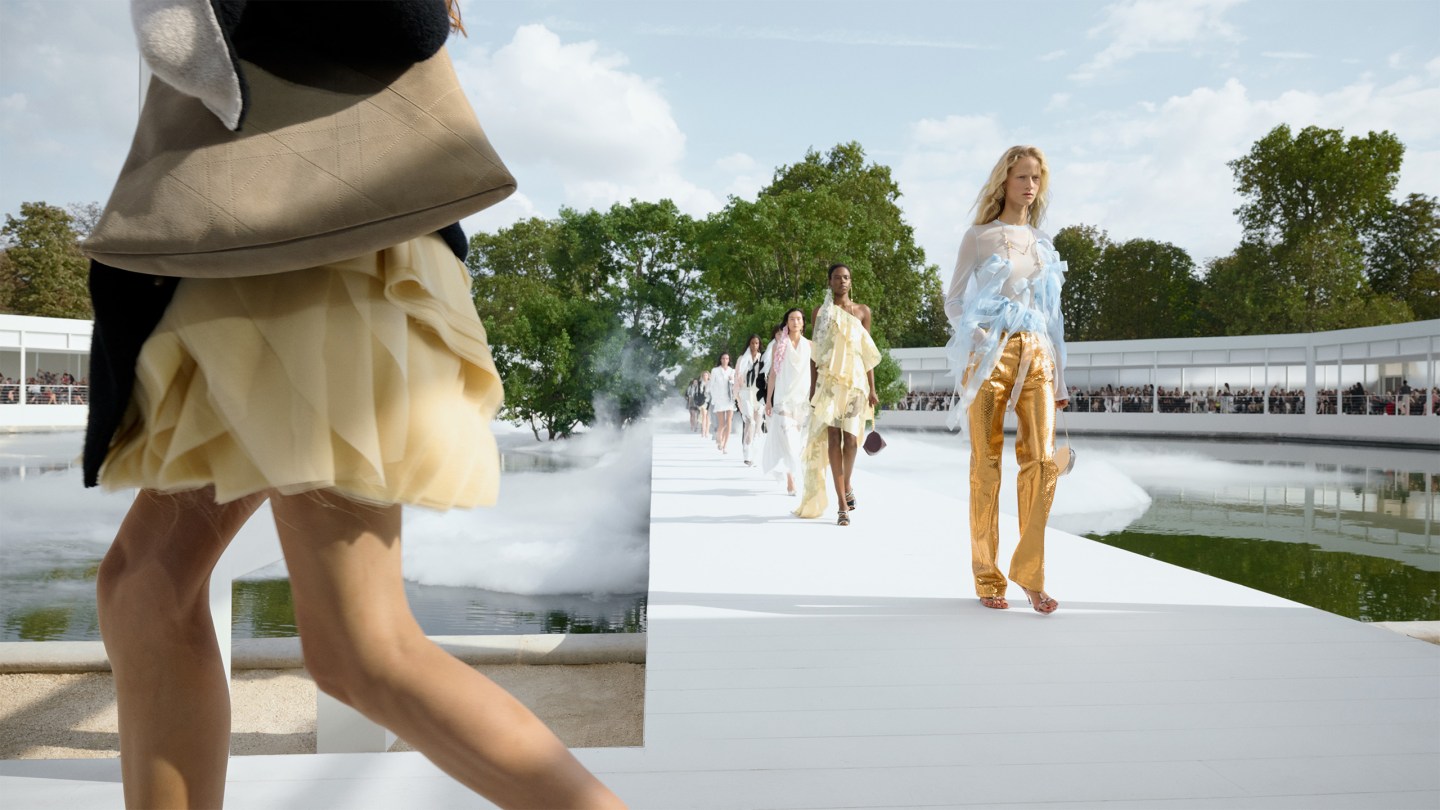
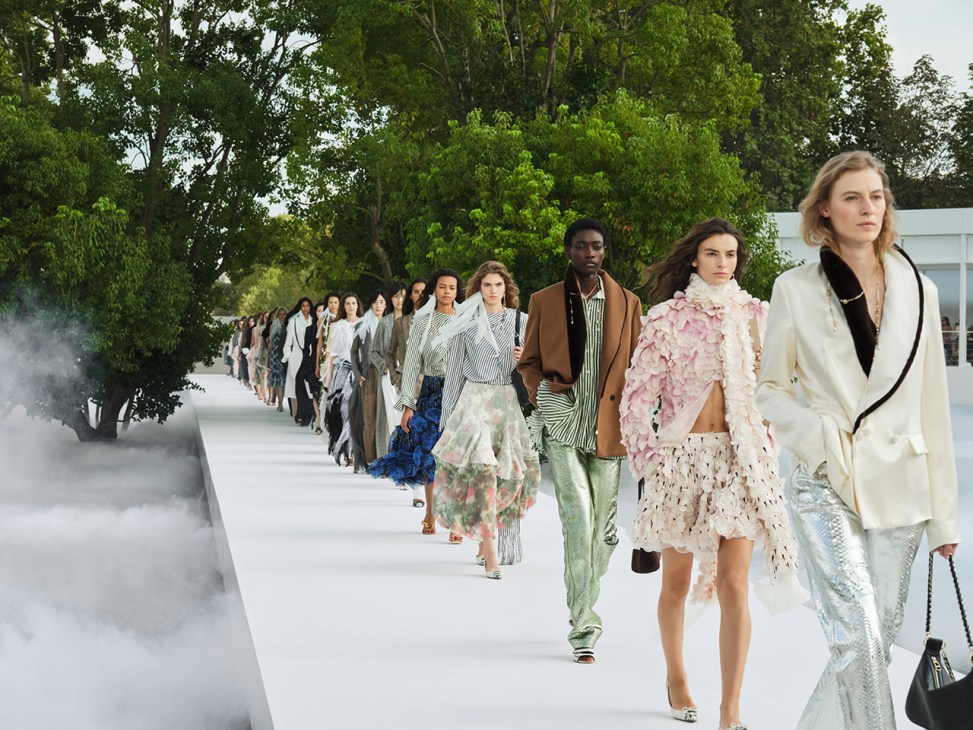
This season, he staged a continuation of his autumn/winter 2026 collection, revisiting both its themes and location, the geometrically precise Le Bassin Octagonal in the Jardin des Tuileries. Christian Dior himself was obsessed with flowers and symmetry found in nature. Anderson picked up that thread last season, tacking lily pads on shoes and floral motifs on clothes. This time the concept evolved into an exploration of what happens when geometry is allowed to move a bit more freely. Tailoring became transparent and fluid, the famous Bar jacket softened. Dresses were scattered with hand-cut petals, which appeared as if they had just blown in. The brand’s classic silhouettes looked as though they had been caught mid-movement. The collection was still recognisably Dior but a little less buttoned-up. And, in turn, maybe a little more grown-up.
dior.com
4.
Loewe
Loewe’s co-creative directors, Jack McCollough and Lazaro Hernandez, explored history for their spring/summer 2027 collection as the Spanish brand celebrates its 180th anniversary. Bridging the old with the new, they put forward a new proposition for dressing – one that, as always, put craft front and centre. Chiffon dresses and midi skirts in bright yellows and electric blues were trimmed in tie-dye and finished with beading, while oversized bomber jackets featured hand-painted stripes in green and blue iterations.
Playfulness was the leitmotif of the collection, featuring shorts and dresses in exaggerated silhouettes that protruded around the hips, adorned floral beadwork. Initially founded as an artisanal leather-goods shop, Loewe is always considered with its use of hides – this time with leather jackets dressed up with thick leather belts. But the brand’s strength is its accessories, in particular the Puzzle bag, which was a runaway hit during Jonathan Anderson’s tenure as creative director. This season, a mesh clutch embellished with glass beads and elongated square-toe kitten heels will hopefully prove to be another commercial success as McCollough and Hernandez solidify their vision for the house.
loewe.com


5.
Givenchy
For spring, Sarah Burton challenged notions of female archetypes, introducing silhouettes that consider the many versions of women. There was a dynamic feel to the co-ordinated leather shirts tucked into streamlined midi skirts or the sturdy double-breasted coats that gave a nod to the 1980s. Yet the tailoring felt sensual too – cue the oversized trousers, disguised as a jumpsuit from the front but elegantly revealing the back.
Elsewhere, softness found form in romantic evening gowns finished with meticulous beadwork and frills, while tasseled dresses draped from wing-like arabesques of brass wire. Burton’s bolder experiments came in the form of leather micro-shorts and biker jackets, paired with hefty ankle boots accented with zippers. The accessories were admirable as well – think figure-hugging denim trousers punctuated by a belt buckle that opens into a compact mirror; asymmetric earrings; and peekaboo totes that revealed contrasting colours or beaded prints when left hanging open.
givenchy.com


6.
Chloé
Is this Chemena Kamali’s swansong for Chloé before taking the reins from Anthony Vaccarello at Saint Laurent? That is the question dominating the front rows of Paris Fashion Week. If this was indeed her last collection for the Richemont-owned brand, it was a joyful one. A parade of multicoloured raincoats was a highlight, paired with sou’wester hats that draped into shawls, lightening the look of stiff vinyl and transparent PVC. Other details were less waterproof: cotton broderie anglaise was a staple across the line-up, appearing as inset panels on milkmaid dresses, camisoles and petticoats; while 1970s-inspired tailoring grounded slips and lacy, lingerie-like harnesses.
Kamali mined the house archives for its feminine and youthful language embodied through babydoll dresses, bateau necklines and flouncy ruffles. Romantic bohemianism is as present as ever, but the designer’s rendition – a collection offset with harder counterpoints in the addition of heavy-duty industrial wear and heavy fisherman’s coats – felt fresh. And her archival impulse is not just an aesthetic one. Nostalgia, when properly handled, can be very good business. Since the German designer’s arrival, Chloé has reported strong sales and the reissued Paddington bag quickly became a bestseller.
chloe.com


7.
Carven
Carven began with a cloud of pastels. Butter yellow, icy blue and candyfloss pink in the form of twin sets and wispy dresses. A rumpled effect, inspired by bedsheets, was achieved through precise tailoring and pinning. Then the collection moved to blacks and whites, for a line-up that is more stern but still fluid. Perhaps that defines Kai Nesselrath’s intention for the label; spring/summer 2027 marks the designer’s debut for the French couture house (which, since 2018, has been owned by Shanghainese group Icicle).
Naturally for a first collection, Nesselrath looked to Carven’s beginnings, back to Madame Carven as a woman who worked with her hands – a doer – and ran that spirit through his show. There was a lovely tension between the everyday and the avant garde. Pencil shavings became golden earrings and polished pencil accessories were pinned into hair. It felt like a smart place to begin for a maison whose identity has become somewhat elusive in recent years. Nesselrath has the rare chance to make Carven his own – an opportunity that he might not have in a house with more visually established codes.
carven.com


8.
Miu Miu
How do you make “real clothes” luxurious? That was Miuccia Prada’s concern this season at Miu Miu. In recent years, the brand has hit on a particular blend of aspirational covetability and high-fashion respect, partly through its nurturing of buzzy relationships with mass-market favourites. This year marked its fifth New Balance collaboration, this time reworking the RC150 racing trainer, while Wrangler was brought into the fold for vintage denim upcycled with the collection’s signature criss-crossed laces.
The collection leaned heavily into the sportswear that has earned the brand a cult following but with a contextual mix-up. Jersey tees went down the runway with pleated skirts; slouchy sweatpants with blazers and silky, 1970s disco-style wraparound tops; and embellished gym bras paired with stern loafers or stilettos. In some ways, it was a continuation of the skirt-centric collection over at Prada, its sister brand, both relying on interesting styling over newness.
Looks were often edited versions of another, with a single element swapped out for something else. Sneakers for loafers, a blazer for a knit, a skirt for a trouser. Mrs Prada might have found her answer to the question of luxury in a high-fashion Ship of Theseus – if we accept that nothing is new, can we find joy and expression in a modular wardrobe that makes old things feel fresh again?
miumiu.com


9.
Hermès
After a summer of record-breaking heatwaves in Paris, the idea of letting in some air preoccupied Nadège Vanhée when designing the spring/summer 2027 women’s ready-to-wear collection for Hermès. In practice, this manifested in open-weave knitwear and clothing with vents, as well as trousers and skirts that can be zipped or unzipped to adjust lengths according to the temperature.
The choice in colour was particularly refreshing, with a focus on sky blue, cream and burnt browns – a muted palette that was later offset with the introduction of sunflower yellow and an almost-red orange. In her show notes, Vanhée explained the chromatic evolution as one that follows the arc of daylight, from early morning mists to the vivid radiance of a high-summer sunset. It was a pared-back tour de force from the designer, whose next collection for the French luxury house will take place in January with a debut couture collection.
hermes.com


10.
Chanel
After the dizzying designer switchups at major maisons over the past two years, some new starters have been quick off the block, while others are still finding their stride. Matthieu Blazy’s spring/summer 2027 collection, which marked a year since his debut, continued to sharpen his optimistic vision for the house.
Giant white birds hung from the glass ceiling of the Grand Palais while models strutted beneath their outstretched wings. Texture has quickly become Blazy’s signature and it added to this sense of movement and flight on the runway: the show was an abundance of feathers, frills and ruffles, as well as a newly engineered smocked tweed. It preserved Chanel’s house codes but had the feel of something much lighter and more fluid.
The collection drew on Gabrielle Chanel’s own fashion journey, beginning with more restrictive silhouettes, before proceeding to jersey, mannish tailoring and, finally, to the trim suit that became her signature. Applause was rapturous at the show’s finale but Blazy remained calm. “It’s a good start,” he told the assembled reporters after the show.
chanel.com