How an American chef broke through the Parisian culinary scene to open Chez Carrie
Chef Carrie Solomon carved an unconventional path. After a personal loss, her new brasserie in the 2nd arrondissement became an act of resilience and a vibrant hub for the city’s culinary community.
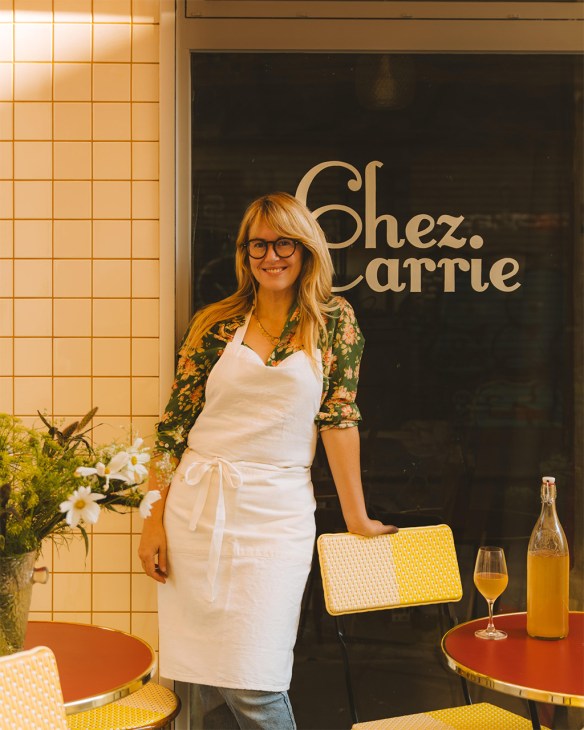
Carrie Solomon is the American founder and head chef of Chez Carrie, a bright new brasserie on Rue Léopold-Bellan in Paris’s 2nd arrondissement. What started as a leap of faith has quickly become one of the most talked-about spots in the city. While the cooking and inviting atmosphere are what people clamour to, Solomon’s journey to opening the restaurant is equally notable.
Though Solomon first came to Paris to study photography, she found herself drawn to the city’s kitchens. She carved a unique path through the French culinary scene, moving from recipe writing and food photography to consulting for restaurants and even cooking at the Olympics. But it wasn’t until a deeply personal loss that Solomon began to envision something entirely her own.
After her husband suddenly passed away, Solomon stepped away from work, taking time to grieve and reflect. It was returning to the kitchen that helped her to start piecing her life back together. That momentum, coupled with advice from mentors and friends in the business, eventually led her to taking an audacious step: opening her own brasserie as an outsider in one of the world’s most tradition-bound culinary capitals.
Despite now having lived in France for decades, Solomon faced hurdles. French bureaucracy is notoriously complex and being an American navigating bank loans, permits and regulations added another layer of difficulty. Yet, Solomon persevered and opened Chez Carrie as a space to host events with fellow chefs and cookbook authors, creating a sense of community in the heart of Paris.
Solomon joined Monocle to discuss the twists and turns of her unconventional career, the resilience required to build something from the ground up and how the kitchen can be a place of healing.
This conversation has been edited for clarity and length.
You’re originally from Michigan. What brought you to France and, eventually, Paris’s kitchens?
When I was 14, I met a girl whose mom worked at the cool restaurant in town. She was a pastry chef [who made] really amazing desserts and she got us both jobs there. So, from an early age, I was always working in restaurants on weekends, holidays and summer break.
When I came to Paris, I thought, ‘I’ll do something different,’ and I first went towards political science and then photography. Within six months, I knew that I wasn’t going to be a fashion photographer and I wanted to be in the food business. But I realised that the French food industry, especially 20-something years ago, was notoriously closed to outsiders. Through image-making and recipe writing, I got a spot in different kitchens where I [worked] next to chefs doing mise en place and thinking up recipes. I had this [nontraditional] way of arriving on the food scene in Paris. Sometimes it’s hard for people to accept the way that I came to this business.
At what point did the entrepreneurial bug take over? When did you decide to open up your own bistro in Paris?
Oddly, it started when I had children. I knew that the years ahead were going to be focused on [my] children but I remember thinking, ‘What should I plan for [my own] future?’ I knew that being in kitchens made me happy. So, in addition to recipe writing for my own cookbooks, I consulted for restaurants and hotels, worked at the Olympics and cooked gold menus for the Le Gallo Stadium. I knew that I was building towards something without being completely sure what that was. Then an amazing residency fell into my lap at the beginning of 2023. I was running the kitchen and I thought to myself, ‘If you do this, you’ll know whether you’re ready for your own place.’
Then my husband died suddenly and I stopped working for a while. I was in shock for weeks. There was a lot to figure out about how to go forward with my life and the thing that ended up saving me was getting back into the kitchen. I returned to the restaurant that I had been cooking at a few days a week and the team was really supportive. At the end of that residency, I needed to take some more time. Then one day, someone [in the business] who was giving me a lot of advice [said], ‘You’re ready, just go for it now and start looking for your place.’ And I thought, ‘Well, what’s it going to hurt?’
The French are known for their love of bureaucracy. Is it especially difficult to navigate if you are not originally from France?I count myself lucky because I have friends in the business and I have been coached. I had a great real-estate agent but banks and brokers are still really hesitant to work with profiles that they’re less sure about. I’ve been [in Paris] for 20-something years but I still don’t have French nationality. I realised that not being a citizen was going to be tricky – and it indeed was. One thing that helped my dossier was the fact that I was going to be the owner [and] the chef. I was the front line and in the team.
You’ve been open since late September [2025]. What are you looking forward to in the year ahead?
I knew when I opened a restaurant that I wanted it to be a place for other chefs, and I had a lot of female chef friends and cookbook authors in mind that could do events with me. I put together a calendar for the next two months, where I have invited different [female authors] to sign their books and to do demonstrations. The idea was: if I have events planned, it will help us to get through the Paris winter. It’s something that people can look forward to.
What advice would you give to someone who wants to start a business?
For those who might have gone through something [horrible or] had their life shattered at some point, it is possible to to pick up the pieces – not all, but some of them – and to build something. I feel that if I can share that a bit, it might give a bit of hope to people.
Listen to the full conversation with Carrie Solomon on ‘The Entrepreneurs’ podcast.