Issues
Affairs
Pluck of the Irish
Josh Fehnert on why, despite not quite making the cut in Monocle’s Soft Power Survey, Ireland’s moderation, spirit and diaspora are quietly influential the world over.

If there’s such thing as a softly spoken superpower – able to quietly project goodwill and often get its way – Ireland is surely a contender. While the mind might go to clichés of green fields and Guinness, Ireland is able to punch well above its weight on the world stage. How? Well, having a grateful diaspora helps, especially if it extends to the White House (“Top of the morning, Joe!”), as does knowing that Brussels has your back. The presence of the blundering UK pressing political self-destruct next door helps too.
Global goodwill comes all the easier when you’re a small, wealthy democracy with a policy of military neutrality. Its good brand was in the top 20 according to the 2023 Anholt Ipsos Nation Brand Index. It’s a top 10 in the United Nations Human Development Index and is perceived to be among the least corrupt, according to Transparency International. It has a free press, is increasing its global aid contributions and has invested in 22 new embassies and trade missions since 2018. Ireland’s gdp shot up 5 per cent this year with similar growth forecast for 2024 – figures that France, Germany and the UK can only dream of. A low corporate tax rate of 12.5 per cent has helped to draw investment and being a lively, liveable Anglophone country with plenty of pubs means that many put down roots here.
Beyond the numbers, there’s nuance. Social progress in recent years has been swift. The fact that a country once ribbed for its fondness for “the drink” is set to become a world leader in health warnings on alcohol packaging illustrates the point. Not to mention the vast legislative leaps made on marriage and gender equality in the past decade. As the power of the church waned, Ireland put faith in education and training. Today it’s one of only a handful of nations where more than 50 per cent of the adult population has completed tertiary education.
This once strict Catholic nation is also now led by Leo Varadkar (pictured, with Joe Biden), a gay doctor of Indian origin with a penchant for colourful socks. That these changes have left people more likely to raise a glass than an eyebrow, and that politics here remains a sensible centrist affair, is also remarkable in an age of fighty populism. Ireland’s proportional representation system is partly responsible: coalition governments are common.
“That’s led to moderation,” says Mark Henry, author of An Optimist’s Guide to Ireland at 100. “And a consistency in policy about education and our success attracting inward investment.”
Even the nation’s cultural tropes are being rewritten. Irish writers account for four of the 13 on the 2023 Booker Prize longlist and it has four Nobel literature laureates. And who’s that on top in the historic Eurovision stakes? Ireland, tied with Sweden on seven. Films, filmmakers and actors got plenty of attention and Hollywood nods at the 95th Academy Awards, including the nominee for the best international feature film (Irish-language tearjerker An Cailín Ciúin), best actor shouts (for Paul Mescal and Colin Farrell) and wide acclaim for Martin McDonagh’s The Banshees of Inisherin.
Not all the nation’s far-flung talent took the gongs for which they were nominated and that’s one way to understand Ireland’s subtlest successes in the soft-power stakes: everyone loves an underdog. Even the nation’s rugby team – ranked first in the world for most of 2023 – were seen favourably despite crashing out of the Rugby World Cup in France at the quarter-final stage. The team told a tale of bravery, pluck and valour rather than ignominy in defeat. By contrast, the harder-to-love England side exceeded expectations but remained almost unanimously disliked. Ireland’s reputation for being reliable, and its peoples’ for being good-humoured, have helped to define its consistent popularity and influence abroad. Even if it doesn’t always get a trophy for its trouble.
Josh Fehnert is Monocle’s proudly part-Irish editor.
Game changer

The South African rugby team’s charismatic 32-year-old captain, Siyamthanda Kolisi, sealed his standing as one of the game’s most recognisable figures in October when he led the Springboks, the country’s national team, to triumph in the Rugby World Cup – its second in succession and record fourth in total. The flanker, known as Siya, had rewritten his country’s sporting history before when, in 2018, he became the first black player to be appointed as captain of a team that was, historically, the preserve of the country’s white elite. During apartheid, rugby in South Africa was segregated and the Springboks were barred from competing in the first two Rugby World Cups.
Now, Kolisi is the embodiment of a unified sport supported by members of all of South Africa’s many and varied demographics. His eloquent post-match interviews regularly feel like soliloquies on rugby’s more poetic qualities: teamwork, sportsmanship, respect. And Kolisi’s powers extend far beyond the pitch – particularly in his charitable and philanthropic work, which have made him a unifying figure in a country still attempting to bridge long-drawn divisions. His by-now-familiar habit of singing traditional southern African songs, such as “Shosholoza”, as he took to the field became a talking point around the world. The unabashed renditions seemed to express a joy at his exalted position and a broader sentiment that felt, to many fans, more universal and more explicitly expressed than those traditionally conjured by a game of rugby.
Kolisi presents South Africa as a country of aspiration and social mobility, where neither race nor class need be impediments to an ascent to the summit of national life – and he does so in front a global audience. Every now and then, a sports star transcends the arena that forged them. In Kolisi, South Africa has a charismatic ambassador whose influence extends far beyond the field of play. He embodies, for both South Africans at home and his legions of supporters abroad, how potent a feeling it is to sing when you’re winning.
Andrew Mueller on…
Unbelievable truths
You’re wrong about the Middle East. To be clear, you might have a firm grasp of the dynamics of the conflict in Gaza and a reasonable understanding of the history that led to this unhappy point but, right now, something that you believe to be the case is flatly untrue. To be even clearer, the author of this column does not exclude himself from this assessment. You should not beat yourself up about this (unless you’re among those who are confidently sounding off on social media on the basis of such misapprehensions, in which case you should). The present Israel-Hamas conflict, ignited by the terrorist group’s vicious assault of 7 October, has been harder to make sense of than most because of a particular combination of factors. Some of these are the depressing eternal elements of warfare – for example, protagonists seeking to command the theatre of information with a combination of evasion, obstruction and invention.
Others are recent developments. If there is a single representative demonstration of our new age of confusion, it is perhaps the 19 October front page of Libération. The French daily splashed with a photo of a protester at a pro-Palestine demonstration in Cairo, brandishing a poster of an injured infant screaming in the rubble of Gaza. Libération’s photo was authentic but the protester’s image was an AI-generated simulacrum.
Inevitably, this prompted widespread wilful missing of the point from the malevolent and/or ignorant on all sides of the argument, a cacophony worsened by the acquisition of an influential social-media platform by Earth’s thickest billionaire. This will get worse until or unless the regulation of social media is taken seriously, to say nothing of the regulation of artificial intelligence.
This columnist’s solution to this problem is doubtless no less utopian or impractical than this columnist’s solution to the Israel-Palestine issue. But basically it is this: it’s long past time that we ceased indulging the nonsense that social-media platforms are neutral conduits of conversation, like phone lines. They are publishers and should be as accountable for what appears on their platforms as any newspaper. (Libération quite properly followed up with a detailed explanation of their misunderstood front page, though it’s certain that vastly fewer people read that than bought excitedly into a narrative of deliberate deception.) Social-media companies do occasionally remove inflammatory or inaccurate content. This demonstrates that they can. They need to be told that they must and, if that necessitates hiring armies of sub editors, that’s their problem.
Andrew Mueller hosts ‘The Foreign Desk’ on Monocle Radio. Listen live at monocle.com/radio every Saturday at midday London time or download as a podcast.
Art house

It took French artist Nicolas Floc’h six months to canoe down the Mississippi river, during which he documented the weird colours that bubble up from its depths. His patron was the Villa Albertine, a US-based arts institution established by the French embassy, which is reinventing the artist residency as a means to refresh – and somewhat revive – French soft power on this side of the Atlantic. “It’s inspired by the Villa Medici,” says acting director Judith Roze, referring to the famed patrons’ palace in Rome, which has been owned by the French state since the 19th century. “The goal is to forge new connections between the cultural scenes of the two countries.”
The residency programme is in its third year and artists in any discipline can apply. They don’t need to speak French; the only requirement is that their project is rooted in the US.
Marseille-based music producer Djellali El Ouzeri, for instance, spent this autumn combing through the sound archives in Atlanta and gathering street ambience to create a sonic “bridge” between the two cities. Other residencies have included research stints by social scientists and philosophers.
In 2024, Villa Albertine will bring artists from 15 countries to the US. “There’s a good stock of Francophilia here but it’s also true that the US is increasingly turning to other geographies than Europe,” says Roze. “Too often the image of France is about the past and there are a lot of misunderstandings about French attitudes towards diversity. So it was important for us to say that France is also a portal to other places in Europe, Africa and the Middle East.”
The villa’s programming is administered via 10 outposts across the US, with its headquarters in New York. Housed in the Payne Whitney Mansion, the Gilded Age home of the philanthropic Whitney family on Fifth Avenue, the villa has just completed an extensive reimagining of its fifth-floor atelier, which overlooks Central Park and will be used to host gatherings. “Villa Albertine is not just a residency programme,” says Roze. “It intends to be a global platform of exchange between the US and France.”
villa-albertine.org
Sunken treasures

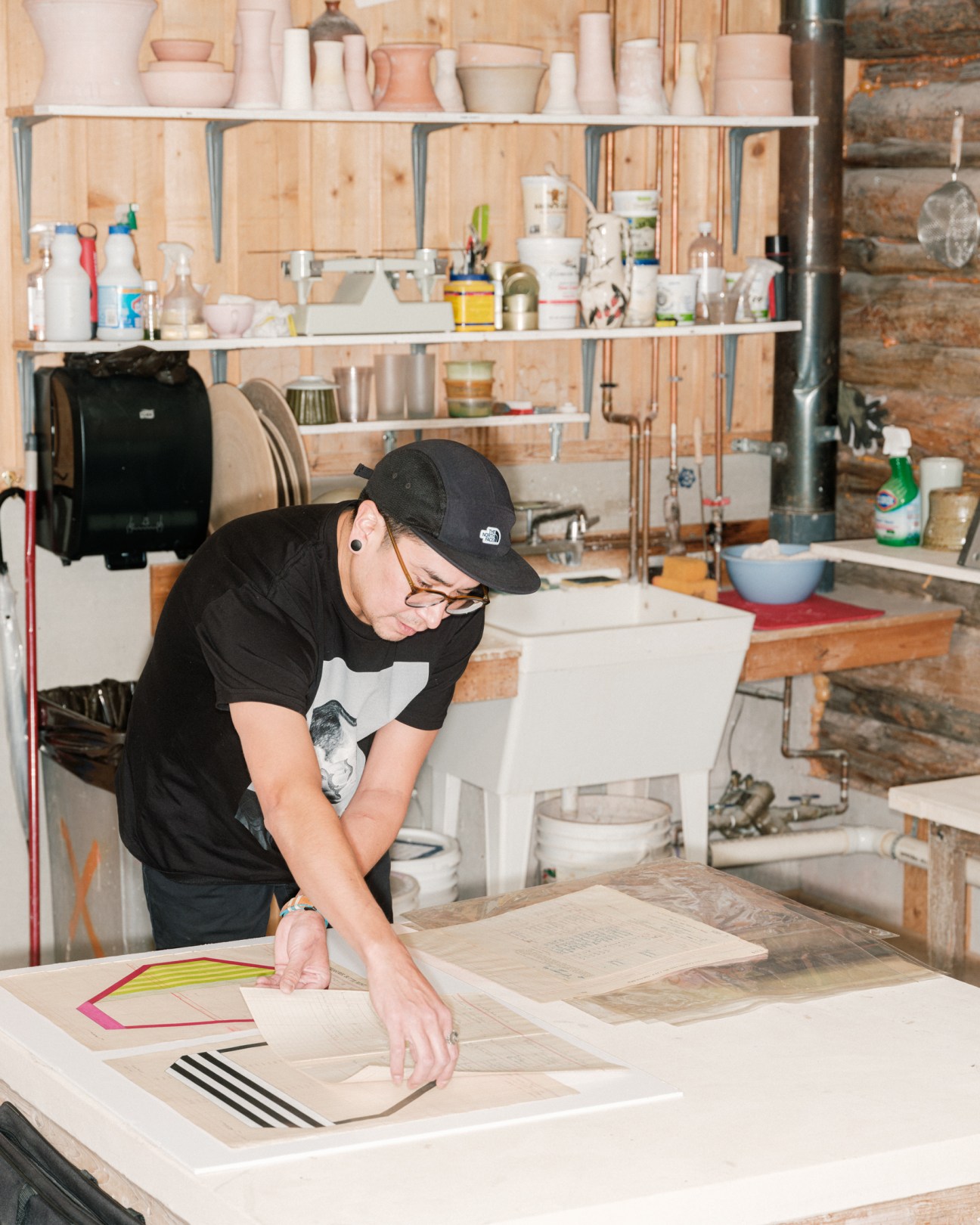
More than 1,190 years after an Arabian trading ship sank in the waters south of Singapore, ceramicists Ng Seok Har and Michelle Lim (pictured above) are still learning lessons from its porcelain cargo. The duo founded Singapore-based Mud Rock studio in 2013; it has since become the country’s premier purveyor of handmade ceramics, supplying Michelin-starred restaurants and fashioning gifts for diplomats and monarchs. “There’s a long history of soft power in ceramics,” Lim tells monocle. She has given guided tours of the Tang shipwreck at Singapore’s Asian Civilizations Museum, focusing on its vast array of painted bowls, ewers and other treasures. These, she says, tell the story of cultural exchange, trade and international relations across oceans.
Mud Rock’s creations perform a similar role today. Soon after the studio was founded, Singapore’s high commissioner in Canberra hosted a dinner that was served on its plates. The ministry of foreign affairs has commissioned Lim and Ng to make ceramics to be gifted to royal families and dignitaries across the world, including those from Sri Lanka, Tanzania and the Vatican. Mud Rock’s beautifully rendered vases, bowls and tiles showcase Singaporean art and local craftsmanship, offering new perspectives on a country associated more with finance and business than with artisanal pottery.
“We don’t want our work to be hidden behind a cabinet,” says Lim. “We imagine people bringing it out every time they meet a Singaporean.” One of the studio’s most memorable commissions was a 90th birthday present for Queen Elizabeth II. They created an intricate tea set inspired by a tingkat, a traditional tiffin carrier, with etchings commemorating the monarch’s connections to Singapore, such as her first visit in the 1950s and the tembusu tree that she planted on one of her later trips. Lim and Ng made nine versions before settling on the final set, which they hand-delivered to the UK to ensure its safety. “There was immense pressure,” says Lim. “But it was an incredible honour.”
Just add water
Venice harbours many secrets and one of them is Anish Kapoor. While Italy’s city of waterways might seem like an impractical place to live or work, the area has always held an appeal for artists. Kapoor, a Turner Prize-winning sculptor, has now joined this cohort. At his studio near Campo San Polo, he tells Monocle why. “It’s God’s country on many levels,” says Kapoor, who has a studio in London but now spends the better part of every year in Venice.

He still struggles with the “belonging, not belonging” feeling of his youth. The son of Punjabi and Iraqi-Jewish refugees, Kapoor grew up in India and moved to London to study art as a teenager. But in Venice, the artist is embracing the liberation of being an outsider. In 2018, Kapoor purchased the Palazzo Priuli Manfrin, a grand if crumbling 18th-century residence, where he plans to establish his own foundation, studio or repository for his works.
The palazzo’s frescoed ballroom and salons are already in use, having opened to the public at the Venice Biennale in 2022 with a display of Kapoor’s art. That same year, he also used it as a second location for his ground-breaking solo exhibition at the Gallerie dell’Accademia, where he debuted works covered in Vantablack coating (considered to be the world’s darkest man-made substance) and a canon that shot gooey mounds of viscera- coloured wax directly onto museum walls. The artist’s recent exhibition at Florence’s Palazzo Strozzi in October brought together some of his most emblematic creations: a blood-coloured wax monolith on train tracks shaped by their continual movement through a doorway; curved mirrors that reflected and warped the viewers’ perception; and forms that were, seemingly, made entirely of pigment.


They were sculptures that lacked solidity and distinct borders; forms that were startlingly shapeless and impossible to fully grasp. “I was trying to portray the way that real objects are not real – the way that material things are immaterial,” says Kapoor. “We know that from our experience of ourselves.”
Kapoor fashions the objects – or “non-objects,” as per his terminology – in collaboration with a team of more than 20 assistants at his London studio. But in Venice, he paints alone. A palette mashed with globs of red paint and silicone sits on the artist’s studio floor, which his dog, Tara, then prances through before walking across some works laying on the ground. Kapoor smiles at her paw trail.
Currently on display at Lisson Gallery’s two New York spaces, the works that Kapoor has produced here feature elements that he has never worked with before, such as Catholic-style shrouds and aureoles. His reasoning? “The job of the artist is to follow the unknown,” he says. “Do what you’ve never done before and risk the possibility that it’s utterly idiotic.” Tara, in his arms now, gives Kapoor’s face a lick. “I’m talking about freeing yourself. And freeing yourself is a process.”
The CV
1954: Born in Mumbai.
1973: Moves to the UK to attend the Hornsey College of Art and, later, the Chelsea School of Art and Design.
1978: Takes part in his first high-profile exhibition, New Sculpture, at the Hayward Gallery.
1991: Wins the Turner Prize.
2018: Purchases Venice’s Palazzo Priuli Manfrin.
2022: Subject of an exhibition held at the Galleries of the Academy of Venice.
2023: Kapoor’s paintings are on display at Lisson Gallery’s two New York locations until 20 December.
Hook, line and winter
Zetterberg takes over and it doesn’t take him long to catch a fish – but it is so small that we must let it go. “We only keep the bigger ones,” he says. “The ones that have enough meat on them.” Finnish law determines the kinds of fish that people are allowed to take home. Zetterberg’s favourites? Zander and perch. But other popular varieties include whitefish, trout, arctic char and burbot.
This time we have to make do with a few small ruffe. But Zetterberg isn’t disappointed. “This is not like going to the supermarket,” he says. “You need practice and patience – and we have just started.”
It’s a sunny winter’s day with subzero temperatures, clear blue skies and little to no wind, and we are preparing to set out for the open sea. “Perfect conditions for fishing,” says our instructor, Antti Zetterberg. We are not sailing; we are walking, because Helsinki’s Seurasaarenselkä Bay is covered in a layer of ice that is 30cm thick. We are here today because Zetterberg, an avid fisherman and editor in chief of fishing magazine Kalastus, has agreed to teach Monocle the ins and outs of ice-fishing – a popular pastime in Finland, where tens of thousands of lakes freeze over during the winter months. Zetterberg has come prepared – so prepared, in fact, that onlookers might think we are setting out on a polar expedition (think winter overalls, ice drill, sonar, various rods and lures, a stool, pliers, Swiss Army knife and dry suit). Should we be worried? “The ice should carry us,” he says, handing us ice picks that we can use to pull ourselves up in case we fall into the freezing water. “But it’s best to be prepared in case it doesn’t.” We pile the equipment on a sleigh and start looking for a spot. Some people are walking their dogs on ice and give us a thumbs-up. Ice-fishing is a respected hobby in Finland and it is considered polite to wish the fishermen luck.
Once we settle on a location, Zetterberg begins showing Monocle how to use an ice auger (a hand-operated drill) to make a hole. After about 10 seconds, we manage to pierce through the frozen lake. Then it’s time for Zetterberg’s party trick. “These are a game changer in ice-fishing,” he says, handing Monocle a small gadget that looks like a stethoscope. This sonar transducer shows you in real time whether fish are lurking beneath the ice. “Before, you would have to wait and see,” says Zetterberg, laughing. “Now you just see.” But there are no fish to be found here. Monocle begins to feel cold and tired but Zetterberg reminds us why we are here. “You’re surrounded by wide expanses of beautiful snowy landscape,” he says. “It makes you feel completely free.”


At our next spot, we make a hole and cast the sonar. “This was the easy part,” says Zetterberg, handing us an ice-fishing rod. “Now we need to lure and catch the fish.” We cast the rod in the water through the small hole, letting it sink almost to the bottom. After a few minutes, Monocle asks Zetterberg whether we should change spots again. “Are you kidding me?” he says, laughing. ” You’ve only been in there for a minute. Sometimes it takes hours – and that’s the beauty of it.” Ice fishing is not a pastime for the impatient. But it is therapeutic and calming, a mindfulness exercise of sorts. After all, Zetterberg explains, how often is it that we can sit still for hours on end, immersed in nature? Something pulls at the fishing rod then suddenly stops. No luck for us this time.
Design
Show of appreciation
Roca has opened a gallery-cum-showroom in São Paulo, following its creation of similar spaces dedicated to culture and conversation in Barcelona, Madrid, Lisbon, London, Shanghai and Beijing. The Spanish bathroom specialist, which was founded near Barcelona in 1917, is aiming to contribute to the design scenes in the cities where it has outposts. The Roca galleries showcase sustainable architecture and design as well as hosting talks that are open to professionals and the public. The new space, created by Brazilian architect Fernanda Marques, draws inspiration from the Atlantic forests of South America, while keeping a contemporary touch via sleek black façades.


Located in São Paulo’s central Jardim América neighbourhood, the gallery sits on one of the most vibrant avenues in Brazil’s biggest metropolis. “For me, the significance of the gallery transcends professional achievement,” says Marques. “The Atlantic Forest is a biome with one of the highest diversity of plant and animal species on the planet, heightening the urgency of its preservation. In this sense, I dare to assert that the work, in and of itself, serves as a manifesto.”
roca.com
Dubai Design Week

Since 2015, Dubai Design Week has rounded off the year of design-minded fairs and trade weeks. At its 2023 iteration in November, more than 20 installations and architectural structures were installed in the Dubai Design District. A key theme that ran through much of the work on show was an eagerness to connect architecture with place – apt in a city often accused of constructing soulless buildings.


“Dubai has always been about the biggest, the tallest,” says Abdalla Almulla, who won Dubai Design Week’s annual Abwab pavilion commission. “It’s important to take what we have learned in the past and use it to change perceptions. We want the uae to be seen as forward -looking.” Almulla, whose pavilion, made from palm trees, was hinting at a return to regional materials to ground architecture in place.
It’s a theme that Shabir Mir, a Pakistan-born, Dubai-based creative also addressed. “The main issue across the world is identity: we’re experiencing a crisis of it,” says Mir, whose “Ring of Life” sculpture utilised waste fishing nets, once ubiquitous in Dubai. “One hundred years ago, this object was everywhere in the city. I want us to consider how we can reflect these things in our surroundings today.”
Almulla and Mir’s installations suggest that designers should look beyond their immediate surroundings for materials and structural inspiration. The results are sustainably minded and give architecture a sense of identity.
dubaidesignweek.ae
Holding the fort


For decades, the Warsaw Citadel, near the centre of the Polish capital, was largely closed off to the public. A 19th-century fortress built on the imperial order of a Russian tsar, it has a long and, at times, harrowing history. But Varsovians are now able to return to the citadel, thanks to the construction of a new public building within its walls: the Polish Army Museum, which has been designed by wxca Architectural Design Studio.
“We wanted to create a site for the capital’s residents and visitors for cultural events and everyday activities,” says Marta Sekulska-Wronska, ceo of wxca. Structurally, the new museum is composed of eight blocks united by a shared green roof, enhancing the verdant surrounding citadel parkland. wxca’s architects were sensitive to the original features of the fortress and its history during the design process too. Chevron patterns on the surface of the museum evoke military motifs, while the walls feature a coloured concrete that alludes to the red brick of the Citadel. Space for reflection was key too. “It was important for us to create a sense of tranquillity,” says wxca architect Pawel Wolanin. “We wanted the interior of the museums to have a slightly sacred atmosphere. During the planning stage, we imagined people whispering inside.”
The new facility is part of a wider development of the citadel. Other additions to the complex, which are currently under construction, include a second wing of the Army Museum (essential, given that it has an archive of more than 300,000 exhibits) as well as the new Museum of Polish History. “As well as hosting visitors to the new headquarters of the Polish History Museum and the Polish Army Museum, the complex of fortifications and expansive green spaces will be opened to the public,” says Sekulska-Wronska. She hopes that, collectively, the buildings will form one of Europe’s largest museum complexes – and transform a long-overlooked part of the city.
wxca.pl
Trade mission
Design Nation is a new Belgian trade show focused on the contract furniture market. Its first iteration took place in the town of Kortrijk in October 2023 and, aside from offering a new forum for brands to present work, it served as a new physical model for industry fairs.
“We decided to move away from a traditional trade show format to a concept with fixed surfaces and plug-and-play booths, so brands don’t need to invest a lot in building a stand,” Design Nation’s exhibition manager, Hannelore Caenepeel, tells Monocle. “If you go to a city such as Marrakech, you have narrow streets where you go from one shop to another, and a central square where you can have a drink.
This is where the idea came from.” The result was a maze-like exhibition hall with booths separated by gauzy white curtains, offering a sense of both airiness and intimacy.
Smaller than many trade fairs, with just 74 companies present, the event had a sense of conviviality that proved popular. “The new format is convenient in terms of setup and costs,” said Philipp Mainzer, co-founder of German interiors brand e15, which was presenting the new Galerie table designed by David Chipperfield. “This trade-targeted event is in our interest because at least half our business is commercial.”
design-nation.eu
Turning heads

Office life has evolved in the past three decades – and so too has Vitra’s partnership with Antonio Citterio. The Swiss furniture firm has, over the course of 30 years, worked with the Italian architect and furniture designer on 10 iterations of the office chair – the latest of which, acx, has just hit the market.
The ambition of its designer was to create a perch that is compact and offers some much-needed comfort for desk-based work. Its standout feature is a mechanism that allows the chair to automatically adjust positioning based on the weight and dimensions of the individual sitting on it. This is supported by a number of control elements, hidden under the seat, which allow the user to further tailor their experience. “The idea was to have an understated chair with a reduced backrest and a warm array of upholstery colours, suited for both home offices and open-plan workspaces,” says Citterio.
Much of the chair is made from recycled materials and it can be easily separated and recycled again at the end of its life. It comes in seven fetching mesh colours along with a matching seat fabric and a light-coloured or black frame. The result allows the user, and chair, to sit pretty in any work environment.
vitra.com
Business
F&B — Canada
Soft spot
When sisters Andrea Grand and Katie Fielding surveyed Canada’s fizzy-drinks sector in early 2020, they spotted a gap in the market for a higher-quality alternative to the same old household names. “The drinks sector in this country was very different back then,” says Grand. “If you didn’t drink alcohol, your only options were a can of pop or a glass of soda, so you would feel as though you were sitting at the kids’ table. We wanted to put alcoholic and non-alcoholic drinks on a more level playing field.”

So in 2021, following careers in marketing in Toronto’s fashion and lifestyle sectors, the pair launched Barbet, a colourful range of naturally flavoured sparkling drinks, all made and canned in the city. “We might have been a little naive to what the beverage industry had in store for us but we were super lucky,” says Grand. “A lot of people were very generous with their time. So we just started asking questions.”
Initially working with a mixologist friend who specialises in cocktails, the sisters crafted three drinks that were tinted and flavoured with ingredients such as grapefruit, juniper, calamansi lime, jalapeno, cucumber, lavender and pineapple. Once released, the drinks quickly found a thirsty audience. “The ingredients have kept people coming back,” says Grand – as have Barbet’s brightly striped cans, which were created in Toronto by Design of Brand.
Attempting to make a dent in a canned-drinks sector dominated by large, multinational manufacturers was a sobering prospect. “I have always been a problem solver and that lends itself really well to entrepreneurship,” says Grand. The team decided to emphasise a key aspect of the brand in deciding where to debut Barbet’s drinks: its small size.
“If you launch your products in a big grocery shop, there’s a perception that you are a big operation,” says Grand. Instead, Barbet approached some of Toronto’s smaller boutique food shops and delicatessens, as well as a selection of the city’s well-regarded independent bars and restaurants.
“We wanted to preserve the more direct, one-on-one connections that we had made with bottle shops, cafés and corner shops,” says Grand. “We knew that, if we could win over 100 people in that way, having them tell a friend about us would have more of an effect than getting our cans on the shelf of a big supermarket.”
The strategy paid off. Demand in Ontario for Barbet’s drinks has doubled every year since launch and expansion into the US is now under way. Grand tells Monocle that she expects sales to reach half a million cans by the end of 2023. “We are scaling the business and excited to introduce it to more people,” she says. “The support for small businesses in Toronto is really strong so it’s a great city to get feedback from your customers. That has been the most important part of the journey for us so far.”
The Entrepreneurs
Power suits
Daisy Knatchbull founded The Deck on London’s Savile Row in 2019 to disrupt the male-dominated world of tailoring, becoming the first house on the storied street to have a storefront dedicated to women. Bespoke suits start at about £2,800 (€3,200) and Knatchbull has also developed a ready-to-wear line.
“I was lucky to be exposed to Savile Row at a young age,” says Knatchbull. “At 23, I found myself on this incredible street. I was able to experience having a bespoke suit made for me. It was this feeling I can’t describe: an incredible, empowering strength coming through the suit. I thought, ‘This is something I want every woman to be able to experience.’”
Knatchbull’s bold vision has led her to wear other hats. “I’ve become a supporter of female entrepreneurship,” she says. “I want to do whatever I can to better that. The stats are against us: only 2 per cent of venture-capital funding goes to female- founder businesses. There’s progress to be made.”
To hear Knatchbull’s story, listen to episode 622 of Monocle’s podcast, ‘The Entrepreneurs’.
Aviation — Canada
High water

This year’s record-breaking summer wildfires in countries including Canada, Greece, Italy, Portugal, Tunisia and Algeria have renewed focus on a storied, Canadian-made method of putting them out. Nicknamed “Super Scoopers” in the US, where they are among the firefighting craft of national and state forest services, Canadair’s red-and-yellow amphibious water-bombing plane can take on more than 6,000 litres before ascending to douse wildfires from the sky.
Originally launched in 1969, the planes ceased production in 2015 as a result of dwindling demand. However, moves to restart manufacturing began in 2019 when Indonesia’s defence ministry made a one-off order for six new cl-515s and a cl-415eaf, which will be delivered next year. And interest in the aircraft, which are manufactured at De Havilland Canada’s facility in Calgary, has been ticking up. France bought 16 new Canadair planes at the Farnborough International Air Show in 2022 to reinforce its existing fleet and the European Commission ordered an extra 12 last July to be stationed across the EU, including in Portugal, Croatia, Italy and Spain. Both deliveries are due by 2027. Expect demand from other territories before then as the return of the aerial firefighting classic takes off.
Economics — Stockholm
Happy campus
Jonna Dagliden Hunt on the world’s first professor of happiness and how the academic department he has set up could lead to us ditching GDP and measuring glee.

In 2008, at the fresh-faced age of 34, Micael Dahlen became Sweden’s youngest economics professor. Now he has a new accolade: he is the world’s first recipient of a professorship dedicated to happiness, wellbeing and welfare. As part of this role, he will head up a new centre dedicated to the topic at the Stockholm School of Economics (sse). But Dahlen is no smiley newcomer to the subject: 10 years ago, he introduced happiness studies to his students and is the author of several books that offer a scientific approach to its research. In fact, his entire body signifies his mission and breaks with the stereotypical view of a professor. His tattooed arms work as Post-it notes for things that make him happier. The number 70, for example, reminds Dahlen not to give 100 per cent all the time, to avoid burnout. A roadworks sign reminds him to learn new things, not least as a professor. “Finally, I’m able to work with happiness full-time and build both the research and teaching around it as much as possible,” he says. “My goal is to make society happier.”
Last year, Dahlen’s programme, Happiness and Wellbeing: Making a Better Life, became the most popular optional course in the school’s history. It is currently struggling to meet demand. Students are keen to find out how they can lead happier lives and eager to be part of what Dahlen calls his “naughty approach”. Some of his challenges to students include making eye contact with strangers, confronting fear, reconciling with a person who they were once close to and asking someone for help. “Hopefully, the course will become mandatory for all students soon,” he says, while showing Monocle some of the rooms and environments of the Center for Happiness, Wellbeing and Welfare.
In addition to a large modern art collection placed throughout the building (initiated by the current principal, Lars Strannegård), there are rooms designed to encourage creativity and spaces for more intimate discussions between students and teachers. In one, students can nestle in small huts for a relaxed seminar. In The Light House Room, a small group of students can tell stories around a pretend fireplace. Other happiness fixes are more questionable. On a desk in the middle of one classroom is a microwave to encourage students to eat in class. “All types of impulses and stimuli affect us,” says Dahlen. It is hard to believe that everyone would appreciate a curry or fish stew being consumed while they study but Dahlen is adamant about his microwave mission. “Even when something smells odd or a bit different, it affects our creativity,” he says.
Research at the new centre will look at quality of life, mental and physical wellbeing, social changes, what constitutes a healthy economy and how companies and society contribute to people’s welfare. The goal is to shape policymaking, guide companies in implementing health-promoting measures to enhance productivity and profitability, and, not least, make research findings accessible to the public.
For Dahlen, the search for happiness began as a way to understand people better. He had noticed that money was the dominant focus for many. And, he says, with soaring interest rates, inflation and recession, we are seeing that it hasn’t worked out as a measure of success, let alone happiness. As part of his mission at sse, Dahlen wants to broaden the understanding that economics should be about so much more than wealth.“As an institution, we are a crucial social actor, a welfare agent,” he says. “And with that, we have the great responsibility to educate students who will go into positions where they can truly make an impact – whether it is in the public sector, politically, in civil society or in business. It’s about providing them with as many tools and as much intellectual space as possible.”
According to Dahlen, welfare is the beating heart of economics. Despite Sweden being named the sixth happiest nation in the World Happiness Report, it is also home to some of the most stressed and worried people. To try to improve things, he is establishing a grand “happiness experiment”. “Can we make all of Sweden a little happier and healthier if we help each other?” he asks. “A first step is to actually have it as a concrete goal and begin measuring happiness in the same way as we do with gdp and other metrics.”
As for the future, Dahlen is an optimist. Despite the world seeming more insecure and unhappier than ever, he believes that we have a bright future ahead. “I’m an optimist for two reasons,” he says. “First, the future hasn’t happened yet, which means that anything is possible.” And second? “We still have so much to discover – and I’m sure that there are lots of fantastic opportunities ahead.”
Lines of defence
In a letter to the US Congress in October requesting an extra $50bn (€47bn) in defence spending, Office of Management and Budget director Shalanda Young cited threats to national security posed by wars in the Middle East and Ukraine, tensions in the Indo-Pacific, a breakdown in border security and an increase in drug trafficking. Such threats are not unique to the US. In 2022, global defence spending rose by 3.7 per cent to more than $2.2trn (€1.87trn).
After a period of relatively benign international relations, geopolitics is heating up and so is the planet. Indeed, Young neglected to mention, probably for political reasons, what many would argue is the most serious challenge to global security: climate change.


Though there is debate over which threat is the gravest, what is beyond doubt is the need for great resources. In this 12-page survey, we analyse the efficacy of the world’s security apparatus and explore ways to improve it – at a local, regional, national and global level. We visit a nuclear submarine in the US Pacific Northwest to explore the effectiveness of mutually assured destruction as a 21st-century deterrent. On a visit to South Korea’s largest arms manufacturer, we assess the economic consequences of a rearming world.
But security isn’t just about guns and armour. In Turkey, we meet engineers working to secure buildings devastated by earthquakes. In the Philippines, we talk to an octogenarian who helped to bring an end to several decades-long insurgencies. And in Estonia, we meet those at the forefront of protecting European cyberspace. Elsewhere, there are essays from leading thinkers on what lies ahead for global security and how to confront it. Plus: inflatable tanks.


Sub culture
We squeeze aboard one of the nuclear vessels being updated by a twitchy US.
When Monocle arrives at Naval Base Kitsap in Washington state, after passing several security checks and surrendering all electronic devices, the pier is a hive of activity as 2,000 workers put finishing touches to the USS Maine – repairing valves, inspecting motors, replacing pumps and applying paint.
“Our pit stops are short, intense and complex,” says Josh Williams, Repair Officer at the Trident Refit Facility. The pier contains a dry dock that is large enough to accommodate a 170-metre-long Ohio-class submarine and 130,000 sq m of industrial space with some €90m worth of equipment. Armed sailors keep a watchful eye while the submarine is at its most vulnerable. On a crisp autumn day, the only passers-by are harbour seals and fishing boats.

The Maine has been in port for several weeks and will soon head back out into the Pacific for the next leg of an endurance race that has been ongoing for nearly 40 years, when the first of the US Navy’s 14 Ohio-class ballistic missile submarines – known as “boomers” – were commissioned. Along with land-based intercontinental ballistic missiles and strategic bomber planes, these vessels are one of three legs of the US nuclear triad.
Once thought of as Cold War relics, nuclear deterrence and doctrines such as mutually assured destruction (MAD) are back in vogue. Both the Biden administration’s 2022 Nuclear Posture Review and Congress’s Strategic Posture report, released in October, warn that the US and its allies now face two nuclear peer adversaries: Russia and China.
“The threat is getting worse,” says Robert Soofer, a senior fellow at the Atlantic Council. As a result, arms control is giving way to nuclear modernisation. The US Navy is playing the long game: it has a strategic plan for nuclear-armed subs through to 2084. The first Columbia-class submarine, which will eventually replace the boomers, should hit the water by the end of the decade. It will be armed with Trident II d-5 missiles with a range of more than 7,400km.

But the boomers are still a trump card. Russia or China could theoretically wipe out US missile silos and bombers in a first strike. They would be harder pressed to locate these stealthy deep-sea craft armed with the capacity for hundreds of warheads. Powered by a nuclear reactor and capable of generating its own drinking water and oxygen, an Ohio-class submarine can stay in the depths indefinitely. The only limiting factor is the crew’s three to four months of food rations.
“We are the deterrent,” the Maine’s Commanding Officer, Travis Wood, who has spent seven years of his life underwater, tells Monocle below deck. “If deterrence fails, we are the tip of the spear.” The Maine’s most recent deployment was a two-and-a-half-month tour that included an April stop in Guam, where senior commanders from the Japanese and South Korean navies came aboard for a first-ever trilateral visit. Wood was circumspect about specifics but he confirmed that boomers are spending more time in the Indo-Pacific to confront a rising China. “Pushing farther west is the current initiative,” he says. Though submarine captains take orders like any naval officer, Wood relishes the relative freedom of a vessel capable only of receiving low-frequency radio communications for most of its time at sea. “This is the most autonomy you can have in the military,” he says.
Life onboard the Maine requires extreme minimalism. Crew members sleep in bunks tucked between missile tubes, 30cm of steel separating their heads from a nuclear warhead.

Their only personal effects storage is a shallow drawer under the mattress – enough for socks, underwear and an entertainment tablet. When at sea, they are unable to communicate with the outside world for weeks. Exercise is confined to a treadmill and weight rack in closet-sized spaces. Two washing machines and driers run laundry 24/7. It takes a special breed to volunteer for such close quarters. Lieutenant Commander Elisabeth Staab has served on a range of US Navy vessels and prefers the boomers. “If you ever had dreams of being an astronaut, this is as close as you can get without going to space,” she says.
With responsibility for 170 sailors, Wood’s hopes for the new Columbia-class are more quotidian than hi-tech: upgrade the kitchen to allow for better cooking. “Food makes the biggest difference to morale on a sub,” he says, before we climb a ladder to the top deck for some fresh air. “It’s your only comfort.”
Export boom
South Korea’s once domestic-only arms maker has turned global supplier.
Workers at Hanwha Aerospace, South Korea’s largest defence contractor, have been busy. Over the past 18 months, there has been record demand for their wares, particularly the K9 Thunder, a self-propelled howitzer that can manoeuvre on rough terrain. Though Seoul refuses to send lethal weapons to Ukraine – so as not to provoke Russia, a key ally of its belligerent neighbour, North Korea – the war has been an indirect boon for the country’s defence industry: in 2022, exports totalled $17.9bn (€16.8bn), more than double the previous year. Many of the countries that have sent arms to Ukraine have chosen to purchase Hanwha-made replacements. In July the company won a contract worth up to AU$7bn (€4.2bn) to build 129 Redback infantry fighting vehicles for the Australian army.
For decades, South Korean contractors were meant to support just one customer: the South Korean military. Even though the 1953 Korean armistice ended combat, North and South are still technically at war. Efforts to deter Pyongyang, which once boasted the peninsula’s superior military resources, meant that South Korea has invested vast amounts in its homegrown industry. Due to this heightened state of preparedness, says Lee Kyounghun, a veteran engineer and senior vice-president at Hanwha’s Changwon Plant Three, Seoul conducts “very rigorous inspections, down to the smallest parts”.


Fighting fit: Hanwha facts and figures
Headquarters: Seoul
6,420: Employees
KRN62.28trn (€44.1bn): Revenue in 2022
Key clients: Australia, Poland, Norway, Finland, Estonia, Turkey, Egypt, India, Malaysia and Indonesia
Having to serve a demanding domestic market, South Korean arms producers became nimble and innovative. Hanwha engineers say that flexibility is a major strength, allowing the use of single assembly lines for multiple models, meaning that the company can tweak the specifications of equipment according to customer demands for terrain, weather and warfare types. Inside the vast plant, robots cut and bend steel K9 chassis into shape. When a fourth assembly line opens in April, capacity will increase to 320 vehicles a year. Hanwha’s engineers keep a close track on customer feedback in order to monitor how their products perform in the field. This is helped by the fact that they assemble many of the orders in the purchasing nations, which improves innovation, though technological transfer to clients can lead to greater competition down the line. “The more you export, the harder it is for you to keep your technological edge,” Dr Marjorie Vanbaelinghem, director of Institut de Recherche Stratégique de l’École Militaire, a French military research institute, tells Monocle. “So you have to be ready to invest a lot. That’s not a problem for South Korea, because it’s very good at investing in technological innovation, but it’s a risk.”
Hanwha, which was founded in 1952 as Korea Explosive Company, a purveyor of gunpowder and dynamite, appears unfazed by potential imitators, especially in the inflation-battered West. Whereas some larger arms exporters there struggle with cost overruns and production delays, it has been expanding its portfolio and absorbing rivals. Recent acquisitions include Daewoo Shipbuilding & Marine Engineering, a huge South Korean shipbuilder that makes frigates and submarines, and Connecticut-based edac Technologies, an aviation engine parts manufacturer. Its current cash cow, the K9, used to be made by Samsung Techwin, a larger company that Hanwha acquired about a decade ago. This proactive approach appears to be paying off. When Monocle visited Seoul’s adex arms fair in October, Hanwha had the splashiest booth, showing off its unmanned combat vehicles, drones and satellites. With geopolitical tensions heating up, Hanwha looks set to supply South Korea’s allies over air, land and sea.
Keyboard warrior
Estonia is at the vanguard of the fight against Russian cyberattacks.
It’s known as Web War One. In 2007, Russian hackers launched a large-scale cyberattack on Estonia that temporarily shut down a large portion of the Baltic nation’s essential services. The infiltration was halted relatively quickly. “By today’s standards it wasn’t anything terribly frightening,” Luukas Ilves, Estonia’s chief information officer and undersecretary for digital transformation, tells Monocle. “But it was the first time that a government had clearly used cybertools to achieve a geostrategic end. They failed but it woke us up to the risks.” Those risks stem from the fact that virtually all of Estonia’s government services are online. To keep these functioning, the country’s cyber defences must be impenetrable.

The 2007 attack turned Estonia into a global advocate for cybersecurity. “I wish there was a single, crisp, strategic answer,” says Ilves. “The big one is just to realise that it’s an important focus. You have to put time, energy and resources into it. It has to be a lot more collaborative than something like defence, where you really can have most of the work done by governments.”
This also means coming up with a common set of rules: when does an attack in the digital world amount to an act of war? Estonia is a leader here too. The Tallinn Manual, produced by Nato’s Cooperative Cyber Defence Center of Excellence (ccdcoe), based in the Estonian capital, lays out how international law can be applied to cyberwarfar and cyber operations.
The goal is in part to “clarify how international law applies in this area,” says Agnes Kasper, head of ccdcoe’s law department. Take the Geneva Conventions of 1949; “It doesn’t matter how you do it,” says her research colleague Aleksi Kajander. “You cannot target civilian objectives during an armed conflict, only military objectives.”
Ilves says that there has been a lull in state-sponsored cyberattacks over the past two years as Russia has focused its efforts on Ukraine. “In the same way that Ukraine is out there fighting for all of us, I’d also say they’re fighting a cyberwar for all of us,” says Ilves. Kyiv has strengthened its own cyber defences with US and Estonian help, and its critical infrastructure has largely held up during the war as a result. But Nato needs to be ready for the aftermath. “When the physical war ends, it could get worse for us in cyberspace,” says Ilves. The fear is that Russia could launch the kind of cyberattacks that it has directed at Ukraine’s infrastructure on Nato member states, in part because even a successful online strike is less likely to invoke Article 5, which is collective defence by Nato.
Nato has stepped up efforts to counter such threats. The world’s largest cyber-defence exercise, Locked Shields, is hosted annually in Tallinn; the 2023 edition was the largest one yet. More than 38 countries and 3,000 people were split into teams, collaborating and competing each other to ward off major cyberattacks. “Things have become a lot better in the past 15 years,” says Ilves. The key is co-operation across borders, between governments and even with multinational companies – the internet knows no national boundaries.
Take it up a gear
Five pieces of kit that defence ministers are hoping for this Christmas.
There is nothing like someone else’s war for demonstrating to any given military what its own inventory is lacking. Ukraine’s defence of Russia’s invasion in particular has prompted an uptick in procurement and some rethinking of requirements, as Russia’s old-school armour-and-infantry onslaught was met with nimble and inventive modern defences. Here is a plausible, if partial, wish list.
1.
High-altitude balloons

In early 2023 a Chinese surveillance balloon was shot down by an F-22 over South Carolina’s coast. Somewhat comical though the event seemed, the idea of weaponising high-altitude balloons is being taken seriously. Future military high-altitude balloons – and solar-powered fixed-wing craft – could have obvious reconnaissance and surveillance capacity, but could also become weapons platforms.
2.
Disposable drones

The Ukraine-Russia war has increased interest in drones. Baykar’s Turkish-built Bayraktar TB2 attracted early attention but it’s an Australian import that might represent the greater leap forward. Melbourne-based company Sypaq Systems has supplied Ukraine with hundreds of disposable drones made of cardboard. These have a range of up to 120km with 3kg of payload and cannot be picked up by enemy radar.
3.
The flying ship

South Korea’s Marine Corps are working on something similar to the Soviet-built Lun-class Ekranoplan flying warship. The country’s defence ministry is funding a military version of the Aron m80, which currently transports commuters. It is anticipated that the craft, skating over such obstacles as sea mines, would enable rapid deployment of amphibious troops.
4.
Unmanned ships

It is not only Ukraine’s success with unmanned aircraft that has caught the eye. The country, which has no meaningful navy, has also used unmanned maritime craft to great effect. Its kamikaze drones have damaged several Russian ships and naval facilities and kept Russia’s conventional Black Sea fleet largely confined to port.
5.
Long-range missiles

The US-built Lockheed Martin mgm-140 Army Tactical Missile System – atacms – was deployed in combat by Ukraine for the first time in October, destroying several helicopter airfields in Russian-occupied Luhansk and Berdyansk. We might be entering a new missile age. The US Navy has reoriented its budgeting towards long-range weapons, while Australia has announced the purchase of more than 200 US-built Tomahawks.
Blown up
Inflatable decoys are deceptively cheap strategic assets on the battlefield.
Deception has always been part of conflict: there is an obvious benefit to persuading an enemy that you are more powerful than you actually are. In the hi-tech realm of modern warfare, there is also an important economic advantage to such ruses. Guided missiles are expensive as well as destructive. If they can be lured away from their targets, it not only preserves the people and assets of the country they were aimed at, it wastes the money of the nation that launched them. Czech company Inflatech has spotted a valuable market.
Many of these, it is impossible to avoid noticing, are models currently being used by Ukraine in its war against Russia. Inflatech is, however, understandably cagey about its customer list.


“Suffice to say, our systems have been sold on four continents and have been battlefield tested, successfully deceiving the enemy,” Inflatech consultant Mike Ritchie-Cox tells Monocle. The company’s blow-up facsimiles cost between €6,000 and €70,000 each. But even the more expensive decoys are still a fair swap for a Russian kh-59 Ovod cruise missile, which has a unit cost estimated at €500,000. The decoys are also useful as firing-range targets and in vehicle- recognition training. A typical deflated decoy weighs as little as 43kg. In combat, they can be deployed in a matter of 10 minutes. “And we have veterans on our staff who ensure that the decoys are “squaddie-proof” – so they can be assembled in the dark by tired users,” says Ritchie-Cox.
Historic decoys
Trojan Horse: Though it probably never existed, the most emblematic decoy in the history of warfare was this enormous wooden horse that turned out not to be a conciliatory gift to Troy but a personnel carrier bearing Greek warriors.
Previous inflatable tanks: Allied forces deployed inflatable Sherman tanks in Dover during preparations for D-Day in 1944, in order to suggest a landing at the Pas de Calais rather than Normandy.
Stone tanks and wooden bombers: In the Second World War, Japan built aircraft from bamboo and replica tanks from volcanic rock. In China, Japanese troops painted a silhouette of a burning US b-29, hoping that other American aircraft would drop down to investigate.
Dummy soldiers: First World War trenches were adorned with papier-mâché heads to lure enemy snipers.
Truce or consequences
Addressing the reasons for rebellion is key to one peacemaker’s successes.

Unassuming Irene Santiago, an 82-year-old grandmother from the Philippines, has been nominated for a Nobel Peace Prize. She also features on the syllabuses of several US universities. It’s all due to her novel approach to peacemaking, which has brought an end to several decades-long insurgencies on Mindanao, an island in the southern Philippines. Over the past half-century, at least 100,000 have been killed and millions displaced here by fighting between government forces and armed groups – some demanding independence, others communism, and one fundamentalist Islamic rule. The Philippine armed forces once believed that the only way to crush these groups was with force. But now, thanks to Santiago (pictured), they see it differently. “They gave a general a top award for no body count and no human-rights violations,” she tells Monocle. “That is a seismic change.”
It took years for Santiago, who worked as a journalist and for the UN before becoming a negotiator for the Philippine government, to persuade her bosses to change their approach. For years she worked to get more civilian and female voices into negotiating teams. Finally, in 2013, there was a breakthrough. The Moro Islamic Liberation Front, a 30,000-strong militant group fighting to establish a breakaway Islamic state, appointed lawyer and community advocate Raissa Jajurie as its key negotiator. Santiago, meanwhile, nominated Miriam Coronel-Ferrer, a political scientist who had led an anti-landmine campaign. For the first time in a conflict that had killed more than 120,000 people, negotiations were led by non-combatants with roots in the communities they represented. Within a year, a peace deal had been signed.
Santiago’s approach began with her eight ingredients for peace: a well-functioning government, fairly distributed resources, low corruption, free access to information, a well-equipped workforce, jobs and business opportunities, good relations with neighbours, and respect for the rights of others. She says that the key to approaching seemingly intractable conflict is to focus on day-to-day things that really matter, such as food security and education. “I am not doing anything about terrorism and ideology,” she says. “Inequality is a root cause of insurgency. This is the difficult part. And this is what we are trying to work on now.”
It’s often taken for granted that building a productive society is something you do once war is over and that resolving a conflict is done on the battlefield. Santiago’s goal isn’t to end war but to make peace. To do that she dealt with civilians, particularly women, who are more likely to be dealing with the pressures and frustrations that trigger conflict. They know what their communities need in order to accept and sustain a peace deal. You can argue for decades over territorial control, temporary ceasefires, prisoner swaps and power sharing, or you can go to insurgents’ communities, ask them what they lack and focus on fixing the problem. “Santiago’s interventions in Davao worked because there was one vision and one goal – to bring back the legitimacy of the state,” says Georgi Engelbrecht of Crisis Group, an international organisation that analyses conflicts. Santiago puts it in simpler terms. “I identified two things: fear and hunger,” she says. “If you can take out fear and take out hunger, you are done.”
The roots of southern Philippine insurgencies
1965: Ferdinand Marcos is elected president of the Philippines.
1971: Moro National Liberation Front forms to fight for an independent Moro nation.
1977: The Moro Islamic Liberation Front splits from the Moro National Liberation Front.
2002: Islamist militants are blamed for bomb attacks on Manila and Zamboanga.
2003: A Moro Islamic Liberation Front attack in Mindanao leaves 30 people dead.
2004: Peace talks begin between the government and the New People’s Army in Norway.
2014: A peace deal is signed between the Philippine government and the Moro Islamic Liberation Front.
2015: Hundreds of Muslim ex-militants sign up to vote in the 2016 elections.
2017: Islamic State-linked Abu Sayyaf and Maute groups seize Marawi City.
2018: Peace 911’s pilot project is launched in Davao City.
2022: The Philippine Army declares Davao City “insurgency-free”.
Shock therapy
Rebuilding after an earthquake applies to confidence as much as construction.

Nehir Kabakulak had faith in the way her home had been built and in January 2020, when a large earthquake hit, her block proved sturdy – there wasn’t even a crack in a wall. But three years later, on 6 February 2023, two earthquakes struck Turkey. The second of these, with a magnitude of 7.6, was centred on her hometown of Elbistan, and her building shook so much that it seemed to be made of paper. There was massive destruction: 1,377 buildings collapsed in Elbistan, nearly a fifth of the city’s total, and a further 2,773 were damaged beyond repair. Some 995 people died here, including Kabakulak’s 17-year-old son, Seyhan, who was staying in another building that night. When she walked through the town after the disaster, she didn’t recognise the streets.
Within a few weeks, state inspectors had assessed her home as safe to return to. But the damage that had been inflicted was deeply unsettling. “It was in a terrible state,” Kabakulak tells Monocle. “The walls were full of cracks. All the furniture was broken. I didn’t trust that it was safe.”
That reaction is common – and understandable – among people who have lived through natural disasters. Our homes are integral to our sense of security and seeing them fail leaves a deep psychological scar. Rebuilding a sense of safety after earthquakes, floods or war is as important as reconstructing the buildings themselves, says Kit Miyamoto, a Japanese-American structural engineer who specialises in disaster response. This year alone he has worked in Turkey, Ukraine, Morocco and Afghanistan, and is planning a mission to areas of Libya that were affected by catastrophic flooding in September. “People want to come back to normality but also many might be scared, even if buildings are safe,” says Miyamoto. “That puts tremendous stress on the displacement camps and it’s important to decompress that so they can be used for people who really need it.” Empty homes and neighbourhoods also bring other risks: looters often arrive soon after disasters and Kabakulak’s home, like others in Elbistan, was targeted by thieves.
In every disaster zone that he visits, Miyamoto sets up joint companies or non-profit organisations with local engineers and trains them how to deliver technical information in a way that even illiterate people can understand.


Then they go out into communities, visit homes and hold town hall meetings where they explain what cracks and other types of damage mean. “We are the doctors of buildings,” says Mustafa Kizil, a civil engineer who is part of the project that Miyamoto has set up in Turkey, in collaboration with Protek, an engineering firm. More than 1.7 million buildings across 10 provinces were affected and over 5,000 buildings have been assessed by the government. “We see some families who can’t sleep in their bedrooms [the first of the earthquakes struck at 04.17] and are sleeping in their living rooms,” says Kizil. “In one meeting a lady was begging me to come to check her apartment. I went and explained to her the factor of safety that is built into buildings and she became comfortable.”
Sometimes fear is rooted in misinformation. Following an earthquake in June 2022, rumours spread of subterranean volcanoes being shaken into activity. Miyamoto’s team checked the area to reassure residents that the rumours were false. In Turkey, more than 50,000 aftershocks followed the initial quakes, renewing the sense of panic. But the remedy can often be as simple as filling in cracks and repainting, jobs that Kizil and his team arrange for the poorest, internationally displaced or most vulnerable people. In one block, criss-crossed with what appear to be deep cracks, Kizil explains to a homeowner that they are superficial and the building is sound.
Kabakulak stayed in a camp, then in a container home for seven months after the earthquake, through an unseasonably cold spring and then a punishing summer. In September, Kizil and his team called to let her know that her home was ready. When she stepped through the door, she found it freshly painted, with no sign of the damage that had terrified her so much. “After it was finished, it felt the same,” says Kabakulak. “Now I can remember my home again.”
Turkey’s 2023 earthquakes
In the deadliest disaster to hit Turkey in its modern history, more than 50,500 people were killed.
387,346: Number of buildings that collapsed.
50,576: Buildings assessed as damaged beyond repair.
58.1: Percentage of collapsed buildings that were constructed after 2001, despite stricter regulations introduced after the 1999 earthquake.
€65.3bn: Estimated cost of rebuilding.
Black swan or grey rhino?
Benedikt Franke gives voice to the slang behind world-changing events.

From “canary in the coal mine” (early warnings of potential hazards) to “red herrings” (strategically placed information to mislead and distract from actual threats), animal analogies are popular in security analysis. This is reason enough to clear up the confusion between “black swans” and “grey rhinos”. In their original definition, black swans are unforeseeable events with major effects on international and domestic politics; grey rhinos refer to obvious risks that we acknowledge but tend to ignore.
Unlike black swans, grey rhinos are thus not totally unexpected but merely overly underestimated. This does not make them less impactful. Coronavirus, climate change or the Hamas attack on Israel are examples of classic grey rhinos – well-known threats that we have been ignoring for too long. Other rhinos on the horizon include the unfreezing of conflicts in the Balkans, the de-dollarisation of the world economy and the collapse of regimes in places such as Iran or Algeria. For all of them we should have plans in place.
Despite the clear logic, both terms still get mixed up. Most people tend to take every sudden development as a black swan but the truth is that most of these events are actually grey rhinos that we have ignored. In fact, much of the popularity of the black swan is down to yet another animal. Namely, the “elephant in the room”. This analogy refers to pressing, often uncomfortable matters that we choose to avoid in the hope of escaping their consequences. This aversion to confronting things head-on makes the black swan an attractive descriptive concept for those who would like to pretend that there was no way to see a particular challenge coming. At the Munich Security Conference, we usually don’t let them get away with it.
Benedikt Franke is vice-chairman and CEO of the Munich Security Conference.
Keep it in check, mate
Nina dos Santos weighs in on the big business of interfering with affairs.

When it emerged in September that Elon Musk had prevented Ukraine from using his Starlink satellite system to ambush Russia’s navy in Crimea, many asked how one private citizen could hold such sway in a foreign conflict. Some called Musk an outright security threat and demanded that his power be curbed. But history tells us that meddling in affairs by wealthy, so-called non-state actors is nothing new. Sometimes they do so to support causes that they see as just. More often, however, commercial interests are their main motivator. Wars, after all, have always been big business. Banker JP Morgan Jnr financed Allied armies during the First World War, while newspaper magnates William Randolph Hearst and Joseph Pulitzer are widely credited with mobilising their titles to press the US government to declare war on Spain in 1898.
But the objectives of today’s foreign-policy freewheelers are not always as clear cut. Musk appears to be as easily influenced by what’s trending on his social-media platform, X, as he is by the words of a world leader. Indeed, modern technology barons own much of the hardware that states rely on and have the cash to bankroll projects that their governments can’t – Starlink being a case in point. You only need to observe the obsequious nature of UK prime minister Rishi Sunak interviewing Musk at a conference on artificial intelligence in November to see the imbalance in power between private wealth and government.
So how can the world’s richest man be brought to heel? Some experts argue that invoking special laws, such as the US Defense Production Act, could force Musk to sell his wares to Washington first, which could then be distributed to the country’s allies. Another option might be to nationalise businesses such as Space X’s Starlink, Musk’s satellite-launching service, which can be considered a monopoly in the field. Though it has been done before, this option would likely prove controversial and might deter other private companies from entering the market and generating the very competition that is needed as a counterweight. Perhaps the best solution would be to bring Musk’s space firms on board as fully funded defence contractors, with the same contractual responsibilities that other players in the sector face, including not selling products to hostile states.
Musk’s Ukraine intervention was a wake-up call for policymakers. Tackling his power so late in the day won’t be easy but it will get harder the longer it is left unchecked. This risks setting a dangerous precedent, creating a world in which non-state actors are increasingly allowed to involve themselves in conflicts of global significance.
Nina dos Santos is a foreign correspondent, TV anchor and the former Europe editor of CNN.
Stronger than fiction
Emma Searle on the sci-fi minds helping states to predict future threats.

A failure of imagination is the worst mistake that a country’s defence establishment can make. This was the conclusion of the 9/11 Commission Report, which investigated the US’s response to the September 11 attacks. In the aftermath, the Pentagon sought advice from dozens of science-fiction writers whose jobs involved imagining outlandish future conflicts. The enlistment of sci-fi novelists to inform defence planning has been practised by governments for decades. In 2005,the Canadian military hired novelist Karl Schroeder to write Crisis in Zefra, a novel set in a mythical African city-state, which fictionalised scenarios that peacekeepers might face in a near-future conflict. Earlier this year, the UK’s Ministry of Defence hired two of the sharpest minds in sci-fi, Peter W Singer and August Cole, to write eight stories about threats that might emerge within the next 20 years. In France, a group of writers known as the “Red Team” have been tasked with imagining conflict scenarios for the French military.
Fiction’s main advantage is that it is the antithesis of a dry report, making expert findings more digestible. “It’s akin to what I do with my children in the morning,” says Singer, author of Ghost Fleet: A Novel of the Next World War. “I sneak fruit and vegetables into a smoothie. At one end you have science-fiction, which is basically like a milkshake. At the other you have the kale – the strategy paper. Together it becomes a hybrid of narrative and nonfiction.” Fiction has also informed policy within Nato. “It has helped us to think through things that we included in Nato’s first climate-change security action plan,” says Ruben Diaz-Plaja, a senior policy adviser at Nato.
Naturally, setting boundaries is crucial. Fiction is only useful to policymakers when grounded in research, offering strategies to mitigate the conflict it describes. This was a central drive for retired Australian major- general Mick Ryan, whose novel White Sun War: The Campaign for Taiwan posits the scenario of a Chinese invasion of Taiwan. “It involves drawing a line from where we are now and where we might be in five or 10 years given the technologies we’re starting to bring into the military,” says Ryan. “I don’t think the book will lead to any great changes but we might then ask, ‘If this happens, what is our position?’” History has shown that unimagined threats can become reality. Coronavirus came as less of a surprise to those who had grown up watching Contagion and The Andromeda Strain. Technologies and weapons were germinated in the minds of novelists such as HG Wells and Jules Verne. Military expertise and wisdom can be found in unconventional places.
Emma Searle is the producer of ‘The Foreign Desk’ on Monocle Radio.
City Gift Guides
1.
Los Angeles
Los Angeles is sprawling but sticking to neighbourhoods is one way to tackle it. Start at BDDW’s brand-new outpost in Hollywood, selling suggestive ceramics painted by Tyler Hays that make for a saucy stocking filler. A short stroll west is North Sycamore Avenue, where bold frames and sunglasses by Jacques Marie Mage can be found at the French designer’s boutique, along with gifts at department store Just One Eye. Refuel at the airy bakery Tartine, then take a cab down Sunset Boulevard to Mohawk General Store, which has expanded on its men’s and womenswear offering with a home shop full of exquisite one-off designs as well as pantry staples by Flamingo Estate. Explore the small boutiques around Silver Lake – a paint-mottled mug from the studio of Peter Shire or a fine bottle from Silverlake Wine makes for an easy gift – before continuing east to The Good Liver in the Arts District for Finnish gardening tools and bronze kitchenware from South Korea. Next? Culver City for art and design books from Arcana, and then a quick cab to Tortoise General Store, where co-owner Taku Shinomoto presents his own Hasami Porcelain alongside a selection of Japanese-made linens, bags and artworks.

2.
Athens
To get a taste of Athens’ positivity, head to Hyper Hypo for the best art books and magazines by local talent plus international titles. Another recent addition to downtown Athens is Mouki Mou for a pared-back range of clothing, jewellery and household objects. For more artisan-made wares, head to Anthologist – a glamorously appointed showroom on the top floor of a neoclassical townhouse, stocking everything from vintage kilim rugs and woven bags from Mexico to Afghan robes. Elsewhere in the city centre is the flagship store of Ancient Greek Sandals, a footwear brand which has stepped up with an elegant homeware collection. Next door is Naxos Apothecary, where shoppers can pick up soaps, scents and skincare products made using herbs from the Cycladic islands. A short walk leads to the Exarcheia neighbourhood, a hub for small independent brands and makers. One such is the excellently named It’s a Shirt, run by Athenian designer Christina Christodoulou. From her shop on Asklipiou street, she sells clothing made at her father’s workshop. Finish with some melomakarona (Greek honey biscuits) at Asimakopouloi, a bakery and chocolate shop that has been family-run since 1915.
3.
San Sebastián
Harking back to its turn-of-the-century heyday – when Spanish royalty would holiday here – is Perfumería Benegas, which opened in 1908. Seek out their own line of products, Colonia Benegas, which are scented with a delicate mix of jasmine and orange blossom. Another of the Old Town’s retail institutions is Casa Ponsol, a hat shop founded in 1838 where you can pick up a warm woollen txapela (a type of Basque beret). Nearby is Elkano 1, an artisan cheese shop selling varieties from across this corner of northern Spain. Down the street is Loreak Mendian, a homegrown clothing brand with a pared-back range inspired by founders Victor Serna and Xabi Zirikiain’s surfer lifestyle. Should the weather not be in your favour, it’s a great place to find a raincoat. A short walk from here is Chocolates de Mendaro for melt-in-the-mouth truffles. Or if you’re looking for a present to feed the mind, continue towards the cathedral to Librería Donosti. This family-run shop stocks everything from children’s books to literary fiction. If you still haven’t found what you’re looking for, head around the corner to Box. You’ll find an array of artisan leather goods: with wallets, bags and briefcases that can be customised.


4.
London
London is a big beast to tame. Open by meeting in Notting Hill to fuel up and find some nibbles at Pastella & Butler’s for the best in cheese and chutney to line your friends and families’ pantries – plus a pastry or two for yourself. Then onto Marylebone for a wardrobe refresh at menswear multi-brand shops Trunk Clothiers and John Simons before a peruse of the tailoring at Casely-Hayford and running gear at Tracksmith, plus a look at TWC’s new menswear outpost on Chiltern Street. The Monocle Café is agreeably close at hand, too. Now, to restore your spirits let’s head to Berry Bros & Rudd in St James’s, the city’s oldest (and probably best) wine merchant, which has survived in the same shop on Pall Mall since 1698. From here, providing your bags aren’t too heavy, it’s a stroll up to Soho for a look at Studio Nicholson’s sparing and elegantly done shop on Broadwick Street. As rain mostly falls on London in the stead of promised snow, an umbrella is not only handy but a great gift – dash to James Smith & Sons, operating on New Oxford Street since 1830, for a bespoke brolly. From there it’s a short walk to stationery shop Present & Correct on Bury Place. At Coal Drops Yard by King’s Cross, MHL is a good stop-off for shirting and cosy knits, while Kitchen Provisions offers a great selection of Japanese knives and covetable cookware. Finally, head up to TwentyTwentyOne on Upper Street for a few final design-minded finds to round off your spree.

5.
Zürich
Start your journey with a hunt for homeware at Edition Populaire. Its careful selection of items is intended not only to be useful but also to add a gentle touch of colour; you’ll find stools designed by Martino Gamper and Charlotte Perriand bedside lamps. For those looking for more, it’s only a few steps over to household specialists Slow Goods to find Swiss-made crafts for the kitchen table and durable pots and pans that will age well and look good on the stovetop. Continue towards Welschland for a fine selection of excellent cheeses, wines and cured meats from French-speaking Switzerland. To find a trove of rare LPs and selected vintage items – anything from furniture to posters – head to 16 Tons at Anwandstrasse 25, which has been trading in tasteful finds since 1989. For taste of a different variety, Confiserie Teuscher, with two locations in Kreis 1, remains a favourite for those with a sweet tooth. Pick up a box of Champagne truffles for yourself and one of the assorted praline boxes for your loved ones. Garçoa is a more contemporary option in Kreis 5, where the young, Swiss bean-to-bar company takes over the Eisvogel ice-cream shop during the colder months. For your beauty regime, the knowledgeable team at Parfumerie Spitzenhaus off Bahnhofstrasse will ensure you’re looking great and smelling the part. There’s also Süskind for hard-to-find fragrances, Fabrikat for stationery and three Soeder shops for skincare. For a wardrobe top-up including ample choice of accessories, head over to Opia in Europaallee, where you’ll find brands such as Rier and jewellery by local brand Yan Jiang Studio. Finally, this being Zürich, weekend opening hours are limited, so for those hoping to find the perfect present on a Sunday, head to the selection of Swiss-made products at the Landesmusem Boutique near Hauptbahnhof or, of course, visit us at Monocle’s headquarters, café and shop in Seefeld.


6.
Toronto
First let’s pick up a record or two at mainstay Rotate This or Invisible City Record Shop, home to a record label of the same name and a small wine bar where you can review your purchases. Several of Toronto’s independent menswear shops have revamped their interiors this year. They include Muddy George on Bloor Street West (for offerings such as cosy Shetland wool jumpers by Harley); Sydney’s fine in-house tailoring on Queen Street West; Lost & Found for Beams Plus; and Il Bussetto leather goods. Elsewhere, Blue Button Shop’s Japanese design offerings remain a Monocle favourite. For the letter-writers on your gift list, head to Wonder Pens, Toronto’s best independent pen and stationery store, which opened a decade ago this year. For print enthusiasts, pick up hard-to-find indies at Issues, Toronto’s newest magazine shop, founded by Nicola Hamilton in 2022. Type Books remains a staple and Flying Books, a few doors down from The Monocle Shop in Little Italy, is excellent.
7.
Hong Kong
In Central, there is Wine Brothers for Aussie labels, LQV for all things French and La Cabane for natural and biodynamic bottles (it also stocks homegrown chocolatier Conspiracy Chocolate for those with a sweet tooth). Head to the Fine Wine Experience in Sai Ying Pun for Hong Kong’s largest retail selection of wines from the Jura to Japan. Teetotallers can make their way to nearby Plantation Tea Bar in Shek Tong Tsui for exquisitely packaged teas and artisanal teaware. Menswear needs can be fulfilled at Salvo (for twill trousers, patterned shirts and mohair jumpers), while those with athletic loved ones can swing by Lane Eight for stylish and sustainable running shoes. Both are located in Wan Chai’s Stastreet Precinct, dense with wonderful shops such as Perfumer H and Kapok – and you can pop by The Monocle Shop. A little further east, Causeway Bay’s Okura select store offers Japanese womenswear and lifestyle brands, while nearby Still House and Hide & Seek offer menswear and accessories. Finally, The Lion Rock Press is the go-to gifting option for nostalgic Hong Kongers – think hand-painted Star Ferry Christmas-tree baubles and beautiful prints of city scenes by Hong Kong artists.

8.
Sydney
Let’s meet at the Strand Arcade between Pitt and George Streets, where Rox Gems & Jewellery has plenty of sparkly things that are sure to delight. At the other end of the arcade is Haigh’s Chocolates, Australia’s best confectionery company, whose family-made wares are super stocking-stuffers. Japanese-Aussie designer Akira on the top floor is well worth a stop-off too. Next, wander down George Street to Hunt Leather for accessories. The inner suburbs also have treats, none more so than The Cookery Book in harbourside
Northbridge, where you’ll find all the latest Australian and international cookbooks, nearby Koskela in Milsons Point and florist Bess in William Street Paddington for a wreath or centrepiece. P Johnson is also close at hand for top-class clothing for men and women. Design-wise, Sydney has plenty of spoils, from Vampt Vintage Design in Surry Hills to The Society Inc by Sibella Court in St Peters. The only issue you’ll have is getting your find home and wrapped.


9.
Lisbon
Christmas shopping can feel like a slog in hilly Lisbon, so start off your expedition by picking up a pair of comfortable walking shoes at JAK – for yourself and a loved one. Pair them with a plaid shirt and corduroy jacket from Fairly Normal and you’ve nailed the laid-back city’s style already. If it’s cool, a pair of cashmere-lined gloves or woolly mitts make a good gift. Luvaria Ulisses steals the show: the shopfront of this 1920s glove-maker is worth the visit alone. For a more intimate present, Paris em Lisboa has stocked the softest bedding, pyjamas and dressing gowns since 1888. Burel Factory also makes elegant shawls, cushions and bedspreads from the Serra da Estrela region. A lobster, mushroom or walnut-shaped ceramic bowl is not something that one needs but Bordallo Pinheiro’s homeware makes for playful gifts. Ditto the Portuguese-made goodies sold at the A Vida Portuguesa sites. Depozito is a one-stop-shop for textiles, toys, toiletries and jewellery. And for those for whom the festive season is more about the culinary pleasures, Comida Independente stocks an excellent selection of Portuguese wines and pantry classics such as olive oil and honey from small producers.

10.
São Paulo
Expect to see Santas in board shorts as the festive season hits mid-summer in São Paulo. For homeware, our favourite is Firma Casa and Dpot is top for furniture. But let’s start with something sweet: Dengo Factory in Pinheiros – a three-storey temple to Bahian cocoa beans selling slabs of fruit-studded chocolate, cocoa-coated nuts and even a make-your-own chocolate bar line. A short ride away, Misci is the latest to join a cohort of up-and-coming fashion labels on Rua Mateus Grou. A few doors down, Feira na Rosenbaum sells the crème de la crème of Brazilian craftmanship, with homeware and décor sourced from artisans and collectives across Brazil. At the end of the street, stroll down Rua Cardeal Arcoverde, where antique shops have hidden gems. From there it’s not far to Rua Oscar Freire, an avenue in the heart of Jardins. Osklen, a timeless Brazilian fashion brand, cuts laid-back styles from cutting-edge sustainable materials. Just a few doors down, the Havaianas flagship shop sells Brazil’s obligatory summer footwear, while round the corner Haight – the Rio de Janeiro beach brand of the moment – completes the look with bikinis and swimming costumes. Nearby Granado, a vintage toiletries brand dating back to 1870, is excellent for stocking-fillers, while Mario Cohen sells prints by some of Brazil’s top photographers, not least Sebastião Salgado. For food, look no further than Emporio Fasano, the hotelier’s great gourmet supermarket and food hall.

11.
Bangkok
Christmas combines two things Bangkok does better than most: festivals and shopping. December’s slightly cooler temperatures also offer a seasonal opportunity to go beyond the air-conditioned shopping malls. Siam Square is a recently pedestrianised shopping area just north of Sukhumvit Road and the central metro station. It’s where fashion trends start and an adventurous young crowd has come for generations to strut their stuff. Thai womenswear label Gentlewoman opened its flagship shop here in 2022 and its branded tote bags have become hot property across Asia. After browsing the area’s independent boutiques, walk up to Sukhumvit Road and cool down inside CentralWorld Bangkok’s retail mecca. Good Goods on the ground floor combines modern Thai design with traditional crafts, stocking everything from clothing and ceramics to larder essentials Thai honey, jam and coffee; a Monocle magazine fits snugly inside their colourful zip-pocket pouches (just a thought). Heading up to the fifth floor, the shelves at the Chabatree concession are chock-a-block with fetching, “Made in Thailand” kitchen utensils. Chabatree’s perfectly weighted wooden serving spoons marry form and function – a product of the founder’s background in engineering and passion for design (try their salt and pepper shakers, his current obsession). Crossing the road to Gaysorn Village, JBB and The Decorum are two Monocle menswear favourites and a must-visit for looking sharp at any end-of-year knees-up. Then, for the morning after, skincare brand Pañpuri is nearby. For our final stop, board the BTS at Chit Lom and ride five stops east to Thong Lo, a popular drinking and dining destination. At the top of the street, furniture showroom Chanintr Craft is worth a visit even if you only have carry-on luggage. The courtyard café is an ideal spot to take stock of your Christmas gift list and the retail wall can cater to most tastes.
12.
Dubai
Dubai has much more than malls. For wonderfully wobbly-looking ceramics, try Cole & Cinder: a Dubai-based firm founded by Nicole Farrelly, whose studio you can book to visit. As far as independent bookshops go, Magrudy’s is the original independent but Books Kinokuniya Dubai in Dubai Mall is the best stocked. Alserkal Avenue in Al Quoz is the place to nab an original artwork while The Edit, curated by Rumana Nazim, focuses on womenswear by female-founded brands. Nearby is The Flip Side record store, ready to cater for vinyl collectors. For something sweet, Kathy Johnston’s UAE-made Mirzam chocolate factory is the place to stock up on festive confectionery. Emirati Mohammed Kazim’s comely sandal shop Tamashee is a must. Elsewhere on the fashion front, L’Afshar makes simple handbags and accessories. Last up we’re off to D3 for a scoot around The Lighthouse concept shop and Peter Ahn’s Frame, both of which are piled with books and design items.


Rich pickings
Clockwise from top left: bag by Hermès, bag by Bally, bag by Prada, hat by Maison Michel, shoes by Hereu, bag charms by Gucci from the Gucci Gift selection, bag by Fernando Jorge / Métier.


Jumper by Zanone from Slowear, trousers by Trunk, fifty fathoms bathyscaphe watch by Blancpain, glasses by Ahlem, hair comb by Celine Maison, pen pot by Connolly, ruler and scissors by Niwaki, wrapping papers and ribbon by Choosing Keeping.
Turn off the screens
Try your luck at a cosy evening spent playing a card game.

Box with two decks of cards by Pierre Yovanovitch for Dior Maison, blanket by Hermès.
Women’s: Jumper and skirt by Officine Générale, alpine eagle watch by Chopard,
necklace and ring by Graff.
Men’s: Shirt by The Workers Club, trousers by Trunk, Mount Iwate – autumn dusk watch by Grand Seiko.
Label maker
Few things are as natural as putting pen to paper – and writing by hand gives your gifts a personal touch.

Bracelet and ring by Boucheron, fountain pen by Caran d’Ache,
card set by Smythson, trinket box by Louis Vuitton, gloves by Hermès,
wrapping papers by Choosing Keeping, ribbon by V V Rouleaux.
Perpetual motion
Body movements will power an automatic watch, so it will feel like part of your person. Choose a subtle design that’s built to last.

Shirt by Dior Men, leather multifunctional tray and soft leather desk pad by Montblanc, musgo real black edition eau de toilette by Claus Porto, candle, candle lid and candle snuffer by Celine Maison, pen (silver) and notebook by Cartier, pen by ST Dupont, royal oak selfwinding watch by Audemars Piguet x 1017 Alyx 9SM.
The finishing touch
A timepiece that complements a recipient’s existing jewellery could become the piece that they are never seen without.

Shirt by Atlantique Ascoli, trousers by Giuliva Heritage, première édition originale watch by Chanel Watches, ring by Chanel Fine Jewellery.


Best foot forward
Outdoor types will appreciate nothing more than the kind of clothing that allows them to be in the open no matter the weather.

Jacket by Hansen, trousers by Trunk, socks by Anonymous Ism, boots by Diemme 3 Ten C, santos-dumont watch by Cartier, ribbon by Choosing Keeping.
That’s a wrap
Found the perfect present? Make the act of giving even more special with some attractive wrapping paper.

Shirt by Blazé Milano curated by Cabana, serpenti tubogas watch by Bulgari, ring by Ole Lynggaard (left ring finger), ring by Cartier (left index finger).
Ring by Bulgari (right pinky finger), cufflink box by Smythson,
wrapping papers by Choosing Keeping, ribbon by V V Rouleaux.
Jewellery box, top to bottom, left to right:
Ring and ear cuff by Ana Khouri, ring by Goossens, earrings by Completedworks, earring by Ana Khouri, ring by Dior Joaillerie, earrings and ring by Ana Khouri.
Case of wanderlust
For the frequent flyer, luggage that will last a lifetime will have them planning their next getaway with relish.

Jumper by Connolly, shirt by Gitman Vintage, trousers by Trunk, socks by Sunspel, shoes by Church’s, classic fusion original black magic watch by Hublot, suitcase and luggage tag by Rimowa.
In your grasp
Combine practicality with style by selecting winter wear in materials that are warm, slim and supple.

Jacket by Akris, bracelet by Dior Joaillerie, gloves by Thomas Riemer.
Surefire hits
If you’re thinking of buying clothing for a loved one, stick to the classics – muted colours are always a winner.

Jumper and scarf by The Workers Club, scarf by Sublime from Couverture & The Garbstore, socks by Patapaca from Trunk, shoes by Mackintosh x Jacques Solovière,
cap by Luca Faloni, gloves by Elmer from Couverture & The Garbstore, umbrella by Mackintosh.
Splash of colour
Help someone stand out from the crowd and inject some personality into their look with playful accessories.

Polo shirt by Luca Faloni, mini dolcevita watch by Longines, ring by Goossens, airpods pro case with strap, bag charm and cable holder by Valextra, in-ear headphones by Montblanc.
Models: Delina, Tom
With thanks to our friends at Twentytwentyone and Another Country.
Making a meal of it
The hors d’oeuvre
Kushikatsu quail eggs

Inventive and alluring nibbles, these skewered, deep-fried quail eggs are cute, tasty and easy to make.
Serves 4
Equipment
4 bamboo skewers
Ingredients
12 quail eggs – if in the fridge, bring them to room temperature before cooking
Salt and pepper, to taste
3 tbsps plain white flour
1 medium egg – add a pinch of salt and then beat
30g fine breadcrumbs
Vegetable oil for deep frying
To serve
Tonkatsu sauce
Lemon wedges
Method
1.
Bring some water to a rolling boil in a small pan, place quail eggs gently into the water and turn down the heat to medium. Cook for 2 minutes, while stirring the water (it helps the yolks to set in the middle of the egg). As soon as your 2 minute timer goes off, drain and cool the eggs in iced water quickly (very important) and leave to cool completely.
2.
Once cool, peel the eggs very carefully and gently. Doing so in a bowl of water will help to prevent the egg whites from breaking. Pat the eggs dry with kitchen paper.
3.
Pour oil about 5cm deep into a pan that is large enough to lay the skewers in and heat to 160C.
4.
Prepare three separate dishes or low bowls. One with flour, salt and pepper; another with beaten egg; and a final one with breadcrumbs (if you have coarse breadcrumbs, blitz slightly in a food processor). Gently coat the quail eggs in the flour, dip into the beaten egg, then coat evenly with breadcrumbs. Carefully place 3 eggs on each skewer and top-up breadcrumbs if needed so the coating is even.
5.
Deep fry until golden – it takes about 2 minutes. Remove from the oil and drain on kitchen paper.
6.
Serve with a small bowl of tonkatsu sauce and the wedges of lemon.
The starter
Baked camembert with green olives and truffle croutons

Serves 4
Ingredients
For the truffle croutons
2 large slices of sourdough bread
40g unsalted butter, melted
Salt and pepper
2 tsps truffle oil
For the baked camembert
250g whole camembert wheel (in its wooden container)
1 garlic clove, skinned and thinly sliced
Green olives stuffed with chilli
Method
1.
Preheat the oven to 200C (180C fan). Spread the butter on the slices of bread and slice into batons. Put them on a baking tray, season and drizzle over the truffle oil.
2.
Remove the cheese from its packaging. If you haven’t got the cheese in its customary wooden box, put it into a heatproof ramekin that fits. Use a knife to score the rind of the cheese with a diamond pattern, then slide the garlic slices into the cuts. Bake in the oven along with the croutons for 30 minutes, flipping the croutons after 15 minutes for an even cook.
3.
Remove the croutons and cheese from the oven. Arrange on a platter with a bowl of green olives. Serve hot.
The main
Japanese-style roast beef with yuzu-soy sauce

Serves 6
Ingredients
For roast beef
1.3kg roasting joint of beef
2 garlic cloves, crushed
1 tbsp olive oil
1 medium-size onion, sliced horizontally into quarters
Salt and pepper
For yuzu-soy sauce
7 tbsps light soy sauce
3½ tbsps mirin
2 tbsps rice vinegar
1 tbsp yuzu juice (available in Asian supermarkets and online)
1 tbsp orange juice
1 tbsp lemon juice
2 tsps agave syrup (or honey)
1 garlic clove, crushed
Method
1.
Preheat the oven to 200C (180C fan). Pour olive oil over the beef and massage the crushed garlic, salt and pepper into the meat. If it is still cold from the fridge, leave it to sit at room temperature for at least an hour.
2.
Heat an ovenproof pot that’s large enough to fit the whole joint. Sear and brown all the sides of the beef for 5 minutes per side. Remove the joint and place the onion slices in the pot then rest the joint on top of them. Pour 3 tbsps water into the pan and place the lid on top to keep the steam in. Put in the oven and cook for 45 minutes. While waiting, combine all the sauce ingredients.
3.
Take the pot out of the oven and remove the beef. Cover beef with a sheet of foil and let it rest for 20 minutes. Remove half of the onion, chop finely in a food processor, then add it to the yuzu-soy sauce.
4.
Slice the beef thinly and serve with the sauce and the rest of the trimmings. It’s also perfect for sandwiches or served over a leafy salad.
The pudding
Fudgey rum-raisin chocolate cake

Serves 8
Equipment
18cm springform cake tin
Ingredients
100g raisins
120ml dark rum
150g dark chocolate (70 per cent cocoa)
125g unsalted butter
150g dark soft brown sugar
4 eggs, lightly beaten
¼ tsp sea salt
Beans from 1 vanilla pod (cut pod in half, lengthways, and scrape out the beans)
35g cocoa powder
30g plain flour
Icing sugar
Whipped cream, to serve
Method
1.
Put the raisins and rum in a small bowl and soak overnight.
2.
Melt the chocolate and butter in a heatproof bowl (a glass one is ideal) over a simmering saucepan. Once mostly melted, remove from the pan, add the sugar and mix. Let it cool for 5 minutes.
3.
Preheat the oven to 200C (180C fan). Add eggs, salt and vanilla beans and beat with a whisk until mixed. Sieve cocoa powder and flour into the mixture and whisk until incorporated. Drain half of the raisins, add to the batter and mix.
4.
Pour the cake mixture into the tin and bake in a preheated oven for 30-35 minutes. Take it out of the oven and let it cool completely then dust with icing sugar. Serve with whipped cream and the rest of the rum raisins. This cake can be baked a couple of days in advance.
Side dish
Brussels sprouts with crispy parmesan crisps

Serves 4-6
Ingredients
500g brussels sprouts
2 garlic cloves, peeled and crushed
2 tbsps olive oil
Salt and pepper
45g parmesan
½ lemon, zested
Method
1.
Preheat oven to 200C (180C fan). Wash and trim the bottom ½cm of the sprouts, cut in half and make a shallow incision in the stem. Toss sprouts with olive oil, crushed garlic, and salt and pepper in a baking tray and put them in the oven for 30 minutes.
2.
Line another large baking tray with a baking sheet and grate the parmesan finely and evenly over it. Bake in a preheated oven for 7-10 minutes until the cheese is melted and golden. Let it cool completely, so it can crisp up.
3.
Plate the brussels sprouts. Break the parmesan crisp roughly and sprinkle over the sprouts. Grate the lemon zest on top and serve.
The side dish
Roast potatoes with preserved lemon and Aleppo chilli flakes

Serves 4-5
Ingredients
1.25kg roasting potatoes, peeled and cut into half or quarters
1 tsp sea salt
3 tbsps olive oil
4 cloves of garlic – break the skin but keep them whole
Extra salt and pepper
2 small preserved lemons
1 tbsp Aleppo chilli flakes
Method
1.
Preheat oven to 200C (180C fan). Pour olive oil into a large baking tray and keep it in the oven to heat up. Bring water to boil in a large pot and add salt and potatoes. Boil for 10 minutes. Drain and let steam for 10 minutes.
2.
Remove the baking tray, add the potatoes and garlic and toss lightly. Season with salt and pepper, and roast in the oven until crispy and golden (45-60 minutes), then remove.
3.
Halve the lemons, remove seeds and chop finely. Sprinkle the chopped lemon over the potatoes with chilli flakes and serve warm.
The cocktail
Pear and cardamom bellini

Ingredients
300ml water
150g caster sugar
Vanilla pod shell that you used for the chocolate cake
8 cardamom pods, bashed with the side of a knife to release the seeds
2 pears, peeled, cored and roughly chopped
1 bottle prosecco
Method
1.
Combine water, caster sugar, vanilla pod and cardamom in a saucepan and bring to a simmer. Once the sugar has melted, add the chopped pears and gently simmer for 15-20 minutes, until the pear looks soft and translucent. Cool completely and remove the vanilla pod – keep in the fridge until needed. This stage can be done days in advance.
2.
Remove the pear from the poaching liquid and purée in a food processor with 3 tbsps of the liquid.
3.
Pour 2 tbsps of purée into each of the flute glasses, top with prosecco and repeat as required.
The leftovers
Roast beef sandwich with wasabi butter and shredded sprouts

Serves 4
Ingredients
8 slices of bread
60g butter, softened
2 tsps wasabi paste
16 thin slices of leftover roast beef
Leftover roasted sprouts, shredded
Method
1.
Lightly toast the bread. Mix the butter and wasabi in a small bowl.
2.
Spread the butter on the toast, place the shredded sprouts and then the roast beef on top and spoon on some roast beef sauce. Top with another slice of toast.
The Opener
From the road
Soft power
Making a mark
Tyler Brûlé on why countries should play to their strengths.
There’s a good chance that, by the time you read this, you have had your Christmas dinner, recovered from your New Year’s Eve celebrations and are on your way to Davos for the World Economic Forum meeting. Are you excited? Looking forward to seeing some familiar faces? Anxious to catch a few political punch-ups on the pistes?
There’ll be no shortage of big discussion topics in Davos – but what will countries do to shine if they aren’t in the middle of the geopolitical action? How does a Mexico or an Ireland make its mark? And what do you do if you’re Thailand? After a recent visit to the foreign ministry in Bangkok and a discussion about soft power, I thought, “What does a new prime minister and team of policymakers do with a nation that occupies the diplomatic middle ground?”
I pondered this en route to dinner that evening. After a tasty meal hosted by one of the country’s new generation of top hoteliers, it struck me. You play to your strengths and dazzle the world with outstanding hospitality, a cuisine loved by all and a dash of good retail. In our October issue, three Thai companies were winners of monocle’s Retail Awards. It’s this story of ingenuity matched with design and service that the country should be selling. Thailand’s Central Group already runs some of Europe’s premier department stores but now is the time for more brands to step forward. The country’s flag carrier could do with a refresh – and how about employing the nation’s best architects to create a new generation of embassies for a punchier presence in Singapore, Tokyo and Washington?
The interrogator
Afie Jurvanen
Canada

Finnish-Canadian musician Afie Jurvanen, who also goes by the name Bahamas, is known for writing and performing country-tinged indie folk. His sixth album, Bootcut, leans even more heavily on Americana influences. Recorded in Nashville at Sound Emporium studio, the record’s rich and varied songs combine breezy instrumentals with wry lyrics and a hint of cynicism. Jurvanen tells us about Air Canada’s film selection, where he gets his books and why he loves country singer Merle Haggard.
What is your favourite bookshop?
I’m always drawn to bookshops when I travel. But I’m actively trying to own less these days so the Halifax Public Library is my new friend.
What have you been listening to lately?
The country singer Merle Haggard’s It’s All in the Game. The album cover is a total stunner and the songs are so clean and well recorded. Probably not his most popular album but I really like it.
Do you prefer coffee or tea in the morning?
I’m addicted to coffee. Not proud of it but it’s the truth. I often have it on my nightstand.
What’s your movie genre of choice?
Whatever is available on Air Canada. I don’t have Netflix or any streaming platforms. Sometimes we get DVDs from the library but that’s usually whatever the kids choose. When I get on a flight I just indulge in John Wick or whatever they have.
Why make a country-sounding record?
I’ve always had songs like that on all my albums. There’s always one or two that lean in that direction. Over the pandemic, I was able to do some recording with these wonderful musicians. We did some remote recording – they were in Nashville and I was in Nova Scotia. And that just went so well. So then suddenly the wheels were turning and I thought, well, that was so fun, wouldn’t it just be amazing if I got down there to work with them in person? And that instinct was the right one.
For more on Bahamas, listen to our interview with the musician on ‘Monocle on Culture‘, which aired on 9 October.
Reporting from…
Monocle’s bureaux chiefs and reporters bring you the latest news and developments from far-flung locales. This month: raising a glass in Thailand and a cinematic night out in Los Angeles.
Bangkok
Booze rules
Bars will be staying open longer in Thai tourist destinations as part of the government’s plan to stimulate the economy. The move reverses the direction of the last administration, which tightened restrictions on the sale of alcohol, especially around Buddhist holidays.
Los Angeles
Silver screen
Cinemas continue to open up all over Los Angeles. Quentin Tarantino’s Vista Theatre relaunched in November after years of renovations; the Egyptian Theater has had a Netflix-sponsored spruce-up and Amazon’s The Culver Theater is packing in first-run showings.
London
Making room
London’s Canary Wharf, the city’s rather dull financial centre, could soon become a more colourful district. Canary Wharf Group will invest £400m (€459.2m) to counter the drop in demand for office space by encouraging businesses, shops and restaurants to move in.
Beat a retreat
When Norwegian author Jon Fosse was told that he had won the 2023 Nobel Prize in Literature, he was doing the second-most stereotypical thing that a writer could do – labouring in a lonely cabin. (The most stereotypical thing that a writer could do is fume at the success of one’s peers, an agreeable pastime presumably forestalled for ever by becoming a Nobel laureate.) There is a rich tradition of writers hunkering in cabins, cottages, huts and sheds. But it is arguable that many of those attracted to the literary life are at least partially seeking an excuse to sit in the garden and ignore everybody. Here are three more literary greats who had a cabin of their own.
1.
Roald Dahl
The prolific author described his garden shed as “my nest, my womb”. Dahl was inspired to retreat into his backyard by a visit to another such hermitage: Dylan Thomas’s boathouse overlooking the Taf estuary.

2.
Virginia Woolf
Woolf famously wrote that “a woman must have money and a room of her own if she is to write fiction”. The room of Woolf’s own was a wooden shed in her garden in East Sussex. It evolved over the years from a tumbledown hovel with an attic full of apples to a self-contained lodge.
3.
George Orwell
It’s a bit of a stretch to describe Barnhill, where Orwell wrote 1984, as a cabin: it’s a decent-sized house. But this homestead on the Isle of Jura in Scotland’s Inner Hebrides fulfils every writer’s fantasy of solitude. Even today, reaching it involves two ferries, a 30km drive and a 6km walk. Make very sure you haven’t forgotten your laptop charger.
Back in flock

UK turkey farmers have finally had a streak of good luck. Last winter saw the poultry industry engulfed by a bird-flu crisis, leaving a shortage of free-range turkeys. Some farmers had to cull more than a third of their flock. However, recent signs of immunity in the feathery animals have brought on a period of prosperity.
The sum of £6.5m (€7.47m) has been allocated to studying viral transmission and research is being carried out by experts in collaboration with the UK government’s Animal Plant Health Agency. With the country’s scientists on the case, the UK’s shoppers can feel confident that they will have ample turkey stock on their festive tables.
Singing about net gains
It is one of the more niche concerns to be addressed by a protest song: fish farming in Iceland. Nevertheless, this is the cause for which microphones have been lofted by Iceland’s most famous musical export, Björk, and one of Spain’s biggest pop stars, Rosalía.
Repeatedly positing “Is that the right thing to do?” (presumably as a rhetorical question), this entrancingly weird gospel-influenced track was released to accompany protests across Iceland against fish farming – an industry that is dominated by Norwegian-owned companies.

In August, thousands of farmed salmon escaped from a facility in Patreksfjörður, with potentially calamitous outcomes for the wild salmon that swim in Iceland’s pristine rivers. As a consequence of this and previous mishaps, the Icelandic government is proposing tighter control of the industry.
This is a huge deal for the Nordic country. Anything to do with fish always is (marine produce accounts for 43 per cent of exports). The least that those taking to the streets deserve is an anthem.
The Truman show

A previously unpublished short story by Truman Capote has been discovered in one of the author’s notebooks, which are held by the Library of Congress in Washington.
It was found by Andrew F Gulli, literary sleuth and editor of The Strand Magazine. The story, Another Day In Paradise, was printed in a recent issue of The Strand, which described it thus: “It has, like so much of Capote’s other works, some autobiographical elements, as well as Capote’s signature style – evocative descriptions, wry humour, and all too human characters.”
But between the title and the protagonist, who lives unhappily in a gilded villa in 1950s Sicily and yearns for copies of Time, it is rather tempting to conclude that Capote shelved the story on the grounds of inadvertent self-parody.