Issues
Cap Karoso, the resort that put Sumba on the map of globetrotters
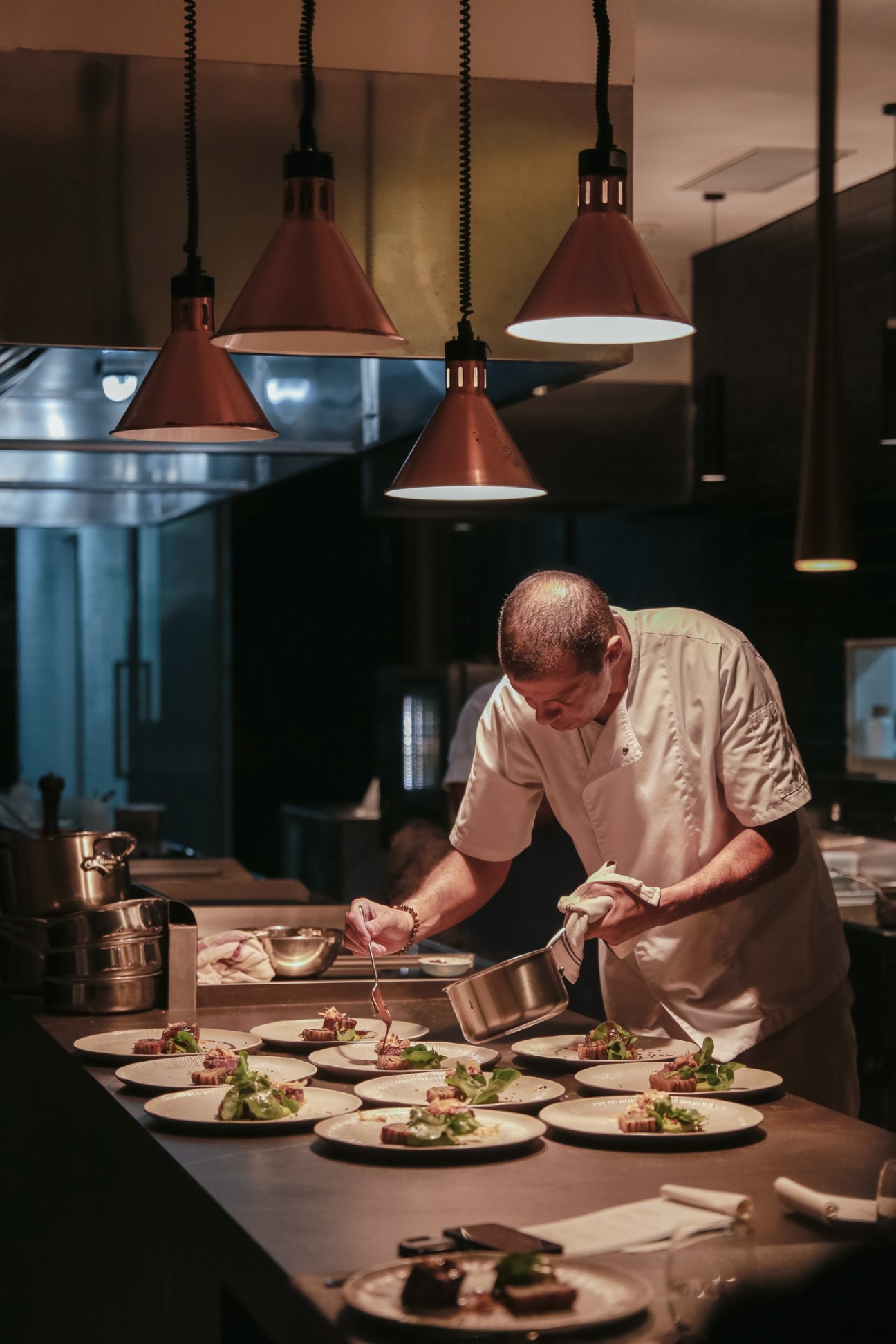
French chef Antoine Levacon crouches and plucks a sprig from a bright-green shrub in the undergrowth and passes it to Monocle. It’s fragrant yet unfamiliar: a scent that’s somewhere between basil and lemongrass. “Kemangi,” says Levacon. “It’s amazing. Now we have it everywhere on the farm.”
Levacon gestures to another patch and a crop of small watermelons resting on the warm, dark earth. Checking on these crops is part of the daily routine of the executive chef of Cap Karoso, a hotel and resort on the island of Sumba, eastern Indonesia. The soil here is fertile and everything from papaya to edamame and even an olive tree grows on this substantial plot of land, which supplies half of the restaurant’s food.
Entrepreneurs Fabrice and Evguenia Ivara came to Sumba on holiday in 2017 and were so taken by the island that they decided to make good on their long-held dream of opening their own resort. “We had always said, ‘After we retire, we’ll build a hotel,’” says Evguenia as we walk along the sand beside Cap Karoso. “When we came here we fell in love and felt that it had a lot of potential. The island was at the tipping point of becoming known.”
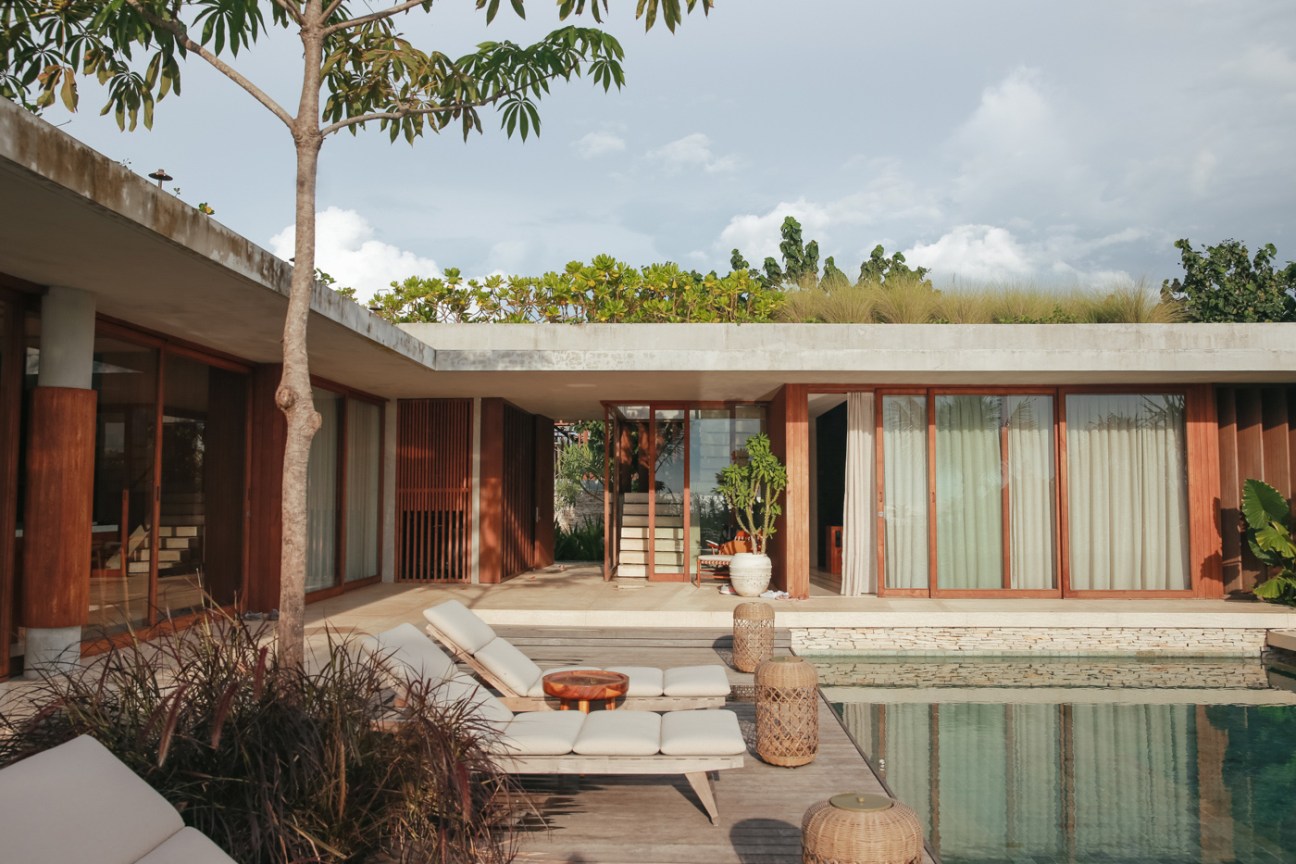


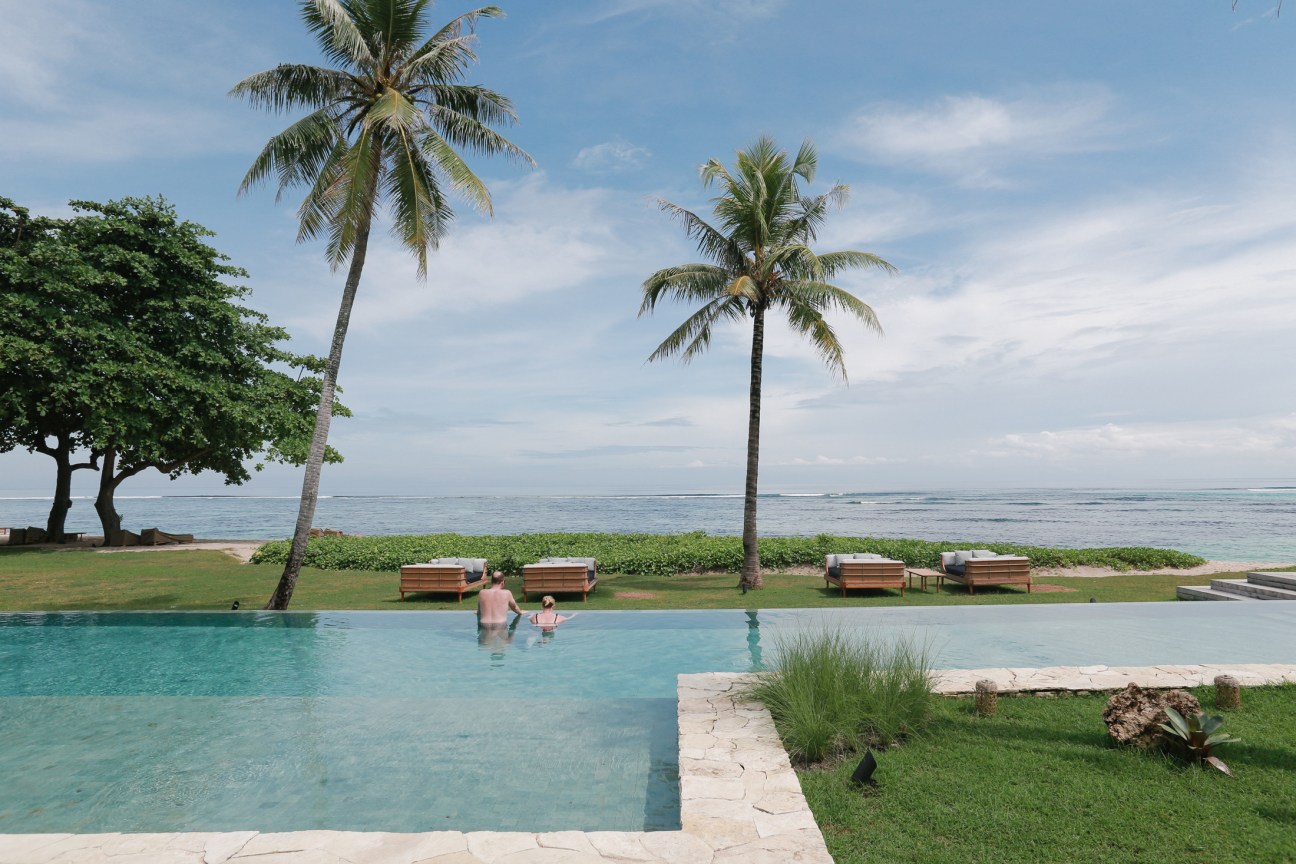
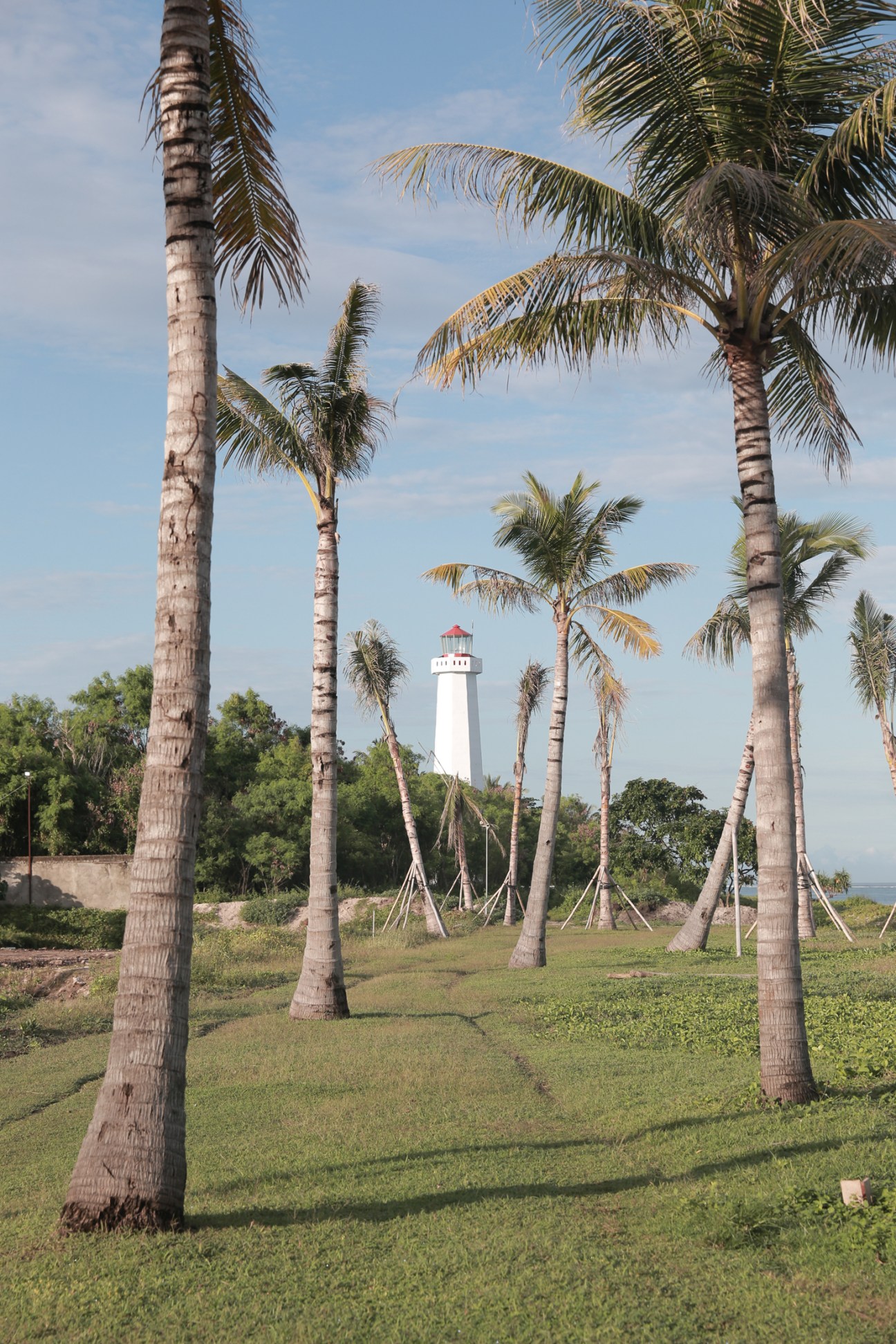
The hotel sits on the western tip of Sumba, with striking views of the Indian Ocean. The water seems to stretch out endlessly; to the west, the closest land is Africa’s distant eastern coast. This sense of remoteness is calming. Getting here requires taking a propeller plane from Bali, then hopping into a car for a drive past cornfields, water buffalo and cliff-fringed beaches.
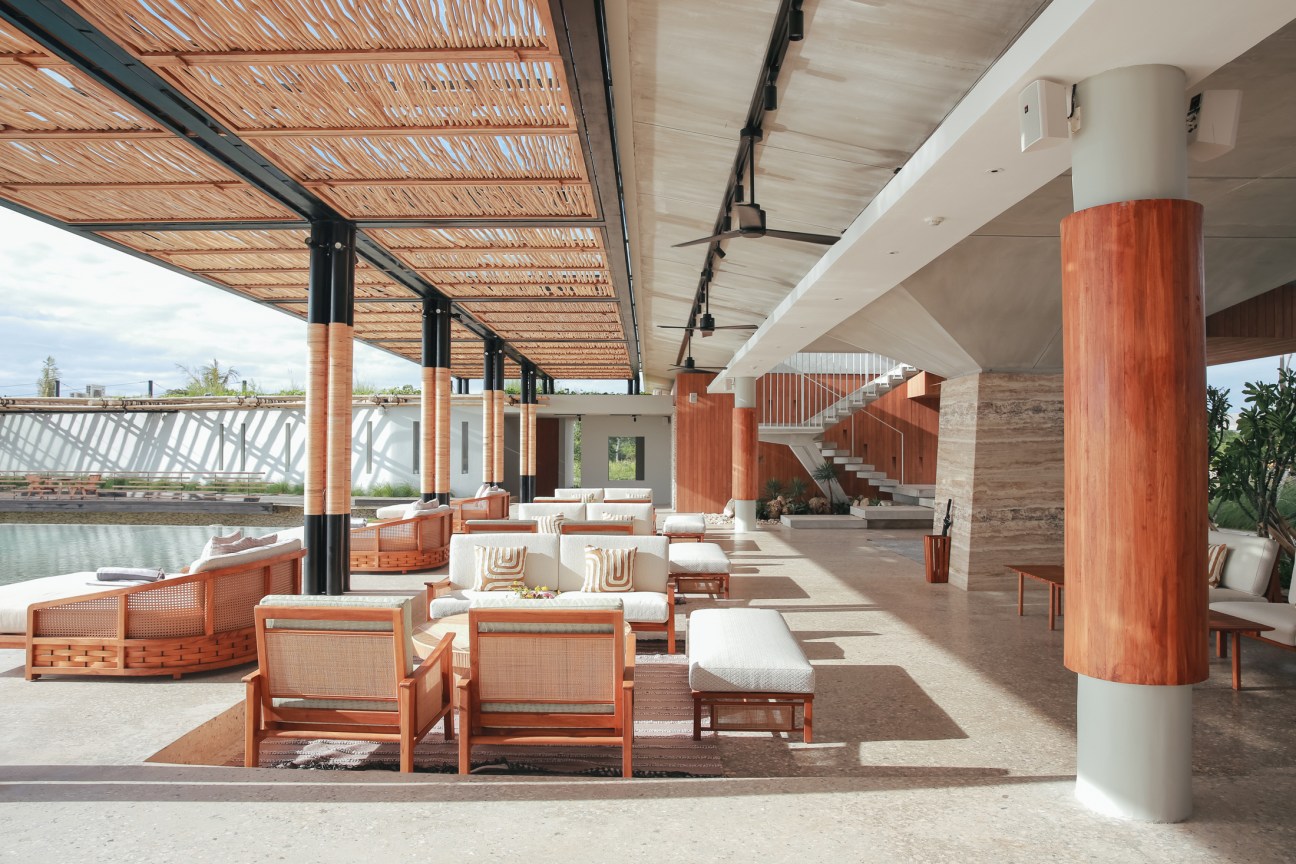
The property’s entrance is understated. It’s only after you’re greeted at the check-in and turn a corner that the full picture comes into view, including an infinity pool, a bar overlooking a white-sand beach and the vast ocean. “We worked on creating this little unexpected moment,” says Evguenia with glee.
There are 44 rooms and 20 villas, all with private pools. Bali-based GFAB Architects gave the resort a terraced layout in a nod to rice paddies, making it fit in well with the landscape. The warm-toned interiors are trimmed with wooden furniture made by Indonesian craftspeople and almost everything in the rooms is bespoke, including the teacups from Bali’s Gaya Ceramic and the French cushion fabric. The owners picked the novels and nonfiction books on the shelves. “Every night, people stay up late, drinking and talking, then they meet the next morning at breakfast,” says Evguenia. “Friendships and interesting discussions arise. Our guests connect and exchange ideas. We want to have a community here.”
capkaroso.com
Monocle comment: Take some time off. It’s important to decompress at least once a year. And if you can do nothing somewhere spectacular, then do – your health and your work will benefit.
The Florentine art residency and hotel fostering creativity in a Renaissance palazzo
Creativity is the lifeblood of cities but in Florence, where its Renaissance past looms large enough to overwhelm the present, contemporary culture needs some champions. This is why the art residency and hotel Numeroventi is fostering a community of artists, designers and musicians from around the world – the city’s historically creative spirit revived in the 16th-century Palazzo Galli Tassi.
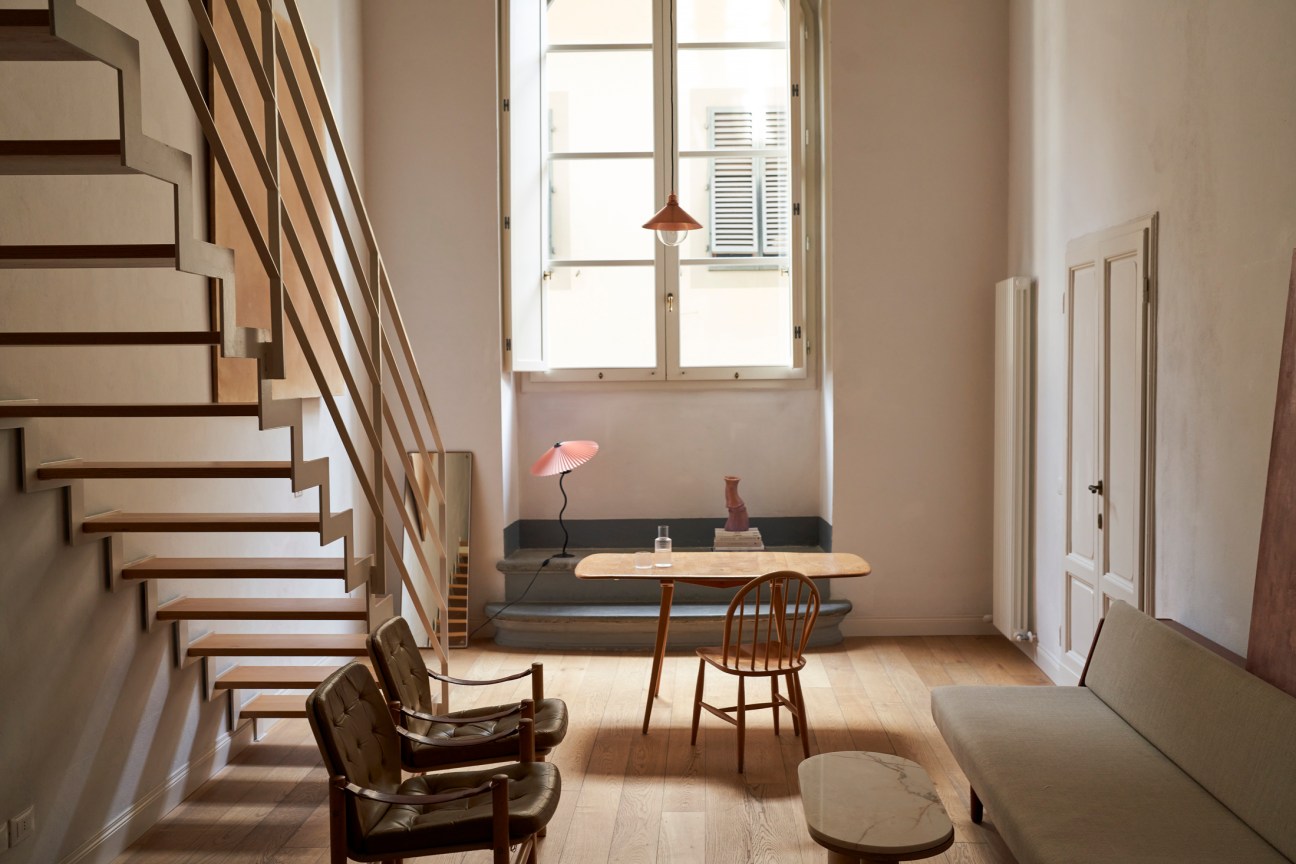
Numeroventi was established by Martino di Napoli Rampolla, who transformed this noble residence into a design destination in 2016. Gradually clearing out the accumulated detritus and remodelling each floor, he filled the centuries-old rooms with icons of modern design and new works by residents, transposing influences of Scandinavian and Japanese interiors to this grand Florentine palazzo.
“Making another Airbnb out of this place would have killed me,” says Rampolla. The time he spent living abroad after university, in Barcelona, Ghent and Tokyo, showed him how vibrant, artistic cities could give a “feeling of participating in something bigger than my own small life”. “I had the need for a sense of belonging and I wanted to create that for others,” he says.
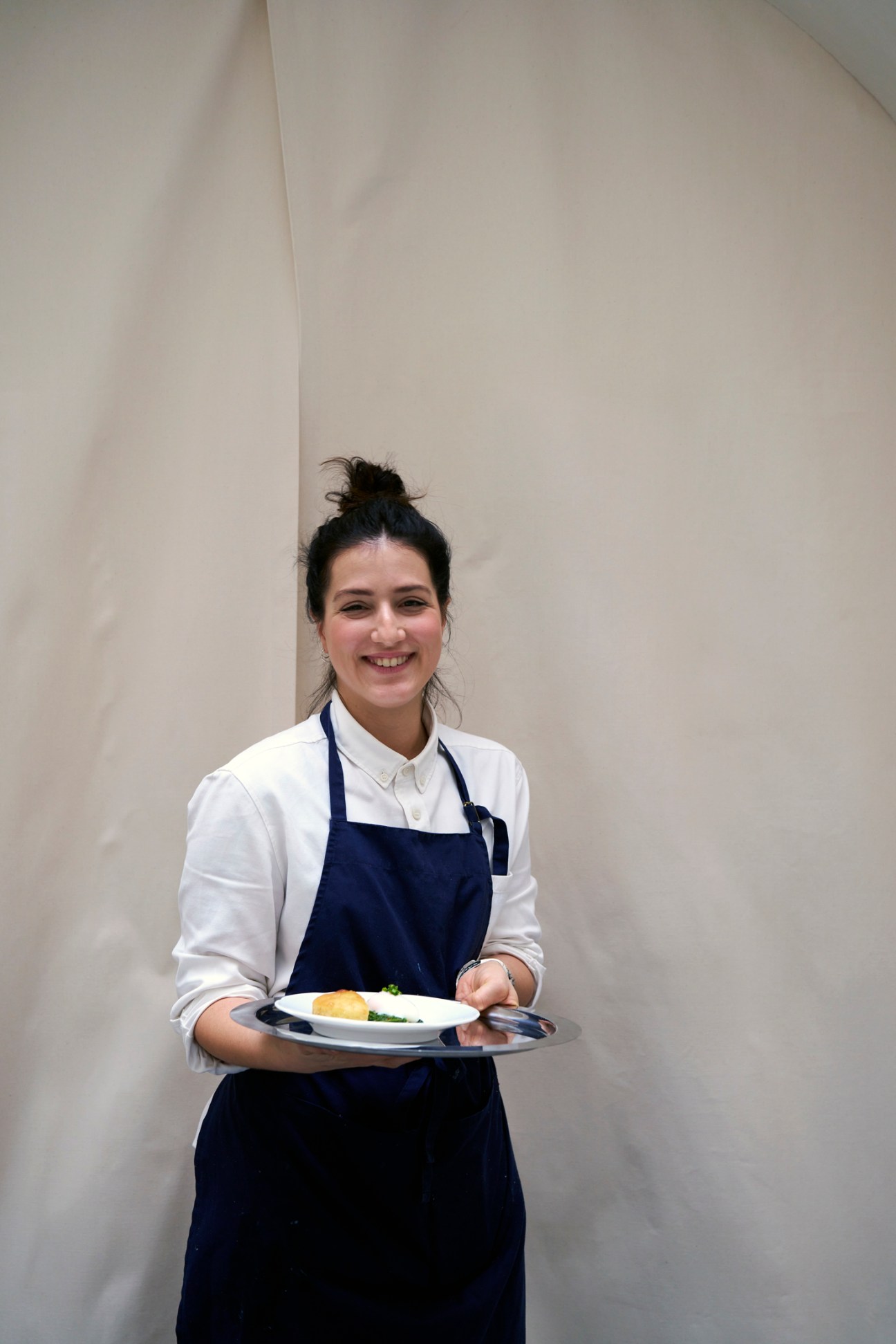
Numeroventi is buzzing with preparations for a new exhibition when Monocle stops by. Recent collaborators have produced a series of works still on display in the ground-floor gallery rooms, with a bullfighting ring and hand-carved wooden spectator seats crafted by South Korean designer Minjae Kim and fantastical paintings by Samuel Guerrero from Mexico City. In the palazzo’s arch-lined courtyard, facing a 1659 marble statue of Hercules and Iole, New York-based artist Gala Prudent has built a twisting ziggurat from local clay bricks. Meanwhile in Numeroventi’s lounge, the young team, which includes a full-time chef, rushes about lighting pillar candles and sticks of palo santo, arranging wine glasses and silverware to prepare for the day’s brunch and inauguration party.
Artist Kasia Fudakowski eyes one of her bulbous glass sculptures as it is wired up to hang mid-air, floating above a long table arrayed with the other works she has produced during her residency. Based in Berlin, Fudakowski has used her time in Florence to imagine these shapes but also to make them with the artisans of a glass-blowing workshop in nearby Colle di Val d’Elsa.
Numeroventi funded and oversaw the production of Fudakowski’s glass pieces. “My relationship with my gallery isn’t like that,” she says. Connecting artists with Tuscan artisan workshops has become increasingly central to the residency’s model. The vicinity abounds in craft for those looking to create in collaboration with artisans, including metal casters, woodworkers, mosaic makers, Carrara’s marble quarries, Volterra’s onyx and alabaster carvers and Impruneta’s ceramics experts. Residencies, with candidates arriving via applications and invitations, are financed by Numeroventi’s hotel operations, with support from the Castello dei Rampolla winery run by Martino’s family in Chianti, which also sponsored the palazzo’s refurbishments.
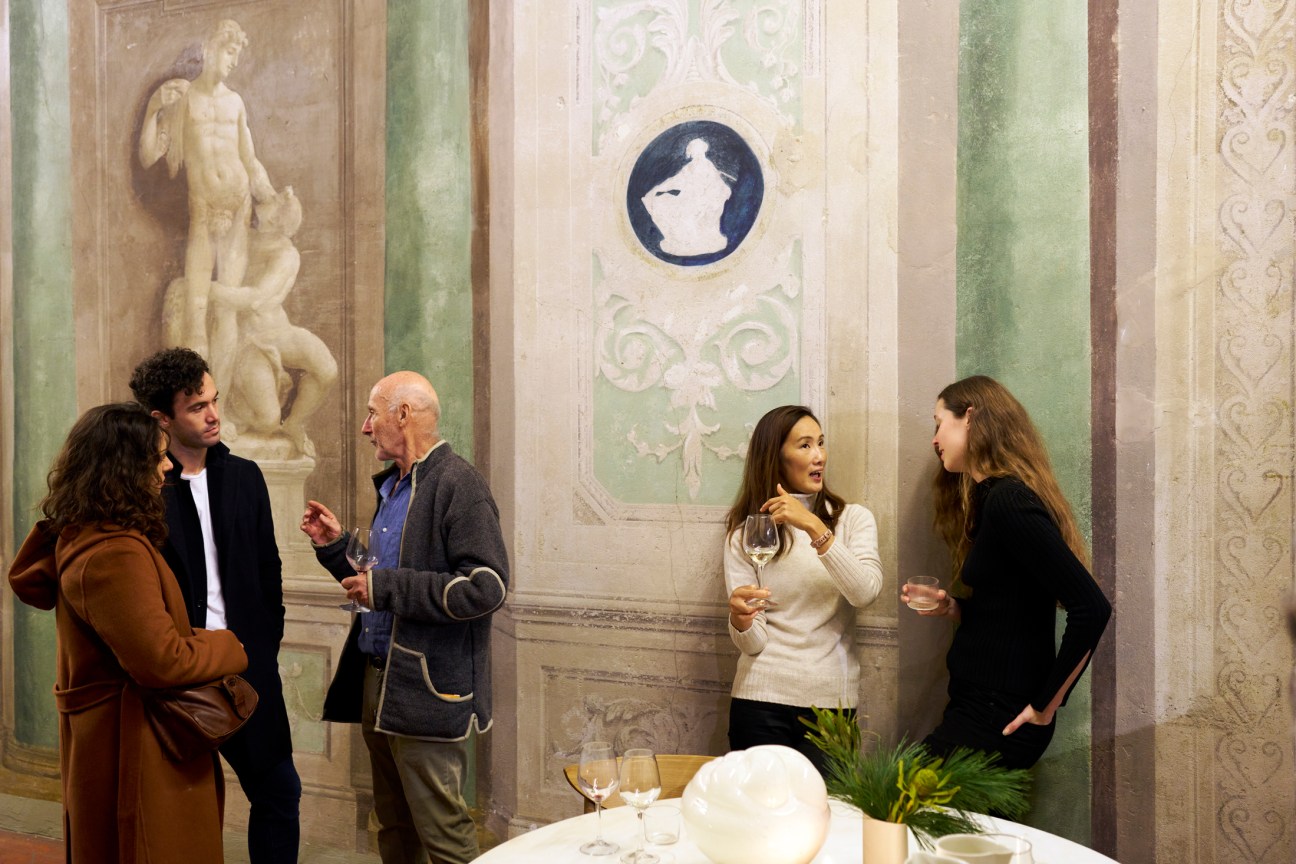
“The focus here is on experimenting,” says Arianna Iandelli, Numeroventi’s gallery manager, who previously worked in a commercial gallery. “We’re involved from the beginning, getting artists and designers to go beyond what they’ve done in the past. And the space itself helps. It’s not a white-cube exhibition room or a blank, white studio to work in – it’s Numeroventi.”
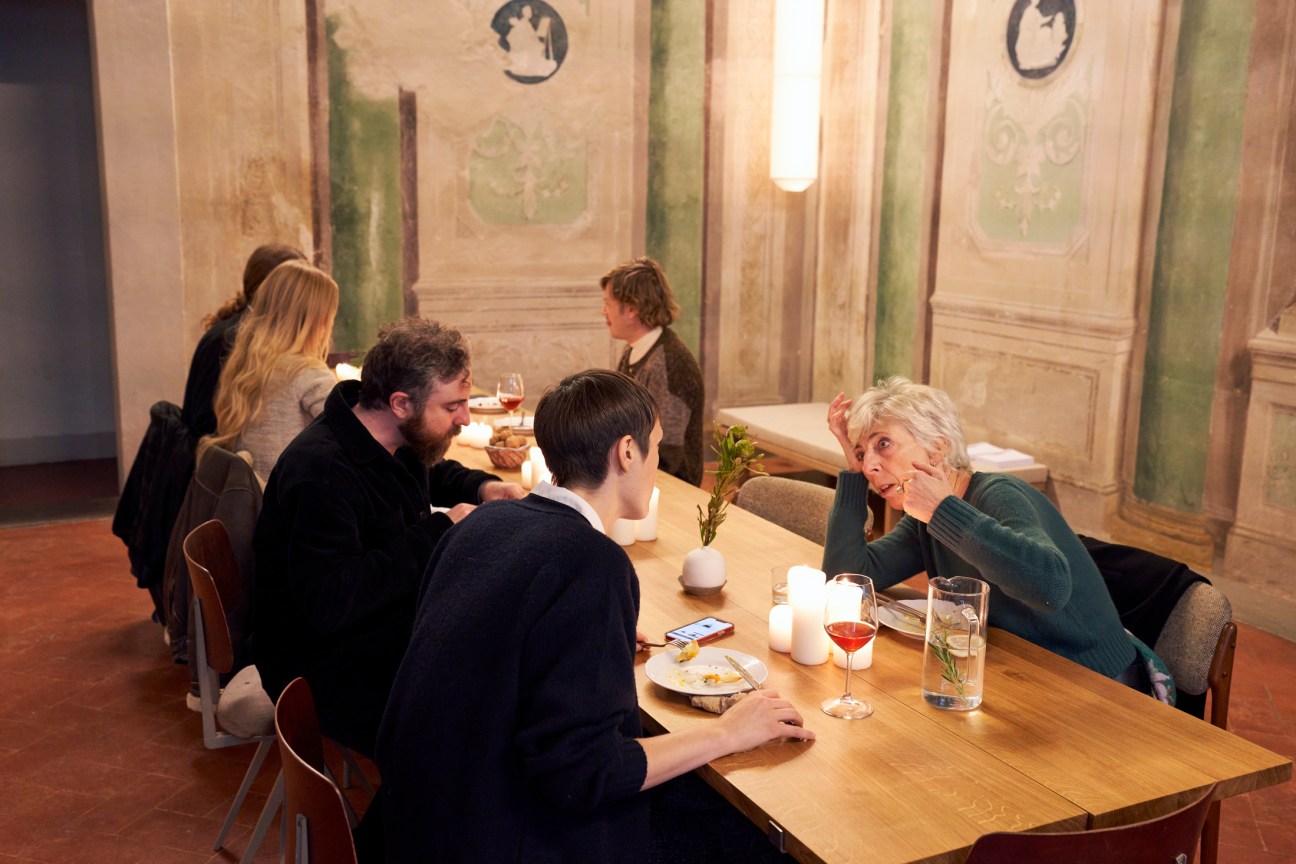
The galleries offer a platform for the fruits of the residencies and open up the palazzo to the Florentine public which, after the brunch for special guests, crowded into the palazzo to see the latest works on view. “This team guides you to greater depths in your practice,” says Maya Dikstein, a Brazilian artist who in her own previous residency at Numeroventi turned deconstructed pianos into tapestries of colourful threads that were played by dancers. “It’s like travelling. If you have the right local guides, you’re able to go deeper than a tourist who can only scratch the surface.”
Numeroventi is a favourite getaway for international songwriters such as Dev Hynes (aka Blood Orange), Benjamin Clementine, Lewis Ofman and Christophe Chassol, who have also performed intimate concerts for locals. Today the music residency is taking a more constructive form, offering sought-after tools to work on pieces in a new collaboration with the Vintage Audio Institute, which holds one of the world’s premier collections of rare Italian synthesizers from the 1970s and 1980s.
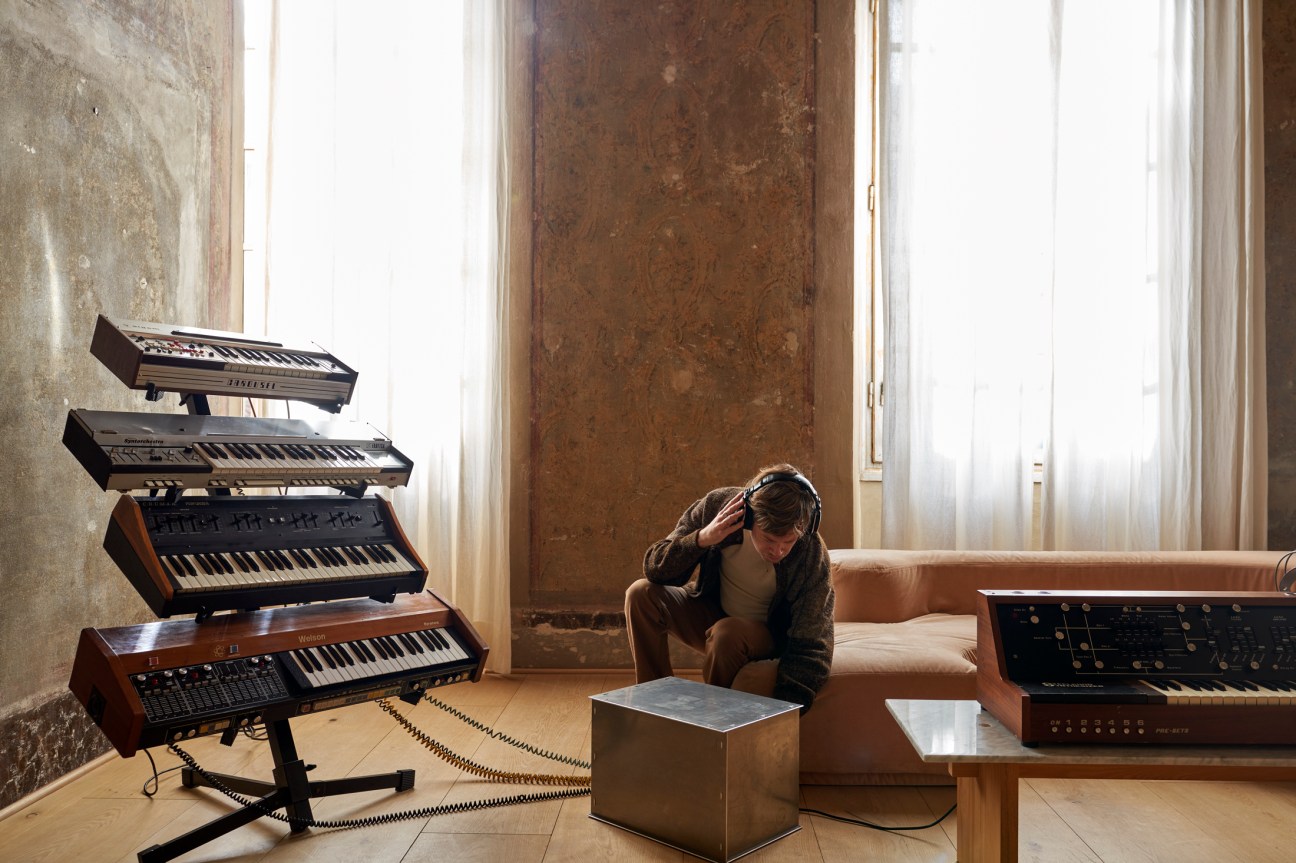
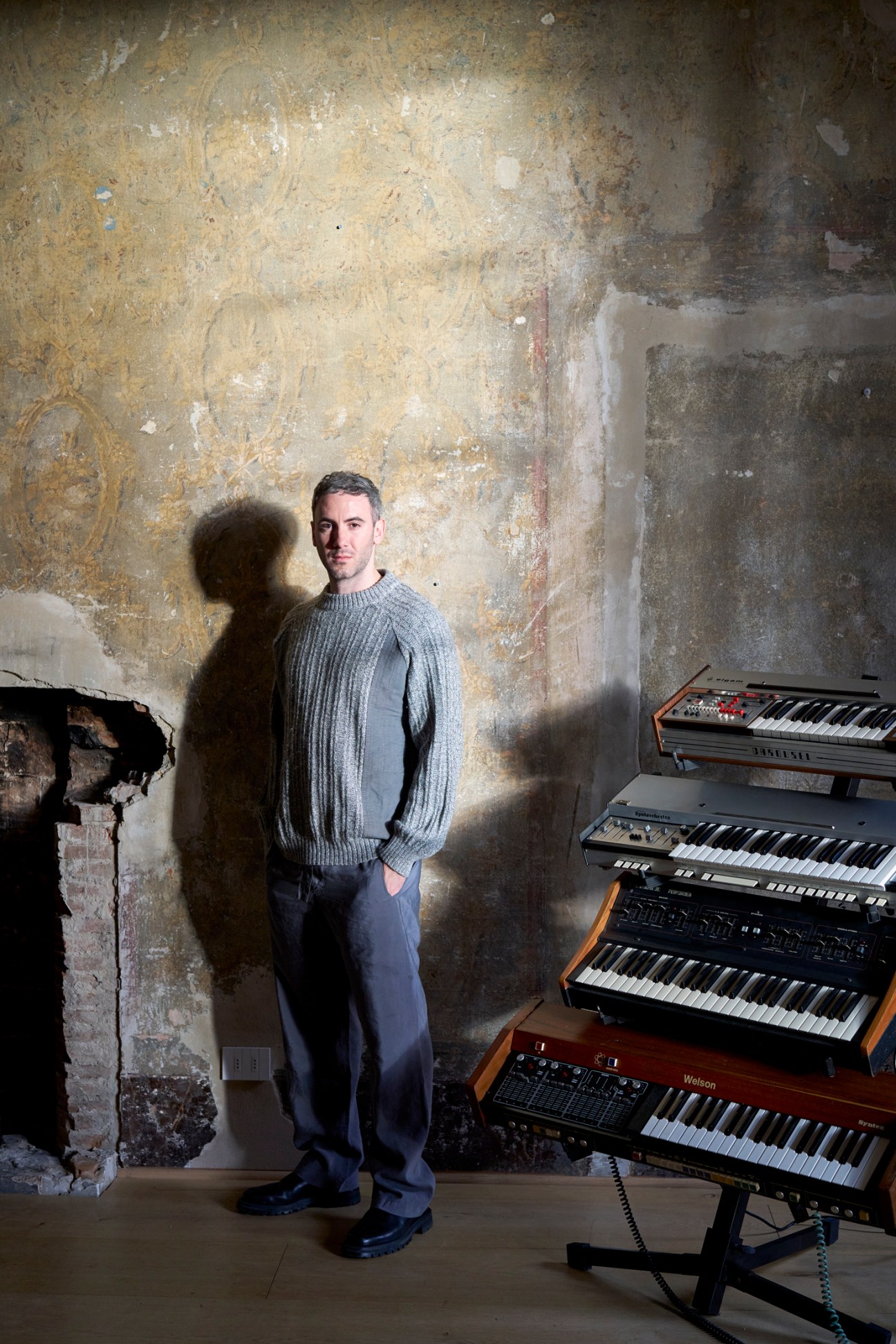
On the day of the opening, a slew of the machines are set up in the top-floor loft, a soaring room whose 17th-century floral-painted walls were only revealed in a recent renovation. “Each machine has a unique character that you’ll never get from digital instruments,” says Pontus Berghe, a musician and founder of the Vintage Audio Institute.
The residency for artists, designers and musicians was, says Rampolla, “conceived as a space to explore your imagination far from career demands”. He is plotting more ways to grow, with a tract of seaside land in Brazil for a Numeroventi outpost abroad, and plans for a natural wine bar in-house in Florence. “This city caters to what we already have, to tourists – not to the youth and the contemporary scene,” he says. “But can the future be based on the past?” It’s a rhetorical question. With Numeroventi, it no longer has to be.
numeroventi.it
Monocle comment: Find a creative corner. Surrounding yourself with like-minded individuals and a nurturing environment will do wonders for your own imagination.
Step into atelier Luca Avitabile, Naples’ bespoke shirtmaker
Calling on an expert cloth-cutter shouldn’t be reserved for special occasions or formal suiting. Skilled artisans around the world take commissions for everything from made-to-measure shirts to custom-made gloves, ties and footwear designed to last a lifetime. Booking an appointment with a local tailor or visiting a specialist atelier while on the road is a smart investment that will ensure that you feel good and look your best during professional engagements and social gatherings. The process also opens up opportunities to build relationships with the people making your clothes and to follow the process from beginning to end, a refreshing change from fast fashion and next-day deliveries.
Naples is a city that’s teeming with workshops that produce one-of-a-kind items. You’ll find the best ties at Marinella, expertly cut trousers at Marco Cerrato, elegant leather gloves at Omega and the finest-quality shirts at Luca Avitabile. “A made-to-measure shirt offers almost infinite possibilities and a level of comfort that is hard to get any other way,” says Neapolitan shirtmaker Luca Avitabile, who is part of a tight circle of southern-Italian sartorie offering bespoke shirting for discerning shoppers from around the world.


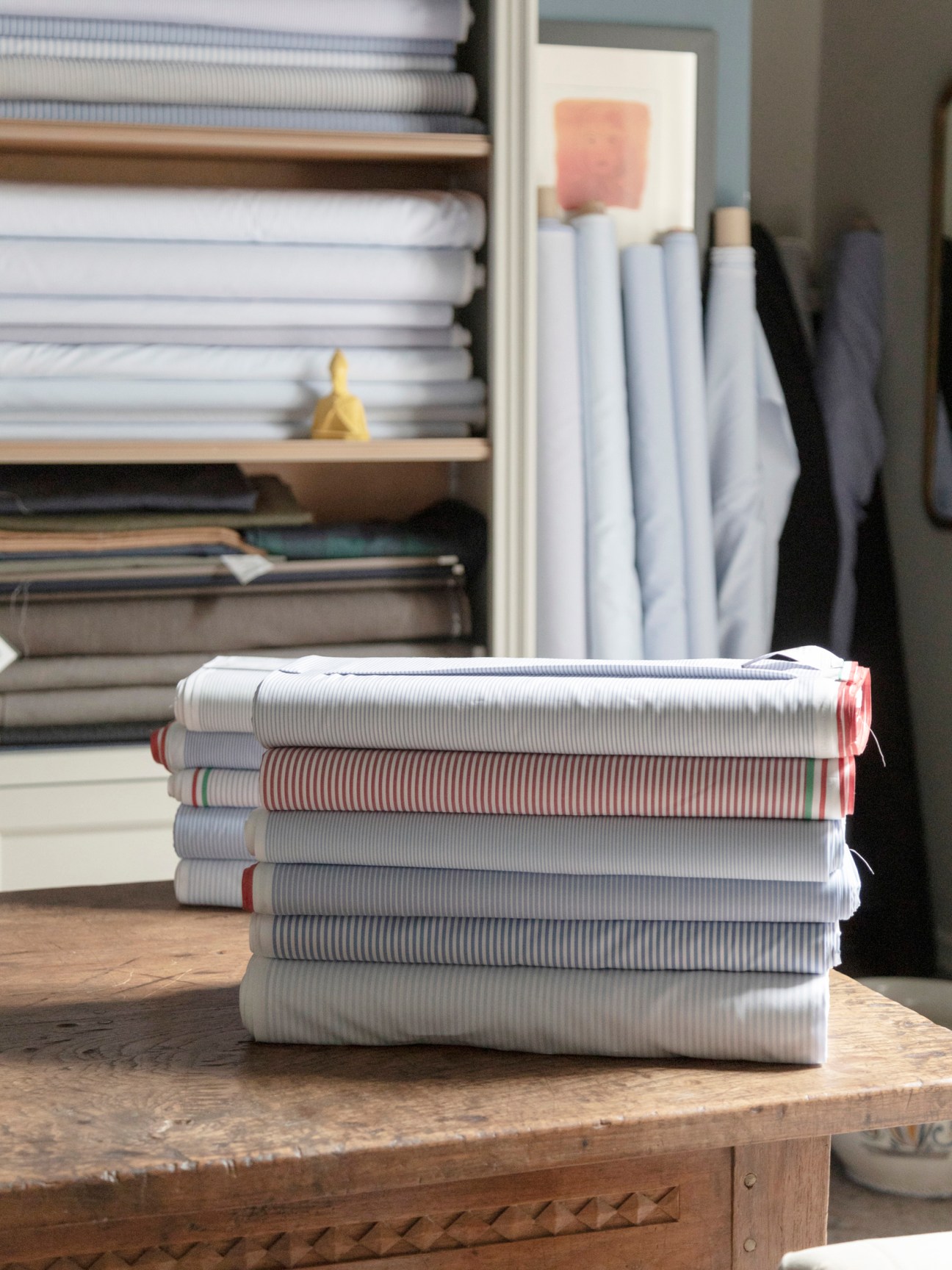
The experience of having a shirt made at Avitabile’s atelier usually starts with a walk along the streets of Naples. Connoisseurs know to steer their way to Via Toledo, a hectic shopping promenade in the city centre. Between the blinking shop signs, they duck through a discreet entryway, walk one flight up an echoing stone stairwell, ring the bell and step into Avitabile’s terrazzo-floored fitting room. After a cup of coffee and the usual pleasantries, Avitabile will pull out a tape and swiftly start taking measurements. It is a seasoned performance. Avitabile was born into the trade – his father was a shirtmaker, as were his grandparents – and also has a degree in shirt-cutting from the Instituto Secoli in Milan.
The model of the shirt follows the Neapolitan custom of having slightly higher armholes than the English standard. “It allows for a snug fit without sacrificing comfort,” he says. Then it’s time to get creative and choose from an array of options: the shape and stiffness of the collar, the type of cuff, the question of front pockets. In Avitabile’s drawers, there are hundreds of fabric swatches, from striped Carlo Riva twill to Alumo’s soft Swiss cotton or even Japanese denim. And don’t forget the buttons: should the mother-of-pearl be Australian or Tahitian? Though Avitabile works with old-school rigour, his version of the tailored look is relaxed. On most days the shirtmaker wears the Friday polo, sewn from a lightweight piqué fabric, paired with a sharp overshirt. The casual models were introduced in 2020 as part of a ready-to-wear line and have proven to be just as popular custom-made. “Clients who come for a classic shirt usually add a [made-to-measure] overshirt or a polo to their order,” says Avitabile.
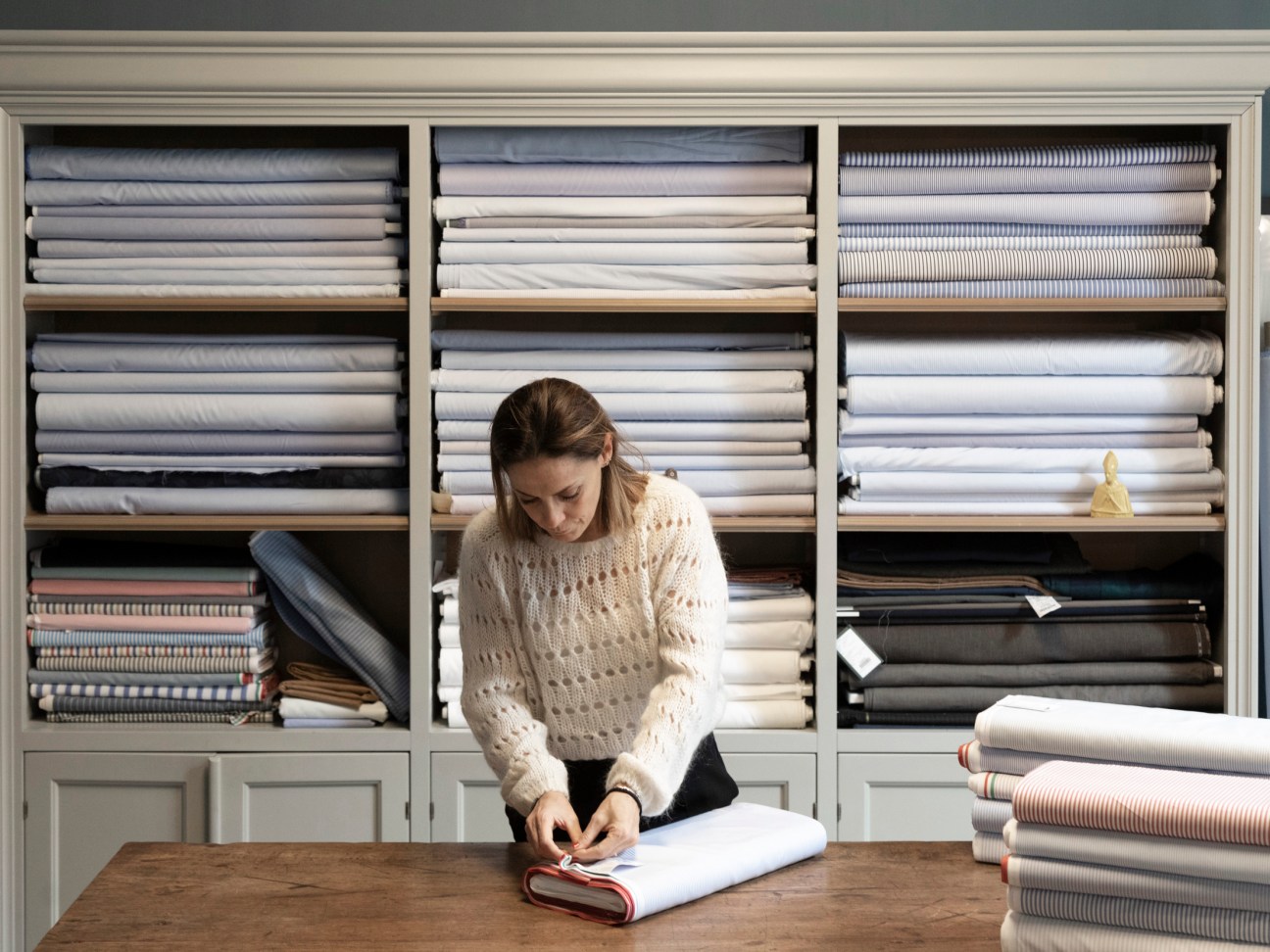
After the introductory appointment, Avitabile sits down to cut a shirt pattern from plain muslin. He then follows this up with a fitting. “This is the most delicate part of the whole process,” says Avitabile, who is a firm believer that there is nothing that can’t be fixed with a few pins and another turn of the sewing machine. “That is my favourite part.”
After the fitting, the atelier is ready to start cutting into real fabric. Within six weeks the finished shirts land on customers’ doorsteps, wherever they are in the world. The workshop archives every customer’s personal shirt pattern, meaning that after your first order, in-person fittings are no longer essential.
Of course, this decidedly old-fashioned process is far lengthier than heading to a department store and picking out a mass-produced item that’s sitting on a shelf. But it’s also a satisfying one that gives you a chance to invest in valuable craft traditions, experience exceptional service and get creative too.
lucavitabile.it
Monocle comment: Fast fashion is convenient but also limited and bad for the environment. Having clothes tailored puts you at the centre of the process – and the outcome. The result? A wardrobe that you’ll love for a lifetime.
Spaces that inspire: Exploring seven architecturally unique places around the world
1.
Somewhere to read
Dipòsit de les Aigües
Barcelona, Spain
Water is calming. It’s appropriate then, that the meditative confines of Dipòsit de les Aigües, which hosts the main library at Barcelona’s Universitat Pompeu Fabra (UPF), are in the vaults of a former reservoir. The structure, which dates from 1874, was originally built to store water for nearby Parc de la Ciutadella, the largest park in Barcelona. Designed by architect Josep Fonsterè (with assistance from a young student named Antoni Gaudí), the interior is defined by monumental pillars that support the arched ceiling.
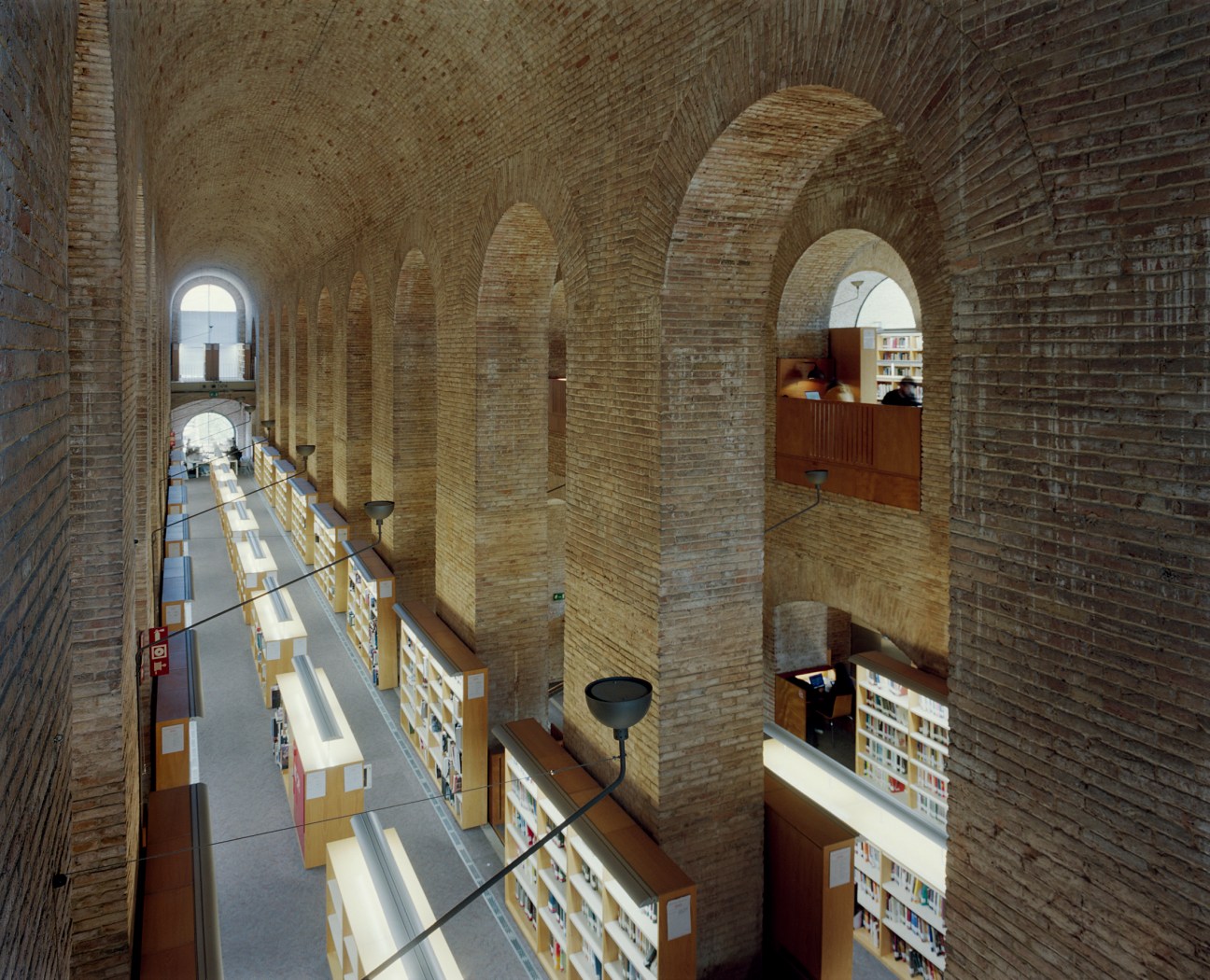
Over the course of the building’s life, it has been used as an exhibition space, an archive and a car park for the city’s police force until, in 1992, it became the property of UPF. After its acquisition, the university gathered a team of architects to develop a sensitive proposal for a new library in the historic vaults. Architects Lluís Clotet i Ballús and Ignacio Paricio i Ansuategui, of Barcelona-based studio Clotet, Paricio and Associats, won the commission and stripped the building back to its bare structure, preserving the historical brickwork. The duo then used prefabricated scaffold-like structures to create tiered floors along the edges of the structure while leaving the central nave at its original level.
It’s an arrangement that can be disassembled and feels more like a furniture fit-out that complements the building and enhances its original value, rather than an imposition on the historic structure. This is an architectural move that has also created a variety of atmospheres within the space, catering to the varied needs of its users. The powerful and open central space is an inspiring environment in which to read, while the cosy corners on its tiered levels are ideal for writing.
“What is surprising is that a structure that seems, at first sight, to be alien to the needs of a library has in fact proved to be the perfect building,” says Anna Magre, director of Biblioteca de les Aigües. The result, she says, is a library that has a monastic quality, where one can find solace from the hustle and bustle of the Catalan capital.
2.
Somewhere to reflect
Paul-Gerhardt-Kirche
Berlin, Germany
One of the most poignant examples of postwar reconstruction in the German capital stands in the southern district of Schöneberg, courtesy of long-defunct city practice Fehling+Gogel. Its jagged concrete spire is visible from afar, the Paul-Gerhardt-Kirche has long flown under the radar; visitors who press down its formidable brass door handle often have the brutalist space all to themselves.

Part of Schöneberg’s old Protestant parish, the church was built in 1962 to replace a large art nouveau original that was destroyed in the war. It now stands next to a surviving 18th-century village church and, whereas the quaint elder sibling is pink-washed and upright, the béton brut Paul-Gerhardt-Kirche has barely a straight angle. Inside, the pews are placed on two sides around the altar, in a layout reminiscent of a concert hall. Indeed, the interior was modelled after the Berliner Philharmonie and it has acoustics to match.
The Paul-Gerhardt-Kirche remains in active use by the community: its choir has swelled to more than 100 members, and it is home to Berlin’s Japanese and Central African congregations. Among the parish staff, the unconventional architecture has always divided opinion. “I am one of the few who actually like it,” says Carola Dieckmann, the church sexton. She appreciates the spartan but tactile materials, the soft light falling through windows on three sides, and the communal feeling that the asymmetric space creates. “You have the sense of being enveloped by people,” she says. Such a sensation is rare in Christian churches, where the architecture is less about building a sense of community on Earth and more focused on a sense of reverence and awe for a deity above. But in Berlin the result is a building that inspires people to connect with their fellow man.
Even so, Dieckmann admits that upkeep of the heritage-protected building is a headache. She points to the milk-glass window above the entrance, which obscures the traffic outside while letting in a misty light. When one pane cracked, the parish had to track down the only workshop in Germany that could manufacture the right glass – for a six-figure sum. Twice, the new window shattered before it could be installed. Resorting to another type of glass would have lost the church its listed status. “We said we would give it one last chance before we give up,” says Dieckmann. Call it luck or divine intervention, but on the third attempt, the glass made it into place intact.
3.
Somewhere to listen
Teatro Regio
Turin, Italy
The regimented 18th-century façades of the buildings flanking Turin’s Piazza Castello give little away in terms of what hides behind them. Indeed, it’s very much by design that the Teatro Regio – renovated to the plans of eccentric mid- century architect Carlo Mollino in the early 1970s – is still so ravishingly surprising today.
“Whereas the exterior might be in keeping with the historic surroundings, the interior is anything but traditional,” says Laura Milan, an architecture historian and Mollino expert. With its quadruple-height foyer crisscrossed with concrete walkways, transparent escalators, dazzling brass light fittings, and with acres of red carpet throughout, the opera house is quite a spectacle. And that’s just the entrance.
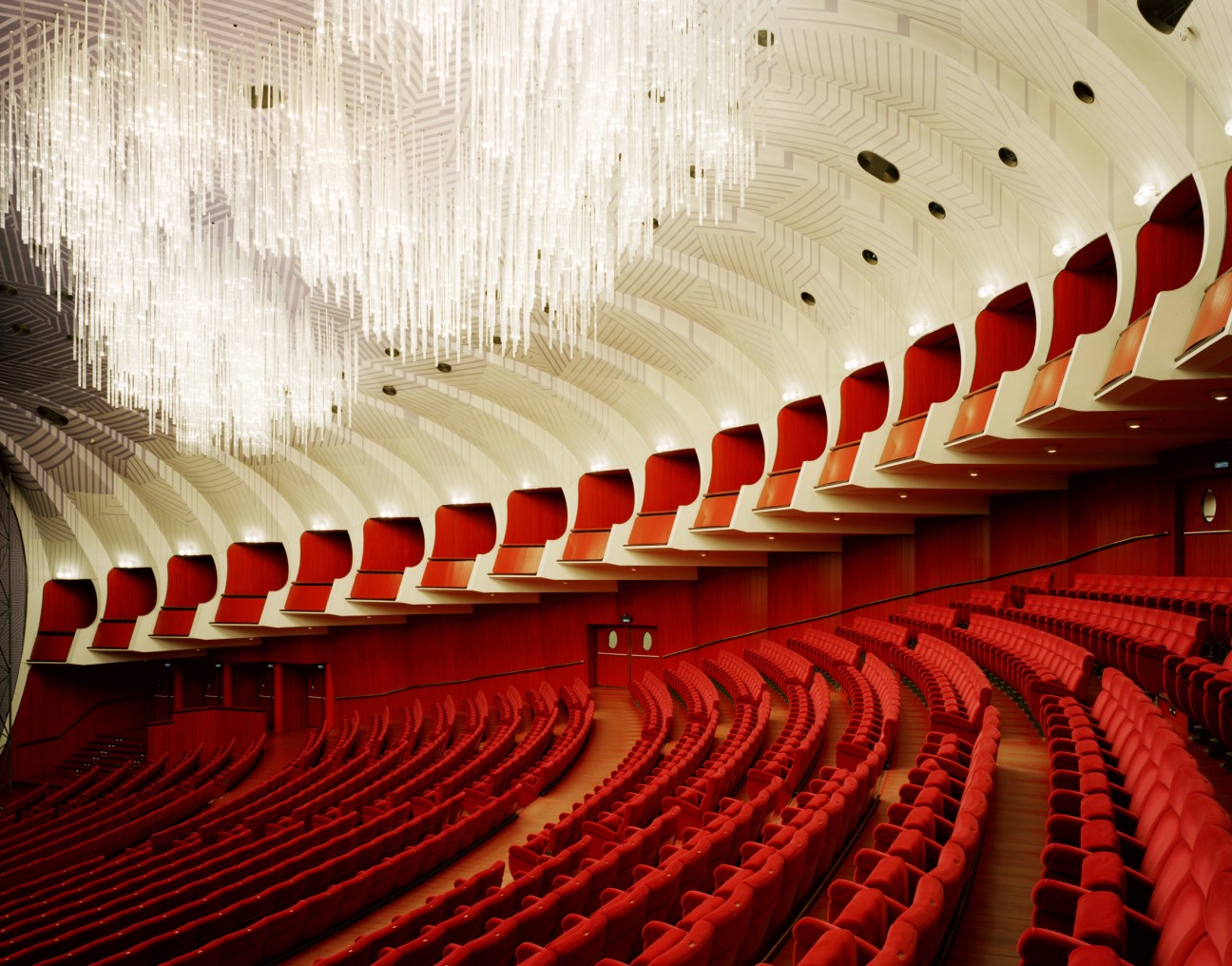
Its opening night in 1973 (when a production of Verdi’s I Vespri Siciliani was staged, directed by Maria Callas and Giuseppe Di Stefano) came after decades of anticipation, says Milan, who holds a PhD from Turin’s Politecnico, where Mollino himself taught. The original structure, an opulent affair built in 1740 to the designs of rococo architect Benedetto Alfieri, burned down in 1936. War-damaged and with other priorities, Turin was left without an opera house for almost 40 years. But beyond that impressive foyer, Mollino’s spectacular auditorium must surely have been a sight worth waiting for.
“Gone was the opera house all’italiana,” says Milan. Instead of boxes arranged in a horseshoe, Mollino designed a vast auditorium with seats sloping down to the stage, while elegant balconies add glamour and hundreds of translucent Perspex tubes create an unforgettable chandeliered ceiling. The resulting hall is mesmerisingly modern – and it’s these features that make an evening at the opera here so breathtakingly distinct from any other performance experience.
A fixation on the forms of modern technology combined with the use of sumptuous materials, Mollino’s designs are a juxtaposition, like the Turin that gave birth to him. This noble seat of the Savoy dynasty is as full of bourgeois restraint as it is of the innovative fervour that enabled auto manufacturer Fiat to be founded here. Mollino, son of a successful engineer, had plenty of that rich dichotomy that so characterises the Torinese spirit. An architect, downhill skier, aerobatics pilot and sadomasochism photographer, Mollino’s legacy is hard to gauge given his eclectic output. But taking a plush red velvet seat in his fabulous opera house is surely the best way to consider it.
4.
Somewhere to escape to
Grampians Peaks Trail Cabins
Victoria, Australia
Western Victoria’s Grampians region – also known by its Aboriginal name, Gariwerd – is renowned for its dramatic landscapes, sloping sandstone mountains and sprawling heathland. The best way to take in this landscape is to follow the Grampians Peaks Trail, which links the range’s most famous vistas, and stay at one of its campsites, where there are multiple structures created by Australian studios McGregor Coxall and Noxon Giffen.
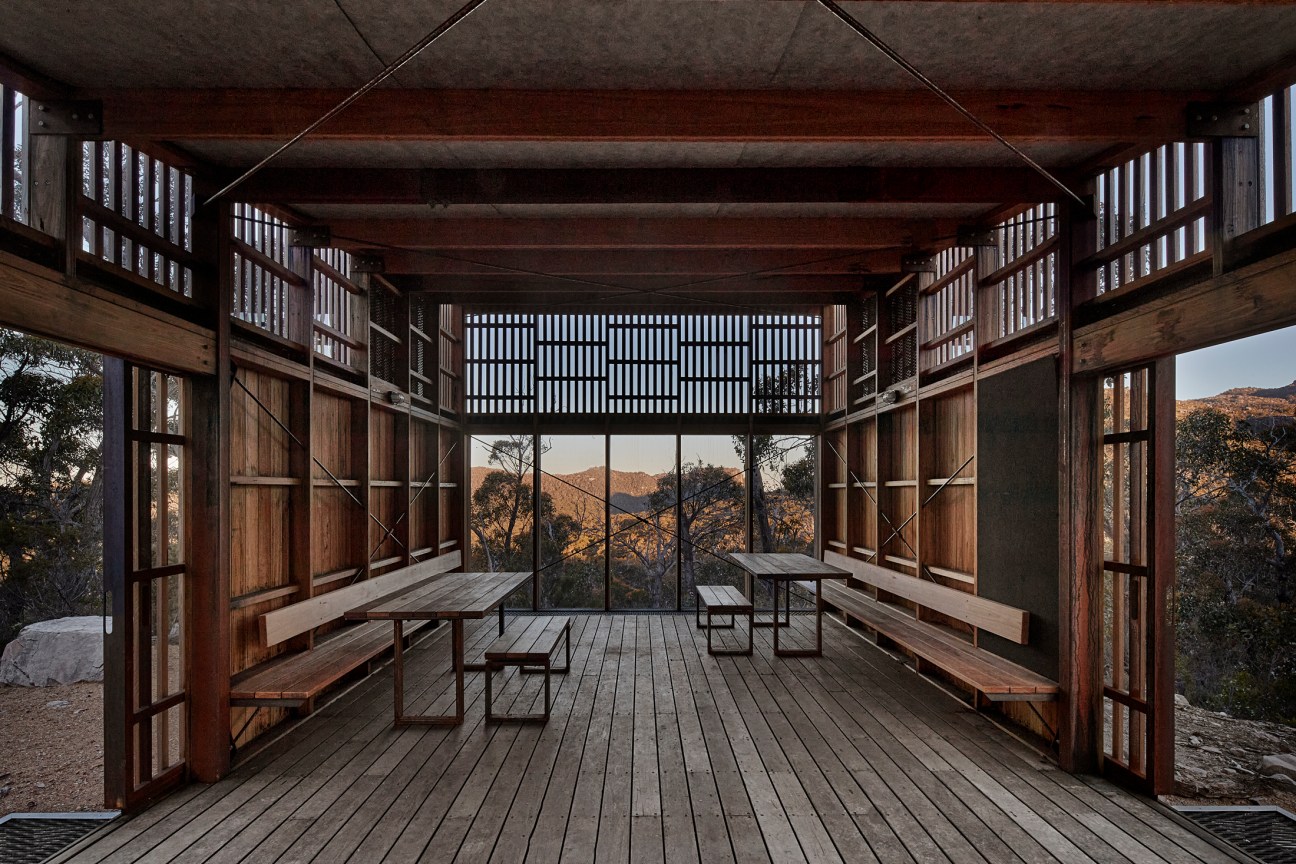
Located at 11 sites along this 160km-long hiking route, the collections of weather shelters, amenities, tent pads, furniture, communal areas and cabins have been designed to discreetly complement the geography and nature. “It’s a pretty strong experience, doing that walk,” says Justin Noxon, co-founder of Noxon Giffen. “We wanted the architecture to be strong enough to honour this majestic and quite powerful landscape but also gentle enough to be part of it rather than dominating it – because the Grampians landscape is the hero of the trail experience.”
The structures have achieved this tricky balance – and that’s what makes them so remarkable. Spending time inside the cabins and shelters increases one’s appreciation for the landscape. This was, of course, by design. Noxon Giffen took direct inspiration from the surroundings – all its structures have sloped roofs, a reference to the Grampians’ distinct peaks. In addition to creating a visual through-line and design family for the entire trail, the roofs also assist rainwater collection. The buildings mimic their backdrop in other subtle ways: in the communal shelters, a clerestory ribbon emulates a gumtree canopy, filtering the light while also providing ventiliation. Many of the materials used were local and recycled, from sandstone and mild-steel cladding to silvered and bushfire-charred gumtree timber.
It is architecture that entices people into the landscape. Those considering a walk along the route can navigate and provision themselves or opt for a short, catered guided tour, providing access to exclusive private cabins. These huts are framed by timber battens and wrapped in a translucent skin, which diffuses soft, mottled light. Inside, there are beds, mattresses and little else. There’s nothing to do but reflect, steep in the serene mountain views and connect with your fellow hikers. “Everything about the architecture is gentle, restrained and part of the landscape language,” says Noxon. It’s about making a place in this ancient landscape, in harmony with it, that enriches you, your experience and your connection with the trail.”
5.
Somewhere to learn
Gund Hall
Massachusetts, USA
The Harvard Graduate School of Design’s Gund Hall in Cambridge, Massachusetts was completed in 1972 by John Andrews having been approved by the school’s dean, and award-winning Spanish architect, José Luis Sert. Andrews, Australian-born and Toronto-based, designed the school with five floors offset like terracing, in “trays”. A single, sloped and ridged glass roof and sides covers the structure, recalling a greenhouse. The resulting building is a work of grand early 1970s exposed concrete with brutalist tendencies, crowned in glazing.
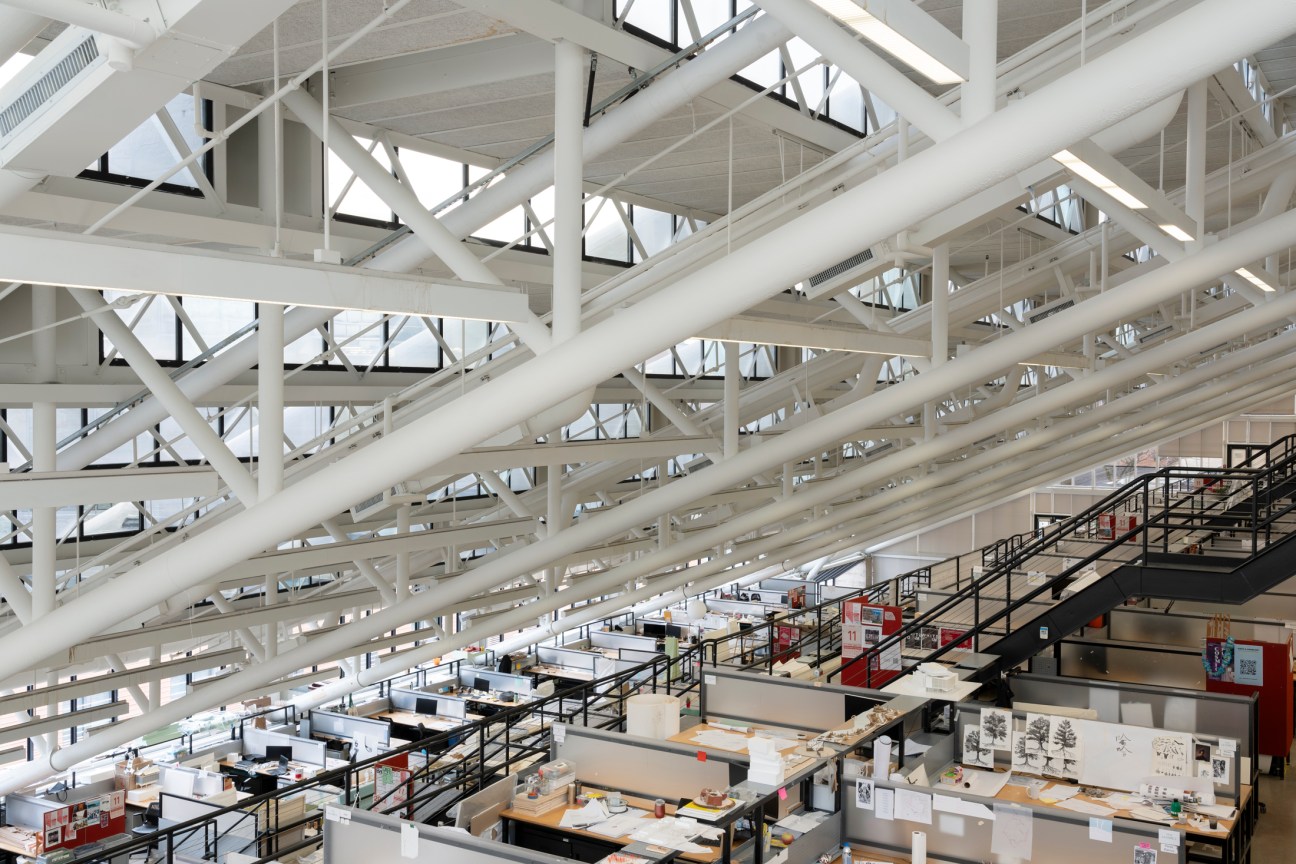
“Andrews was intent on making the studio space the heart of the school,” says Sarah Whiting, current dean of the school, which is commonly known as GSD. And, as students here will tell you, he emphatically succeeded, with the interior landscape a riot of design, from top to bottom. Many GSD students have a desk in the trays. When viewing them from the uppermost fifth tray, looking towards the first, the workspaces appear to be on a mountainside covered by all manner of models, drawings and paraphernalia. The GSD is now home to about 1,000 students and faculty members. The majority are split between three core departments: architecture, landscape architecture and urban planning and design. Much is learned in the building by simple observation, often between design disciplines that in most schools overlap only rarely. “Students feel that they have a cohort,” says Whiting. “The building renders visible what they’re doing and makes a community.”
But while the trays have helped to create an inspiring learning environment, no building is perfect. Famously, Andrews’ design leaks, is cold in winter, hot in summer and entirely unsustainable to operate. A spate of renovations will begin in summer 2024, including new, highly efficient glazing. This hi-tech minimalism comes from “respect for the architecture and architect”, says Professor David Fixler, an expert in architectural preservation and chair of the Faculty Building Committee for the renovation. “At GSD we are leaders in approaching the cutting edge with gusto.”
Yet the building is comfortingly protective of its students. Nooks, back staircases, secret lounge areas at the ends of hallways – there is always somewhere half-hidden to offer refuge. The building itself teaches a core lesson: the trick to much of good design is kindness and an understanding of human scale and needs, even in the grandest or most sublime structures and landscapes.
6.
Somewhere to dine
Casa de Chá da Boa Nova
Porto, Portugal
In architecture, there is no set formula for the perfectly composed space. It comes from trial and error. But Álvaro Siza Vieira, Portugal’s most gifted interpreter of modernism, found one solution early in his professional life with his design of Casa de Chá da Boa Nova, a fine-dining restaurant situated in a seaside suburb of Porto.
Commissioned in 1958, when Siza was just 25, the low-slung structure, which was initially a tea house, invites visitors via a series of steps and landings that lead up to the whitewashed exterior in a gradual procession. Perched a few metres from the Atlantic on a rocky outcrop, the building follows the rugged topography of the site to minimise its artificial profile, save for two mast-like angular chimneys.

Siza used a gently sloped, terracotta-tile roof with a pattern and colour that mimics a nearby chapel. Inside, visitors are greeted by a double- height atrium lined in Afzelia, a red-hued African hardwood, and stairs leading down to a south-facing bar and a west-facing dining room that offers sweeping views of the ocean via floor-to-ceiling windows. To maintain focus on the sea, the roof extends, similar to a ship’s bridge, so that a diner’s gaze goes straight out to the blue horizon. This makes for an ideal pairing with the two-Michelin-starred restaurant’s sea-based menu.
“Our guests have direct contact with the Atlantic,” says chef Rui Paula, who notes that Siza even designed a mechanism to lower the windows to the floor to allow people to enjoy alfresco dining when weather permits. “Our menu revolves around the Atlantic, which is very cold and oxygen-rich, and fish and shellfish from Portuguese waters; this one-of-a-kind location allows us to reinforce this within a beautiful setting.”
The interior, which underwent a faithful renovation before being converted into a restaurant in 2014, reflects Siza’s obsession with detail, as he designed every aspect of the restaurant down to the service trolley and table lamps. A subtle, yet effective decorative feature is the wood slats that protrude from the ceiling in the 20-seat restaurant. For Paula, the conjunction of his finely crafted tasting menu and the rich Afzelia wood, with white walls and abundance of natural light, often leaves patrons speechless. “There is a quiet harmony in the ambience that Siza has created,” he says. “For a chef, you cannot ask for a better backdrop in which to present one’s cuisine. I never tire of coming to work when I have this space and this view to look forward to.”
7.
Somewhere to meet
Fujio
Nagasaki, Japan
Long before high streets were populated with global coffee chains, Japan had its kissaten – independent cafés that offered proper service and a place to sit quietly; some specialised in classical or jazz music, or books. Against the odds, many survive today, offering an experience that could hardly be more different from the conveyor belt we’ve all had to get used to.

Nagasaki’s Fujio opened in 1946 and is now under the stewardship of the founder’s nephew, Tatsumasa Kawamura. There have been gentle updates – this is an interior to savour with earthy colours, gentle lighting and plenty of warming timber – but the basics are the same: a cheery welcome with a glass of iced water and hand towel on arrival followed by excellent coffee and perhaps a warm egg sandwich made with fluffy white bread. Fruit sandwiches are another staple of the kissaten menu and are a particular speciality of this café.
A visit to Fujio is a reminder that architecture is enhanced by the people who inhabit it – in this case, the community in which it is ingrained. Indeed, Fujio is part of the city’s history (it even gets a mention in famed novelist Shusaku Endo’s Sand Castle). As regulars stream in and out, there’s a gentle camaraderie that only a long-time business, in cosy confines, can provide. The Japanese kissaten should be celebrated not just as a retro relic but as a great example of good hospitality. Many of us don’t relish streamed music and our name misspelt on a paper cup. “Kissaten culture is unique,” says Kawamura. “I want to keep it alive.”
The new net-zero fire station carrying the flame for considered civic architecture
Among the civic buildings that anchor an urban setting, from public libraries to neighbourhood police outposts, there’s one urban structure that holds a particular potency for the Canadian architect Pat Hanson, who co-founded her studio, GH3*, in Toronto in 2005: the fire station.
“The fire hall is one of those city buildings that is embedded in a neighbourhood,” she says. “It embodies a community’s sense of security. Even the way in which these buildings are depicted in children’s storybooks captures the excitement at watching the fire engines coming out of the station. And they’re usually built with masonry and stone, which gives them a sense of permanence and creates a feeling of trust.”

It is in that spirit that Hanson approached her design for a new fire hall in a suburban neighbourhood in the Canadian city of Edmonton, in the province of Alberta. “We would never worked on a fire station before, so that was our starting point for what we really wanted to imbue in this building – a little bit of that cultural and social context, as well as how it functions.”
Windermere Fire Station, which opened last July, is Edmonton’s first net-zero building, which means that all of the energy that the complex uses is generated by the building itself. There are 382 solar panels embedded in the long, south-facing sweep of the station’s asymmetrical pitch-roof and an underground geothermal facility, buried 70 metres beneath the complex, heats and cools the building. Any surplus power is sold on to Edmonton’s electricity grid.
The way that a fire station operates, however, made ensuring that the building wastes as little energy as possible a challenge, Hanson says. “A fire hall’s doors open thousands of times during the year. That has a huge effect on the ability to control the amount of energy that escapes, especially in winter.”
Hanson overcame that by replacing the type of doors that are common in fire stations in North America: doors that roll upwards to allow the fire engines to exit. Instead, European-style bi-fold doors were installed. “The speed at which doors open is absolutely crucial and we found that these doors could do that faster.” Minimising the number of windows in the fire engine hall and installing thicker insulation panels in the walls also help to keep the energy in.

The station’s asymmetrical, pitch-roofed silhouette and exterior walls, which are in dark-grey interlocking brick, are playful nods to the residential architecture that will populate the surrounding neighbourhood once its construction is complete. It is also a reference, says Hanson, to the dual function that a fire station has to perform.
“Fire stations are very interesting building types,” says Hanson. “They are basically domestic quarters for the firefighters; while they’re on duty, they live in the fire station. So a portion of it is really like a big house. And then the rest is the kind of technical, industrial and mechanical area where the fire engines are kept. We wanted to get those two spaces to feel architecturally as though they were one. Firefighters are often the first at the scene of an emergency, so they see the worst of everything. It was important to create a feeling of peacefulness and serenity in the domestic quarters. That was key.”
Windermere Fire Station is the latest addition to the city of Edmonton’s burgeoning roster of well-designed civic architecture – an approach to urban design that has caught the attention of procurement departments at city halls elsewhere across Canada. “Culturally, it has made a huge difference across the whole city,” says Hanson. “Architecture has become something that people in Edmonton pay closer attention to. The city is really setting an example.”
Monocle comment: It takes some courage to commission civic buildings that go beyond the banal and dare to be beautiful. When it happens, it is to be applauded – and held up as a benchmark for others to aspire to.
Roger&Sons: Singapore’s next-generation woodworkers
Take one look into the Roger&Sons workshop in Singapore and you’ll know that there is something special about the operation. In place of spit and sawdust is a high-ceilinged space that’s spick and span, with woodworking benches flanked by detailed drawings and handmade objects. To top it off, the workshop is in Jalan Besar, a central neighbourhood known for its cafés and boutiques. Most of the island’s carpenters, in contrast, have plonked themselves around Singapore’s fringe. “In our effort to make carpentry more accessible and less intimidating, we wanted to be closer to people,” says co-founder Morgan Yeo.
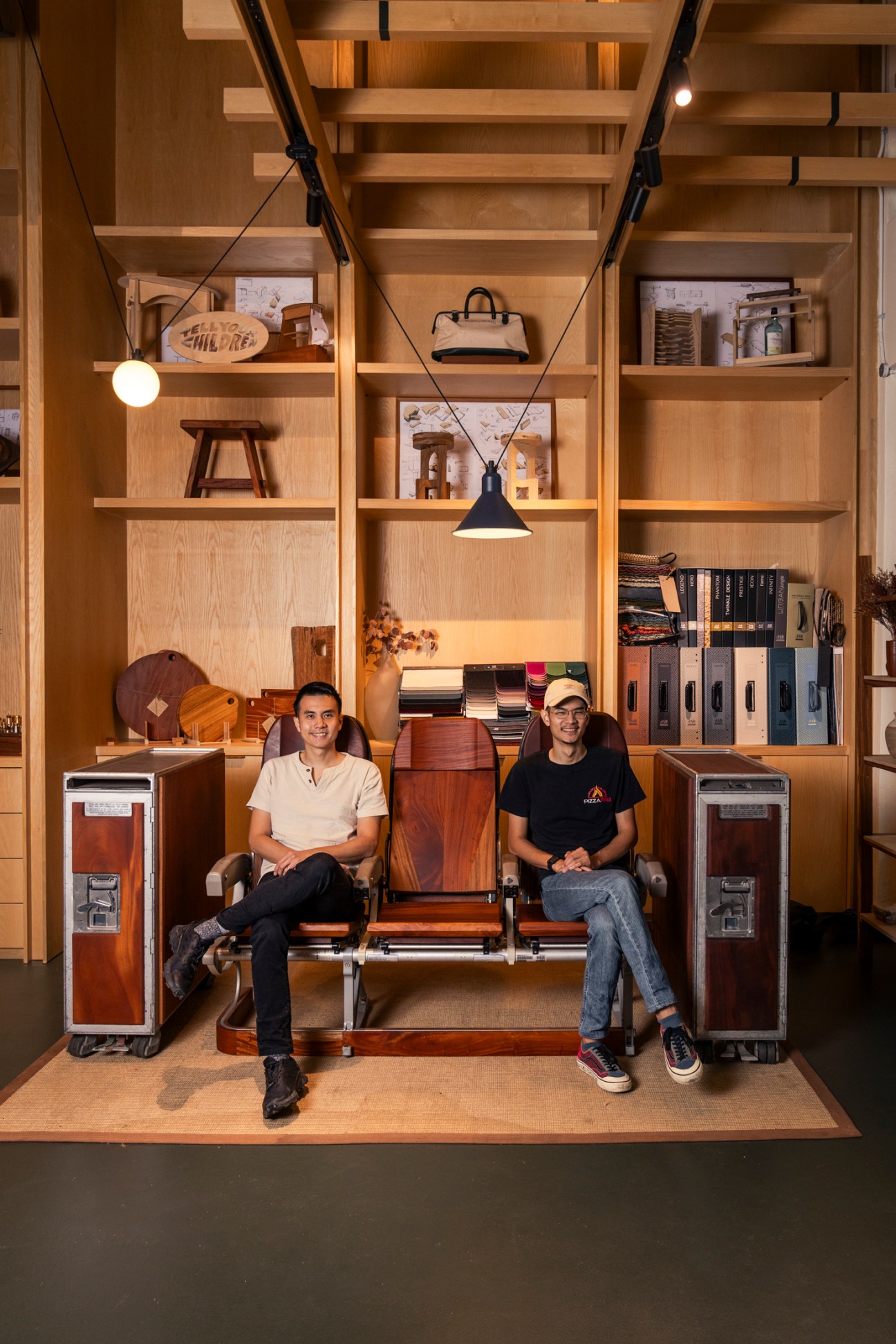
But it hasn’t always been this way. In 2014, Yeo’s father passed away, leaving behind JR&P Industries, a business that made run-of-the-mill furniture, such as kitchen cabinets and wardrobes. “For the past 50 years, the bulk of carpentry work in Singapore was basically nailing plywood with an air gun and applying laminates over it,” says Yeo. Bespoke woodworking in the city-state was a dying trade.
So when Yeo and his two brothers, Lincoln and Ryan, chose to continue their father’s legacy in 2014, they knew that they needed to go against the grain. Rebranding the family firm as Roger&Sons, they buckled down to create custom furniture. “We wanted to take on projects that most local carpenters would reject without batting an eyelid,” says Yeo.
It’s an outlook that is reflected in its portfolio: custom wooden ear cups for headphones and a levitating shaving brush are just two of Roger&Sons’ unconventional projects from the past few years. Such works often start from a personal place, as their clients are looking for the perfect solution to a specific problem. Over the course of a few weeks or even months, Yeo learns about their needs, makes prototypes, then pours himself into making the object. He sees Roger&Sons as a kind of guide who joins its client on a journey to create something that means the world to them, whether that’s an oak wine cellar for a homeowner or tables for Italian restaurant Fico.
Sustainability rests at the foundation of Roger&Sons. This is beautifully reflected in The Local Tree Project, Yeo’s ground-up initiative that salvages trees that have been felled for urban development and are considered waste. “We have stockpiles of abandoned logs in Singapore’s sawmills waiting to be turned into mulch or pallet wood, yet we’re still importing so much wood from overseas,” he says. His team extends the lifespan of this discarded timber by using it in Roger&Sons projects. Since founding the programme in 2019, it has refashioned local rain trees into benches for Singapore’s new aviary, Bird Paradise, and created a public playground in the city’s Tanjong Pagar neighbourhood using reclaimed African mahogany. In fact, 80 per cent of Roger&Sons’ work today involves felled wood from Singapore. Now other woodworking companies are open to exploring the use of these sources – all thanks to Yeo.
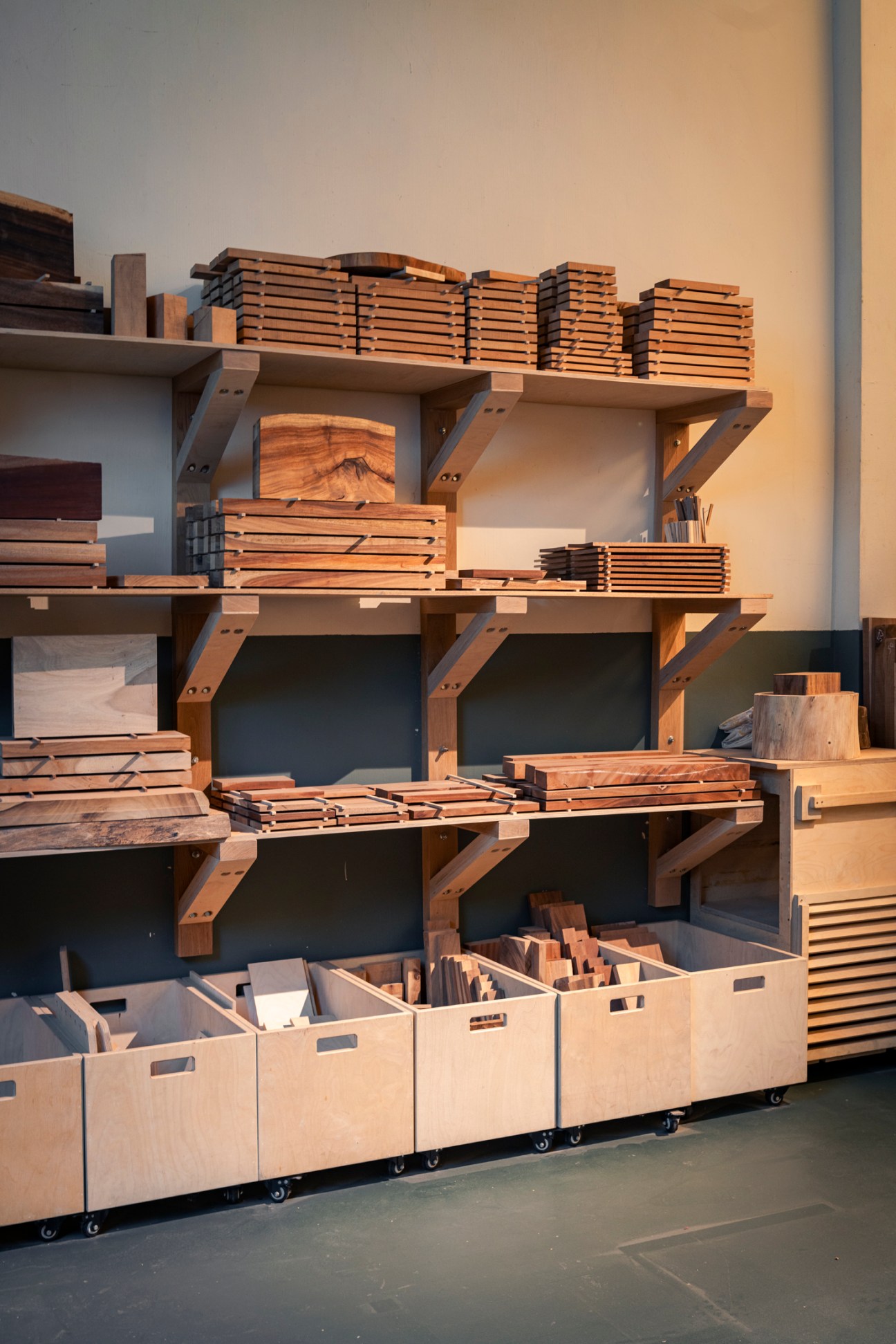
What drives Roger&Sons is Yeo’s restless pursuit in levelling up his craft. Spend some time with him and you’ll quickly learn that he never stops thinking about new ways of woodworking. “How we make a box today and how we make it in 10 years’ time will be different for us,” he says. This spirit of openness and inquiry has led him to collaborate with like-minded vanguards, even those outside woodworking. For example, he partnered with Semula, a company that processes plastic bottles into reusable high-density polyethylene, to create bespoke stools for Creamier, a local ice-cream joint. Recycled milk bottles from the shop were used to form plastic chair tops, while the legs were made from restored African mahogany.
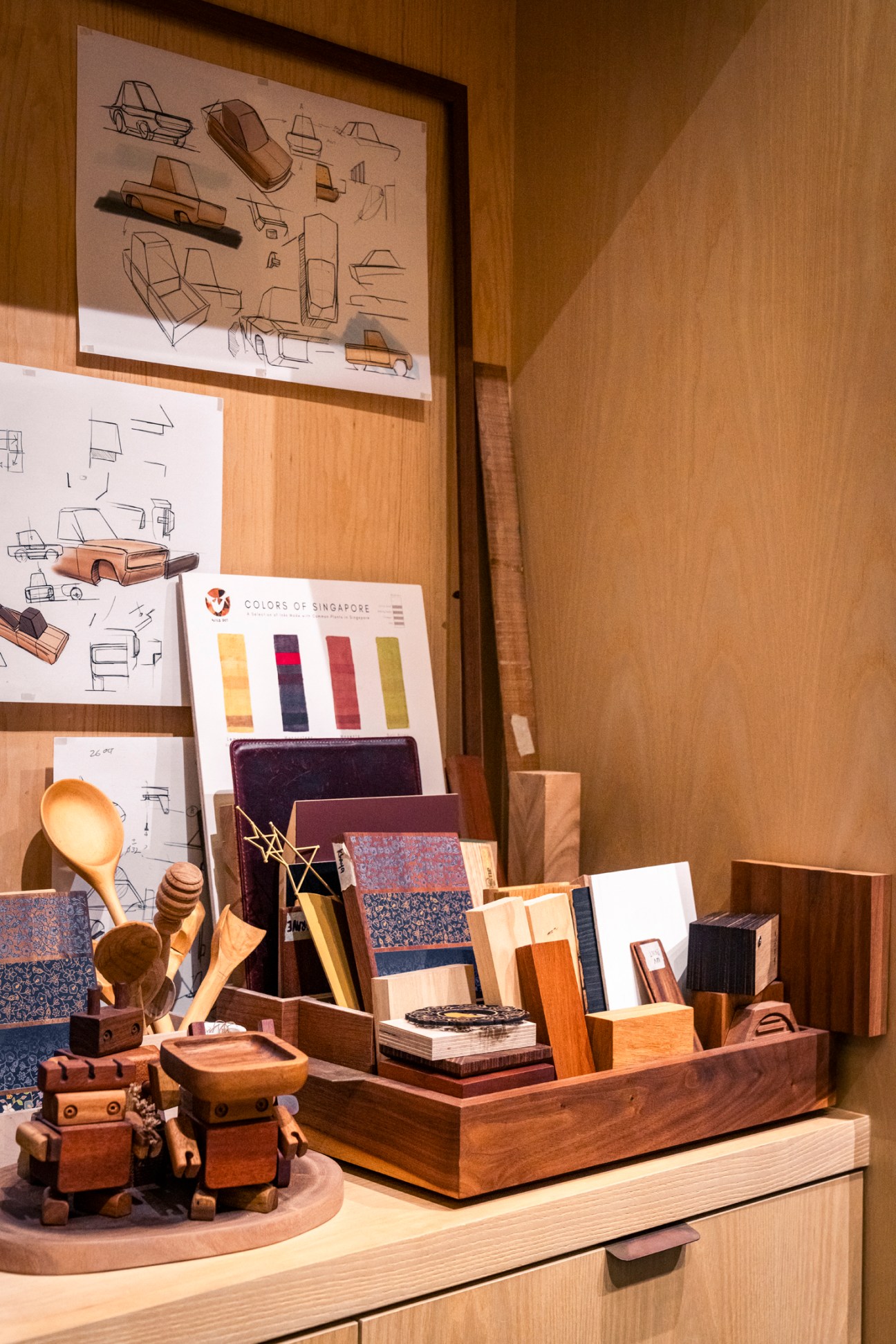
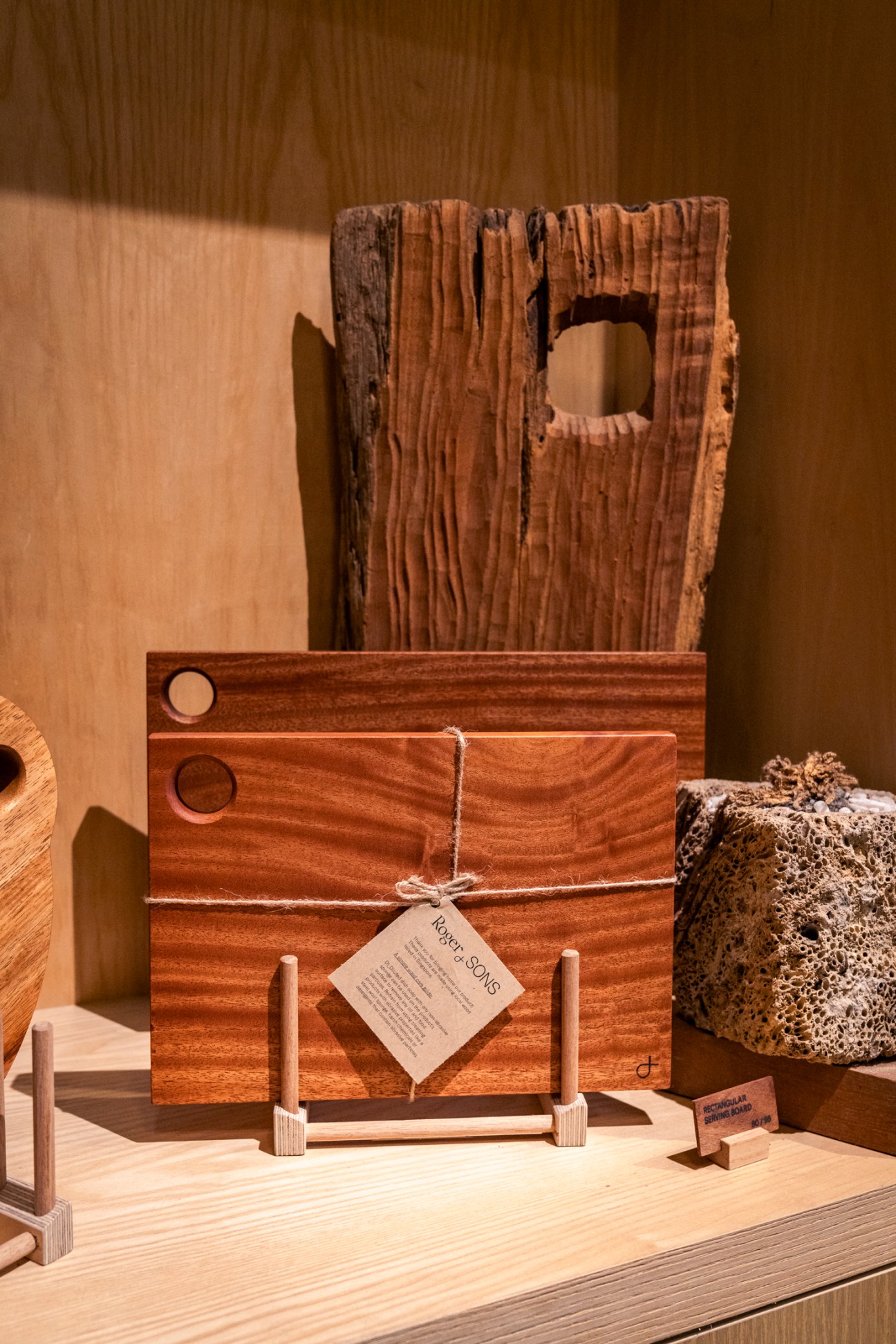
Recently, Paris-based product designer Christophe Machet and Yeo tinkered with sawdust and eco-friendly glue to create a new material for lampshades. With such blue-sky experimentations, Yeo hopes to open up possibilities for Singapore’s makers and designers. “We’ve often looked to America and Europe for cutting-edge design and materials,” he says. “But I believe that we’re able to develop innovative materials using the resources here too.”
Roger&Sons turns 10 in February, marking a fruitful decade of transformation in which Yeo and his brothers not only turned their father’s flagging business around but have forged a new way forward for Singapore’s woodworking industry. One thing stays the same, though: their palpable passion for carpentry. So what does Yeo think sets Roger&Sons apart? “A lot of heart goes into our woodworking and this will come through in our products,” he says. “When you touch it, you’ll instinctively know that it was made from love.”
rogerandsons.sg
Monocle comment: Consider bespoke furniture and fit-outs for your home. A skilled carpenter tailors to your needs. Plus, independent makers are better connected with local supply chains, limiting your carbon footprint.
Rukhshana Media: A female-led news website that reports on women’s lives under the Taliban
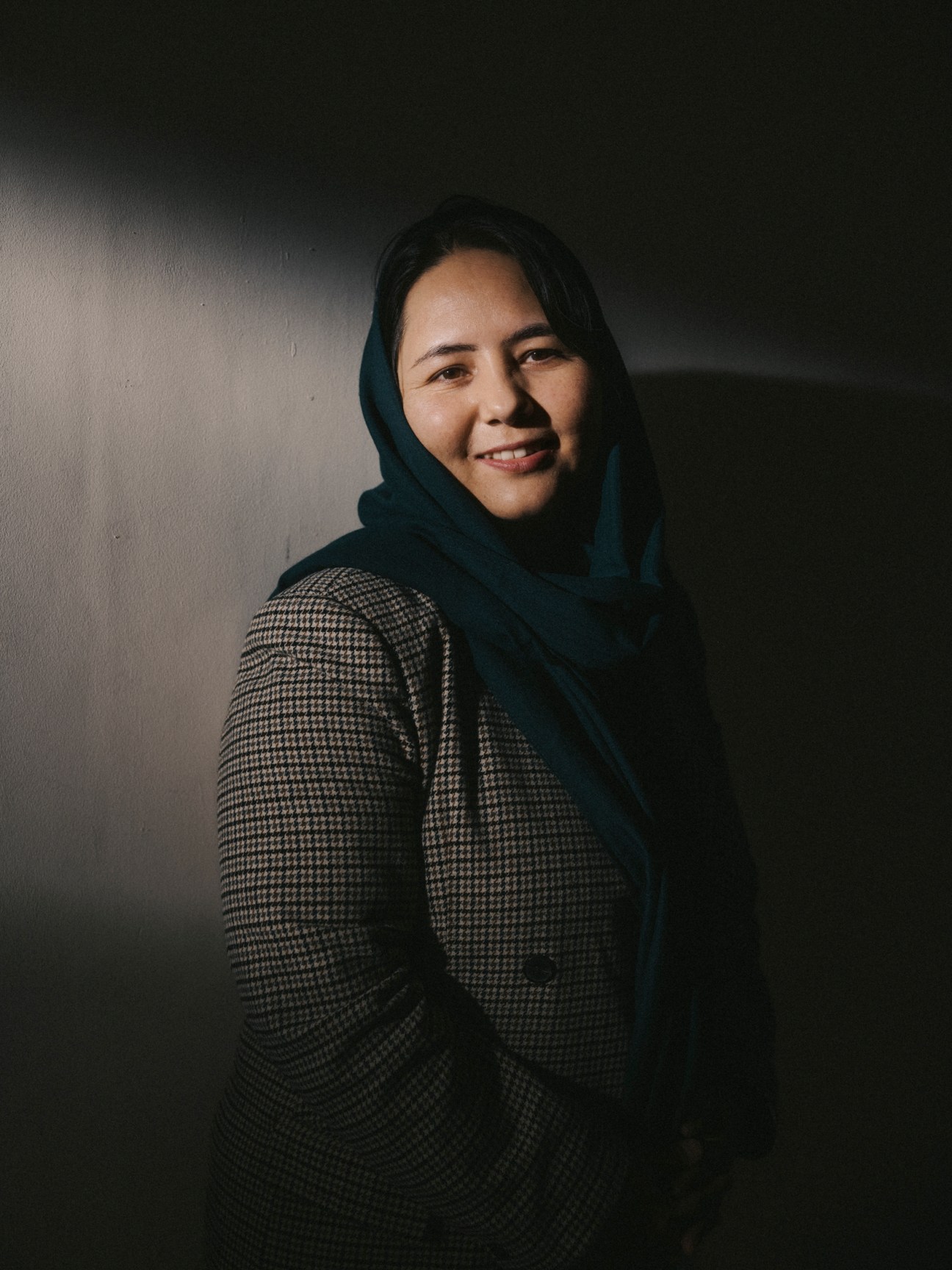
The London headquarters of Rukhshana Media is intentionally nondescript. From this secret location, the news website is informing readers about what life is like for Afghan women under Taliban rule. “I grew up in a country where, right now, being a woman is a crime,” founder Zahra Joya (pictured) tells Monocle. “And being an independent journalist? That is double the crime.” On a drizzly winter afternoon, the scene feels a long way from Kabul, where Joya went to university and began working as a journalist during the US occupation. Despite her family’s wishes that she become a lawyer, Joya founded Rukhshana Media (named after a teenager who was stoned to death having been accused of adultery) in 2020, just a year before the Taliban returned to power. Fearing for her life, Joya accepted an invitation from the British Embassy to settle in the UK.
In London, Joya directs a team of some 20 staffers, including 10 journalists, the majority of whom are female, reporting secretly from inside Afghanistan. The news website features stories about how badly women are treated in Afghanistan but also on the more positive ways in which they have organised to resist what Joya calls “a gender apartheid”. There are pieces about the teacher who broadcasts lessons to young girls via Youtube, a girl who helps her peers apply for scholarships abroad and a group of women who gather at unsociable hours to exercise outdoors (the religious police will often disperse women from public spaces).
Joya’s team operates under the threat of severe punishment and even death. In March 2023, three teenage Afghan girls were killed while working for a broadcaster in Jalalabad. Their struggle is part of a wider assault on press freedom. The number of journalists fleeing persecution has escalated worldwide: the Committee to Protect Journalists has recorded a 227 per cent increase in the number of exiled journalists over the past three years. This comes at a time when disinformation on social media, growing political polarisation and the rise of populism has led to widespread distrust in the media. The most obvious example is in the US, a country in which freedom of speech is constitutionally enshrined and where more than half of the population now believes that the national media is lying to them. Whether you lay the blame for this on failing news agencies or disillusioned consumers, Joya’s story is a reminder of the power of journalism and why the profession needs protecting.
Joya’s fearless crusade against gender discrimination began in 1996 at the age of five, when she dressed up as a boy and called herself Mohammed so that she could continue her schooling despite the Taliban ban on female education. “When I see so much injustice around me, [I think that] you have to do something, you must tell the story, you must criticise, you must take a picture,” she says. When asked about the state of journalism in the UK, she says that there is no comparison to the risks reporters face in Afghanistan. “You have no idea when you leave your house in the morning whether you will be coming back home at night,” she says. “You must say goodbye to your family, you must hug your mum and your dad and the person you love.”
All good journalists, she believes, have one thing in common: the urge to tell the truth. This core principle can get lost in the noisy media landscape but journalists such as Joya continue to risk their lives in the service of it. “Journalism is not a job; it’s a responsibility,” she says as our conversation comes to an end. “We should all take it seriously.”
Monocle comment: It’s easy to become jaded by media that often treats news as entertainment. But a free press is a privilege. Support independent journalists in parts of the world where careers – and lives – are under threat.
The design agenda: The subtle art of London studio Jonathan Tuckey Design and the Sharjah Architecture Triennial
Secret space
Many people who pass the work of Jonathan Tuckey Design (JTD) may never guess as much. The London-based architecture and design studio’s projects are defined by subtle renovations and conversions. Case in point is Urban Barn, a home combining a garage, workshop and existing house into one residence. The project, on an unassuming terraced grove in west London, is part of JTD’s efforts to reimagine housing in the capital. Here the focus has been on creating privacy for the owners – and expressing something of their character through an intriguing sequence of rooms.
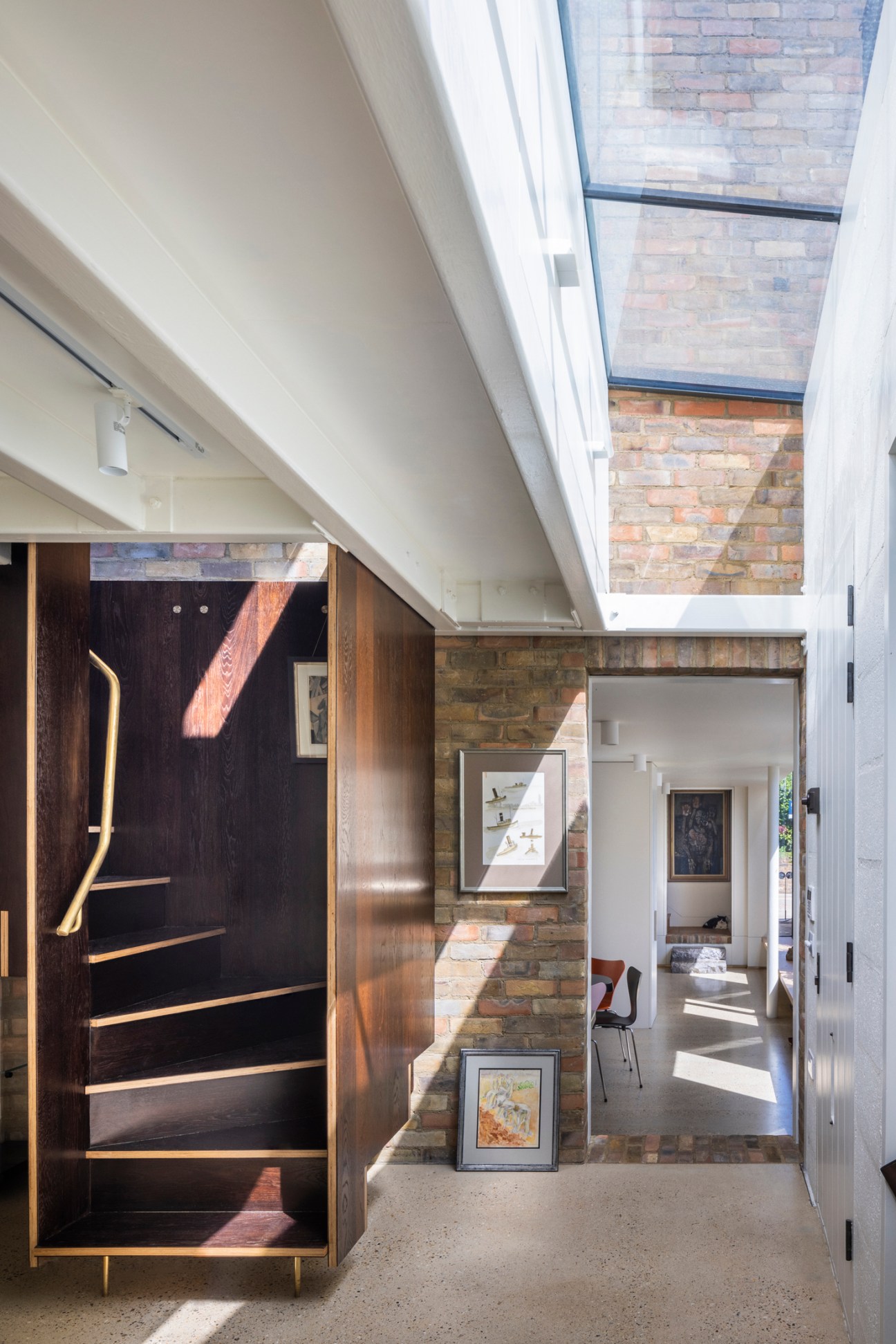
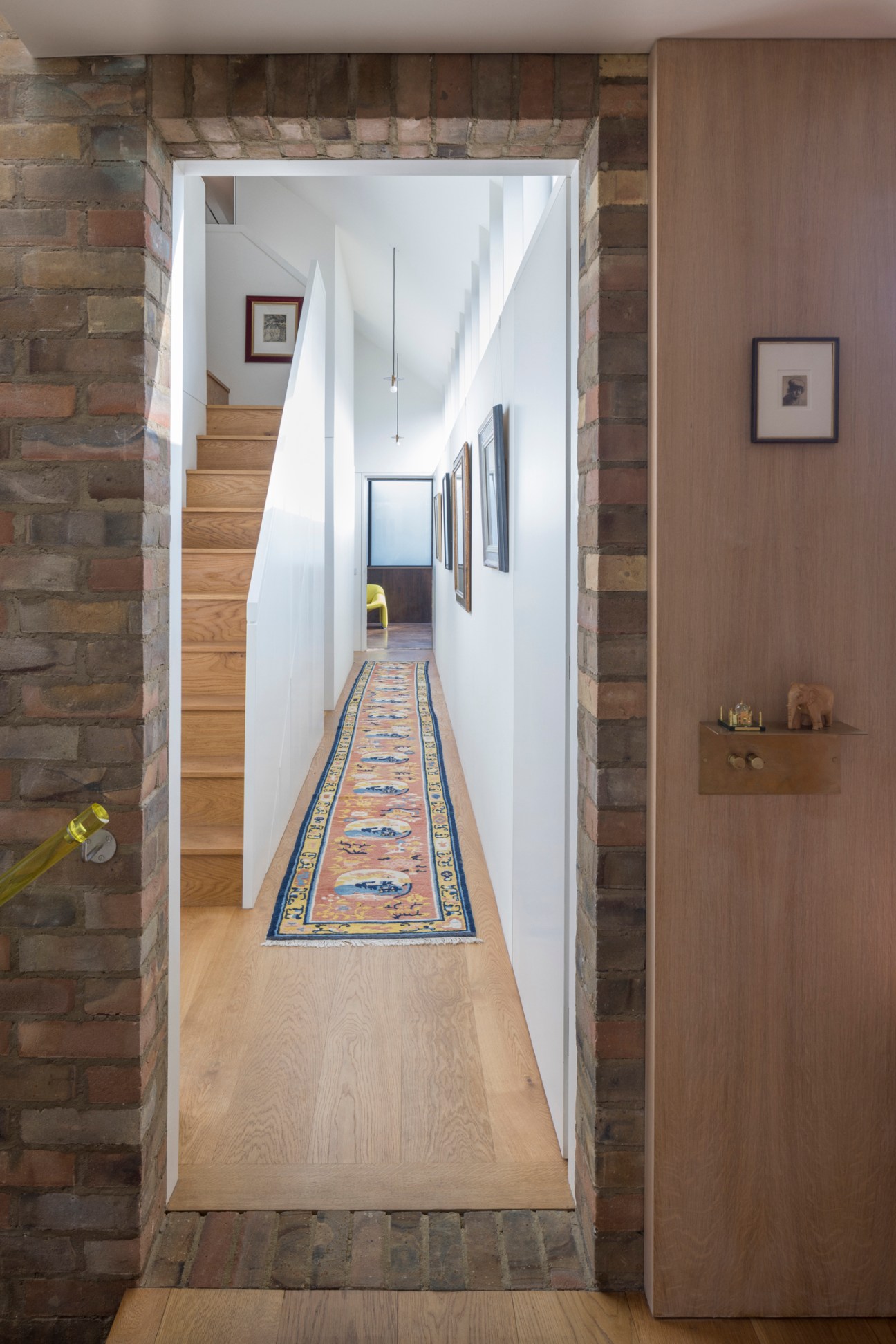
“We wanted each of the spaces to reveal something new about them,” says Jonathan Tuckey, founder of JTD. “We thought about it like one of those grand country homes that were built with an enormous number of rooms. As you get to know the owner better, you are led deeper and deeper into their home.” Appearing as three homes from the outside, the building is defined by exterior features including a porch and a cloister. Tuckey cites industrial spaces as inspiration, alongside garrets from the tops of castles and tiny chapels. “Throughout the project, there was a sense of the building being a collage of different spaces that had evolved over a long period of time.”
As much a place to entertain, Urban Barn is a space for residents to retreat. “There is a hideaway in the mini library,” says Tuckey. “But that space also offers a view down the long gallery that can take you from one end of the house to the other.” The end product is a maze of a home, hidden behind the façade of ordinary terraced housing – a prime example of how generous residences can be created without destroying the look and feel of a neighbourhood.
jonathantuckey.com
On design
Nic monisse on: Sharjah Architecture Triennale
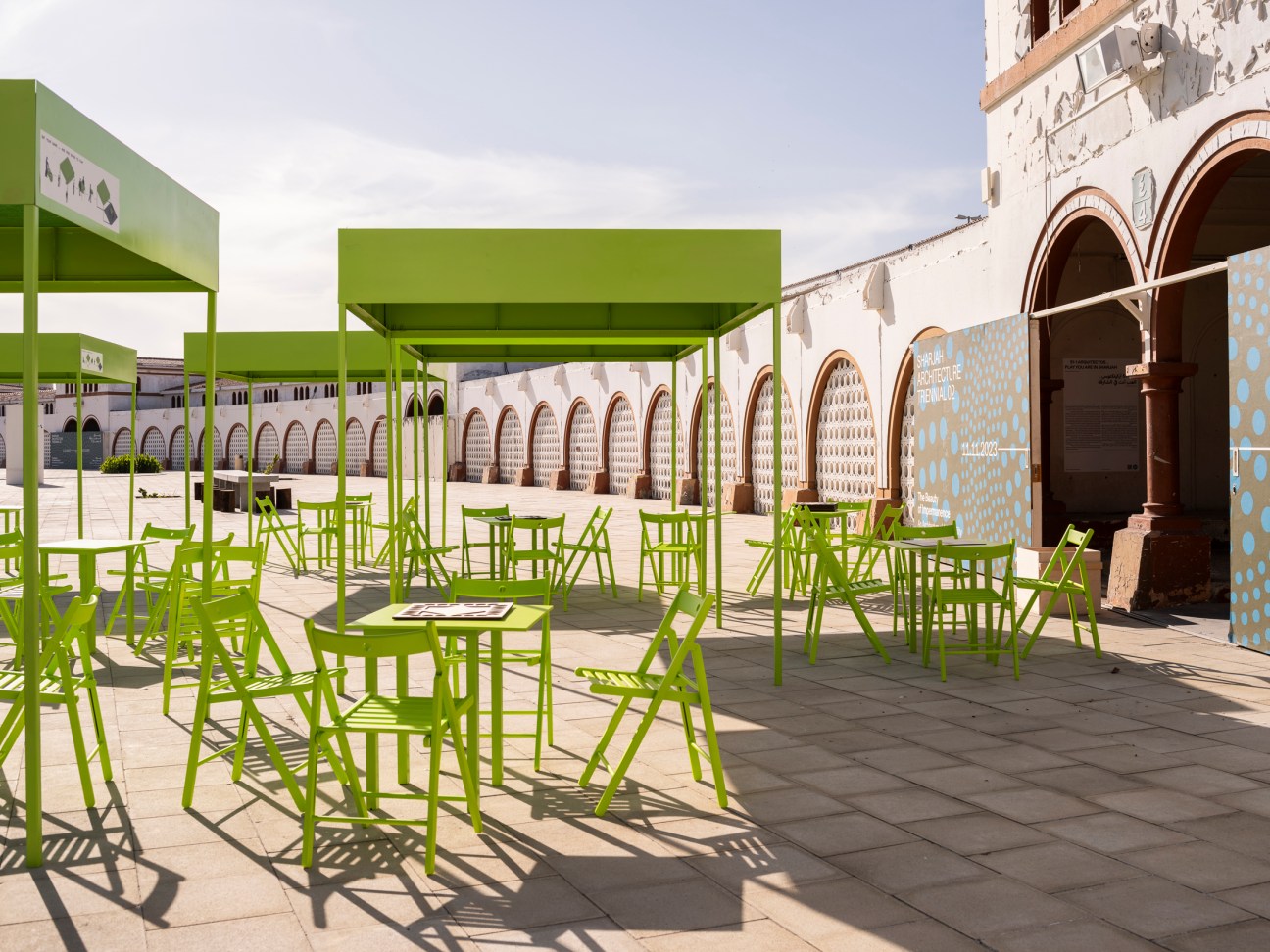
The second edition of the Sharjah Architecture Triennial, a platform for design in Asia and Africa, is in full swing. Curated by Lagos-based architect Tosin Oshinowo, it examines how a culture of reuse and reappropriation in the Global South can help to deliver more sustainable and resilient buildings across the world. The projects on show are impressive – and so is the setting of the event.
The triennial is spread across several repurposed buildings in Sharjah. Al Qasimiyah School was designed in the 1970s and decommissioned in the 2010s; it’s now the event’s headquarters and main exhibition space. The abandoned Al Jubail Fruit & Vegetable Market, from the same era, is hosting exhibitions in its shady arcade. In the Old Slaughterhouse nearby, you’ll find a showcase by Nairobi-based architecture firm Cave Bureau. All these structures were made using locally sourced materials and maintain a cool temperature. They were largely forgotten, unable to compete with the city’s shiny, newer buildings that rely on glass, steel and air-conditioning to function.
The decision to give them a new lease of life reinforces the aim of the event. “We want you to ask questions about how we design, build and reduce our carbon footprint,” says Oshinowo when she takes Monocle on a tour of Al Qasimiyah School. Looking back at simpler solutions from the past is sometimes the best way to build a better future. Visit the Sharjah Architecture Triennial before it wraps up in March 2024 and see for yourself.
For more design and architecture analysis, subscribe to the Monocle Minute On Design.
Architecture: USA
Culture swap
The American Midwest has strong links with the Nordics: about three million Scandinavians immigrated to the region between 1825 and 1925. It’s a heritage that is celebrated in the small town of Decorah, Iowa, at the campus of cultural institution Vesterheim, which Norwegian-American studio Snøhetta is gradually overhauling.
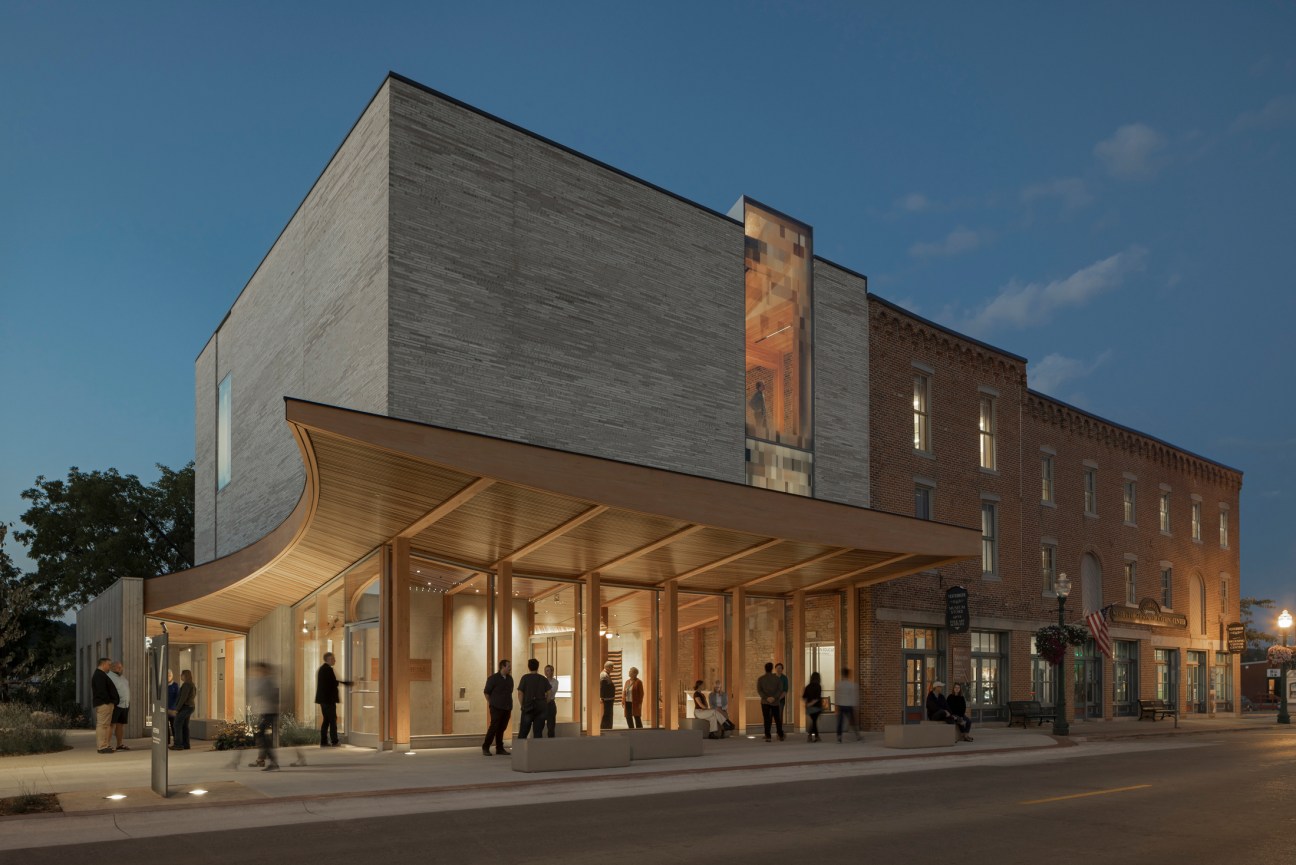
First opening as a museum dedicated to Norwegian-American history in 1877, the architects were tapped to develop a masterplan for Vesterheim (which means “western home” in Norwegian) in 2019. The first fruits of their labour appeared in late 2023 with the opening of a new building called The Commons. The large structure is a fresh entry point and community space for the campus, which contains a museum and folk-art school. In addition to providing a central gathering space for the cultural institution, it will also serve to visually link Vesterheim with the town’s main thoroughfare, thanks to its striking wooden-canopied conservatory. “The canopy projects out over the sidewalk, evoking some of the geometry and profiles of traditional Norwegian sailing vessels,” says Chad Carpenter, the project’s lead architect.
In addition to paying tribute to Nordic heritage, American-built traditions are also incorporated into the project, with the exterior masonry locally sourced from the Iowan town of Adel, the brickworks of which date to the 1880s. The outcome is a building that is, according to Carpenter, simple and robust, welcoming, warm and light-filled. “They’re all values that can be found in both American and Norwegian design,” he says.
snohetta.com
Events: Global
Save the dates
The first few months of the calendar year are action-packed for creatives and design-enthusiasts, with a host of events, exhibitions, fairs and trade shows. Here’s Monocle’s pick of the bunch.
Stockholm Furniture Fair
Starting on 6 February, this is Scandinavia’s trade fair of choice. The region’s top brands will show their contract and residential furniture.
Design Doha
The first edition of Design Doha, which begins on 24 February, will include exhibitions on weaving and architecture, and a coaching programme for designers.
Milan Design Week
The world’s biggest design event takes place from 16 to 21 April. EuroCucina, a section of the trade fair dedicated to kitchens is slated for 2024.
NYC3Design
The icff, WantedDesign and Lightfair take place during the annual festival, from 16 to 23 May. Expect everything from large contract works to collectible pieces.
Orgatec Tokyo
Pick up tips on materials, lighting and fit-outs for offices at this event, which takes place from 29 to 31 May.
Design: Portugal
The right path
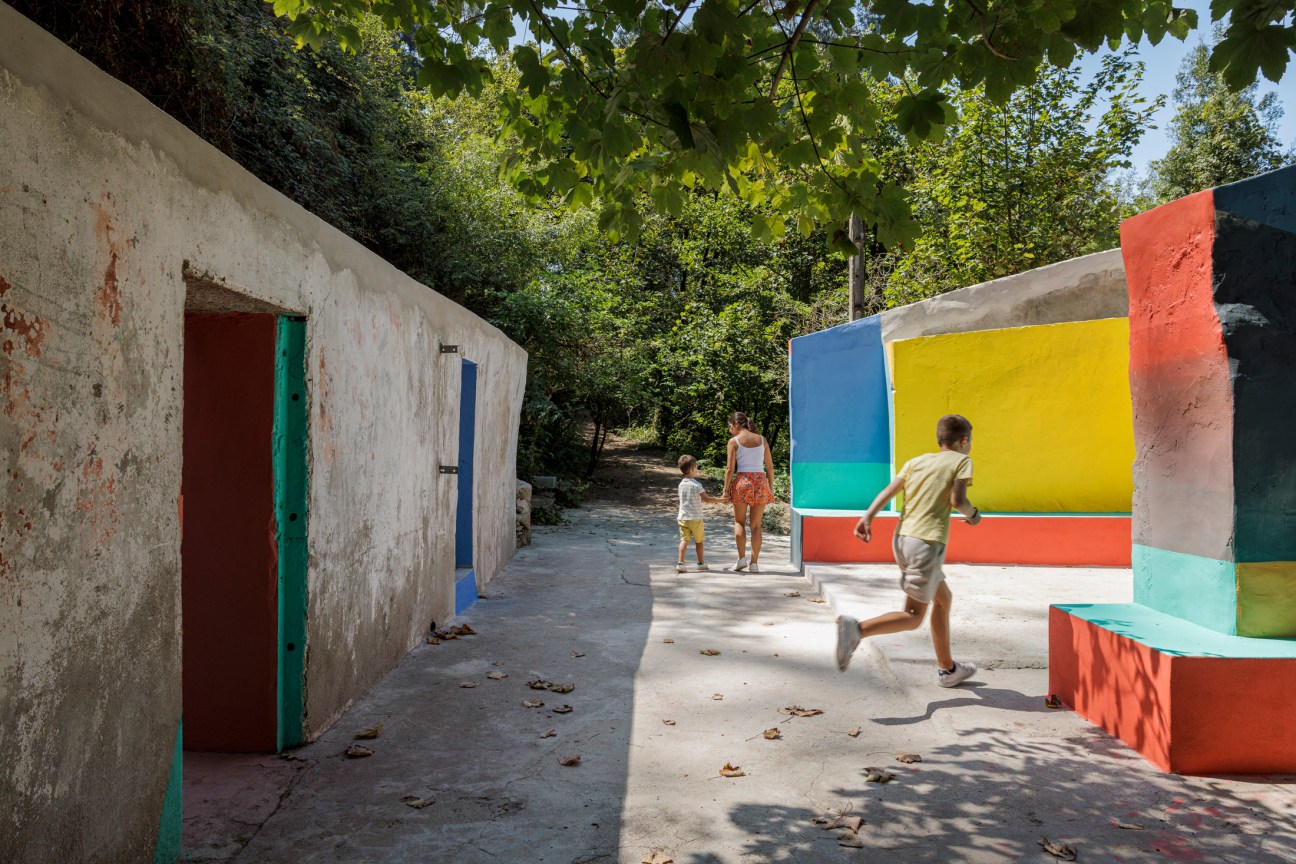
Escadinhas Footpaths is a colourful network of pedestrian walkways in Porto’s seaside municipality of Matosinhos, which links the neighbourhood of Monte Xisto to the banks of the River Leça. Designed by Portuguese architect Paulo Moreira, the project was, in late 2023, nominated for the Mies van der Rohe Award – a EU-backed prize for contemporary architecture that recognises works of conceptual, social and cultural excellence.
Moreira’s intervention involved the rehabilitation of existing stepped footpaths through repairing of handrails, the addition of new benches and a simple lick of paint. Repairs were made to the riverbank too and the Porto-based architect also opened up a new web of footpaths that carve their way through a ruin on the neighbourhood’s outskirts, transforming the dilapidated site into a vibrant yet calm spot for locals.
The project was made possible thanks to the Portuguese government’s Healthy Neighbourhood Programme which, in 2020, set aside €10m for community building initiatives. Moreira was able to request funds without prompting from private investors. “As an architect, I’m always looking for ways to contribute to improving invisible areas,” he says. “I am curious about the strangeness of these spaces and how they could become something more.”
paulomoreira.net
The culture agenda: A conversation with Naomi Klein and a research project that’s sniffing out European heritage
Community: Morocco
Center of excellence
Hicham Bouzid spent two years searching for the perfect premises to house the new headquarters for Think Tanger. Having co-founded the non-profit cultural agency in 2016, he had since been running it from a former fish market in downtown Tangier, organising artist residencies within the space alongside a programme of talks and workshops for the community.
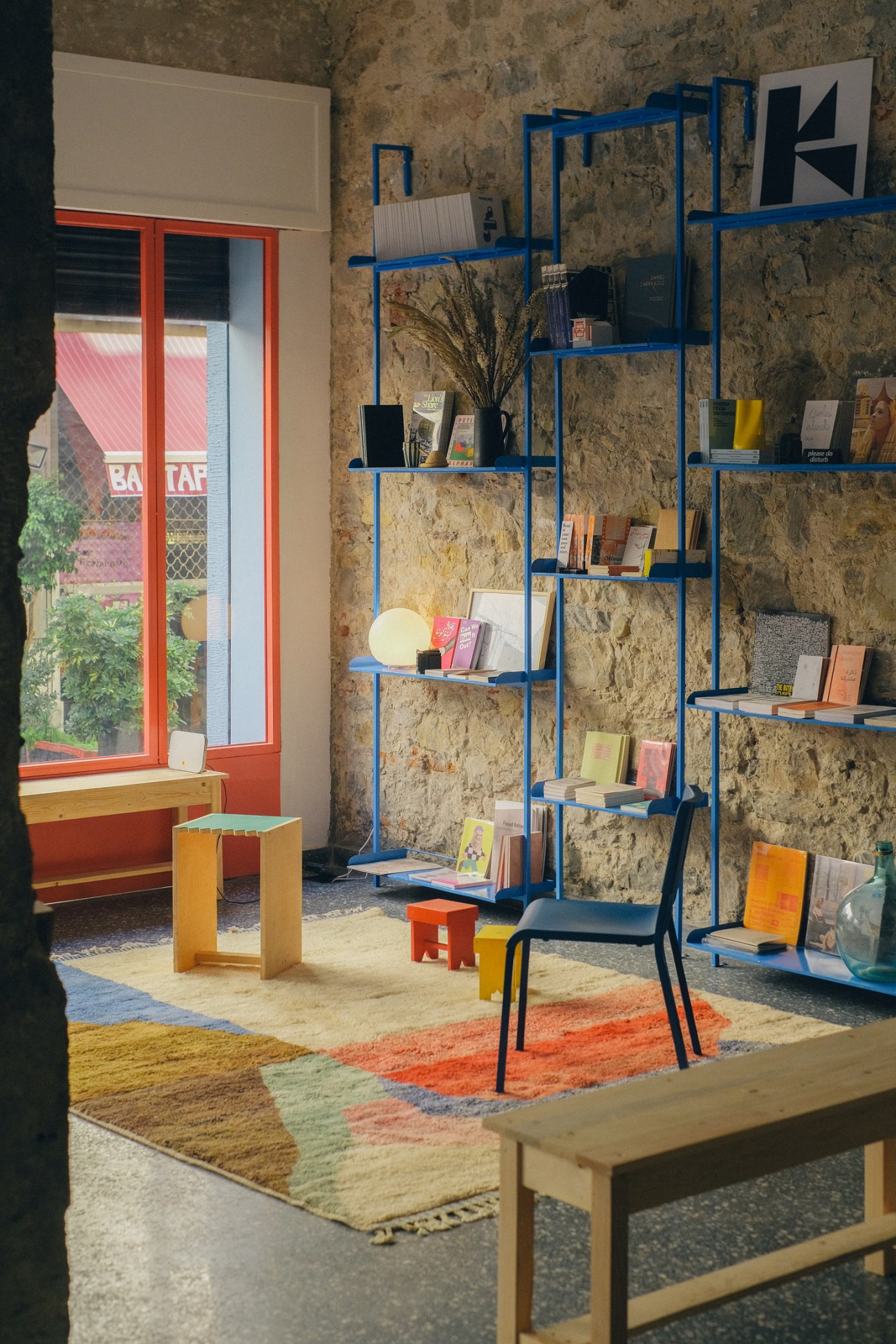
When the organisation and its ever-expanding programme of cultural activities began outgrowing the site, Bouzid made it his mission to find a new, larger centre of operations. He eventually stumbled on an empty café, which once housed the city’s first chess club, in Tangier’s Spanish quarter and set about renovating it: laying a new terrazzo floor and installing custom-made tiles, bookshelves and wooden furnishings.
The work took Bouzid and his team about a year and there were various pre-launch parties and events before it officially opened to the public in 2023. Known as Kiosk, it houses workspaces for the Think Tanger team as well as providing a meeting point for all their outreach work by hosting all manner of talks, workshops and screenings. “Now we have somewhere we can invite urban planners, artists, architects and researchers to give talks about cities to our community,” says Bouzid.
Bouzid is currently putting together the 2024 programme, which he says will have an increased focus on the intersection of artificial intelligence (AI) and urbanism. “We’ve invited various people from the tech world to discuss the dynamic between AI and cities, and how we can work with it.”
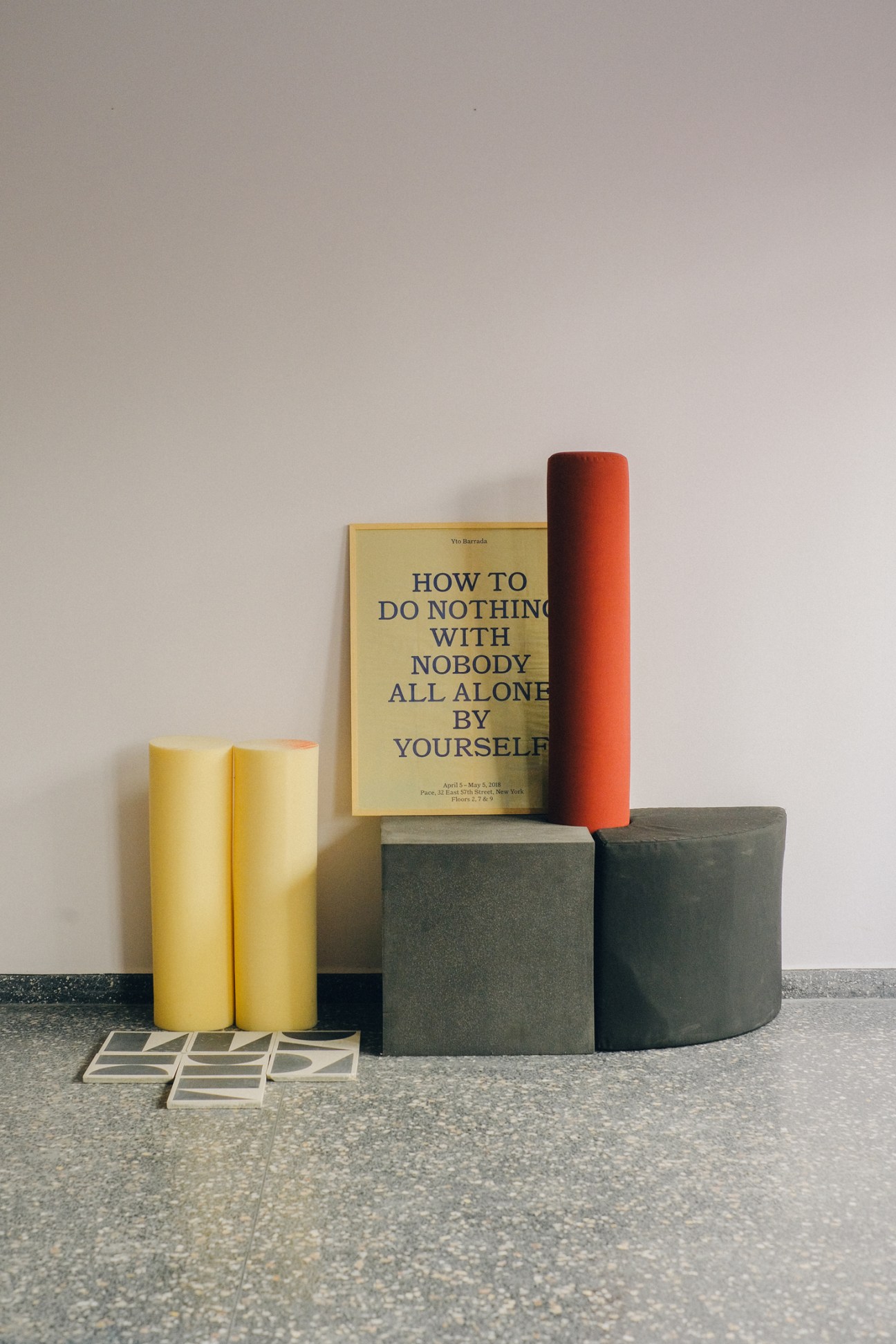
Think Tanger also produces small, risograph-printed publications in collaboration with visiting cultural practitioners, as well as its own annual magazine, Makan. All are on sale at the space’s bookshop. “Alongside our own publications, we stock books and magazines from small, independent publishers, mostly from within the mena [Middle East and North Africa] region,” says Bouzid. “The topics they cover are basically all an extension of what we do at Think Tanger, discussing subjects such as art, architecture, urbanism, decolonisation and graphic design.” Titles are available in a mix of Arabic, French and English; visitors are encouraged to use the space as a reading room as well as a shop.
What’s most important to Bouzid is that Kiosk remains accessible to people from a cross-section of generations and backgrounds. “One of the things I’m most proud of is how we’ve become a melting pot of so many different communities,” he says. “It’s a rare thing here. We’ve managed to achieve this because we’ve been working for several years with people in areas of the city that don’t generally have much access to arts and culture. So they’re already aware of us and what we’re doing.”
With the launch of an on-site café later in the year, Bouzid hopes that Kiosk will be able to draw even more of the community. “We’re still a small team, so we’re moving in baby steps,” he says. “But we already have a beautiful counter ready to serve visitors. We’re excited to start putting it to good use.”
Books: Canada
Q&A
Naomi Klein
Author and activist

Award-winning Canadian author, activist and filmmaker Naomi Klein’s latest book, Doppelganger: A Trip Into the Mirror World, is out now, published by Penguin. It’s a thoughtful and funny exploration of duality that also tackles the rise of conspiracy theories and far-right views.
What is a doppelganger and who is yours?
It’s the idea that there is another “you” walking around somewhere. My experience of having a doppelganger relates to other people perennially mixing me up with [conspiracy theorist] Naomi Wolf.
So what made you think about confronting your own reflection?
It’s a funny thing when you have a doppelganger who’s nothing like you; to have this shadow that’s not in your control. She [Wolf] was writing about her orgasms and was, let’s say, “a little looser” with her sources. Then she was at the vanguard of coronavirus conspiracies. That’s when I lost all control. I was hurt, I felt, “What have I spent my life doing creating this sort of self that can just disappear through the actions of someone else?”
What did you do?
I wrote Doppelganger to take control of my own life and try to make some sense of it.
For the full interview, listen to episode 409 of ‘Meet the Writers’ on Monocle Radio.
History: Amsterdam
Raising a stink
The Odeuropa research project has encouraged Europe’s art institutions to add an olfactory element to their displays. Julia Webster Ayuso picks up the scent.
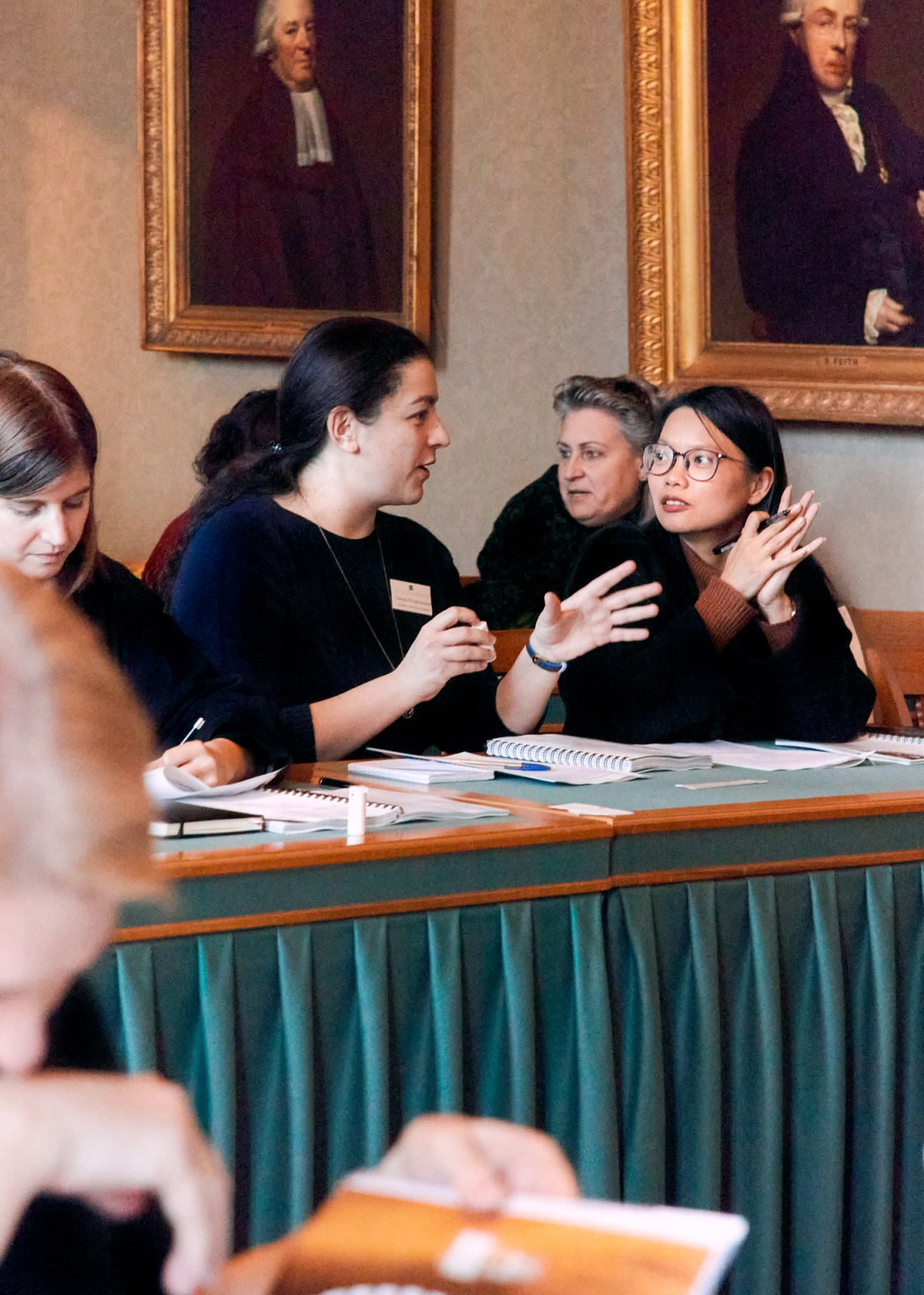
“Does this capture ‘hell’ for you?” asks art historian Sofia Collette Ehrich, as she hands out finger-pump diffusers to participants in the Trippenhuis, home of the Royal Netherlands Academy of Arts and Sciences in Amsterdam. We tentatively raise the devices, which emit an unpleasant, smoky odour of indole and skatole (both faecal scents). The reaction among attendees – students, academics and museum curators – is almost unanimously of disgust. “That’s hell,” confirms one woman.
Between 2021 and 2023, Ehrich and an international team of researchers explored past and present scents as part of the €2.8m Odeuropa project. Researchers and academics used artificial intelligence to comb through thousands of images and texts from 1600 to 1920 in order to pick up references to smells and build a digital library of European odours, the Encyclopedia of Smell History and Heritage, which is publicly available online.
Once catalogued, some scents were preserved or recreated, encouraging curators to incorporate odours in museum exhibitions, making visits more immersive. The scent of hell – a “fantastical” representation of what the underworld was thought to have smelled like – was designed to accompany “Christ in Limbo”, a 1549 oil painting by Martin Schaffner at the Museum Ulm. “Fundamentally, what a lot of people want to know when they’re interested in history is what it was like to be there – what it was like to be in the past,” says William Tullett, a lecturer in early modern history at the University of York, who is at the forefront of the encyclopedia project. “Smell is a critical component of that.” He has studied the significance of fragrances such as tea, frankincense and tobacco in European history, and says that our entire approach to smell has changed over time.
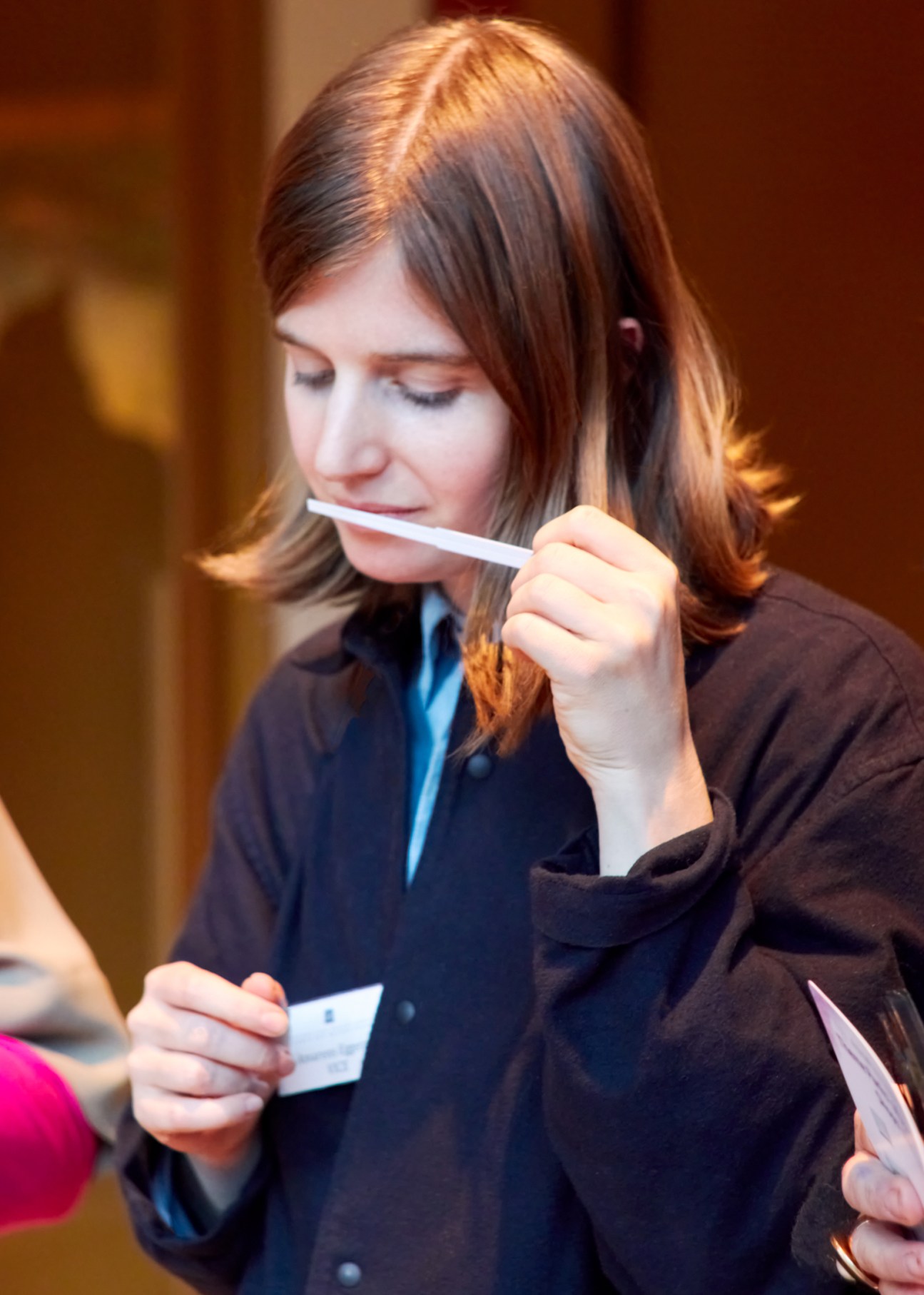


Since the 19th century, says Tullett, the museum experience has become predominantly visual. Most exhibitions involve looking at objects in galleries or reading texts and we are told to speak quietly and not touch, let alone sniff, anything. But this hasn’t always been the case. “In the 17th century, in the first museums, which were largely private collections, people would pick stuff up and taste it,” he says. Though the fact that historical objects are now more protected is largely a good thing, reintroducing smell into museums could open up all kinds of possibilities, helping us to better understand the past and lure a different kind of visitor. “Scent is a great draw for an exhibition because you have to be physically there to experience it,” says scent designer and olfactory curator Tasha Marks, the founder of AVM Curiosities who has spent more than 10 years creating scents and promoting their unique role for cultural institutions such as the V&A. For a recent exhibition at the Museum of London Docklands, she recreated the smell of the East End’s commercial past, using interviews with dockworkers and research about the olfactory landscape of the Thames. “Scent allows a layer of interaction that wouldn’t have been possible otherwise,” she says. “It’s a great way to break down boundaries.”
In the hierarchy of the senses, smell has always been at the bottom of the list. Studies have shown that even our language reflects this: while we are used to describing images and sounds, when it comes to smell, our vocabulary is more limited. As a result, smells are not part of our cultural heritage, which is something that the Odeuropa project could help to change. In recent years, museums have opened up to experimenting with smells, and exhibitions including olfactory experiences have been hugely successful. In 2022, in an attempt to raise interest in part of its permanent collection, Madrid’s Prado Museum commissioned Spanish fashion and fragrance house Puig to create a series of scents to accompany “The Sense of Smell” by Jan Brueghel and Rubens, a painting that depicts more than 80 species of plants and flowers. The museum expected the exhibition to bring in about 100 people per day but after three months it was attracting more than 1,000. Whereas visitors who don’t know about the history of art might find it difficult to immerse themselves in a painting, smells are often more accessible because they are more dependent on personal experience. “With smell, there’s no wrong answer, so it’s quite liberating,” says Marks. “There’s no pressure to be correct; there’s only pressure to engage – and that’s very positive.”
The business agenda: A course correction for Berlin Brandenburg Airport and rethinking men’s skincare
Aviation: Germany
Better late than never

For years, the safest conversation starter in Germany’s capital has been to commiserate about Berlin Brandenburg Airport. There’s plenty to talk about: you can kick off by mentioning the hour-long security queues, ease into lamenting the shoddy public-transport connections and the illogical signage, and then spend the rest of the time marvelling at the epic quagmire that led the airport to start operating 9 years behind schedule. Aletta von Massenbach (pictured) took on one of the least enviable jobs in town when she stepped in as the airport’s CEO in 2021, a year after its opening. “If you didn’t have a clue how to make it better, it would have been overwhelming,” she says from a boxy conference room overlooking Terminal 1. “We had a plan.”
The efforts of Von Massenbach, who has experience managing many airports around the world (and is the first woman to lead a major one in Germany), are gradually becoming tangible to travellers. In an official ceremony in October, the federal police relinquished its responsibility for operating security control and the lanes are being redesigned and updated with state-of-the-art X-ray machines. While Berlin lags behind hubs such as Munich and Frankfurt, new flight routes are being added to the schedule at a fast clip.
Another urgent task has been to boost staff morale. “Normally, people are very proud to say they work in aviation,” says Von Massenbach. “Our employees didn’t even dare say where they were working.”
But no amount of management wizardry is likely to quench the criticism of Berliners. Many nostalgists are happy to wax on for hours about Tegel, the city’s decommissioned 1970s airport and view its replacement as an avatar for everything that is going wrong in the country. “It was for far too long a not very good example of Germany’s capability to manage big projects,” says Von Massenbach. “I don’t take it personally.” The CEO’s phlegmatic attitude appears to have paid off. After years of failure, things at Brandenburg seem to finally be looking up.
The Entrepreneurs
Laura Kramer on: Rethinking men’s skincare
New year brings with it personal-transformation resolutions, with renewed gym memberships and promises to cut down on apéro topping the list. But health doesn’t stop at losing kilos; the biggest organ of the body is often overlooked. Dutch founder Gregor Jaspers is on a mission to change that with The Grey, his luxury men’s skincare line that he launched in 2018.
The idea came on a work trip to Milan Fashion Week when Jaspers realised that there was a gap in the market for a compact men’s skincare line, which matched his need for efficient products that would fit into his small suitcase. “I was a buyer for a department store in the Netherlands and travelling extensively. I looked at my cluttered wash bag filled with women’s, unisex and men’s products, some packed in golden jars with massive lids and only 50ml of eye cream in them.” He realised that there wasn’t a tailored solution for men who wanted high-performance products without the frills. “I felt neglected and ignored as a male consumer.”


This sparked his desire to create a line blending the efficacy of luxury skincare with simplicity and convenience for a straightforward routine. “I asked the developers at the laboratory to make a single product containing all of the different moisturisers I’m using for the day, night and eyes. That became our three-in-one face cream and it’s an absolute best seller, a pillar of the brand.”
Today, The Grey offers products featuring botanical and active ingredients, with formulas that quickly absorb into the skin and don’t adhere to facial hair. “We get messages from clients who have skin issues so we developed the Comfort+ cream especially for them. And we get the most emotional emails from guys whose skin we fixed. So that’s why we do it.”
It’s since expanded offerings from men’s grooming products to an SPF cream that took three years to develop, supplements and teas that promise to nurture skin from the inside out. “Men should take care of themselves in every aspect of their life,” says Jaspers. “And I think telling that story all over the world is what makes me eager to go to the office every morning.”
thegreymensskincare.com
To hear more from inspiring business folk, tune into our weekly radio show, ‘The Entrepreneurs’, at monocle.com/radio
Aviation: USA
Two of a kind
The largest passenger air carriers in two of the more remote corners of the US are planning to merge in a landmark deal announced in December. Alaska Airlines, which was founded in Anchorage in 1932 and is headquartered in Seattle, intends to buy Hawaiian Holdings, the parent company of Hawaiian Airlines, for $1.9bn (€1.76bn).

The importance of each airline runs deep in their respective states, given that the regions have been more reliant on air travel than the rest of continental US – the only way to navigate the Hawaiian archipelago before the airline’s launch in 1929 was via steamship. The deal, therefore, feels like a good fit.
Alaska Airlines is the fifth-largest carrier in the US and this is an opportunity for it to expand its reach beyond routes along the North American west coast, as well as across Alaska’s remoter regions. The combined carrier will grow Alaska Airlines’ fleet to 365 aircraft and will transform Honolulu into a major air hub, thanks to Hawaiian Airlines’ connections with both the US west coast and the Asia-Pacific region, including its longstanding routes to cities such as Tokyo, Osaka, Seoul, Auckland and Sydney.
If the deal is greenlit by US regulators, who are expected to rule on whether the deal aligns with US monopoly regulations in the first quarter of 2024, it will create a major new competitor in US aviation, which has recovered robustly from the turbulence caused by the pandemic.
Importantly, however, Alaska’s proposed acquisition of Hawaiian Holdings will see each airline retain its individuality and branding, meaning that the two legacy airlines will continue to fly the flag for their respective regions, much like they have done for close to a century.
Hospitality: Global
Q&A
Mark Willis
CEO, Fairmont

Few international hotel brands can match the often castle-like properties of Fairmont, which first flung open its doors in San Francisco in 1907. CEO Mark Willis tells Monocle about Fairmont’s extensive expansion plans and explains why, shortly after taking up his post, he moved its global HQ from Paris to Dubai.
You moved Fairmont’s global HQ to Dubai. Why?
Globally, Dubai is a very central location. We have hotels all over the world; we have owners all over the world who we need to interact with in person. We have about 30 hotels opening in the next 36 months. It’s a great hub do that from. We’re also able to recruit great talent here.
Where will Fairmont’s newer outposts open in the next three years?
We’ve been careful with where and how we grow the brand. Among the portfolio that’s due to open are Geneva and Prague, which are full renovations, and an amazing new 500-room hotel in Bangkok. We have an opportunity to grow in new locations – Miami and Las Vegas in the US; Paris and Berlin in Europe; and Phuket, Kuala Lumpur, Bali and other destinations in the Middle East.
What is one aspect of the hotel sector where you see opportunities for growth?
We are actively looking at how to retain the best members of our teams and how people can work in different ways to make the roles stimulating and to offer opportunities to grow. It’s a wonderful industry. We need to encourage younger team members to come in and work within it.
fairmont.com
Architecture: Japan
History reimagined
Fed up with seeing old homes being demolished in Japan, Tomohiro Fujii, a Central Saint Martins graduate, decided to take action. Together with consultant Shori Fuji, he set up Kessaku (“masterpiece” in Japanese), a company that aims to protect historic houses by offering shared ownership.
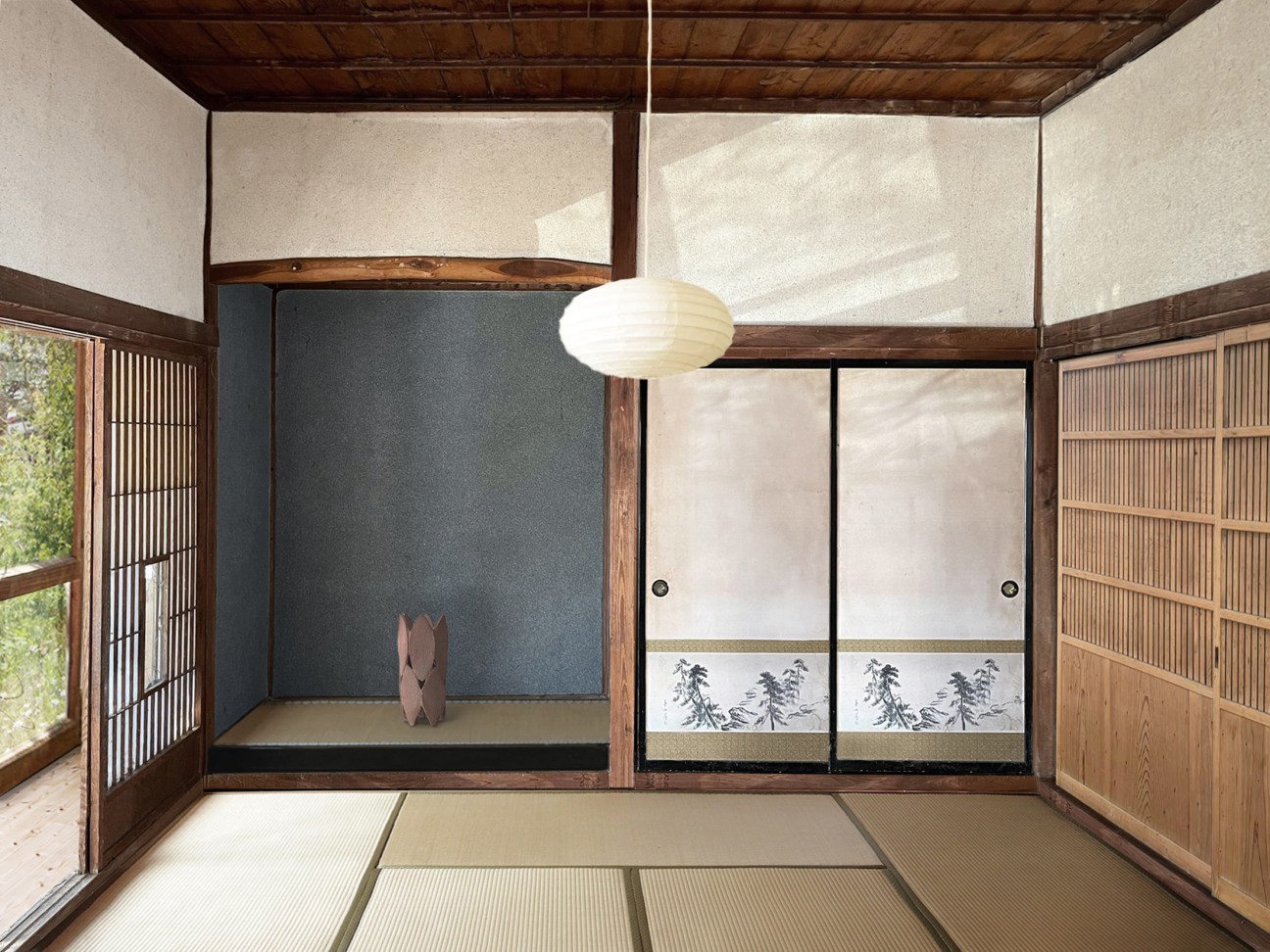
Fujii’s idea is to offer people the chance to buy a stake in a property from as little as ¥1,000 (€6.40); depending on the amount they put in, co-owners would then be able to stay a certain number of days per year. The properties will be everything from a traditional Japanese house to an architect-designed home from the 1970s and Kessaku will take care of management and maintenance. “There are plenty of people like us who want to look after old buildings but don’t have the time or the resources to take one on by themselves,” he says.
The first property on offer is a wooden house in Nagano from the 1930s (pictured) that belonged to a lacquer craftsman. With nobody to inherit it, there was a danger of it falling into disrepair. “It’s a beautiful house,” says Fujii. “We want to restore it and make it comfortable.” Many owners find that registering a building as a historic property is more trouble than demolition. In Tokyo, where land is more highly valued than buildings, the problem is acute and old houses are disappearing fast. Fujii says that tourism is helping as visitors are keen to stay in historic homes. “There’s a change towards valuing older buildings and we would like Kessaku to be part of that transition.”
kessaku.casa