Issues
Sea change
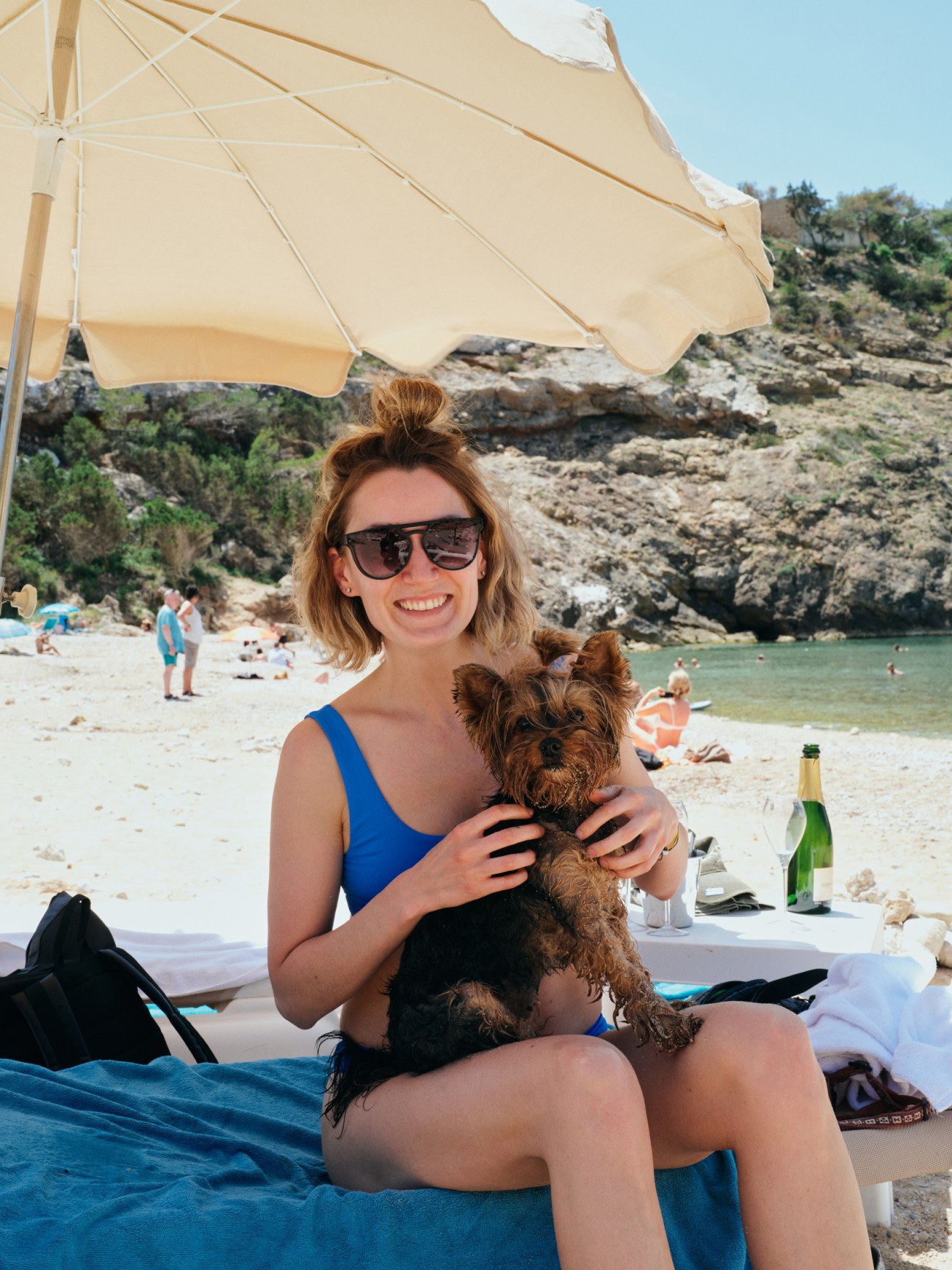
“They tried to take me down but I outsmarted them,” says José Luís Pelayo, grinning defiantly. A beer in hand, Pelayo is accompanied by his teenage son, who is neatly folding cutlery into serviettes after a busy lunch service at Restaurante Pelayo. We’re sitting around a plastic outdoor table by the beach as the low-hanging sun bounces blinding light off the waters of Formentera’s Migjorn beach. At the bar, a woman with a bad Spanish accent struggles to order paella. It’s a familiar scene of the Spanish early summer: sanguine, unhurried, far-removed from the pace of city life. But all is not as it seems in Spain’s beachside-restaurant trade.
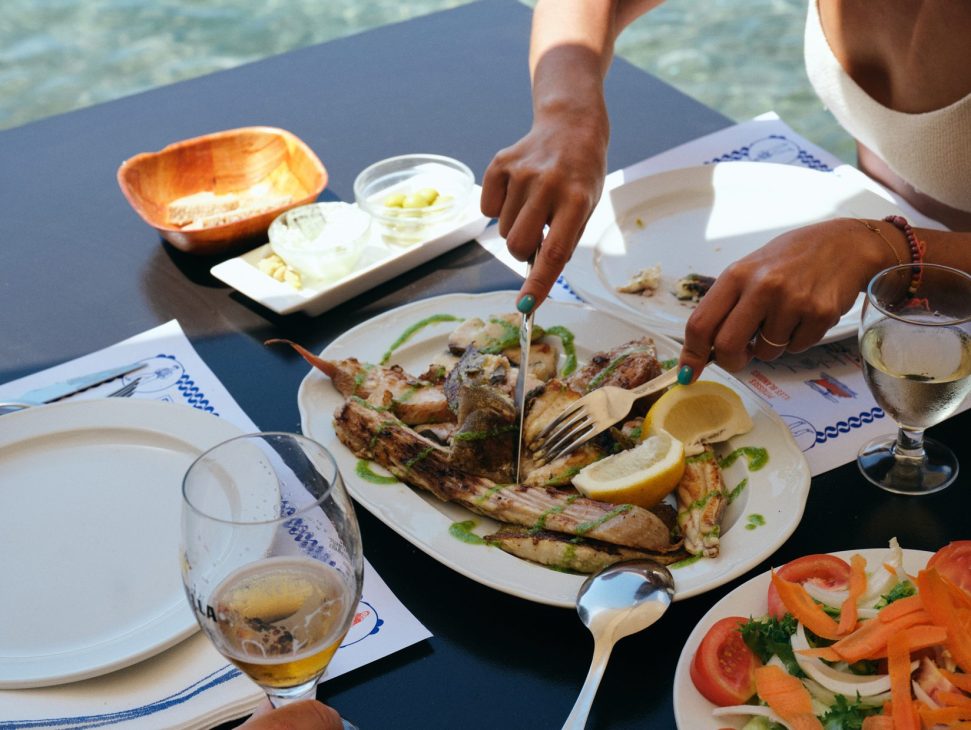
“This is a weird time for our tranquil little island,” says Pelayo, as the waves crash nearby. A recent (and hastily announced) government decision to re-tender operating licences for the island’s chiringuitos and smaller kioscos has put business here on hold. These seasonal, no-frills eateries are staples of the Spanish coast and, despite their size, still do a mean trade. In Formentera, nervous chatter abounds about what many see as a hostile takeover of their shoreline. Legal challenges were launched and protests erupted. As decades-old family-run eating spots draw battle lines in the sand, the structures of several of the yet-to-open beach huts sit unopened like washed-up hulls of forgotten boats. Beachgoers have been left confused, adrift and hungry for answers.
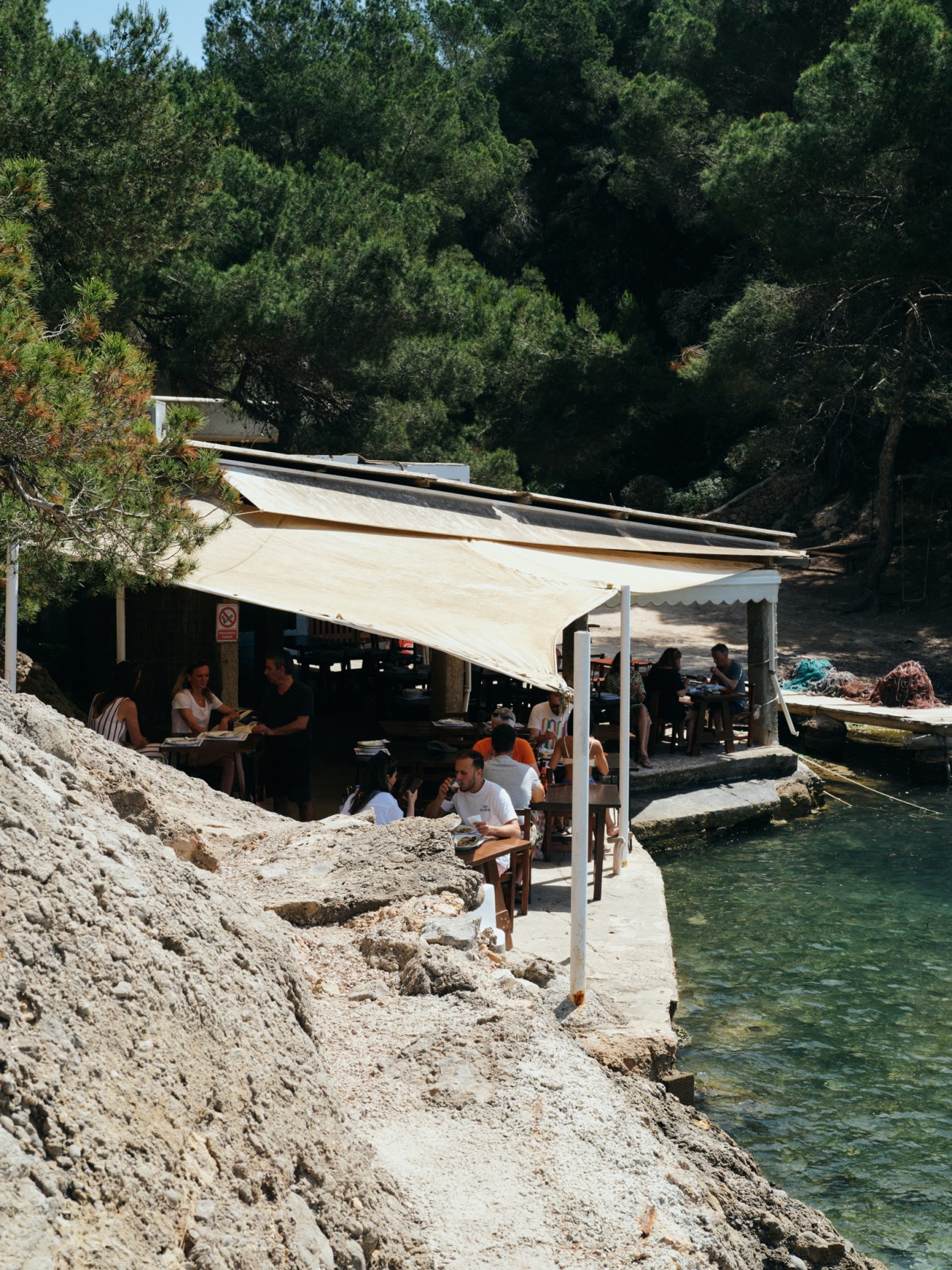

Formentera’s charm has always been the simple life. Here, like much of Spain, a chiringuito is somewhere to switch off, tuck in to some fresh, lightly seared seafood and let the sound of the ocean calm the mind. Now, even these secluded sands are feeling the force of private equity and property speculation lapping at the legs of the plastic chairs. A typical “government concession” for operating a small kiosco can currently cost the owners about €20,000 a year. But talk of “professionalising operations” has seen some rates jump to an eye-watering €173,500. Locals are dubious about the motives but also worried about losing their affordable places to eat.
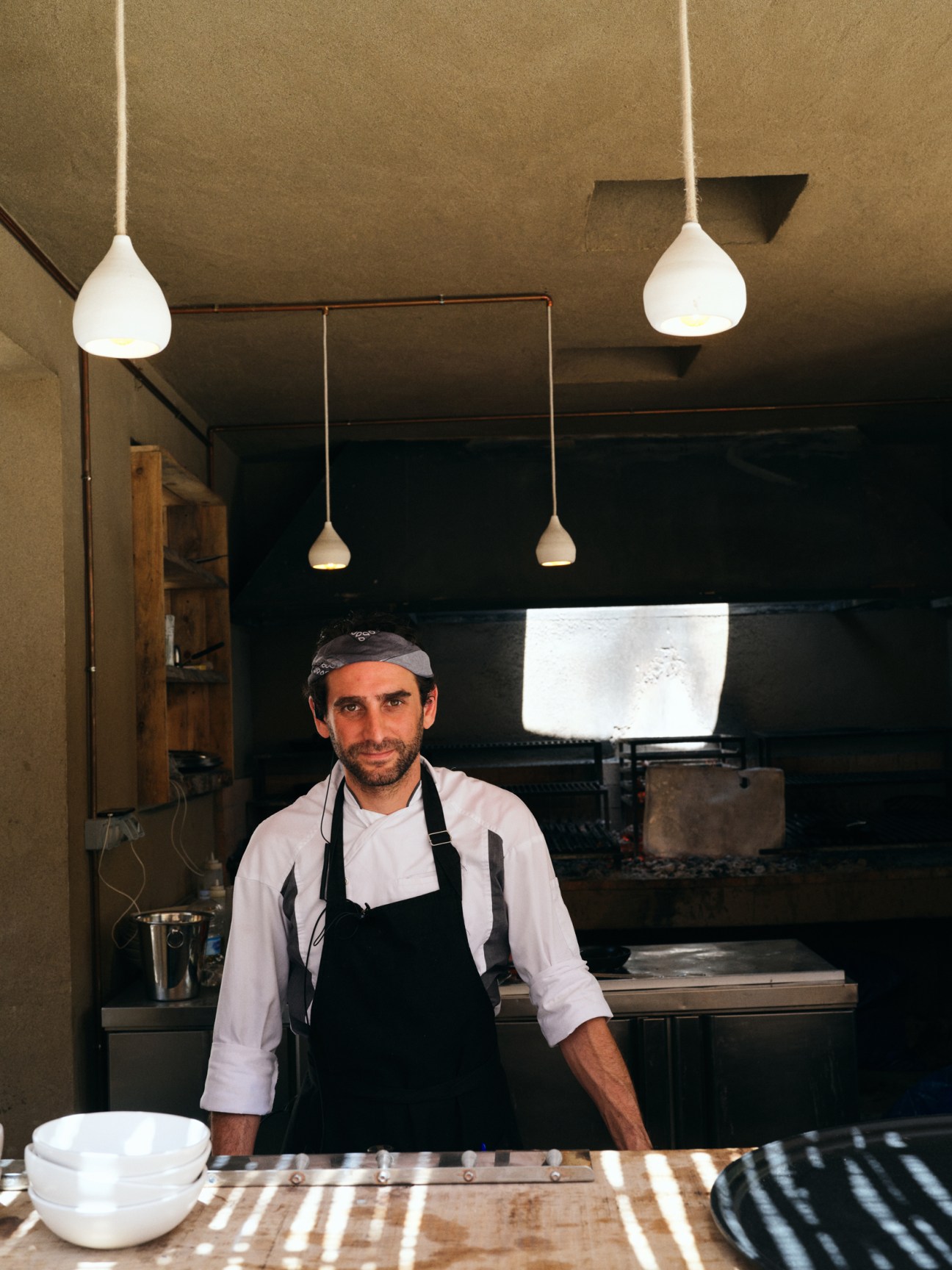
“We’re the only one still open,” says Pelayo, with just a hint of glee. Pelayo will be able to extend the 43 years he has spent darting between the multi-coloured chairs of his ramshackle restaurant thanks to the decision his father made 50 years ago to purchase the land outright. That ownership has complicated any potential backroom deals to uproot his family’s livelihood. The Pelayo family have watched fashion moguls, football club owners and hedge-fund directors snap up nearby properties. Their giant Sunday paella feeds up to 400 people on Sundays – for €16.50 a head. Keeping such customs alive is as much about standing up for the everyman as defending the island’s simpler way of life.

Under Cala Saona’s tall juniper pines, waiter Miguel brings one of Formentera’s best-known dishes – a giant tray of lobster, fried potatoes and eggs – out to a table of still-dripping swimmers. “Restaurante Chacala started with just a grill on the rocks in 1969 but we made some improvements,” he says, gesturing to the roof and fitted-out kitchen; it’s a monument to the way many popular beach businesses here have evolved. Miguel is also concerned about the inflationary squeeze of “bigger fortunes, soaring prices and fewer places opening.”
Politics and finance have always been table fodder, though. This summer, as conversations about uneasy futures flavour many meals, signs of the gradual creep of commercialisation sit in plain sight. A serviette dispenser sponsored by Coca-Cola here; chairs branded by a beer company there; coffee cups stamped with the insignia of an importer for your post-meal espresso. At many beach restaurants such as the Formentera family-owned Chacala, big companies have found a way to secure seats at a table.
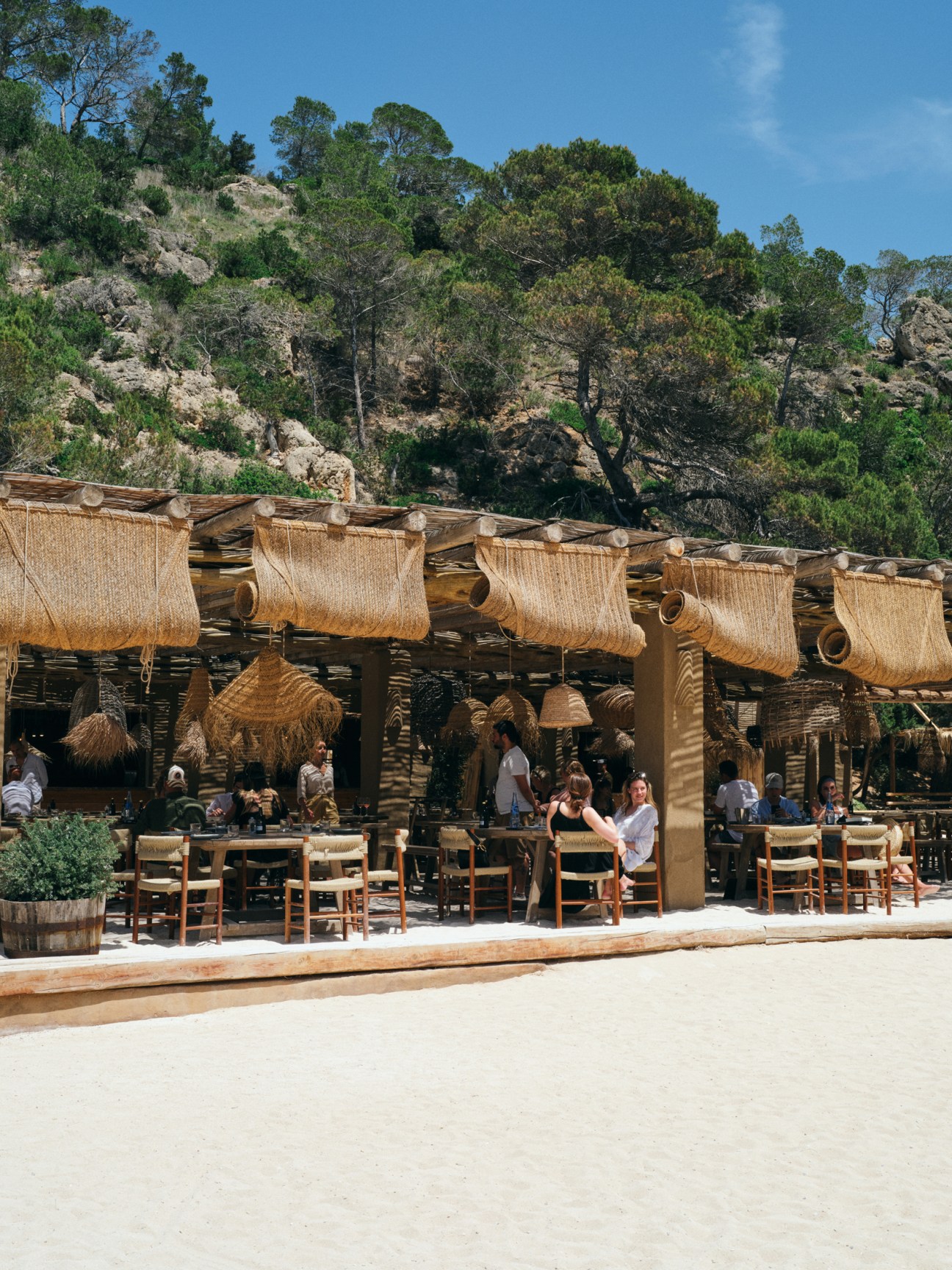
Passing the baton between the old guard and new has always presented opportunities too. Such transitions are a natural part of the tide of change. For restaurant Es Còdol Foradat, the former owners had grown tired after 25 years of continuous service in the sand dunes and sold their leasing rights to Catalan chef Nandu Jubany. The food here is now more refined – and pricier – than before but it’s still acceptable to stroll in barefoot with a pareo wrapped around your waist. Here, under the swaying rattan lampshades, the over-branded plastic is replaced by bespoke ceramics and hand-woven chairs: the upshot of more expensive paella (meals can cost up to €150 a head) but it’s also a visual tribute to the simplicity of seaside restaurants.

Beach eateries to try
Formentera
Restaurante Chacala
Cala Saona
Kiosko Bartolo
Platja de Migjorn
Es Còdol Foradat
Platja de Migjorn
Restaurante Pelayo
Platja de Migjorn
Ibiza
El Bigotes
Camino Cala Boix a Cala Mastella
Mar y Sal
Ses Salinas
El Silencio
Cala Molí
Costa Brava
Tragamar
Calella de Palafrugell
Es Dofí
Tamariu
The neighbouring island of Ibiza is no stranger to the spectre of popularity. An abridged version of the island’s success story goes a bit like this: some free-thinking iconoclasts found paradise. A new-age mythology about hedonistic life-on-the-fringe became a magnet for the masses. First bemused, then opportunistic, local farmers got rich, then greedy – and richer still. Paradise now comes with a price-tag and lots of stakeholders seeking a slice of the profits. While this has presented new opportunities to many, some smaller businesses have been priced out and faltered.
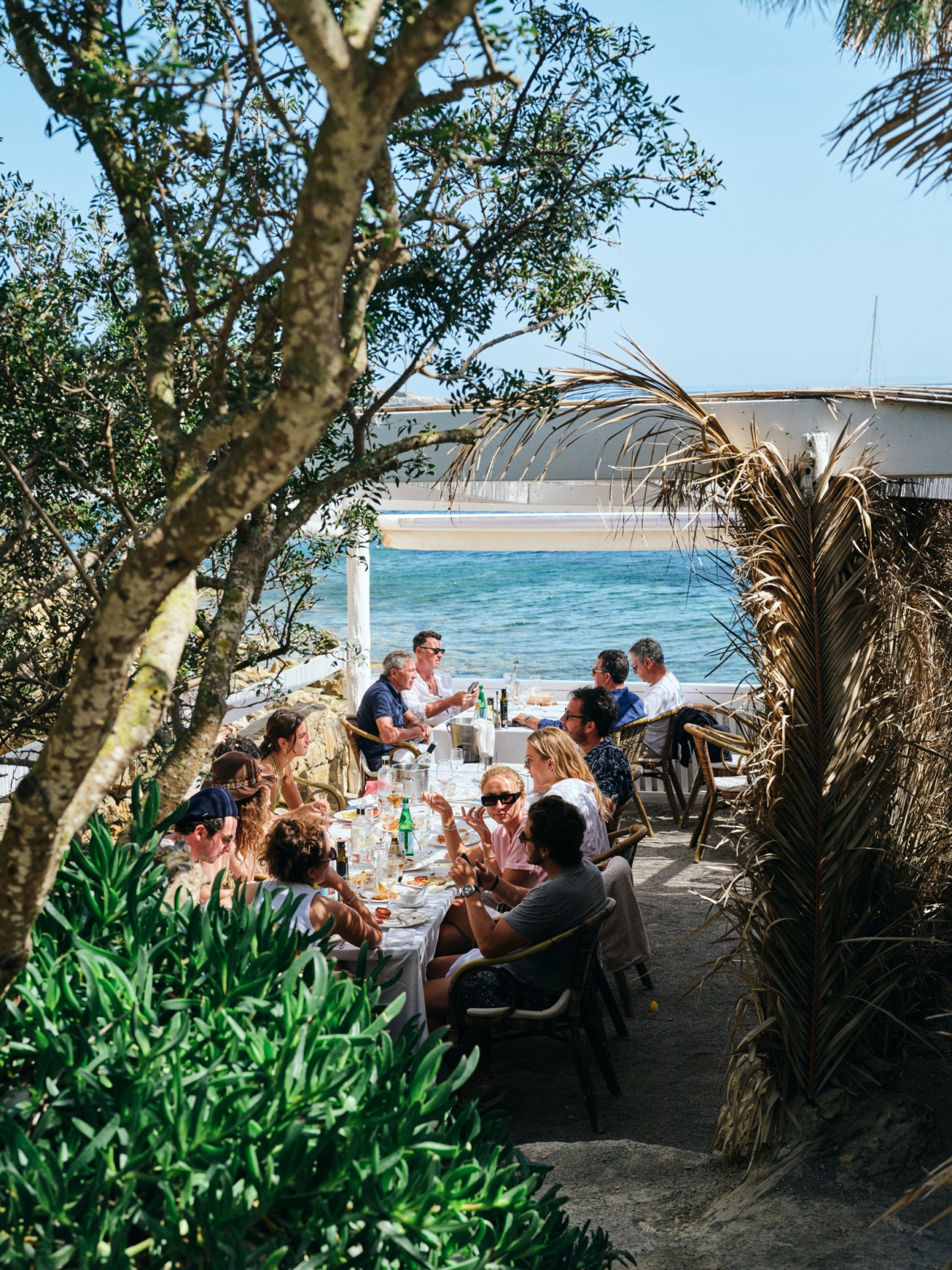
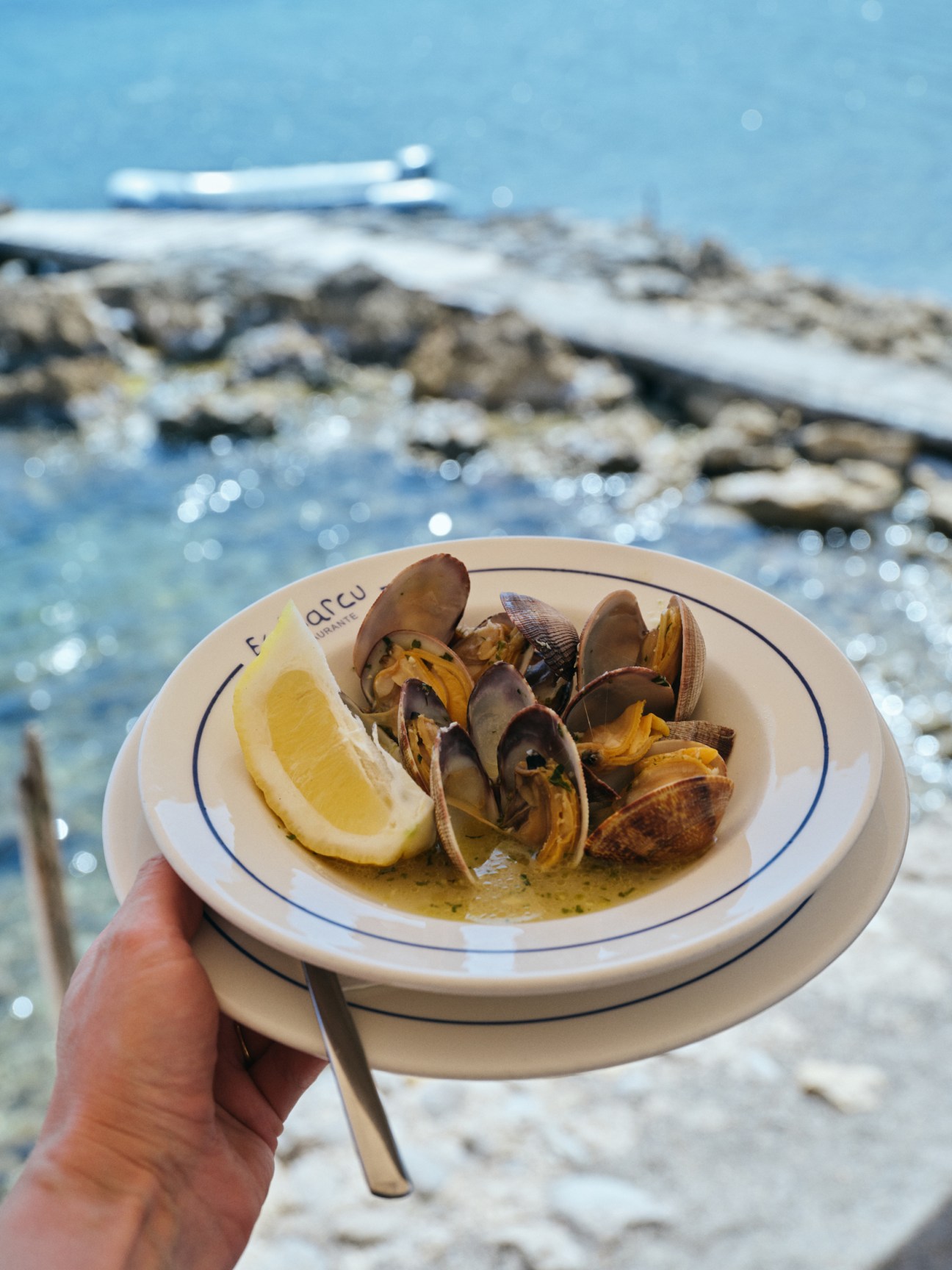
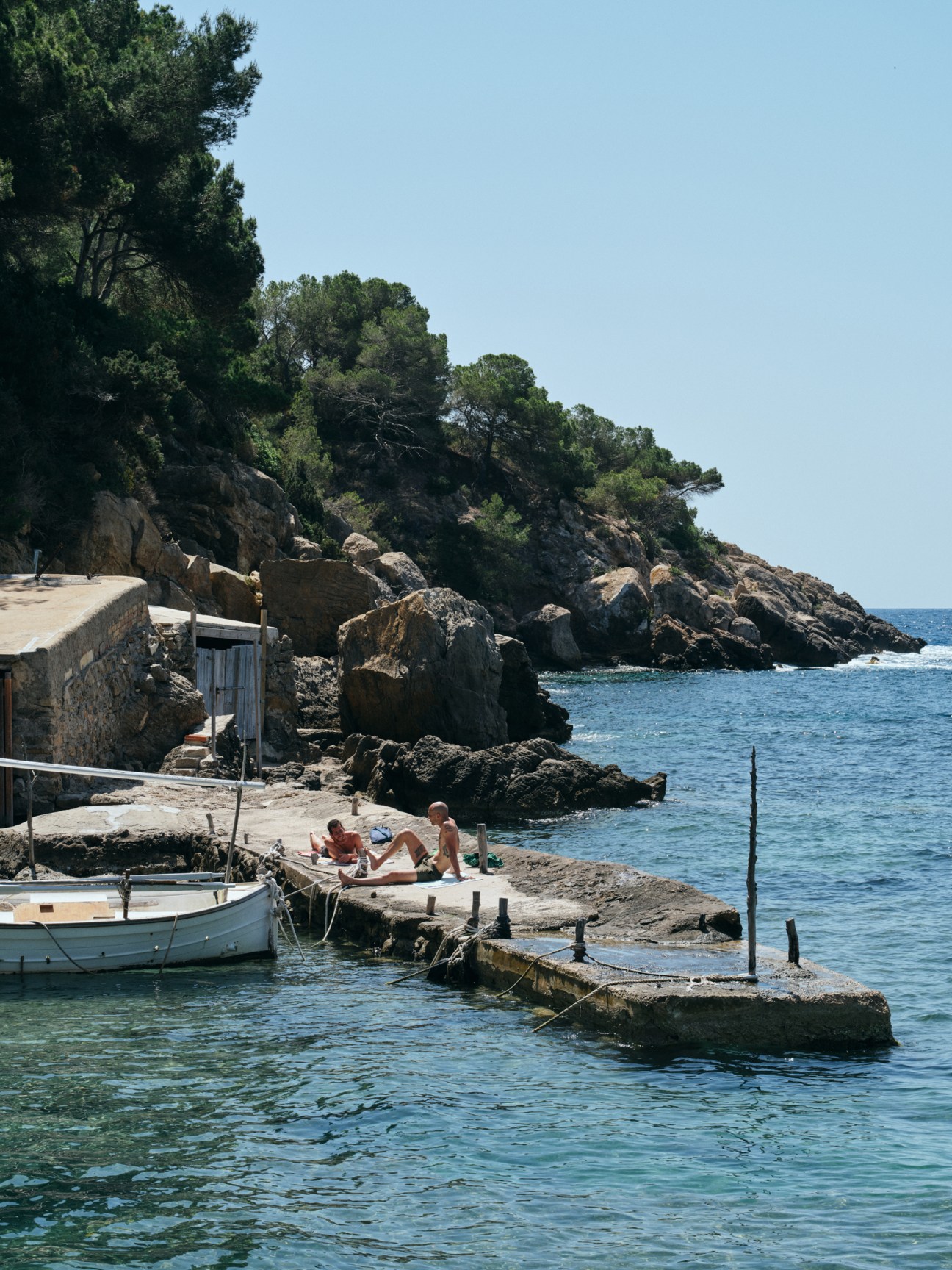
Some stubborn strongholds still quietly fend off the commercial currents. In the stony alcove of Cala Mestella, El Bigotes started as a fisherman’s shack where Juan Ferrer prepared Bullit de Peix, an Ibicenco fish-and-rice stew, for friends. With smoke billowing from under the roof, the maître-d’ clutches a vast reservations book to confirm that arrivals are in the right place. There are two daily sittings: wood-fire grilled seafood at midday (€17) and the coveted fish stew served at 14.00 (€22). Reservations for the latter need to be made nearly two months in advance. This said, prices have remained low. Loyal patrons are also lured by the continuity (a novelty here). The family’s traditional llaüt fishing boat is anchored at arm’s length from the restaurant and the old chairs are as sturdy as ever. The unspoilt views of the cove do the rest.
Down south, behind the dunes of Ses Salinas beach, Quim Coll is readying the reopening of Mar y Sal, a once-dilapidated beach bar and eight-room hostel purchased by a group of Barcelona-based restaurateurs. “We don’t want to open another expensive, exclusive place,” says Coll, the kitchen director. “The bar used to be open 24 hours a day, catering to all types, so veteran customers shouldn’t be left out in the cold.” After 57 years of service, this changing of the guard shouldn’t rock the boat.
Now in its second season, the Ibiza restaurant El Silencio has qualms about tending to the wealthy blow-ins at the expense of locals and it has done something about it. The Paris-based hospitality proprietors split their venue in two: catering to the bold and beautiful on one sand-floored side and offering another, more affordable menu around the pool. “A lot of people don’t realise the work that goes into setting up a place like this,” says Antoine Caton, head of operations, about their seasonal operation, which involves bringing in sand and water as well as bringing in guests.
Elsewhere, Caridad Cabañero has been running Es Xarcu with husband Mariano Torres for 40 years. She knows long-time customers’ table preferences by heart and Torres’s mobile phone rings hot with requests for the restaurant’s tender to come and pick them up from their boats. “It’s the love of people that motivates me every day,” says Cabañero, brushing off talk about profits or the economics of the restaurant business. “Although this year rising fuel prices have put the pinch on our fisherman: some aren’t even taking their boats out.”
Back on the mainland, it’s a few ticks before 11.00 on the Costa Brava’s Platja Canadell and the sea mist hasn’t deterred a sprinkling of morning sun-chasers. Children skim stones into the small waves. A mother and son battle over a game of padel while a furrowed señor surveys the beach, his expression flapping between indifference and inquisition.
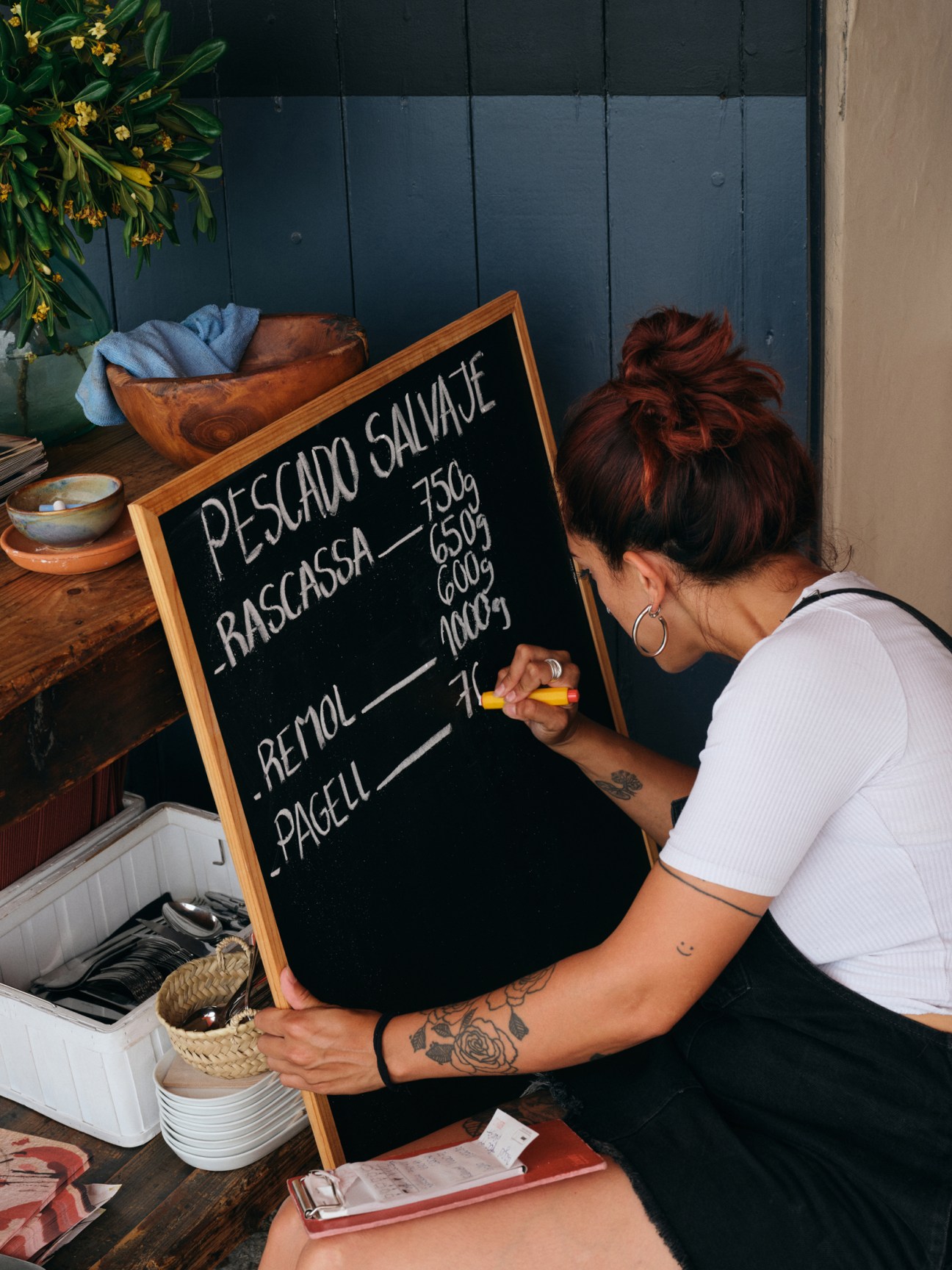
Under the orange awning of seaside restaurant Tragamar, waitress Julieta is too focused on the here and now to talk about the future; she’s chalking up today’s peix salvatge (wild fish) specials, which are cooked in salt, grilled or baked to the customers’ liking. Inside, manager Marc is trying to stem the flow of people who see the 180-cover restaurant – the only establishment on the lower beach – more like a facility than fancy eatery. “The trick is patience, knowing how to lay down the law, and being simpatico,” he says. Half a dozen people have already poked their heads through the door asking for takeaway drinks or a quick trip to the bathroom. Marc, understandably, would be more interested in getting them to fork out for the grilled squid garnished with sobrasada.
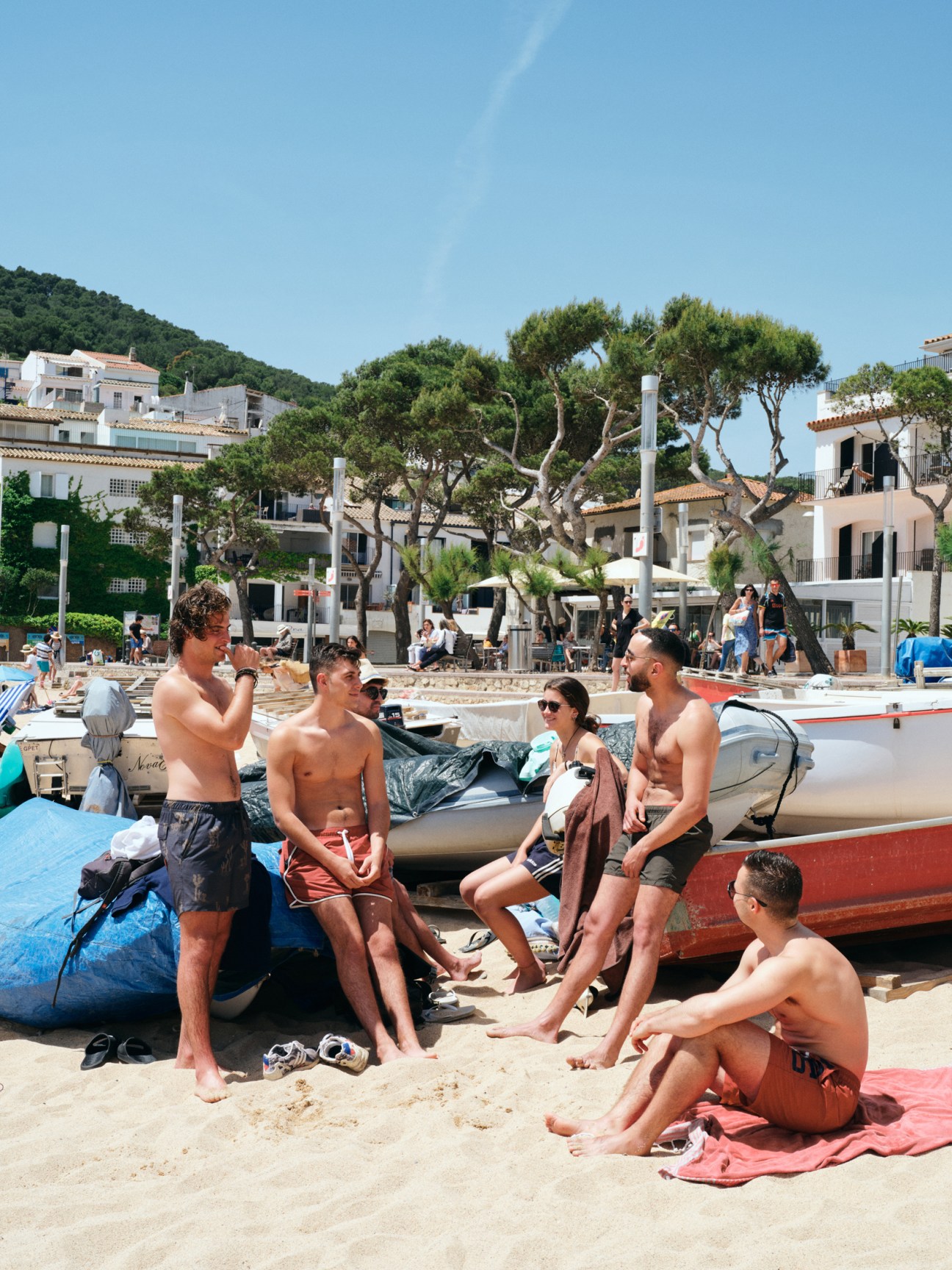
Not far away, on the postcard-perfect beach of Tamariu, Carlos Herrera is standing in front of Es Dofí (“the dolphin” in Catalan), anticipating the midday rush of customers. “We don’t take reservations,” he says. “Our first-come-first-served rule gives everyone a chance to get the best table.” He and his brothers, Ilario and Alfonso, took over their father’s 50-year-old restaurant several years ago. “Even if the queen came, she’d have to wait her turn,” he says in jest. Carlos greets many customers by name, some with hugs, aware of everyone around him. As people feast on plates of sonsos (tiny fried fish) and sip on tissana (sangria with cava), Es Dofí has a spontaneous, unfussy feel, despite being run like a tight ship.
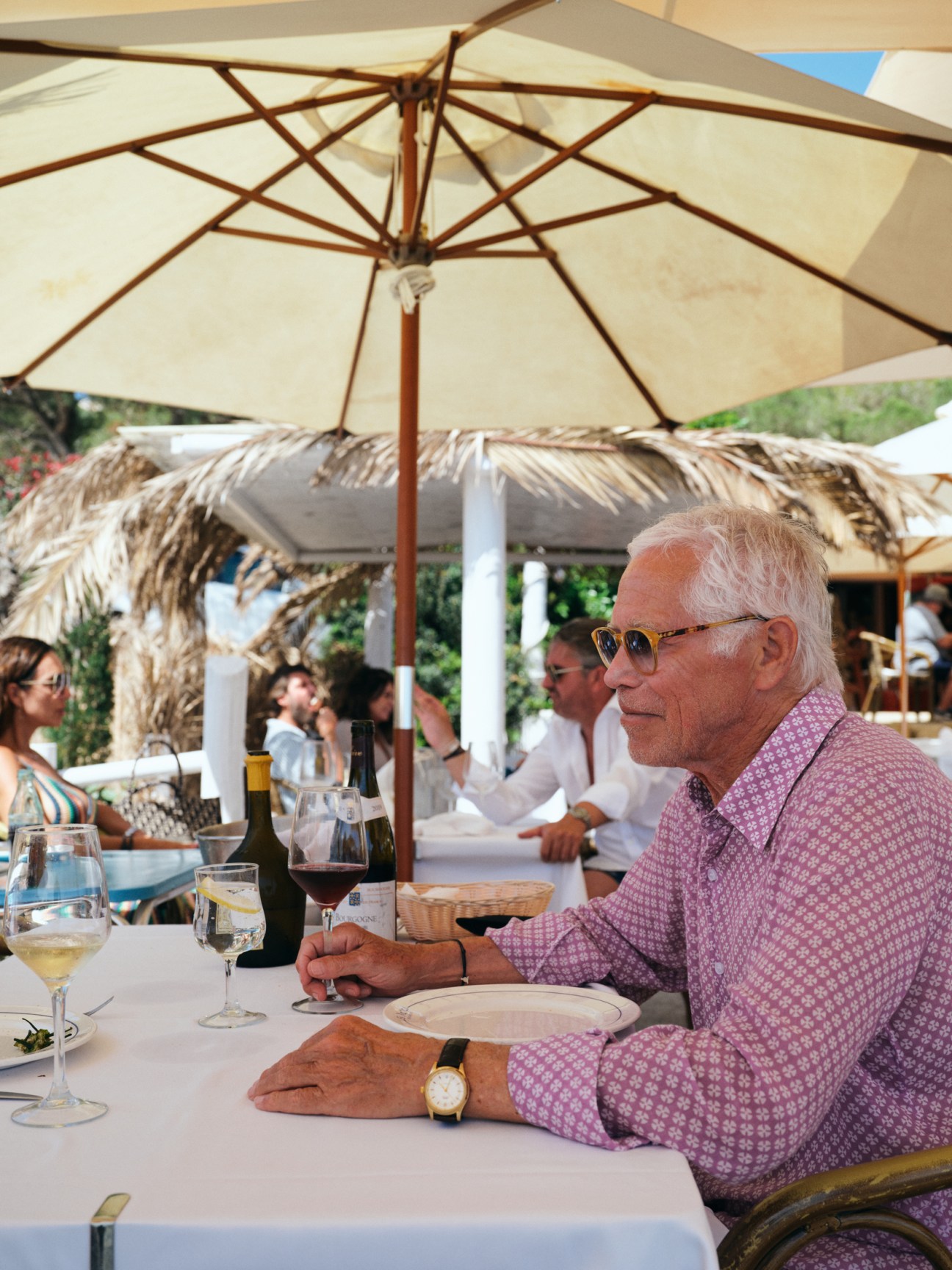
Nextdoor, a gentleman in a low-slung deckchair gestures Monocle over. “This house was built by Spain’s best architect,” he says. He’s not wrong. The four-storey town house was designed by modernist Josep Antoni Coderch and the sunlounger- slumped, Barcelona-based publisher Antoni Paricio has been visiting here in style most summers since 1976.
Whisking us up for a tour to the rooftop, Paricio points to the shore where fishermen once operated makeshift restaurants on the sand. “Change always comes; things get bigger,” he says, pointing to the row of evolved esplanade restaurants. “But sometimes we don’t really need so much.” As the waves slide in and out, his poignant words could be about the sea or about life itself. “But create something with integrity,” he says. “Then you can resist the stronger tides.”
Pursuits of happiness
1.
Quick on the draw
Culture
Writer
Shantell Martin (as told to Sonia Zhuravlyova)
Known for her stream-of-consciousness line-drawings, US-based British artist Shantell Martin shares the power and pure joy of creating.

I encourage everyone to pick up a pen and just draw. You don’t have to be an artist. That mechanism of connecting your head to your heart to your hand is so powerful. There’s a reason that we all draw as children. We’re given this gift that allows us to calibrate ourselves to the world. But along the way, perhaps by design or just through bad luck, it is trained out of us by society.
I never knew that being an artist was a career option so I studied graphic design because at least I would be in the creative space. When I graduated I went to Japan. I wanted to be in a place that was completely unfamiliar. I found a job teaching English and didn’t draw for a while; I pushed it away but it came back to me.
A friend who organised avant garde concerts asked whether I would like do some of my drawing on an overhead projector when one of the bands was playing. That experience changed my life because it was the first time that I found peace within myself. While drawing live, I switched off and it gave me complete focus in the moment. Initially I froze but then I just started drawing. Then, 45 minutes later, I lifted my head and saw that the show had finished. I looked down and there was this magical drawing. “Wow,” I thought. “That’s me. I did that.”
After that it was about finding technical clarity, wanting that line to be as crisp and perfect as possible. In Japan there is a craft-based culture focused on attaining mastery over a lifetime, which I absorbed. Drawing for a live audience was about being present and creating an experience. That gave me a foundation of who I am as an artist and accelerated my career.
We all have a style within us, a creative fingerprint, and I’ve been able to extract that through the process of live drawing. You could say that it’s a kind of performance. What’s wonderful about it is that it doesn’t give you time to be anyone else. You can only be yourself. So it’s the most honest way to find your style – you don’t consider what someone else might do.
For every new work or show, I think about what I want to say. I’m always asking questions. I want to put a wish, hope or an intention out with my work. For example, for my latest show at Subliminal Projects in Los Angeles, I spent weeks just thinking and writing a 27-point manifesto about the future of art, then created a show around that.
I also use words. But words are made up of lines too; it’s just that we give them more power or they come with more baggage. I’m a very proud dyslexic. As an artist I have creative freedom to make all of these lines and also the freedom to create words as I hear them. I see this as a superpower, a way of seeing things from a different perspective. But words have a power over us. I use them to pull people into the drawing because I rarely use colour.
When I create a show or an installation, although the scale might be big there’s nothing in there that you couldn’t do yourself. All of the tools and the media that I’ve used are accessible. I love showing that a simple line can be so powerful that you can use it to create installations that are larger than life.
Creativity is finding yourself in environments and situations where you can forget about time. When that happens you put yourself in the moment. You can have honest actions and reactions. It’s the freedom to know that you can create when you want, where you want, how you want, without any judgement, assumptions or pressure. It’s also about the experience of making a mark and seeing what it looks like. And when I say “mark”, that doesn’t have to mean a physical mark. It could be cooking, dancing or moving your body – whatever sort of creative expression that works for you. So do it. Make your mark.
About the writer:
British visual artist Martin grew up in southeast London and attended Camberwell College of Arts and Central Saint Martins. Today she divides her time between New York and Los Angeles, where she has worked on everything from live drawing installations to designing and choreographing a ballet.

2.
Walking the walk
Travel
Writer
Annabel Streets
Author Annabel Streets explores what makes cities a pleasure to perambulate and how to get the most out of your stroll.
Most people decide to visit a city based on what they might see and do there. Not me. Because of my personal and professional interest in seeing things on two legs I seek out walkable cities. In my decades of pounding the pavements in hundreds of cities around the world, something struck me: the ones that properly revive me are those around which I can easily and pleasurably walk.
Strangely, these aren’t always the places that are lauded in studies or rankings of the world’s most walkable cities. So I put one foot in front of the other to find out a little more. Like many of us I have a sedentary job so a break means getting moving – no lying by a pool for me. I also want the chance to see, hear, smell and taste new things. A walkable city should provide a sense of escape and novelty while you’re on foot. I want to stroll from market to museum to monument, while eyeing up beguiling buildings and flamboyant fashionistas along the way. Herein lies the problem: many cities deemed walkable aren’t pleasurably walkable.
Paris, Venice and Athens, for example, regularly top the league of Europe’s most easily strollable cities. Their attractions are in close proximity and their pavements are generous in size. Yet these are among the most polluted places in Europe. Time spent inhaling exhaust emissions (vaporetto fumes in Venice), accompanied by the screech of motorbikes, does little for our health or mood. A study published last year described air pollution as a bigger killer than Aids, hiv, tuberculosis and malaria combined, not to mention being more deleterious to public health than smoking or war. The last time I visited Paris, which was once my favourite city, I felt as though I was inhaling diesel and vowed never to return.
But if you must hit the bucket list of big-city locations, don’t despair because I have a few tips. Air pollution and traffic noise fall at certain times of the day and in certain weather conditions. The best time to walk larger, polluted cities is in the rain, which disperses harmful emissions, muffles noise and reduces the crowds – just remember to take an umbrella. Wind is similarly effective at cleaning the air, so breezy days are good for a city ramble. Try to walk when traffic is at its least busy: avoid rush hour or opt for early mornings or evenings. Even better, take an old-fashioned map and plot out routes that avoid arterial roads or download one of the newer mapping apps, such as Go Jauntly, which can plot green routes that are less polluted and frequently more interesting. If you still can’t avoid traffic-clogged routes, walk at the furthest edge of the pavement and breath through your nose – our nasal cavities contain a remarkable air-filtration system.
“I want to stroll from market to museum to monument, while eyeing up beguiling buildings and flamboyant fashionistas along the way. Herein lies the problem: many cities deemed walkable aren’t pleasurably walkable”
Instead of big, blockbuster cities, I now prefer to walk in smaller, quieter cities with cleaner air. So I’d rank Salamanca over Barcelona, Toulouse over Paris, Tallinn over Kraków, for example. But my real favourites are the handful of cities that have banned traffic altogether from their centres, such as Dubrovnik and Ghent. I have a hunch that we’ll see many more of these in the coming decade. I also like larger cities with extensive pedestrianised areas, such as Munich, Stockholm and Oslo. Nordic cities have among the cleanest urban air.
Alongside uncrowded pavements and traffic-free zones, a joyfully walkable city also needs plenty of green, open spaces, which is one of the reasons why London routinely appears in the top five of the world’s most walkable cities. But it’s not just bounteous greenery that makes a city enjoyable for pedestrians. Cities with plentiful water, be it a coast, canals or a river, often overflow with walking opportunities. Some of my favourite places have miles of beautifully reclaimed river frontage designed solely for walkers: think Brisbane and Bordeaux.
Good public transport is perhaps paradoxically vital for a properly walkable city as it enables pedestrians to take short cuts or carry home their shopping. It also allows those living or staying outside the city to visit without their wheels. Even the old-fashioned idea of a network of trams, which produces significantly less air pollution than cars, is coming back into fashion. As I write, I’m just back from a working visit to Sydney, where the original tram system was ripped out in the 1960s to make way for cars but is now being reinstalled. On this trip I used the tram when I wanted to discover walking routes that were often further afield. A study carried out during the pandemic found that walkers who sought out diverse routes reported feeling happier than those who trundled along the same well-walked paths. A change of scenery is often all it takes to shift our perspective and our mood.
About the writer:
Streets is the author of 52 Ways to Walk, published by Bloomsbury, and Windswept: Why Women Walk (under the name Annabel Abbs), published by Two Roads.
3.
Great expectation
Science
Writer
David Robson
Author David Robson holds forth on the psychology of expectation and how small changes in the way we think can help create a brighter future.
Whether you want to lose weight, get stacked, write a novel or learn to play a musical instrument, almost all positive life changes ultimately come down to willpower. Do you have the self-control and focus to stick to your goals? Will you avoid the temptations that will lead you astray?
You might know some rather irritating people who can truthfully answer this with a resounding “yes”. These are the folks who seem to be able to effortlessly achieve whatever they turn their mind to. For others, the temptations of junk food, phone-scrolling or trash TV seem too great and so their goals fall by the wayside. These decisions aren’t trivial either: scientists estimate that up to 40 per cent of premature deaths can be attributed to lifestyle decisions stemming from low self-control (a fatty feast here, another drink or cigarette there).
It might be comforting to assume that these differences are hardwired into our brains. Some people just have better willpower than others. Research, however, suggests another alternative: that our willpower is shaped by our beliefs, which in turn are learned from people around us. Our ideas can become a self-fulfilling prophecy. They determine how easily we lose mental focus or give in to temptation. And by changing their ideas, anyone can improve their self-control.
These findings build on emerging evidence that “expectation effects” can transform our lives. The most famous is the placebo response, in which our belief in a medicine’s effectiveness can actually increase its benefits.
“For many people, a single setback can be taken as evidence that their willpower is weak. As a result, people abandon goals and give in wholeheartedly to vices, a phenomenon pleasingly known in psychological literature as the ‘what-the-hell effect’.”
So are you ready for an experiment? First let’s establish how you frame challenges. Do you feel that as challenging situations accumulate, it gets more and more difficult to resist the temptations? Do you feel the need to refuel with snacks or TV or a treat after something strenuous? Do you need time to recover your mental energy after strenuous mental activity? If so, you have what psychologists, including Veronika Job at the University of Vienna, Austria, call a “limited” theory of willpower.
By contrast, people with a “non-limited” theory of willpower take another view. They might feel energised by strenuous mental activity and seek out new challenges (rather than chocolates) as a result. When they resist temptation they feel strengthened to withstand new ones. They are also more likely to believe that mental exertion helps build cerebral stamina so they can continue hard tasks for longer. These are the effortlessly purposeful people.
In laboratory studies, people with a limited willpower mindset tended to be more easily distracted after tasks requiring deep concentration. Those with the non-limited willpower mindset remained focused for far longer. Indeed, in many situations, their willpower actually increased over time, like a muscle toned by repeated use. Their mental stamina becomes self-perpetuating.
The long-term consequences of these findings are profound. Whether they devote themselves to study, eating healthily or exercising, people with a non-limited mindset tend to be far better at sticking to their goals. Intriguingly, Job found that these differences are especially visible at times of stress, precisely when people are most likely to abandon their goals.
Our mindsets tend to be shaped by the people around us as well as our upbringing. One cross-cultural study by Krishna Savani at the Nanyang Technological University in Singapore found that, based on their performance in laboratory tests on focus and self-control, people in India are more likely to endorse the non-limited viewpoints than people in the US. Indian respondents tended to welcome challenges to their willpower and gave in less often than Americans.
Fortunately, and wherever we come from, our mindsets can be changed. Even reading about non-limited willpower was enough to shift some participants’ beliefs. This very essay might have already given you a head start (you’re welcome). Evidence also shows that finding a role model and reminding yourself of their iron will can galvanise your determination.
But we also need to rethink our attitudes to failure. For many, a single setback can be taken as evidence that their willpower is weak and they are doomed to repeat the stumble. As a result, we abandon our goals and give in wholeheartedly to vices, a phenomenon pleasingly known in psychological literature as the “what-the-hell effect”. We need to avoid this all-or-nothing way of thinking and focus on the overall progress leading up to that point.
The past three years have yielded plenty of stress that was beyond our control but the latest neuroscience shows that we all have the power to change our habits for the better. The question is, what are you expecting?
About the writer:
Robson is a science writer and the author of The Expectation Effect: How Your Mindset Can Change Your World, published by Canongate in the UK and by Henry Holt in the US.
4.
The big retreat
Leisure
Writer
Petri Burtsoff
There is no better way to de-stress than to take yourself away from the distractions of daily life. Here’s what the Finns do.
Long before “mindfulness”, “going offline” and “switching off” became part of our language, the Finns had a simple antidote to the stress of city life. They leave and head to simple cottages in the countryside. In a country of five million people, there are more than 500,000 such cottages, almost all of them in the woods, beside a lake or by the seaside. Finns retreat to their cottages en masse during the summer holidays, often spending weeks living a simpler life, some voluntarily foregoing even the basic luxuries of electricity or running water.
The Finns aren’t alone in retreating somewhere for the summer break either. Italians flock to the sea during the ferragosto holiday in mid-August and many inhabitants of the cooler corners of northern and western Europe make for the Med. Many Parisians are rarely seen in Paris in July and August. But, in my humble and highly partisan opinion, it doesn’t compare to the benefits of disconnecting the Finnish way.
Research shows that recovering from work stress takes time and it only happens when your mind and body are removed from the cause of stress. The recovery can be hastened when you move to a place that’s disconnected from work and where you can occupy your mind with something else (I suggest mushroom picking and skinny dipping).
Finnish cottage holidays aren’t at all sedentary. Potatoes, onions, tomatoes and herbs need to be planted, tended and harvested. That wood for the lakeside sauna won’t chop itself. Come to think of it, that picnic table could do with a quick sanding down and varnishing and woe betide the holidaymaker who falls behind on maintaining his or her fishing boat after the ravages of winter.
This might sound stressful to some readers but rest assured, when there’s no one breathing down your neck, no deadlines to meet and no client to please, chores become leisurely pastimes that help you shift your focus. And that’s really the key. When your brain focuses on a new activity you’ll quickly feel a sense of disconnect from common concerns such as a bulging inbox.
But this isn’t a self-help book, more a piece of shared wisdom. In my opinion there are no quick fixes to help you achieve meaningful and effective rest. That said, Finns have learned that disconnecting properly takes time – the idea of a measly week or two off every year, as is the standard in Japan or the US, sounds rather disagreeable to our ears. Summer houses prove that disconnecting is possible – even in the age of email – and it does not even have to mean switching your phone off.
After a few days of rusticity, surrounded by nature and living a simpler life, you’ll find yourself forgetting where you left it. Or, with a little luck, the battery will die and you’ll find yourself without the electricity to charge it.
About the writer:
Monocle’s Helsinki correspondent Burtsoff has contributed countless reports to the magazine and Monocle 24 radio. After embedding with Nato’s Cold Response forces in northern Norway recently we decided that he’d earnt a break.
5.
Advantage set
Sport
Writer
Michael Booth
Monocle’s Copenhagen correspondent excels at many things but his lamentable tennis skills are something from which he draws both comfort and amusement. Even, that is, if he was beaten to the baseline by a 12-year-old girl.
One of my best friends is a life coach. I was visiting her in her life-coachy home in a converted bakery in the north of England recently when she asked me, “Michael, what makes you happy?” I suspect she was hoping for something like “seeing my family flourish”, or “pushing beyond my comfort zone” or “my volunteer work”. My response, however, was to focus on me. I’ve always thought that “comfort” is the best of all the zones and I don’t do any volunteer work. So I found myself answering, “Hitting a tennis ball.”
Not much for a life coach to work with there: an uncomplicated, almost brainless pursuit, something a labrador retriever might choose. But, for me, hitting a tennis ball is far from simple because I am completely shit at it. Whether playing in the garden as a child, loping around the municipal courts as a teenager or on the rare occasion when I’ve had chance to pick up a racket as an adult, my game has been lamentable.
But recently I began talking about joining the local club and playing again. There was scepticism from some members of my family because of my perceived decrepitude and lack of fitness but, for some reason, my wife had faith and for my 50th birthday she booked a week of intensive training at a club in Mallorca as a gift.
“Even someone of almost wilful physical ineptitude can shrug off the shackles of lifelong rubbishness and find joy in hitting a ball”
We were a mixed group of men and women, ranging from our early twenties to properly elderly. On the first morning, the scowling, leather-skinned Spanish ex-pros charged with our instruction told us to warm up by jogging around the court so they might also assess our fitness and place us in the various ability groups.
It turns out I excel at gently shuffle-jogging around a tennis court because I was put in a group of men in their early thirties, all of whom had that lean, mean look of club tournament players. I knew even before we started that I would be hopelessly out of my depth but a tiny voice in my head told me to go with the flow. What if I wasn’t actually that pitiful after all?
We were told to start knocking the ball to one another. And I was as atrocious as I’d ever been. It took the instructor less than 20 seconds to realise his error and direct me to a far court, where I was told to start hitting with a Spanish man, Olivier, who I later discovered was 72. (He was good but I destroyed him with the drop shots.)
At one point during my third day my instructor, visibly agitated with my slow progress, invited a 12-year-old girl onto the court to demonstrate where I was going wrong with my backhand. She was amazing. A champion in her age group, apparently. He didn’t do it to humiliate me; it was just an effective way to show me a great backhand. Still, a 12-year-old girl.
But you know what? I absolutely loved my Balearic boot camp. I loved the potential energy of that ball in my hand, the eternal hope in defiance of all the evidence that I wouldn’t shank it to the moon or once again plop it straight into the net. I loved the gratifying “thwock” when it hit the sweet spot. And is there anything more exhilarating than executing a proper top-spin backhand, concluding with your arms spread, head turned to the left as the ball describes a sleek parabola into the opposite corner?
I managed it for the first time ever on the third day. Slowly, I was becoming slightly less rubbish. The instructors introduced tiny adjustments to my swing, my positioning, my grip, which had a transformative effect. I found that it was possible to change, to improve.
This was a revelation to me. If you are prepared to open yourself to new ideas, to sacrifice some dignity and learn from 12-year-old girls, even someone of almost wilful physical ineptitude can shrug off the shackles of lifelong rubbishness and find joy in something as simple as hitting a tennis ball. Turns out it wasn’t a life coach I needed.
About the writer:
Booth is an award-winning, best-selling author of seven non-fiction books. He is Monocle’s Denmark correspondent, and contributes to numerous newspapers and magazines.
6.
Just for the joy of it
Keyif
Writer
Hannah Lucinda Smith
What can Istanbul’s cats and that eccentric gentleman with his feet in the Bosphorus teach us about taking time to enjoy urban life? Hannah Lucinda Smith decodes the ancient Ottoman art of ‘keyif’.
When was the last time you did something simply for the joy of it? Not to learn anything new, nor develop a skill, not for the likes on social media but just for the delectation of the moment and pursuit of sublime sensations washing over you? I would wager it has been a while. If so, you need to get acquainted with the concept of keyif.
The word translates from Turkish as “pleasure”, but in practice it is much more than that. Keyif can be found in the feeling of the sea lapping around your toes as you smoke your hookah pipe, having dragged your deck chair and plastic table out to paddling depth. It can be found in an hours-long breakfast that meanders through courses of cheeses, eggs, jams and honey and keeps you full until dinner. It is there in the delight of rocking in a hammock, watching the clouds and listening to the cicadas. For a pastime to count as keyif it must involve minimum effort, maximum gratification and achieve nothing more than a pleasing state of mind.
Here in Istanbul, the Bosphorus is the main source of keyif. Sometimes it is enough to simply watch the waves from the deck of a passenger ferry on a sunny day or from the window of a top floor apartment in a storm. If the weather is clement, find a spot on one of the city’s corniches, park a camping chair and simply stare out into the water. Find one of Istanbul’s public beaches and dive in if you’re feeling more daring or, if you’re lucky enough to have one, take your fishing boat out and simply bob around for a few hours to enjoy solitude in the middle of a city of more than 15 million.
Walking aimlessly, hands clasped behind your back and brow knitted in contemplation, was a traditional Turkish way to find keyif but these days many of Istanbul’s young men prefer to drive around in cars garlanded with Turkish flags and alloys, pumping music through boom boxes at window-rattling levels. Keyif for them, maybe, but not for the rest of us. As a rule, though, this pursuit should be conducted at low speed and low volume. Nature, food, chatter and idleness: these are the key ingredients of keyif.
It is a shame that such a concept has come to be seen as alien, or even sacrilegious. At some point, leisure became a commodity, a product to be sold, rather than a lack of anything dull or pressing to do. And if something is to be sold, then it must have a value: it has to promise to improve you in some way. Sports to make you live longer, travel to broaden your mind, creative hobbies to make you more interesting and marketable; we have managed to turn our time off work into yet more work. Pleasingly, keyif offers none of this. It will not give you a killer body, nor things to brag about to your friends. There is nothing to make you fitter, better, faster or stronger. And that’s OK too.
Another rule for recognising the concept is that if something calls itself keyif, then it is probably not. In Turkey, you’ll find countless restaurants and cafés of this name, and most of them will be stressful and overpriced. The concept is far too nebulous to be utilised like that. Even Turks can’t fully explain it, nor very often tell you whether an experience can be classed as keyif or not. Only you can decide that and only in the moment that it is happening. It might be found as you sip from a cheap flute of tea on a plastic stool in a pavement café or as you observe the beautiful people going about their day in an upmarket neighbourhood. There is no set price range for keyif.
Neither is it something that can be captured and shared. Your keyif location is probably photogenic but the spell will be broken as soon as you even consider taking a picture. If you are thinking of the future, of how your photograph will turn out and how much attention it might garner, then what you are experiencing is no longer keyif. You have allowed the banality of your ego to sneak in and break your connection with the moment. Stop. Switch your phone off along with your brain and try turning yourself into a sensory receptacle – a human being – rather than a content creator.
For inspiration look to the street cats, Istanbul’s real masters of keyif. Note the expressions on their faces as they stretch out in the sun, snoozing as everyone else hurries around them. Watch how they ascend to ecstasy as a passerby stops to tickle their ears. Then see how they immediately disappear as soon as someone whips a camera phone out. Cats do not care about life hacking. They are not bothered about how many times their photo is liked and shared (although that will probably be more than any photos of you). They don’t even care about being liked in real life. Their existence is dedicated almost entirely to the pursuit of sensory pleasure and the joy of lazing.
Holidays are the perfect time to explore the concept of keyif. If going to a beauty spot and posing for endless photos or doing extreme sports really pleases your soul, then congratulations: you have found your path to keyif. But before you start, take a moment to ask yourself where the pleasure really lies.
Is it in the moment of doing those things or is it in the anticipation of what benefits they will bring you? If it’s the latter, then you might need to keep searching. Because most of us, whether or not we would ever admit it, are happiest when we are doing not very much at all.
About the writer:
Smith is a journalist who has lived in Turkey for the past decade, reporting on everything from conflicts and coups to culture and street cats. She is also the author of Erdogan Rising, a biography of the Turkish president, and co-author of Zarifa, a memoir of Afghan women’s rights activist Zarifa Ghafari.
7.
Passage of time
History
Writer
Joseph Pearson
Historian and author Joseph Pearson traces the history of the European summer holiday from Roman roads to Romantic rogues and today’s knights in silicon armour on smartphones.
The summer holiday is a recent invention. More often in human history, voyagers have travelled long and far to find new shores and bounded along beaches in search of riches rather than for the sheer sunny joy of it. Well, mostly.
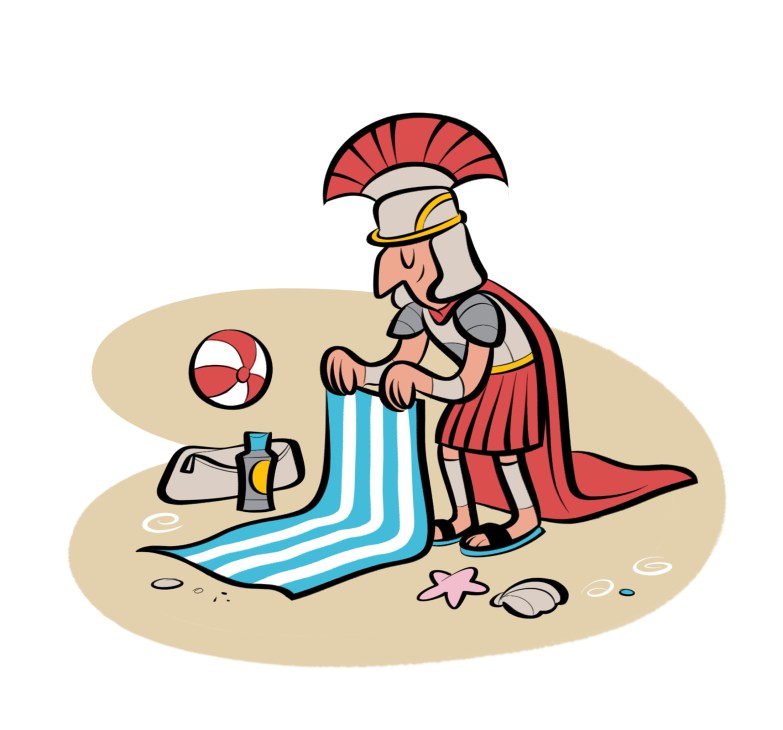
The closest antecedent of the modern beach break can be found among the ancient Roman holidaymakers – and it was the success of their cities that helped. With some 400,000km of road, a common gold currency to trade in and relative peace for 200 years, this enormous, prosperous empire allowed – perhaps for the first time – an untrammelled mobility for the purposes of hedonism for people of (almost) all classes.
This might mean nipping down to your beach villa on the Gulf of Naples to hobnob with the Caesars at Baiae, Campania. Those wealthy enough to head farther afield for a Greek beach vacation – say a tour of the Homeric lands – or an Egyptian Nile cruise would have been gone for much longer and paid much more than the package travellers of today. In fact, the “father of the guidebook”, the early geographer Pausanias, developed and honed his skills in the 2nd century AD. That said, the fruit of his work, the first-ever tourist guide (to Greece, in Greek) was notorious even in its time for its misleading directions and digressions – sure proof of both the fact that the Ancients had much to learn about the art of tourism and that getting a guidebook right is hard work.
“Lord Byron’s shacking up with a Venetian mistress, complete with pet fox and two monkeys, is just one example of the Romantic-era idea of the package holiday”
The fall of Rome in the 5th century AD led to the deterioration of the roads that had so reliably borne holidaymakers to their escapes. The summer holiday, in its Roman format, was put on ice for a millennium and a half. During the Middle Ages and the Renaissance, only the truly dedicated crossed the continent and swimming trunks and a towel were the last thing on these intrepid ramblers’ minds. Purposeful voyages were undertaken by journeymen and artisans, religious pilgrims and, naturally, knights rescuing fair maidens. Some travelled to improve their health. Michel de Montaigne, for example, turned to horseback riding to forget his bouts of potentially fatal kidney stones, travelling as far as Italy in search of curative waters. That said, in a rather modern spirit of the holiday, Montaigne drank rather more wine than water. His 1580s travel journal memorably warns that his favourite tipple was “rather undrinkable in Florence and diluted in Rome”. All roads, it seems, return here.
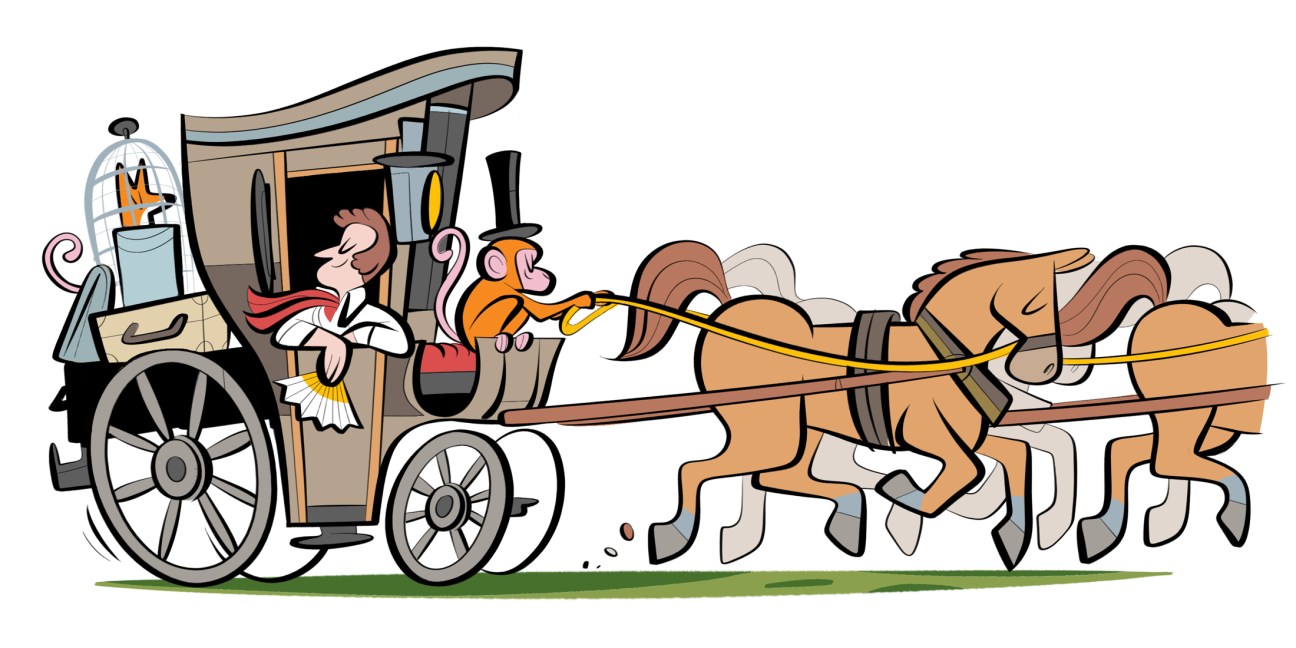
The most epic continental journey was the Grand Tour of the 17th to 19th centuries – a sprawling itinerary taking one to three years and not simply confined to a single summer. Wealthy young men were chaperoned through the Swiss lakes down to the crumbling ruins of Ancient Rome. The trip was, ostensibly, educational – an opportunity to dally with aristocrats, brush up on languages and “come of age”. Lord Byron’s shacking up with a Venetian mistress, complete with a pet fox and two monkeys, is just one example of the Romantic-era idea of the package holiday.
If the Romans both invented, then killed, the summer holiday, it took an enterprising British Baptist, teetotaller and cabinet-maker called Thomas Cook, to resuscitate something like it in 1841. His idea to herd 500 people to a railway excursion from Leicester to Loughborough (for a shilling each on the newly opened Midlands Counties Railway) inadvertently invented the world’s first package tour. This was just the beginning. By 1855, Thomas Cook & Son offered a tour to Europe and, by 1872, the first round-the-world all-inclusive.
The British Industrial Revolution and the attendant railroads and steamships opened up transport in a way unknown since Roman times. Adventurers zipped overseas for novel, if not dangerous, purposes: swimming between continents (after Byron in the Dardanelles) or climbing the Matterhorn (the Londoner Edward Whymper). The first Alpine Club in the UK dates from 1857, just as Swiss railway engineers conquered the vertiginous mountain passes. French writer Marcel Proust, an insomniac, read the train timetables to put himself to sleep. Travel was in the collective consciousness. By 1906, with the opening of the Simplon tunnel, Paris to Venice on the Orient Express took less than a day. Swish.
Even as late as the 1970s, the countries boasting the most summer travellers were those that had industrialised first and grown wealthy from it (up to 80 per cent of Northern Europeans went on summer holiday, while only 25 per cent of Italians did). Meanwhile, from the 1970s, the rise of affordable air travel took over from the railroads, a path leading to the unimaginably cheap flights today.
The summer holiday is therefore a rather recent reinvention thanks to Cook and the railways. But could it also disappear, just as suddenly as with the destruction of the Roman Empire? Surging fuel prices and responses to the climate crisis could both be causes. And holidays could once again become less common and, sadly, less pleasurable, for another reason: now that our devices follow us everywhere, people are abandoning our cubicles to become remote workers. The machines they service and the work they do are no longer bolted to the factory floor. Rather, laptops and phones fit into our carry-on baggage. These knights in silicon armour stay away for longer – and for work. Ironically enough, the rise of the digital nomad, on a warming planet, could make us rethink the value of those long but purposeful journeys perfected in the Middle Ages.
About the writer:
Canada-born Pearson is a Berlin-based author and historian. His latest book, My Grandfather’s Knife, is published by Harper Collins and The History Press. He also writes for the BBC, Newsweek, and the New England Review.
Business
F&B
Berlin
Buttering up Berlin
Every four weeks, a delivery truck filled with four tonnes of French flour parks on Maybachufer in the Kreuzberg district of Berlin. Across the street, at La Maison bakery, Parisian-style brasserie tables and chairs spill out over a canal-facing terrace while a buttery scent hangs in the air. In a small room at the back, pâtissiers knead, roll and bake up to 1,000 croissants a day. On a sunny weekend morning a Berliner vying to grab one might have to wait an hour in a queue that snakes around the block.
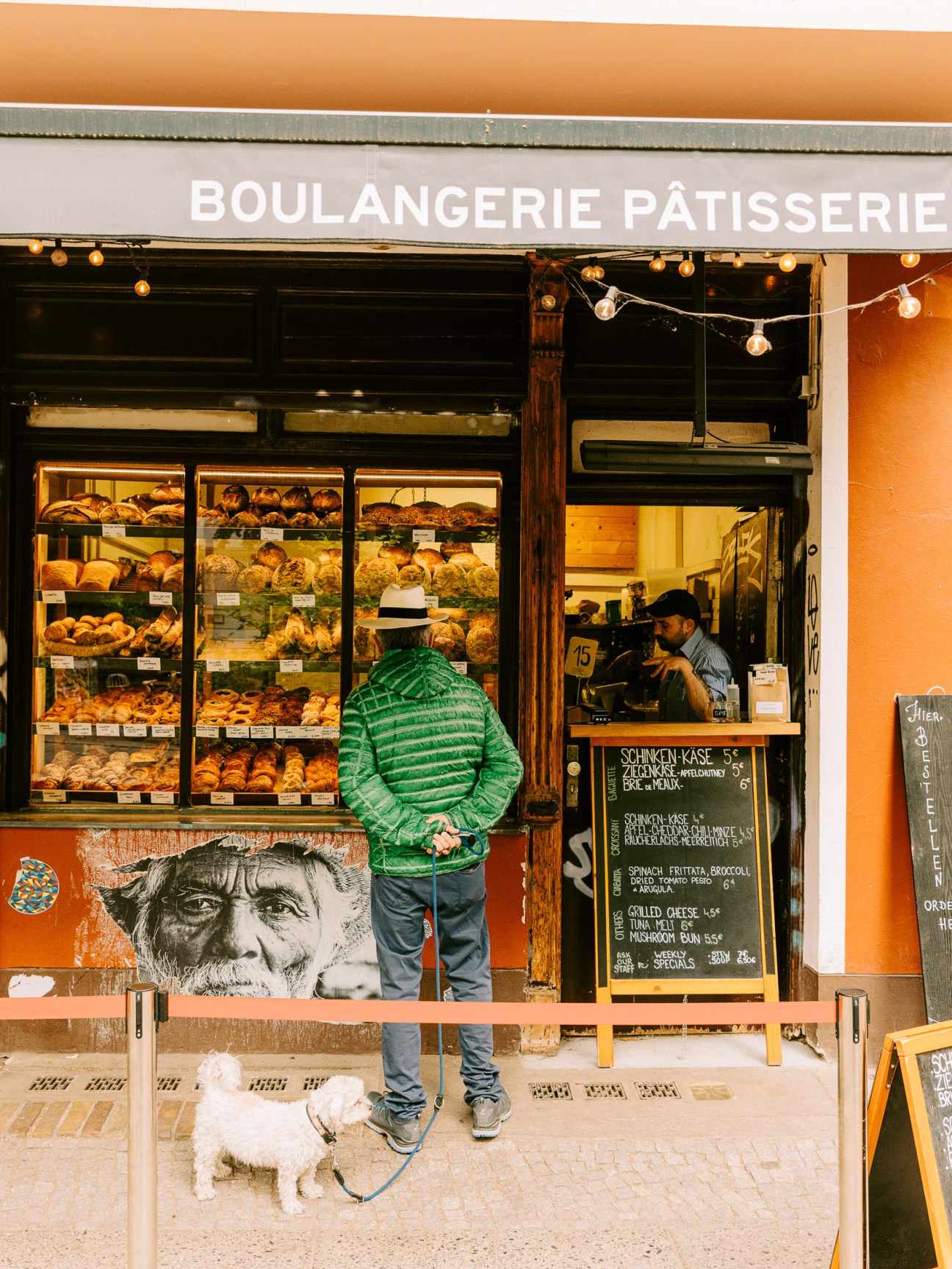
“I lived in France for a while and when I came back to Berlin, I was pretty shocked by how few places made their own croissants,” says Andreas Altmeyer, who opened La Maison in 2019. “German bakers don’t really learn how to make them.” Altmeyer can take some of the credit for the city’s current pastry craze: since long lines began forming outside La Maison, at least half a dozen new artisanal bakeries have opened in the city to serve the booming demand. Today it’s possible to get a morning bun made from croissant dough rolled in spiced sugar with orange, ginger and black pepper at Sofi in Mitte, or a rye and buckwheat croissant served with cascara syrup and a ball of burrata at Prenzlauer Berg’s Café Frieda.
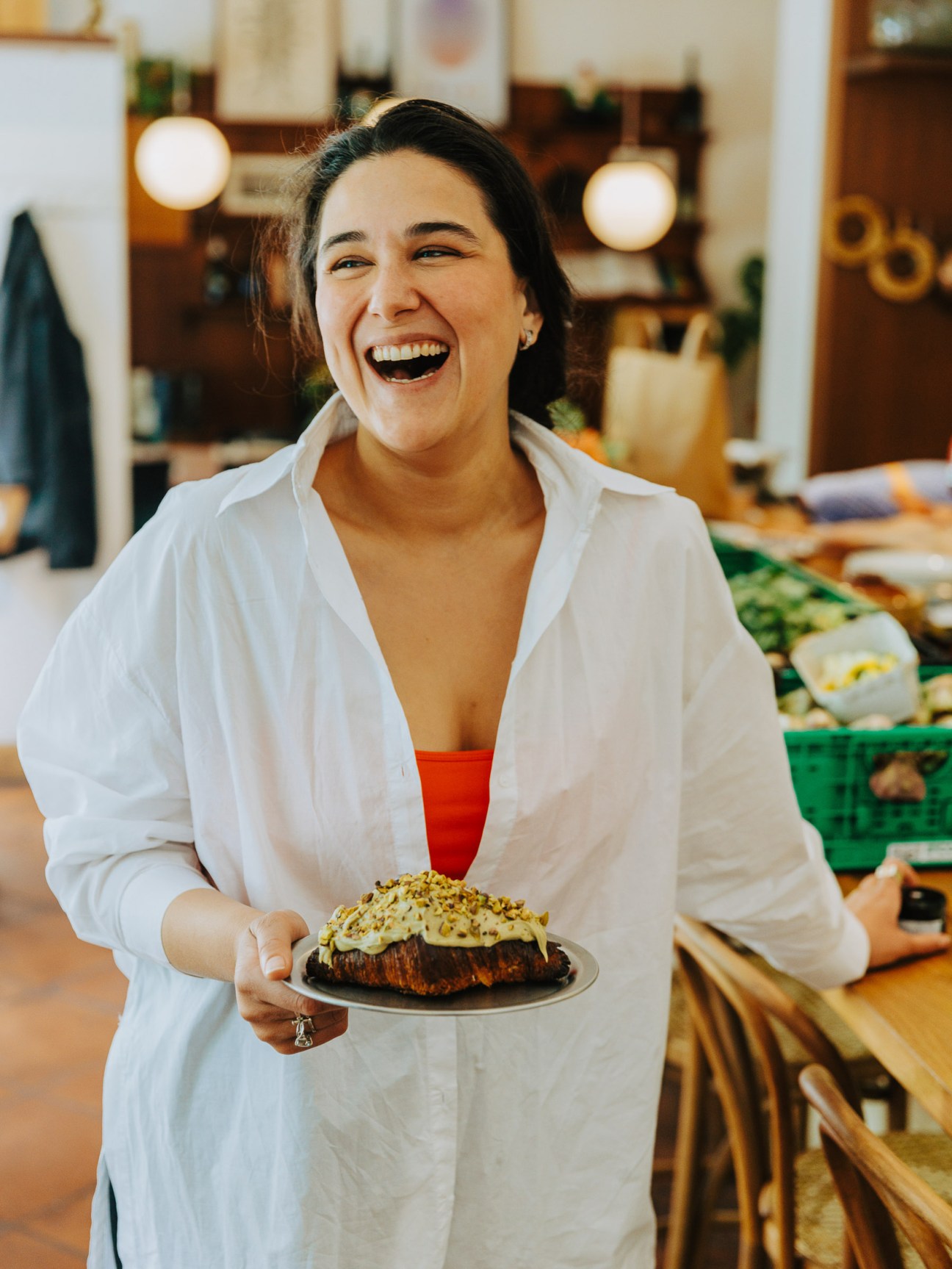

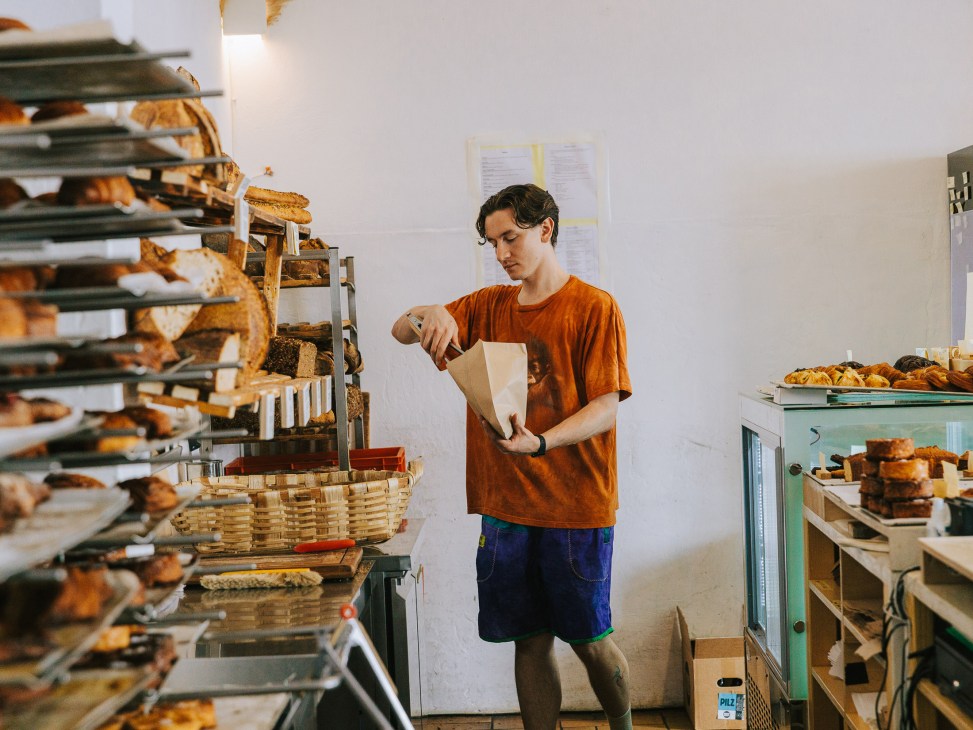

“When we started out it was a different landscape,” says Anders Alkaersig, co-owner of Albatross, another popular bakery in Kreuzberg. “Luckily the cohort of people interested in buying artisanal products has grown.” A croissant gets its delicious, flaky texture from lamination, a process of folding dough and a slab of butter into a flattened rectangle with paper-thin layers that puff up in the oven. Passersby are able to peek into Albatross’s production facility, which is kitted out with blast proofers and a laminator the size of a dinner table. Here, bakers knead, laminate, freeze, ferment and bake the croissants in a delicate three-day process.
The specialist machinery is no small investment for a fledgling business but the reward is pastries that are the polar opposite of the dark-grained and dense bread typical in Germany. “It’s nice that there are more places opening because it broadens the market,” says Alkaersig. “You can go around and see that there are ways of making a croissant that are in the same tier but just different.”
Morey Talmor and Guy Kenneth, two friends soaking up the sun outside Albatross on a Friday morning, become animated when describing the texture of the croissants they have just eaten. “By some way of magic, you have a cube of butter that went ‘puff!’ and expanded into a pastry just like popcorn,” says Kenneth. “It’s so light that you have one and it leaves you wanting more.”
Berlin’s bakery queues have become almost as notorious as the ones outside its nightclubs. “I really don’t like the culture of big queues,” says Altmeyer. “I’ve heard people say that they are good for business but my goal has always been to speed up the process as much as possible.”
Employment
China
The great escape
If you’re running the HR division of a major multinational and thinking about releasing office space because you’ve been stuck with implementing a hybrid workplace policy, you might want to hit pause before giving up too many desks.
On a recent visit to Paris, the CEO of a major French luxury group tells Monocle that his biggest management concern isn’t the conflict in Ukraine, the state of the markets or stalled supply chains, it is the impending talent exodus from China. “No one wants to stay after the school year finishes,” he says. “Everyone wants to come back to Paris or be reassigned somewhere else in the world. And, of course, I owe it to these colleagues to find them new positions, even if I don’t have any, given all that they’ve been through.”
As China approaches three years of on-off lockdowns, Beijing is struggling to contain the steady stream of horror stories that have accompanied its “dynamic” approach to containing the pandemic. From families separated because a mother or father has been shipped off to a quarantine centre hundreds of kilometres away to managers who have moved from running shops to becoming trauma counsellors, China is set to lose tens of thousands of executives, entrepreneurs and their families as conditions have become intolerable and quality of life eroded.
“It’s not just Western staff who want to leave, it’s also our Chinese staff,” says a Spanish vice president of a global retail group. “It’s become increasingly uncomfortable to host conference calls with most of our company able to travel and do their jobs while our Chinese teams are locked up at home. It raises many questions about what business in China will look like in the medium term.”
While multinationals are unlikely to exit the market, there’s the looming challenge of how they’re going to oversee a region that’s tricky to manage at the best of times. Do they start offering hardship or danger pay because working in Shenzhen will be seen as unsavoury? Or, like so many shifts that occurred during the pandemic, will things settle back to something that resembles normal?
“I doubt it. Staff are leaving and memories aren’t that short,” says the French CEO. “When you’re sent into quarantine, separated from your pet and then told it had to be put down for reasons unexplained, you realise you’re in a country with values too far removed from your own.”
Aviation
Global
Flights of fancy
Can an industry that transports the rich and powerful at speed ever be sustainable? If a Mediterranean-bound Boeing with 180 holidaymakers on board is environmentally culpable, what of a €60m Gulfstream G650 carrying six bankers and three crew from Zürich to New York?
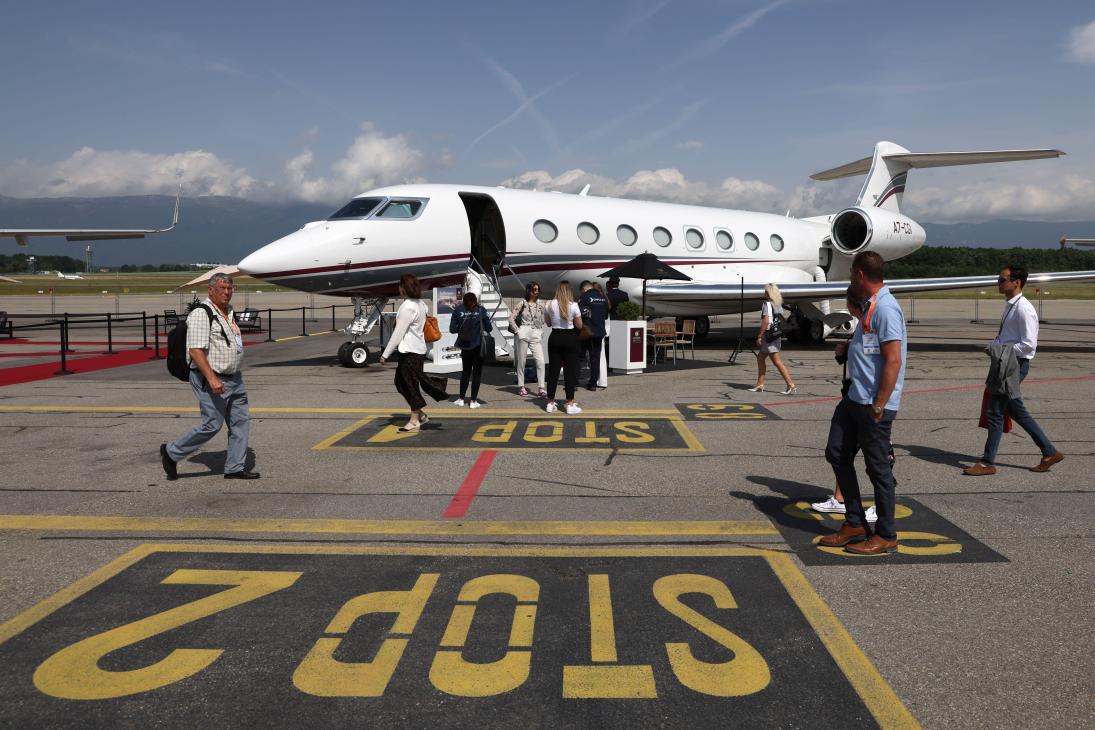

That private aviation can be green is a tough sell. Yet the journey to carbon elimination was a key theme at this year’s European Business Aviation Convention and Exhibition, which is held annually in Geneva. On the surface, it was business as usual at the city’s Palexpo, with ultra-wealthy clients and window shoppers mingling with trade visitors.
Gulfstream and Bombardier have long been battling for the title of longest-range and fastest business jet. This year Bombardier took the initiative, announcing the relaunch of the 15,000km-range-nudging Global 8000.
Business aviation is booming. Lockdowns, border restrictions and the grounding of much of commercial aviation during the pandemic saw those who could afford it turn to this reliable and safe way to travel, whether owned or chartered.
France’s Dassault had its newest intercontinental offerings on show – the Falcon 6x and, in mock-up, the larger 10X. Airbus Helicopters displayed a limited-edition ACH130 with an Aston Martin-styled interior. Shared – or fractional – ownership operator Flexjet is beefing up its European fleet with five more aircraft this year.
The sustainability message was very much present, with biofuel seen as a way to offset emissions and new forms of propulsion, such as hybrid electric, a longer-term solution. The sector is convinced it can become carbon-neutral by 2050. Watch this airspace.
Images: 3 Kaveria, Alamy
Design
Public space
Italy
No place like home
The buildings that line the piazzas of Italian cities are as important as the public space itself. They define the space, serving as the backdrop for residents to sip their caffè, meet friends and watch the world go by. These buildings should, as such, be home to businesses and operations that serve the needs of local people. This is not the case in Venice, where St Mark’s Square is more tourist trap than civic heart.
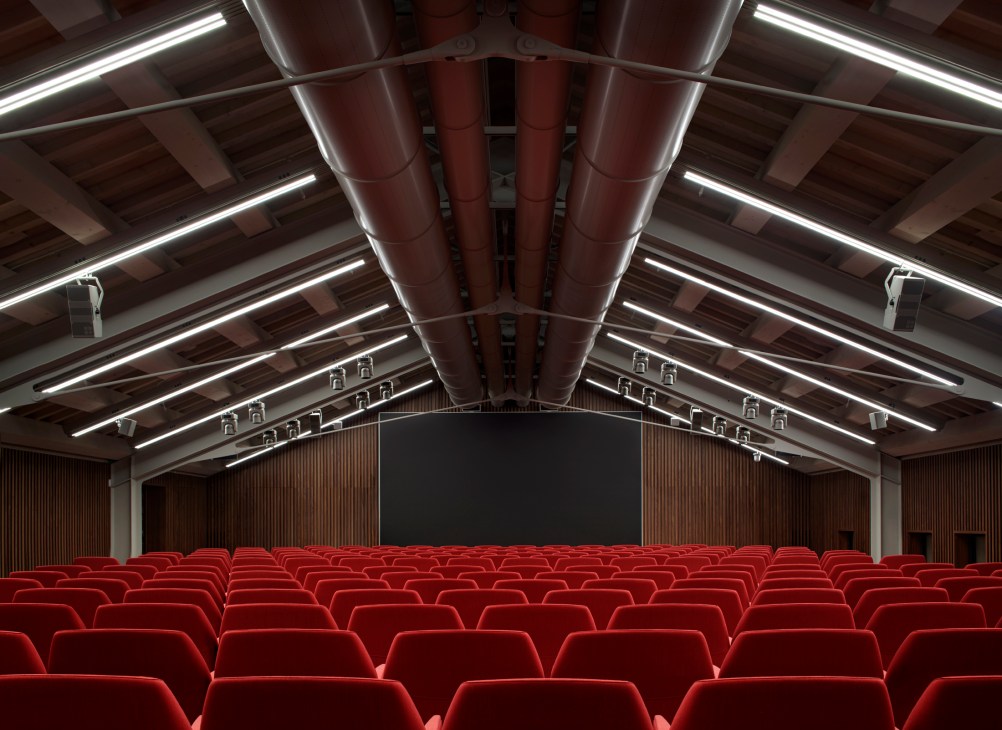
It’s a situation that has been made more difficult by the fact that the Procuratie Vecchie building, with its iconic arched colonnade on the northern side of the square, has been closed to the public since it was built in 1538. But a newly completed renovation of its interiors by David Chipperfield Architects Milan (DCAM) looks to – in Chipperfield’s words – “return the building to the people as a place to love and a font of inspiration.”
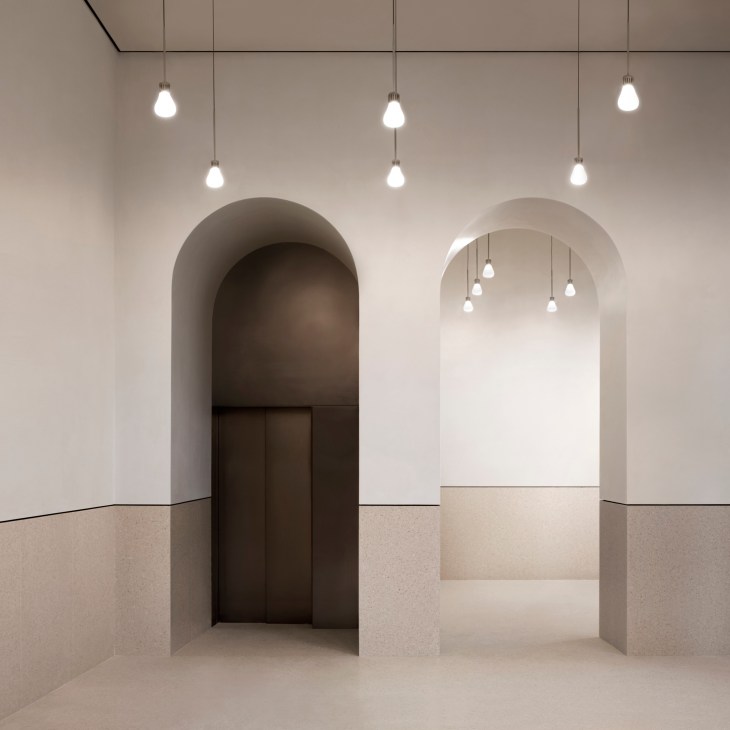
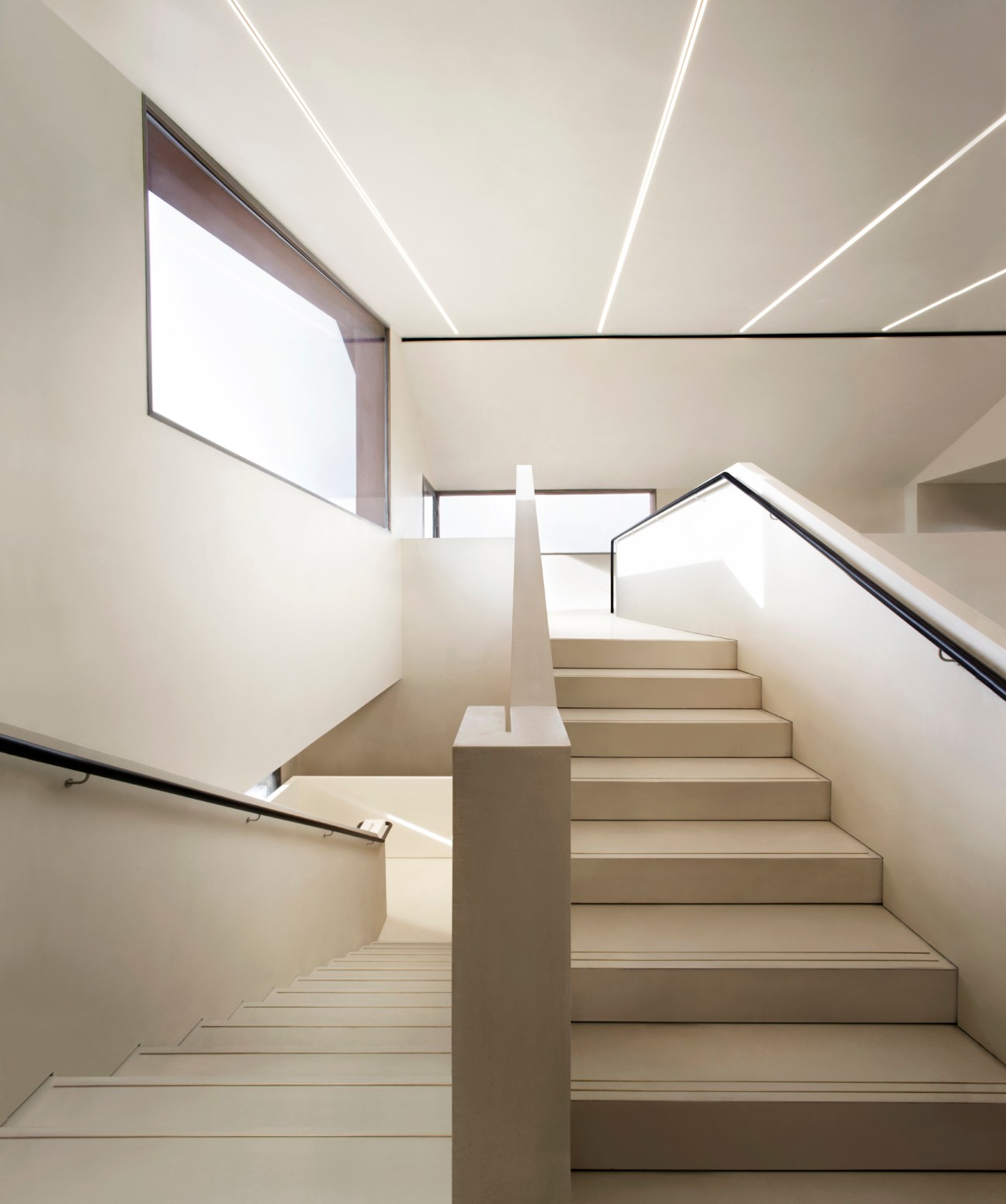
Mostly vacant since the 1980s, Procuratie Vecchie was built as a home for senior Venetian government officials and is now owned by Generali, the insurance company that commissioned dcam to revitalise the structure’s interior. With the exception of striking new staircases, a rooftop pavilion and a new auditorium, the architects opted for a soft touch, seeking to reveal the various architectural interventions that have taken place over the building’s 500-year life. Historic terrazzo flooring, timber ceilings and frescoes have been revealed and original brick walls whitewashed to tie the spaces together.
Every change was finished in partnership with local craftspeople, using traditional methods – an expensive and timely process. “We went a long way beyond strict commercial decision-making. It’s much easier to cover up a wall and much easier to put some plasterboard somewhere,” says Chipperfield. “What we’ve done is uncover everything and bring everything back. That takes patience, not just from the architects and the craftspeople but also from the client to understand that restoring something in this way is a noble cause.”
The building’s first and second floors have also been transformed into offices, a move that returns daily work to the centre of a city dominated by tourists and museums. Even more significant is the creation of the auditorium and new exhibition spaces, a café and rooftop terrace – all open to the public and managed by Human Safety Net, a global foundation supporting people living in vulnerable circumstances.
“Of course, in Venice, it’s expected that international visitors will come and discover this space,” says Emma Ursich, Human Safety Net’s executive officer. “But the people of Venice will benefit too. They have a new space to be, where they can come for brunch on Sunday morning or listen to a concert.”
The transformation of the building will allow locals not only to enjoy new views across the rooftops of St Mark’s but new ways of experiencing Venice. It points to a more hopeful future – one where Venetians are invited to reclaim their city.
Architecture
UK
Competitive nature
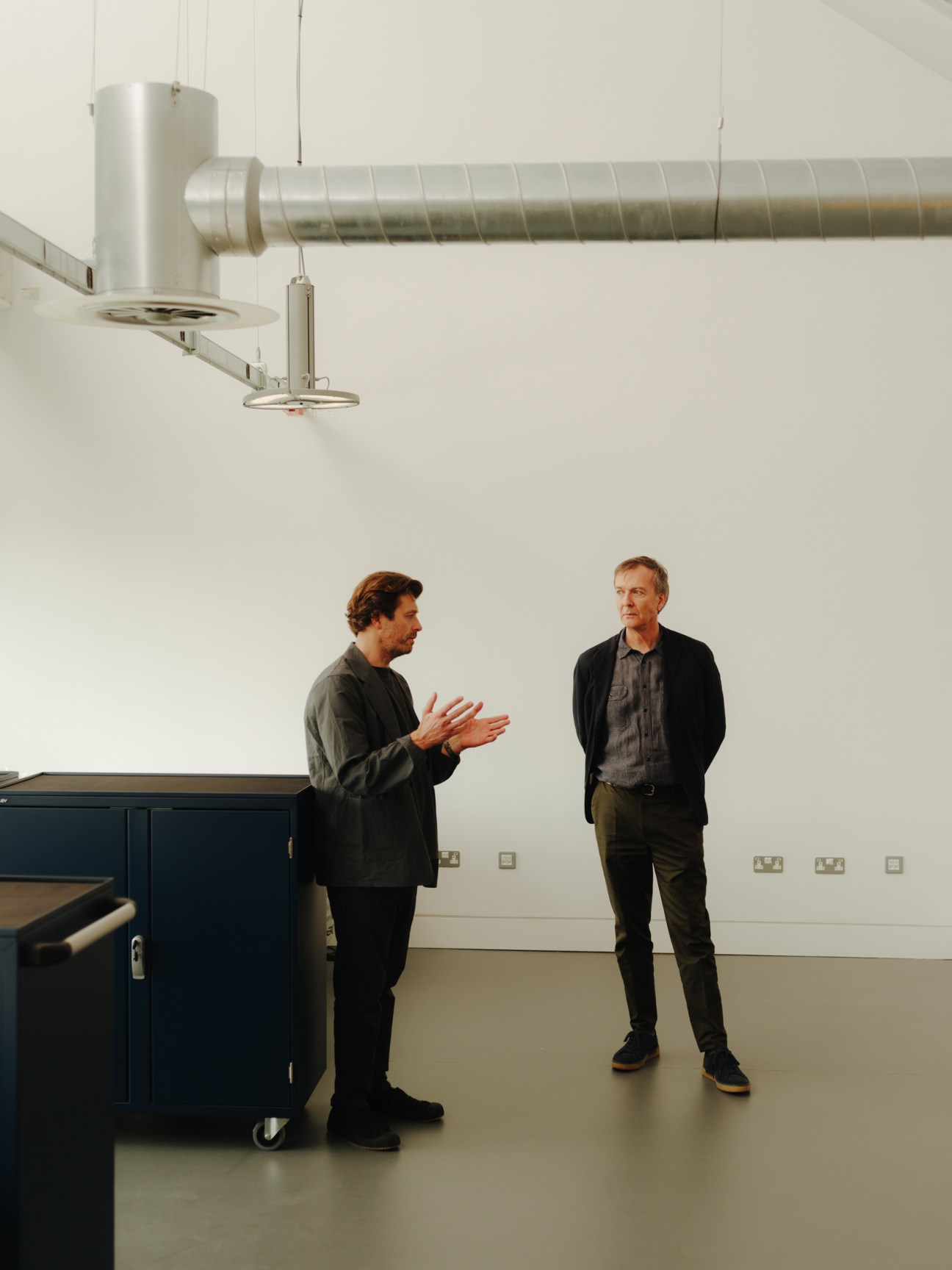
The winners of architectural competitions face a lot of scrutiny around the worthiness and quality of their design. But no such grumblings have greeted Herzog & de Meuron’s newly completed Royal College of Art (RCA) building in London’s Battersea. Named the Rausing Research and Innovation Building, it was completed to a 2016 competition-winning design by the Swiss practice.
“It was a unanimous decision that they would be the winner because they were the only entrant that proposed a concept that looked beyond the site,” says Paul Thompson, the rca’s vice-chancellor. “They didn’t present a singular building but rather a vision that referenced the immediate streetscape and other rca buildings.”
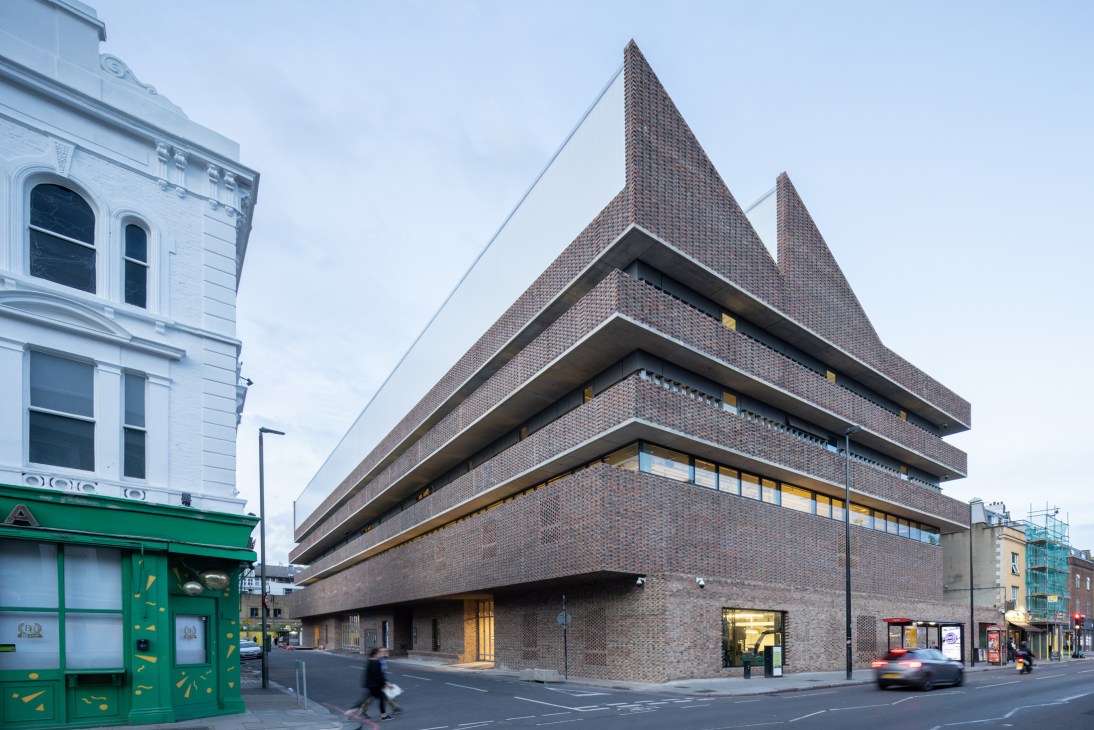
It’s a vision they have executed to perfection, with the new structure opening up to the neighbourhood around it. Located a short walk from the rca’s flagship Dyson building, the Rausing, as it’s known, is composed of a ground floor with workshops (with full-height windows in some, allowing passers-by to look in) with two distinct wings on the floors above; one houses research spaces for subjects from robotics to manufacturing, while the other has dedicated design studios with balconies that enjoy views of the street and the Dyson building beyond.
“It felt natural to include all these balconies and give students the ability not just to open a window but to be able to get outside, look down and get a perspective [on the campus],” says John O’Mara, Herzog & de Meuron’s UK studio director.
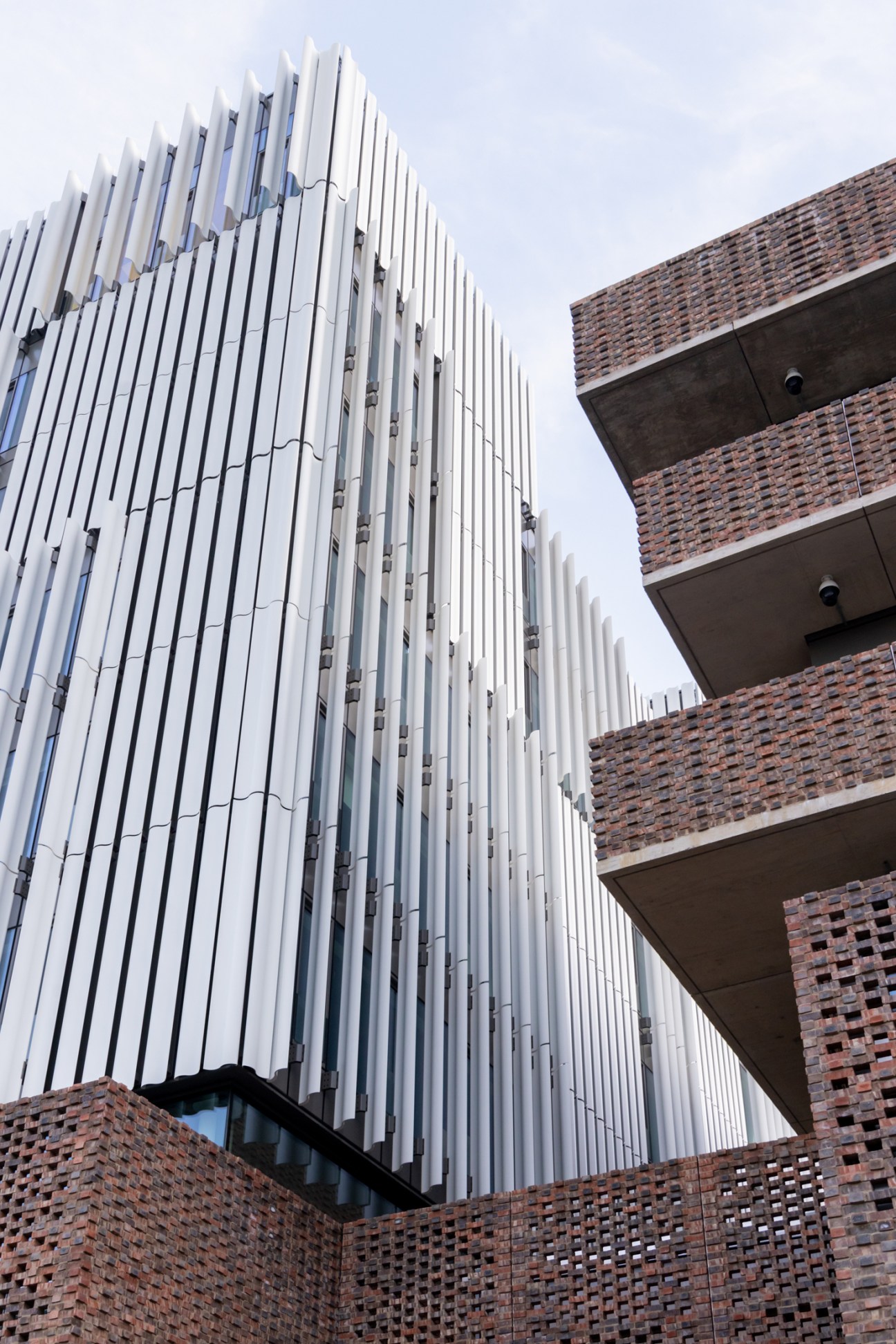
At the centre of the building is The Hangar, a double-height exhibition space with vast doors at either end that open out onto the street and connect to walkways intersecting the site. The result? Easy access for locals and students alike to the building’s leafy courtyards. “What we wanted to do was make it feel very much a part of Battersea,” says O’Mara of the building’s openness to the public. “We wanted to root it down here and cement the neighbourhood for the rca.” And that’s just what they’ve achieved – bricks and mortar justification for scooping that gold.
On Design
Nolan Giles on…
Engaging citizens
Westfield shopping centre in east London isn’t the type of place you would imagine to hear a compelling conversation around urban planning. But tucked in to an out-of-use retail space, crowds gather around a miniature version of the local area plotted out on a table. They’re here to learn about a corner of London that is being developed through a 2012 Olympic Games legacy project, which aims to improve quality of life. Too often in city developments the public isn’t engaged with what’s going on in the place it calls home. Exercises like this suggest that citizens are excited about shaping the place they live in and want to take part in the conversation.
It’s an idea that Spanish architect and curator Javier Peña Ibáñez has fostered in his home city of Logroño, where he hosts the Concéntrico festival each year (see page 178). Here the generally dry topic of urbanism is examined through beautiful, playful installations, which are temporarily constructed across the city. Beyond being a gathering point for a global community to debate building better cities, the event educates locals from all walks of life about the positive effect of good urban design. The result is an informed population engaged in this small city’s progression.
So what initiatives can be implemented in cities that don’t have the luxury of festivals? First, private developers and government bodies need to drop the jargon and level with those whose lives are going to be affected by their grand projects. Words such as “placemaking” and “densification” aren’t fun or engaging. People want to hear stories – not just about how a development will improve their lives but what inspired it and how the history of their neighbourhood informed its future. They also want to imagine themselves in said future – photo-realistic renderings are OK, but more creative approaches to providing this are welcome. “Storytelling” is another overused expression in design but in the case of making urban development a palatable topic, it’s a valuable tool.
Fitness
Mumbai
Running the city
Prasad Ramamurthy on the joggers stretching their legs in congested Mumbai.
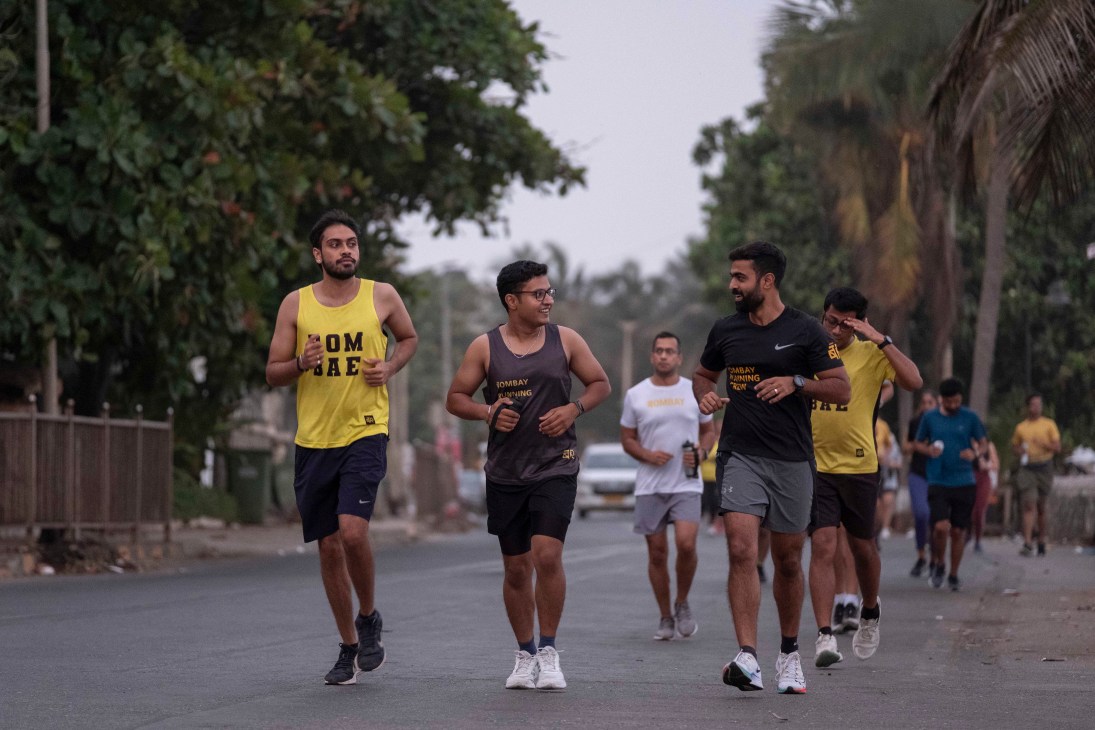
It’s 05.30 on a Thursday. The sky starts to turn purple and Mumbai begins to stir. In a carpark in the coastal suburb of Bandra, a group of nearly 50 people, ranging in ages from 21 to 73, stand chit-chatting, high-fiving and back-slapping. All are members of Bombay Running, one of a growing number of running clubs in a city not well known for such pursuits. Today’s run will follow a stretch of seafront called Bandstand. It’s one of those rare spots in this city of 20 million souls where residents can come to open their lungs and stretch their limbs.
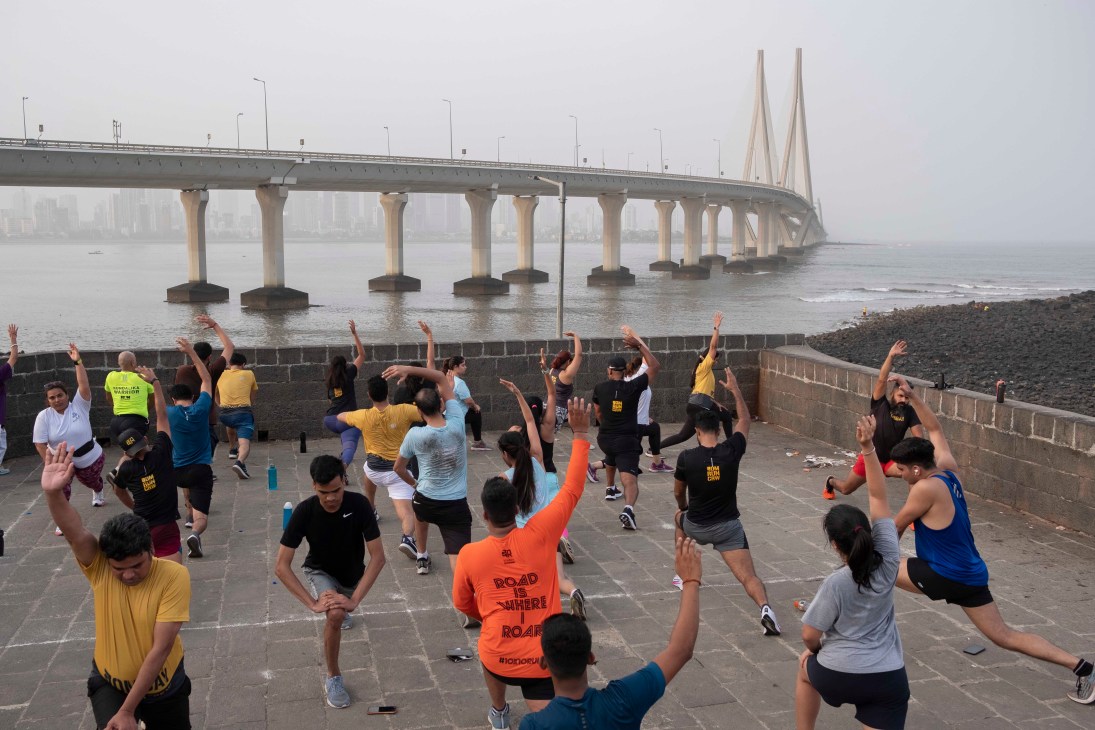
Over the past 10 years there has been a steady increase in the number of Mumbaikars taking up running. Their city has been slow to adapt: Mumbai has been ranked 27th of 30 in a survey of pedestrian-friendly Indian cities. This is unsurprising when you consider that only 30 per cent of the city’s streets have pavements. Add to this a traffic density of 2,150 vehicles per kilometre, very poor air quality and an astronomical construction boom and it doesn’t seem like a runner’s paradise.
What the city does have going for it are pockets of respite – residential neighbourhoods with green cover, large public parks, seaside promenades – and a growing population of hardy joggers. “The city could have better infrastructure and dedicated lanes for runners,” says Bombay Running’s Deepak Oberoi, who has been pounding the city’s streets for almost 20 years. “But when life gives you lemons, you learn to adjust.” That means timing a run to coincide with less traffic and lower temperatures: early mornings and late evenings. Runners also vary the length of their runs based on the season – shorter through the summer and monsoon, longer in winter.
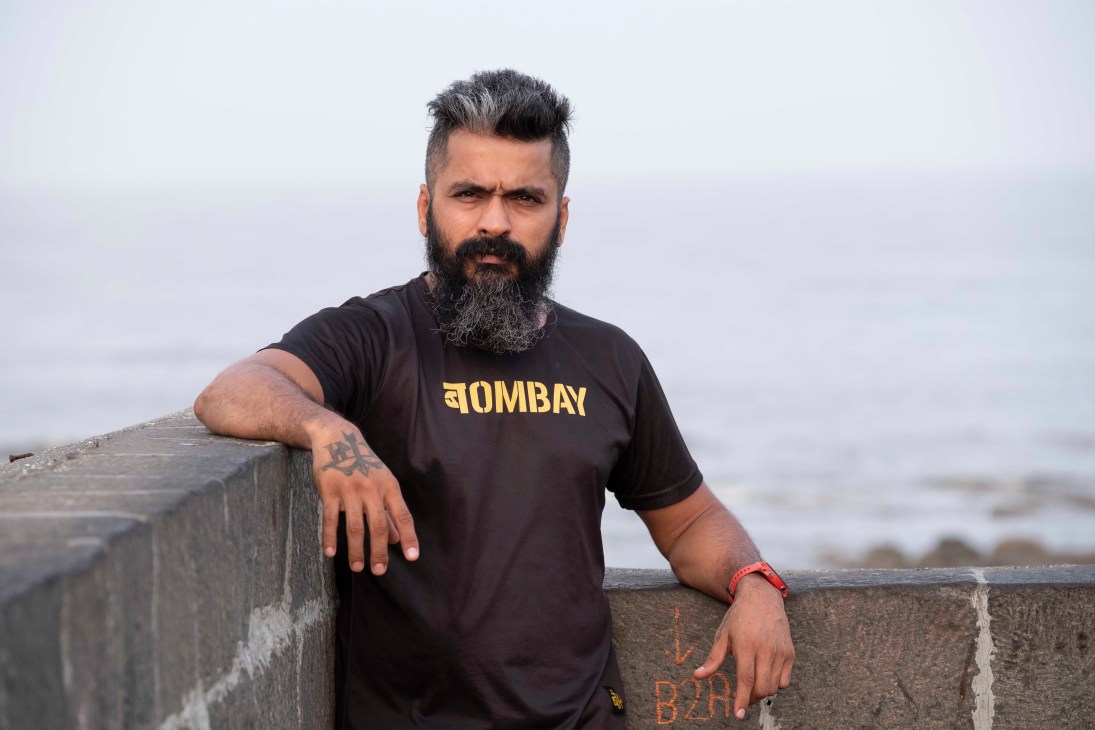
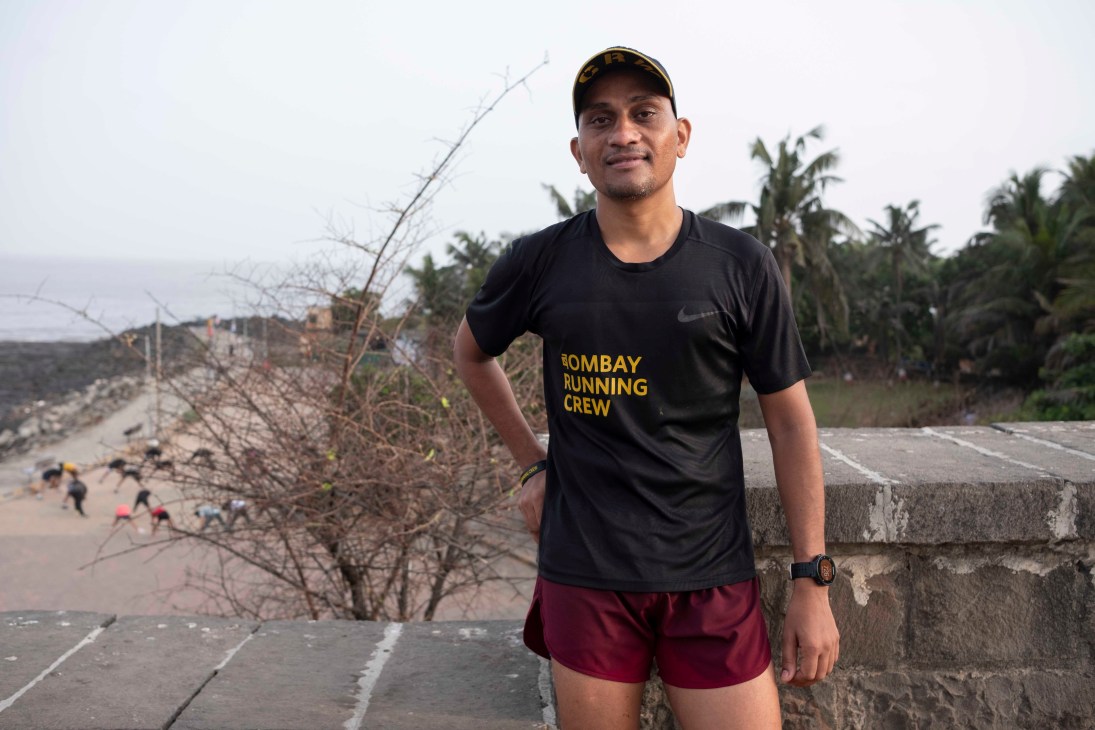
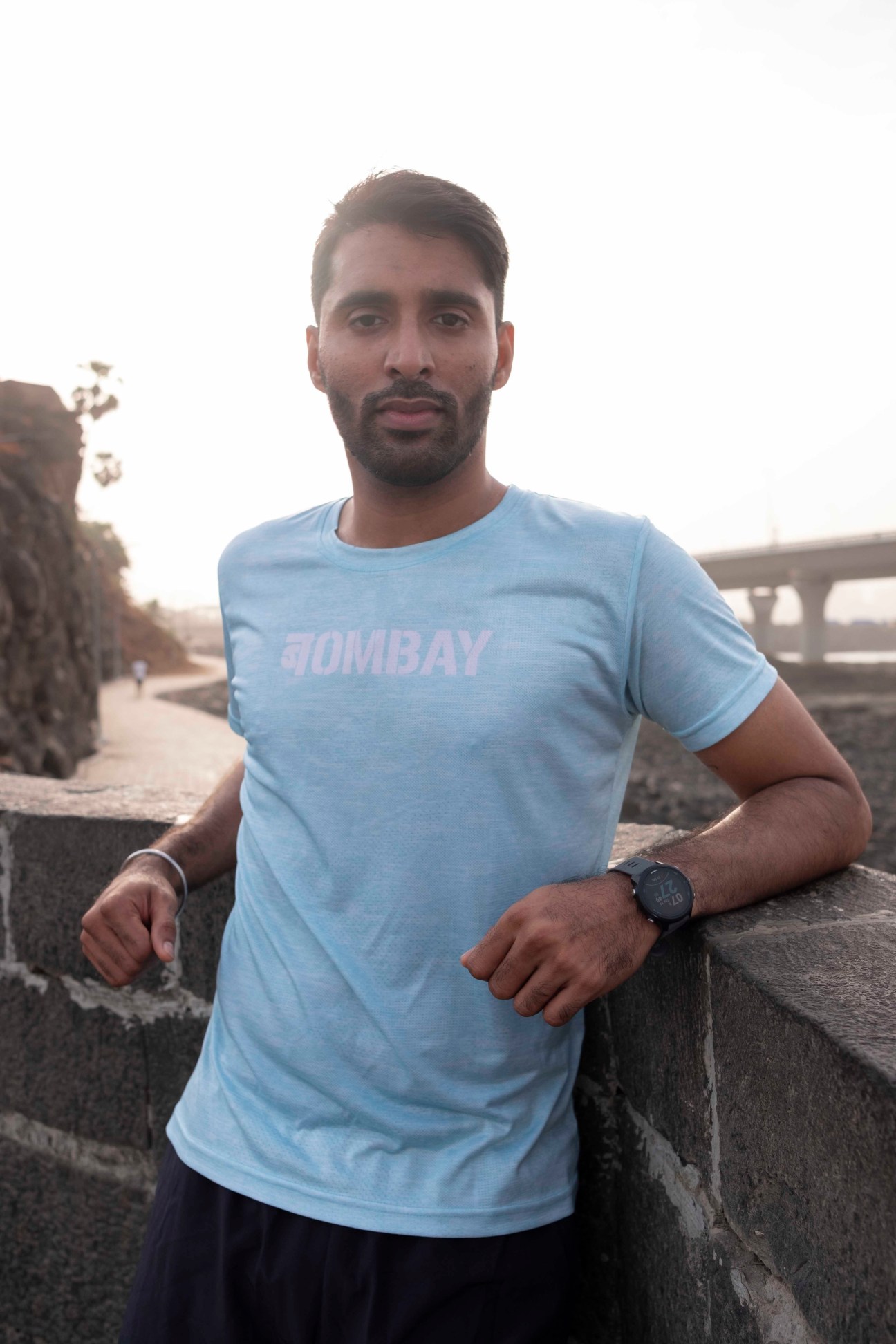
Another factor is the day of the week. Shops and commercial establishments in different areas shut on certain days, which gives Mumbaikars a chance to run undisturbed. Puspamitra Sahu likes to go on Sunday jogs through the downtown financial district, home to her office at India’s central bank as well as two Unesco World Heritage sites. “When you’re at work, you don’t have the bandwidth to look around,” she says. “At the weekend, streets are empty. We can appreciate the area’s art deco and Indo-Saracenic architecture at our own pace.”
Becoming more aware of her surroundings is a by-product of her runs, says Shweta Bhalerao, who uses the time to explore Khar, the suburb where she lives. “I might have passed a shop or a beautiful bungalow and not noticed it because I was inside a car,” she says. “But now, because I’m running, I’ve learned to appreciate my neighbourhood more.” Lifelong Mumbai resident Gaurav Bangera agrees. “When you’re running, your body is at work,” he says. “But your mind is free to observe and remember. Running past public parks, I’ve remembered how my parents would take us there on picnics. That makes this city feel even more like home.”
How Athens is redesigning itself for extreme heat
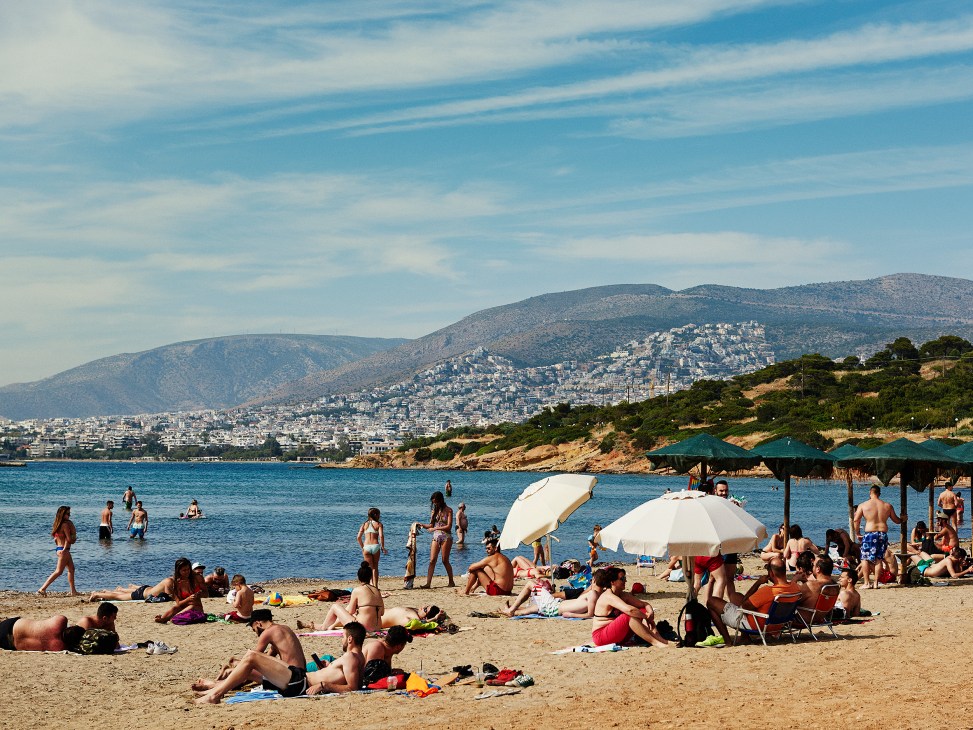
Athens is the hottest capital city in mainland Europe, a place where heatwaves that send the mercury up to 40C are an all-too regular occurrence. That’s why Eleni Myrivili’s job exists. Last summer she was appointed as the city’s (and continent’s) first chief heat officer, tasked with helping to build resilience against rising temperatures.
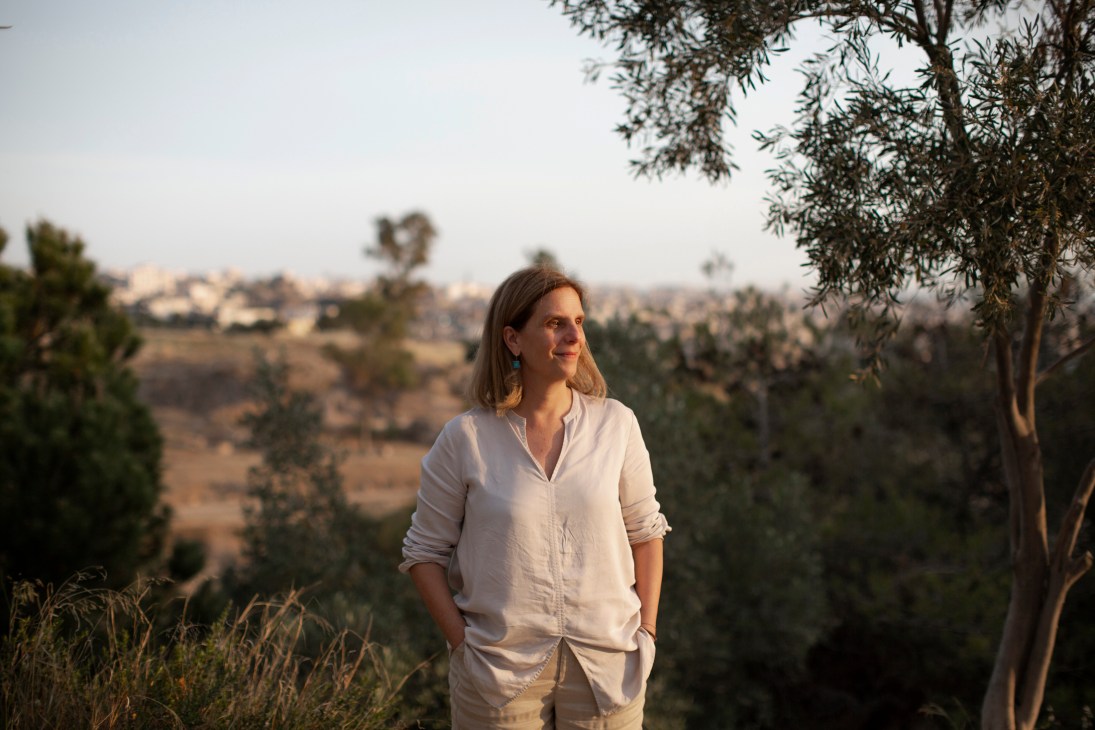
Monocle meets Myrivili (pictured) on Philoppapou hill on a late spring evening. There is a cool breeze blowing but the balmy heat reminds Athenians of what’s to come. A 2018 report by Newcastle University showed that among 571 cities worldwide, Greece’s capital will be one of the hardest hit by heatwaves and drought in the coming decades.
That portentous warning was proven correct almost immediately: devastating wildfires in the Attica region north of the city later that year became the second deadliest of the century, killing 102 people. Then last year, following Myrivili’s appointment, Greece experienced its worst heatwave since the late 1980s, with temperatures reaching a record 45c. “On a basic level, heat causes serious health problems to the most vulnerable, increases the frequency of wildfires and even affects a country’s productivity and economy,” says Myrivili, gesturing animatedly.
Her background is in anthropology, in which she received a phd from Columbia University in 2004, before becoming a leader of Greece’s Green party in 2007. From 2017 to 2019, she served as a deputy mayor of Athens, promoting urban growth and climate-change resilience in her hometown. Myrivili’s new role is similarly multi-faceted: she must employ her anthropological knowledge of communities alongside her political nous and climate activism in order to bring about change.
In a place like Athens, this will be no mean feat. The city suffers from a number of disadvantages, both man-made and natural. It is densely populated and surrounded by mountains, with few public parks. “The challenge here is to introduce nature-based solutions,” says Myrivili. “We don’t have the luxury of vast open space or large pavements. The battle against heat is really a battle to reclaim public space, especially from cars.” She has backed plans to introduce more no-traffic zones, electric buses and metro stations, though progress is slow.
Myrivili’s appointment reflects a realisation by mayor Kostas Bakoyannis that something has to change. “Athens has made big steps towards being greener, which is a major part of the cooling puzzle,” says Myrivili. In the past few years, a number of pocket parks have been created in built-up areas and formerly disused water fountains renovated. Her mission is to find and implement more far-reaching solutions.
“My goal is to create more ‘green and blue’ infrastructure,” she says. “Bringing water back to the city is so important, restoring our streams and rivers that we buried underground.” One of the more recent initiatives is a plan to create “green corridors” connecting different neighbourhoods. “The idea is to pedestrianise those streets, plant more trees on either side and ban parking.”
She insists that though city hall can do more, it’s imperative that individuals also step up. “When we’re redesigning the city, it also comes down to the materials we build with.” Athens is largely made from concrete and asphalt, materials that absorb and store heat, which they then radiate at night.
“We need to go back to retrofitting buildings with thermal efficiency. We need to look back at traditional architecture and how people found ways to cool their homes before we started using fossil fuels.”
Gazing across the whitewashed metropolis, she speaks hopefully of an irreversible sea change in public opinion, “Athenians are demanding more from their leadership. One of my aims is to try and unite all the different advocates for a greener Athens. That’s the only way to make the city green and blue.”
Images: Felix Odell, Eirini Vourloumis
Comment
Horticulture
Almere
Going green
Josh Fehnert visits an expo for greenery that’s trying to change our cities – and perspectives.
“It’s about how to make cities healthier and nicer to live in,” says Frank Cornelissen, commercial director of the Floriade Expo 2022 horticultural fair. He’s standing in the shadow of a 20 metre-tall sculpture of a parent and child made from Cor-Ten steel bees. “We need bees, we need pollinators,” he adds. It’s a bright, cloudless day and we’re in Almere, a planned city 30km east of Amsterdam. Here, amid the drifts of tulips and grey-haired flower fanciers, organisers are selling Dutch horticultural chutzpah to the world.
Founded in 1960, Floriade took root as a once-a-decade garden jamboree for all things flowery, leafy or green. Spread across a 60-hectare site around an artificial lake, this year’s edition is stuffed with organic oddities, from huts made from mycelium to swathes of unkempt woodland and immense greenhouses containing the wares of some 200 green-fingered firms. There are also 33 national pavilions where artists, architects and curators have created spaces and exhibitions that riff on this year’s theme: Growing Green Cities.
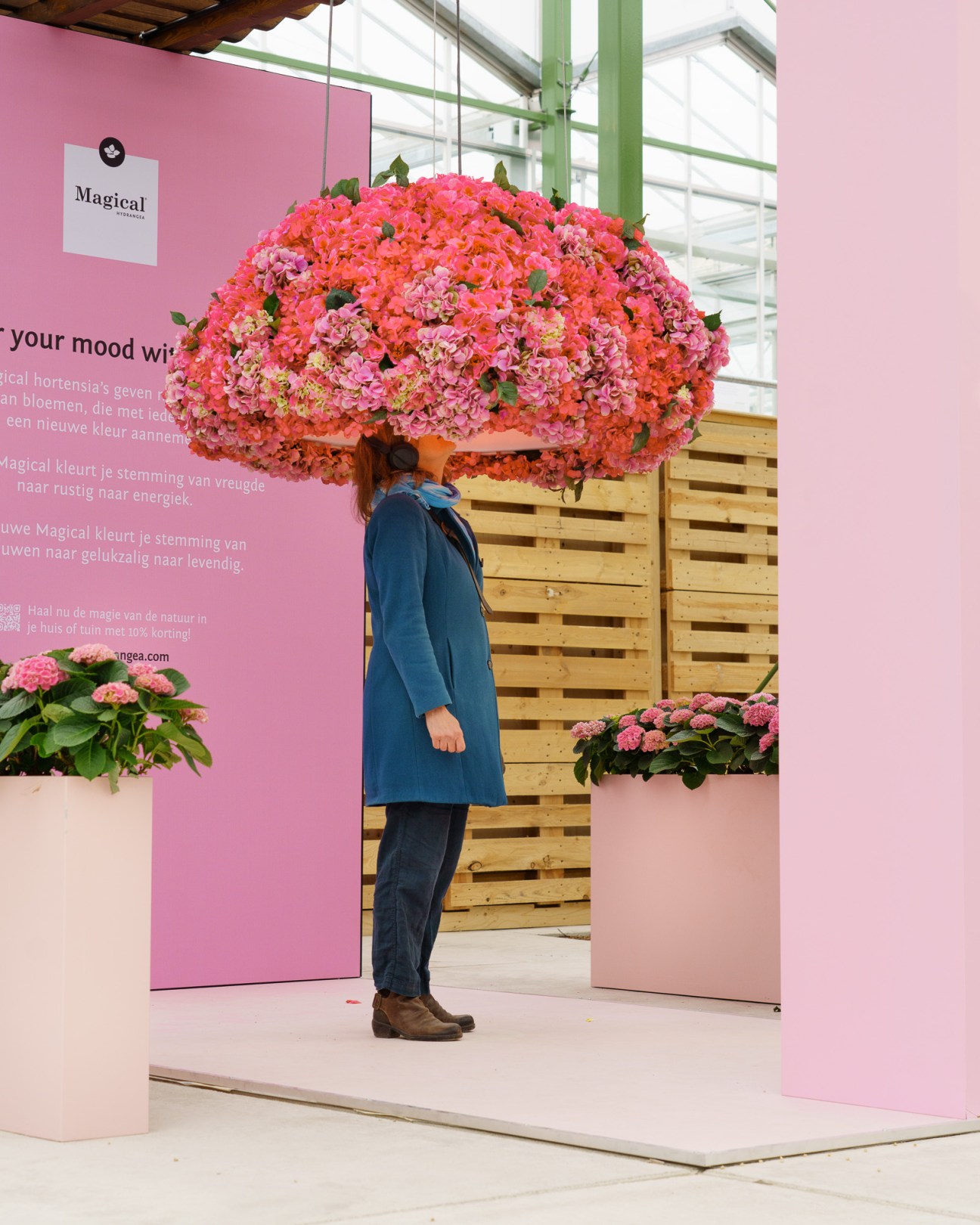
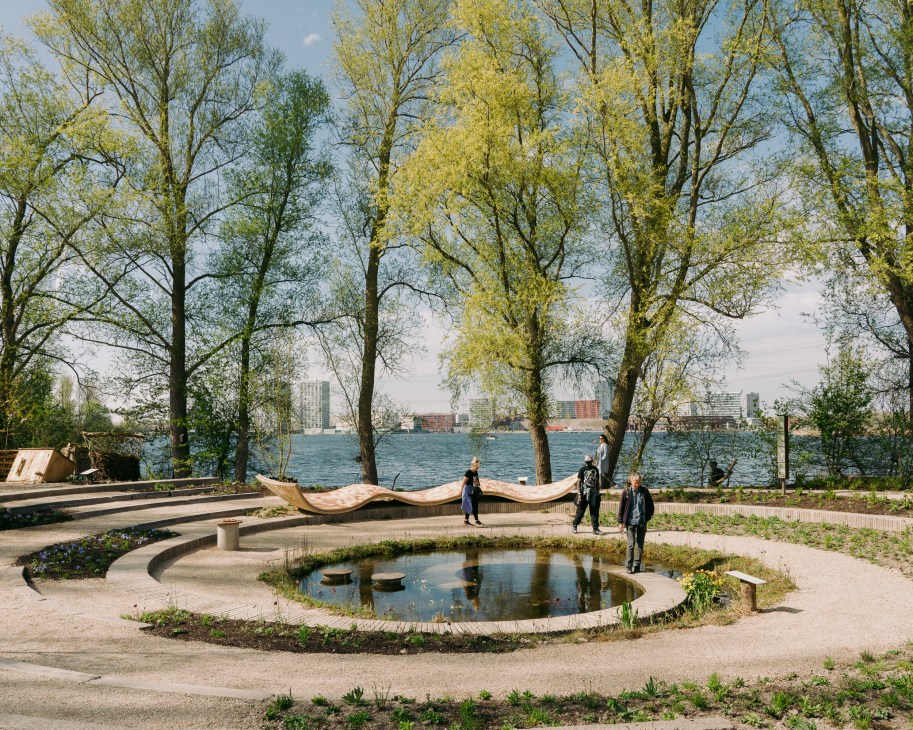
The uae pavilion yields a latticed structure riffing on the nation’s modernist-inspired 1960s sha’bi houses. The crunch of salt crystals underfoot and the sound of trickling water give way to an exhibition focused on the uae’s geographical position between the desert and ocean. “We have mangrove forests that grow in the sea, we have meadows of seagrass and many other salt-tolerant plants,” says Angela Migally, executive director of the Salama Bint Hamdan Al Nahyan Foundation. She worked with Amsterdam studio Tellart and architecture firm Pragma to respond to Floriade’s city-focused brief, which takes in topics from food security to water scarcity.
“Human beings are nature,” says Herman Kossmann, co-founder of Amsterdam-based Kossmanndejong. He helped to shape Amsterdam-Almere’s wooden exhibition space, which aims to give nature a voice and nudge onlookers to listen to what it’s saying. “Amsterdam has 800,000 inhabitants. But you could say that we have trillions if you count animals, plants and bacteria.” A pleasant idea but it’s hard to know what to do with it. As I wander out, past the selfie space, I ponder how the high-minded messages touted by many of the pavilions might take root elsewhere.
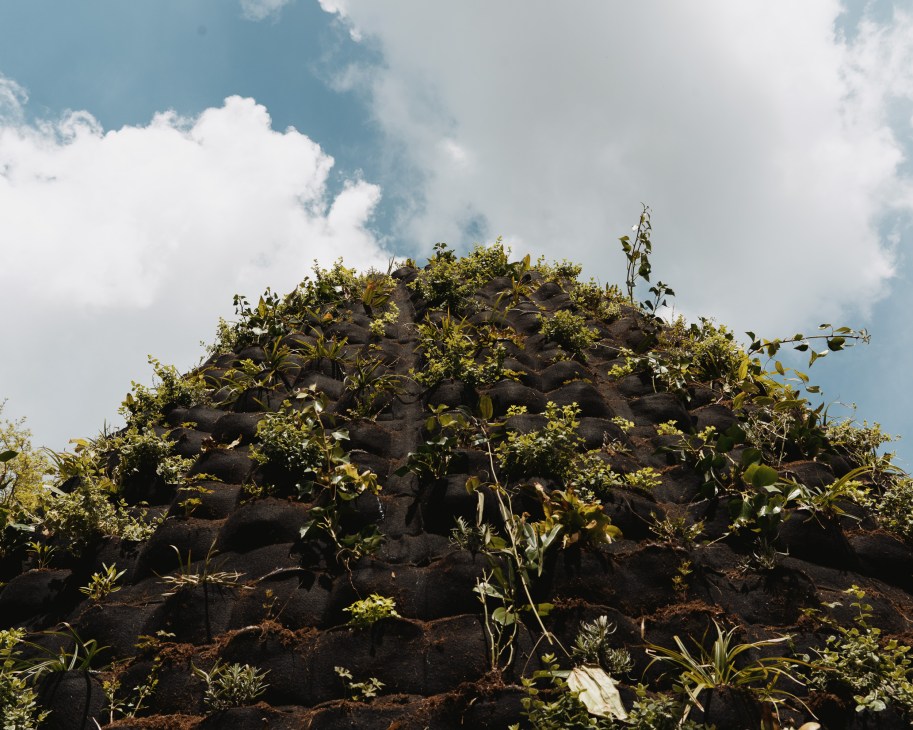
One definite legacy of the show will be the site itself, which is slated to become 20,000 housing units as part of a nationwide plan to build a million new homes. Rotterdam-based mvrdv is overseeing the plan for a leafy rethink of the garden suburb, to be dubbed Hortus. For now, it’s hard to imagine such calm amid the furore of the fair.
Before I leave, and as the sun sets, I take a few moments to visit Utopia Island. This is the wildest part of Floriade, where a handful of gardeners and artists have been left to create spaces to sit, stroll and enjoy the nature. Blissfully there’s no-one around to hammer home the “concept” either – no small text to take in or statistics to quote. It’s here, under a beech tree by the waters of an artificial lake, that city planners might learn most about the virtues of greening our urban landscapes.
Hear more on ‘The Urbanist’ at monocle.com/radio.
Society
USA
Death of the salesman
Henry Rees-Sheridan From ‘inspirational and educational hubs’ to online sales only, as electric-vehicle manufacturers begin to eschew tradition, are we about to witness the end of the car showroom?
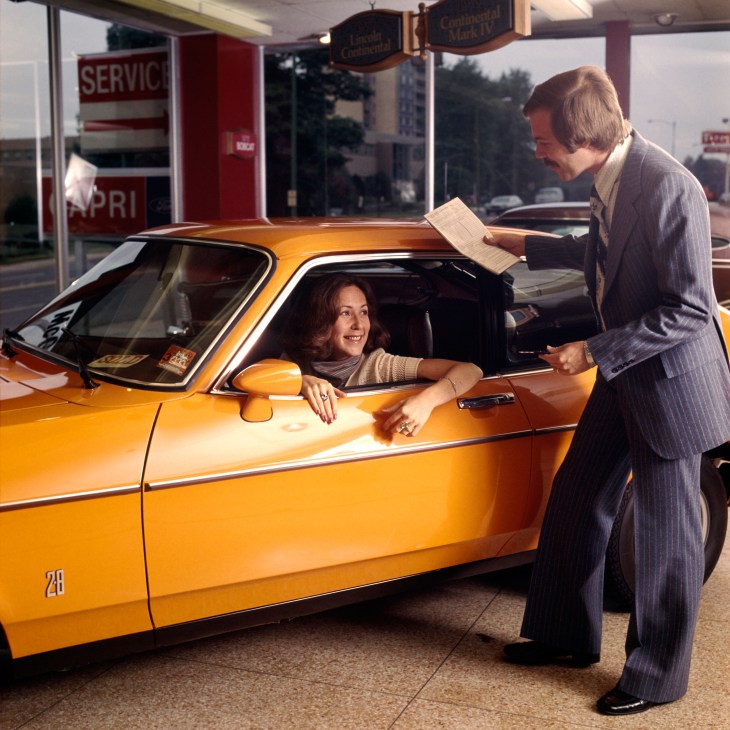
The shimmering forecourt. The windscreen price tags. The grim rictus of the crumpled salesman. An instantly recognisable fixture of the US suburban landscape, the car dealership brings together two prominent features of the nation’s culture: entrepreneurial capitalism and automobile ownership.
Dealerships – and dealers – loom large in the national imagination. From The Simpsons‘ Gil Gunderson to Fargo’s Jerry Lundegaard, no figure more poignantly conveys the predatory desperation at the frayed edges of the US economy. Indeed, the stigma attached to the profession has even touched the life of the current president. When Joe Biden became a senator in 1972, his father quit his job as a car dealer because, according to the president’s sister Valerie Biden Owens, he “didn’t want a United States senator to have a used-car salesman for a dad”.
It would take a strange sort of masochist to enjoy a trip to the outskirts of town to be upsold mudflaps. So why haven’t alternatives to dealerships emerged? One reason is that innovation within retailing has been stymied by regulation. In the early 20th century, car dealers were at the mercy of manufacturers, who could undercut their own franchisees by endorsing a new dealership down the street. In the 1940s and 1950s, laws were adopted to protect them. There was a limit placed on the number of franchisees a car-maker could license in a given area and the direct sale of cars by manufacturers was prohibited. In most states these laws still apply but the industry is changing rapidly.
Electric vehicles (EVs) accounted for all of the net growth in global car sales in 2021. Several prominent EV manufacturers are young companies that are not locked into the legacy dealership model. They’re taking advantage of this freedom by developing new ways of using physical spaces to sell their cars.
One of them is Rivian, a company specialising in off-road EVs. Its flagship bricks-and-mortar location is Venice Hub in Los Angeles, where there are two display vehicles that visitors can sit in. The rest of the facility looks like a modern community centre with a library, communal hall and open-air spaces. Denise Cherry, who designs Rivian’s facilities, describes the Hub as a “space designed to inspire and educate people”. The events held there often have nothing to do with cars and include bicycle maintenance workshops and tending the Hub’s edible garden.
Polestar, a performance EV manufacturer owned by Volvo, has taken another approach. In buildings that resemble the lair of a discerning Bond villain, colour and material samples are displayed in chrome drawers and the walls are adorned with artfully framed photos of the cars’ components. The company’s website describes its spaces as like “an art gallery where the cars are the exhibits”.
What Rivian and Polestar’s very different buildings have in common is an absence of salespeople. Polestar’s website boasts that “product experts are on hand to share their knowledge and enthusiasm with you. Selling just isn’t in their job description.” The truth is that, in many states, franchise laws mean that they couldn’t have salespeople even if they wanted to. Instead, if a visitor wishes to buy one of the vehicles on display, they must do so online. Other EV manufacturers, such as Tesla and Lucid, also offer such an option.
EV makers still have major hurdles to overcome. The new technology presents manufacturing challenges. Rivian’s stock, for example, fell sharply this year after the company failed to meet its 2021 production target. But the sector will inevitably grow. If companies eschewing dealership models continue their ascent, the traditional car showroom could slide into obsolescence within this decade.
What would that mean for our retail – and cultural – ecosystems? We can surely find a better use for the land that dealerships currently occupy. But the psychic energy that car dealers are avatars of has to manifest somewhere. Virtual currencies seem to be the new epicentre of contemporary American legerdemain. But it just doesn’t feel the same being hustled online.
Dispatch
Polesia, Ukraine
Soldiering on
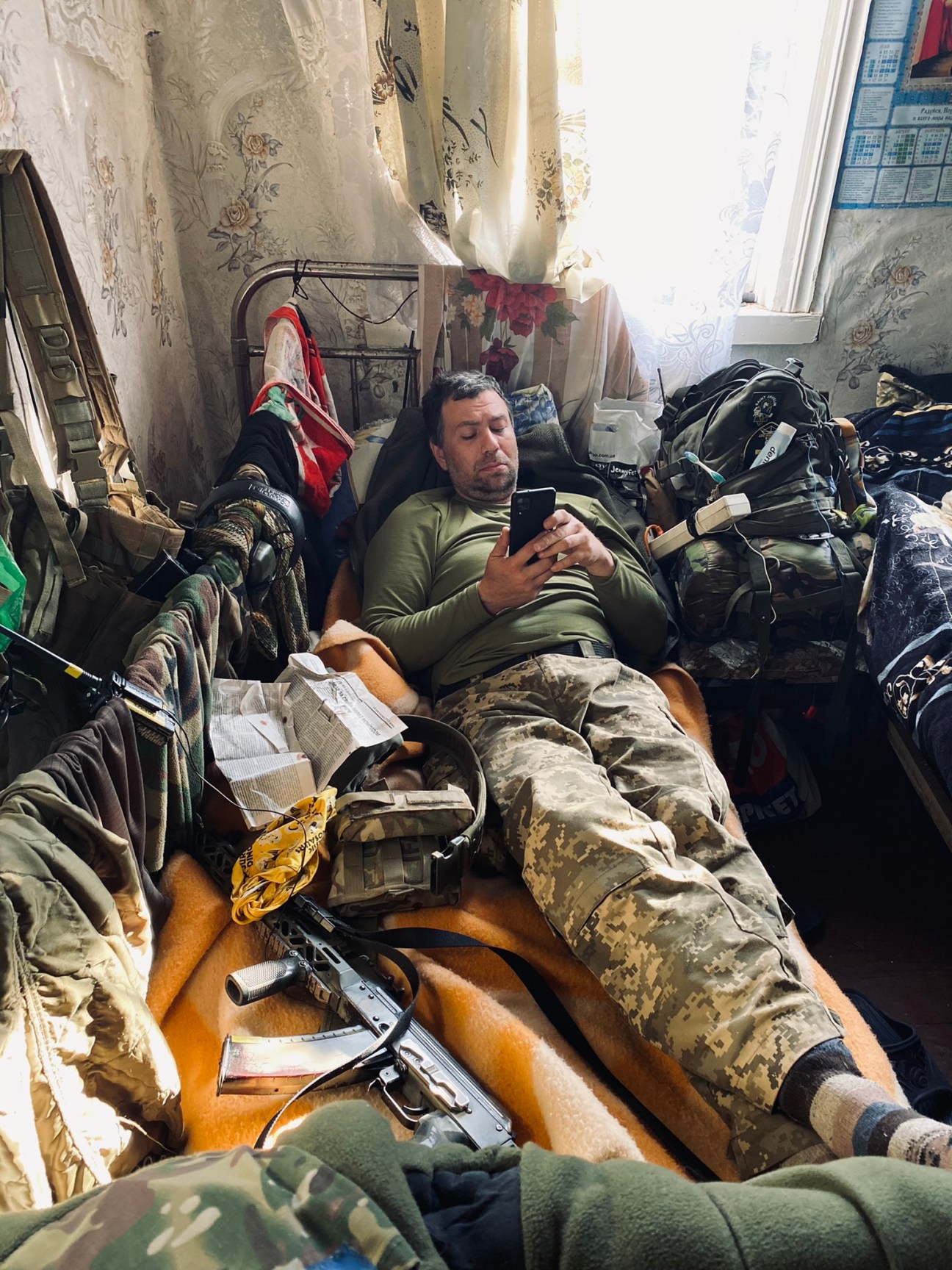
In the February issue of Monocle, Ukrainian novelist and former soldier Artem Chekh wrote a dispatch from his hometown, Kyiv. He spoke of his latent dread of a war he hoped would not happen. Since then, his worst fears have been realised. His wife and son have moved west to Lviv and Chekh has re-enlisted in the army. He writes for Monocle from Polesia, near the border with Belarus, where he is stationed with a company of the Ukrainian Territorial Defence Forces in the thick, battle-scarred woods that surround the infamous town of Chernobyl.
Music is my saviour. The same music as before: Leonard Cohen, The Beatles, The Cranberries, Morcheeba. I have some basic ideas about other people’s private boundaries. That’s why I listen to music using headphones and keep things under my folding bed, not scattered all over the house. I don’t interrupt when someone speaks. I don’t shout when someone is asleep. I share cigarettes with my comrades. I’m a good boy.
Three months ago all my private boundaries were protected. I was working on a novel; I had a glass of wine in the evening and pizza delivered to my front door. But I am a soldier now. I live with 20 combatants, all recruits in Ukraine’s Territorial Defence Forces, in an old house in Polesia, a wetland region north of Kyiv. We are former truckers, music producers, shop owners – they are my family, my home comforts and my pizza couriers now.
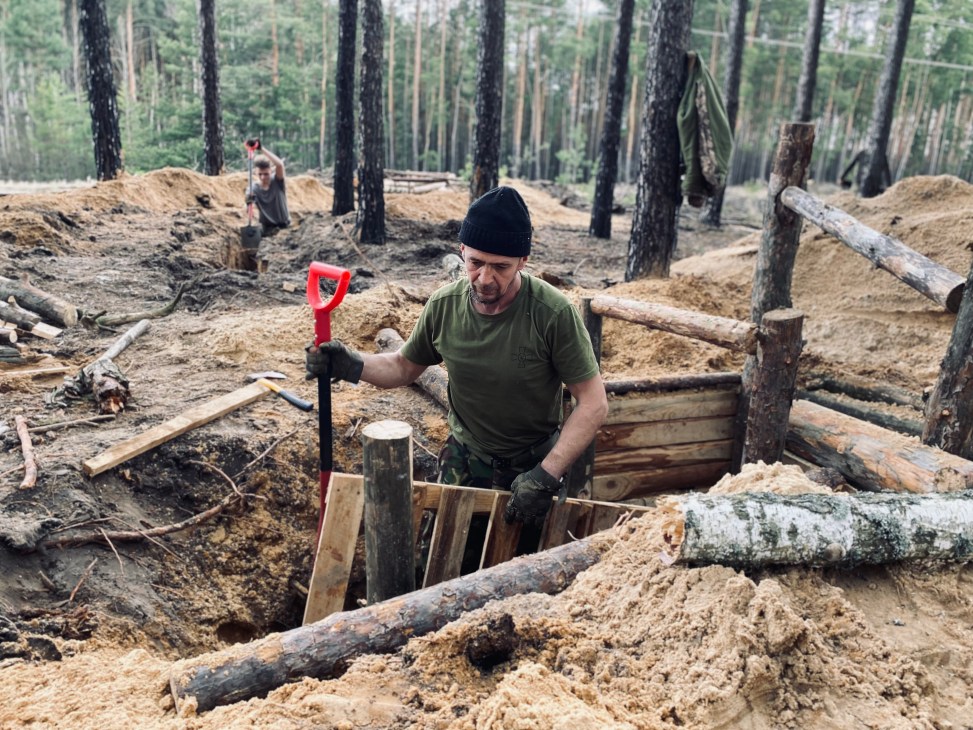
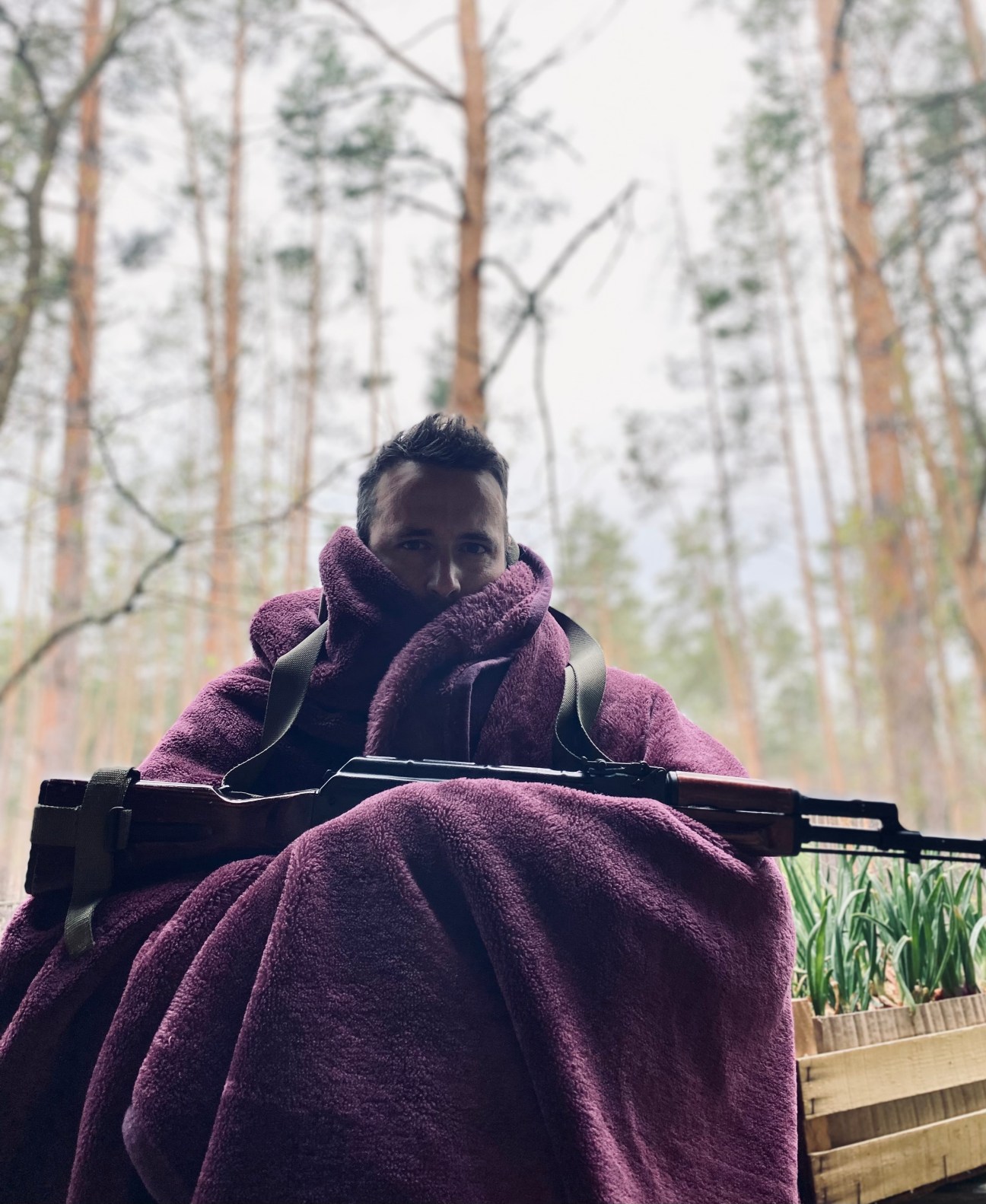
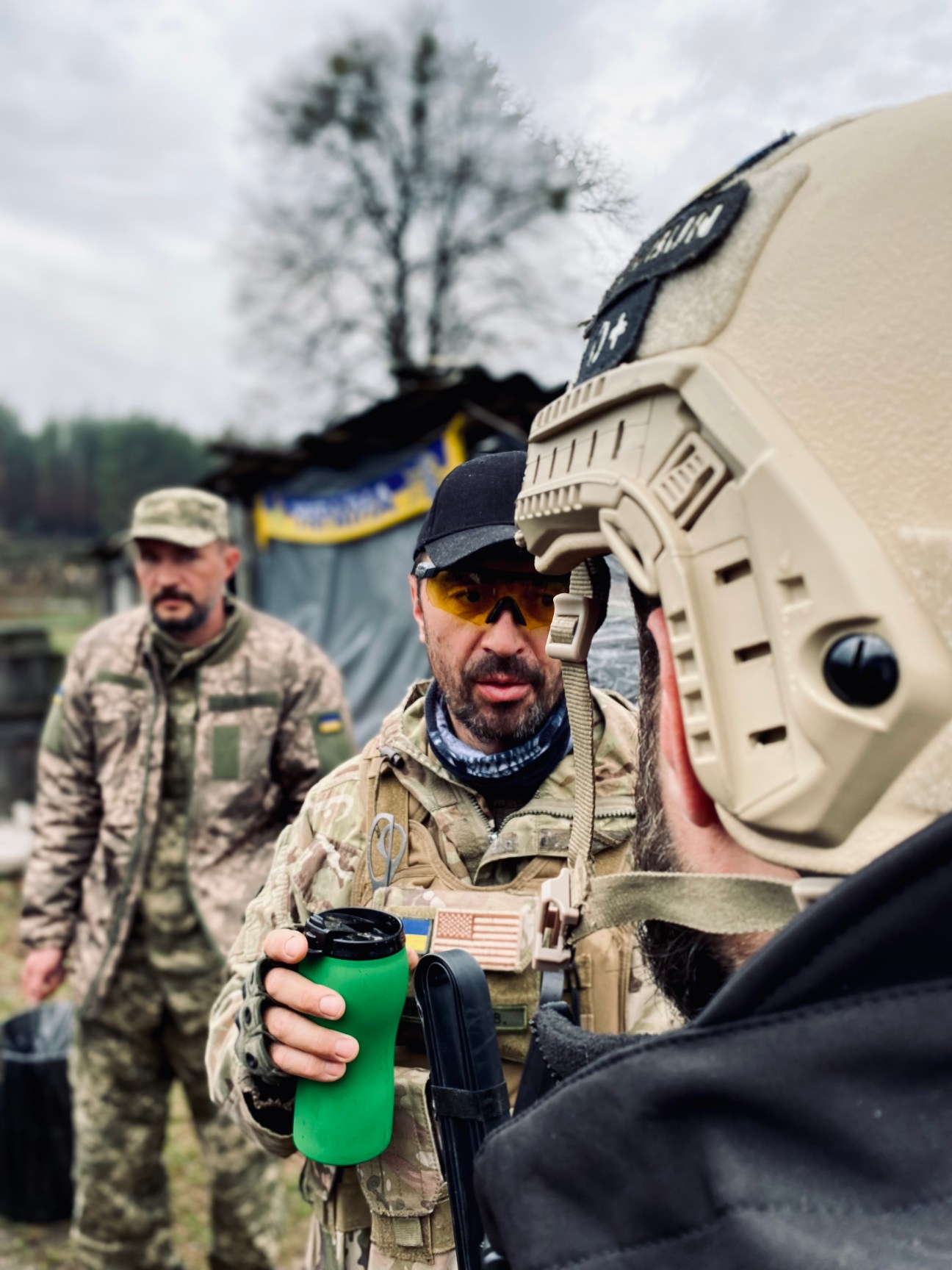
Yesterday I was in Gostomel and I stopped by to look at the townhouse where my friends used to live. I wrote about them in my previous article for Monocle (see issue 150). Those friends with whom I drank wine and talked a lot. I looked at their mutilated house and cried. Then I got back into the car and drove on.
If you set out from our base in the morning you will be in Chernobyl by lunchtime. This was a desolate area, even before the war. The 30km radiation zone, put in place after the nuclear disaster in 1986, has made it a region of half-empty villages, poor infrastructure and dense forest. It’s scarred by a different, more devastating, disaster now. Everything is ringing with the heavy echo of hostilities. The columns of Russian troops aiming for Kyiv passed through here. Every family can tell you horrors from the occupation.
One of the local women offered us the house of her dying mother. We found walnuts on the windowsill, a 2013 calendar hanging on the wall, religious icons, plastic flowers, holey curtains, hand creams, candles, mosquito spray in the cupboard. On the bedside table is a guide to radiation safety.
The locals help us with food: milk, eggs, venison. We help them with gasoline and our presence. They are calmer with us, they say. If we are here, then there is no enemy.
A month ago we were guarding strategic sites in Kyiv. First the famous TV tower which was hit by a Russian missile on 1 March. We moved to the area three days after the strike. Kyiv looked like London from Danny Boyle’s 28 Days Later: empty, rubbish-strewn streets, military police in suvs. We were conducting drills, waiting for the Russians, securing the ravine of Babyn Yar, where 33,771 Jews were massacred by the Nazis in two days in 1941.
In late March the Russians were forced to turn back from the capital and my unit was moved into the woods near the border with Belarus. Our first task was the inspection of one of the houses. The owner’s son was in the army, so the enemy buried an anti-tank mine in the front garden. While we were looking for it, we heard stories of murder and looting, mined cemeteries, raped girls and boilers stolen from houses. Eventually our interlocutors all moved onto one inevitability of Russian occupation: the shit. Faeces on the beds, on the pillows, on the kitchen tables, left as a sign that the Russians were here. The Polish writer Stanislaw Jerzy Lec called this “excremental fierceness”.
On our fifth day in Polesia, the medical service brought our neighbours their son’s car. The car was all shot-up but its owner was nowhere to be seen. Locals claimed that the Russians were being redeployed from the area and that some of them were apologising and saying that they were only “following orders”. When the Buryats and Chechens were deployed to the village the real terror began. Violence, looting and public executions.
When we entered a new village, the local women would surge towards us, hugging, crying and thanking us. But we were embarrassed. We didn’t liberate these lands; we didn’t chase the Russians away. My unit moved here to prevent a new attack on Kyiv, to build defensive ditches, dugouts and bunkers while more armed units are fighting in the east and south of Ukraine. I read obituaries every day, recognising familiar names. My acquaintances and friends. Former journalists, public figures, normal people.
The day the invasion began I thought about my possible destiny. It seemed that life was over and I mentally said goodbye to everything, thanking the universe for the wonderful years it had given me. Did I imagine myself as a soldier digging trenches in the centre of Kyiv or hugging and comforting an old babushka who was crying like a child? Did I think that I would be driving a used pickup truck with a machine gun on its roof? What was I thinking when Russia launched its attack? I don’t remember. It was so long ago.
In the first days of the invasion, I tried to join the battalion I had served with in 2014. Despite the fact that I was in the priority reserve, I was not registered. In desperation, I agreed to my former commander’s suggestion to go to the battalion’s headquarters without registering. “We’ll find a solution,” he said. But nothing was decided. My former comrades went south and I was left alone in the barracks, confused and unhappy. It seemed to me that I was of no use; everyone around was fighting and I had nothing to offer. After a few days I joined the Territorial Defence Forces. As for my former comrades, it’s difficult to stay in touch. I know that one of my commanders was killed but I don’t know how many others are still alive.
Several difficult lives have been lived. Many things that seemed impossible to ever imagine have happened on roads I used to drive down on trips to the countryside. Meanwhile, the trees have bloomed, nature has woken up – it has its own schedule to keep to. After the liberation of the Kyiv region, my city is also coming back to life. There is tension, there is the pain of war but the streets are crowded, the roads are congested, the cafés, gyms and dry cleaners are open, the supermarkets are full of groceries. Only the anti-tank checkpoints and sandbags remind us that, until recently, this was the front line. And, just a few kilometres beyond the suburbs, you can see the ruined cities whose names now ring out in infamy: Bucha, Irpin, Borodyanka.
From time to time I visit Kyiv. Not everyone is so lucky. I go to my empty apartment to wash my clothes, have a hot shower and lie on my orthopaedic mattress. Then I jump back in the car and return to the forests that have become my new home. The forests that halted my enemy.
We have come to terms with the fact that the war will be long and we will have to reconquer our territories one at a time. This is a great and terrible war. But I know we will win. We have no other option.
I’m lying on an army couch; I haven’t taken off my shoes because I’m on patrol in half an hour. We are preparing to go somewhere closer to the fighting in the east or south. I’m glad because, right now, the stoves in our house are so hot that I can’t breathe. It’s like being in an office here: we argue over how hot to have the room. Sometimes it gets tense. I use such brutal curses that I surprise myself. But now I am tired and I have no strength to quarrel. A long night of patrolling the woods is ahead of me. So Radiohead are in my headphones, a 120kg soldier is playing Angry Birds on his phone next to me, the windows are shaking because de-mining is taking place in the village. I’ll lie down for a while, then I’ll make myself a coffee, fill my flask and go out into the dark woods hoping finally to meet a deer. I have never seen a live one before.
Photographer: Alex Crétey Systermans, Alamy, Artem Chekh
Affairs
Urbanism — France
Off the road
Hugging the Mediterranean for 5km, Marseille’s famous corniche is a crucial part of the city’s life. No surprise then that a decision in 2021 to shut the road to motor traffic on at least one Sunday a month has proved hugely popular.
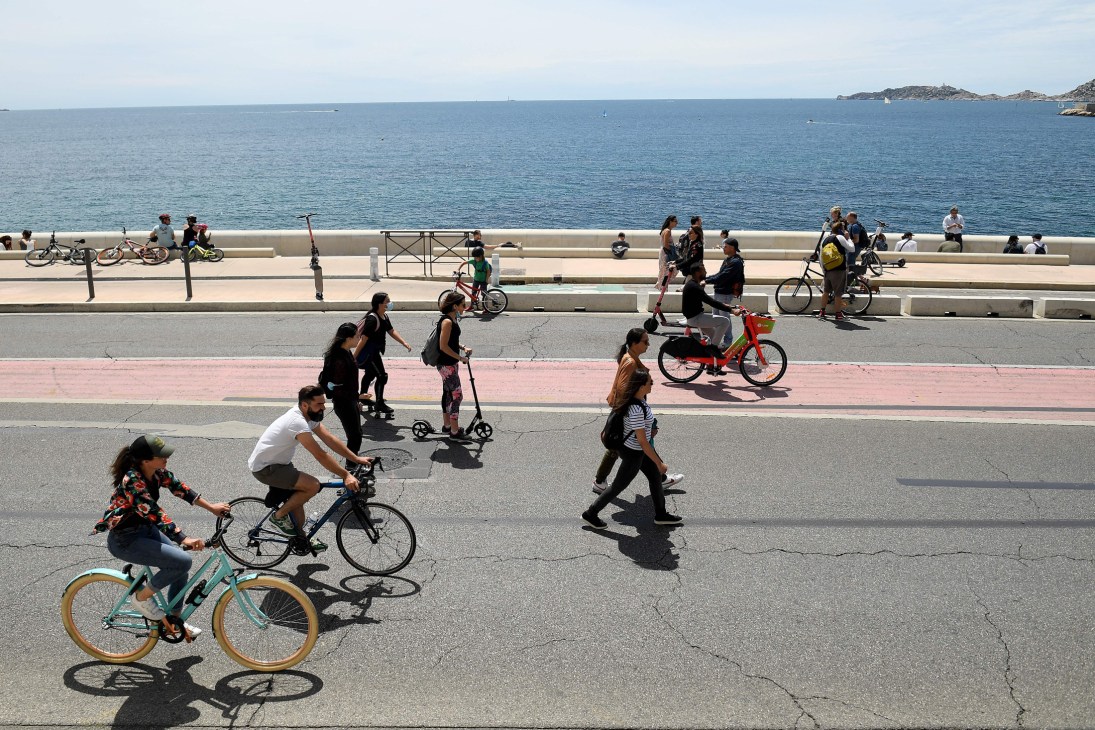
On designated La voie est libre (“The way is free”) days, the road is filled with locals and tourists walking, running, biking and rollerblading. Food trucks – many of them selling panisses (chickpea fritters), a local speciality – punctuate the route. Cafés, bars and gelato stands do a roaring trade. Usually the corniche would be choked with traffic on a Sunday. “It feels like we can finally breathe,” one resident tells Monocle. “It’s about reclaiming the most beautiful part of our city, even if it’s just for a day.”
This inspired initiative is one of several efforts to transform the city by the Green-Left coalition – known as Printemps Marseille (Marseille Spring) – that swept the municipal elections in 2020. Before that, France’s second city had a rather ignominious environmental record. According to rankings collated by the Clean Cities Campaign, it is the most polluted city in France; the new administration is determined to change that. Parts of downtown have been fully pedestrianised. There are long overdue plans to expand and improve the city’s creaking public transport system. More cycle paths are also in the pipeline.
This year Marseille was chosen to participate in an EU project gathering 100 cities aiming to be carbon neutral by 2030. Local officials note that nearly half the city’s emissions are caused by motor vehicle use. Getting more of Les Marseillais out of their cars, even if it’s just on a Sunday, can only be a good thing.
Politics — Lebanon
Independents day

Najat Aoun Saliba is the kind of politician that Lebanon has not seen in living memory. She trained in analytical chemistry in the US before returning to her homeland to take up a professorship at the American University of Beirut. Air pollution became her chief concern. For Saliba, Lebanon’s environmental woes are symbolic of its government’s criminality. She didn’t get involved in politics until circumstances compelled her. During the garbage crisis of 2015, when government incompetence led to tonnes of rubbish piling up in Beirut, she took to the stinking streets.
“After seeing the situation deteriorating I started feeling that scientific publications alone aren’t going to make a difference,” says Saliba. By the time the 2019 mass movement – “the thawra” – came about she was part of a network of activists. It was the 2020 Beirut port explosion that propelled her into politics. “Waking up the day after the explosion and feeling the city devastated, the smell of death everywhere, the ground shaking under our feet, we really felt that the government had abandoned us,” she says.
Saliba and a group of like-minded reformists launched Taqaddom, a radical party that ran two independent candidates in this May’s parliamentary elections. Both won, unseating long-serving MPs who had dominated the Chouf-Aley region. Saliba is one of only eight women in the new crop of MPs – the highest number a Lebanese parliament has had. More than a dozen other independent candidates won.
While they are only a small group within the 128-person parliament, Saliba believes that they can make a big difference in changing the culture of a government that has ignored its people for decades. “Other politicians here come for power or money but we are coming as servants of the people,” she says. “We are presenting ourselves as honest, transparent and inclusive. And I want the people to watch what we do and hold us to account.”
Three essentials in new Lebanese MPs’ in-trays
Justice for the victims of the Beirut blast
Establishing an independent judiciary that’s able to hold corrupt officials to account is a vital first step.
The healthcare system
Lebanon once had the region’s best hospitals but in the past two years the healthcare system has collapsed.
Restoring depositors’ rights
When Lebanon’s financial system crashed, the biggest losers were small depositors, many of whom lost their life savings and pensions.
The Foreign Desk
Andrew Mueller on…
The Australian election
In Australian politics, a theme recurs of charismatic Labor leaders returning their party to power after long periods of governance by conservative Liberal-National coalitions: Gough Whitlam in 1972, Bob Hawke in 1983, Kevin Rudd in 2007. Anthony Albanese, Australia’s new Labor prime minister, is not of this ilk – although he has never claimed to be.
It is plausible to think of Albanese as Australia’s Joe Biden – a timeserver whose party agreed on him because they couldn’t agree on anybody else; whose election victory owed more to weariness with a divisive and shambolic incumbent government than to enthusiasm for the alternative. But a win is a win – and this win could prove important.
The end of Scott Morrison’s premiership is – or so it must be hoped – the end of equivocation about climate in Australian politics. Morrison and similar fatalists insisted that Australia could not fix a global problem alone, which is true enough. But though Australia is a smallish country by population, it commands disproportionate space on the world stage. Therefore, it could, and should, take a lead.
Albanese arrived in office pledging an emissions reduction target of 43 per cent by 2030. His victory also adds to worldwide hopefulness for those who prefer government by unfussy centre-left types who’d rather improve the lives of their fellow citizens than conduct inane culture-war bun-throwing. Australia suddenly seems less a natural ally of Boris Johnson’s UK than it does of Biden’s US, along with Canada, Spain, Germany, Portugal, Slovenia, New Zealand and all five Nordic countries.
Another former Labor prime minister, Paul Keating, cited historian Manning Clark’s theory of the country’s history as a contest between “enlargers” – those with an upbeat vision of what Australia might be – and “straiteners and punishers” who are the spiritual heirs of the cops who arrived with the convicts in the 19th century. In Australia, Labor has traditionally enjoyed depicting itself as the party of the enlargers. Though it might run counter to his cautious instincts, Albanese should think big.
Society — USA
Clean streets
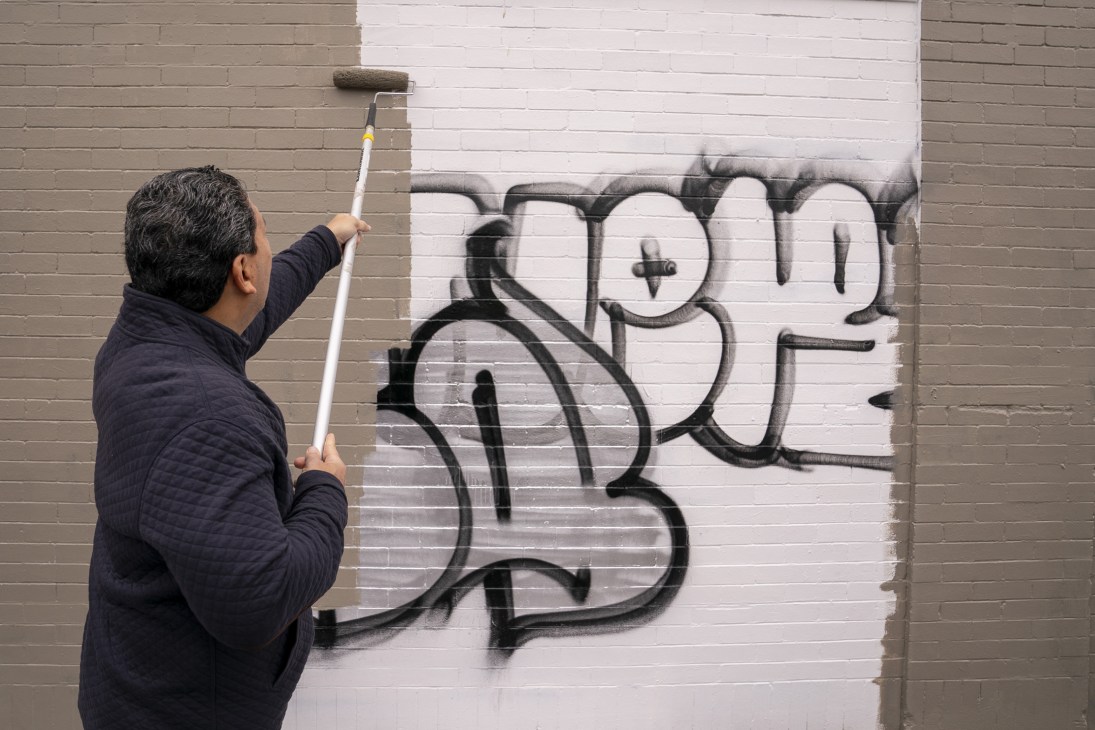
Bruce Harrell campaigned to be Seattle’s mayor on a platform to clean up the streets of a city that, until recently, scored high in liveability rankings (since the pandemic and 2020’s protests, graffiti and illegal refuse dumping have proliferated). This resonated with voters, who elected him last November with 62 per cent of the vote.
Six months into the job, Harrell and his administration have cleared homeless encampments that had become frequently unsafe magnets for drug trafficking and crime, referring those in need to shelters and housing.
Abandoned vehicles are getting the boot. And the mayor has committed to hiring 125 extra police after the force, demoralised by “defund” rhetoric, lost officers in droves amid a spike in gun violence.
In May he asked Seattleites to return the favour. On a Saturday in that month, several thousand turned out for the first One Seattle Day of Service, which Harrell’s team organised as a collective effort to roll up sleeves citywide. Civic associations, charities, garden clubs and community groups welcomed their neighbours to pitch in on everything from painting over graffiti and picking up litter to ripping up weeds and planting flowers.
While Harrell appealed to the public’s sense of civic pride, he also added a carrot: volunteer hours could be used to pay off $50 (€47) worth of parking fines, traffic camera violations and other minor municipal infractions. When helping a city get back on its feet, the ends justify the means.
Diplomatic spat
Port in a storm
Who vs who: Hungary vs Croatia
What it’s about: The landlocked nature of Hungary and tactless related remarks by the country’s combustible prime minister Viktor Orbán (pictured). Asked why Hungary was opposed to a complete ban on Russian oil imports, Orbán explained that such an embargo was an easier threat to make for EU countries with sea access. Not an unreasonable point but Orbán followed it wistfully with, “We would have had ports too, if they hadn’t taken them away from us.” Croatia heard this as provocative nostalgia for the days when it and its Adriatic coast were part of the Austro-Hungarian empire and accordingly summoned Hungary’s ambassador for one of those meetings at which biscuits are not proffered.
What it’s really about: Borders in the Balkans have been historically prone to violent alteration and therefore remain a touchy subject. Though Croatia’s foreign ministry issued a thunderous denunciation of “territorial claims against foreign states”, an attempt by Hungary to recapture lost Habsburg realms can be safely assessed as unlikely. It is hard to know whether this specific indiscretion was deliberate, instinctive or a slip of the tongue but it is pretty much standard Orbán.
Likely resolution: Relations to be restored to a low simmer until the next time Orbán says something belligerent and/or obnoxious. On form, it shouldn’t be a long wait.
Images: Getty Images, Reuters
Dreams take flight
For Mark Vanhoenacker, it all began in his childhood bedroom: as he stared at the paper globe perched on his desk, next to a model aircraft, dreaming of cities and places far from his hometown in Pittsfield, Massachusetts. “I was very drawn to the names of cities. When you’re spinning a globe, a name is almost all the information you have,” he says.
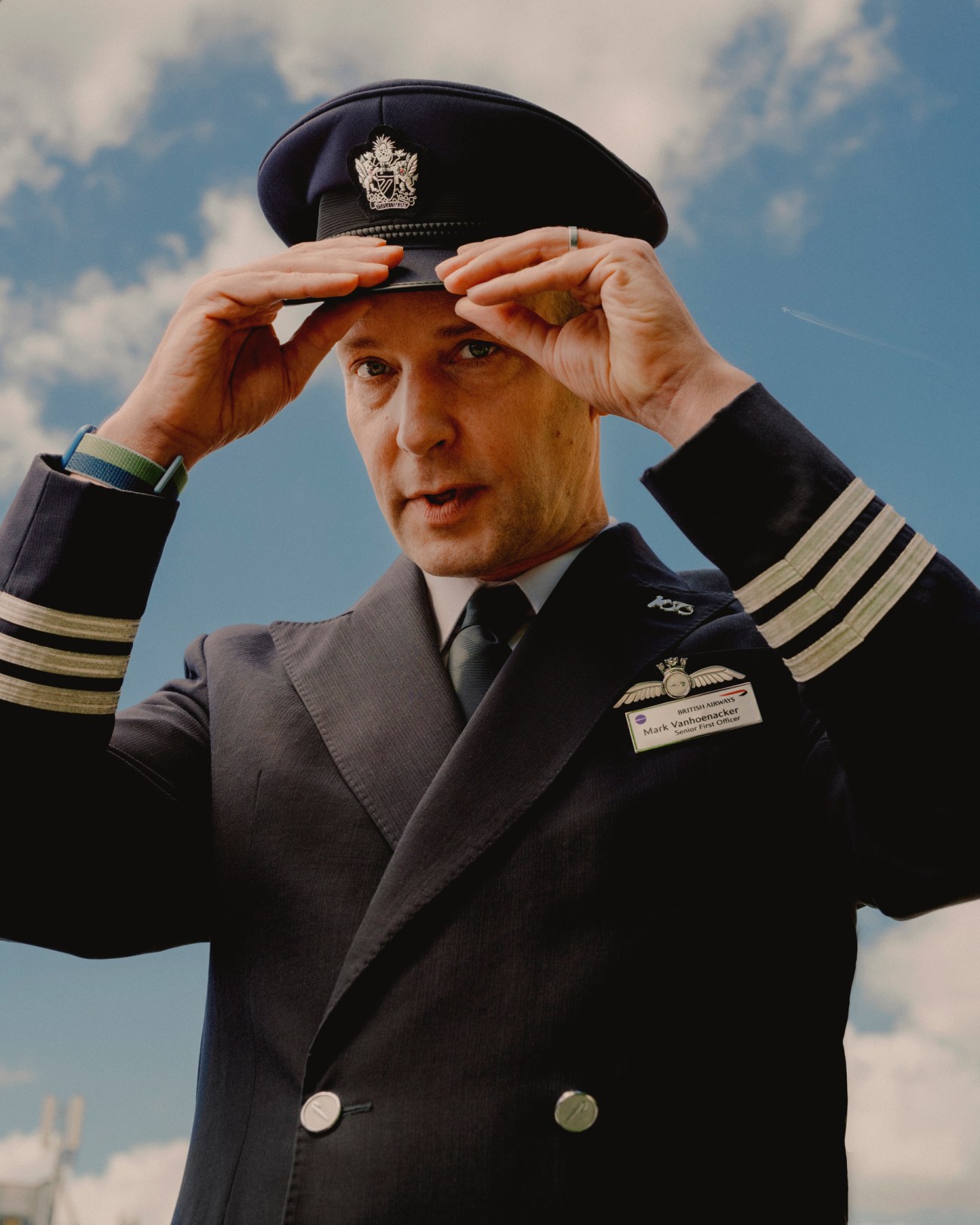
Now a veteran British Airways long-haul pilot, he has recently written a travelogue-cum-urbanism memoir called Imagine a City – a follow-up to his hugely popular Skyfaring: A Journey with a Pilot – reflecting on his relationships with metropolises across the globe and how they have changed over the course of his nearly 20-year aviation career. But, he explains, there was turbulence on arriving at this point.
Growing up gay, in a small town, meant that the hustle and bustle and freedom of big urban settlements was just the stuff of dreams. “Like a lot of kids in that situation, I looked at cities as a way of going into another place and imagining my own future – a future that might be more comfortable than how I felt at the time,” he tells Monocle.
As he moved through his adolescent years, Vanhoenacker’s fascination with names on the globe turned into a curiosity over airline route maps. “You would see these two names that were only connected by this curving, perfect line. I knew that all of those places were impossibly complicated and intricate, with rich histories, and yet they were connected in this deceptively simple way by aeroplanes.”
Today, Vanhoenacker recognises cities by silhouettes, co-ordinates, or the particular way the streetlights shine at night from above. And while it’s not uncommon for passengers to stare out of the window and wonder what lies below – especially when crossing a part of the world for the very first time – Vanhoenacker confirms that the view really is better from the flight deck. “With those fast forward windows, it really is an extraordinary sight. As we’re descending you can see how cities are steered by geography, by the rivers or mountains around them, how they lie by the harbour or the way a railway line crosses its entirety.”
This, Vanhoenacker explains, is one thing that anyone – pilot, urbanism enthusiast or otherwise – can learn about observing cities from the sky: how the grid, when viewed from above, can tell us about our likely experiences on the ground, leading to an unexpected appreciation of a place. For proof, he points to his own relationship with Salt Lake City. “I saw it first from the air, which drew me to spend time there. It’s in an extremely striking location, ringed by mountains in the east, which gives way to a desert. So when I visited as a traveller, I was much more excited about going there, because I already had the sense of the city from seeing the grid above.”
When Monocle meets Vanhoenacker, he’s just about to take his routine pilot exams, where every six months he has to go into a flight simulator to practise all kinds of scenarios (even the most unlikely ones). His favourite aircraft is the now-retired Boeing 747 – the same as the model aircraft he had as a child.
And as for his favourite view when he makes the approach into a city? “I really love flying into Los Angeles, especially in the last hour and a half of the flight. You get the sense of these vast deserts transforming into a ring of mountains, which are often snowcapped, and then beyond them you have this bowl of light lying on the edge of the Pacific. It’s an extremely dramatic approach. And I really recommend that you get a seat by the window on the right side of the aircraft.”
The CV
1974: Born in Pittsfield, Massachusetts
1996: Graduates in history from Amherst College, magna cum laude
2001: Begins pilot training in Oxford
2003: Pilots his first commercial flight with British Airways
2007: Pilots first long-haul flight from London to Hong Kong
2015: Publishes first book, Skyfaring: A Journey with a Pilot
2018: Begins piloting Boeing 787 aircraft
2022: Imagine a City: A Pilot Sees the World is published
The Opener
How to live: Hotel etiquette
The list
Even a fantasy hotel needs house rules. These would be ours, writes Tyler Brûlé.
Though Monocle gets more than its share of offers to open a hotel in an emerging city, a resort in a far-flung destination or a members’ club in one of our key markets, we have resisted the temptation. But we do think about who we’d hire to oversee a renovation (did I hear you say Studio KO or Studioilse?), run the bar or design the uniforms (Sofie D’Hoore, please). We also think about the house rules that would keep things civil and serene. Welcome to the Auberge Monocle.
1.
Make an entrance. We worked hard on our fine fittings and flattering lighting, so get dressed up and turn a few heads.
2.
Don’t photograph other guests. You know perfectly well why.
3.
Light a candle. The restaurant is dim for a reason. If you can’t read the menu, we’ll bring you an extra candle.
4.
Take it back to your suite. We used to say this when a couple were getting too frisky on the lounger; today we ask that you take your conference call in your room.
5.
You might make friends for life by sending a bottle of rosé to the people across the terrace. It’s a nice thing to do. If they refuse, let the front desk know and we’ll ensure that we’re fully booked should they want to return.
Finally, keep your phone on silent or, better yet, leave it in your room. You’ll be surprised how much your stay improves. Merci!
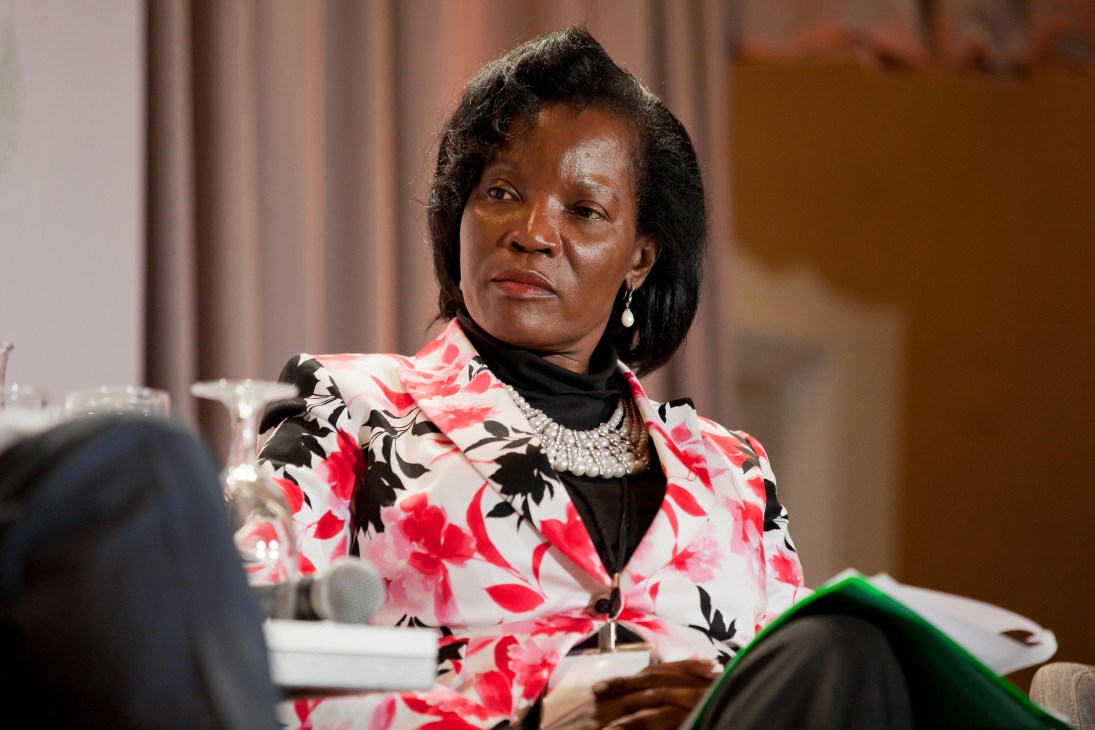
The Interrogator
Jennifer Musisi
Uganda
A lawyer by trade, Jennifer Musisi never had plans to lead a city. But her work at the Uganda Revenue Authority, where she helped stabilise an organisation dealing with crippling corruption and systemic dysfunction, meant she was perfectly placed to head up a public authority. So when the Ugandan central government established the Kampala Capital City Authority in 2011, Musisi was a natural choice to be its first executive director, a position equivalent to mayor. She stayed in the job until 2018 and now serves on the board of c40 Cities and as a UN ambassador for sustainable development – roles where she helps to improve the lives of urban dwellers. Here, she tells us about issues facing mayors across the globe and why she loves living in Kampala.
To start, tell us about your work at the Uganda Revenue Authority.
I was tasked with bringing down corruption and building up the country’s revenue base. In Africa the tax base is small and businesses try to evade paying it. Part of my job was convincing people that the government wasn’t going to squander it but use it to build better roads and improve healthcare.
How did you end up at Kampala Capital City Authority?
My plan was to take early retirement, do some consulting and work on my art. But the president requested I come and help transform Kampala.
That’s a significant change of plans. What did you learn about local government in Kampala?
A lot of what happens in cities eventually ends up affecting the rest of the country and, as a result, local governments in urban areas offer a template for development purposes for the rest of the country. In Uganda, for example, everything begins and ends with Kampala. Here, there’s a lot of rural to urban migration, with the population growing exponentially every day. This means that there are challenges in terms of providing jobs and infrastructure, and dealing with unplanned development. But if we sort out these issues in the country’s biggest city and test solutions here, we can create templates that can be replicated in smaller urban centres.
What are some of the most pressing issues facing cities across the globe?
The big thing is working out where the money is going to come from to implement solutions. Almost every city I know is stretched financially, so national governments have to come in to support cities in their mandates. Urban areas are the financial, political and industrial centres of nations. They are everything, so they need to be prioritised by national governments.
Finally, what do you love about your home city of Kampala?
The people and the climate. The weather and wildlife are lovely. It’s paradise as far as I’m concerned.
Reporting from…
Monocle’s global team of writers bring news of rogue beavers storming Zürich, exciting regeneration projects in Los Angeles and Tokyo, and Hong Kong’s superstar boy band.
Zürich
Eager beavers
In recent months wild beavers have been steadily advancing from the Swiss countryside towards Zürich’s urban climes. And they’re earning celebrity status. One of them, which locals have nicknamed “Bucky”, has become a big draw for urban wildlife spotters.
London
When in London…
Cancel your holiday in Italy: the City of London is investing £2.5m (€2.9m) to encourage tourists to visit its unheralded Roman ruins. The goal of this drive is to invigorate the somewhat soulless financial and business district outside working hours.
Tokyo
Japanese garden
Regeneration work has begun on the outer edge of Yoyogi Park, near Monocle’s Tokyo bureau, where an unloved chunk of land is set to be transformed by 2024. The area will have a new skatepark, running station and, most importantly, plenty of greenery.
Hong Kong
Mirror ball
In July there will be anthems galore when Hong Kong’s government marks the anniversary of its return to China 25 years ago. However, we expect more passionate singing at the Coliseum when boy band Mirror perform 12 sold-out shows at the Cantopop arena.
Toronto
Sobering news
It’ll be a dry summer in Toronto – and not due to warm temperatures. The council has, once again, refused to lift a ban on drinking alcohol in parks. But public pressure is growing and city hall might not be able to bottle making a change to the law for much longer.
Los Angeles
On the waterfront
A scheme to put the Los Angeles river to better use has been approved. For inspiration, city planners should look to the Frogtown neighbourhood, where a cycle café and small businesses have already given their stretch of the river a fresh lease of life.
Holy fail
Few typographical errors are as legendary as a glitch in a 1631 British edition of the King James Bible. The text omits the key word “not” from the seventh commandment, thereby instructing readers, on the highest authority, to commit adultery.
Perhaps 20 copies of the so-called “Wicked Bible” are still intact and have, inevitably, become more coveted than any neighbour’s ass, fetching five-figure sums at auction. One has now surfaced in New Zealand and is being cared for by the University of Canterbury in Christchurch.
The perpetrators of the error received worse punishment than most sub-editors who miss a trick: they were stripped of their printing licence on the order of King Charles I of England. Anyone who has worked in publishing will have been party to a misprint – they’re easily done, if rarely as amusing as this one. That could be why the Almighty carved his edicts into stone.
First flush of film-making
What do German film-maker Wim Wenders, Japanese architect Tadao Ando and one of Japan’s most celebrated actors have in common? The answer: public toilets. Wenders has announced that he’s making a film about The Tokyo Toilet, a project that saw Ando and a host of other starry Japanese architects design beautiful, clean public loos in Shibuya. The film’s hero, a toilet cleaner, will be played by Kôji Yakusho, an appealingly self-effacing actor who starred in Babel. With a global release expected in 2023, we’re hopeful that Wenders’ film might encourage other cities to build cinematically inspiring toilets of their own.
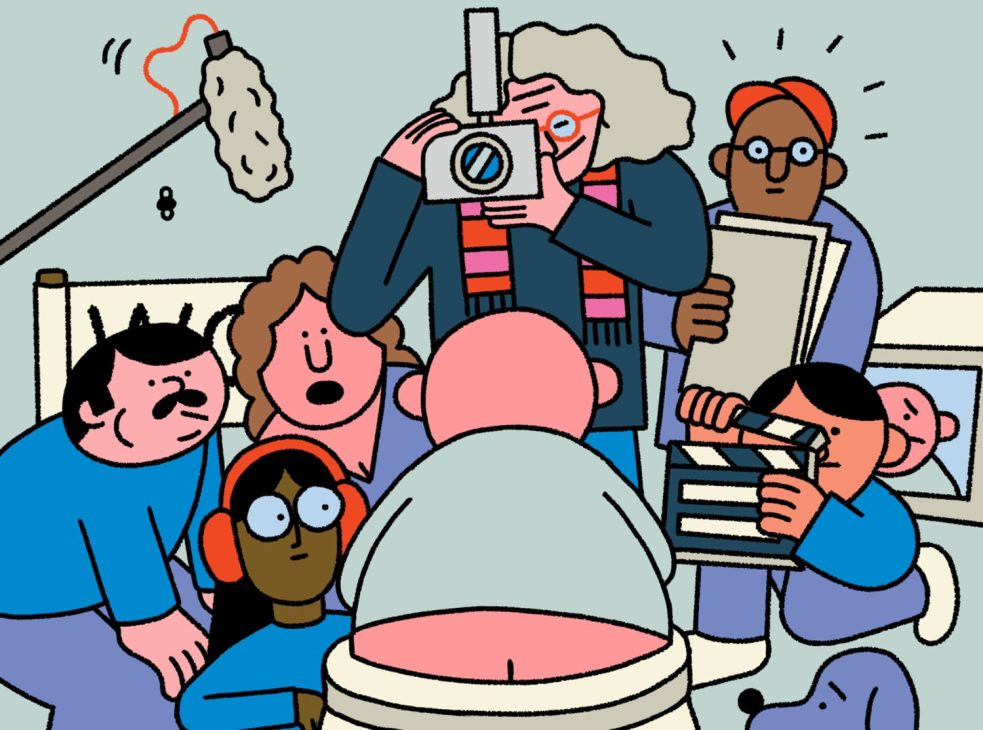
New releases

A new state-run programme in Bolivia is offering early release to prisoners who improve their literacy while behind bars. Which other countries are easing pressure on their penal system by offering similar incentives?
1.
Brazil
In Minas Gerais state, prisoners can pedal stationary bicycles that charge nearby street lights. The bright idea sees sentences reduced with three eight-hour shifts in the saddle.
2.
India
At Yerwada Central Prison, cons can take part in a yoga programme to get months taken off their sentence. How’s that for a flexible release?
3.
Thailand
Thai inmates can fight for their freedom in a Muay Thai match against foreign opponents. If they win, they can earn an early release date.
Hot potatoes
The US-Mexico border is one of the world’s most fraught, thanks largely to conservative American politicians inflaming fears of immigration across it. But it is not widely appreciated that Mexico has concerns about what travels in the opposite direction – specifically, potatoes. In May a shipment of American spuds crossed freely into Mexico for the first time in more than 25 years. Due to Mexican pettifogging, US potatoes had previously only been allowed to be sold within 16 miles (26km) of the border. But following a decision by Mexico’s Supreme Court, American taters can now be sold everywhere.
Correspondent’s view
Quality of life
Simple pleasures
I have a go-to walk on summer nights in Paris that always leads me to the same place: La Palette. On rue de Seine, in the heart of Saint-Germain-des-Près, this bar has long been popular among the staff and clientele of the neighbourhood’s galleries. Its painting-lined interior spills out onto a buzzing terrace. I sit down in my usual spot with a good view of the entrance. Sometimes I read; sometimes I write. Mostly, though, I people-watch: the most entrenched of Parisian pastimes.
But why La Palette? Well, this is a place to linger. It’s where the beau monde – France’s fashionable set, from artists to politicians – gather and debate late into the night over bottles of wine; former president Jacques Chirac was a regular. Here, business meets pleasure as local gallerists exchange gossip about recent finds at estate sales and auctions. Couples clink glasses and friends share a planche laden with cheese and charcuterie under the evening sky.
In his essay “Les vraies richesses” (“True Riches”), French author Jean Giono praised the simple life of fresh air, food and wine shared with friends, objects made with care, and time in nature. Although Giono was writing in the 1930s, some things have not changed: our quality of life is still largely shaped by our ability to eat well, laugh among friends, relax outside after a long day’s work and, in Paris, people-watch too. As dusk falls over La Palette, I will raise a glass to that.
Image: Alamy
Key to the city
The city is back. For believers in urban living, the past few years have been a testing time as think tanks, columnists and handwringers have talked up the exodus to the ‘burbs and beyond, predicted the decimation of all retail, said that the wfh movement will derail attempts to revive pandemic-punched downtowns. We’ve also had to endure the soothsayers and futurologists who have railed against grand urban visions for new infrastructure (surely, they say, cargo bikes and ride-shares are all you need?), investing in new offices (because that Wework story really worked out how they predicted).
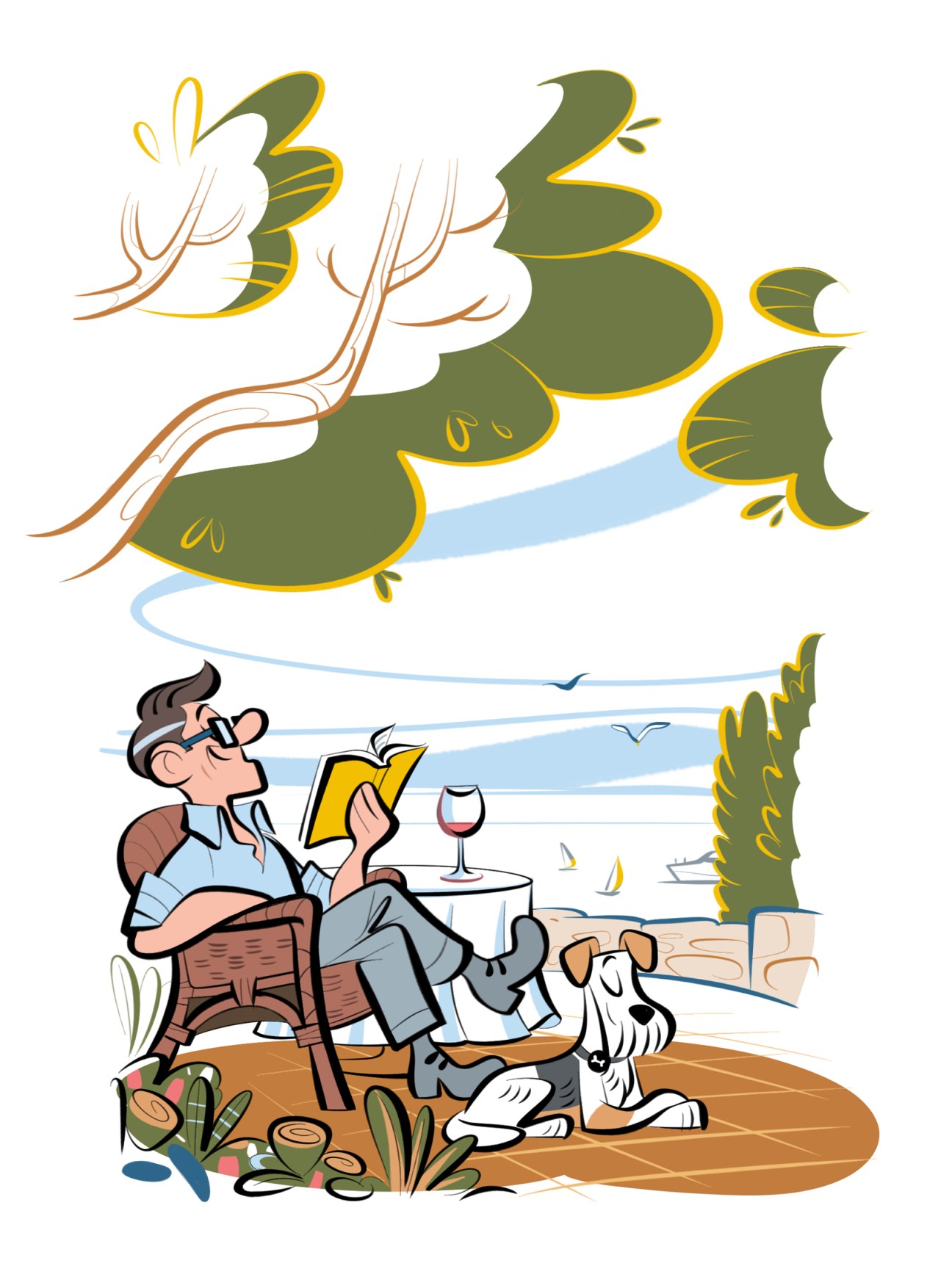
But it turns out that our cities have a resilience that allows them to adapt and change – and come roaring back. Not the same but not diminished either. Ask anyone apartment- hunting in Paris or London if demand for urban living has left it a renters’ market and you’ll soon understand that demand is buoyant. The trouble is that too often we extrapolate a vision of the future from just a few troubled spots, a few headline-grabbing reports. It’s more mixed and interesting than that.
Yes, our cities have come back to life after the pandemic at different speeds, but they remain as hothouses for social change, innovators in sustainable architecture and design, and places where magical things can occur. Of course, some people have left the city permanently for greener pastures but that’s nothing new and the gaps that they have left are being snapped up by a new generation of people who understand that a great city lets you come of age surrounded by supportive peers; dare to embrace your dreams.
This passion for cities is why I loved reading the proof pages for this Quality of Life issue, which unpacks the shifts reshaping our hometowns. In the US, for example, Chris Lord travels to Miami to see how the city has gained a new generation of entrepreneurs moving from the chillier north because of its mix of business-friendly policies and a quality of life also improved by its very sunny disposition. For the nomadic worker, Miami – along with a host of southern sunshine-belt outposts such as booming Dallas – has become a huge draw.
But Europe has its own sunbelt. In Lisbon our correspondent Gaia Lutz meets the recording artists from across the Lusophone world who are using the city as an incubator for rich musical experiments that forge sounds from Africa to Brazil. It’s a scene that is making Lisbon reassess its cultural landscape and hopefully leave it richer and more diverse. Something similar is happening in Marseille where a few key metrics – affordable rents, those hours of sunshine and a cacophony of cultural influences – are making the city the go-to place for a new generation of French artists – read Julia Webster Ayuso’s report here.
And in Palma de Mallorca we meet Jaime Oliver and Paloma Hernaiz from the architectural practice Ohlab who understand that all those hours of Mediterranean sun also come with a challenge: how to make buildings that can stay cool without you cranking up the air-con. You can see their new Passivhaus apartment block here.
Yet urban inventiveness is not limited to sunny outposts. Writing his debut story for Monocle, Tom Vanderbilt visits Oishii, a vertical farm in New Jersey that’s growing Japanese mountain strawberries that sell at $50 for just eight fruit. The Oishii venture is a luxury player in the urban farming story but it’s one of many tech-driven projects attracting huge interest and investment as people wonder how cities will best feed themselves in the future – and as the technology becomes cheaper and more widespread.
And then, of course, there’s the survey of the best cities to call home – we always send this to newsstand and then duck for cover as people wonder why their hometown failed to rank. But that’s the joy of this survey: it starts debate, makes people look around and wonder what would make their city better. Anyway, I am sure you will let us know your thoughts. But despite any jostling among fans of particular cities, how great that there is so much excitement about the future of the city in general, about how it shapes and changes our lives. And how, done well, it can deliver a better quality of life for all its citizens.
Thank you for reading – and I hope subscribing to – Monocle. Feel free to email me at [email protected].