Issues
Feel the breeze
The world is getting warmer and ever more urban, so the heat is on to build cities in smarter and more sustainable ways. But how can you create infrastructure that keeps people cool, even in the tropics, without relying on energy-hungry air conditioning?
Thankfully, there are plenty of proven design ideas out there to help. Developed by pioneering architects in steamy places across the world, these cool designs work with mother nature rather than against her. It’s architecture that channels the breeze, offers room for greenery and encourages us to live outdoors as much as possible. And it is available to admire in places as disparate as Hawaii and Milan, as our round-up of rules for keeping cities cool highlights.
1.
Use breeze blocks
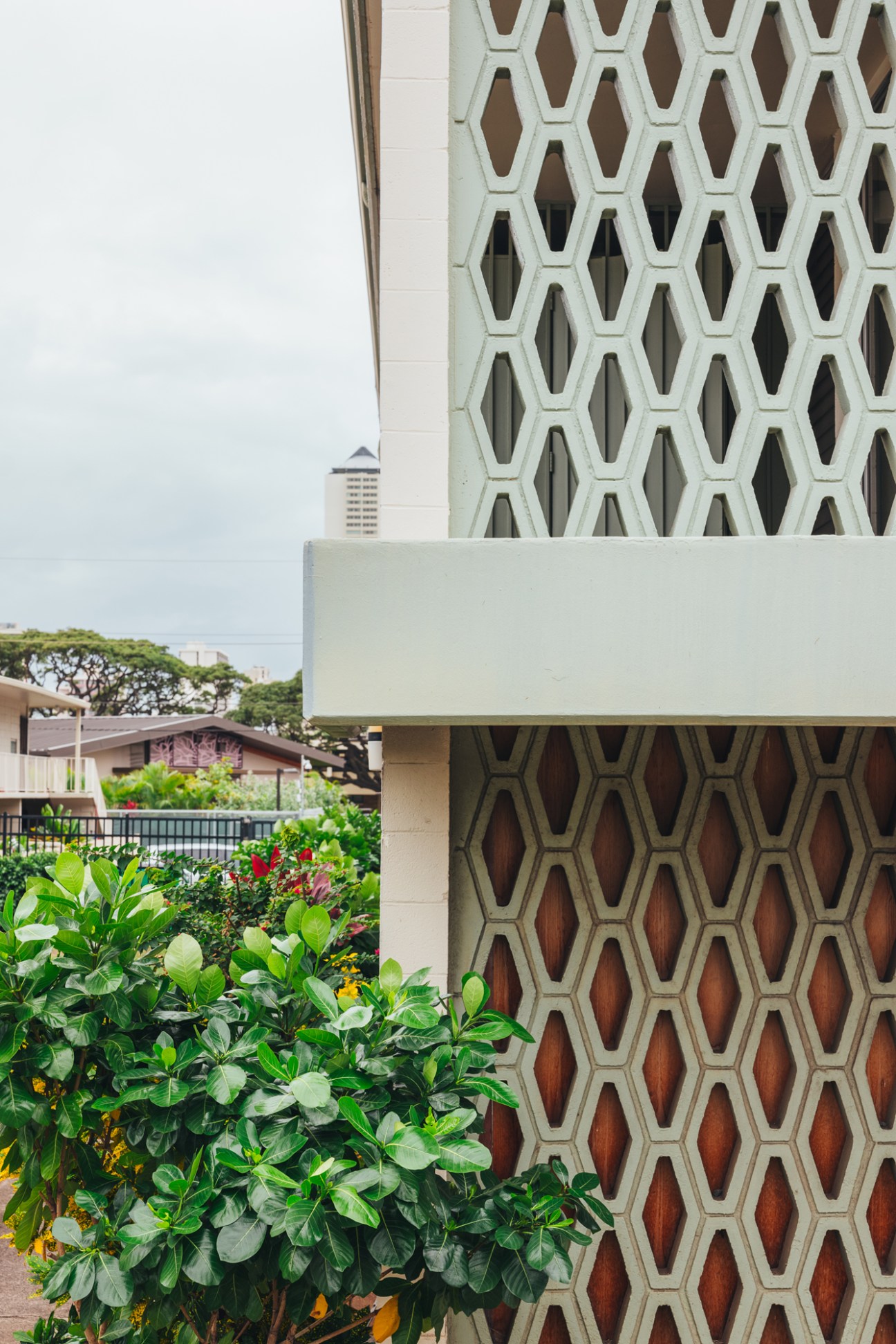
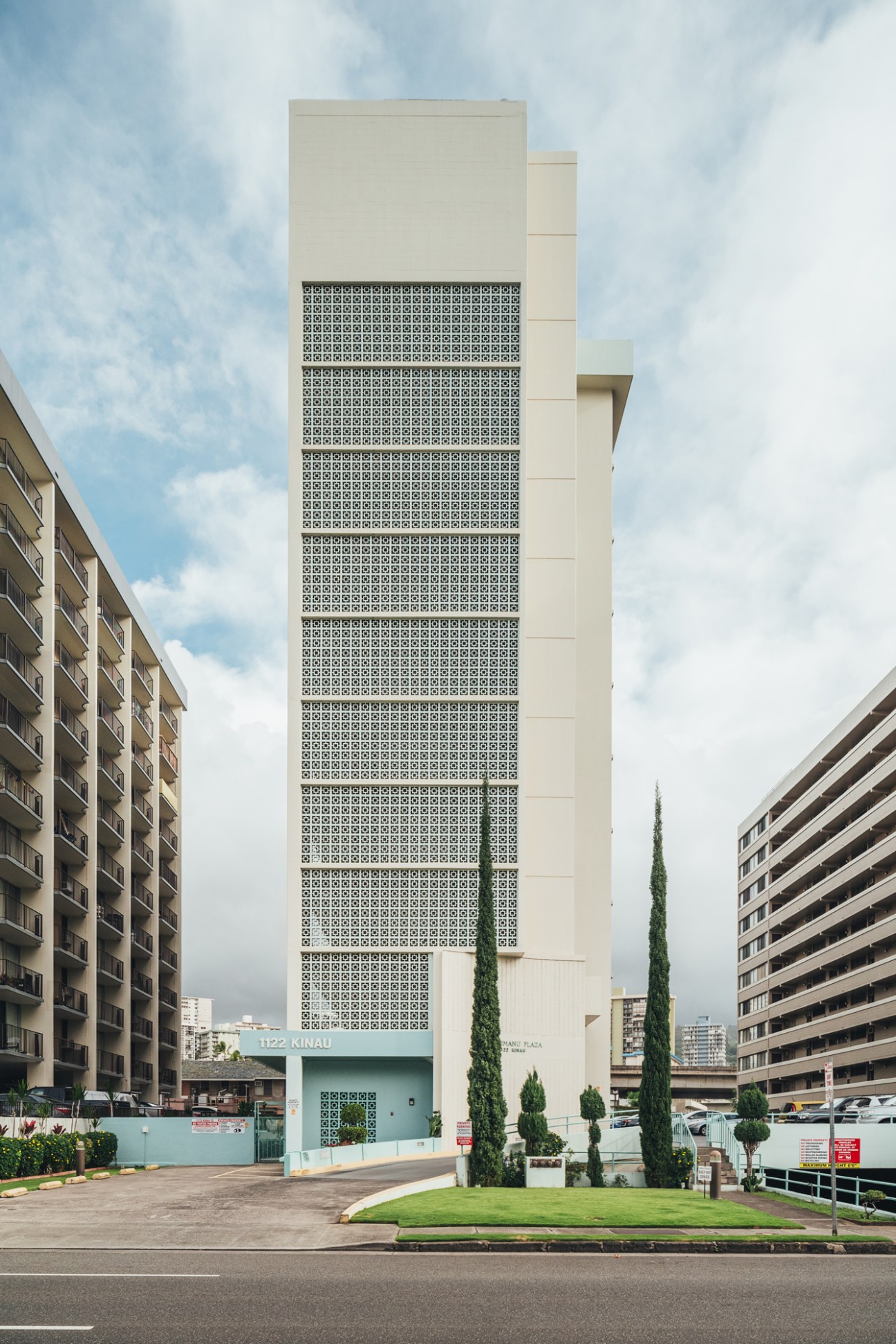
Adding breeze-block elements to a building can be an artful and practical way of cooling it down. From 1950s homes dotting the avenues of Australia’s Gold Coast to the façades of Hawaii’s modernist holiday apartments, these special concrete bricks can come in a variety of patterns and recall the cheery days of mid-century summer holidays. Perforations mean that air can pass through, while the brick remains strong enough to help to support a structure.
2.
Load up with lush greenery
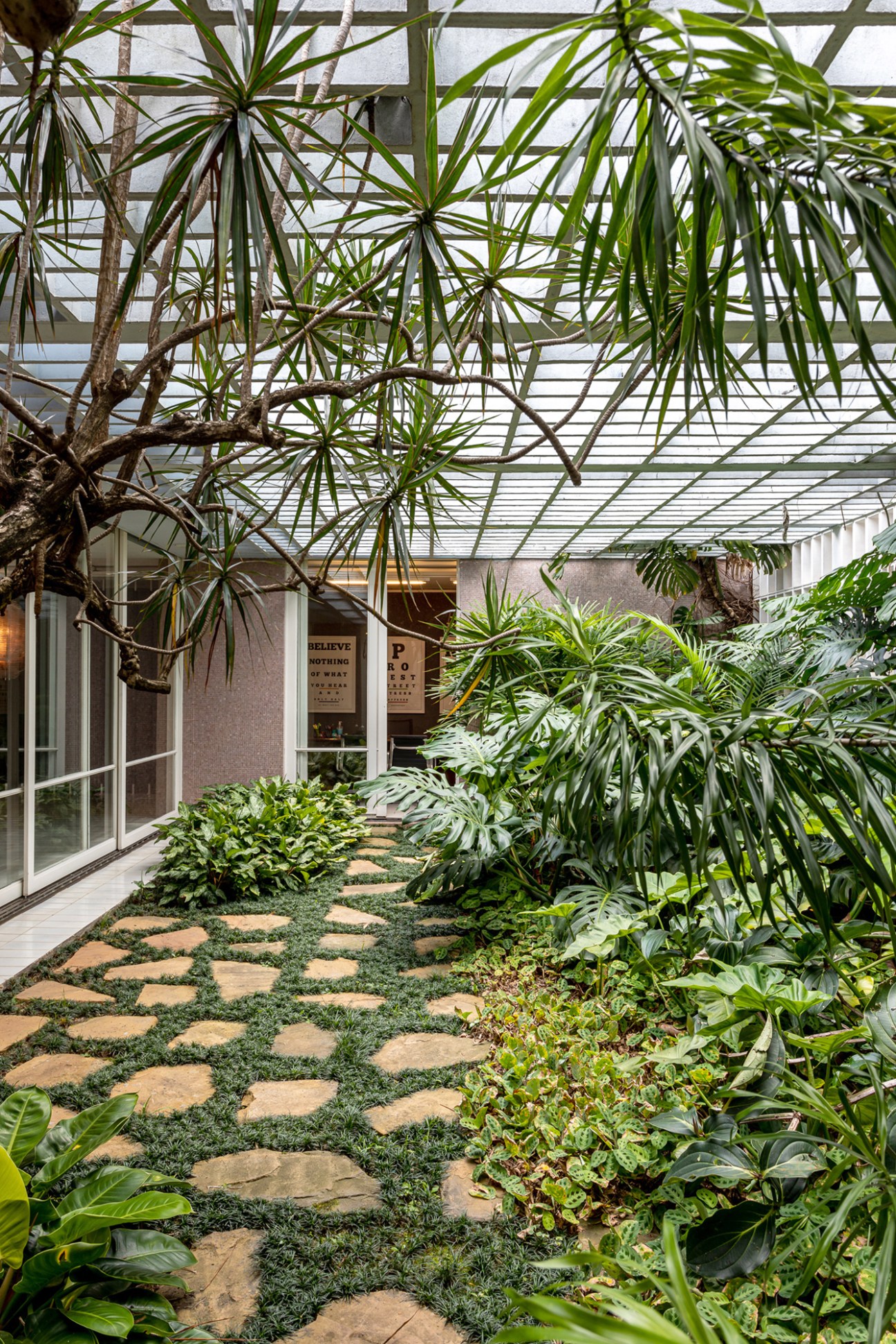
Any bright botanist will tell you how simple it is for certain plants to thrive even in the most concrete-heavy of urban jungles. The trick is to use foliage that requires little room for roots and with wide absorbent leaves that flourish out in the open. These can be plonked into well-placed planters in urban apartment blocks and, as long as they receive enough water, they reward residents with shade and the wellbeing benefits that come with living around greenery. This lush example is the Castor Delgado Perez Residence in São Paulo’s Jardim Europa district.
3.
Hang out
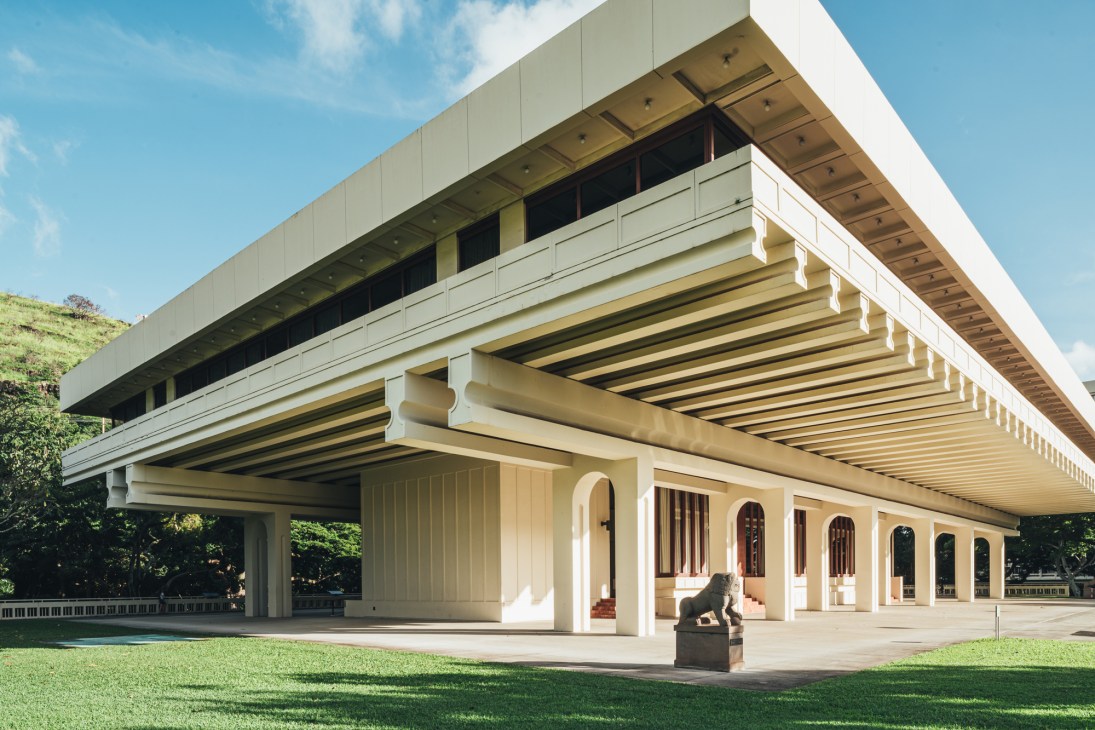

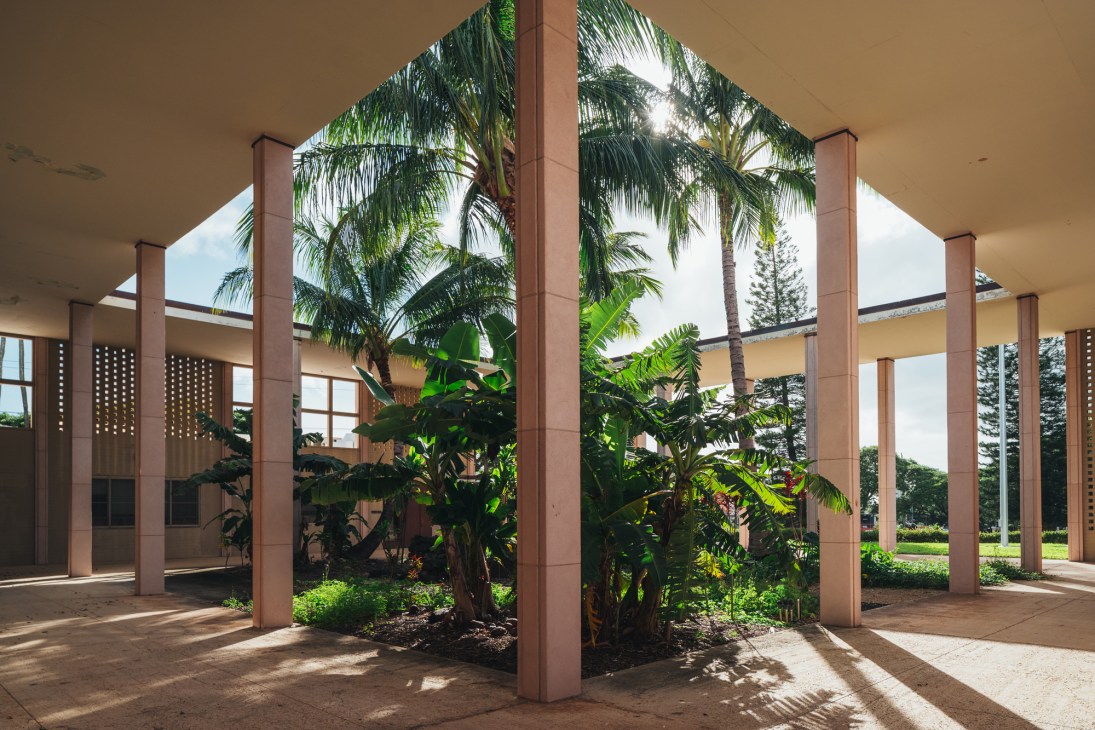
A characteristic of clever tropical modernist design is the use of large cantilevered roofs to provide shade. A more extreme method sees the entire raising of a building to provide a spacious sun-free area beneath it. IM Pei’s pioneering work at the University of Hawaii from 1963 (pictured) exemplifies this rule. Here, a handsome hall space provides a shaded on-campus courtyard below the elevated main building.
4.
Keep arcades open
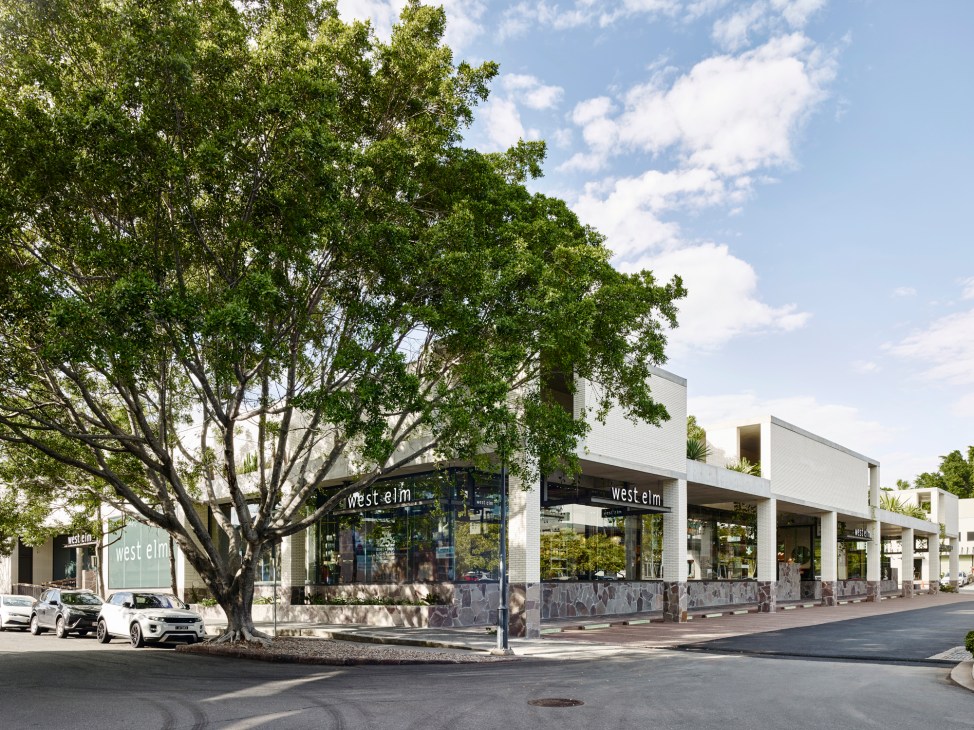
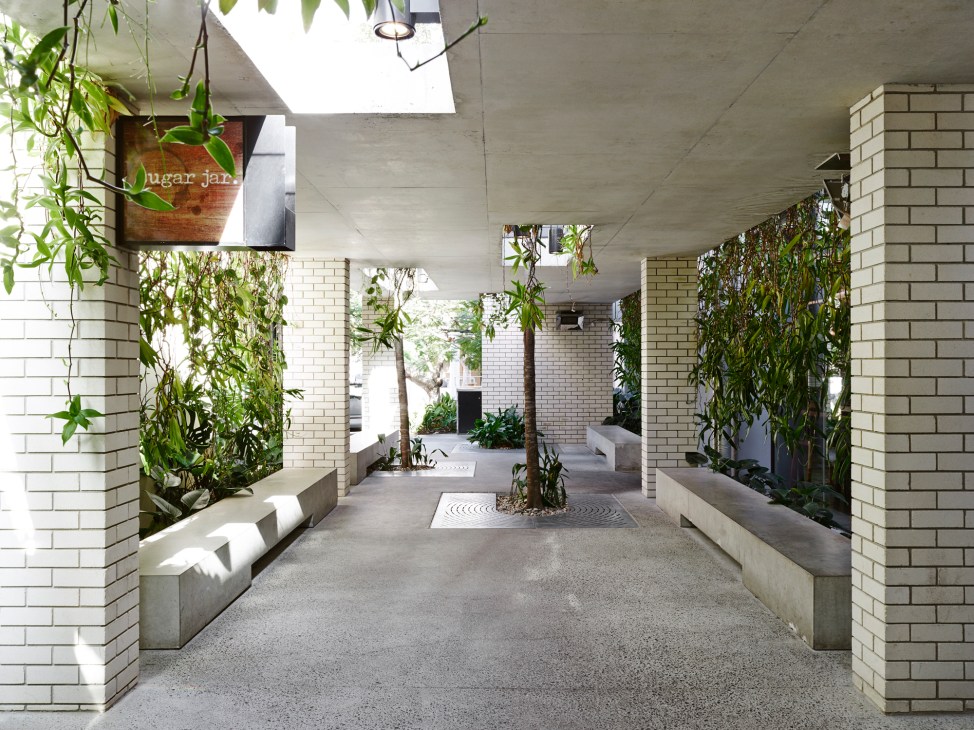
Shopping centres are perhaps the built environment’s most over-designed elements – often done in a way that requires excessive use of air conditioning. But creating room for convenient commerce needn’t be done in such an eco-insensitive manner. Just look to the work of Aussie architects Richards & Spence in Brisbane’s most coveted shopping district. Here at the James Street precinct, the use of a clever open design, shade-producing overhanging features and plenty of planting all combat the city’s harsh weather conditions to provide a breezy place for buying goods.
5.
Make careful openings
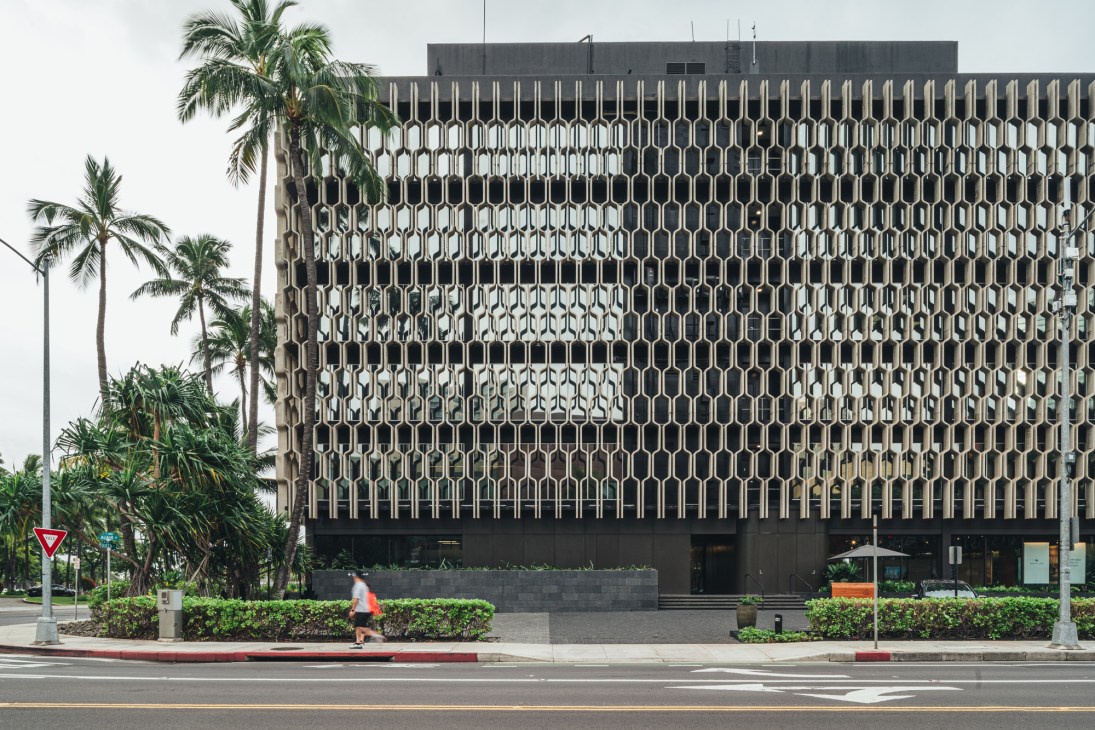
Some of the best examples of embracing the wind in architecture come from cities in the tropics. Across Honolulu’s sun-drenched streets, mid-century architects created clever ways of cooling citizens, while reducing the need for air conditioning. Perforated walls or latticed brick-lined enclosed gardens and courtyards can be found all over the city.



6.
Create cool canopies

Our golden rule for keeping things cool in cities comes directly from the natural world. The simple tactic of planting big leafy trees along streets and pavements to create shade can be overlooked in urban design. Take a relaxing paseo (evening stroll) along the busy tree-lined promenade of a well-planned Spanish city and you’ll catch our drift.
7.
Splash out
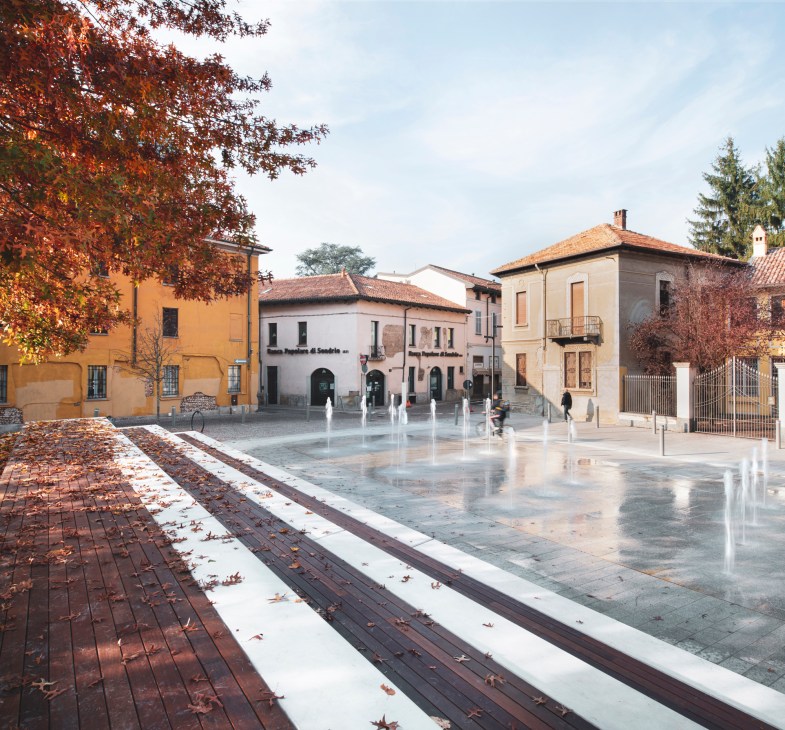
The sound of running water alone can soothe a hot and bothered soul. Examples such as this smart water feature on the outskirts of Milan (pictured), created by urban design firm Openfabric, are welcome in warm cities the world over. Children can splash about under the sprinklers while adults take in the scene.
8.
Promote a gentle through-breeze
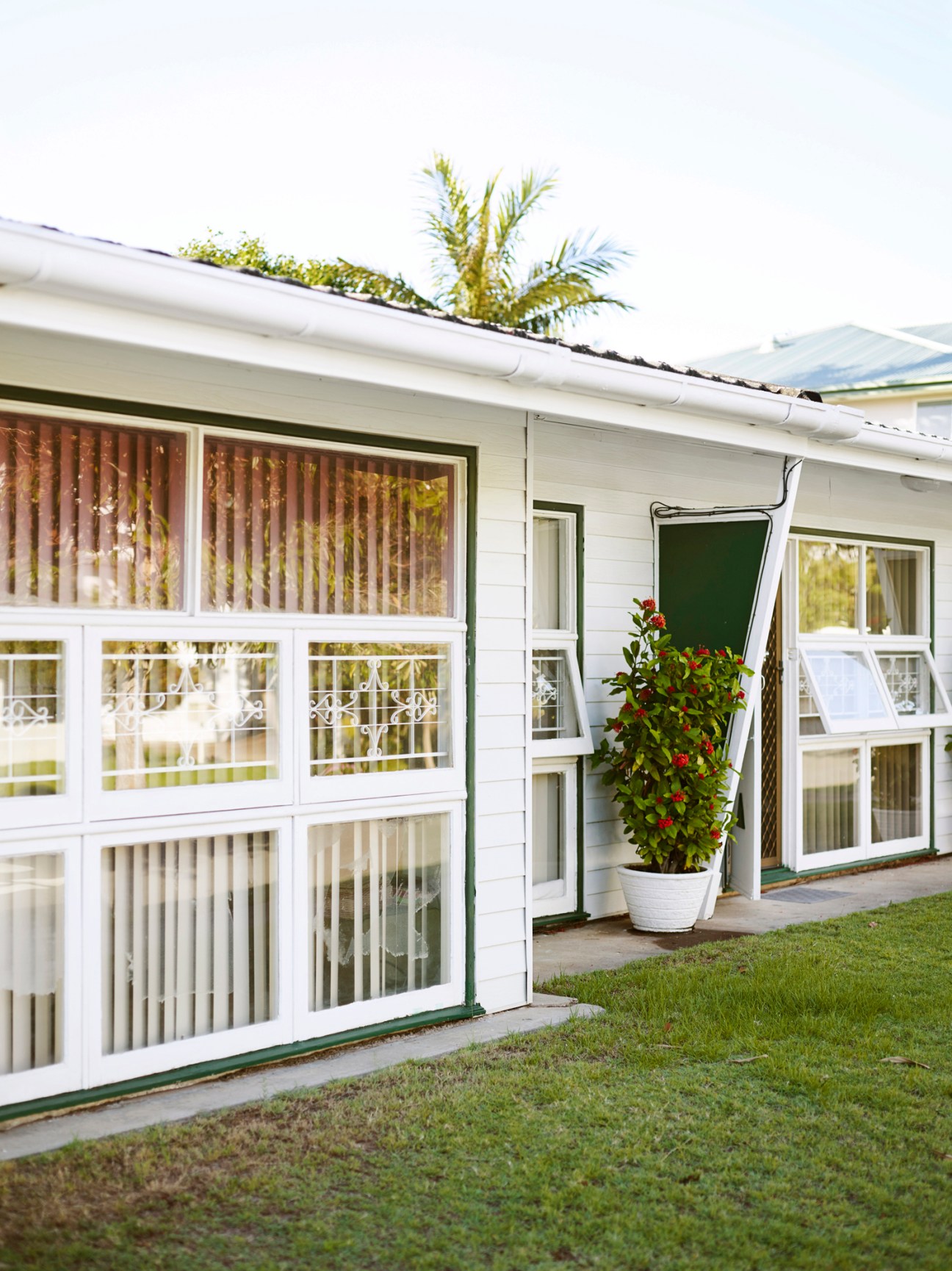
Australia’s architects use wide windows that can be opened to maximise breeziness. The 1960s was the golden era for this kind of home, borrowing ideas such as cantilevering roofs and applying them to airy coastal homes.
9.
Keep flooring fresh
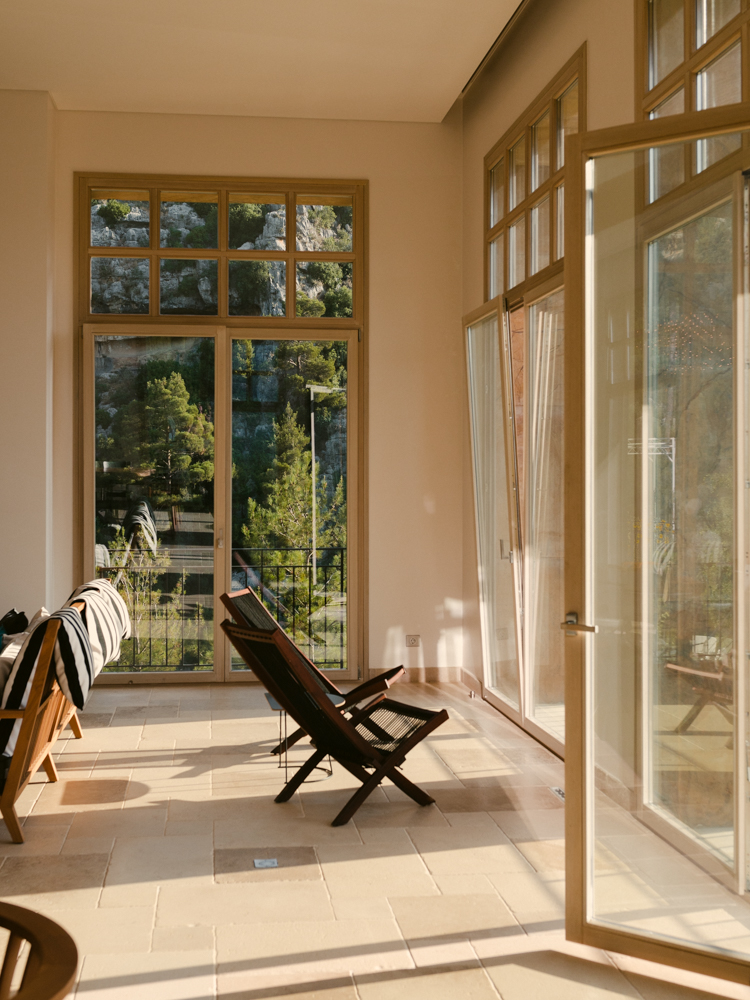
Another simple solution we can steal from mother nature can be found in the wonders of stone flooring. A repeller of heat, stone feels cool underfoot no matter how hot the weather. Stone and tiled floors have the added bonus of being made from non-porous materials that repel dust and bacteria, and contribute to healthier living environments.
10.
Bank on balconies
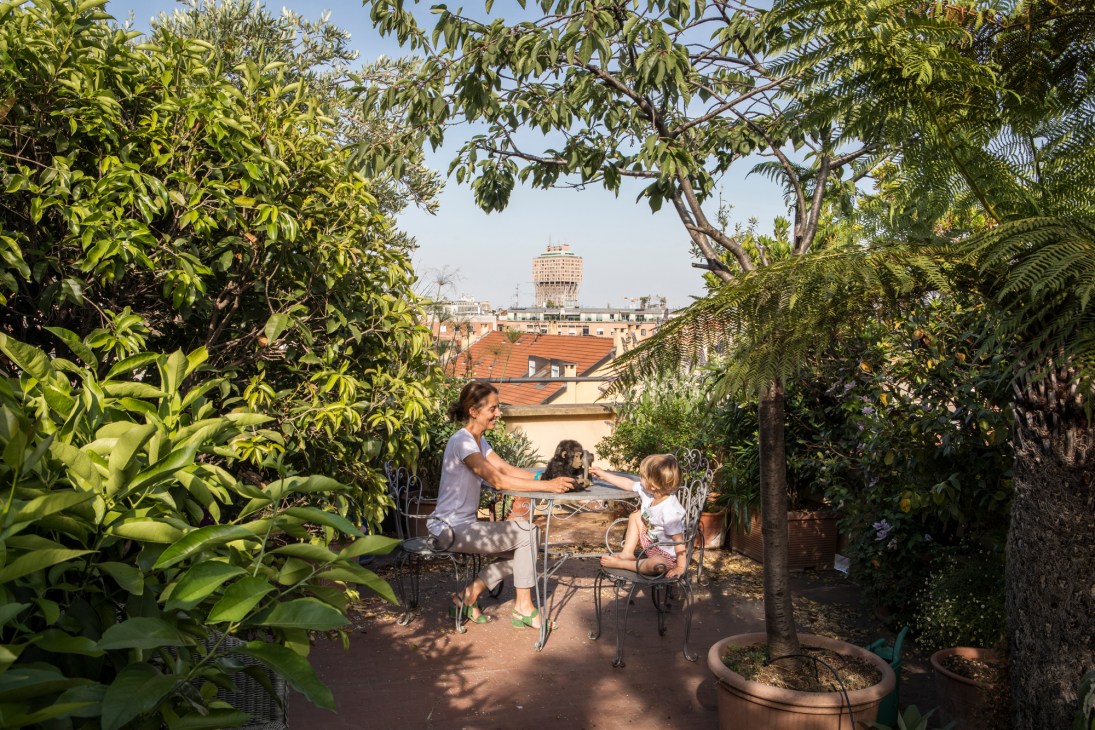
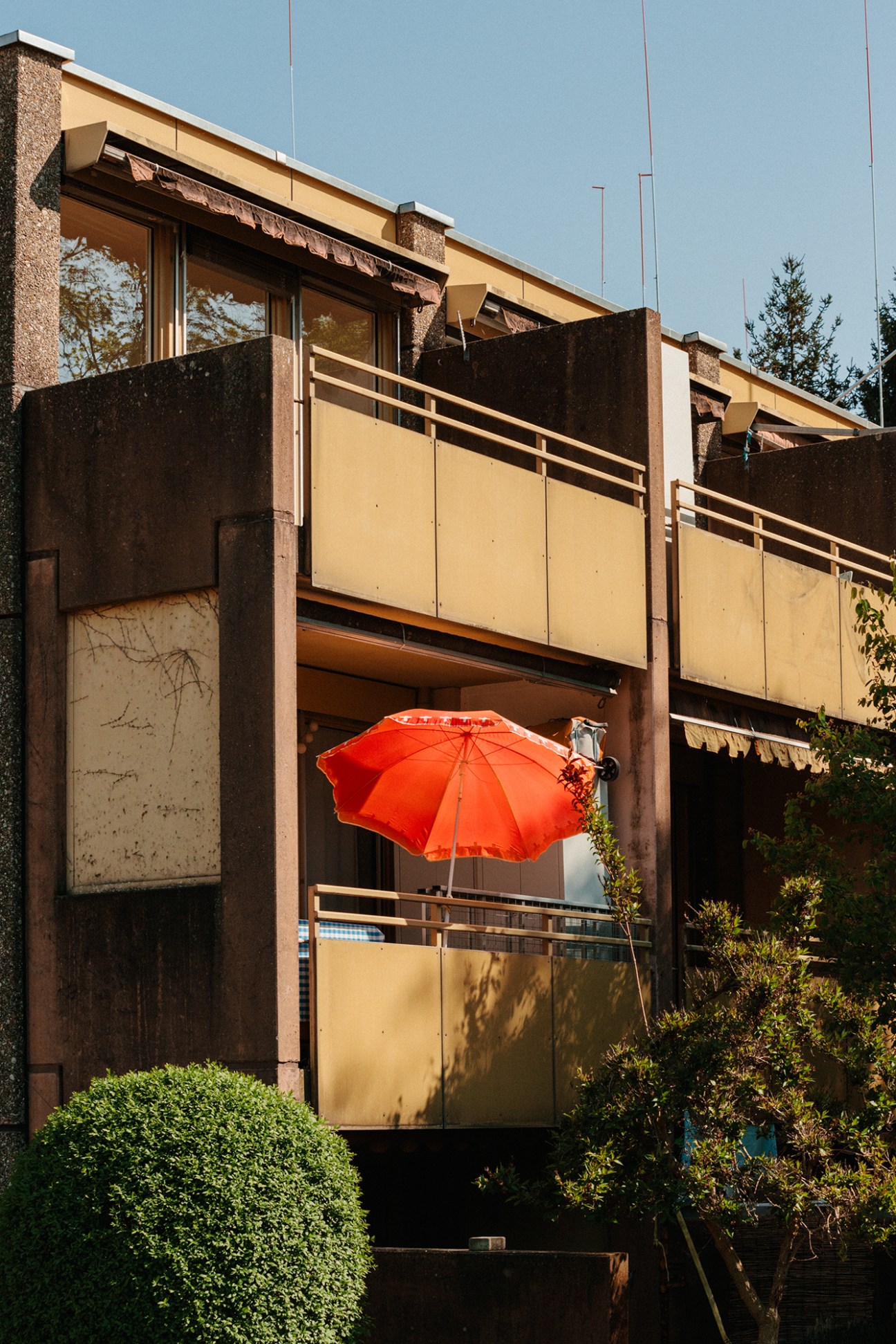
You’d be surprised how much of an effect a breeze-blessed balcony can have on apartment living. While many of us sacrifice floor space for the convenience of living in the city, those with balconies do urban living best. Capped off with an awning and a good dose of greenery, a balcony can become a cool and practical outdoor living room – and a perfect spot to beat the heat on a sunny summer’s day.
See our film on balconies at
monocle.com/film.
Concrete jungles
All of us pine for nature sometimes. Even the most impassioned city lover would agree that world’s best urban environments are the ones that can provide a little taste of the wild. It’s wilderness that best sustains the flora and fauna that we need to better enjoy our lives. Yet in many cities, developers went too far in creating concrete sprawls that neglected the importance of real nature – and the results can be depressing. But, thankfully, there are solutions arising today to reverse the damage. And they reach far beyond superficial man-made efforts.
The most interesting of these is the simple reintroduction of patches of wilderness, otherwise known as “rewilding”. In dense tarmac-laden cities, however, this is a task that’s easier said than done. Which brings us to the green-fingered entrepreneurs, designers and architects who we have highlighted over the following pages. With the noble aim of bringing wilderness to the city and providing biodiversity with its best shot to succeed, their innovative solutions are deserving of our appreciation.
1.
Where a community is in bloom
Beirut, Lebanon
Those who walked along the banks of the Beirut river before 1968 would have found people fishing and picnicking beneath its pine and pistachio trees. But a government decision that year to encase the river in a concrete bed has since led to decades of environmental and social degradation. “The river became a no-man’s land and a site of all sorts of abuses as a result,” says Lebanese environmental architect and forest-maker Adib Dada. “Waste was dumped in it: raw sewage, industrial waste and even a crocodile that must have been someone’s pet. It completely disconnected the community from this river.”


For Beirut-born Dada, exploring a means to stop this pollution and heal riverside communities became a pet project, something he sought to tackle through his sustainably minded architecture studio The Other Dada. The Beirut-based firm’s green ambitions were bolstered in 2019 thanks to a collaboration with Zürich-based entrepreneur Elise van Middelem. Her organisation, Sugi, sources funding via online donations for rewilding efforts in cities across the globe.
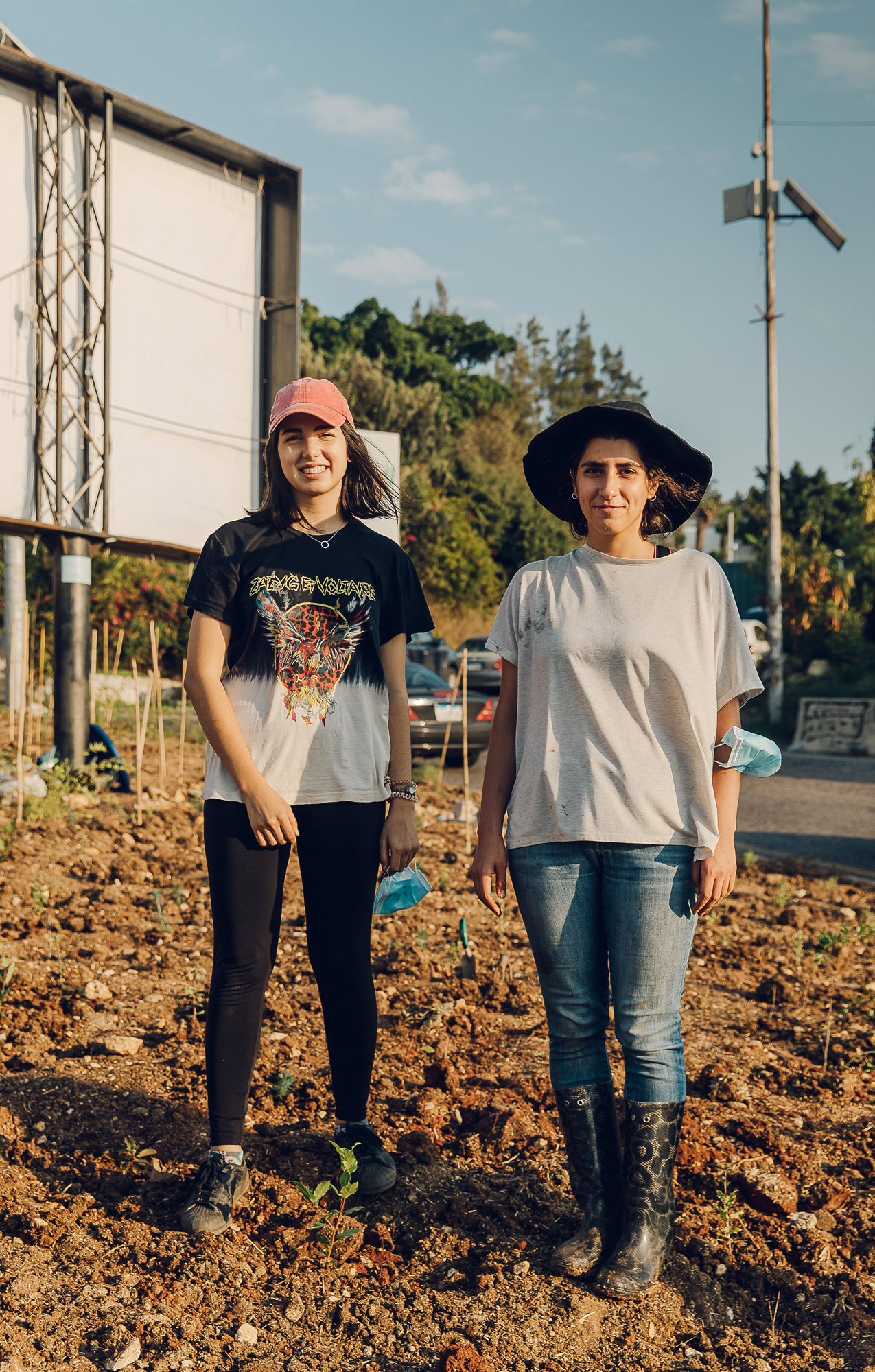
Seeking a location to pilot Sugi’s first project, Van Middelem reached out to Dada to see whether it would be a fit for his river-revitalisation efforts. Dada was keen, inspired by Sugi’s unique approach to rewilding, which draws upon the Miyawaki method. This Japanese-developed planting method can result in biodiverse, wild native forests growing 10 times faster and 30 times denser, while absorbing more pollution, than most forests that have been planted conventionally.
Taking to the task with gusto, Dada trained in the method with Shubhendu Sharma, a Miyawaki master whose work had initially inspired Van Middelem to launch her organisation, and the first Sugi-funded rewilding project began.


Over two phases, on an urban landfill adjacent to the river, Dada’s team of 15 volunteers planted 500 sq m with 2,000 trees and shrubs from 17 native plant varieties. The project, called Beirut’s Riverless Forest, was inaugurated in 2019 and its effects have been dramatic. The forest has begun to fulfil some of the ecosystem services typically supplied by the river. Groundwater has been recharged, flood risk diminished, air pollution reduced and air temperatures regulated.
Importantly, Riverless Forest has brought people back to this once-neglected patch of the city. “The riverbanks used to be such a great social space and people are now coming to this spot once again in order to engage in planting and maintenance activities,” says Dada.
Through this community, more projects have been able to flourish in Beirut, with volunteers from the first project working with Dada, Sugi and the municipal government rewilding an area called Zouk Mosbeh. The project, which began in 2020, focuses on a triangular strip of road reserve that’s adjacent to the country’s polluting electricity plant. It is hoped that the aptly named Power Plant Forest will equal the effect of the Riverless Forest by healing a degraded landscape, reducing pollution and rebuilding a community.


2.
Where sustainability is on top
SLA, Copenhagen
When it comes to greening our cities, the term “rewilding” isn’t one that sits well with the team at SLA, a Copenhagen firm that has become a global go-to for bringing nature into urban areas. “Everything we bring into this city is new, so if it’s nature, it’s a man-made nature; if it’s wilderness, it’s a new wilderness,” says SLA founder Stig Andersson, who joins partners Mette Skjold and Rasmus Astrup to discuss the matter with Monocle. We meet atop one of the firm’s best-known projects: the green rooftop park on the uniquely designed power plant-cum-ski slope, Copenhill. Here is possibly the most concrete example of the trio’s man-made “city nature”.
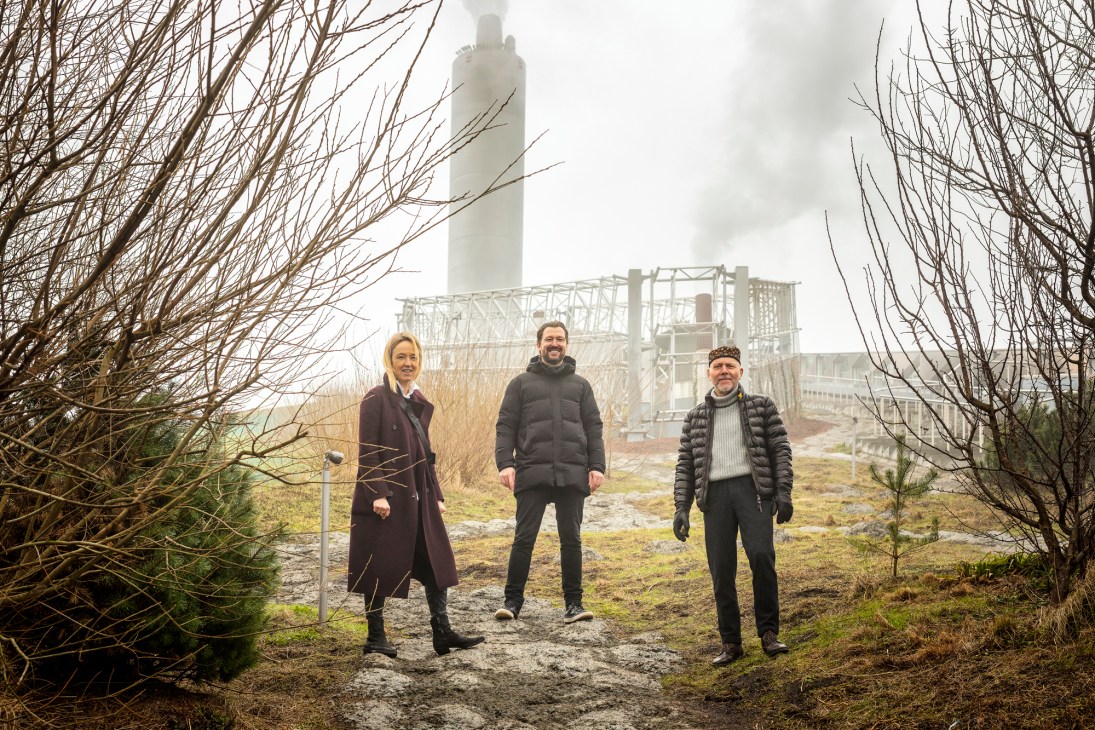
Tell us about nature on Copenhill.
RASMUS ASTRUP: The core element here is to spread biodiversity. The key consideration with our planting was to ensure that birds would eat seeds and small berries and spread them, so that the birds are moving the biodiversity around the site. Recently we discovered a species of bird here that prefers high hills, so that was pretty amazing. The bird knew that this was an artificial hill but also knew that this hill still provides it with what it needs.
How does SLA operate as a team?
METTE SKJOLD: We have people in the office from a wide range of institutions in the Nordic countries and beyond, including those from architecture schools and landscape-architecture graduates, as well as horticulturists and people with a wide range of technical expertise. We have a team of biologists working on environmental issues and we have anthropologists and sociologists who are working with the added social-value elements.
How helpful is nature in forming social value?
STIG ANDERSSON: We have four issues that we believe work together in the way city nature performs best. One is social; then aesthetic; the third is biological diversity; and the last is the physical part, dealing with climate, pollution and so on.
So aesthetics are a key principle?
SA: This work is about beauty because humans admire nature and it makes us feel good. A walk in the forest puts you in a better mood. So when we are working with providing new nature, we need it to help fulfil wonderful lives for other people and not be there to just improve the climate and so on.
Where can we see a successful project in full effect?
MS: We won a competition five years ago to transform a roundabout and residential street in the east of Copenhagen. It was a pilot project on climate adaptation and rainwater management. We removed two thirds of the paved area and rather than adding convex structures to move rainwater away from the street, we created a project that embraced the rainwater, even in extreme conditions. We added more than 30,000 plant species and 578 trees.
You receive commissions from the private sector. Why is there a commercial demand for your work?
RA: When we worked on the Novo Nordisk headquarters in Denmark, we provided storm-water management and increased the biodiversity. They wanted something to show that, as a brand, they believe in biodiversity and they were able to become a better company. The biggest assets they have, like most companies, are employees, so they have to take care of them. Today innovation takes place outside. When you see a butterfly or bird and you talk more informally, ideas really do happen. Our work has a major business case in cities too, which also are competing against each other for talent and to be the most liveable, the most pleasant and the most sustainable. Our work is something that everybody needs – and our clients are willing to pay for it.
3.
Where water encourages life
Bishan, Singapore
A meandering waterway flows through Bishan, an area in central Singapore characterised by high-density residential blocks. When Monocle visits, families are taking their shoes and socks off to play in the water, wading to visit little islands or observing the insects and animals ashore. This was once a concrete canal that separated the residents from the park but it’s now a multifunctional rewilded waterway; a green and porous infrastructure with benefits to the environment and the community at a low cost to the city.
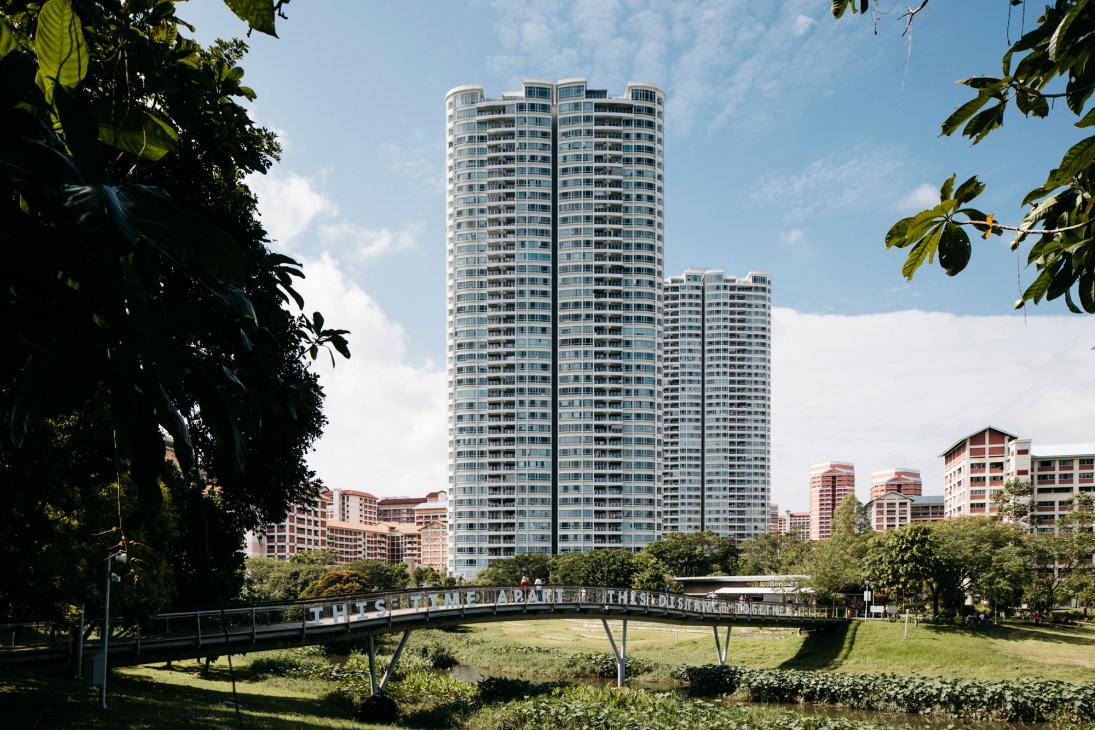
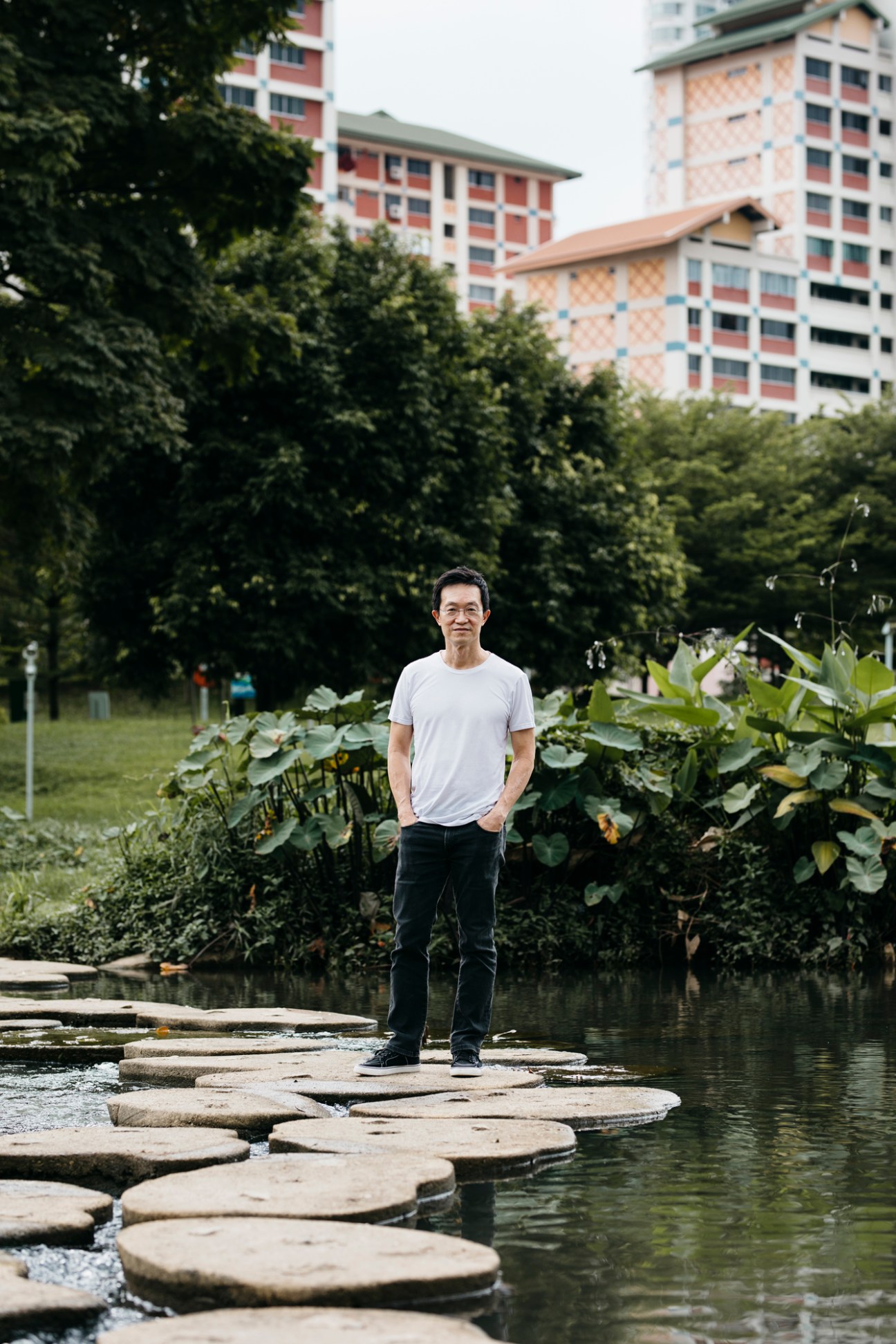
The Bishan-Ang Mo Kio Park is a 3km-long integration of nature that was born from the government’s Active, Beautiful and Clean (ABC) strategy to encourage the community to appreciate water in Singapore. “The first thing my children do when they get to the park is to run into the river,” says Leonard Ng, country director at Ramboll Singapore and country market director at Ramboll Studio Dreiseitl for Middle East and Asia-Pacific region, the designers behind the 62-hectare project. “They are playing yet learning about the value of water. We want to encourage the next generation to protect our waters and I believe that Bishan park has served this purpose,” says Ng. He adds that 10 years have passed since the park was built and it has now reached its mature form. “Trees have matured, the meanders have stabilised and wildlife has colonised and found its rhythm.”
When Ng’s team initially pitched the the project, they were aided by being able to show how costs could be saved. The idea that the park would facilitate a small stream during dry periods but extend over a much bigger flat plain during storm events caused by climate change was smarter than an expensive widening of the existing concrete channel. “There was a barrier between where people live and where people play,” he says. “And we used wild nature to stitch that landscape together. The most valuable attribute in the natural river is constant change.” He says that when dry, the stream is 10 metres wide, giving the community access to the parkland. But during a storm the river can expand to become more than 100 metres wide, only to recede in a few hours.
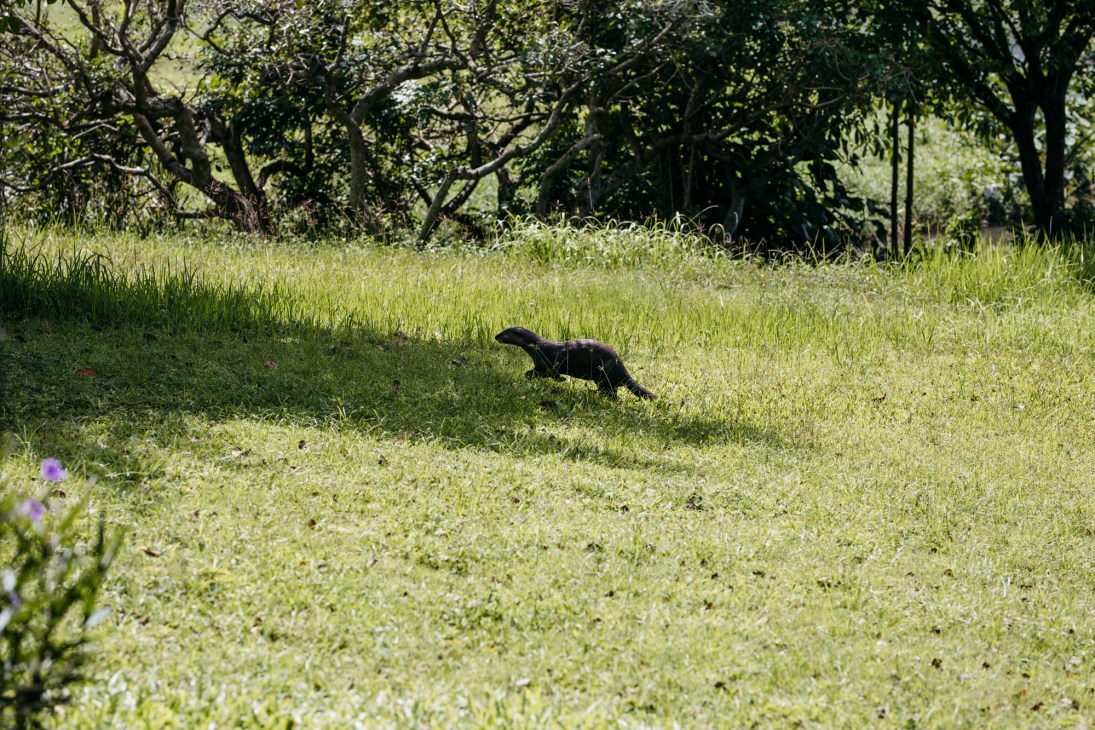
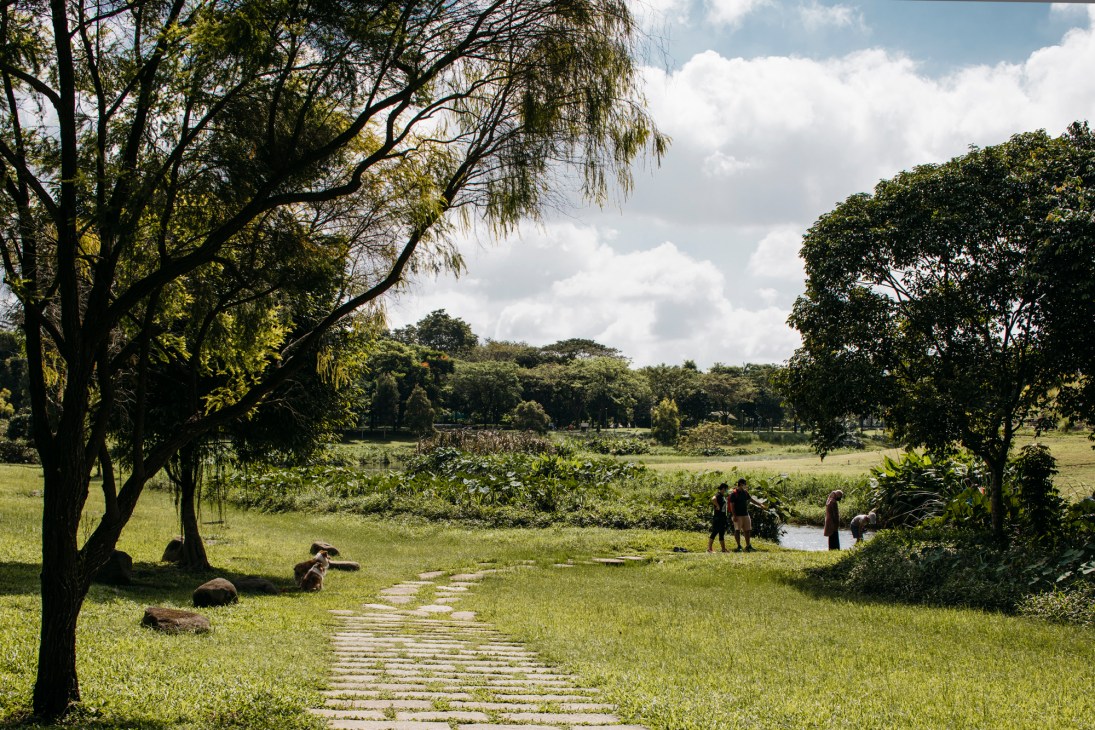
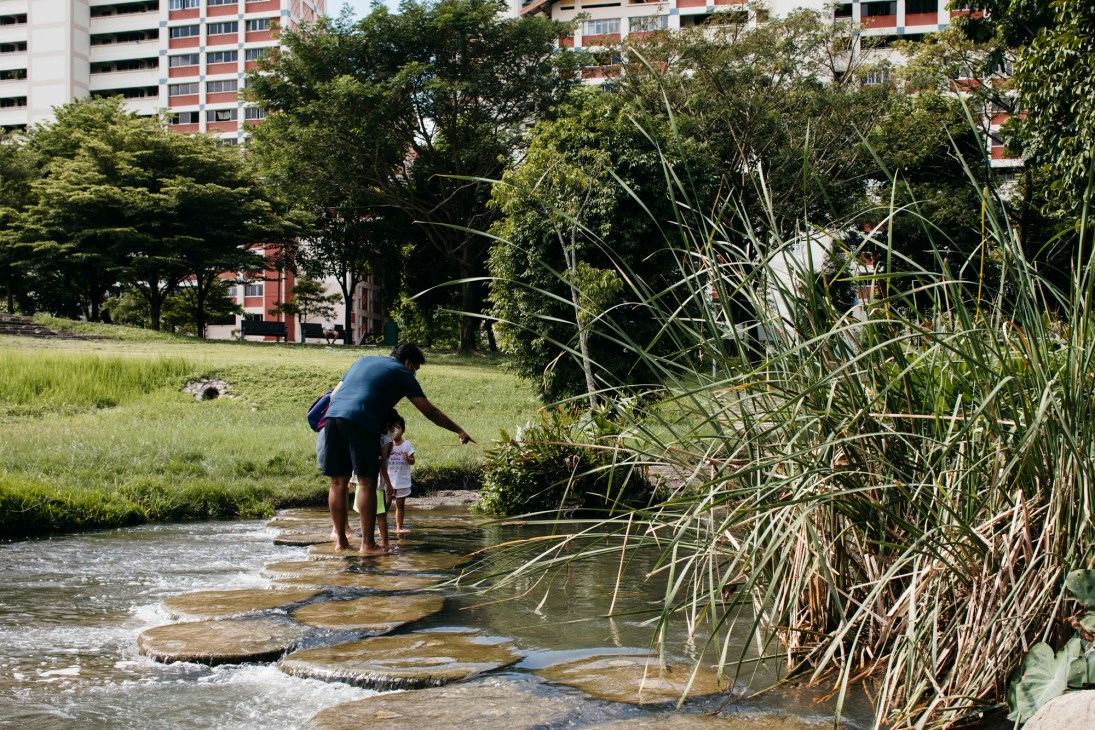
Thanks to the project’s success, the past few years have seen a doubling of the number of annual visitors to Bishan park. But the beginning of 2021 saw some heavy rainfall in Singapore, which meant that the concept was put to the test. “It was the heaviest rain in 30 years in Singapore but the river did what we designed it to do,” says Ng. “By holding the water back, the river allowed for the downstream city infrastructure to cope better.”
When Monocle visits, the park is resplendent in tropical sunshine and onlookers watch a dragonfly as it lays eggs under a well-placed boulder. Butterflies gather around the woven reed and children are playing by the landscaped riverbank. It’s the design of the Bishan-Ang Mo Kio park that has made it a balanced ecosystem and one of the city’s most beloved playgrounds.
“We didn’t bring in the dragonflies but we provided places for them to nest,” says Ng. “After the dragonflies came the birds and, over time, the ecosystem forms a beautiful balance. And that attracts humans. The wildlife has improved the liveability in the area: there are lower levels of illness and the property values have increased.”
Only human
Watch
1.
Strange fruit
Apples
Christos Nikou
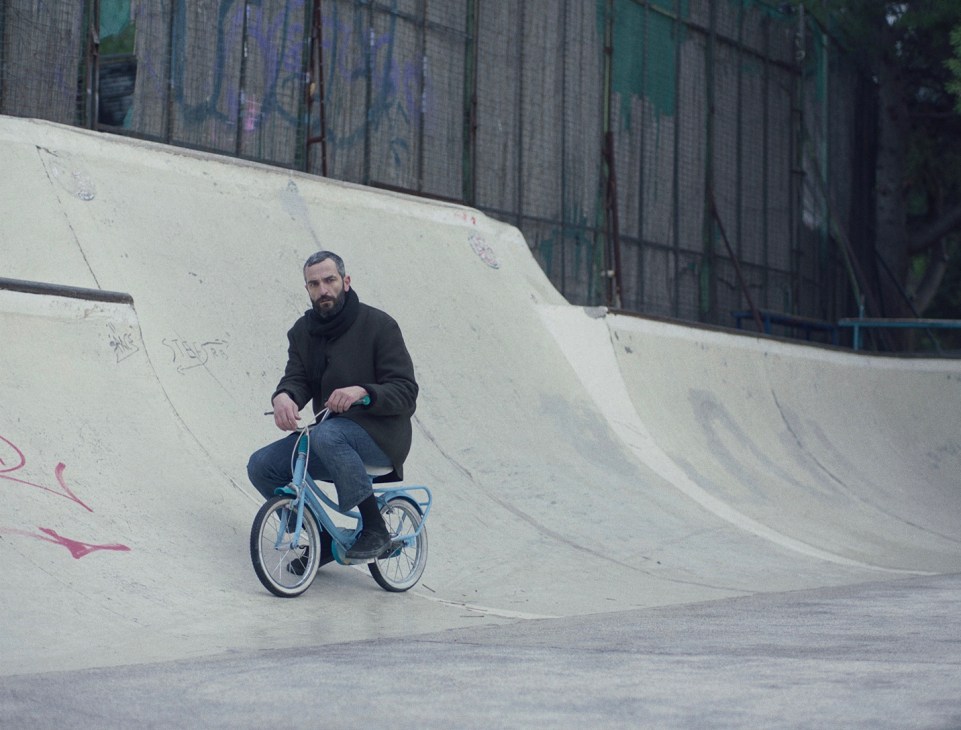
The premise of debutant director Christos Nikou’s absurdist drama about a pandemic doesn’t seem as surreal now as was perhaps initially intended. As the citizens of Greece are stricken with amnesia, one man adjusts to his new existence. Nikou avoids the tropes of dystopian fiction and doesn’t labour his points. The result is gently spellbinding.
‘Apples’ is released on 19 March
2.
Hard truths
The Dissident
Bryan Fogel
Fogel’s latest documentary is an exceptional but disturbing forensic look at the 2018 assassination of journalist Jamal Khashoggi inside the Saudi consulate in Istanbul. Most streaming platforms are steering clear of this incendiary feature but it’s available to watch on demand.
‘The Dissident’ is out now
3.
American dreams
Minari
Lee Isaac Chung
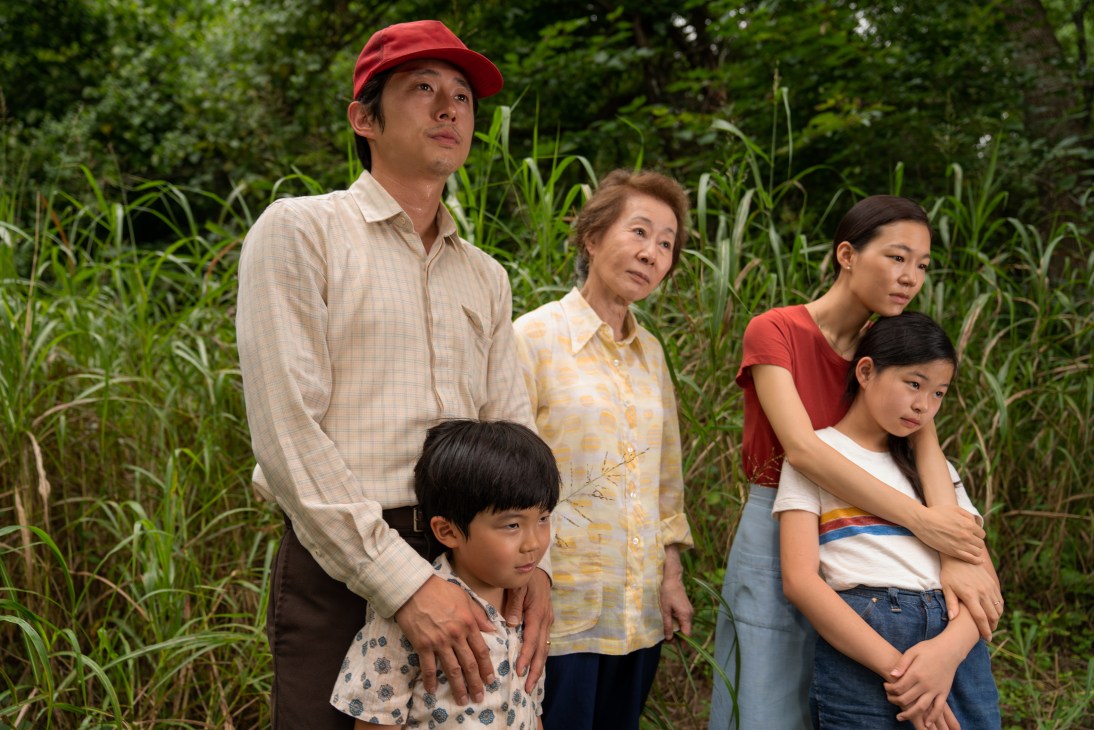
Though the dialogue is mainly in Korean, Minari might be one of the best US films of 2021. Centered on an immigrant family in 1980s rural Arkansas, it tackles themes of self-sufficiency and self-betterment, while never mythologising the struggle of trying to make it in the US.
‘Minari’ is out on 19 March
4.
Double act
Malcolm and Marie
Sam Levinson
Shot in secret after a two-week quarantine for its minimal cast and crew, director Sam Levinson’s film stars Tenet’s John David Washington (Malcolm) and Euphoria’s Zendaya (Marie) as its only characters. Set during a single night, the story follows the couple as they return home from a film premiere and dig deep into their relationship.
‘Malcolm and Marie’ is out now
5.
On the frontline
Notturno
Gianfranco Rosi
Three years in the making, this documentary by Oscar-nominated Gianfranco Rosi provides an intimate portrait of those living on the borders of Syria, Iraq, Kurdistan and Lebanon. Its mesmering visuals, uninterrupted by music or voiceovers, make this immersive viewing.
‘Notturno’ is out now
Listen

1.
Golden age
Time
SG Lewis
Debut-album highlights from the UK-born SG Lewis, who broke onto the electronic music scene last year, include the delightful title track – with Canadian artist Rhye – and the groovy “Feed the Fire”.
‘Time’ is out now
2.
Still on song
Chemtrails Over the Country Club
Lana del Rey
Dreamy pop songs suit Lana del Rey’s whispery voice – so why change tack? Romantic Americana at its best, this hugely anticipated follow-up to the acclaimed Norman Fucking Rockwell! is the latest solid instalment in a remarkably consistent discography.
‘Chemtrails Over the Country Club’ is released on 19 March

3.
Guitar hero
Little Oblivions
Julien Baker
Recorded in her hometown, this Memphis musician’s third studio album is an introspective record, asking questions about love, loss, addiction and religion by way of the 25-year-old’s epic, breathy wail and astonishing guitar playing.
‘Little Oblivions’ is out on 26 February
Read

1.
Artificial intelligence
Klara and the Sun
Kazuo Ishiguro
Hopes are high for the new novel from the Nobel prize-winning author of Never Let Me Go, whose works were praised by the Swedish Academy for their “great emotional force”. His latest, a story about an “artificial friend” called Klara, who observes the world from a shop and hopes to be bought by a human, is set to be a further exploration of what it means to love.
‘Klara and the Sun’ is out on 2 March
2.
Digital divide
No One is Talking About This
Patricia Lockwood
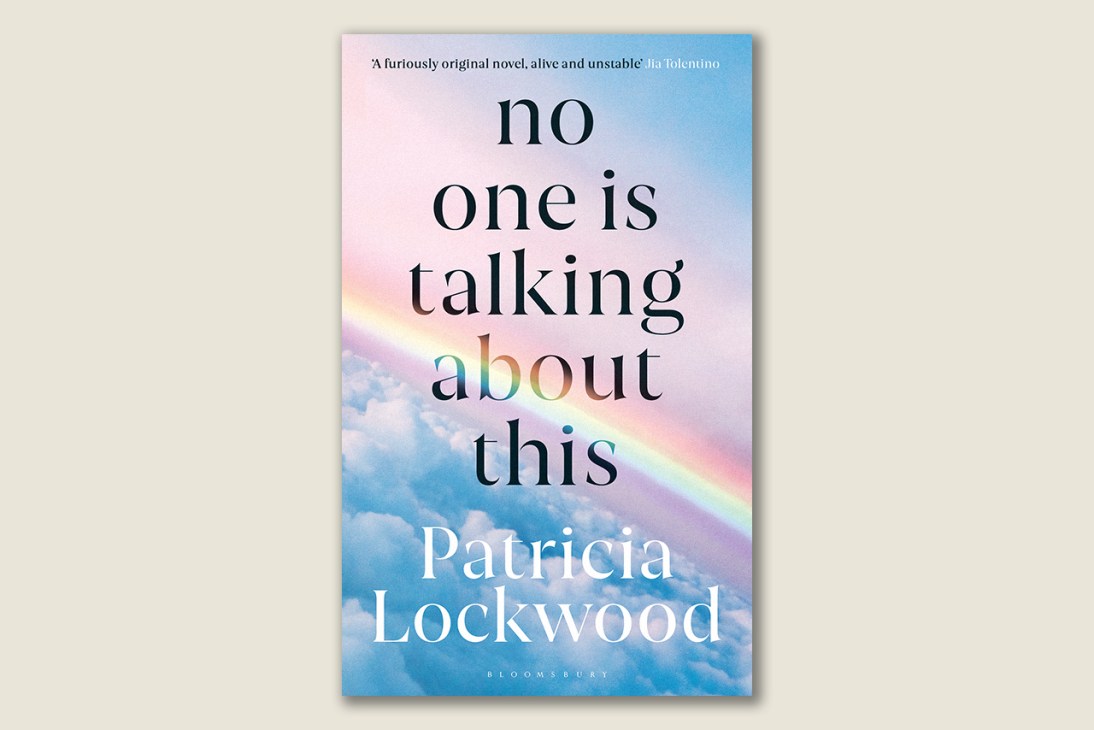
Fans of Lockwood’s memoir, Priestdaddy, can rest assured: her debut novel is just as glorious. A woman known for her social-media presence is thrown by two messages from her mother: “Something has gone wrong”; “How soon can you get here?” Lockwood ricochets between heartbreak and hilarity, earnestness and irreverence. Many novelists are writing about our fragmented, part-analogue, part-online lives but few do so as well as Lockwood.
‘No One is Talking About This’ is out now
3.
Living on a prayer
Our Lady of the Nile
Scholastique Mukasonga
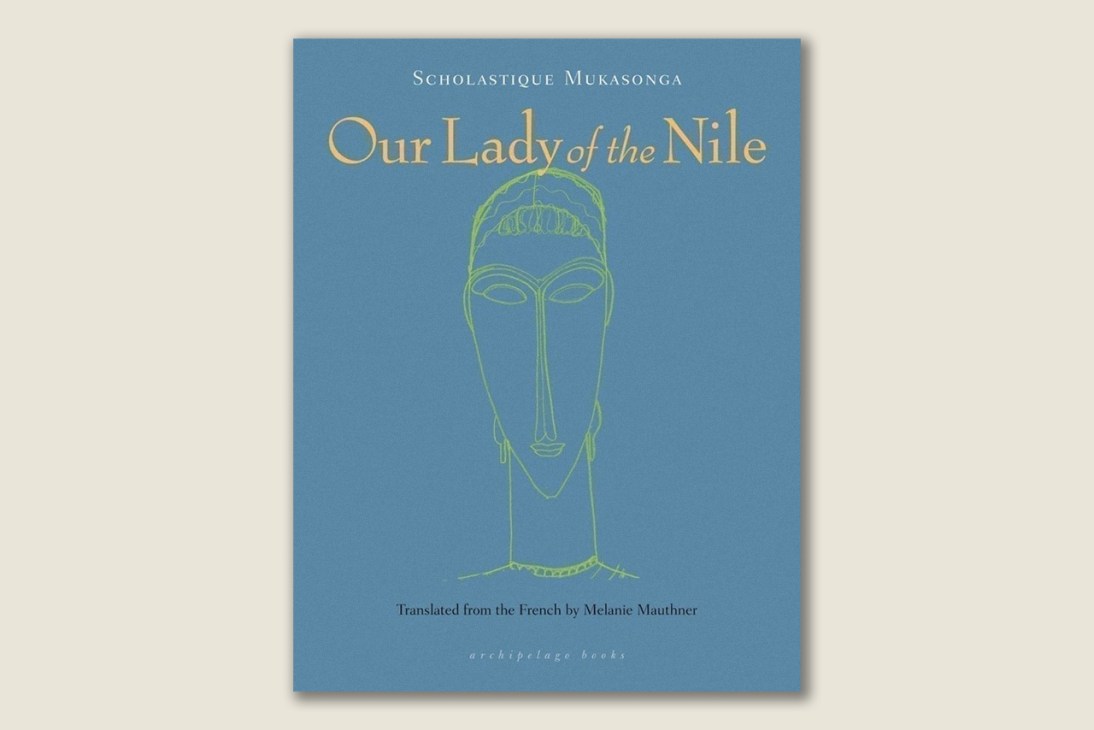
The premise – a school run by nuns, high in the Rwandan mountains – might evoke Black Narcissus but Mukasonga’s debut sets itself apart. In the run-up to the 1994 genocide, pressure bubbles as petty rivalries jostle with promises of loyalty.
‘Our Lady of the Nile’ is out on 18 March

4.
Dirty jobs
Temporary
Hilary Leichter
Leichter’s weird and wonderful take on the world of work finds her protagonist on increasingly strange placements, ranging from swabbing the decks of a pirate ship to being the PA to an assassin. It’s a hilarious peek into the gig economy.
‘Temporary’ is out now
5.
Inside story
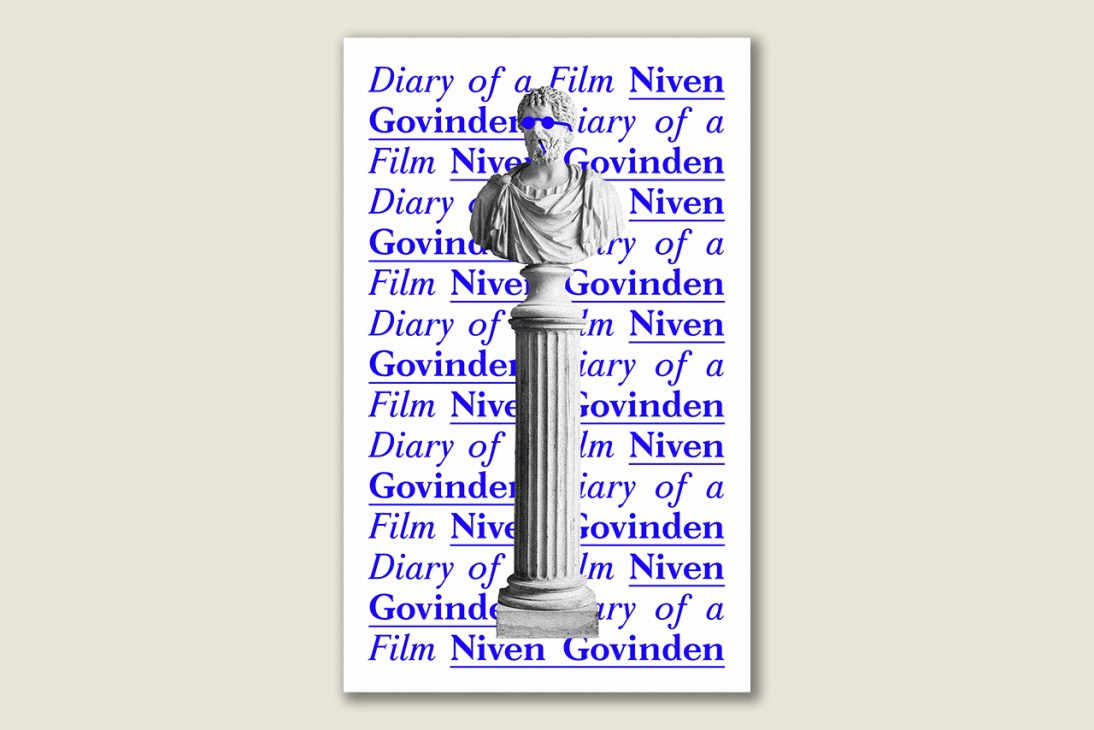
Diary of a Film
Niven Govinden
Govinden’s elegant sixth novel is narrated by an auteur known to the reader only as “maestro”. Visiting an unnamed Italian city to premiere his new feature at a film festival, he strikes up a conversation with a woman over a morning espresso, finding himself enthralled by her life story. In a strong, clear tone that’s unfettered by hyperbole, Govinden allows us to access to the narrator’s mind as he muses on love, work and who should tell whose stories.
‘Diary of a Film’ is out on 18 March
Safe in the knowledge
Sustaining self-education
Deichman Bjørvika library
Oslo
This waterside library sets the standard in making culture accessible, while being an exemplar of enironmentally conscious design.
“Libraries ceased to be dusty book-storage facilities a long time ago,” says Knut Skansen, the director of Oslo’s new Deichman Bjørvika library. “Today they are first and foremost about the future. To move into a building that is all about protecting that future sits extremely well with what a library is all about.”
When Oslo’s city planners set out to replace the unfit-for-purpose brick building that had served as the Norwegian capital’s public library since 1933, they wanted to create an environmentally friendly structure for the readers of tomorrow.
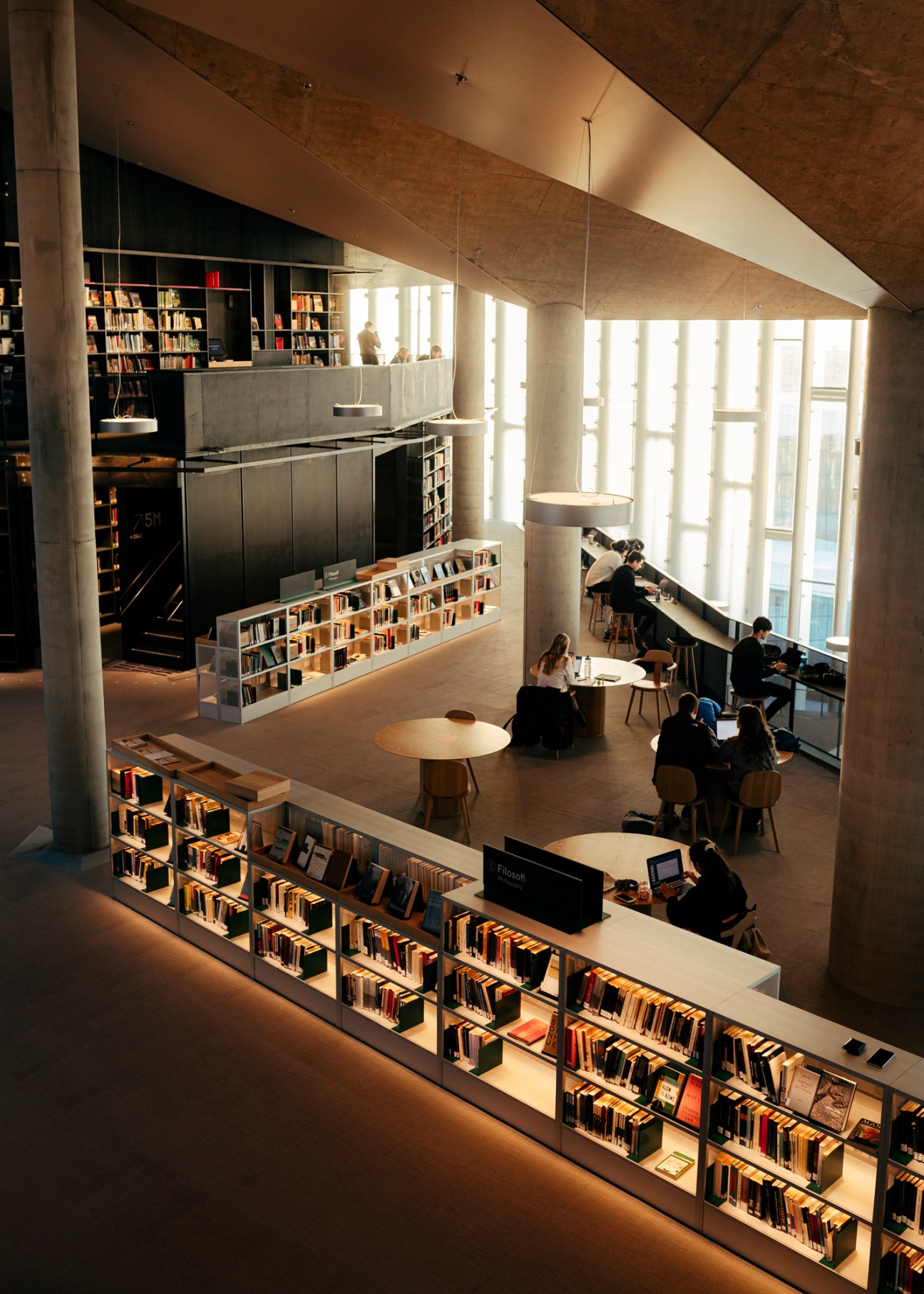
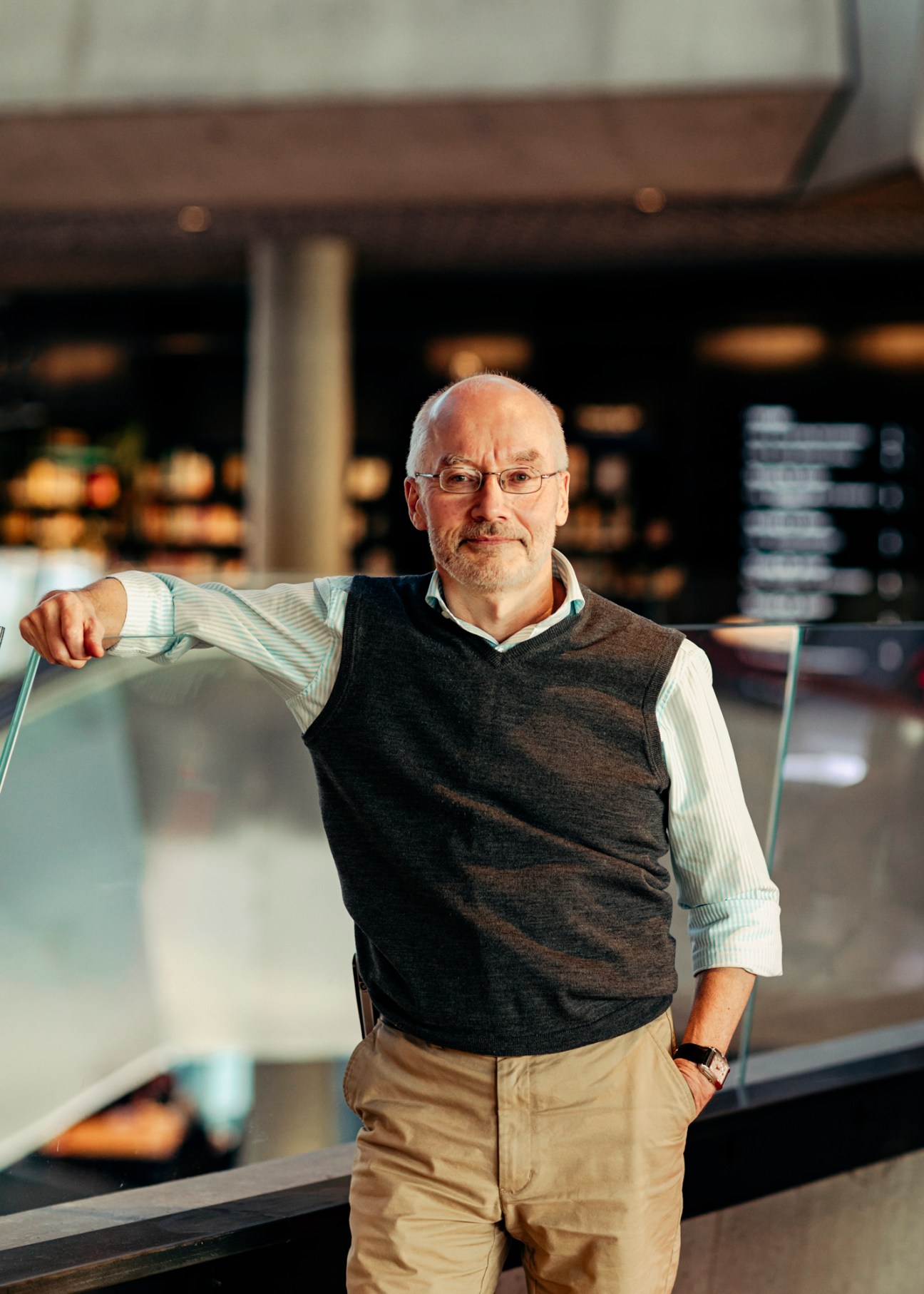
“Energy efficiency, reduced emissions and design have been closely inter-woven all the way from the planning stage through to the construction phase and in the finished building,” says Vibeke Johnsen, the City of Oslo’s head of project. Having opened last summer, the library now sits proudly on the seafront next to the Opera House.
Norway’s capital can be a place of climate extremes, with temperatures sometimes reaching 30c in summer and plummeting to minus 20c in winter. Ordinarily, regulating the temperature of a six-storey open-plan structure would be a costly and energy-intensive affair but this building’s bill is just a fraction of that which would normally be expected for a construction of comparable size.
“We had two aims when we started,” says Johnsen. “That the finished building’s net energy need should not exceed 85 kilowatt hours per square metre, and the total emissions from materials, construction and daily use should be 50 per cent lower than for a project of a similar size.”
Both of these objectives were surpassed. The energy need was measured at 75.6 kilowatt hours per square metre and the choice of building materials, including low-carbon concrete, has helped to cut emissions by nearly 70 per cent.

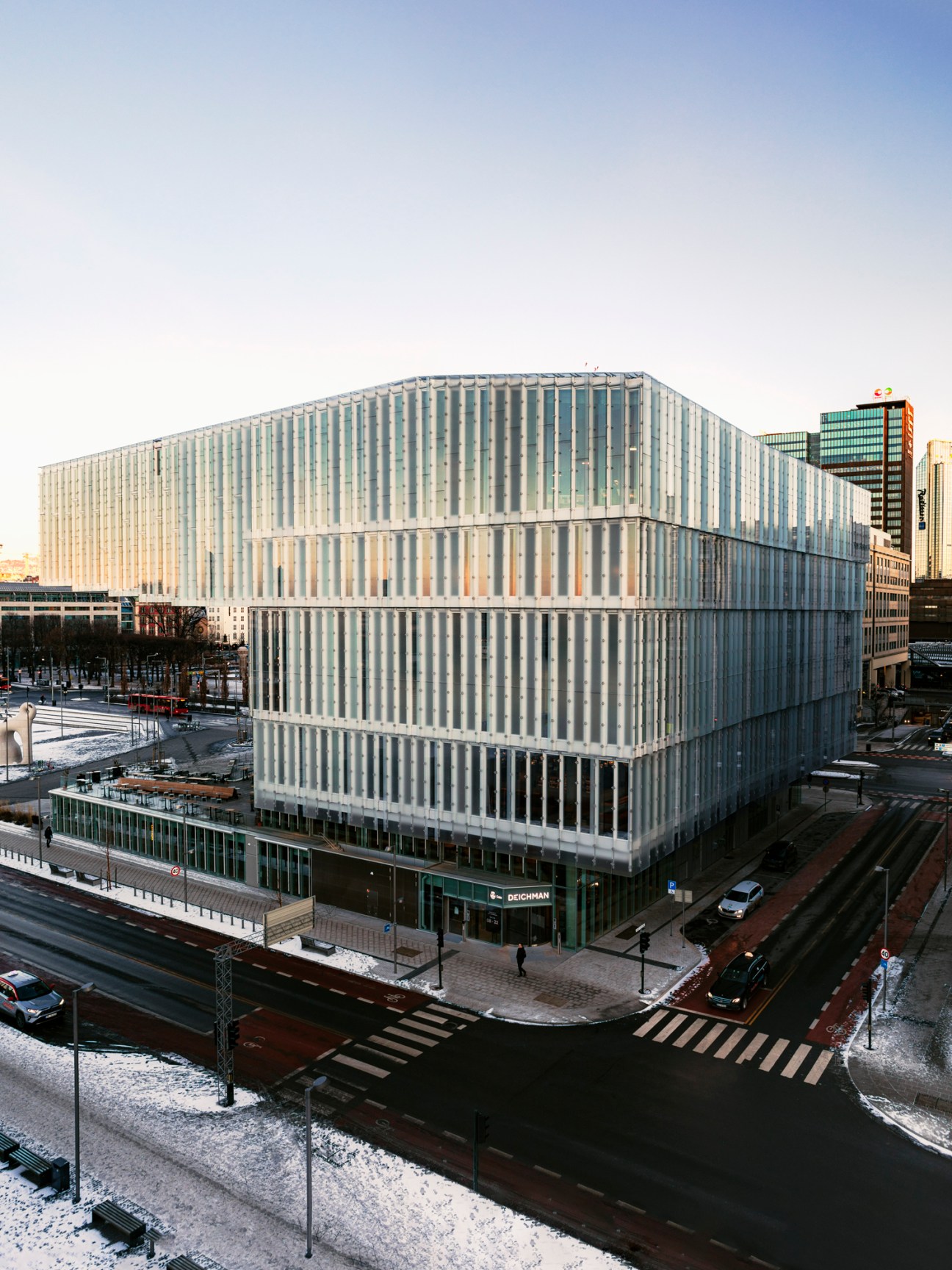


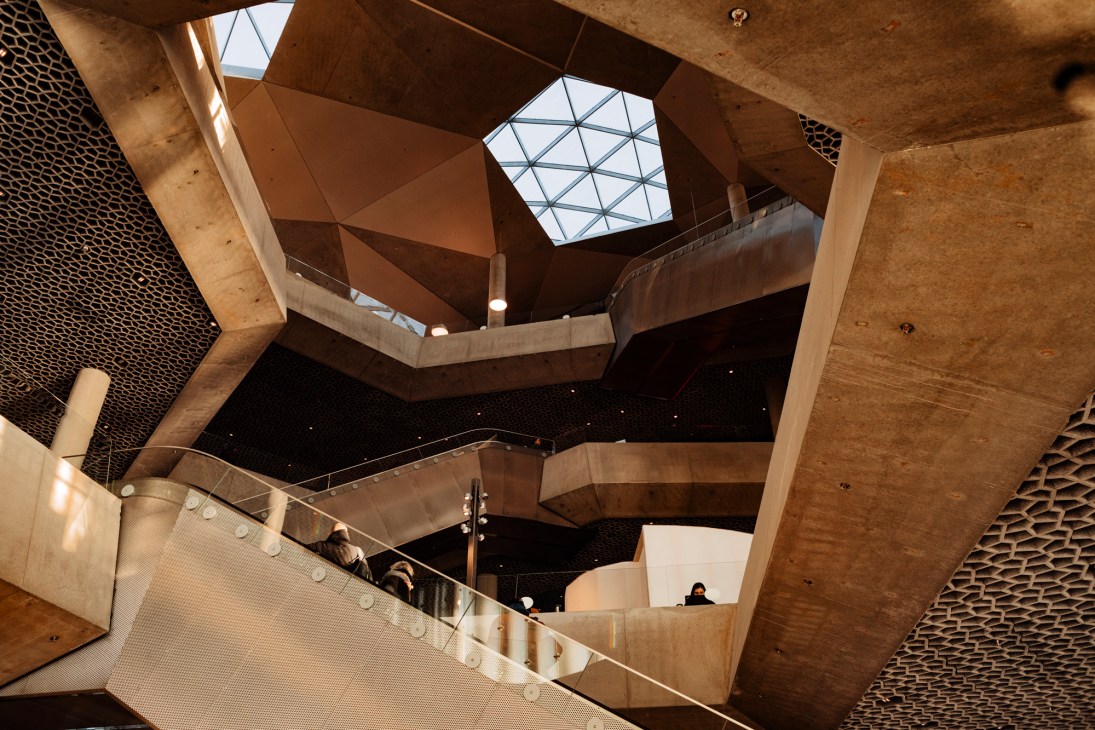
From the outside, the building manages to appear both imposing and inviting, with large glass walls that let in as much daylight as possible. The top two floors cantilever over the lower half, offering views of the fjord and city. More daylight floods in from three large louvred windows in the roof and is then distributed down through the floors via diagonal light shafts that reduce the need for artificial illumination. Warming and cooling pipes are built into the floors, while the exposed concrete functions as a heat sink that cools the building in summer.
Home to about 450,000 titles, the library also has a cinema, an auditorium, a restaurant and offices. The lower floors have been set up to encourage interaction, while the upper levels are intended as quiet spaces. Here you’ll find reading rooms and the Future Library project, an ongoing collection of works of fiction published between 2014 and 2114. These are printed in limited editions using wood from 1,000 trees specially planted for the purpose.
Library director Skansen hopes to soon be able to host regular public talks, workshops and other events once again. Some of these will focus on the future of Oslo – and the planet. “Libraries are the world’s oldest sharing economy,” he says. “Now the community can come here to share ideas on a sustainable society.”
deichman.no
Sustaining hard conversations
My Country Talks
Germany
The media has a responsibility to foster dialogue, civil debate and democracy, not shouting matches or echo chambers. Hanna Israel joined Zeit Online’s initiative to do just that – and the idea is catching on.

Hanna Israel (pictured) is project manager for My Country Talks. The scheme was born out of an experiment that was launched in Germany in 2017 by media outlet Zeit Online, which contacted people on opposite sides of the political spectrum and invited them to have a one-on-one conversation. The idea was to encourage a more constructive approach to dialogue than the one found in online comments sections. Multiple European media partners, including Italy’s La Repubblica and France 24, have since brought the initiative to their own countries. Like-minded events are planned this year in the US, Thailand and elsewhere.
How did you get involved with My Country Talks?
Before joining I was working for one of the biggest German TV talk shows, Anne Will, a polarising form of debate between Germany’s top figures and politicians. I was always questioning what effect such debate formats have on political discourse and polarisation, which is something that I think we all have to deal with in Europe at the moment. So I decided to do something different. Now I’m dealing with debates on a very different level.
Why is it important for media organisations to take the lead in a project like this?
The basic idea was really to help people restart conversations. It was motivated by the frustration of seeing Western countries becoming polarised, which threatens democratic discourse and thus the functioning of democratic society. As a big media outlet you don’t want to lose large parts of society, you want to reach them. It’s also about helping media outlets re-establish trust. We’re not only bringing people back into the dialogue but we’re reporting on it. People are gaining a voice via an outlet where they might not normally be represented.
Does the format of the debates differ depending on the country?
We’re putting a lot of trust in our media partners, who can decide what the best approach is within their respective context. For example, we’re developing a co-operation with a public broadcaster from Thailand. But right at the beginning the broadcaster said that it’s important to have these discussions moderated by a third person. This was because they didn’t think that just by answering controversial questions people would directly go into an open discussion once they met. So there’s a lot of room for every media partner to develop something that is adjusted to their context. However, the idea to have people of differing political opinions talking to each other is the key. That’s what we’re exporting to the world.
Sustain your neighbourhood
Reinventing the newsstand
Barcelona
Contemporary community ‘quioscos’ are once again flying the flag for the power of print.
When Pablo Pardo, Davide Datti and Gautier Robial realised that newsstands in Barcelona were selling more gadgetry, sugary snacks and garish flamenco costumes than magazines and newspapers, they realised that something had to be done. Many of the older faces behind their counters seemed clueless to the world of resurgent print, including the many internationally successful titles edited in Barcelona. In the previous decade, 120 of the city’s 399 quioscos had closed or disappeared altogether.

So in 2019 the team launched News & Coffee. Sat on the Passeig Sant Joan in El Born, stacked with hard-to-find titles and serving La Marzocco-brewed coffee, this small stall offers inspiration, escapism and human connection – a quiosco recast as a community lifeline.
The trio now sell more than 650 copies every month and have since opened two more stalls. Locally published magazines such as Apartamento, Openhouse and Perdiz are popular purchases.
“We want to be the best,” says Yaël Hupert, who chooses the evolving selection of titles. There are plans for a radio station, subscription services and pop-up newsstands in hotels. The aim, she says, is to keep “people entertained, amazed and amused”.
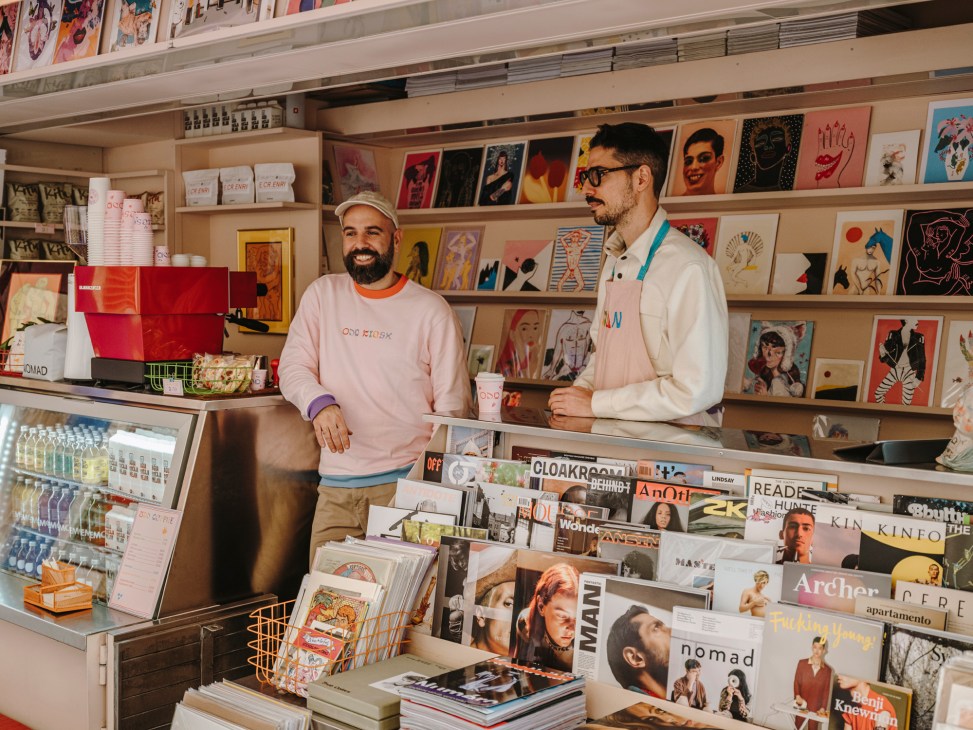
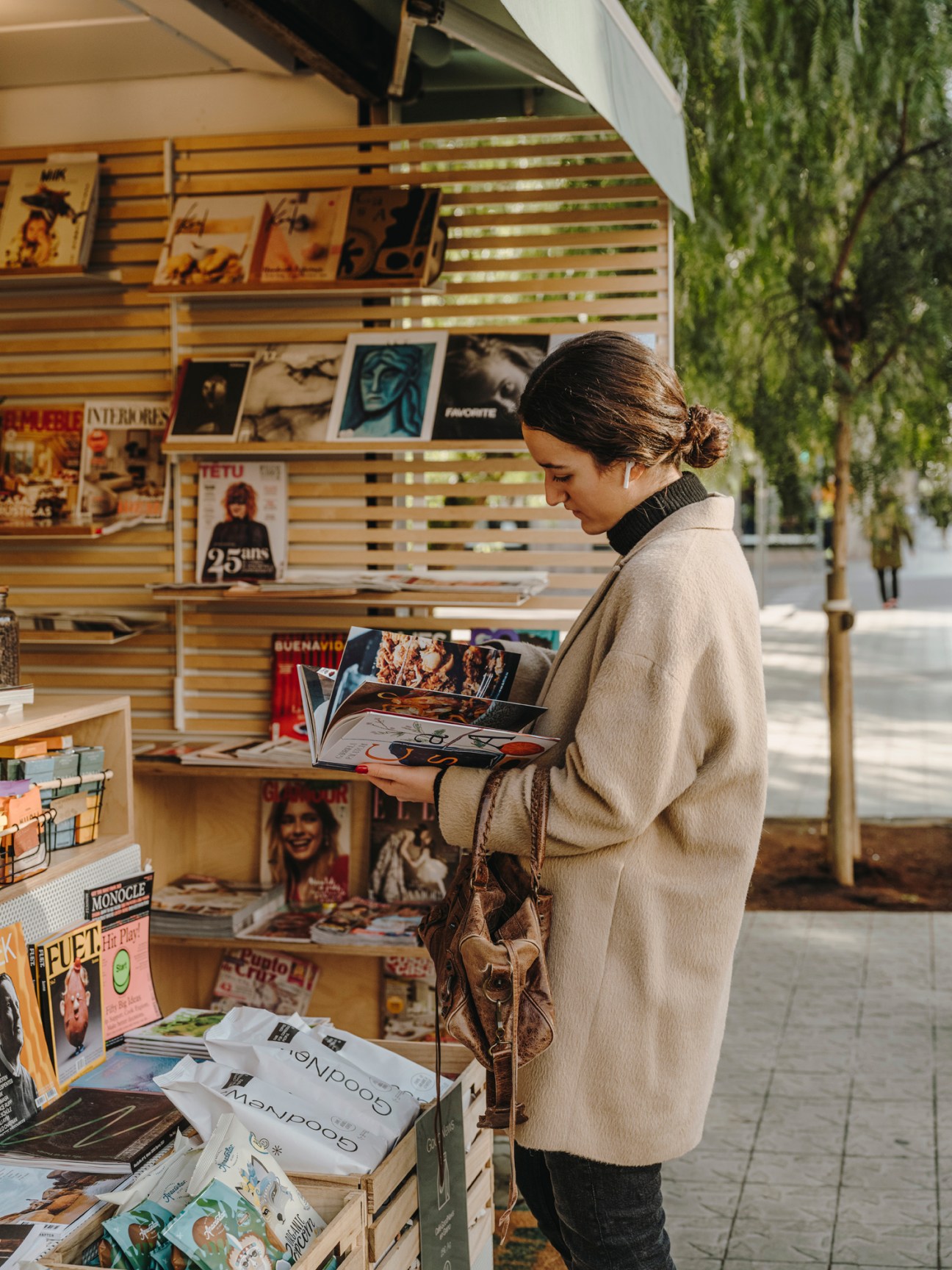
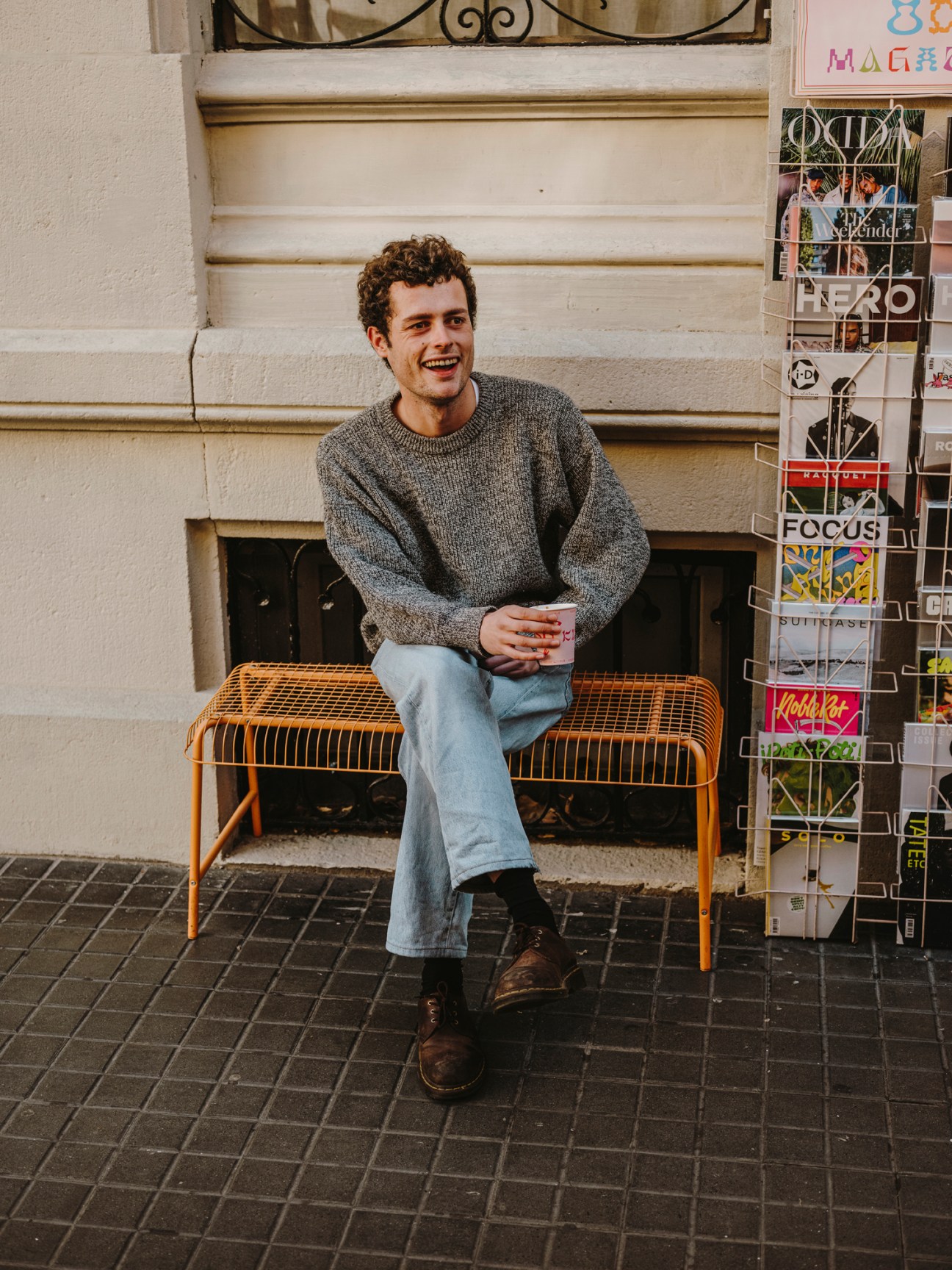
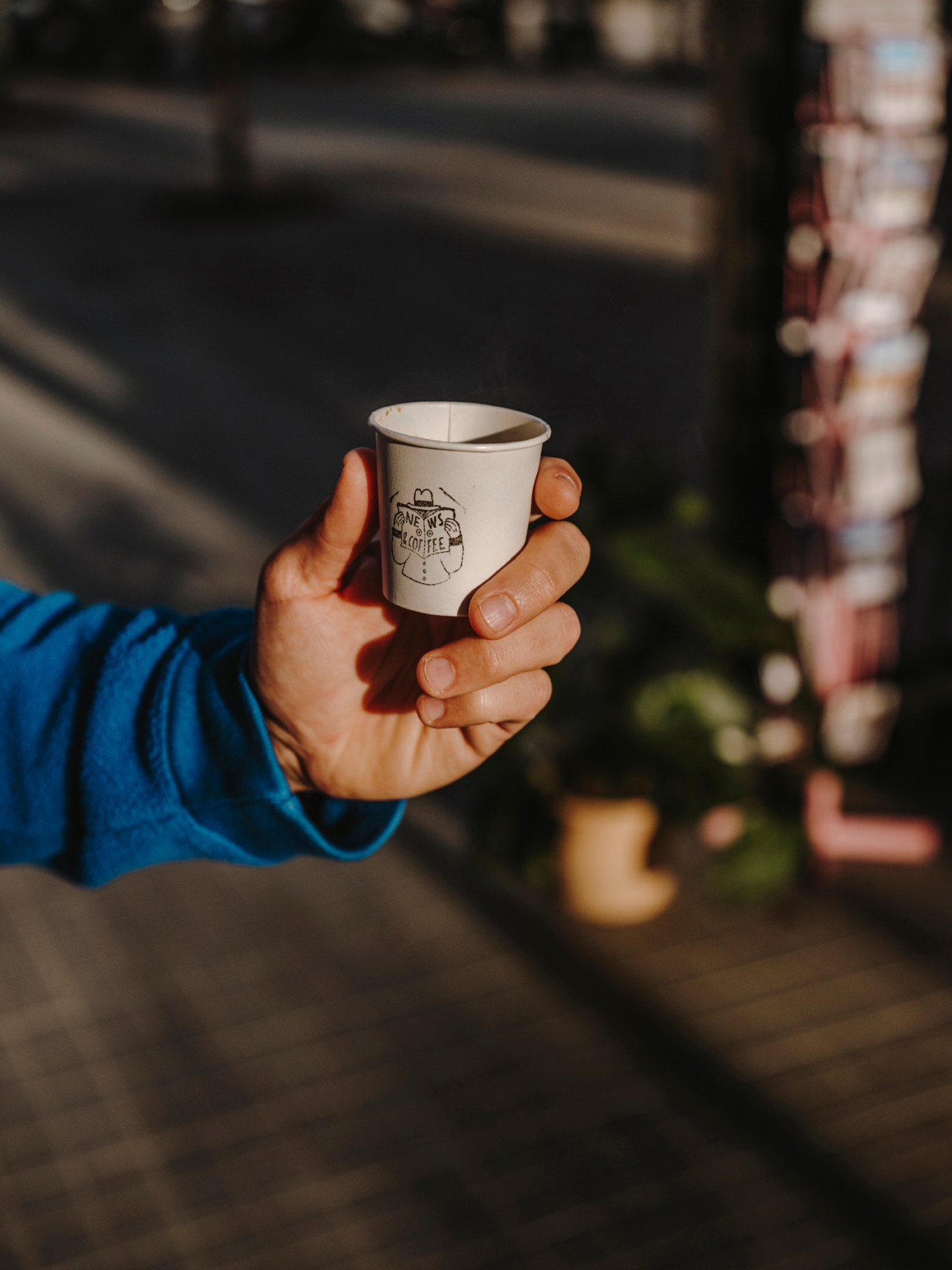
Others in the city have emulated their idea. In affluent Sarriá, a group of friends rebranded a corner quiosco into the aptly named Good News, mainly offering publications with a positive spin. “We were overwhelmed with negativity and wanted to change the narrative,” says co-founder Lucas de Gispert. The friends recently opened in a second location, encouraging customers to share a good news story with them to get a 20 per cent discount on their coffee.
Odd Kiosk, another newsstand, is the work of graphic designer Ivan Jiménez and architect Txema Montero. Here the shelves mix traditional press with queer-culture titles and slightly provocative prints. This sets the scene for some intriguing interactions: white-haired señoras collecting their dailies chat with youngsters flicking through a fashion quarterly. “We’re bringing art, visibility and colour to the streets,” says Jiménez.
It was in 1888 that Barcelona’s first newsstand opened to much fanfare. More than a century later, if reading habits at these revamped quioscos are any indication, the appetite for well-spun stories remains strong.
Call of the wild
You might say that René Araneda owes his career to a puma cub born without a tail. In 2012 the Chilean film-maker came across the bundle of tawny fluff – with its mother and sibling – in Patagonia’s Torres del Paine national park. In what was his first big commission, Animal Planet, a television channel, charged him with turning the footage into a one-hour special. He calls it “the game changer”.


More than 10 years later, Araneda, an independent film-maker, has directed and produced films, episodes and sequences for clients including Netflix, the BBC and National Geographic. He has navigated the wilds of Chile to capture footage of flamingos, blue whales and guanacos –camelids with long eyelashes that are part of the same family as llamas. And he’s stuck with pumas, filming a family in their den for Netflix’s Night on Earth series, and following several through Torres del Paine for Into the Puma Triangle. “My favourite place on Earth is Torres del Paine,” says Araneda. “It’s the place that opened my eyes and made me fight to be a wildlife film-maker. When I die I want my ashes to be scattered there.” Whether they’re filming feathers, fins or teeth in oceans, rainforests or tundras, such zeal is common among those working in this industry.
Increasingly, that enthusiasm is shared by audiences. No longer the preserve of yawn-inducing Saturday afternoon television, natural-history documentaries are more popular than ever. This shift arguably started in 2016 with the remarkable success of Planet Earth II, a big-budget BBC epic narrated by David Attenborough. Each episode amassed more than 12 million viewers in the UK and almost three million in the US. And the popularity of the genre continued in 2020 when My Octopus Teacher became an unexpected hit.
Animal attraction
Hottest species: Big cats; sharks; predators generally (“Americans love teeth,” says Köhler); penguins; dolphins.
Hardest sell: Bats. “Always – not only since coronavirus,” says Köhler.
Most popular location: “Africa is still a powerful pull,” says Gunton.
Next frontier: Oceans. “They’re unexplored; there are unknown species and behaviour that has never been seen before,” says Araneda.
That these programmes were available to watch on Netflix is no coincidence. The evolution of the natural-history documentary industry owes much to streaming services, with Apple TV, Amazon Prime and Disney+ also releasing an ark’s worth of shows. The fact that “super-duper blue-chip” wildlife productions are in the mix of Netflix offerings rather than confined to nature broadcast and cable channels means that they are “bolted onto the zeitgeist,” says Peter Hamilton, editor and publisher of the Documentary Business newsletter. As well as opening up the genre to a younger audience, he says, the heavy promotion of premium wildlife shows by the streaming platforms means that there is generally “more awareness of natural history”. Today these shows can inspire the sort of fervour associated more with Spiderman than spiders.

Nature programmes hold many attractions for viewers. They are a balm in tough times – least of all during the pandemic – offering both escapism and perspective as they transport us to lands where animals, oblivious to humanity’s problems, go about their daily business – mainly trying to not be eaten. Plus, as concern about the effects of climate change escalates, the shows educate us about the state of the planet and are therefore often imbued with a certain poignancy.
Look who’s talking
Many people associate nature productions with the honeyed tones of David Attenborough but how important is a narrator to a show’s overall success? According to Walter Köhler, founder and CEO of Terra Mater, not very. “Attenborough is a big exception,” he says. Although in the past there have been prominent nature presenters in Germany (Heinz Sielmann and Bernhard Grzimek) and France (Nicolas Hulot, who went on to become the country’s environment minister), they’re unknown outside their home markets. Because narration is often added by national broadcasters, the person behind the voice is not a matter of particular concern to the programme’s creators. “Even if it’s a famous person, when you change the language, you lose them,” says Araneda. “And there are more than 200 languages. For marketing, it’s important at a certain level but your film has to survive because of a story, not a voice.”
“In the past four or five years the appetite for natural history has blossomed, particularly in the US,” says Mike Gunton, the creative director of BBC’s Natural History Unit (BBC nhu) in Bristol. The BBC nhu, the world’s most storied nature-film creator, recently made headlines when it announced that it will be opening a studio in Los Angeles in 2021. The logic is clear: many streaming platforms, with whom the BBC nhu is increasingly collaborating, are headquartered in California. “There is appetite for big, ambitious projects and those resources are available in that part of the world,” says Gunton. Whether it’s exploring digital options or experimenting with shorter formats, he believes that the landscape is “going to change significantly over the next five years”. “We need to have some presence where that is happening to be able to respond quickly,” he adds.
But that’s unlikely to mean conjuring up a hit show at speed: nature productions usually involve playing the long game. It’s a fairly tight-knit industry, comprised of the BBC nhu and a cluster of other Bristol-based firms, big producers and networks such as Austria’s Terra Mater Factual Studios and US-based National Geographic, Discovery Channel and Smithsonian; the streaming services; regional public broadcasters; and independent film-makers across the globe. Historically, it has been dominated by a handful of firms because creating nature documentaries is a complicated, expensive and highly specialised undertaking.
Costly and ever-more-advanced gear – drones, long-lens cameras and stabilisers – is required to capture that smooth overhead shot of a migrating herd of wildebeest or zero in on a tiger’s iris. And obtaining the necessary footage is, notoriously, a test of endurance. “If you fall under 100 or 200 shooting days for an hour of publishable content, you’re lucky,” says Walter Köhler, founder and CEO of Terra Mater. “Teams are out there for unbelievably long times. In 24 hours a lion is active for four; you are sitting doing nothing for 20 hours a day,” he says, grinning. Weather adds problems: in snowy mountains, or on blustery seas, visibility is an issue. That is partly why sunny Africa is such an attractive option for productions. All that time in the field means that, according to Köhler, producing a good blue-chip programme “for less than €400,000 is nearly impossible and super blue-chip production, like the episodes for [Netflix show] Our Planet might go up to something like £3m [€3.3m].” But with good execution and intelligent distribution, this is a lucrative business. In terms of revenue, television and streaming platforms are “much more important” than cinemas, says Köhler. And because nature is the only documentary genre that is “absolutely universal” – animals aren’t confined to one language – films and shows can be distributed anywhere, making for a highly efficient model. (This doesn’t apply to productions for streaming platforms which tend to involve exclusive rights.) Terra Mater always creates one version with an English-speaking host and one with none. “The only thing you have to do is add your narrator and, suddenly, everybody in the world is understanding,” he says. “In no other business is it that easy.” He likens hit nature productions to “a blockbuster franchise,” with play across platforms, dvd versions and spin-off soundtracks, merchandising and child-related entertainment.
In addition to commissions for big studios, independent film-makers produce and syndicate their own films to boost income. “Our own films are not Planet Earth III but they’re good enough to be distributed,” says Araneda, explaining that for an hour of footage, “maybe one country pays $5,000 [€4,117], another $10,000 [€8,238] and another $20,000 [€16,477].” He likens films to songs, in that film-makers receive royalties every time their work is sold, if they own it. “It’s a good business if you know how to manage the various options.”
Some creatures, such as sharks, big cats (especially cubs), penguins and certain cetaceans (whales and dolphins) are fail-safe options. But a great nature film does more than document animal behaviour; it puts its subjects in a broader context and has a clear goal. “A growing trend is identifying exactly what change you’re hoping to inspire and integrating that campaign into every piece of the production,” says Lisa Samford, executive director of Wyoming-based wilderness film festival Jackson Wild. For some viewers, being informed about issues is, itself, a step in the right direction. Yet increasingly the point is to inspire actual change – in viewers, governments and corporations.
“It’s a finely adjusted knob on the dial because people come to these programmes for a number of reasons,” says Gunton. “Part of it is to enjoy the wonder of the natural world. There’s lots of internal debate about the ratios of [providing] wonder to identifying the challenges. Some advocates say that natural history should only be talking about the climate crisis; I don’t share that view. If you just talk about problems, audiences can feel frustrated.” But because of the numbers of eyeballs they draw, he accepts that such programmes can be a “powerful tool” to help shift behaviour.
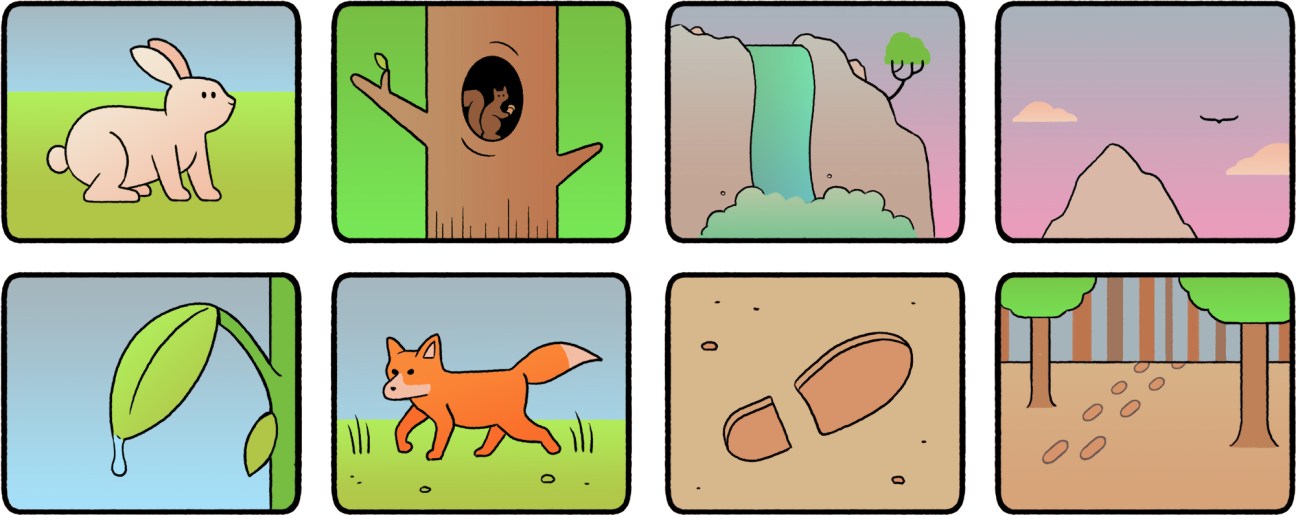
Sometimes the effect of a film is clear. Terra Mater has created the role of “impact producer” on its productions, and two of its thriller-style documentaries have prompted government action. As a result of 2016’s Ivory Game, China banned its legal ivory trade. And after Sea of Shadows, about the illegal trading of the tiny vaquita porpoise by Chinese mafia and Mexican cartels, most of the criminals involved were jailed.
Köhler says that the industry needs to not only feature environmentally conscious stories but reduce its own carbon footprint. This means flying crew around the world less and working with talent in the locations that are being covered – a practice that has been encouraged as borders have closed during the pandemic. This means more stories from people like Fiona Tande. In 2020 the 33-year-old Kenyan produced and directed Enanyokie, a short film about Maasai people and their relationship with nature and the colour red. She also founded Pridelands Films, a platform connecting Kenyan film-makers with big-budget studios. “There’s a need for a film agency that represents the locals,” says Tande. “[Overseas companies] kept using non-Kenyans who set up in Kenya; it was frustrating.”
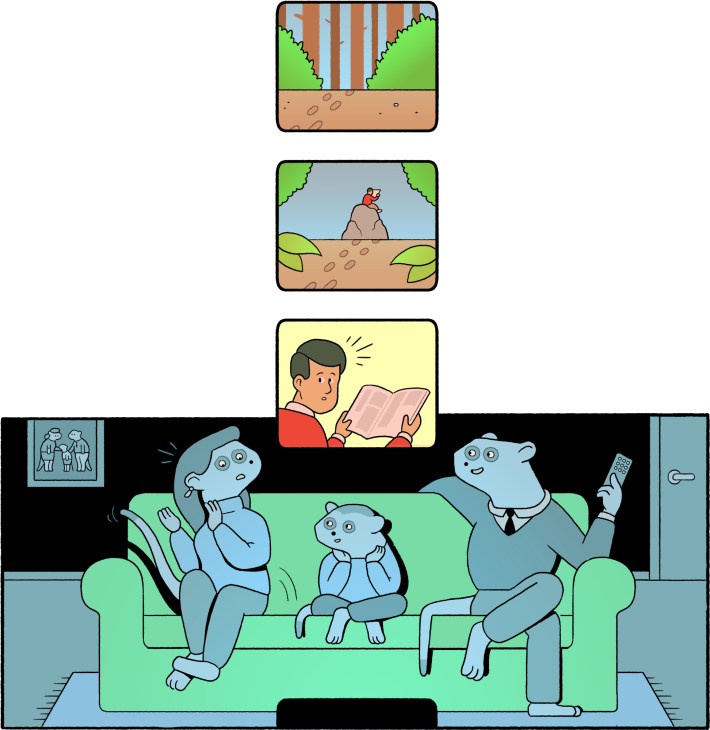
Tande is Maasai and says that, having always lived “among this wildlife,” she and her compatriots have access to stories that foreigners do not. She wants her films to resonate with African audiences, who are often overlooked. “The Western audience is very much in love with wildlife,” she says. “The ones that we really need to get through to are those who live next to these animals. They’ve had an ancient relationship with the natural world but the new generation is mostly disconnected to nature; it’s prudent for them to protect that in the future.”
When asked why it’s tricky to inspire action in audiences, she blanches. “It’s not really difficult but for a long time we’ve had blue-chip series that only told the stories of the animals and removed the people,” she says. “If you show the connection we have to wildlife, you tap into another level. I’m looking to encourage the human stories of wildlife – because it doesn’t exist in a vacuum.”
True colour
At the entrance to each of the four shopping floors at Green Pea, the Turin mall that bills itself as the world’s first green retail park, is a set of panels that customers have to walk across. The tread from the shoppers’ feet generates energy that is then displayed on a screen in joules. Although this is perhaps slightly gimmicky, it’s all part of Green Pea’s eye on the future, says Francesco Farinetti, its CEO. “Twenty years ago solar panels were expensive and inefficient,” he says, pointing to how much they have developed since.
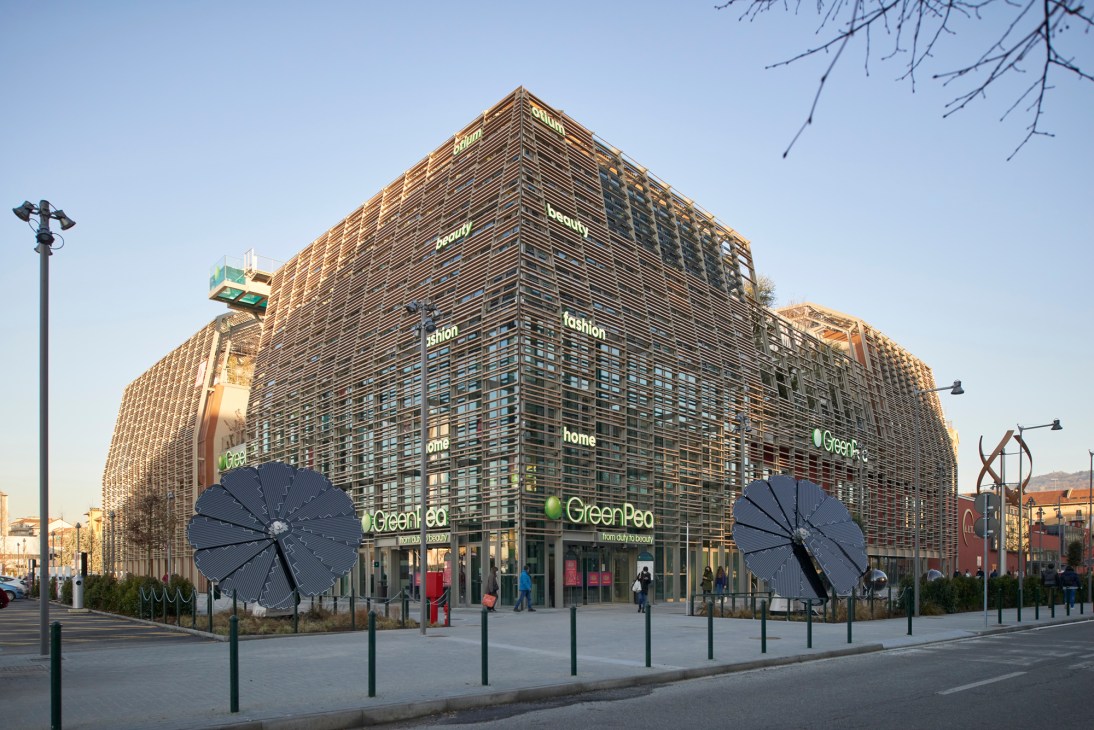
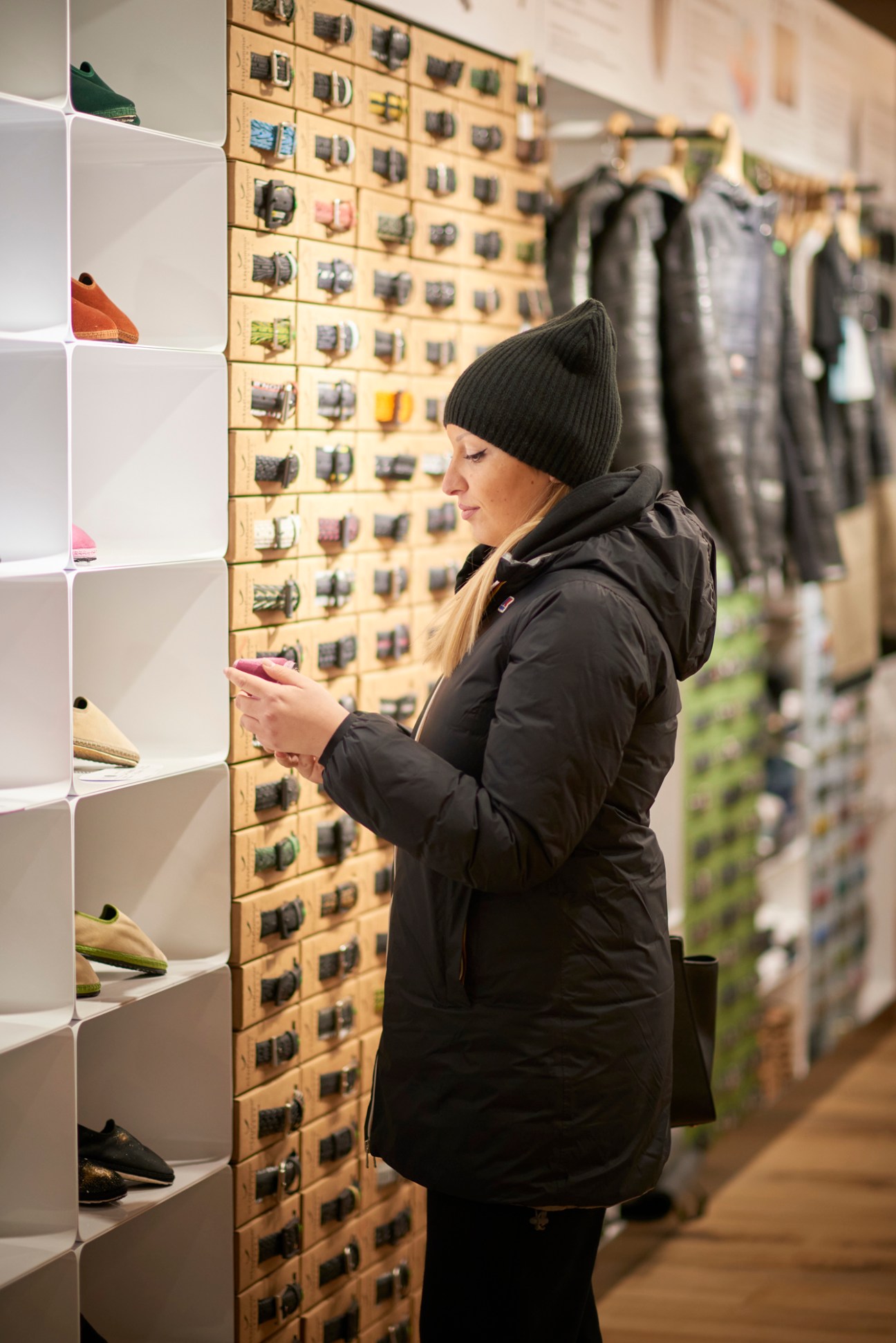
Green Pea’s goals are ambitious. With a self-declared mission of saving the planet by changing the way that we consume, the sustainability-focused mall is the brainchild of Farinetti’s father, Oscar, the man behind the Eataly food markets that now number 41 outlets in 15 countries. Green Pea opened in Turin’s Lingotto neighbourhood in December 2020, next to the site of the original Eataly. Ten years in the making as supply chains were tweaked, Green Pea has as its tagline, “From duty to beauty”. Inside its vast imprint are more than 100 partners, mostly Italian alongside some big international players such as Patagonia, Whirlpool and Timberland. Everything from eco-friendly furniture to electric cars is sold.
Farinetti takes Monocle on a tour of the building, which is clearly a statement of intent. Designed by Cristiana Catino and Carlo Grometto, the shopping centre generates about 88 per cent of its energy from renewables, such as geothermic, solar and wind. The wooden frame of the outer shell is comprised of timber from fallen trees that were recovered from northern Italy after a storm. Farinetti points to one of the 83,650 bolts in the metal frame of the interior that allow it to be easily dismantled and fixed. Collected rainwater, meanwhile, is used for the hydraulic system.
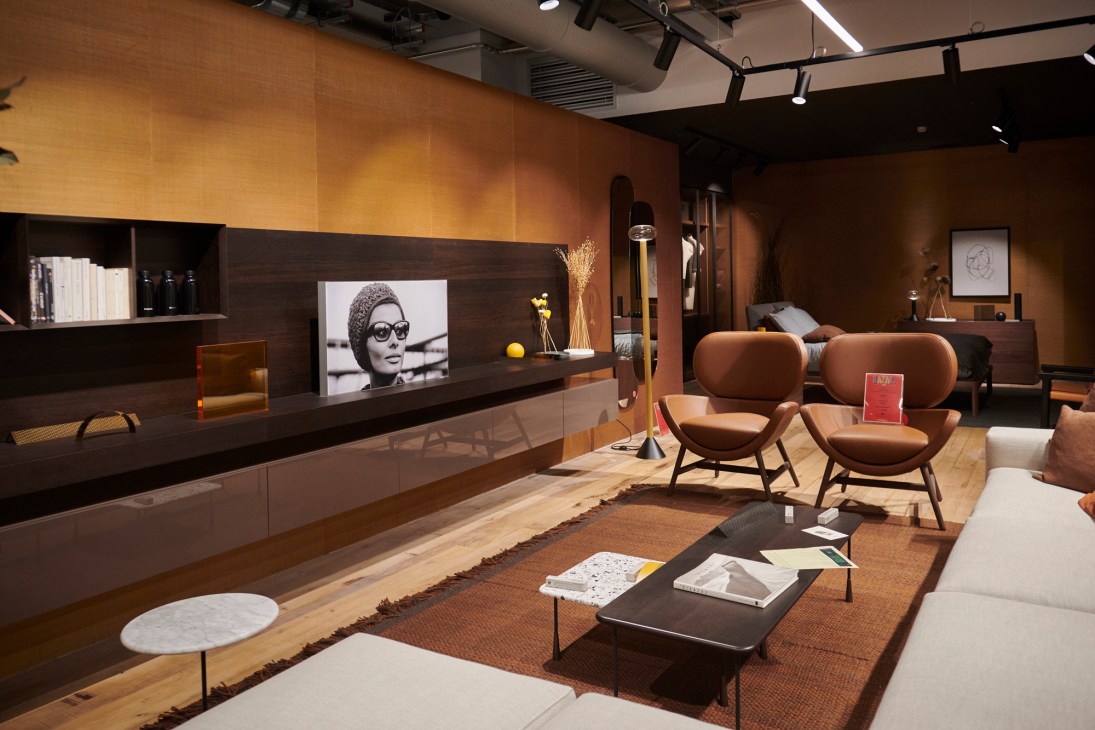
There’s also an instructive element. “In our Eataly shops, education is important,” says Farinetti. But Green Pea takes this to new heights. There’s a museum on the ground floor with diagrams of the building’s features, while displays in shops and next to escalators offer information on the air-purifying paint that’s daubed on the walls and show samples of the organic cotton used by some clothing brands.
Green Pea is purposely pushing “Made in Italy” furniture and fashion. The former is largely aimed at contract clients, while the latter is oriented towards everyday punters despite its potential pitfalls when it comes to sustainability, particularly concerning workers’ conditions and production transparency. Farinetti points out that every brand partner publishes a seven-point environmental agenda (such as K-Way’s work with industrial partners that share “the same company welfare policy”). He also adds that new partners sign a Green Pea manifesto that means contracts can be terminated if values turn out not to be shared.
Monocle’s Green Pea picks:
AMR-Natural Colours
A knitwear brand founded by Anna Mello Rella and Omar Bertona. Garments are produced with natural fibres and the dye of 200 plants.
Ri-Generation
A small set-up on the “home” floor showcases this project. Ri-Generation fixes old or damaged appliances then sells them to consumers at a fraction of the cost of a new one.
astelav.com
Allegro Natura
This cosmetics brand and laboratory has produced a special line exclusively for the mall.
allegronatura.it
Sease
This company was founded by Giacomo and Franco Loro Piana. Its classic clothes are made using natural fibres combined with petrol-free synthetic materials.
sease.it
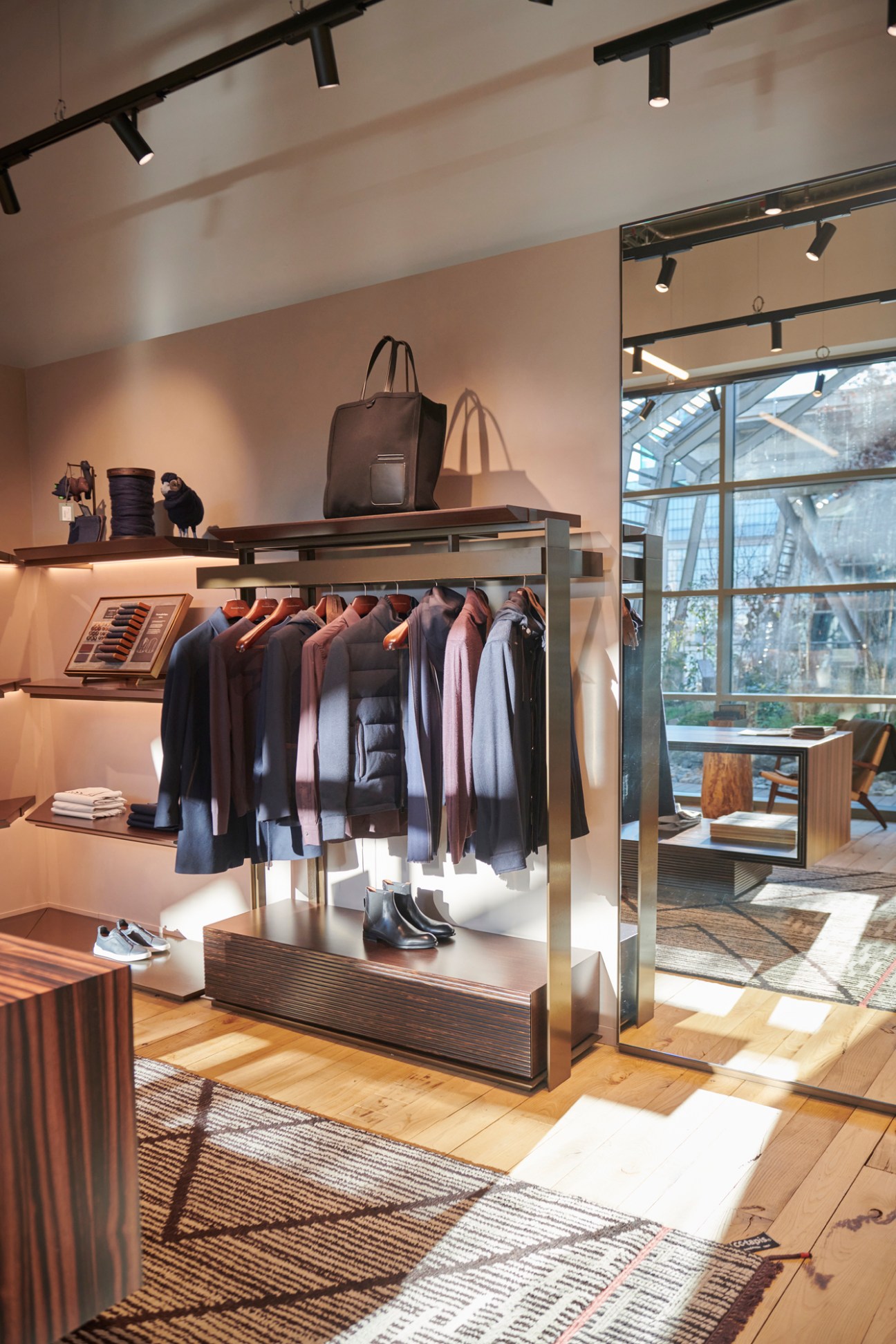
For head of the fashion floor Roberto Orecchia, whose family has a 10 per cent stake in Green Pea, working with labels that have already adopted green policies would be missing the point. “If we had only chosen companies that already produced sustainably, we wouldn’t change anything,” he says. “We pushed companies to become sustainable.” Several brands have produced green lines in collaboration with the mall, including Ermenegildo Zegna, which launched its “Use The Existing” collection here, and Borbonese, which teamed up with slow-food producer La Granda to use discarded hides from meat production in its leather bags.
Referring to some of Green Pea’s big-name brand partners, including Mastercard and Italian telecoms company tim, Farinetti makes an analogy. “To us, Green Pea sustainability is not a 100-metre sprint with only 10 people, where the first to reach the finish line is the king,” he says. “It’s more like the New York marathon: the idea is that most people reach the finish.” For Stockholm-based Erik Elvingsson Hedén, who compiles the Sustainable Brand Index, Europe’s largest brand study on sustainability, casting your net wide can be a good thing. “We can’t shut companies out,” he says. “Involving them is better. It’s tougher from a brand-communication perspective but in the long-term it’s what’s needed.” For Farinetti, his “nightmare” is to inadvertently do a company’s “greenwashing”. He says that Green Pea will be judged if it fails to achieve wider change in the longer term.
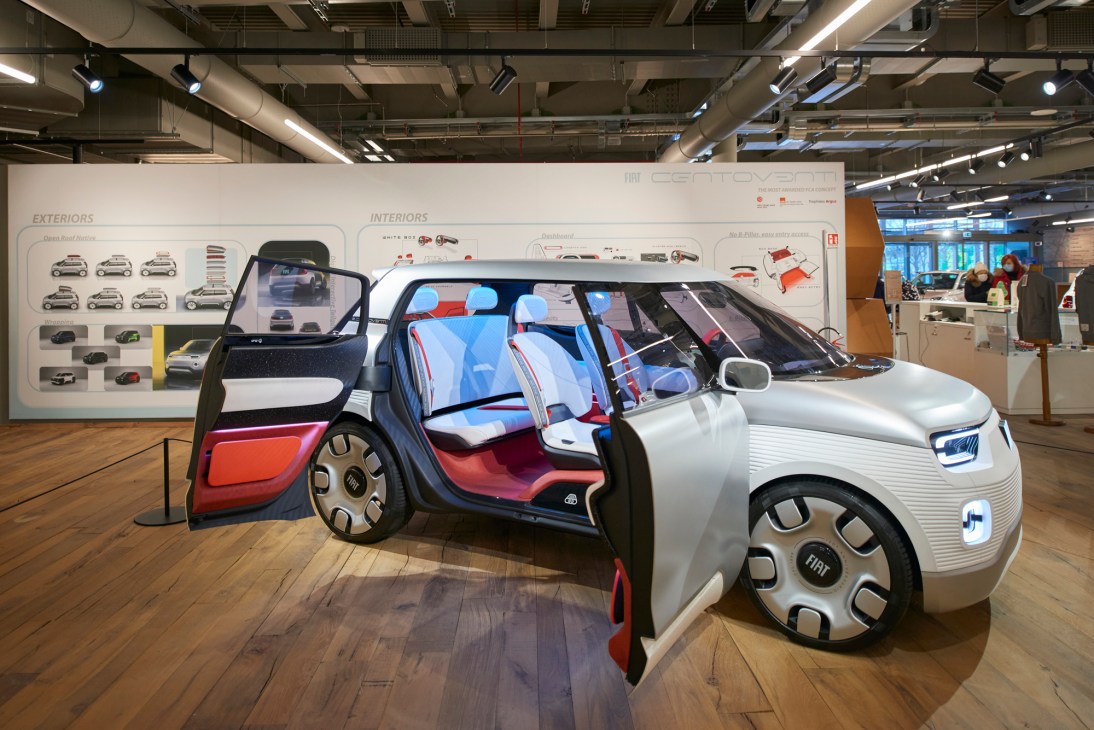

There’s a hint of Ikea to the mall in the way that customers are guided through floors with showrooms. But Farinetti isn’t planning on becoming as big as the Swedish giant for now; he would rather follow a similar expansion plan to Eataly. Despite opening at a torrid time for retail and, when we visit, having to close at weekends due to coronavirus restrictions, the mall attracts about 3,000 shoppers a day, says Farinetti. He sees distinct models for the Green Peas of the future, either replicating Turin (he’s looking into sites in Los Angeles and Moscow) or occupying space in an existing mall. Farinetti has Dubai and the Middle East in his sights too, believing that shoppers there are crying out for “something different”.
Green Pea is more mass-market than Eataly, covering what Farinetti calls “pop to top”. Although some might argue that focaccia and parmesan are an easier sell, Farinetti says that the margins are greater in furniture and fashion than food. So can Green Pea can be a success? “If it has the right mix of experiences, shop and food, then yes,” says senior retail analyst Chara Baram of London market researchers Mintel. And Farinetti knows that “experiences” are key. “Why do I have to get up and go to a shop when I can order from my sofa and normally save money?” he asks. “Only if it’s worth it.” He’s banking on Green Pea being just that.
greenpea.com
Green Pea in numbers:
15,000 sq m of retail park
2,0001 plants and trees in and around the building
€50m in investment
32 clothes shops
24 home furnishing shops
4 shopping floors and one rooftop area with spa, pool and private club
1 car dealership, laundry and bookshop
Building societies
Sustainability is all the rage for companies these days and concepts relating to the idea of “green building” stand to gain more than most in the coming years. That’s partly because the construction sector is a key emitter of pollution. According to a 2020 report by the European Climate Foundation, energy use in buildings accounts for more than a third of all greenhouse gases emitted into the atmosphere, yet the construction industry “is one of the sectors that has arguably seen the least progress to date” when it comes to reducing emissions. That reality has prompted economies such as the EU to press for tougher building codes as they work towards the ambitious goal of becoming carbon neutral by 2050.
But better building isn’t really just about reusing materials, installing energy-efficient lightbulbs or using renewable energy sources. Nor is it always about pioneering technological advancements. As ever, it’s also about the simple things, such as tending to a neighbourhood and adding shutters to windows. And for some in the construction business, it pays to look backwards to time-honoured traditions and long-forgotten building materials that, with a few modern updates, can prove to be surprisingly durable and effective in meeting the same goals.
On the following pages, we look at some of the imaginative businesses, architects and designers that are helping to make our world a better place, including a Norwegian firm turning plastic marine waste into simple new products, the rooftop farmers finding new space for agriculture, and the Indian companies that are helping us to breathe better air.
1.
Natural building remedies
Eelgrass roofs in Denmark

The craft of weaving dried eelgrass into roofs isn’t a new housing solution on the Danish island of Læsø. The technique, which mimics knitting, dates to the 1600s when women used the grass to create cheap fireproof roofs. Today there are 19 historic hobbit-like houses on the island – and with a few innovators aiming to revive the technique, there should be more to come.
Eelgrass, which washes up on Danish shores in abundance, is a wonder material. Rot and fire-resistant, the wispy seaweed is nearly indestructible. “It can absorb carbon dioxide and sequester it,” says Kathryn Larsen, a Copenhagen-based architectural technologist who was inspired by Læsø’s houses and is developing contemporary seaweed thatch panels.
“When used in a wall or roof as insulation, eelgrass can create what’s known as a ‘breathable construction’,” says Larsen. Eelgrass can absorb and release moisture, allowing air to pass through the construction, improving indoor air quality.
Henning Johansen, a master thatcher on the island, is also rejuvenating the ancient craft. Rather than twisting the dried eelgrass by hand, as Danes did in the 1600s, he uses a screwdriver to spin the strands into long, thick bundles that are packed together on roofs, resulting in a sturdy canopy. To ensure a healthy seaweed supply, farmers such as Kurt Schierup of Møn Tang are working to harvest more eelgrass.
For Larsen, one challenge is the stigma around the plant. “People think eelgrass is smelly and slimy but this isn’t the case,” she says. “I’m trying to change people’s perceptions.”
2.
Cleaning up their act
Graffiti removal in the US

New York has a long and ambivalent relationship with graffiti. The metropolis is the seat from which the art form caught the world’s attention in the 1980s but its golden age was a time of much deprivation and crime, and it’s generally thought of as a nuisance by officials.
In 1999 the city sought to combat illegal graffiti with a programme called Graffiti-Free NYC. By dialling the number for non-emergency government services, business owners could summon a team of graffiti-removal specialists to scrub tags from their building at no charge. However, the programme has been suspended since March 2020 due to coronavirus-related budget cuts. Until it’s restored, New Yorkers might look to another city for ideas.
In Pennsylvania, Graffiti Removal Experts (GRE) is a private company that exclusively employs homeless and formerly incarcerated people. “We hire directly from a prison re-entry programme in Philadelphia and we’ve had very good results,” says Todd Kelley, an army veteran who started the business in 2012.
Kelley condemns the “99 per cent of graffiti that’s just squiggles,” but believes that “talented artists should have the option to display their art in a public space”. “We can often find them paid work or, at the minimum, permission to paint a large wall in our neighbourhoods,” he says. A big wall with art on it doesn’t get vandalised, he adds. But, Kelley says, “a big empty wall is just like a blank canvas.”
3.
Breathe more easily
Cleaning India’s dirty air

There’s a small but growing gaggle of activists and innovators trying to tackle the toxic air that is choking India, one of the world’s most polluted countries. “The situation is only getting worse,” says Barun Aggarwal, founder and CEO of Breathe Easy Consultants. His is one of several companies offering purification solutions to clean the air inside homes and offices. “India burns thousands of tonnes of rubbish, including plastic, which emits high levels of dioxins and furans that are extremely carcinogenic to the human body,” he says.
Solutions such as Breathe Easy, although welcome, are unaffordable for the majority of Indians but there are some less expensive fixes too. Pi Green Innovations has won awards for its Carbon Cutter device that fits onto vehicles or generators and, it claims, captures 90 per cent of the dirty particulate matter emitted from exhausts. And a team of scientists from the Indian Agricultural Research Institute has developed a fungus and jaggery (an unrefined sugar product) capsule that can make rice fields decompose quickly, so that farmers don’t have to burn their patches twice a year.
The ideas are there. The next step is building awareness and pushing implementation. That’s why Jyoti Pande Lavakare, writer and co-founder of activist group Care for Air, says that pollution must remain top of the agenda. “Breathing the toxic air in New Delhi is like drinking sewage,” she says. “You wouldn’t drink toxic water so why should we breathe toxic air? Government and big business need to step up and do their part.”
4.
Constructive research
A living lab in Switzerland

Driving the use of research and innovation to construct the sustainable buildings of the future, Next Evolution in Sustainable Building Technologies (Nest) is a living laboratory near Zürich. A public-private partnership, its base includes apartments for researchers where new materials and building solutions can be tested.
The site is situated on the campus of the Swiss Federal Laboratories for Materials Science and Technology (Empa), and is run in conjunction with another government-backed institution and dozens of private corporate partners. “Nest’s mission is to accelerate research and innovation for construction,” says its managing director, Reto Largo. “You can validate your prototypes here in a real-life environment.”
The site consists of a core building with platforms where experimental units can be built and later removed. One example is the Urban Mining and Recycling unit designed by German company Werner Sobek with architects Dirk E Hebel and Felix Heisel. The apartment features reusable materials, while its façade includes aluminium and copper that can be separated, melted and recycled. “It was important to create a unit that can be fully disassembled, while showing that you can make something elegant and contemporary,” says the project’s manager, Bernd Köhler, a senior architect at Werner Sobek Group.
5.
Reusing waste
Aion in Norway

With a coastline stretching just shy of 3,000km, Norway’s economy has long relied on its fisheries. The country is the world’s second-largest exporter of fish, an industry that racks up more than NOK94bn (€9bn) a year. Yet this economic boost has a price: the disposal of 10,000 tonnes of fishing equipment in the sea every year, mostly plastic ropes and nets.
Hoping to address the issue is Oslo-based Aker Biomarine, which has been producing Omega-3 supplements for the past 15 years. Last December it launched a sister company, Aion, with the goal of supplying businesses with functional products made entirely from plastic waste collected by Aker and its partner companies.
“Plastic is a valuable resource and we want full circularity,” says its CEO, Runa Khoury, who has spent the past two years as Aker Biomarine’s sustainability director. “We want to channel it into useful items for the retail and catering sectors.”
After acquiring a company that had been in the business for some time, Khoury secured Aion its first commissions: recycling plastic waste into trays for McDonald’s and shopping baskets for Norwegian supermarket chain Meny. With plans to expand its client base beyond Norway, Aion has partnered with Oslo-based architecture firm Snøhetta, which will bring its expertise in materials and product design to develop a range of fully recycled items for businesses to adopt.
“Most of us want to see the world produce less plastic but the incentive isn’t there yet,” says Khoury, stressing that sourcing virgin plastic is less expensive than recycling it. “We want to be the ones promoting quality offerings and closing the plastic loop.”
6.
Future-proof offices
Shimizu in Japan

Japan gets a bad name for its scrap-and-build culture. Houses are torn down after 30 years or so, while 1980s office blocks are considered ripe for demolition. Times, though, are changing thanks to a rethink of the ethics of short-term building.
Construction companies have an important role to play. Shimizu Corporation, one of Japan’s biggest builders, is putting the finishing touches to a zero-energy office in Kanazawa. Due to open in May, the three-storey structure will use hydrogen energy, solar power, radiant air conditioning, geothermal heat and natural airflow and lighting to reduce carbon emissions. “Zero-energy building is going to be standard in the near future,” says spokesperson Hideo Imamura. “We want to be ready for a new era.”
The building will generate power too. Shimizu has been working to develop a system, Hydro Q-Bic, that uses the excess energy from solar power to make hydrogen, which is stored and converted into clean electricity.
The technology is hidden behind traditional elements drawn from Kanazawa’s machiya townhouses. Wooden latticework exteriors double up as earthquake-resistant walls, while the ceiling uses fire-resistant wooden beams.
With more people working from home than ever before, large offices need to justify their worth. Builders such as Shimizu are incorporating the need for more flexible, paperless workspaces into their designs.
7.
Fabulous prefabs
New Zealand and Australia

Sustainable, economical and even portable kit homes are gaining traction down under. Dozens of companies now offer modular homes that can be built in factories and then shipped out, flat packed, to their destinations. New Zealand-based Fraemohs has been in the field for more than 50 years and is best known for its Scandinavian-style solid timber homes. The company also sells to Pacific Island nations, including the Cook Islands and Fiji, and as far away as Japan.
Along with custom-built homes, Fraemohs offers a number of designs in its “kitset” range. “Kitsets are a significant part of our business,” says the firm’s general manager, Amanda van der Kley. “Every year we sell about 50 of them but we have the capacity to scale up rapidly.” Describing the kitsets as an “interlocking Lego-style system,” Van der Kley says that the solid timber and structural integrity form a large part of the buildings’ appeal, which proved themselves during the 2011 earthquake in Christchurch, where Fraemohs is based. “The foundations suffered but the houses remained intact.”
Fraemohs’s relatively high prices of NZ$1,000 to NZ$2,000 (€600 to €1,200) per square metre make it an unlikely choice for many but other companies are working on alternatives. Melbourne-based Prebuilt, which has operated since 2003, has partnered with Pleysier Perkins architects to create customisable modular homes that can be built, transported and erected quickly, with a turnaround time that could help in a housing crisis.
8.
Neighbourhoods to watch
Self-manage your own space

Defining what makes a good neighbourhood is difficult but public life and space would be at its core. So how to improve these factors for businesses and residents alike? “It’s a question of how we best work together to shape our public realm,” says Ethan Kent, founder of Placemaking X and former fellow of New York’s Project for Public Spaces.
A good place to start is with the residents and retailers who form the community, by helping them to take ownership of their own patch. This might involve decorating the front of homes and improving shopfronts to ensure that they’re attractive; just sweeping the front porch can go a long way. Businesses and residents should be encouraged to “self-manage their spaces,” says Kent. “It’s about people taking more care of them and wanting to spend more time together in them, almost competing to contribute to the shared experience.”
Good buildings matter too, not only in terms of architecture and performance. “Façades are important,” says Kent. “They should have visibility, character and detail to invite the right mix of retail and create an active neighbourhood.” These fronts can be enhanced by walkable streets, shady canopies, outdoor dining and generous pavements. Do all that and you’re on track to create a neighbourhood that, in Kent’s words, is “lovable, not just liveable”.
9.
Parks in context
Blue Temple in Myanmar

What makes a good city park? The focus shouldn’t just be on creating healthy green spaces but on filling a real need in the community. After all, parks are prime social-gathering spaces.
Blue Temple’s latest project, a community recreational park in the north-central Yankin township of Yangon in Myanmar, is a good example. “Yangon is a city that was designed for cars,” says Raphaël Ascoli, the architect who launched Blue Temple in 2017. “It lacks pedestrian areas and green public spaces. So our goal was to create a community space with an educational focus.”
Set to be completed this spring, the park is built on former wasteland and designed with input from the community’s residents. Ascoli, who teaches architectural design at Yangon Technological University, sources regional materials and borrows from traditions, combining them with his own computational design techniques to create higher-performing structures. “One of the core elements of Blue Temple’s identity is hyper-contextual design,” he says. “Every park that we design adapts to a specific community, environment or economic context.”
For the Yankin park, Ascoli sourced local bamboo and drew inspiration from the region’s use of the material in scaffolding. “The idea was to turn this tradition into something new,” he says. “We wanted to show that it could provide jobs for craftsmen.” Blue Temple’s next project involves creating affordable prefab housing, also made from bamboo, that could help to solve Myanmar’s housing shortage.
10.
Cultivating space
Rooftop farming in Belgium

Rooftop farms have grown in relevance as developers and planners have sought overlooked city spaces to reclaim and turn green. “They are a way of improving the environmental performance of a building,” says Steven Beckers, founder of Belgian rooftop-farm start-up bigh. “They protect the building from sun and cold, and capture carbon dioxide.” A rooftop farm can also become a source of organic food, boost urban biodiversity and make an ugly space more attractive.
bigh is behind Ferme Abattoir, one of Europe’s most ambitious aquaponic rooftop farms. At 4,000 sq m, it sits on top of Brussels’ Foodmet market and includes greenhouses and outdoor gardens with bees to pollinate its crops. There is also a fish farm in the greenhouse.
All the food produced is sold in the downstairs market or in nearby shops and restaurants. The farm uses the building’s existing cooling system and traps wasted heat to maintain the greenhouses’ temperature, while solar panels power pumps and lighting, and aquaponic systems recycle water.
bigh is in talks to roll out similar projects on an office block in Paris, a retail park in Lille and two more buildings in Antwerp and Brussels. It has also partnered with waste expert Veolia to develop its work on aquaponics and permaculture. The aim is to take the rooftop farms worldwide, says Beckers. “The project is designed to be repeatable.”
Into the future
Thomas Ingenlath
CEO, Polestar Gothenburg
The Volvo-owned, all-electric marque knows what its growing stable of drivers want: sustainability, dynamic driving and zero compromise.
Fledgling carmaker Polestar was established in Gothenburg in 2017 as a spin-off from owner Volvo (Thomas Ingenlath is a former senior vice-president of design there). The brand, which builds its cars in China, is focusing on the Polestar 2 in 2021, with an expansion of its variants. With more than 40 showrooms in 10 countries, Polestar has plans to further expand into Austria, Denmark and Finland.
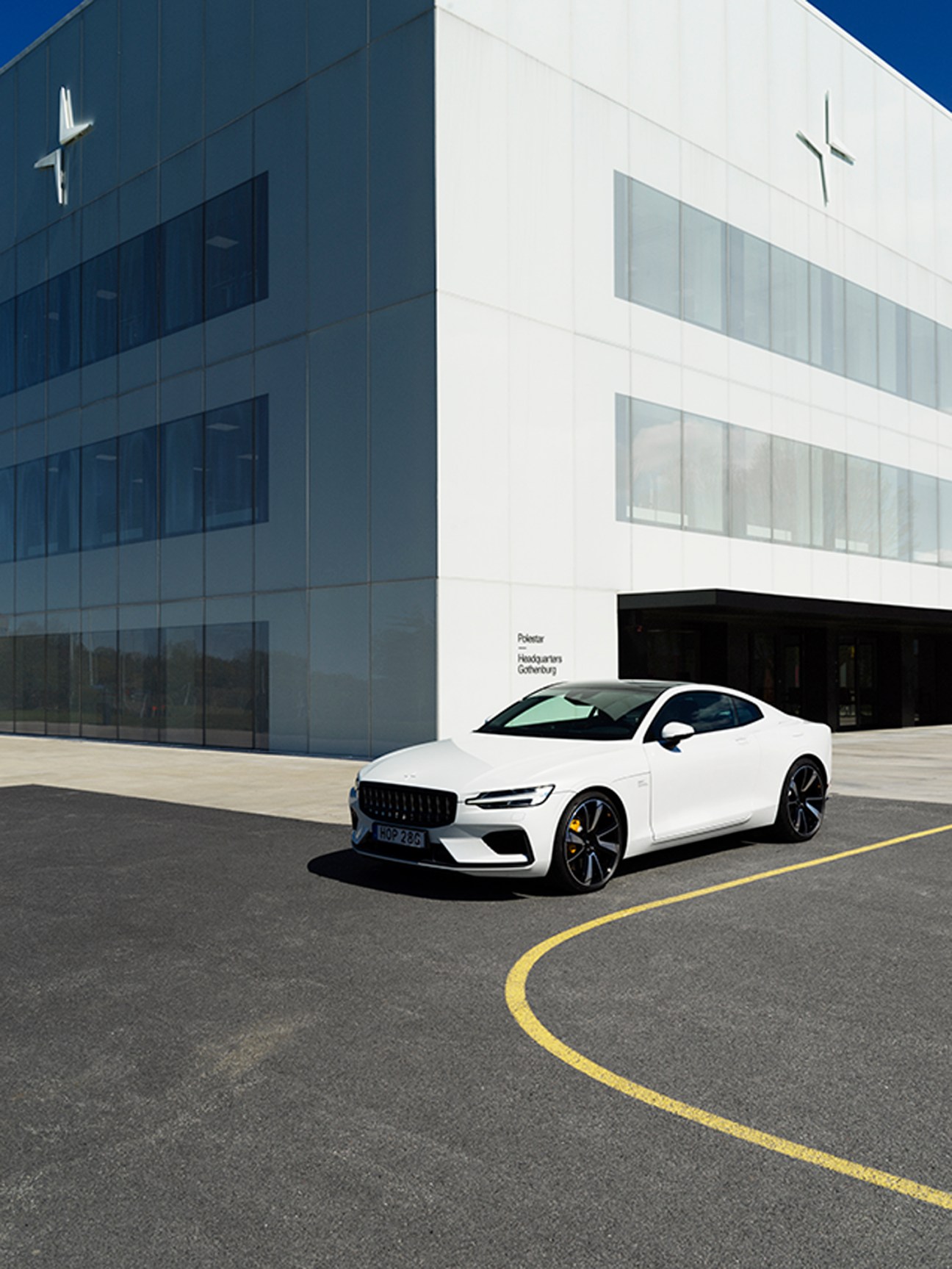

Why do we need Polestar when we have Tesla
The electric car market is reaching maturity. That means there is not just one car that satisfies people’s needs; it comes down to your lifestyle and how the car fits into that. Tesla is the market leader and we do not intend to compete with it – we want to sell to the kind of people who would normally drive a bmw or Mercedes.
What are the challenges facing the market?
Although 2020 was a difficult year for the automotive industry, electric car sales accelerated. However, we recognise that they remain a very small minority. To expand the market, we need to work on educating customers. For instance, many worry about having to charge their car every day. But the average distance someone drives in a day is about 40km; the Polestar 2 can travel 470km before it needs to be charged. One big obstacle is infrastructure; we need policymakers to encourage the creation of more charging points for electric vehicles. And we need more of our grid energy to be generated from sustainable sources in order for electric vehicles to move towards carbon neutrality.
What is your growth model?
Our two cars range in price from €40,000 to €155,000 and we aim to sell about 100,000 of the Polestar 2 this year. Northern Europe is currently our main market. But eventually, we intend to have around a third of our market in the US and a third in China, which is why production is stationed there. It has also helped us recently too. Many plants in Europe have been forced to close for longer periods through the pandemic, while our China-based facilities remained open. Transport was affected but the benefits outweighed the costs.
polestar.com
Polestar 2 in numbers
4.7 sec 0 to 100mph
204 km/h Top speed
470 kms per battery charge
€60,000 Starting cost
Ryan Gellert
CEO, Patagonia, Ventura, California
The ethical clothing brand’s new global head tells us why Patagonia’s remit will always be as much environmental as it is commercial.


Founded in 1973 by former climber Yvon Chouinard, Patagonia has long been speaking up about issues that go beyond the usual remit of an outdoor- clothing brand. Headquartered northwest of Los Angeles, the firm regularly features high up in fashion transparency and sustainability indices but is arguably better known for its activist stance. This has involved everything from picketing governments about oil and gas exploitation to defending public land rights – all part of its declaration of being “in business to save our home planet”. After 12 years at the helm, former CEO Rose Marcario left last year to be replaced by Ryan Gellert, who had spent six years heading the brand’s European operations from Amsterdam. Overseeing a company with revenues thought to be about €1bn (Patagonia doesn’t publish these figures), he spoke to Monocle from Ventura, California.
Are you looking to make your mark as Patagonia’s new CEO?
I don’t see it that way. I’m invested in doing what is best for us by living up to our mission statement on the effect that we want to have. So I’m shameless in stealing the best ideas from wherever they may be. Do we want to be thinking about new ways of doing things? Product line extensions, categories, whatever. Before I became CEO, we started a food business [Patagonia Provisions] a few years ago. I want to see that scale.
A lot of businesses have suffered from the pandemic. Do tough decisions need to be made now?
The laws of economic gravity apply to Patagonia like they apply to everybody else. And this has been the [fiscal] year we all know it to be. We’ll finish it smaller than a year ago. Some of that is intentional and some of that is a result of the pandemic. We feel comfortable with that. We’re not a revenue-driven business; we are very much a financial-health-driven business.
Why is a clothing brand like Patagonia involved in activism?
I’m not going to preach to other brands that they have to be activists; I can only tell you why we choose to be. There are two dimensions to Patagonia. One is being a responsible business. People often refer to us as leaders in sustainability. Let’s be clear, we’re not a truly sustainable business, despite our best efforts for 47 years. The external work is being part of an activist community. We’re in business to save our home planet and so we will offer opinions, scathing ones at times.
Is there are risk that you are contributing to polarisation?
I don’t want to be unconstructively contributing to that. But if the response is, “Shut up, let’s just all be quiet and keep businesses as usual” – that’s completely unacceptable. We have fouled our planet and we have a responsibility to change that. We live in a racist country [the US] that has hundreds of years of not treating all Americans as equals and we have a responsibility to contribute to changing that. Absolutely. Unequivocally.
Patagonia tells people to buy less. Some CEOs might wonder why. Can you explain your approach?
What’s the scorecard we’re all planning for? Is it just unbridled growth? Is the goal that every year you’re bigger and more profitable than the year before and that’s what success looks like? And anything that doesn’t match that simple, narrow definition is failure? The finances are a means to an end, not the other way around.
How big a part of the core business would you like to see upcyling and recycling become?
There’s this broad set of services that we have that use an umbrella term called Worn Wear. When I think of Worn Wear, it’s about helping customers to really think about the effects of their decisions. It will include rental in the future, that’s a natural extension. Hopefully we can start to create greater scale around circularity and move to a much higher level of recyclability, which is deeply embedded in our business. I would like to scale it to the point where those services are cannibalising our sales of virgin product. That’s the goal – we should be creating that challenge for ourselves.
Patagonia in numbers
72 Product-repair facilities globally
107 Retail stores globally
3,100 Employees globally
450 Employees deciding which organisations Patagonia supports
Basil Engler
Founder, Dabbavelo, Zürich
One Swiss start-up is addressing the food-delivery sector’s throwaway problem, while proposing a more appetising pay cheque too.
Food-delivery businesses are thriving worldwide as takeaways are ordered via a swipe of a screen. But there’s a less palatable side to this transaction: wastage, such as containers and cutlery, is rife, while gig-economy delivery workers are often only paid per job. This is where Zürich start-up Dabbavelo steps in.
“We were angry at the rubbish,” says Basil Engler, who co-founded the company in 2019. The idea is based on the system perfected by Mumbai’s dabbawalas, a metal-lunchbox delivery and return service. In Dabbavelo’s case, peckish users choose a restaurant on its platform and pay a deposit for a plastic food container. Customers then return the container the next time that they order food or drop it off at Dabbavelo’s offices. “It’s important to use something more than once,” says Engler. “Our containers are used maybe 150 or 200 times.”
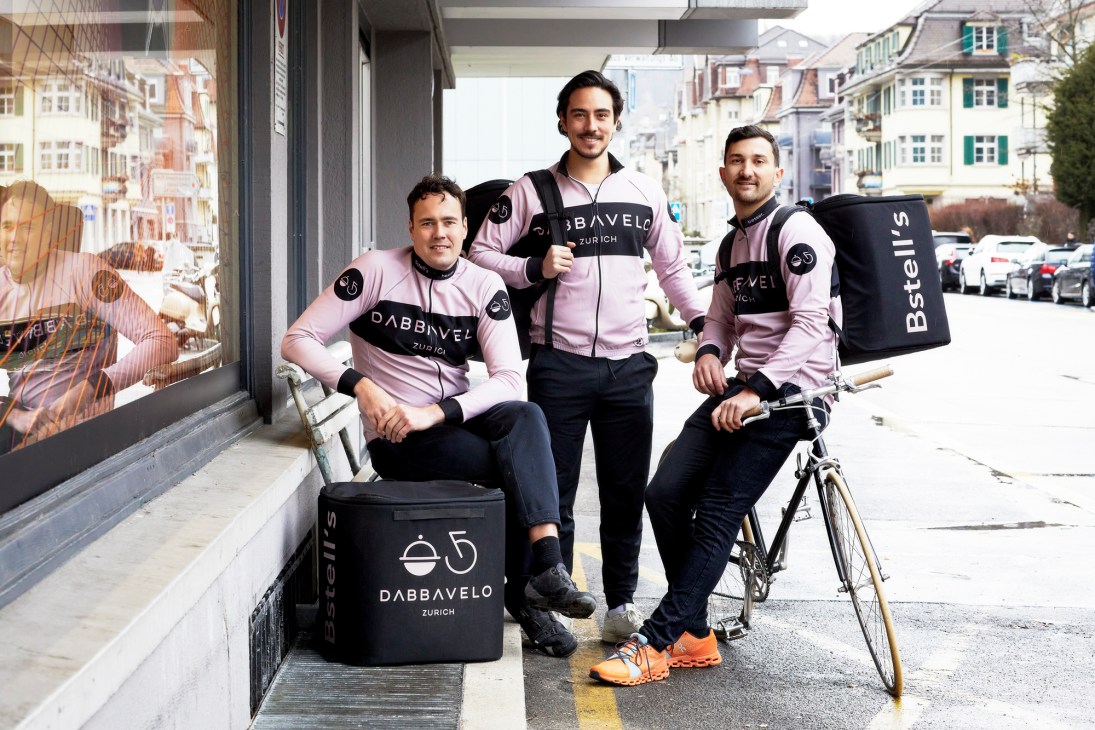

Dabbavelo, run by seven people in their twenties, hasn’t stopped there. Its food is delivered only by bicycle and Engler, who has been a courier himself, knows that this “tough job” should be remunerated appropriately. Its 34 delivery workers receive chf25 (€23) an hour and there are plans to expand the current network to 60 riders.
Challenges remain. Only a handful of restaurants from more than 20 on the Dabbavelo platform use the containers because the company takes a slightly larger cut than for conventional packaging. But with a low-price promotion in place and a successful crowdfunding campaign to pay for more containers, Engler and his team are improving the product. There’s talk of expanding to other Swiss towns and possibly even Germany. But for now? “Small steps,” he says.
dabbavelo.ch
Henrik Henriksson
CEO, Scania, Sweden
In a sector not known for its green credentials, the Swedish heavy-vehicle producer is one of several firms now determined to get its sustainable strategy on the road.
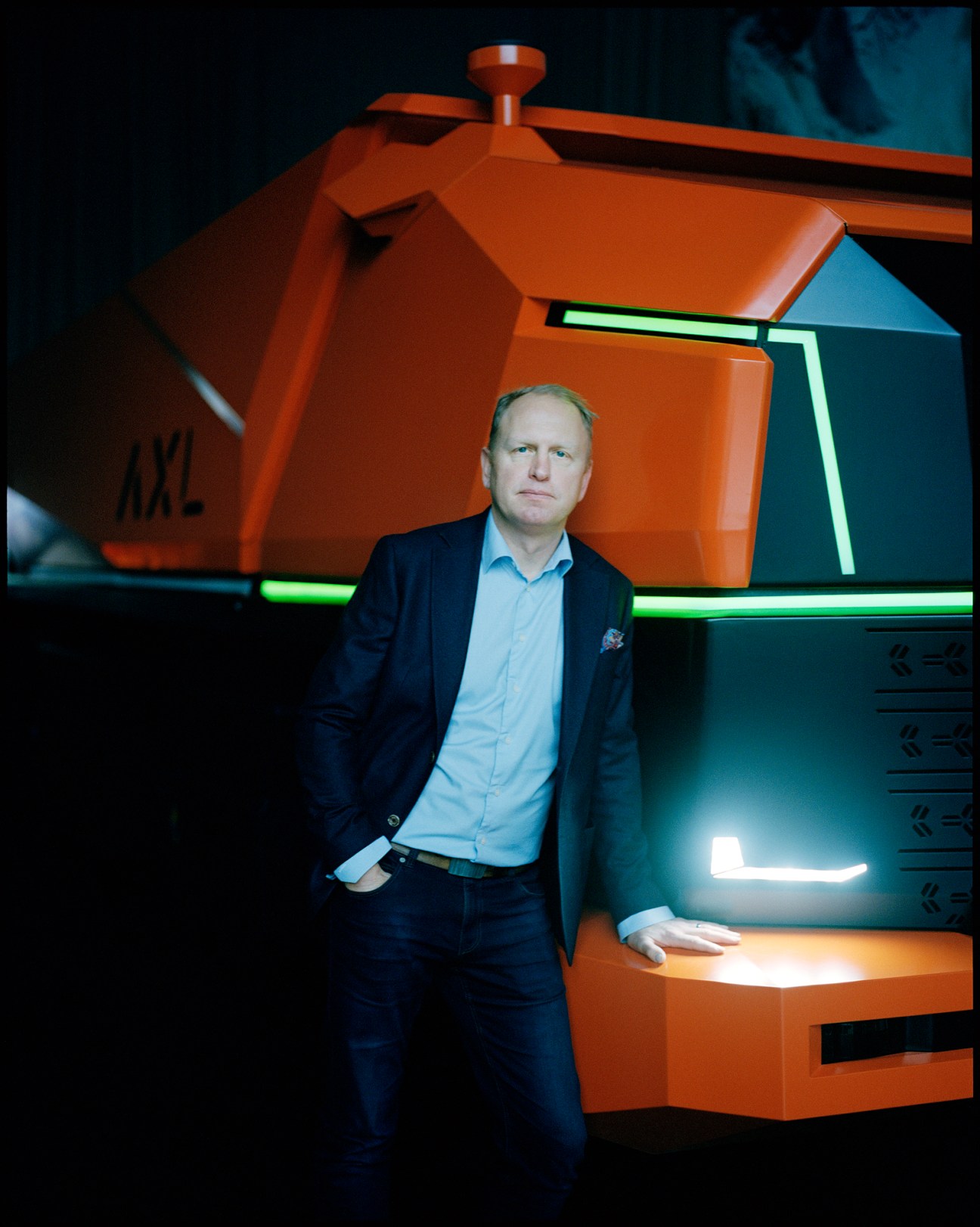
Typical Scania semi-trucks are designed to run for 1,500,000km before retirement. The Swedish company’s museum-like showroom in Södertälje, just south of Stockholm, belies the fact that they are built to be tough. Yet while durability is still key, what Scania’s leader really wants to talk about is sustainability.
Right now that’s not a word especially associated with commercial trucking and heavy vehicles. But Scania CEO Henrik Henriksson says that his firm is on its way to changing that. “Our sustainability journey is not a campaign, it’s not a project,” he says. “This is the only way. That’s why we don’t have a sustainability strategy at Scania; we have a sustainable strategy. It is built into everything that we do and it has given us a tremendous momentum.”
Henriksson cites the recent move to shut down all of Scania’s global operations for a few hours on a Friday for sustainability training. Managers gathered the company’s 50,000 employees into small groups to train them in sustainability initiatives and brainstorm new ways in which to make their teams greener, both in the short and long term. The CEO has also been a force in the wider industry, helping to pull together eight companies in the sector to pledge to meet the co2-reduction targets of the Paris agreement.
Scania’s new electric semi-truck, which can travel up to 250km on a full charge, was unveiled last autumn and is one of the company’s flagship products for the future. That’s despite the fact that uptake of electric commercial vehicles remains slow, in part because of a lack of infrastructure to support them. But Henriksson sees that picking up. The company expects 10 per cent of its lorry sales in Europe to be electric models by 2025. By 2030, he says, that figure will be at 50 per cent. And Scania is not the only company getting in on the game. A growing number of start-ups are designing or launching electric commercial trucks, including fellow Swedish outfit Volta and Nikola in the US. Established big players in the sector, such as Volvo and Daimler (which makes Freightliner vehicles), are doing the same, while Tesla, naturally, has its own electric semi-truck in the pipeline.

Scania will have some advantages going into the fight. Among them are its global presence, broad customer base and extensive track record. The company operates in 100 countries and has longstanding relationships with thousands of customers worldwide. It has been making commercial vehicles for 130 years.
Even though the new electric lorries get the headlines, the company is putting a lot of its focus into its diesel- powered vehicles that are already operating around the world. To ignore those trucks and their emissions would be foolish, says Henriksson. Scania is working with farming operations and other partners to get sustainably sourced biodiesel or biogas into tanks, reducing carbon emissions among conventional fleets by 90 to 95 per cent in the process.
For Henriksson, it’s all part of a complete shift in perspective. “A few years ago we realised that we needed to put on different goggles and see ourselves belonging to something bigger,” he says. “Which is an ecosystem of transport and logistics.” He points out that among the traditional stakeholders, such as customers and suppliers, the company now also considers wider societal good and the planet; doing what’s right and the bottom line are not mutually exclusive. “These days, as a company leader, if you’re not transforming your business to become truly sustainable you will soon not be relevant,” he says. “We are part of one of the biggest problems in the world [in terms of emissions]. We want to be part of the solution instead.”
Electric potential
Driving the future
Electrified truck haulage is set to be a lucrative business and many firms are getting involved. Alongside Scania, Germany’s Daimler has announced that its 18-wheeler Ecascadia should be in production by 2022. Other players include the Phoenix-based Nikola Motor Company, which uses battery and hydrogen-fuel-cell technology. Volvo is also opening electric orders in Europe this year, while Tesla has a four-engine semi-truck in the pipeline.
The new Detroits
Seats of (electric) power
The centre of automotive gravity has long shifted from Detroit as many manufacturers move into electric vehicles and other alternatives. Here are four potential new industry hubs.
Athens
Greece could become Europe’s manufacturing base for electric cars. Athens introduced tax breaks for buying electric last year, prompting Volkswagen to sign up to build an electric testing ground on the Greek island of Astypalea. Another German firm, Nextego, intends to build a factory capable of making up to 45,000 electric cars per year.
Tel Aviv
Known as Silicon Wadi (Hebrew and Arabic for “valley”), the Tel Aviv region has produced the Waze and Mobileye success stories in the past decade and is home to technology-savvy start-ups working on everything from battery life to wireless electric charging for buses.
New Delhi
India’s transport ministry wants the country to become a manufacturing hub in five years to satisfy its unquenchable thirst for cars. Chennai in the southeast has been dubbed the “Detroit of India” but cleaner alternatives might come from elsewhere: plans for an electric lane along a New Delhito Mumbai highway should focus minds and manufacturers elsewhere in the country.
Taiwan
Founded in 2011, Gogoro manufactures scooters and electric bikes. Its sleek new Eeyo 1, dubbed the “sports car of e-bikes” by one critic, launched in the US, Europe and Taiwan last summer and was quick to make an impact.
Scania in numbers
€15bn Net sales in 2019
52,000 Employees worldwide
100 Countries in which Scania has a market presence
100,0001 Vehicles and engines delivered globally in 2019
18.7% Market share in Europe, as of 2019
4% Increase in lorry sales, 2018-2019
50% Targeted reduction in co2 emissions by 2025
6,631 Alternative fuel/clean-energy trucks delivered in 2019
Peter Njonjo
CEO, Twiga Foods, Nairobi
By creating a more efficient food-supply chain, one Kenyan company is bringing down prices. And it has the rest of Africa in its sights.
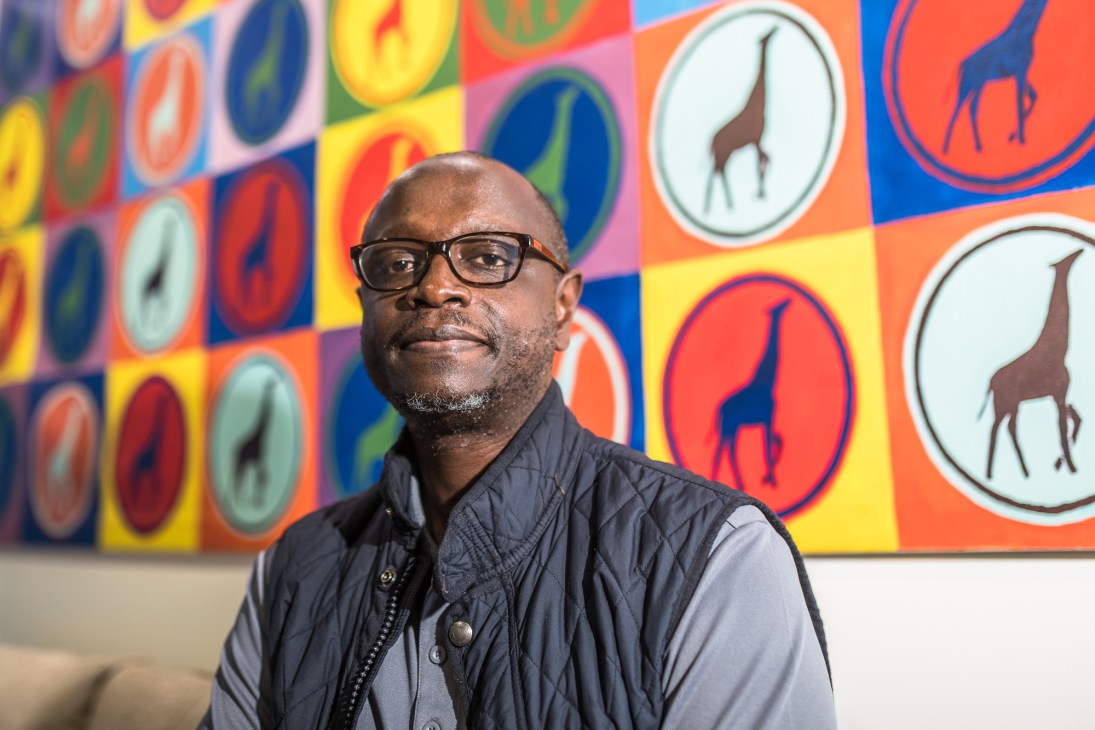
Hidden within a mid-rise block in a leafy Nairobi suburb are the offices of a company with a lofty goal: revolutionising retail business in Africa. Founded in 2014, Twiga Foods has a simple premise. Acting as a logistics connector, it pulls together small retailers and links them to farmers.
“In Africa the retail structure is informal and fragmented: 80 to 90 per cent are the retailers you see on the streets – the dukas, the kiosks – and that creates an inefficient supply chain,” says Peter Njonjo, Twiga’s 44-year-old co-founder and CEO.
Twiga can claim international backers including Goldman Sachs, the International Finance Corporation, French private equity firm Creadev and Dubai-based Wamda Capital. Having poured $60m (€49m) into the company, they view Twiga as a sound opportunity amid the converging dynamics of population growth and urbanisation.
“The key problem we want to solve is the cost of food in African cities,” says Njonjo. While hyperlocal, small-scale shopping at street-side kiosks is the norm in urban Africa, Njonjo saw an opening rather than a problem. “Instead of trying to break [the informal retail market] with technology, it’s better to try to enhance it, to create more sustainable businesses,” he says. “We want to build a world-class supply chain in informal retail.”

By aggregating the demands of retailers who order their daily fresh produce on their phones through an app, Twiga creates access to the market, along with the scale and reliability to give farmers the confidence that they need to invest and expand. The company’s technology-driven logistics platform glues together the fragments at both ends of the informal retail-supply chain, creating efficiency and lowering costs.
Twiga operates only in Kenya for now but Njonjo has ambitious and well-funded expansion plans in East, Central and West Africa, with the Ivorian capital Abidjan first on the list. Its goal is nothing short of improving lives across the continent. Kenyans, for example, spend more than half of their disposable income on food – nine times that of Americans and five times that of Europeans. “Africans spend most of our resources on feeding themselves,” says Njonjo. “If you free up the money that is being spent on food, it could fuel other industries. There are a lot of big challenges that Africa faces; we have been able to pick one of those challenges and turn it into a profitable opportunity.”
Angela Brooks
Managing principal, Brooks + Scarpa, Los Angeles
Away from the whims of private developers there will always be a demand for built projects tailored to societal and environmental needs.
Brooks + Scarpa is a multidisciplinary architecture, landscape and urban-design collective formed in 1991. Based in Los Angeles, it has a global project portfolio, winning recognition for innovative designs that meet complex social and environmental needs. These include Nest, a rapid-construction housing kit equipped with off-grid energy, water and sewer systems designed to address homelessness. The practice also works on intangible design projects, such as a construction manual to help the City of Fort Lauderdale’s planners and builders meet the challenge of rising sea levels. We spoke to Angela Brooks, the firm’s managing principal, to find out more.
How did your approach to architecture and design develop?
My first job out of architecture school was working for a non-profit developer called the Los Angeles Community Design Center, which built affordable housing. I was interested in the development side, and it was the only place in LA where architects and developers worked together. As an architect, I could use my expertise to help them to build a community. I would call myself a frustrated planner.
Does sustainability sell?
Sustainability includes things such as social equity and housing for everyone, not just energy-efficient buildings. I’m interested in affordable housing and housing for homeless people because it’s a big need. But we also design parks, museums, historical renovations. Thirty years ago, architects would tell me to just do one type of building because it’s easier and you’ll make more money. When the recession hit, everyone else went out of business and we’re still here. Private developers dropped off the planet but we had non-profit clients who had money and were invested in longer-term projects.
What are the biggest economic challenges you face now?
Coronavirus has changed the way that we do business. We’re building a lot of housing but the projects have slowed. Economically we’re fine; our employees are happier working at home because they don’t have to commute for an hour every day. We haven’t had to lay anyone off; we’re still moving forward.
How would you like to see Los Angeles develop as a city?
Los Angeles has been called a bunch of suburbs in search of a city. It has developed piecemeal and it has sprawled. What we’ve been doing for the past couple of decades is building on top of that and densifying what’s actually here. It’s an interesting challenge to me: how do you build a walkable, liveable city on top of something that’s already built?
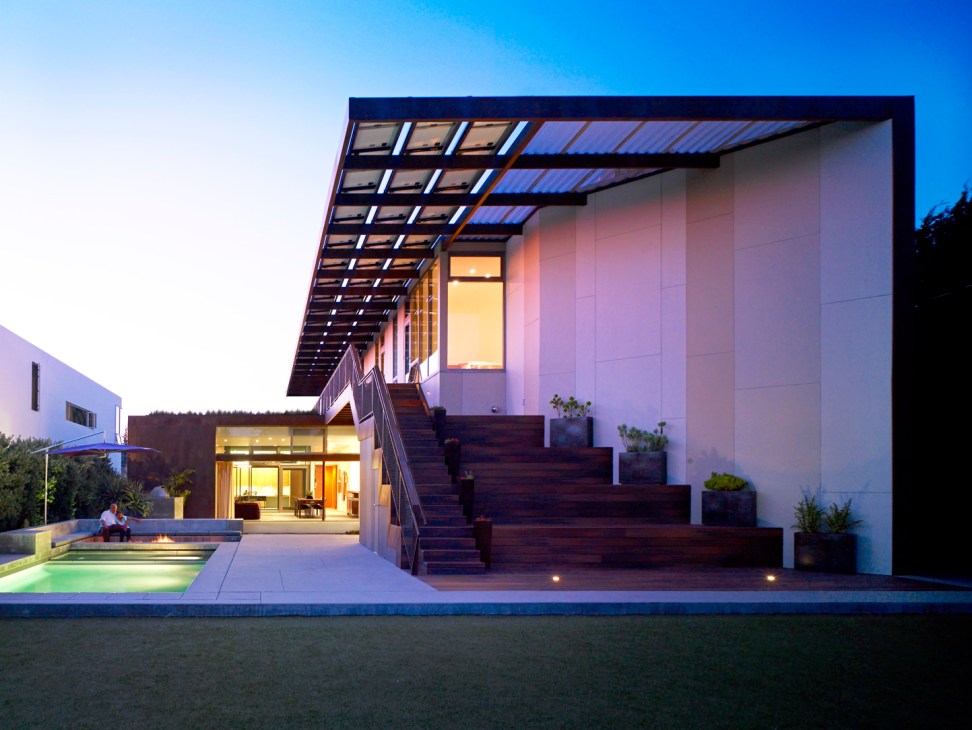
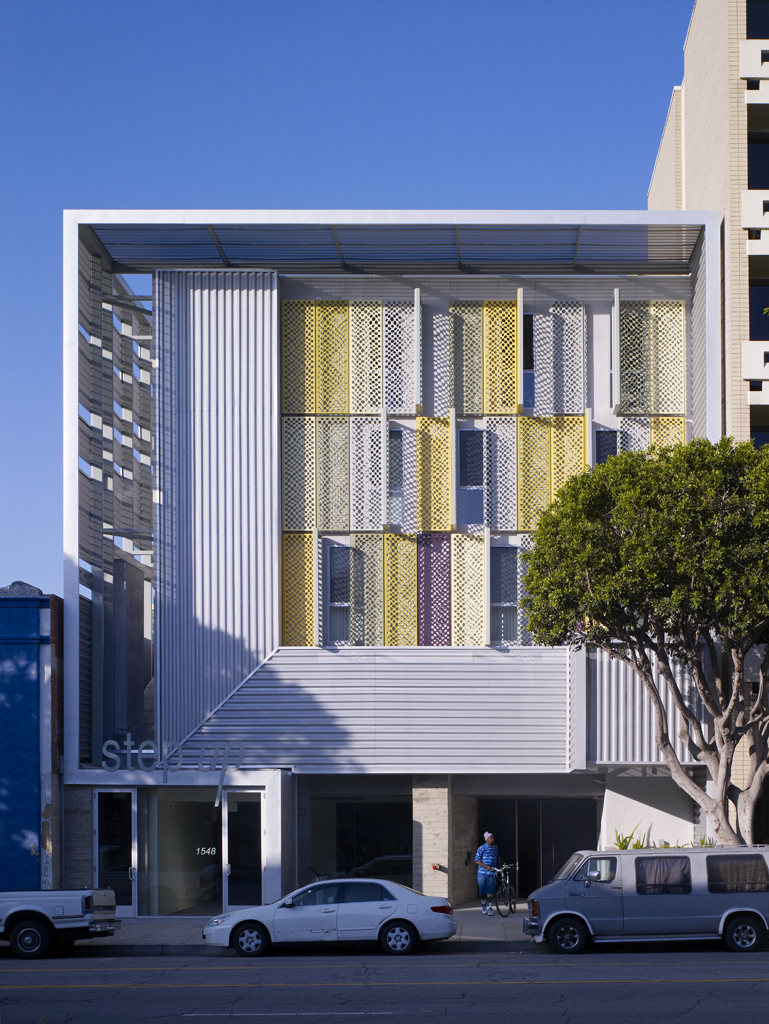
Brooks + Scarpa in numbers
2 Offices (in Los Angeles and Fort Lauderdale)
173 Major domestic projects since 2000
7 Leed-certified projects
66,433 Homeless people in LA County, as of June 2020
Sofía Pescarmona
CEO, Bodega Lagarde, Mendoza, Argentina
Achieving sustainable business practices results in a virtuous circle that benefits the production process, employees, communities nearby and the planet.
Sofía Pescarmona is a third-generation co-owner of Argentina’s Bodega Lagarde, founded in the country’s most famous wine province, Mendoza, in 1897. She runs the winery with her sister Lucila (pictured, on left, with Sofía), who previously worked in New York and is in charge of the export side of the business. The firm’s 70 members of staff look after five vineyards.
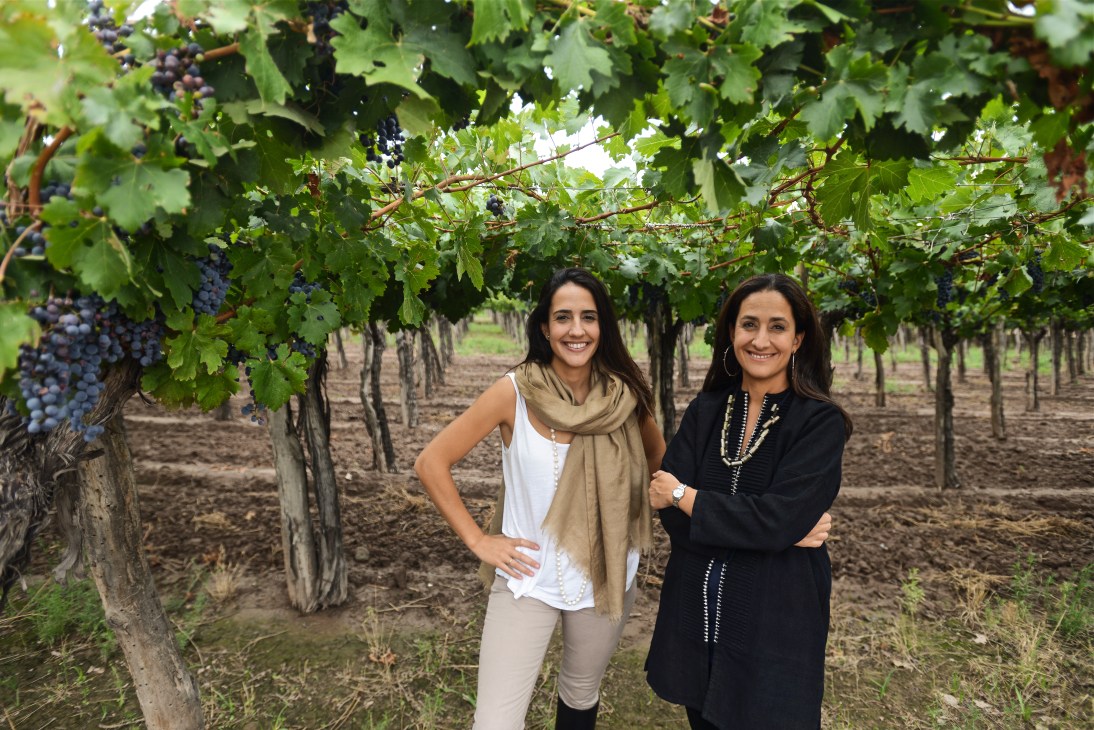
Lagarde is distributed in more than 40 countries and is the oldest winery in South America to adhere to B Corps standards (it received its certification in 2019), which combines social and environmental performance with the need to make a profit. At Lagarde, that means working on issues including water conservation, waste management and producing lighter bottles. Pescarmona tells Monocle how it makes wines better.
Bodega Lagarde in numbers
2 Offices (in Los Angeles and Fort Lauderdale)
173 Major domestic projects since 2000
7 Leed-certified projects
66,433 Homeless people in LA County, as of June 2020
What’s your vision with regards to doing things better?
Lagarde’s 124-year history means that it has withstood time and anyone who’s ever worked here has always moved the bar that little bit higher. Long-term responsibility means leaving something even better in place for the next generations.
How do you take less of a toll on the land?
Recyclable waste and water management are key. We sought to improve our carbon footprint in the centenary vineyard, so during the pandemic we invested $50,000 [€41,300] to convert from traditional flood irrigation to a drip system, thereby saving up to 30 per cent in water usage. We’ve also started farming organically and the malbec and semillón grapes we’ve grown are in our Orgánica line.
People are key in B Corp’s model. How do you work with the communities here?
First, look at your staff – do you treat them well, are they growing? Half our employees are women and we ensure that they receive the same pay as their male counterparts. Looking after employees’ physical and mental health is also vital: an on-staff doctor holds clinics for vintners living in rural areas. Second, look at your closest communities. Mayor Drummond [in Mendoza’s Luján de Cuyo wine region] is a poor district, so we set up an auxiliary school to help struggling children, as well as training teachers.
How else do you achieve a positive impact?
Lightweight eco-friendly bottles account for 70 per cent of production to ensure the lowest possible environmental impact. Every year we find ways to improve, for example, using natural yeast or doing away with unsustainable trellis supports for carob trees. Next, I’d like staff to swap jobs to understand their colleagues’ roles.
Ebikego, India
Delivering cleaner cities
In 2017, Ifran Khan moved to the highly polluted city of Amritsar and set up e-mobility company Ebikego. His aim? To offer a cleaner alternative to “last-mile delivery” for e-commerce companies, delivering everything from technology products to groceries direct to households. Now Ebikego is in eight major Indian cities. With an ever-growing fleet of 1,500 electric vehicles, the company has tie-ups with most major e-commerce players in India, including Amazon.
Developing countries depend on scooters and motorcycles for mass mobility, because they’re affordable. But most in India are two-stroke engines that consume the cheapest and dirtiest kinds of fuel. That’s why Khan is proud to prove that cleaner alternatives work just as well, if not better. “We started with 700 delivery executives, travelling 80,000km a day in clean evs,” he says. “We were saving the country from 500,000kg of carbon emissions a month. That’s increasing every day as we put more on the road.”
To say Khan is ambitious would be an understatement. By 2025 he hopes not only to have exponentially scaled up his company
to 250,000 vehicles but also to be entirely carbon-free. He’s just developed solar energy-charged batteries, which run for about 100km after a two-hour charge, so Ebikego vehicles won’t need to rely on grid electricity. “People, profit, planet – all three matter,” he says.
Asian provocateurs
Syed Saddiq
Malaysia
Position: Co-founder, Malaysian United Democratic Alliance
Malaysia is set to lower its voting age from 21 to 18 when a constitutional reform comes into effect later this year. This will allow millions more young people to vote, which could propel new faces to the forefront and finally retire the same group of politicians that has led the country for decades. Malaysia’s candidate-in-chief for change is Syed Saddiq. The 28-year-old MP is backed by swathes of the country’s disgruntled youth and his appeal is causing concern in the halls of power.
Saddiq was formerly the youth and sports minister in Pakatan Harapan, Malaysia’s “hope coalition”. The multiracial, reform-based alliance achieved the seemingly impossible in 2018 by unseating the United Malays National Organisation (UMNO) from power after more than 60 years. Saddiq played a big part in lowering the voting age, which was his proudest achievement while in government.
However, after 22 months, the coalition imploded, undermined by infighting, and UMNO ended up back in government without an election. “It was a betrayal of the people’s mandate,” says Saddiq, who admits to feeling “disgusted and disappointed” by his senior colleagues, including former prime minister Mahathir Mohamad and successor Muhyiddin Yassin.
Instead of walking away from politics, Saddiq ended 2020 back in opposition with his own party, planning to change Malaysia’s broken democracy. Party funding is one murky tradition in his sights. “It’s one of the root causes of corruption in Malaysia,” says Saddiq, sporting a black T-shirt emblazoned with “Muda”, an acronym for his party, the Malaysian United Democratic Alliance. Big donors contribute large amounts of money that’s often funnelled through personal accounts. “In Malaysia we do not even have a political funding act.”
Starting afresh has allowed Saddiq to replace Mohamad and Yassin’s race-based Malay populism with a more progressive agenda. “For this party to succeed, it must treat diversity as Malaysia’s greatest asset,” he says. Pragmatism plays well in conservative Malaysia and Saddiq wants to capture the centre ground. He cites Thailand’s Future Forward Party (FFP) as an inspiration. FFP came third in that country’s last election by mobilising the youth vote.
Can Muda do the same? “We can if we get our party registration done,” he says. Saddiq is taking legal action after his application to register Muda was rejected – a sure sign that he has rattled the old guard. With elections expected once the pandemic is under control, the next government is likely to involve the same characters, corruption and cronyism. But Saddiq has time on his side and millions of potential new voters eager to see a lasting change in Malaysian politics.
Isko Moreno
Manila
Position: Mayor

As next year’s race to replace Rodrigo Duterte as president of the Philippines gathers pace, the early favourites are two city leaders: Duterte’s daughter Sara, the mayor of Davao; and Francisco Domagoso, the mayor of Manila – a former actor who goes by his stage name, Isko Moreno.
“Every politician wishes to be the president,” says Moreno, while stopping short of announcing a run. Some business leaders looking beyond the Duterte-era are already rallying behind him but the presidential election in 2022 might come too soon. By then he’ll have served only one term at city hall.
In 2019, Moreno defeated the tainted incumbent, Joseph Estrada. A “poor boy” who grew up scavenging for garbage, Moreno promised voters a “different Manila” and won by a landslide. Since then he’s championed open government and has focused on improving the living standards of his underprivileged constituents.
Current projects include building public housing, clearing the cluttered streets and cracking down on crime. His methods, while tough, suggest that there is a vote-winning alternative to Duterte’s murder squads. Moreno mandated that police officers must bring suspects in alive. “It’s an insult to our judicial system to take matters into our own hands,” he says.
The energetic 46-year-old wants at least another three years to continue his turnaround of the capital. “Within 10 years, Manila will be back on the map as a competitive city,” he says.
Seiko Noda
Japan
Position: Chief deputy secretary-general, Liberal Democratic Party

Seiko Noda has a spacious office in the Tokyo headquarters of the Liberal Democratic Party (LDP), which has ruled Japan almost continuously since the 1950s. Noda has been elected nine times since 1993, in addition to representing her Gifu constituency in central Japan, and has held several cabinet positions. The party’s chief deputy secretary-general is frank about the choices that women in Japanese politics have to make. “You can either be practical and get things done or stand in direct opposition to male-dominated politics,” she says. Noda prefers pragmatism.
“The LDP is a man’s party; 10 per cent of the cabinet is female,” she says. “Push ‘female’ agendas and you will be crushed.” That hasn’t stopped Noda talking about her struggles with infertility – she gave birth at 50 – her disabled son or the right of Japanese women to retain their maiden name when they marry. “It’s barely even feminist,” she says, laughing. Her candour isn’t always well received. “I’ve taken 100 times the flak that most people do.”
Japan ranks low on female parliamentary representation and Noda says that Japanese women too often assume that they’re not qualified to enter the political arena. “It’s subliminally ingrained into children’s minds at a very young age that politics, like Sumo wrestling, is a man’s world.” She set up a school to encourage would-be female politicians and wants equal pay to be the norm. “The problems that women face connect to much larger societal issues,” she says. “If they were corrected, it would benefit the livelihoods of everyone, including men.”
Her work is getting noticed. As prime minister Yoshihide Suga’s ratings sink, Noda is being spoken of as a serious contender in this September’s leadership election. She says that she will take every chance to run for the job of prime minister. “If you’re a Diet member, you have to strive for the top or you will lose the drive to serve the nation properly. You always need to think with a leader’s mindset.”
Park Young-sun
South Korea
Position: Seoul mayoral candidate
Elected: Parliamentarian since 2004 but appointed to the cabinet in 2019
Background: Before entering politics, Park was a journalist for more than 20 years, including a role at broadcaster mbc. Since 2004, she has served four consecutive terms for some of South Korea’s main left-leaning parties.
Media profile: One of the more prominent women in South Korea’s male-dominated political jungle, Park is a key figure in president Moon Jae-in’s Democratic Party. Many expect her profile to rise further in Seoul’s forthcoming mayoral elections.
Key ambitions: Her top priority is creating a fair marketplace in the digital economy, where a few online platforms dominate. She wants to encourage smaller businesses to adapt to new technologies, connect to more consumers and thus close the widening gap between them and the big corporations.
Biggest achievement to date: Park is known as a “chaebol sniper”, keeping in check family-owned conglomerates that dominate the South Korean economy. She led the Chaebol Reform Special Committee in 2015, passing laws that regulate criminal activities by top companies, including tax evasion and illegal transfers of power.
Up next: If Park wins the Seoul elections in April, she’ll be the first woman to become mayor – and one of the most prominent politicians in the country.
Monocle view: Park’s presence in South Korean politics offers much-needed gender balance. She’s knowledgeable in business and open-minded about new technologies. Whether or not she becomes Seoul’s mayor, Park is here to stay.
Arya Rajendran
Thiruvananthapuram, India
Position: Mayor
Elected: December 2020
Background: The 21-year-old college student officially became the youngest mayor in India’s history when she won the election in Kerala’s capital, Thiruvananthapuram. As the daughter of Communist Party of India activists, politics is in her blood. She has also held several positions in the student wing of the party.
Media profile: Though eyebrows were raised when she was announced as a candidate, Rajendran became the darling of the media with her clear and confident answers to the many questions fired her way.
Key ambitions: Tackling waste management is her top priority, though she also wants to increase health facilities, work on women’s issues and establish programmes for youth in the city. She’d also like to finish her degree in public administration.
Biggest achievement to date: Winning the mayoral election. India is no stranger to strong female politicians, although most come from powerful political families. The fact that Rajendran won the mayoral election at such a young age, while coming from a more humble, activist family, could very well inspire other young women to enter the political fray.
Up next: Rajendran has her work cut out: being high profile for reasons of age and gender means that she’ll have to work hard to prove she’s more than a passing anomaly.
Monocle view: As a political firebrand with a high media profile, Rajendran will face plenty of scrutiny in the coming years. But she already counts past mayors, well-known business owners and even celebrities among her fans.
Nadiem Anwar Makarim
Indonesia
Position: Minister of education and culture
Appointed: October 2019
Background: In 2010, Nadiem Anwar Makarim founded Gojek, Indonesia’s first $10bn (€8.3bn) start-up, which began as a Jakarta ride-hailing call centre with 20 ojek (motorcycle taxis). By 2019 there were two million drivers throughout Indonesia. He resigned as CEO in 2019 to join the cabinet of president Joko Widodo.
Media profile: There’s plenty of press interest in Makarim and his wife, Franka Franklin, who is the CEO of a jewellery company. His many media awards include “Asian of the Year” from The Straits Times.
Key ambitions: Set to be in office until 2024, Makarim has laid out four areas of educational reform, with more focus on assessment and less on exams. Inspired by Peter Jackson’s success in New Zealand, Makarim also hopes to turn Indonesia into an attractive location for film-makers.
Biggest achievement to date: The youngest minister in recent Indonesian history – he is 36 – quickly made his mark in the education sector by abolishing the high-pressure annual National Examination, which was seen to prioritise memory over competence.
Up next: Like most nations, Indonesia’s schools face challenges due to the pandemic. Riding out that storm while overhauling the education system will be a big test.
Monocle view: The entrepreneur turned politician is bringing his business brain to the education system, along with a strong sense of public duty. His high profile and success in the private sector suggest a long future in politics.
Pritam Singh
Singapore
Position: Leader of the opposition; secretary-general of the Workers’ Party
Elected: Member of parliament since 2011
Background: After military service and university at home and in the UK, Singh qualified as a lawyer before entering politics aged 33. He rose up through the Workers’ Party during his decade in parliament and was elected leader, unopposed, in 2018.
Media profile: A humble, family oriented man of the people, the leader of the centre-left party identifies with blue-collar workers and has campaigned for a minimum wage. Singh has kept a low international profile so far but his exposure, as the official leader of the opposition, should increase.
Key ambitions: Building a “first-world parliament” for a first-world country. Singapore’s political development over the past 50 years has not kept pace with its economic miracle and its parliament is still dominated by the family of late statesman Lee Kuan Yew and his People’s Action Party.
Biggest achievement to date: Leading his party to its most successful electoral performance in last year’s general election. Winning 10 out of 93 seats prompted prime minister Lee Hsien Loong to recognise Singh as the official leader of the opposition – a first for Singapore.
Up next: A new-look government. Prime minister Lee has postponed his retirement until after the pandemic but Singaporeans are starting to look beyond the Lee family.
Monocle view: Taking on the entrenched government is never going to be a fair fight but forthcoming leadership changes should give Singh a leg up. He would do well to refresh his party’s image and adopt a more progressive agenda.
Pannika Wanich
Thailand
Position: Former spokeswoman for the now-banned Future Forward Party
Appointed: 2018
Background: A former television anchor at the Voice TV network, one of the few liberal channels to survive in Thailand, Wanich was instrumental in getting the opposition Future Forward Party off the ground and galvanising support before it was dissolved by the constitutional court in 2020 (which many say was down to military interference).
Media profile: Due to her previous role in TV, Wanich is well-known. She is busy on social media and has nearly a million followers on Twitter. Her outspokenness translates well on the platform as she offers incisive criticism of the government.
Key ambitions: Apart from broader sympathies with the vast array of concerns raised by the recent anti-government protests, all eyes are on the Bangkok governor elections later this year.
Biggest achievement to date: Getting Future Forward, which was only founded in 2018, to become the third-largest party in 2019, despite the difficulty of entering a political world of vote-buying, bribery and provincial family dynasties.
Up next: When the constitutional court dissolved the party in 2020, Wanich was handed a 10-year ban from politics. However, her behind-the-scenes involvement with the latest incarnation of her party, Move Forward, is well-known.
Monocle view: Even though her role in frontline politics has ended for the foreseeable future, Wanich remains a prominent figure for millions of young voters. In a time of increasingly turbulent politics, all is still to play for.
Chiang Wan-an
Taiwan
Position: Member of the Legislative Yuan (national lawmaker)
Elected: 2016 and 2020
Background: Political royalty. Chiang would bleed blue – the colour of the now-opposition Kuomintang (KMT) party that ruled Taiwan for most of the postwar period. The son of a senior KMT official, Chiang is also the great-grandson of former president Chiang Kai-shek. He returned to Taiwan in 2013 after a decade as a lawyer in the US.
Media profile: The 42-year-old is seen as the rising star of the KMT and he attracts plenty of cameras and microphones, both for his famous lineage and his popularity with female voters. Chiang has inherited his great-grandfather’s good looks.
Key ambitions: Reforming the KMT. The nationalist party is floundering in opposition without strong leadership or an obvious route back to power. Chiang wants to inject new blood into the party and break with some traditional tenets that have become toxic at the ballot box.
Biggest achievement to date: Re-election to his Taipei constituency by a convincing margin in 2020. Chiang won in the face of an ascendent Democratic Progressive Party (DPP) under president Tsai Ing-wen.
Up next: Taipei’s mayoral election in 2022. Party officials are already talking up Chiang’s candidacy for the high-profile position – a potential stepping stone to the presidency. Recent polling puts him in front.
Monocle view: Chiang’s proven ability to compete with the DPP for the votes of centrists, liberals and urbanites makes him a serious candidate to become the next mayor of Taipei and could lead the KMT back to effective opposition.
Strong foundation
An embassy is commonly a fortress or museum but in Kenya’s capital of Nairobi, the French mission is a total manifestation of diplomacy: soft power in the hard form of timber, stone and concrete. It was designed with the environment in mind but also with aesthetics and, of course, security as priorities. The quiet compound sits on a hilltop between two valleys sloping towards the narrow, murky Getathuru river and, beyond that, Nairobi’s Karura Forest. The embassy’s lawns and stands of mature bombax, cedar, cypress, fig and jacaranda can make it feel more like an extension of the woodland sanctuary than a seat of international diplomacy.
Since brokering the Paris Agreement in 2015, France has played a crucial role in the global effort to fight climate change. The Nairobi embassy, says ambassador Aline Kuster-Ménager, is evidence that France can walk the talk. “This embassy is a good tool for promoting climate and the environment, and showing that we put our words into action,” she tells Monocle during a tour of the outpost.
Besides being France’s envoy to both Kenya and neighbouring Somalia, the career diplomat represents her country at the UN Environment Programme. Kuster-Ménager calculates that the environment occupies perhaps a quarter of her time. “When I started as a diplomat in the 1980s in Congo-Brazzaville, the big topic was the cold war,” she says. “Climate was an issue for scientists.”
But that began to change at the 1992 Rio Earth Summit and gathered pace after the 1997 Kyoto Protocol. By the time of the Copenhagen Accord in 2009, Kuster-Ménager was working in the French environment ministry. Copenhagen, she says, was a disappointment: a failure for the climate but also of diplomacy; two issues that, for her, are entwined.
Climate change is “a world of experts, each with an issue,” she says. “But you have to reconcile this with a bigger diplomatic picture; there has to be a result.” This was rectified six years later when France brokered the Paris Agreement, later ratified by 189 countries, which pledged to limit the rise in global temperatures to less than 2c compared to pre-industrial levels.
Global action necessitates co-operation. For Kuster-Ménager, concern about the climate crisis “has revamped diplomacy” and provided France with an opportunity. “The image of France is through our embassies and it’s also a political message,” she says. “People are struck when they come here: it’s modern, elegant and very different. And I like it.”
The previous embassy occupied the top two floors of a 16-storey building near the US embassy, which was bombed by al-Qaeda in 1998. More than 200 people died in the incident and, after the attack, every foreign mission rethought its exposure.
The French presence in Kenya was scattered, with the embassy in one high rise, the economic and trade mission in another and the ambassador’s residence in a fading neighbourhood. France had a long lease on two villas on the site next to Karura Forest. In 2015 they were demolished for the new €12.3m campus. Paris-based architecture firm Terreneuve won the competition to design and build the new embassy. It sought to present “an open design that is closely tied to the surroundings, both protected and welcoming”. After the metal detectors and reinforced glass at the security office, visitors to the embassy are greeted by two connected buildings linked by an outdoor atrium resembling a dhow’s upturned hull; the economic and cultural missions are housed in one, with diplomacy and defence in the other.
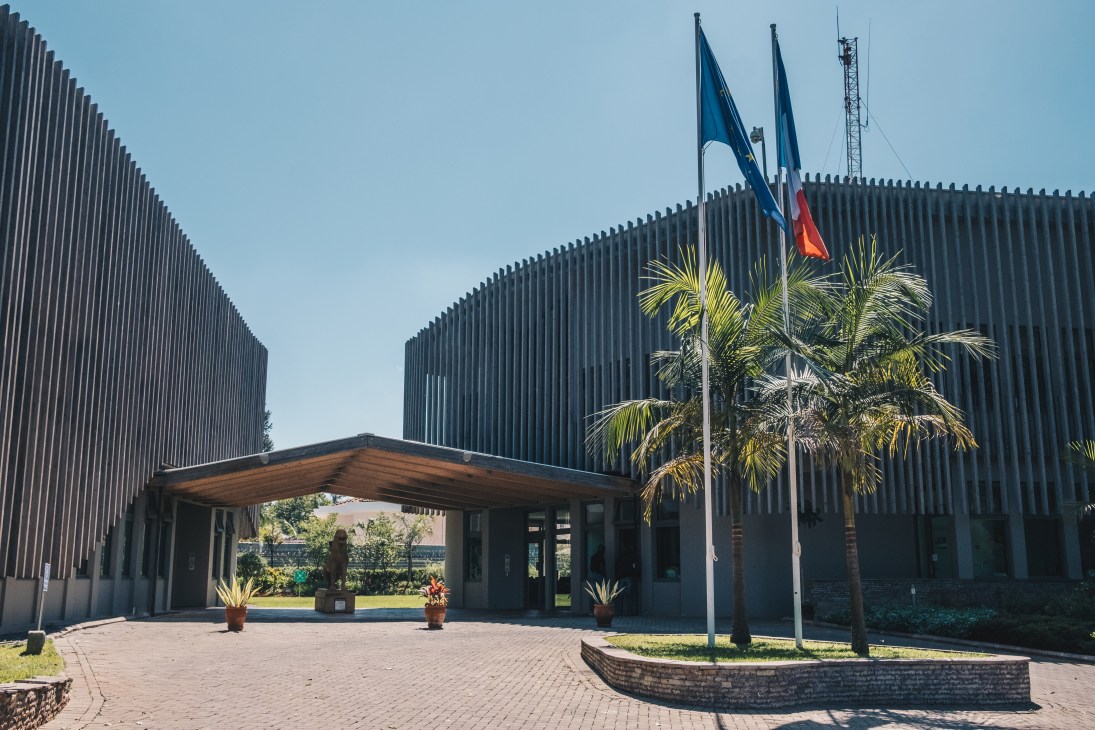
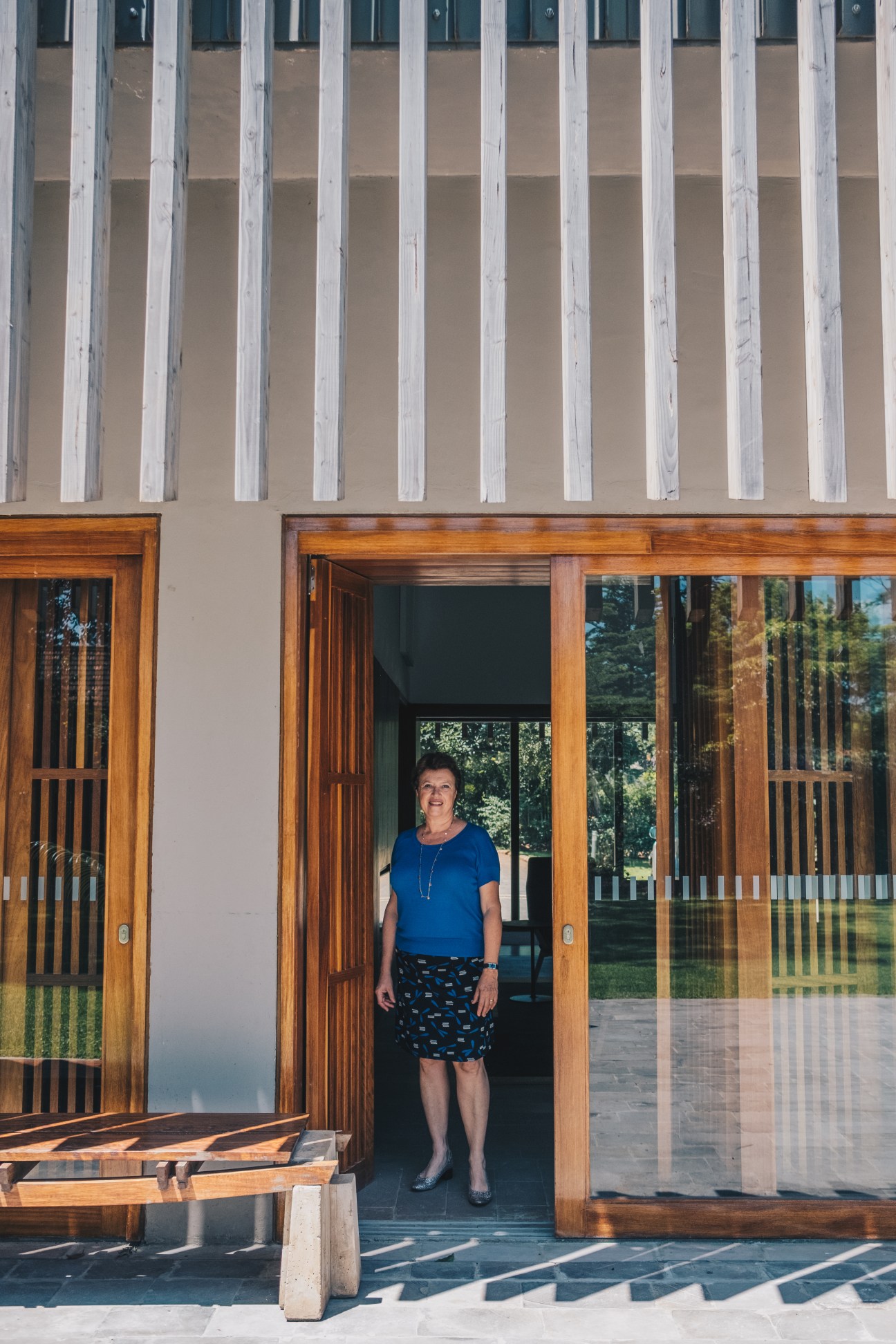
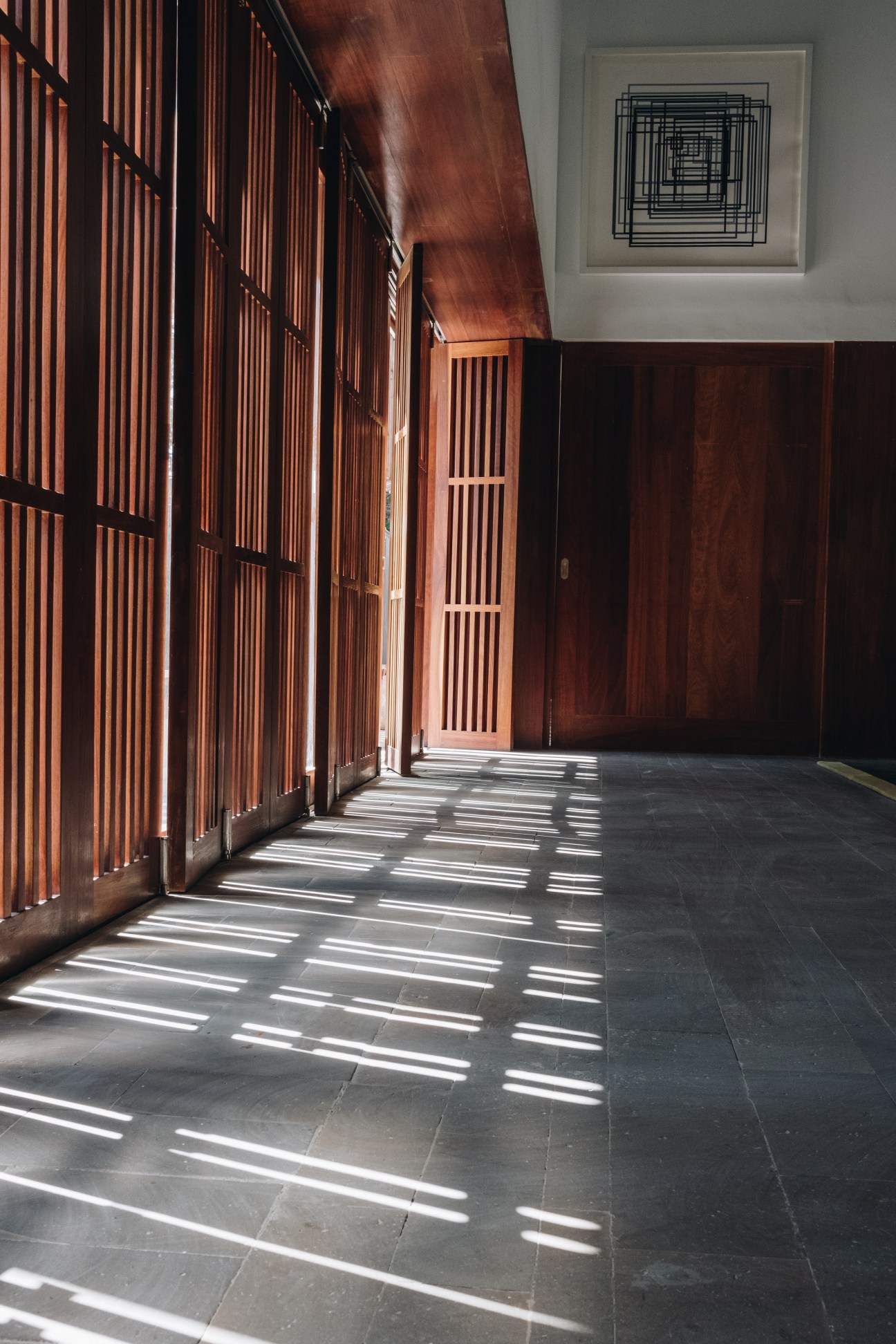
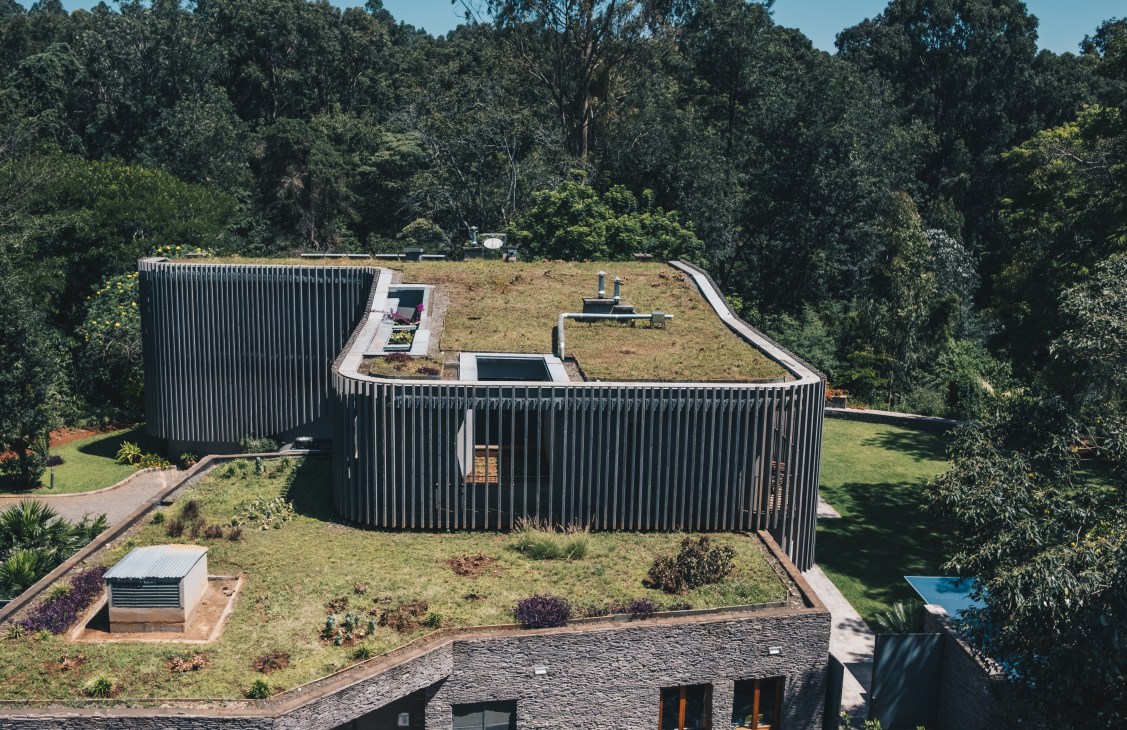
The reinforced concrete buildings were sunk into the soil. The exterior walls are enveloped in an undulating curtain of pine slats that protect the concrete from the equatorial sun. The roofs are planted with succulents and grasses for insulation and waterproofing. The result is that they stay cool; air conditioning is not required even in summer. Sensor-operated lights and solar water heaters help to reduce electricity consumption. Rainwater is collected in underground cisterns for watering the gardens and flushing toilets.
Still, Eugène Schumacher, France’s regional properties manager for eastern and southern Africa, says that more can be done. His list includes establishing beehives and planting a vegetable garden. The latter might prove challenging. Kuster-Ménager and her husband attempted to grow a vegetable patch when they arrived nearly three years ago but the acrobatic vervet monkeys that are the scourge of Nairobi gardens got the better of them. “I have monkeys knocking at my window,” she says. “They eat everything.”
Primates aside, the embassy residences have the feel of a lush oasis. Inside Kuster-Ménager’s house, an immense picture window looks out from the lounge onto the forest. “I like that you can be inside and outside at the same time,” she says. Adjoining the main lounge is what she calls her “salle d’oiseau“, where she holds private discussions, which is decorated with painted birds – helmeted guinea fowl, malachite kingfisher and a hoopoe.
As much as the embassy is a statement of France’s environmental ambitions, it is an expression of Gallic design and construction nous too. Kuster-Ménager hopes that it is also an inspiration to others in Nairobi, a city that rarely takes the time to weigh aesthetics or sustainability against profit when it comes to building. “This is a model of what can be done in Kenya,” she says. “It’s a broader idea of promoting clean building and new techniques, and that there is business in this – but also that environmental constraints are not always a negative.”
Green ambitions
Three more embassies that sell their nation’s environmental prowess
The Finnish embassy in Washington
This trailblazer for sustainable diplomacy opened in 2008 and was the first embassy in the US to receive the Leadership in Energy and Environmental Design award. It was upgraded from a gold to a platinum ranking in 2015 thanks to smart energy-consumption monitoring and free bicycles for employees. An exterior living wall signals its sustainable credentials, while a wood-panelled interior captures a Finnish emphasis on handsome natural materials.
The UK embassy in Montevideo
Became the first consulate in the world to achieve carbon-neutral status in 2020. The team removed all single-use plastics, installed solar panels, enforced strict recycling rules and created an organic garden. The structure retains a British charm, showing that you don’t need entirely new buildings to make an embassy eco-friendly.
The Norwegian Royal embassy in New Delhi
Hailed as the first “green embassy” in the smoke-choked city when inaugurated by Norway’s prime minister in 2019. Up to 95 per cent of the materials used to construct it were procured at New Delhi’s markets. The building’s solar panels provide the lighting and hot water, and rainwater is repurposed using underground reservoirs. Strict rules manage the building’s waste, which is sold to recycling companies wherever possible.