Issues
How Acne Studios turned a historical Paris building into a playground for creativity
“The customer is addicted to design in whatever shape it takes,” says Jonny Johansson, the creative director and co-founder of Acne Studios. The Stockholm-based fashion label’s attention to the spaces that it inhabits, from runways to its shops and offices, is indicative of the increased overlap between design, architecture and fashion. Nowhere is this more obvious than in Paris, where part of its womenswear team and a sewing atelier are based, and where the Acne Paper Palais Royal – a permanent gallery space owned by the house – opened in the first arrondissement in June. Now it is consolidating its Parisian presence with a new, design-forward headquarters on Rue des Petites Écuries.
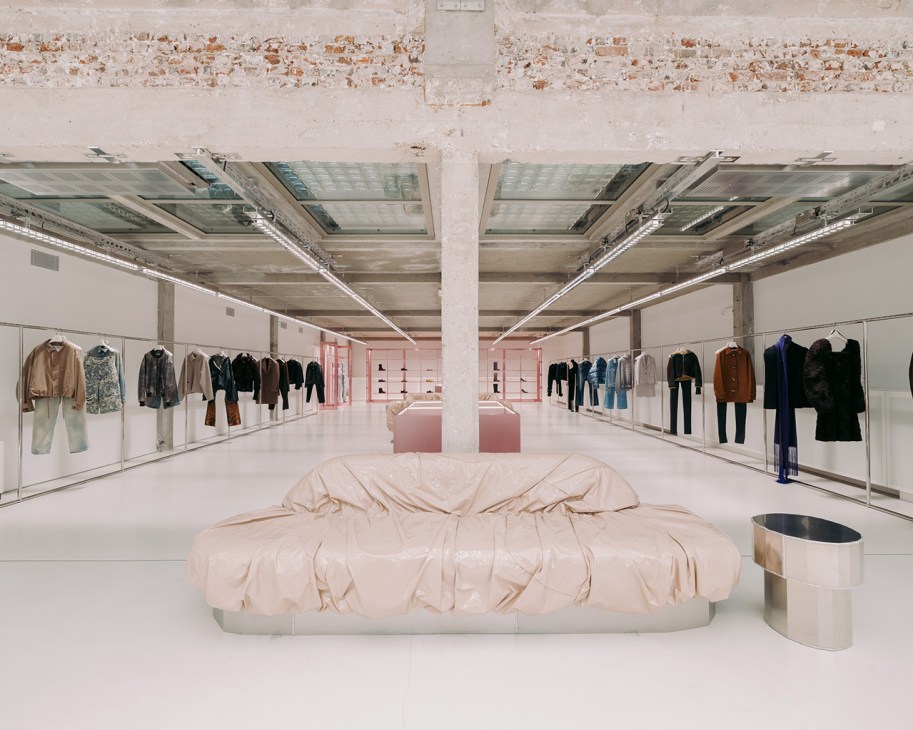
Johansson led the repurposing of the former 1930s laboratory of French cosmetics brand Gomenol, in collaboration with Swedish design studio Halleroed. “We talked about everything, including the sinks,” he says, adding that, having known Christian Halleröd, co-founder of Halleroed, for more than 30 years, there was an ease of understanding to their collaborative process.
About 80 employees work in the Paris headquarters, spanning womenswear, merchandising, buying, finance, HR and wholesale, as well as part of the Acne Studios atelier. “We planned the layout so that there was a flow from one department to another, from the fabric developers to the designers, for example,” says Johansson. The structuring of the building’s spaces needed to account for a showroom and a fitting area, as well as the more traditional office set-up. Communal spaces such as a courtyard with a seating area and a canteen were central to his vision of what a headquarters should provide for its employees: a place to gather and discuss creative ideas. “Conversations and employees interacting make a company interesting,” he adds. “I always think that it’s a good investment.”
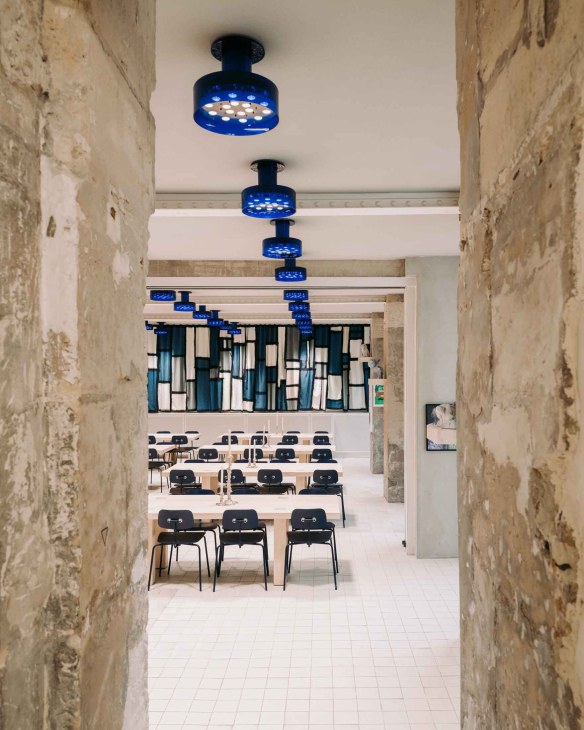
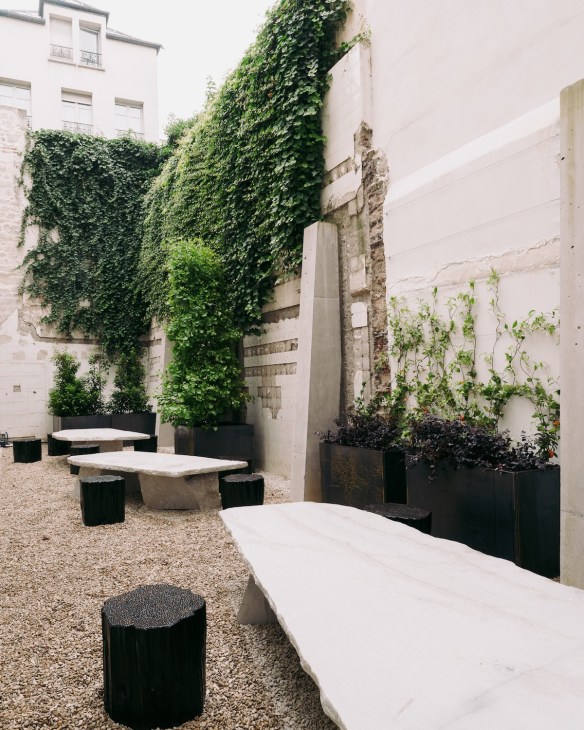
Throughout the space, original features such as parquet floors, a vaulted glass-tiled ceiling and gold-painted mouldings have been preserved and juxtaposed with exposed concrete and modern furniture by the likes of Lukas Gschwandtner and marble sculptures by London-based artist Daniel Silver. A pair of sofas upholstered in light-pink vinyl by UK designer Max Lamb sit in the showroom; an ultra-contemporary series of light fixtures by French artist Benoit Lalloz illuminate the canteen. “I like contrasts and buildings with history, where the past, present and future are contained in one space,” he says. “To gut out a building is like erasing history.”
“In the future, if you looked back at our brand and why we did certain things, you would see that it wasn’t just to sell clothing,” says Johansson. “There’s also the idea of being a sign of the times in a way. I’m not saying that we’ve succeeded yet but that’s the obsession.”
acnestudios.com
Read next: The Monocle City Guide to Paris, featuring the best hotels, restaurants and retail spots in the French capital
How Montpellier’s mayor is leading Europe’s mobility transformation
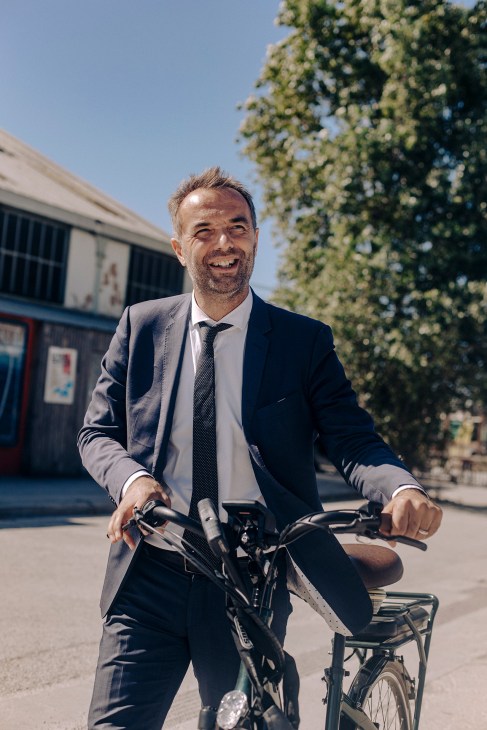
“I have a carnal relationship with Montpellier,” says Michaël Delafosse, the French city’s 48-year-old mayor, in between sips of his morning coffee.This kind of statement would raise eyebrows coming from an ordinary local politician. But Delafosse, wearing a slim-fit suit and sporting a closely cropped beard, can somehow get away with it. Perhaps it’s because his style is backed up by a track record of undeniable substance.
Montpellier is that rare thing in France, as well as the rest of Europe: a provincial city with a rising population and a flourishing economy. Nestled in the southern administrative region of Occitanie, about 10km inland from the Mediterranean Sea, it has been France’s fastest-growing city since 2000 and is now its seventh largest. The Montpellier Business & Innovation Centre (BIC), the city’s incubator, has fostered a bustling start-up scene that has attracted the likes of game publisher Ubisoft and the creative division of state broadcaster France Télévisions, both of which have relocated here.
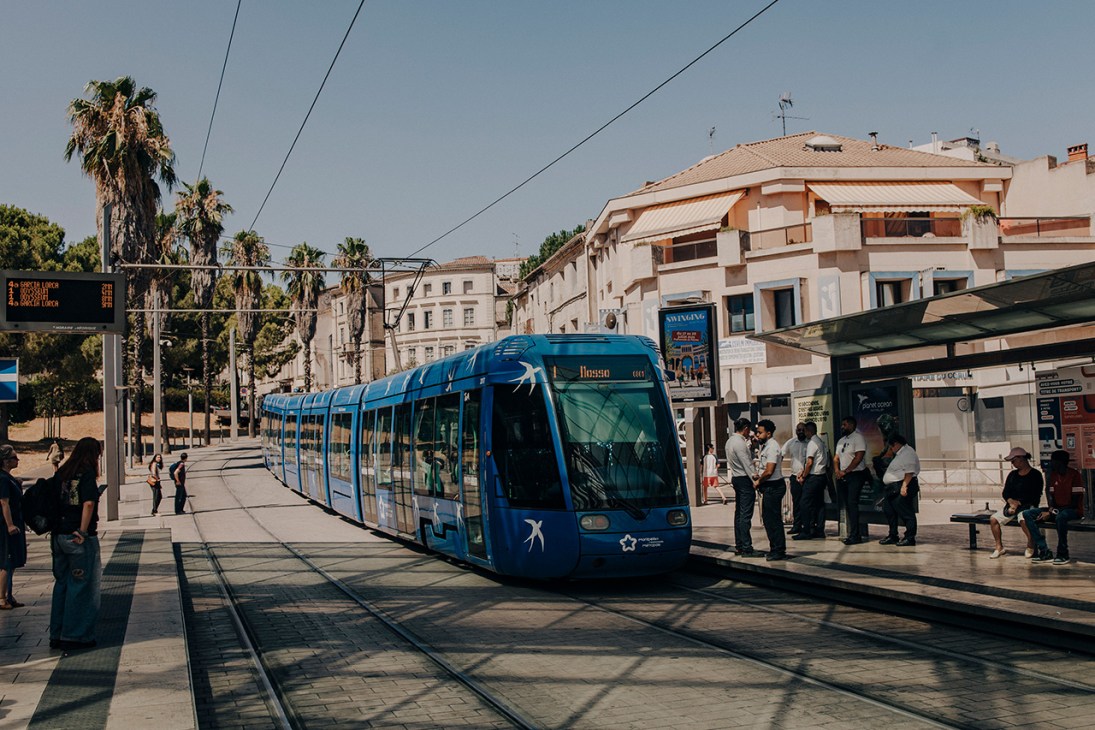
Montpellier has also positioned itself as a hothouse of avant-garde urbanism. It became one of the first cities in Europe to reintroduce trams in 2000, having abandoned them in 1949; in December 2023 it made public transport free for all residents. The latter was among Delafosse’s key campaign pledges during the 2020 municipal election, alongside a commitment to expand the city’s cycle-lane network (which now extends to about 235km) and turn central Montpellier into the continent’s largest pedestrianised urban area.
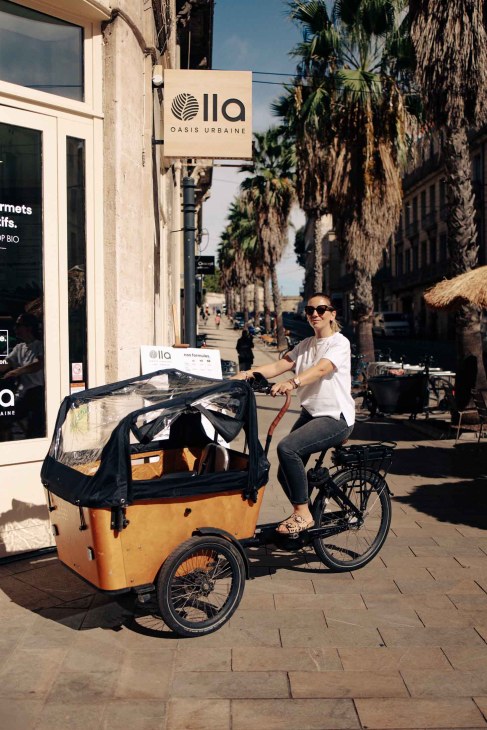
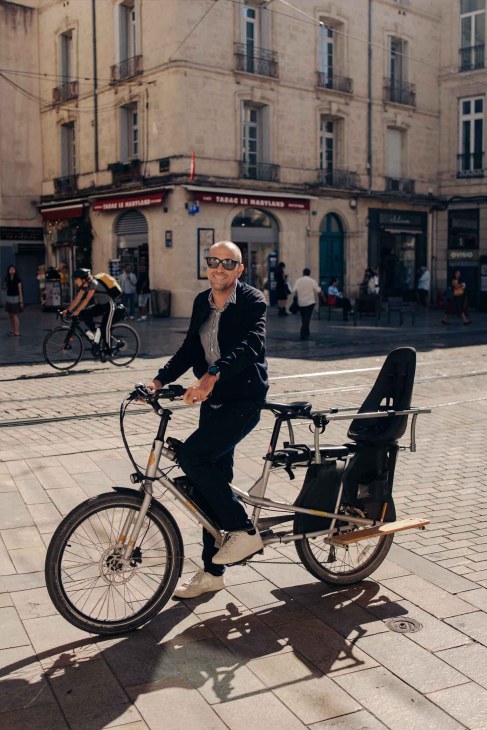
Despite his success on what could be called the radical side of urban politics, Delafosse – a history and geography teacher by trade and a longstanding member of France’s Parti Socialiste – isn’t a straightforward left-winger. He has taken strong stances on issues such as security, increasing police funding and CCTV coverage, tough-on-crime positions that have resulted in death threats from local drug traffickers. At the same time, he has pursued environmental and social-housing policies that have drawn criticism from opponents on the right. These moves, alongside his vocal rejection of some of Emmanuel Macron’s national policies, have seen him buck the trend of a Parti Socialiste that has appeared caught in a perpetual downwards spiral.
Delafosse has been marked out as a rising star in the party and is being talked about as a future presidential candidate. Though the mayor’s approval ratings hover at the 65 per cent mark – a rare feat in polarised France – Delafosse has his critics, many of whom argue that he has always had an eye on the Élysée Palace. In a 2022 profile in national daily Libération, an acquaintance described him as “hard to pin down”. He has refused to say whether or not he will run for a second term in March 2026, insisting that he has already achieved “two mayoral mandates in the space of one” – a claim that has led to allegations of arrogance in some local newspapers.
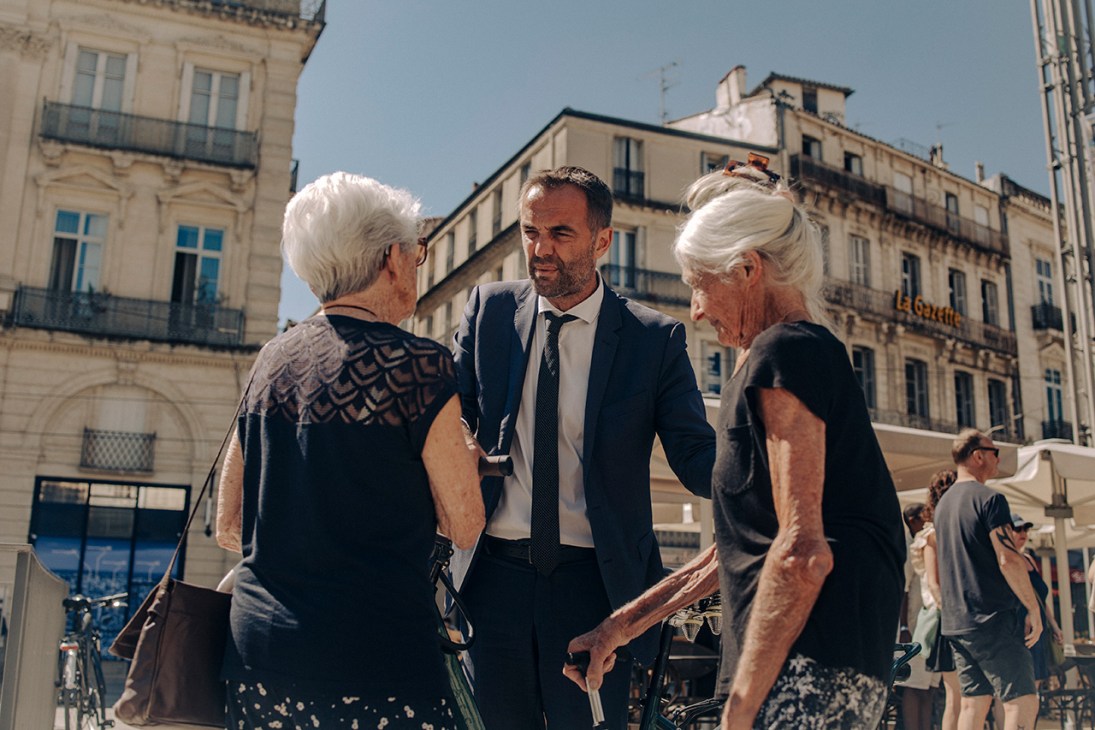
Before he commits either way, Delafosse wants to show Monocle around his hometown. After a morning caffeine hit, he hops on his electric bike. We are on the outskirts of the city in Halle Tropisme, a former military warehouse that was built in 1913 and now houses 10,000 sq m of space for artists’ studios, exhibitions and events. Nextdoor is an old military barracks that is being repurposed as part of an eco-district with 2,500 new homes, a third of which will be allocated to social housing.
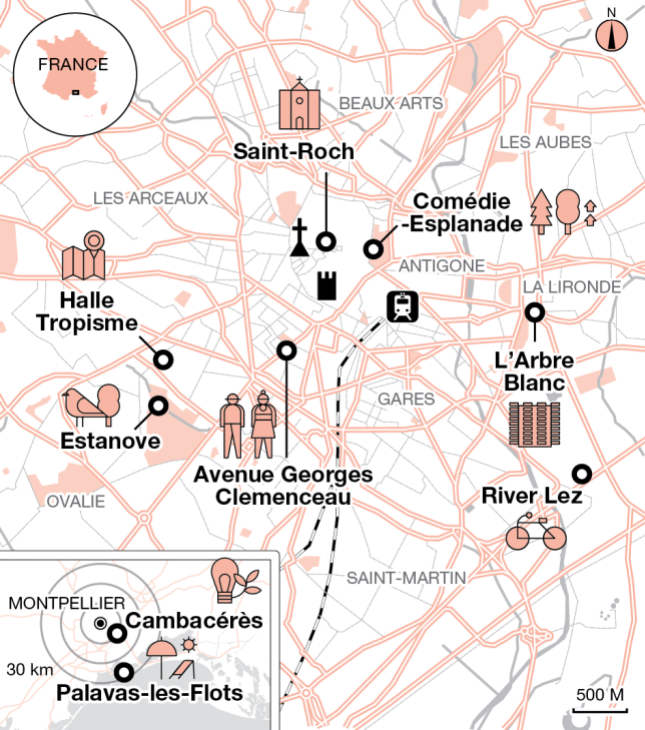
Together, the two former brownfield sites will form the heart of the new Cité Créative neighbourhood, which is slated for completion by 2027. From December this year, a 16km tram line will link it to the rest of Montpellier. The Cité Créative typifies Delafosse’s approach to urban renewal: developing brown-field sites rather than breaking new ground, while using buses, trams and trains as the engines of change. Not having to pay to ride into town should increase the attractiveness of the neighbourhood to prospective residents.
Perhaps more crucial to the mayor’s plans, though, is a pledge not to raise taxes on ordinary citizens to fund the city’s free-transport scheme. Its annual cost of approximately €40m is largely being borne through a mobility tax imposed on companies with at least 11 employees (which benefit from a more mobile workforce, according to Delafosse), as well as central-government funding. The mayor also points out that revenue is still rolling in from out-of-towners, particularly tourists, and that there have been savings from paring back the fare-collection infrastructure.
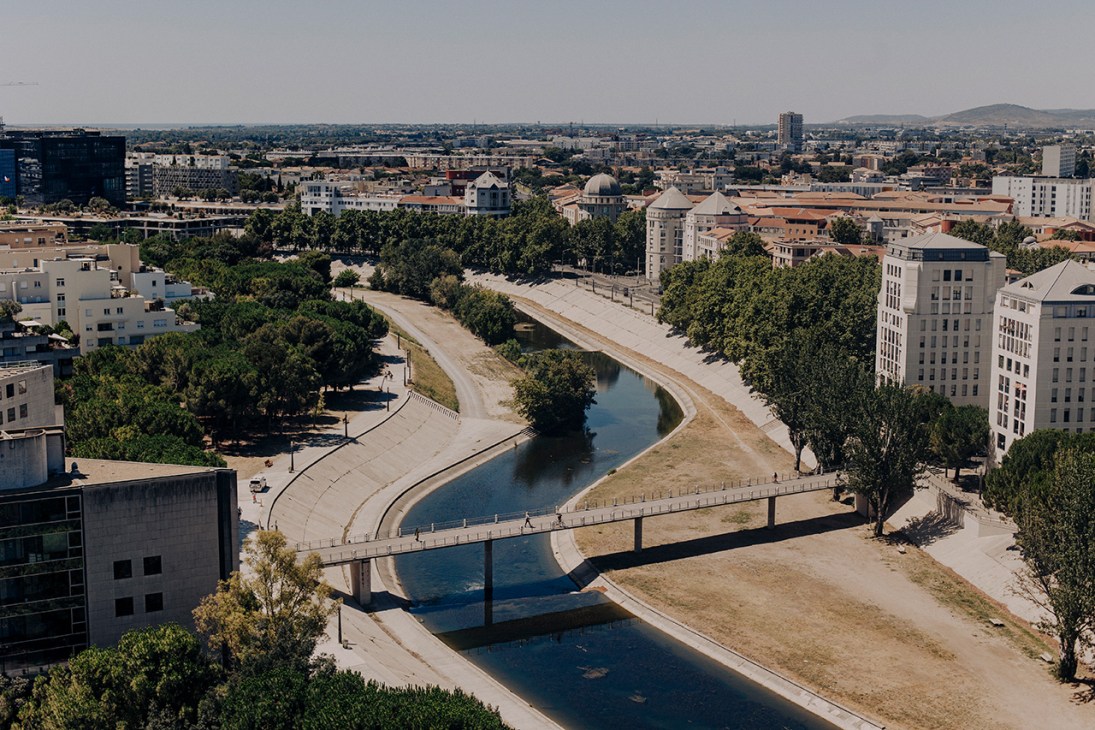
The city’s residents have mostly welcomed the scheme. Several informal surveys by local media suggest an overwhelmingly positive response from users, especially students, who make up about 17 per cent of Montpellier’s population. “It’s amazing,” teacher Fiona Joyce tells Monocle. “Everyone I know thinks that it is too.”
When he announced the plan, Delafosse said that he hoped to see an increase of about 20 per cent in the number of passengers on the city’s transport network by 2026. After just 12 months, the network reported a 33 per cent rise. Transport unions, however, disagree that this is unequivocally positive. Their members have decried a “degradation” of the overall service as a result of overuse, as well as the additional burden on drivers. Delafosse bats away such criticisms. “In Paris, the service is expensive and it is still overburdened,” he says. “In any case, cities that have implemented free transport don’t turn back.”
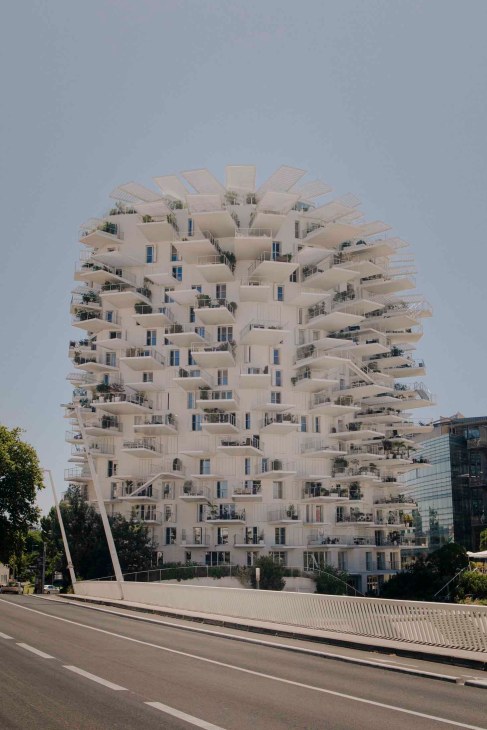
Laisné and Manal Rachdi in 2019
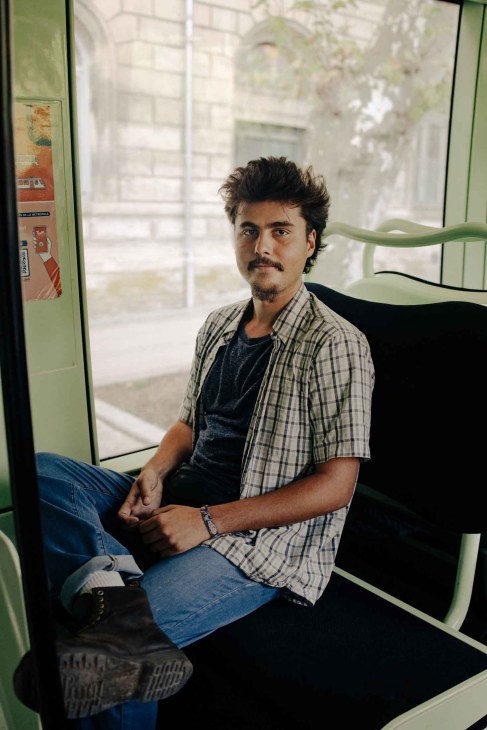
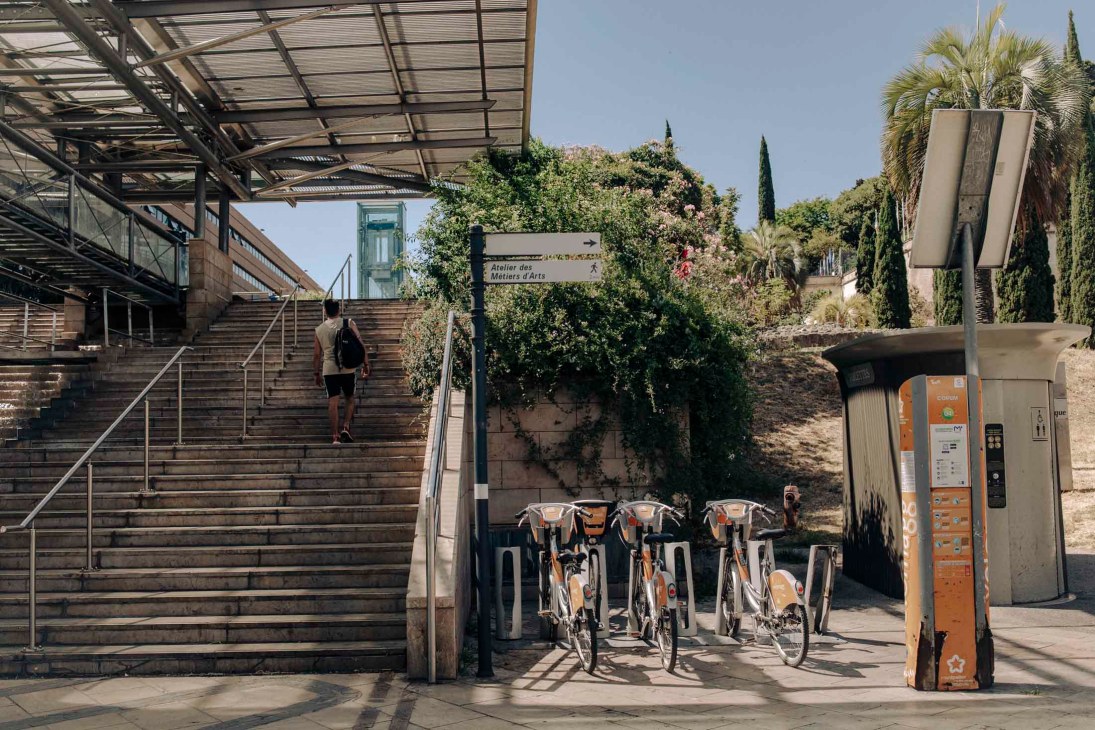
As in other places across the globe, Delafosse’s plan to pedestrianise the city centre by banishing most private cars has run into fierce opposition from shopkeepers who fear a decline in footfall. Newspapers in Montpellier have devoted countless column inches to listing noise complaints and roads closed due to construction. Though Delafosse’s enthusiasm is hard to resist, the frequent sight of cafés, épiceries and boulangeries standing empty behind metal sheets and pedestrian-diversion signs on a sunny July morning isn’t particularly reassuring.
“I was here when the first tramline was being built and we were complaining then too – but afterwards we all thought, ‘Wow, this has changed our lives,’” says Vincent Cavaroc, the director of Halle Tropisme. “We were also moaning that we would no longer be able to drive our cars into the city centre. But today everyone is happy to have one of the largest pedestrian centres in Europe. All of this has required a lot of audacity on the mayor’s part: after all, the best way to get re-elected is usually not to touch motorists. But he has carried out very important work.”
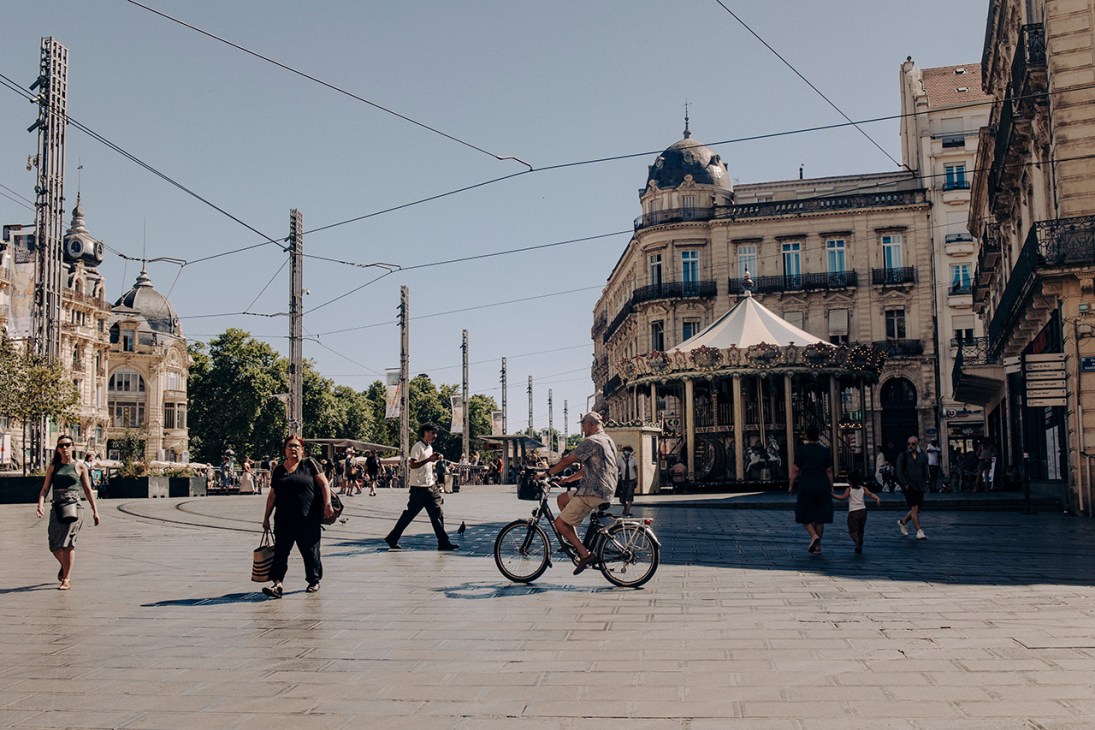
As recently as 2022, 40 per cent of journeys under 2km in Montpellier were made by car. Cavaroc echoes a common sentiment when it comes to the pedestrianisation of city centres: before it happens, some people vociferously object but many erstwhile opponents are later won over by a transformed urban space. To force through such radical change, politicians need charisma and conviction, both of which Delafosse has in abundance. The debate, however, is often divisive.
“If we want ecology to be a common concern, we must include everyone,” says the mayor as we stroll down the Esplanade, Montpellier’s historic central boulevard that makes up the main artery of its new pedestrianised zone. “That’s why free public transport is such a powerful lever. It reconciles respect for the planet with the social dimension of having accessibility for all.” A family of four, he explains, can make savings of €1,470 per year thanks to the scheme.
Under a canopy of towering elm trees that flank the main walkway, Delafosse pauses for a moment to watch a couple of children playing in water jets as their mother watches on from a nearby bench. Behind him, a few spindly specimens of the 50,000 trees that he has pledged to plant by 2026 sway in the breeze. “Show me where the children are and I will tell you what kind of city you are in,” he says. “A city that thinks of its children’s place in it is one that thinks of the future.”
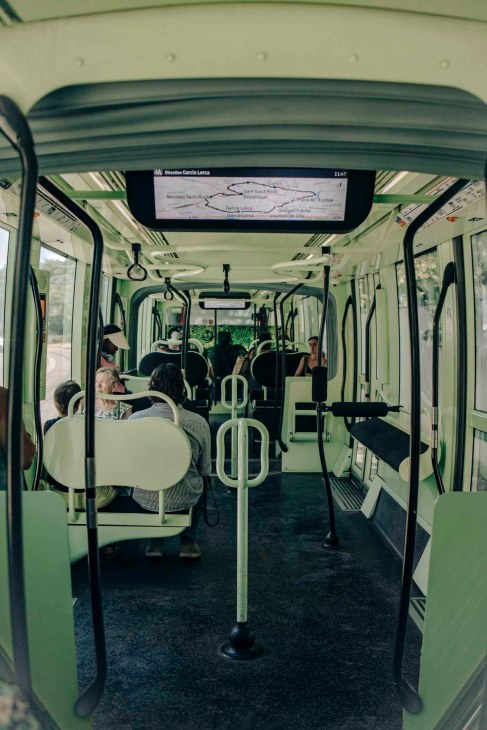
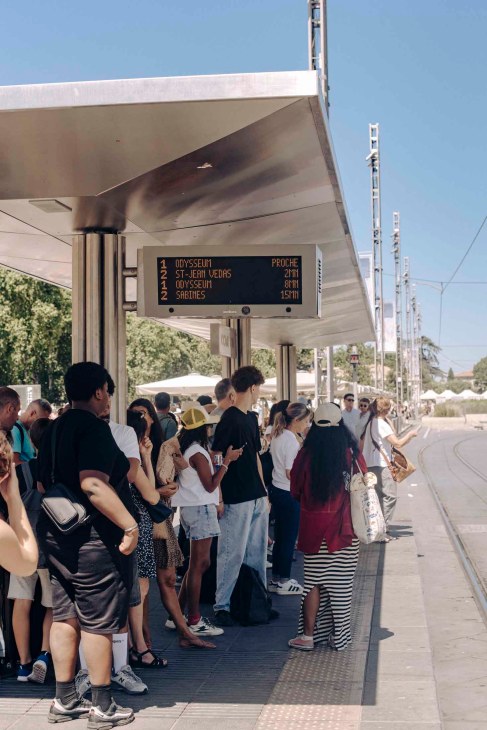
As to what he believes his own future holds, Delafosse keeps us guessing, saying only that he will announce whether he will run again after a period of “reflection” with his family. If Monocle had to guess, we would wager that Montpellier’s mayor will soon be hopping on the TGV to the Gare de Lyon. He has achieved a lot in just five years and exemplifies a certain type of ambitious 21st-century politician whose views on urbanism align with a populace that’s open to reimagining the urban space. But for now, he’s back on his electric bike, riding off into the afternoon.
Montpellier mobility in numbers

Green spaces
About 500 new trees, 2,000 shrubs and 700 bushes have been planted in Parc Georges Charpak, creating wildlife corridors and boosting urban biodiversity. In Parc Marianne, wildflower grasslands now cover 1.5 hectares.

Buses
The first line of a new Bustram network opened in May. Manufacturer MAN Truck & Bus France, which has supplied 70 electric buses, commissioned illustrator Alain Le Quernec to create a design for each of the five planned lines.

Cycling
Under Delafosse’s administration, more than 150km of new cycle paths have been integrated into the city’s network. A 384-metre underground cycling tunnel will also connect the Comédie and Antigone areas of the city.

No cars
The city’s main thoroughfare, Avenue Georges Clemenceau, was fully pedestrianised in 2022, removing the some 11,000 vehicles that drove along it daily. A low-emission zone has also been implemented across most of the city.
Trams
Montpellier’s enviable tram network continues to expand. Line 1 has recently been extended to the city’s Sud de France TGV station, while a new station has been added to Line 3 to provide better service.
Inside Sweden’s fight to protect public-service broadcasting
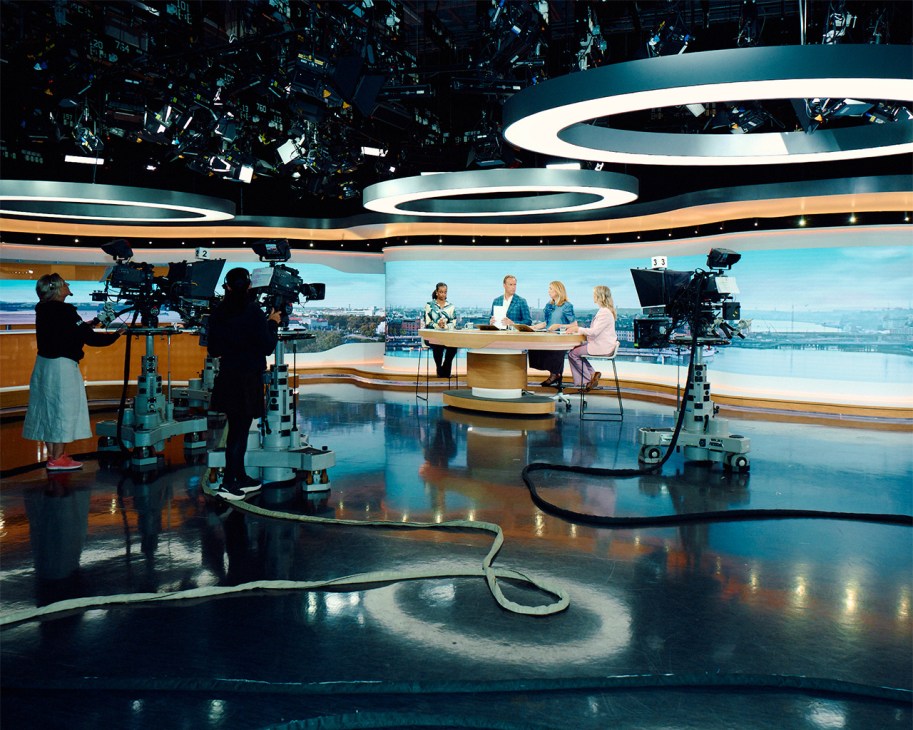
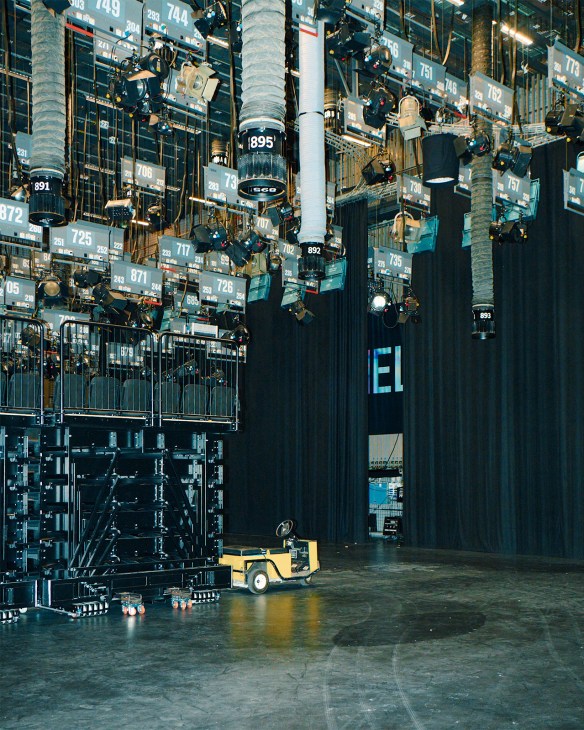
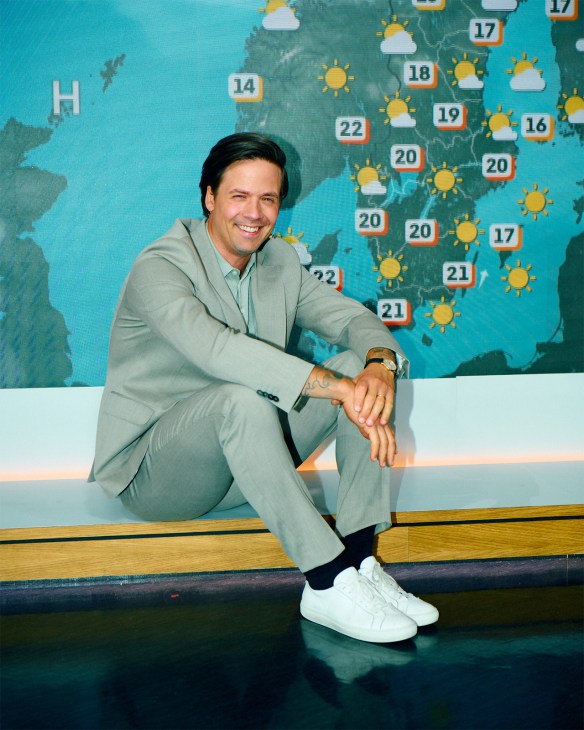
You wouldn’t guess that weatherman Nils Holmqvist has already been at work for nearly five hours when he riffs on the day’s forecast just after 08.00. The meteorologist is perky, charming and on point as he makes his contribution to Morgonstudion (The Morning Studio), which will run live for the next two hours. “I’m usually a favourite at weddings – I can really talk about the weather,” says Holmqvist.
The waters are calm at Sveriges Television’s Studio 5, where the morning team of presenters, technicians and camera operators runs the show with seamless professionalism. But storm clouds have been gathering behind the scenes at Sweden’s three public media companies: Sveriges Television (SVT), Sveriges Radio (SR) and educational-content provider Sveriges Utbildningsradio. At first glance all seems well: the current broadcasting permit is set to be renewed for another eight years at the end of 2025. A new law that will enshrine the definition of public-service broadcasting as being free from political, commercial or religious interference will also soon come into effect.
Yet behind the scenes, there are problems brewing. Some commentators, including prominent journalist and author Janerik Larsson, believe Swedish public-service media will become obsolete. “People don’t gather around the campfire in the same way as we used to,” he says. “It has nothing to do with content. It’s just that we consume media differently today.”
Critics believe that public-service companies are gaining an unfair advantage over other media players because they have guaranteed financing. Meanwhile, the government wants to cut back on what it describes as bloated organisations. In response, management at the companies say that the government’s new proposed financing model of tweaking the allocation of tax funds (beginning with a higher sum that will be reduced in phases) will force additional savings. In the past two years, more than 200 journalists have been laid off across the three broadcasters.
Management at SR has also expressed dismay at the rising costs of analogue transmission over state-run network Teracom, adding to an already stretched budget. That cost could swell further now that commercial broadcaster TV4 has announced that it is going 100 per cent digital, leaving the public-service broadcasters to foot the entire analogue bill. In addition, the government wants to create an investigative panel to explore the impartiality of Sweden’s public-service companies in response to critics who say that there is a left-leaning bias at play. The proposal has ratcheted up the debate over the degrees of separation between the state and the broadcasters.
“Right now, public-service media in Sweden faces political enmity,” says Fredrik Stiernstedt, professor of media and communications at Södertörn University in Stockholm. “The government wants to rein it in. It’s an old political project of the right that now has air under its wings.”
Yet Stiernstedt points out that the picture in other European nations is worse. Reporters Without Borders describes European public-service media as being in crisis. Across the region, funding is being called into question as broadcasters compete with digital platforms. In Italy and Hungary, public broadcasters are increasingly being used as political instruments. In Poland and the Czech Republic, there has been a direct state takeover.
In August new legislation came into effect in the EU as a prospective antidote to these trends. Among other safeguards, the European Media Freedom Act sets out to protect media pluralism, editorial independence and transparency of media ownership to ensure the free functioning of public-service media in the EU. “It’s probably the most advanced media legislation ever created because it tackles several issues,” says Marius Dragomir, the director of a global think tank focused on the study of media organisations and a co-creator of online database State Media Monitor. But he isn’t very hopeful about its impact. “The act won’t have any effect whatsoever,” he says. “For example, Hungary will adopt the legislation but it won’t be implemented – at least, not under the current government.”
Dragomir believes that the sector still fulfils an important mission in Europe “but corruption will continue to be an issue for free and fair reporting,” he says. “Oligarchs buy media outlets and manipulate them. The new law will not change that.”
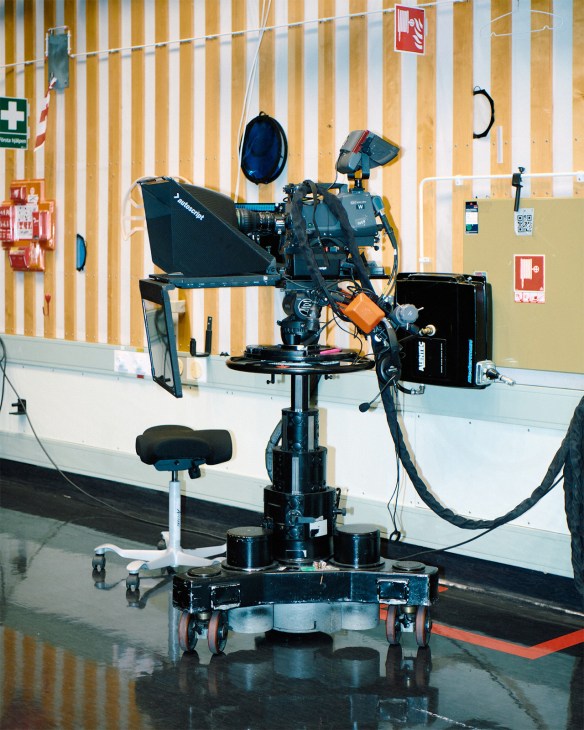
Despite the challenges, the conflict in Ukraine has brought the issue into sharper focus in Sweden and the Nordics more widely. The country has been expeditiously rebuilding its dismantled military apparatus to be ready to fight should the need present itself. “Even those who believe that we don’t need to be there editorially understand that we need to exist for the safety of the nation,” says Cilla Benkö, the CEO of SR. “If, God forbid, there should be a war in Sweden, SR might be the only media company in the country that can still transmit. We’ll keep broadcasting, even if the lights go out.”
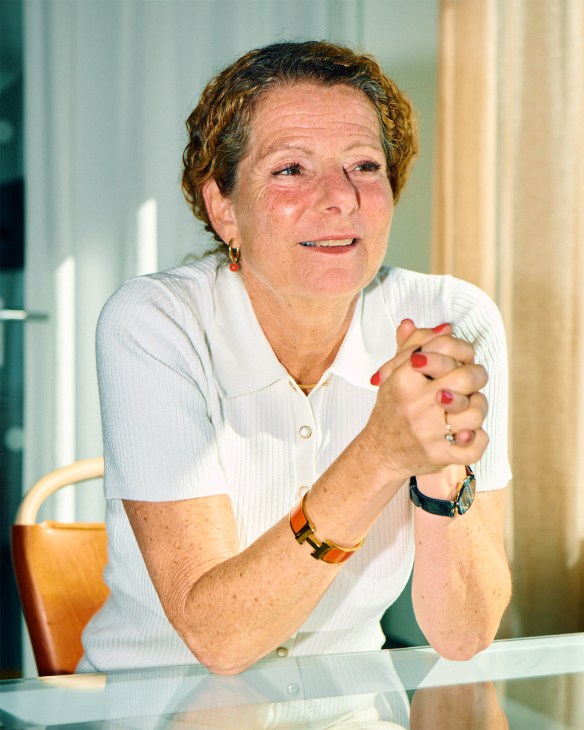
Wearing an understated outfit and with her curly red hair pulled into a ponytail, Benkö sits in a sun-dappled office overlooking the rooftops of Östermalm in Stockholm. “Until now, we have been under varying degrees of economic pressure, depending on who has been in power,” she says. “But we are now moving in the direction of being under pressure politically as well as financially.”
Benkö, who started as a sports reporter 40 years ago, has had a lot of practice arguing the case for SR’s unencumbered independence and its long-term survival. “While we face the gargantuan challenge of competing with global digital-media consumption and tech giants, we also have to defend our existence in a way that we didn’t have to before,” she says. “All the while, we perceive that the Swedish people want more free and independent media. They want to be sure that what they hear is true. They turn to us because they trust our output.”
Of a population of 10.6 million people, 7.4 million listen to SR’s four main and 25 regional stations across the country every week, on both FM and digital platforms. It’s proof that, despite challenges for the overall organisation, SR’s radio programmes continue to be hugely popular.
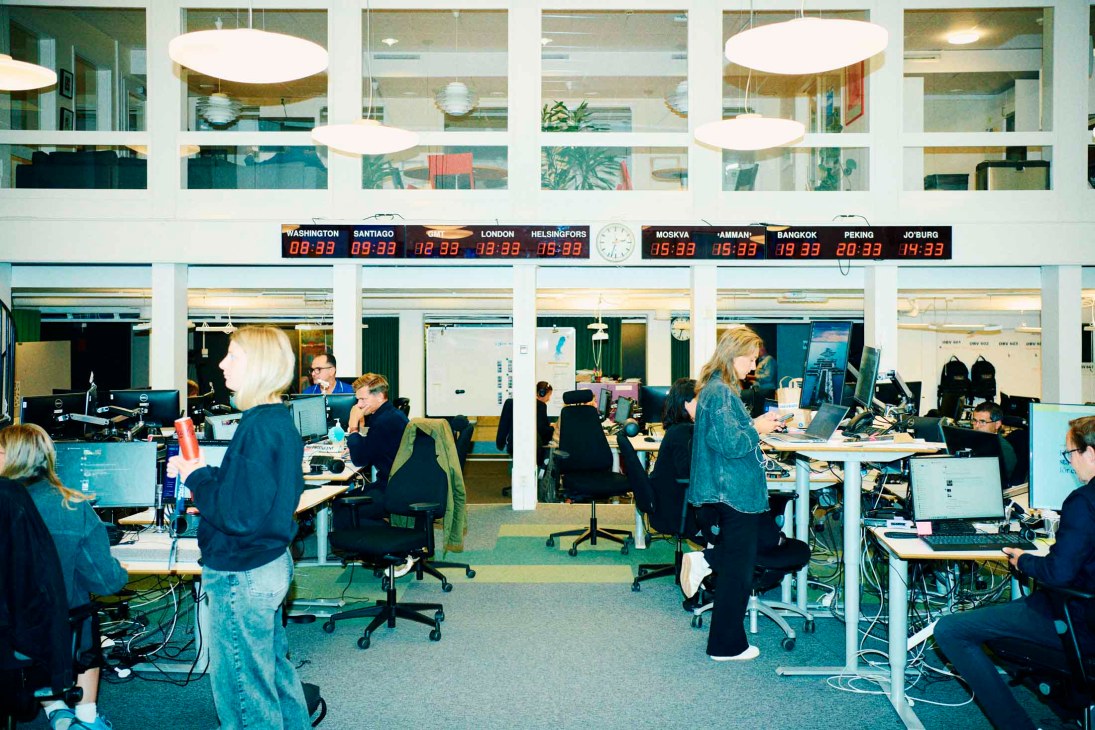
SR celebrated its centenary this year. Its cavernous entrance reopened in time for the summer anniversary party, with upgraded security features and a fresh look. The overall refurbishment of Radiohuset (The Radio House), a concrete-and-glass monolith from 1962, has been 25 years in the making and is incomplete. There remains a neglected feel in the beating heart of SR’s news hub, Ekot (The Echo); its show has been on air since 1937. Eventually the entire Ekot team will move into a more expansive newsroom.
“We’re on borrowed time,” says Billy Abraha, a producer at Ekot. “We have developed our digital content enormously over the past few years. We’ve improved SR’s app and created great content on the landing page that complements the output on FM.” Despite the digital transformation, Abraha is cautious about the future. “It’s tricky to say what things will look like going forward when we’re not sure about funding levels and how they will affect staff,” he says.
Abraha’s colleague Helena Gissén, who joined Ekot as a political commentator after 25 years at commercial broadcaster TV4, agrees that the mood at work is at times subdued. “At TV4 we got used to savings packages every few years,” she says. “People are not used to that here and many are worried about more budget cuts.”
On call to provide analysis around the clock, Gissén has just signed off her shift on P1 Morgon, SR’s most popular programme with a reach of 900,000 daily listeners. On today’s show, Gissén commented on the legal case against Henrik Landerholm, a former national security adviser accused of leaving classified documents at a conference centre. “In the end, we do this work for the public,” she says. “That is why we are here.”
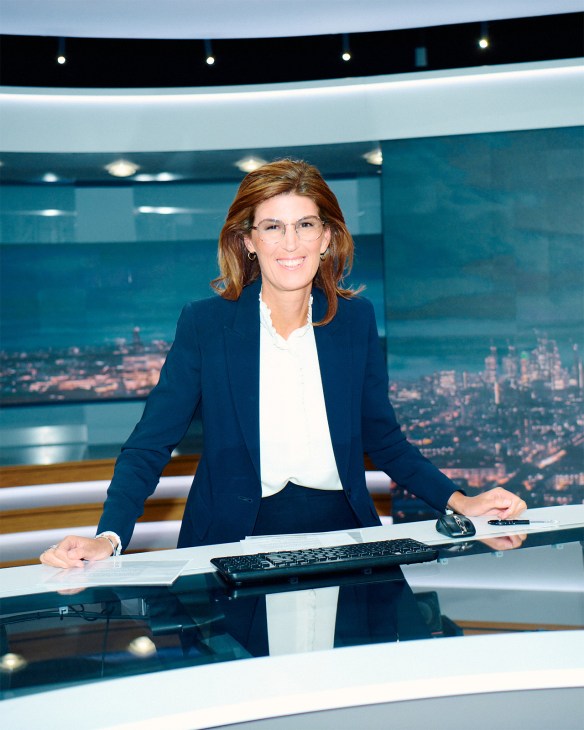
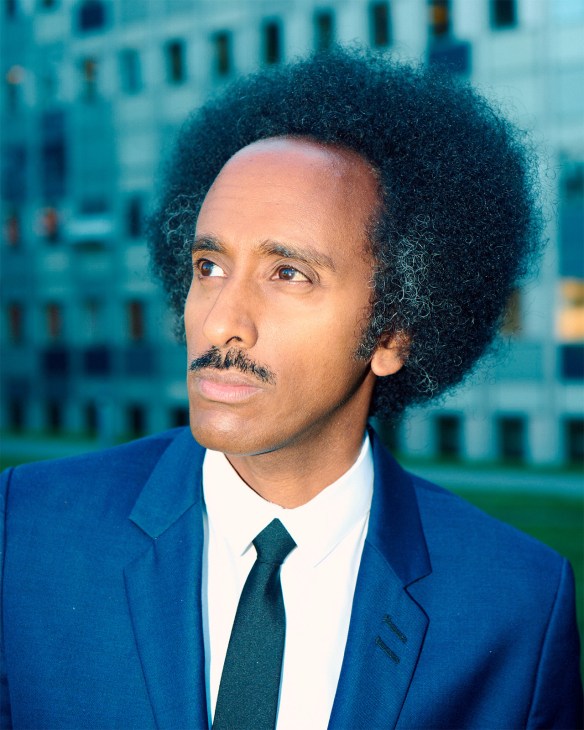
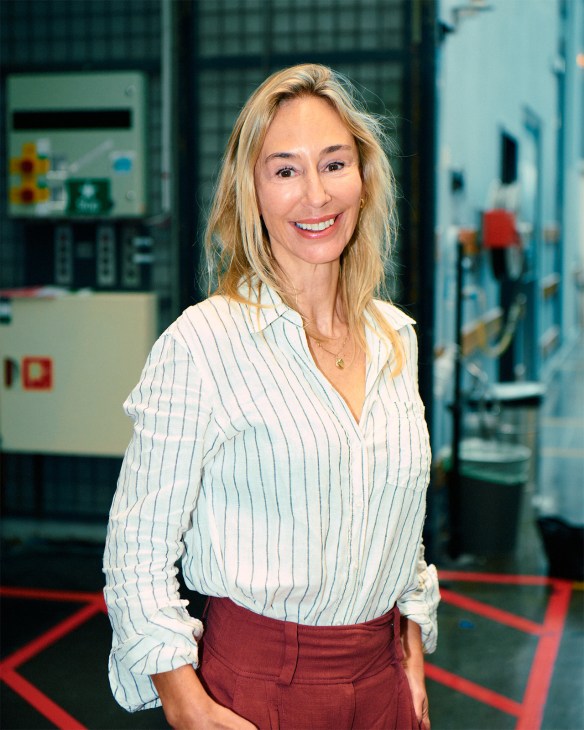
In the newsroom at SVT, there is a reassuring hum of voices and engaged prepping for the day’s shows. The journalists, producers and editors are back from their morning meetings. The head of SVT news, Karin Ekman, delivers an update on the segments that did well over the weekend and those that could have done better, and welcomes two new political reporters into the fold.
The teams then huddle together in editorial discussions specific to every news programme, deciding on what to broadcast over the next 12 hours. The big-ticket item on the agenda for the flagship news programme, Aktuellt, which airs every weeknight at 21.00, is an interview with Ukraine’s former foreign minister Dmytro Kuleba.
A large portion (81 per cent) of Swedes watch SVT every week, which is broadcast from Stockholm, Malmö, Gothenburg and Umeå in the north. About one million viewers over the age of 25 watch evening news programmes Aktuellt and Rapport. But despite high ratings, SVT journalists understand that they need to remain in the viewers’ good graces and prove themselves worthy of the taxpayers’ kronor that keeps the lights on in the studios.
“It’s up to the public to decide through their elected representatives what they want our service to be,” says Jon Nilsson, a longstanding presenter of Aktuellt. “Even if I believe that the work that we do is important, people are allowed to voice opinions on how much it should cost to produce. So far, we are still here – alive and kicking.”

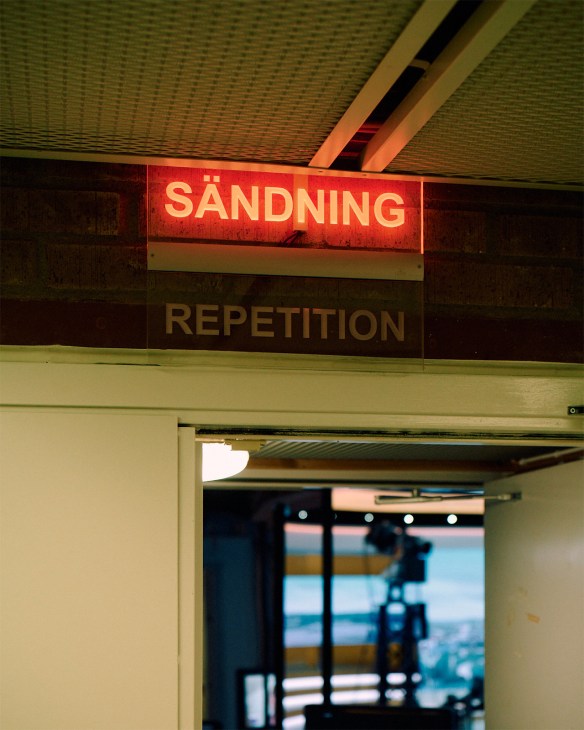
As his Aktuellt co-host Cecilia Gralde gets ready for the interview with Kuleba, she talks about the need to stay connected with the public. “We constantly have to renew ourselves; we can never stay idle,” she says. “The goal is to be engaged with our audiences.” Although Gralde has extensive experience as a news journalist – she began her career in 1998 – she took on a temporary posting as SVT’s Europe correspondent over the summer. While in that role, she covered, among other events, the pride parade in Budapest, wildfires in Spain and the Nato meeting in The Hague. She was looking “to experience what it’s like on the ground, being questioned from the studio back home”, she says.
In contrast, Gralde’s colleague Samir abu Eid is on his first day back at headquarters after 15 years posted in the Middle East. He is trundling through the newsroom on crutches because of a bandaged foot. “It’s not what you think,” he says. “I didn’t get hurt covering Gaza. I was playing basketball.” Abu Eid has become a familiar face to Swedes who watched his Middle East reporting almost daily. Today he is on his way to provide expert commentary on the region live from Studio 5. He confesses that he is already longing to be back in the field. “It’s very odd to be asked if I’ve brought a packed lunch to the office,” he says with a chuckle.
Whereas SVT’s former Middle East correspondent might be itching to get back into the thick of things, his boss has a resolve to stay at the helm, steering the ship. Ekman has a firm vision for the new direction of SVT news. “Public-service broadcasting isn’t immune to challenges,” she says. The focus is on capturing younger audiences by, without abandoning facts, moving away from doom-and-gloom journalism as much as possible towards solutions-focused reporting and “storytelling”. Though difficulties appear to be coming from all sides, Ekman is clear in her belief in the unique role played by public-service media in today’s world. “We have the experience and heft to continue to be the trustworthy haven that we always have been,” she says.
The architect who built work-life balance (and his family) into his own office
The idea of living in a flat above your workplace might raise questions about the pitfalls of being in constant proximity to your job. But French architect Jacques Moussafir couldn’t resist the chance to renovate a 10-storey structure in Paris’s Haut Marais neighbourhood, combining his home and office life in a single building.
Does he mourn his commute or cherish its abolition? And does he miss the mental separation between life and work that physical distance brings? “I find it very practical,” Moussafir tells Monocle with a smile when we meet him at his Parisian base. “There are some inconveniences, such as the temptation to go downstairs and work just a little longer – the boundary can become porous. But it’s my way of working as an architect. I can’t separate the two.”
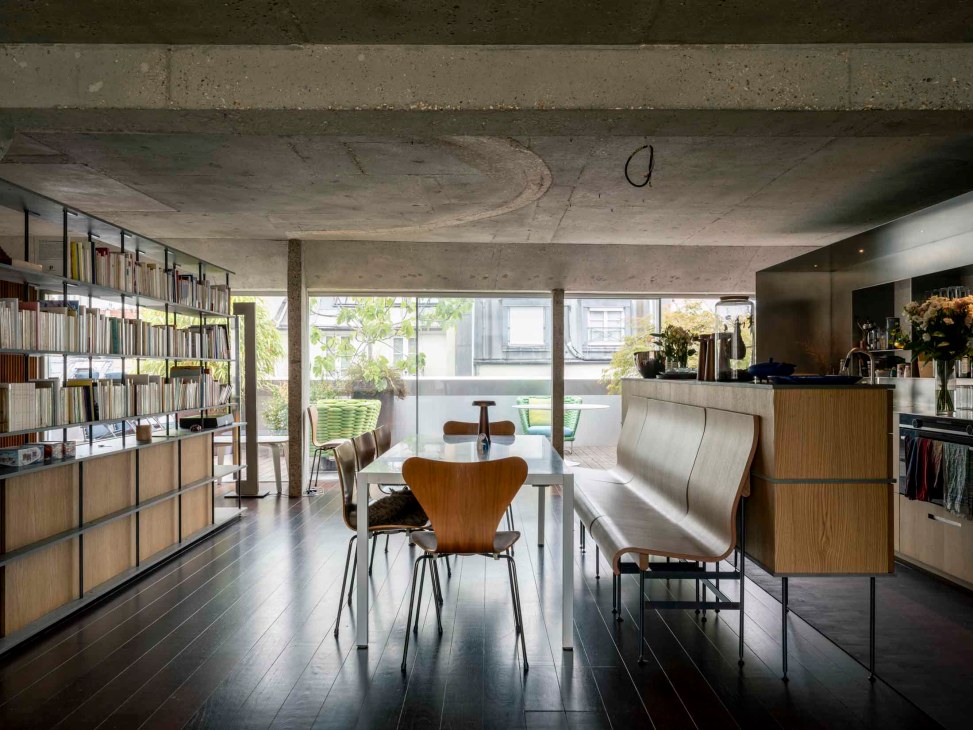
With its aluminium-and-glass exterior, the imposing building on Rue du Vertbois stands in stark contrast to the historic structures that surround it. “We were already living in the area when the opportunity to take over the building came about,” says Moussafir. “We were looking for somewhere with a terrace and space for an office. What we ended up with was a little bigger than we had anticipated.” Originally designed in the 1970s by French firm Biro Fernier as a commercial building, the concrete behemoth exemplifies the architecture of France’s three-decade postwar economic boom and comprises seven storeys that sit atop a three-level underground car park.
When the building came up for auction in 2012, it required a complete renovation of the façade and the insertion of structural and safety elements, including staircases and guardrails, as well as floor and ceiling coverings. The works were completed in 2022 and the building is now mixed-use, with different areas sectioned off and rented out. Meanwhile, Moussafir occupies the top three floors with his family; another level houses his architecture firm.
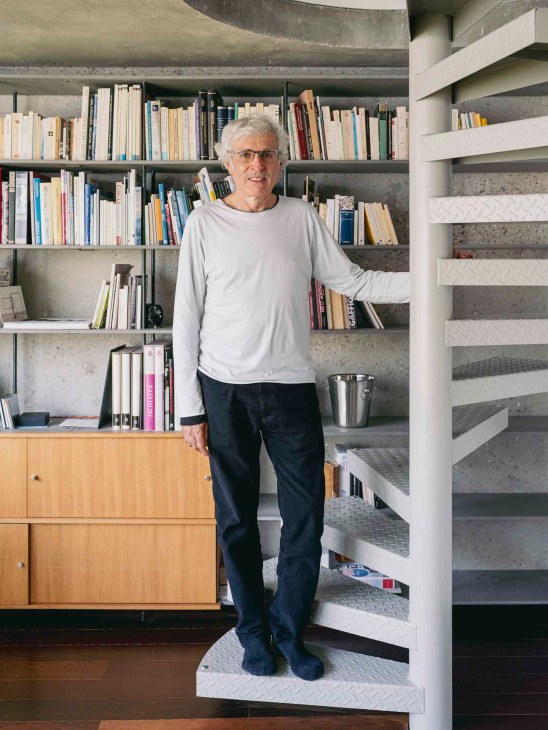
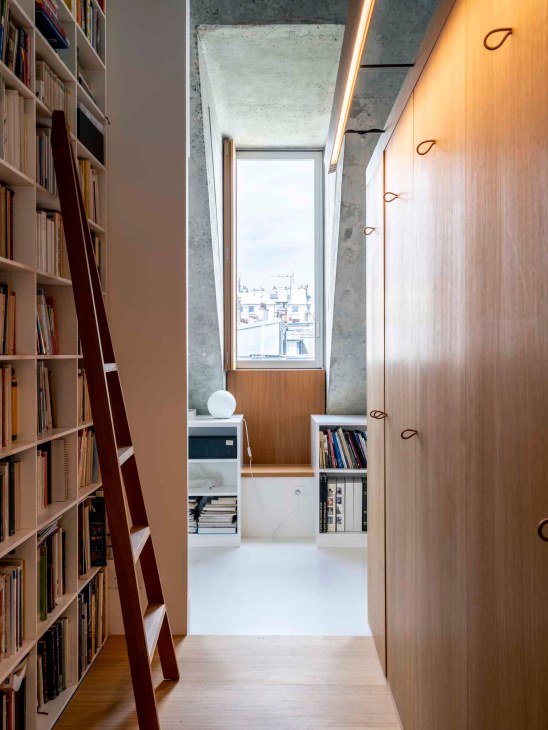
Having already worked on significant projects, including the Museum of Fine Arts in Dijon and the Institute of Civilizations in Paris, Moussafir didn’t hesitate to commission himself. “It can be difficult to be your own client,” he says. “I have a friend who is also an architect and when it came to her own apartment she chose to hire someone else. It was easier, mostly for her partner, I think.”
For the exterior, Moussafir chose glass and aluminium planes that jut out at unexpected angles to create an intriguing play of light and shade. Entering an elevator in the building’s lobby, you make your way to an upper floor, where Moussafir’s open-plan office can be found through floor-to-ceiling glass doors. Here, oak finishings and wooden ceiling panels arranged in a grid formation soften the effect of the exposed stone walls, concrete beams and steel shelves.
“I like materiality,” says Moussafir. “When we moved in, I removed all of the paints and varnishes to emphasise the raw concrete.” For the carpentry, he enlisted Martin Bereuter, an Austrian cabinet-maker and longstanding collaborator. His use of honey-hued oak across every level brings visual harmony to the large-scale project. Northeast features a Japanese maple, bamboo and a fig tree that bears fruit twice a year (once in June and again in September). As Monocle takes a seat outside on woven-rope Ami chairs by Paola Lenti, the view from our perch is typically Parisian, with zinc-grey roofs, sand-tone walls and curlicue wrought-iron balconies extending as far as the eye can see.
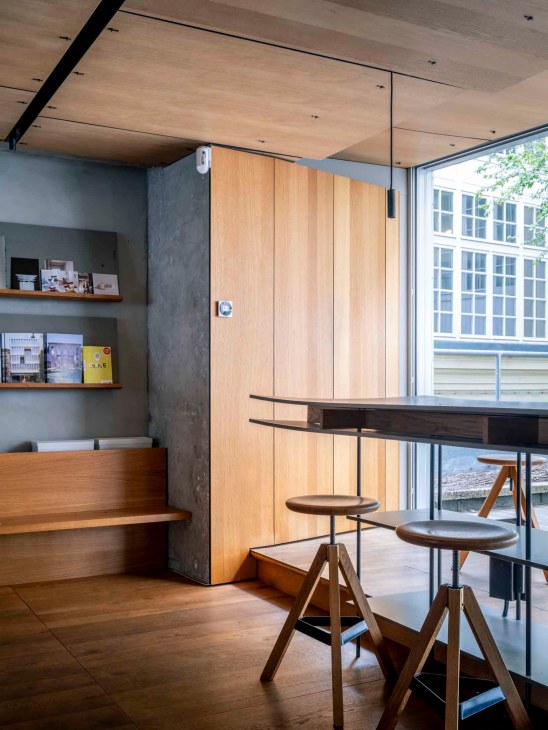
Honey-hued oak panelling envelops the workspace
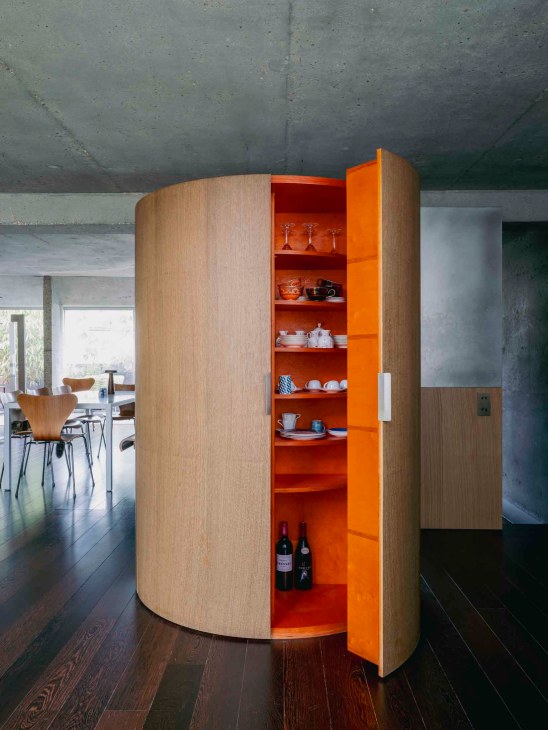
An unexpected orange interior adds colour to the living room
Moussafir opens the sliding doors and windows on either side of the living room to catch a cross breeze and a continuity between the indoor and outdoor spaces is quickly established. From here, the family’s tennis-ball-yellow On the Rocks sofa by Italian furniture company Edra is an unexpected injection of brightness amid the cooling palette of concrete and oak. Behind it, a statue by Antony Gormley sits in dialogue with an Isamu Noguchi-designed Akari UF3-H paper floor lamp and vintage armchairs inherited from Aubépine’s parents. Aside from these pieces, the decoration of the space is mostly provided by bespoke, minimal black-steel shelves stacked with books ranging from a hefty volume on Bob Dylan’s lyrics to works by Molière and some cookbooks.
It’s a varied combination partly inspired by Moussafir’s peripatetic life – one that spans the Democratic Republic of the Congo, Greece, England and France. “My childhood in these places was no doubt important but I’m more influenced by remarkable architects,” he says, citing Estonian-born American master Louis Kahn, Swiss Pritzker Architecture Prize-winner Peter Zumthor and Australia’s Sean Godsell as sources of inspiration.
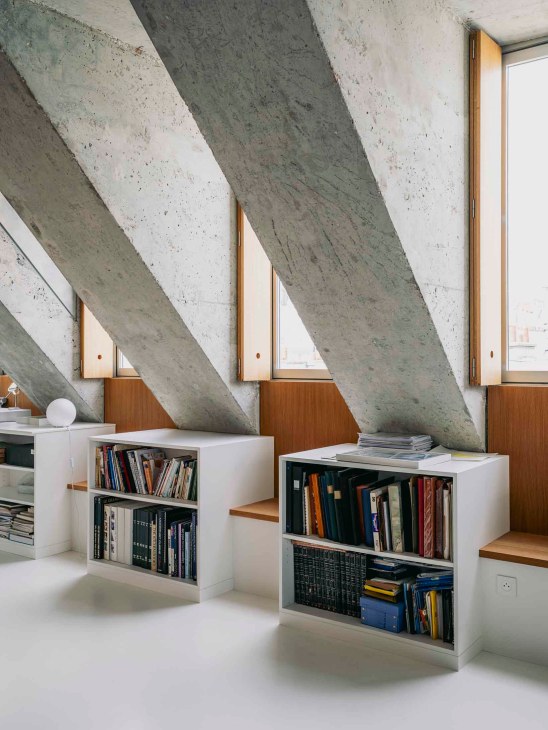
Bookshelves are tucked under concrete beams
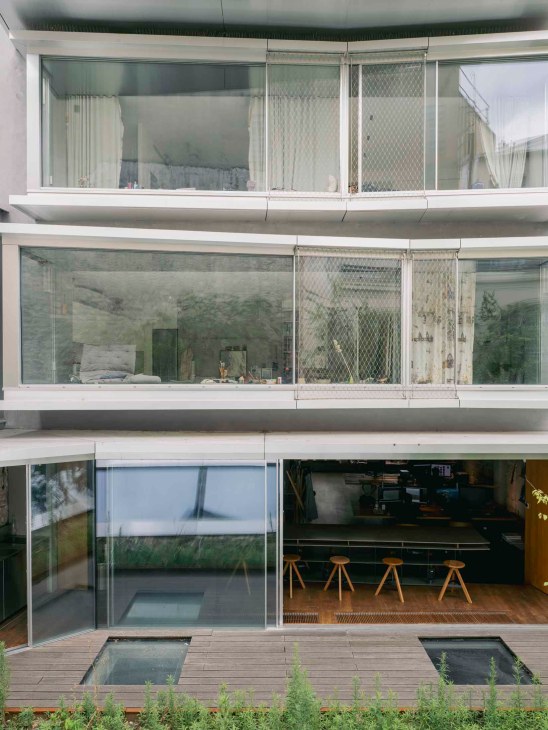
Aluminium and glass panes jut out at unexpected angles
“I look to Nordic architecture but my main interests are materials and details,” he says. “Even without a budget, you can create beauty from raw materials, thanks to expert joinery and some contrast.” A case in point is the undulating wooden bench on one side of the kitchen table that Moussafir asked Bereuter to install as a space-saving solution.
“We’re actually on the second iteration of our kitchen,” says Moussafir. “My first idea was very conceptual: it was contained within a round structure and the dining area surrounded its perimeter. It was beautiful but sadly impractical. That’s the challenge when you’re your own architect: you have to live with the mistakes that you make.”
The final stop on Monocle’s visit is to the top floor of the building that can be accessed via a grey-metal spiral staircase. In this concrete attic, Moussafir and his wife’s bedroom is cradled between angled beams. A bed takes pride of place, with blue linen that matches a vertical headboard, while more bookshelves and oak finishings echo the other floors. But the secluded nature of the space brings a layer of intimacy to Moussafir’s home. “I love the separation between the floors,” he says. “In the morning, when I go down to the kitchen and the living room, it feels totally different. The rooms that are used throughout the day and those that I occupy at night feel cut off from each other.”
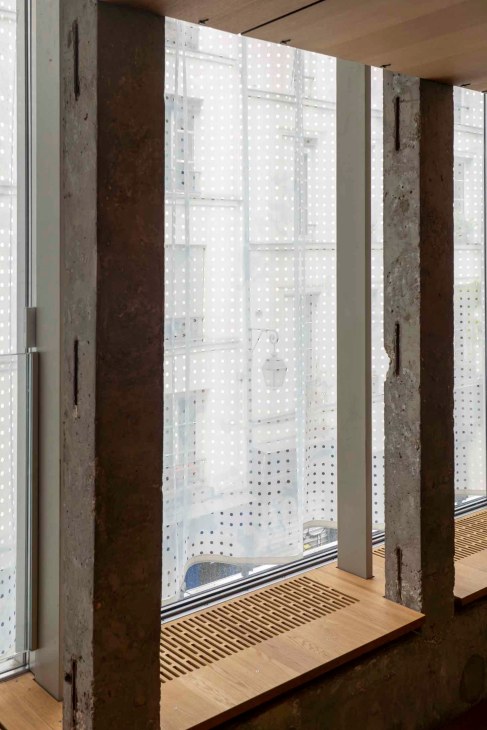
Perforated wood panels conceal the radiators
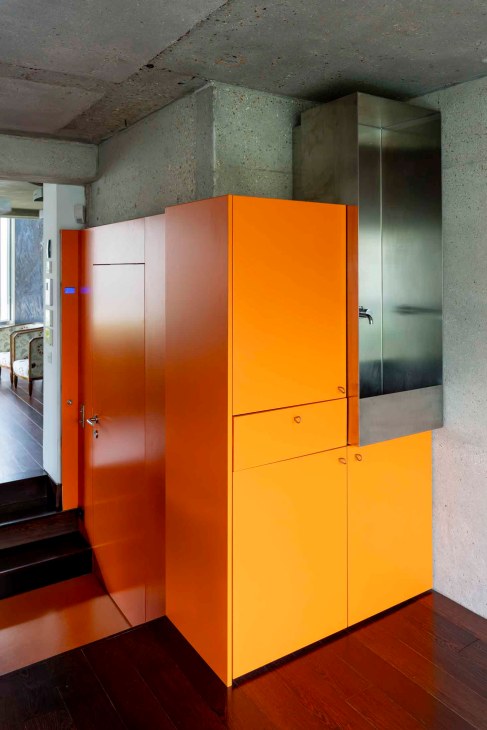
Pops of zesty orange to contrast with the minimalist décor
Ultimately, the configuration of the different levels that house the office and the various areas of the home is the trick to successfully balancing work and personal life when these two coexist closely. “I have friends who are able to disconnect at the weekend but, for me, the two parts of my life are interlinked and I like it that way,” says Moussafir. “It’s a luxury just to go downstairs in the morning and get to work. And if I have a little free time, I can also go upstairs and see my children for lunch. The absence of limits goes both ways.”
moussafir.fr
Peter Copping charts a new future for Lanvin couture
British-born designer Peter Copping is a collaborator at heart. Ever since his student days at Central Saint Martins in London, he has always been drawn to group projects and creative dialogues. “For graduation, three of us went to our professors with the idea of having a joint show, which had never really happened before,” says Copping, sitting in the Paris studio of French luxury fashion house Lanvin. Today he serves as its artistic director, tasked with the label’s revival. “We even got sponsorship, which wasn’t spent very wisely. We just went out having fun – things you’re allowed to do when you’re that age.”
After graduation, Copping went on to the Royal College of Art. He then began building one of the most impressive CVs in the fashion industry, working with some of the best designers of his generation. A chance meeting with Christian Lacroix at The Conran Shop in London led to a stint as a couture apprentice at the label in Paris; he later secured his first full-time position at Iceberg in Milan. In the early 1990s he returned to Paris to work for luminaries including Sonia Rykiel and Marc Jacobs at Louis Vuitton. “I always knew that I wanted to come back to Paris and make it my home,” he says. “Everyone from Jean Paul Gaultier to great Japanese designers such as Yohji Yamamoto was here in this city. I wanted to be right in the middle of it.”
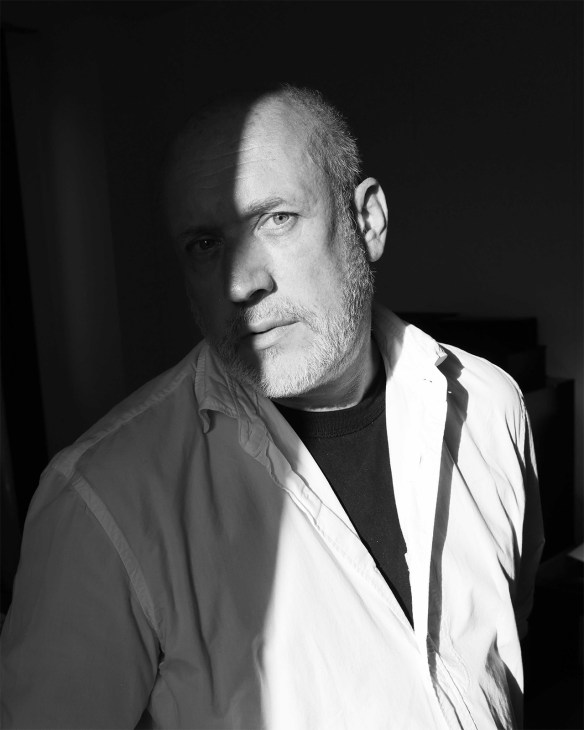
Creative-director roles naturally followed, first at Nina Ricci in 2009 and then at the US-based Oscar de la Renta in 2015. But two years later, Copping was ready to return to Paris and to the couture atelier, working behind the scenes to relaunch Balenciaga’s couture line with the house’s then-creative director, Demna. “It was nice being able to work at a slower pace and really having time to investigate things,” adds the designer, admitting that he is as obsessed with the artisanship of couture as he is with the clients who commission these one-of-a-kind creations. “I would always sneak out from backstage and take pictures.”
Last year, when fashion houses began reshuffling their executive teams and creative-director positions began opening one after the other, Copping’s name unsurprisingly started to circulate in HR departments across Paris. Though he wasn’t “desperate to be an artistic director” or to be back in the spotlight, when he was offered the opportunity to take the creative lead at Lanvin it was too good to refuse. “It’s a beautiful house with a beautiful history,” says Copping of the Parisian brand, founded by Jeanne Lanvin in 1889 as a small hat shop.
Though it’s a leadership role, Copping’s job presents endless opportunities for collaboration. Rather than putting himself at the centre of the story, he is passionate about mentoring – and learning from – the brand’s young design team, who Monocle sees whizzing in and out of the studio. Equally, he has made it his mission to dig deep into the brand’s archive and pay homage to its pioneering founder. “I couldn’t wait to see it,” says Copping. “As soon as I got through the door, I asked, ‘Well, where is it?’ It’s all about going back to the roots of the house so I have been exclusively looking at the Jeanne Lanvin period, which feels very relevant today.”
Unlike in many fashion buildings, there is no sign of excess in his light-filled office on Rue du Faubourg Saint-Honoré – just practical furniture, piles of sketches and books on muses such as US socialite and interior designer Lee Radziwill. Copping has spent months here going through the Lanvin archives, including those at the Palais Galliera. “The museum has a lot of amazing pieces from the 1930s,” he tells Monocle. “I’ve found myself particularly drawn to them because the era’s silhouettes have a certain ease and comfort.”
Visiting Lanvin’s bedroom out of hours at the Musée des Arts Décoratifs (where it has been installed since 1965), Copping was also able to step inside the cordoned-off area and better understand her refined taste, as well as her appreciation for fine materials and decorative art. “Seeing that level of sophistication really gave me quite a sharp understanding of who she was and how she lived her life,” says the designer, who shares a similar love for interiors and collecting textiles from his travels.
For his debut autumn/winter 2025 collection, presented this January, he loosely evoked Lanvin’s sophisticated style in the form of column dresses, sumptuous velvet, leather fabrics and subtle sleeve embellishments. He was cautious about translating anything too literally, conscious of the need to avoid veering into costume territory. “I didn’t want to be overly academic about it,” he adds. “I cherry-picked items and tried to make them feel contemporary.”
This ability to tell Lanvin’s story through a modern lens immediately grabbed the industry’s attention and reignited hopes about the revival of the storied house, which is owned by the publicly listed Lanvin Group (formerly Fosun Fashion Group) and for years had struggled to maintain momentum beyond its robust business in trainers. “Lanvin has always been known for evening wear but there’s more that we can offer in day wear and particularly knitwear, which takes me back to my days at Sonia Rykiel,” says Copping, who also presented his first menswear collection as part of his January debut. “There’s an element of precision in men’s tailoring that I really enjoy. Lanvin used to have a huge menswear business so hopefully we’ll get back to that. We just need to let people know that [aside from the trainers] there’s a full fashion collection here again – nice knitwear, good coats, tailoring – so that men will start to return.”
As part of Lanvin’s transformation following the arrival of Siddhartha Shukla, its deputy CEO, in 2021, the company has been rethinking its branding and the artistic director has been playing around with the label’s powder-blue house colour. “Jeanne Lanvin had her own dyeing plant and books filled with different versions of blue, almost like a modern-day Pantone book,” says Copping. “I want to have it in every outfit, even if it’s a small detail inside a garment.”
The brand’s emblem, an illustration of the founder and her daughter, can also be found on Copping’s mood board. “For me, it represents family and a community that extends across different generations,” he says. “Today, family means so much to so many people. And I like the idea that the house reflects a modern family in some ways.” Having made a successful debut, this September the designer is returning to Paris Fashion Week to present his sophomore collection. “We’re sandwiched between Louis Vuitton and Dries van Noten. That will make for a great day of shows and it’s important for us to be among the competition,” he says with a smile.
To prepare for it, he has continued to explore the art deco era through Jeanne Lanvin’s eyes, examining sharp graphics from the 1930s and observing the works of other designers referencing her, including Geoffrey Beene. “When people ask what I plan to do for my next collection, I simply say, ‘We’re going to do the same thing.’ There are so many facets of Lanvin’s work to draw upon, from her personal style to the way that she put things together. She really deserves to be much better known.”
lanvin.com
How Catherine Rénier is turning Van Cleef & Arpels into living art
Luxury brands are always pursuing cultural relevance. Where many once focused their attention on pop culture and celebrity endorsements, today’s heritage fashion companies, jewellers and watchmakers seem more interested in forging partnerships with literary luminaries, choreographers, filmmakers and artists.
Founded in 1906 by husband and wife Alfred Van Cleef and Estelle Arpels on Paris’s Place Vendôme, Van Cleef &Arpels has always immersed itself in culture. In the late 1960s, an encounter between Claude Arpels and choreog- rapher George Balanchine resulted in the creation of Jewels, a ballet dedicated to precious stones and presented at the NewYork State Theatre.
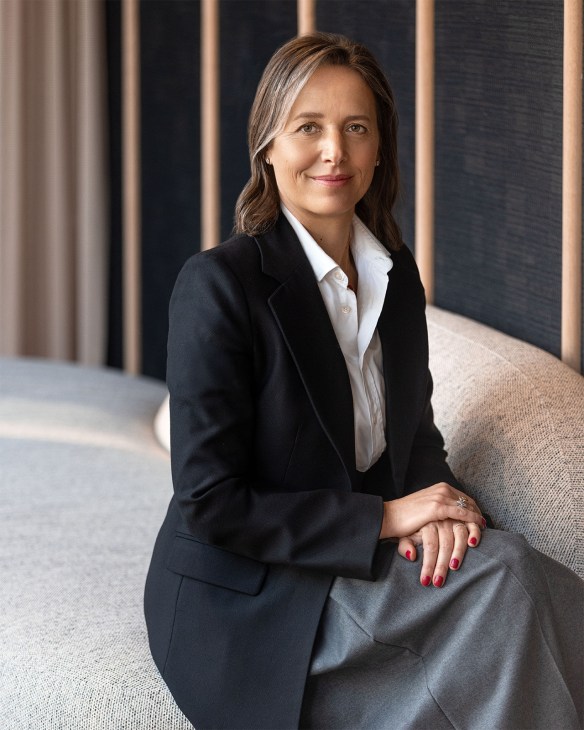
Today the house plays a major role in supporting some of the world’s most important dance institutions, from The Royal Ballet in the UK to the Kanagawa Arts Theatre in Japan. It has also just introduced its own imprint with Italian publisher Franco Maria Ricci and runs L’École, a school of jewellery arts with campuses in Paris, Hong Kong, Dubai and Shanghai. There, people of all ages can sign up for courses in diamond grading, gemology or the history of art deco jewellery.
All of this is part of the reason why Van Cleef &Arpels is now in a position of power, with a growing appetite both for the stories that it has to tell and for the products that it has to offer. Signature jewellery lines, including the Alhambra, have found a new generation of fans, while its watch business continues to expand, with one-of-a-kind automatons and complications produced in-house. Its jewellery watches are also growing in popularity among female collectors and soon the house will also be renewing its focus on men’s timepieces – Pierre Arpels designed the brand’s first men’s watch in 1949 for his own use.
The brand’s new custodian is its CEO, Catherine Rénier, who spent 15 years in senior positions in the company before leaving to lead fellow Richemont house Jaeger-LeCoultre. Here, she tells Monocle about her homecoming and how she plans to maintain momentum.
Why did you want to return to the brand as CEO?
I spent 15 years at Van Cleef &Arpels in the beginning of my career so coming back felt very natural. The maison has remained true to its identity: it has always offered a very positive vision of life and that hasn’t changed. But everything is now on another scale and the initiatives are more impactful. L’École, for instance, now has four permanent addresses. When I was leaving in 2018, we had hardly opened one. Our festival Dance Reflections has also greatly developed. The project has taken on a life of its own and has a big impact on choreographers and the world of contemporary dance. My role is to continue that and, of course, make sure that the brand’s very old identity continues to blossom.
Dance has long been a source of inspiration for the house. Is there power in consistency?
Nature, dance, everything related to love or luck – all of these territories of expression are very clear within the maison. You know whether something belongs within the Van Cleef &Arpels’ world or not. Even when you look at nature through the eyes of the maison, it’s about colour, blossoming flowers and spring – it’s not an aggressive kind of nature. There isn’t only a territory of expression but also a specific view of that territory. Our strength is in being clear about our identity and being consistent over time in expressing it and fuelling our designs with it.
The market constantly demands novelty. How do you find balance?
Being consistent doesn’t prevent creativity. You don’t always have to change your source of inspiration. Take love – it’s a universal theme and we can express it in one way through the complications on traditional watches and in a completely different way in our automaton watches. There’s no need for us to perpetually look for new themes. We fuel ourselves from our patrimony.
Speaking of your poetic complication, have you had to reconsider the purpose of the watch and even the way in which we tell time?
Watches started as useful objects, which people used to tell the time or even help them as they travelled between time zones. They played some of the roles that our phones now play. For a house such as Van Cleef & Arpels, it’s now a lot more about the poetry of time or presenting another view on time. For another watchmaking maison, it might be more about technical expertise and the mechanical engineering that goes into the watch as an object of craft and complexity. For us, the mechanics will always come after the story – we do it the other way around. We are thinking about storytelling first and then put the mechanism at the service of it. Watches now have to play a different role – they’re less practical tools and much more art objects. This really is important when it comes to the way that the public looks at mechanical watches.
With its signature padlock-shaped clasp, your Cadenas watch has stood out in the market this year. Why do you think that this design in particular appeals so much again?
It’s a piece that dates back to the art deco period, which was an inspiring time for the maison and the art world in general. It has aged extremely well because it hasn’t changed – it has just improved. It’s a bold design but also remains discreet.You have to wear it to really understand it. I hope that it will take more of the spotlight this year. There is a love story that’s built around it [it was inspired by the duke and duchess of Windsor] and this year it’s clearly one of the stars of the show for us.
Van Cleef & Arpels is primarily known as a jeweller. How did you go about developing your watch-making expertise?
We started with a partnership and looked for experts who could assist the maison in expressing its vision of time. So the first poetic complications were done with watchmaking experts who brought in the solution. But over the years, our vision of time required new developments, new patterns and innovations. We began to integrate this know-how within the company so that the collaboration between the research and development teams, the design studio, the enamelling team and the watchmakers became more fluid. Now they’re all based in our workshop in Geneva. Since 2022 the development of all of the modules for the poetic complications has been done in-house to enable the story to go a step further.
Is that why investing in education has been a focus?
We spend time and effort talking about these jobs. What does it mean to be a jeweller? What type of career can you have? We educate people about this side of our world. It’s like a pépinière[nursery], a breeding ground for young jewellers. Students are nurtured so that they can move on to take a role in one of our workshops. It’s a necessary effort because these jobs rarely come to mind when a young student is choosing their career path. You can’t just decide that you will go to an enamelling school – you have to find a spot in a workshop and be taught by a qualified enameller. So we have a role to play in creating more opportunities for older generations to share their experiences and convince younger people to join.
Slowly but steadily, interest in craft jobs is increasing. Is that the result of technology fatigue?
The world is always in search of balance. So traditional craftsmanship is serving as an answer to modern technology, to the very short life cycle of objects nowadays. You come to our world and you’re looking at timeless products.
As your watch business grows, so does your presence atWatches andWonders in Geneva. Why is the fair worth the investment for you?
It’s important for us to have a dedicated watchmaking moment to focus our attention on our watches, the novelties and the stories around them. More generally, the fair has risen to another level. It’s now a place where members of the public come at the weekend. Sales are not the objective; you have the boutiques for that. It’s more about education and bringing a new crowd into our world. I’ve seen young people and I’ve seen families with strollers – people are curious. It’s a rendezvous with watchmaking, like an art fair. It’s important for the industry at large because it shows how relevant watchmaking is today, even if you don’t need a timepiece to tell the time.
vancleefarpels.com
Inside Renzo Rosso’s bold strategy for OTB’s resilience and growth
With his leonine features and all-black uniform, Italian-born Renzo Rosso cuts a distinctive figure in high-fashion circles. He is the founder and chairman of Vicenza’s OTB Group (short for Only the Brave), which owns a portfolio that includes Diesel, Jil Sander, Marni, Viktor&Rolf and Maison Margiela. In 2024 the group reported a turnover of €1.8bn, resisting the broader luxury slowdown and laying ambitious plans for an IPO and expansion in markets such as Mexico and the Middle East. Though he admits that luxury is “now in crisis”, Rosso remains optimistic.
His recent hiring decisions and willingness to take risks have received much praise. From entrusting the up-and-coming Meryll Rogge with Marni to bringing experimental Belgian designer Glenn Martens to Maison Margiela and poaching Bally’s Simone Bellotti as Jil Sander’s new creative director, there’s plenty to look forward to at OTB.
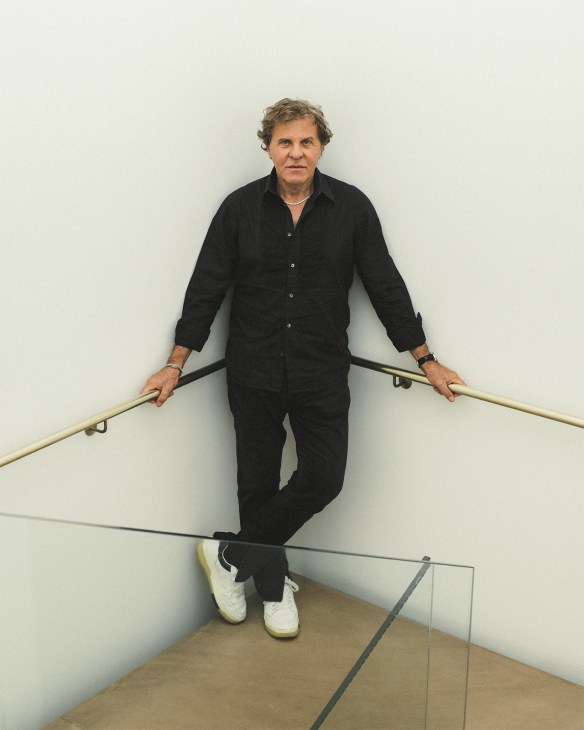
When Monocle meets Rosso at the Jil Sander HQ in Milan, he is deep in conversation with Bellotti about his debut spring/summer 2026 show. Racks of crisp shirts and overcoats are wheeled away as we sit down with him. In his black shirt and jeans, he personifies a certain ideal of a laidback CEO but, as the conversation veers towards retail strategy and supply-chain audits, it’s clear that he means business.
It has been a tough year for the fashion industry. How have you been navigating the upheaval?
Wars, political instability, taxes, duties – it’s complex. People are spending less and questioning whether they need more clothes when their wardrobes are already full. How do we come out of this? By fostering a better connection with the end consumer. Shop traffic is also falling. In China’s malls, it has decreased by 50 per cent; in Europe, it’s at minus 8 per cent. The US is at about minus 17 per cent. How can we pay our rent and employees? The answer is by relationship-building and convincing existing customers to increase their spend. To do so, we need to tell our clients the stories behind our products. [UK fashion designer and former creative director of Maison Margiela] John Galliano was the master: every dress had a story behind it. Storytelling sells a product. We’re well placed to do this because at OTB we have always promoted creativity. And through creativity, you gain respect.
What is your approach to hiring talent?
I’m very close to the hiring process of our creative directors. Before hiring John [Galliano], I met him every few months for two years. I would always tell him, “I want to work with you – when you’re ready, tell me.” One day after dinner in Paris, we went to Maison Margiela and I showed him the archive and what the house represents. That’s when he came on board.
I’ve never designed a thing in my life. I’m just someone who knows the market and who has worked with incredible creative directors who taught me how to have an open mind. At the moment, brands are changing creative directors like soccer players, moving them from team to team. With OTB, I think in periods of 10 years.
A decade is a good length of time for a person to be at the helm of a brand. The first few years should be about learning the DNA of a house and not necessarily succeeding. Once that’s established, a creative vision can be developed and market appeal grows. Then, after 10 years, you need to give a touch of modernity to a brand, a refresh. That’s what happened at Margiela and Marni.
When we hire a new creative director, I’m not just looking for someone who ticks the boxes of working at Dior, Gucci or wherever. I’m looking for someone who can do ready-to-wear, jewellery, shoes and bags, interior design and cosmetics. With Jil Sander, we looked at 17 potential creative directors. Three of them were some of the biggest names in the industry. I told them to prepare a plan to turn the brand into a luxury house comparable to Hermès. I asked the same of Meryll [Rogge]. I was impressed by how much these designers loved the Marni brand. They knew the history of the house better than
I did. In the end, I chose Meryll because her vision was perfectly in line with how I wanted to drive the brand forward. And I was looking for a woman because, for me, Marni is a brand that appeals to a woman’s mind.
What are the benefits of being a smaller group compared to bigger conglomerates such as LVMH?
I don’t dream of having a gigantic company – we’re not LVMH but we can be cool and less bureaucratic. I want my team to work with fluidity and an emphasis on creativity and sustainability. I like being able to catch up with people over lunch or dinner and create relationships.
OTB owns Italian leather goods maker Pelleteria Frassinetti and, last year, purchased shoe company Calzaturificio Stephen. Are you aiming to own your supply chain?
The goal is to protect our manufacturing. We’re currently doing audits on everyone who works for us and you can’t stop at the first layer. You have to check if the suppliers that you have hired are outsourcing the work to others.
There are many ways to do so: for example, if electricity is being used at night, it could be because work is being outsourced to people who are underpaid and doing night shifts. So you can check the electricity bills. The stricter you are, the less likely it is that these things will happen.
Are you still planning on taking OTB public?
Yes, I’m just waiting for the right moment. I don’t need money; we’re cash-flow positive. I want to do it for my successors and for transparency. My dream is for all of my employees to be my business partners, even if they own just a single share. I want us all to be able to say that OTB is “our company”.
Istanbul’s secret village: Why Kuzguncuk is the city’s coolest historic quarter
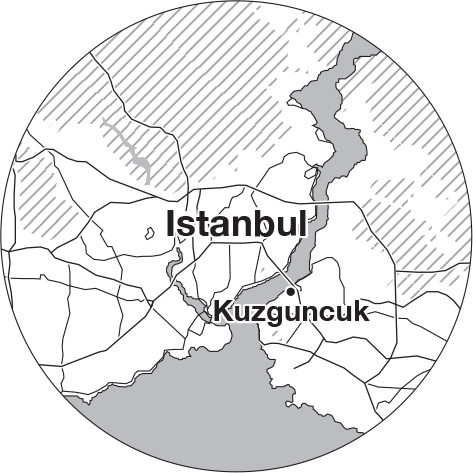
There’s a place in the middle of Istanbul where you can sit at a window flung open onto the water and look across the sweep of the Bosphorus as it runs through the city’s heart. To your right is a parade of fine wooden houses with lace-like trellises, each with a private jetty. To your left is a small public square where locals drink tea on benches under a spreading linden tree. And behind you, up the narrow valley, is a neighbourhood that feels like a rare find amid the city’s overdeveloped sprawl.
Monocle is lunching at Ismet Baba, a meyhane – or fish restaurant – that has been operating from this spot in the centre of the Kuzguncuk district since 1951. A huge photo of its founder, Ismet Baba, watches over the regulars who gather here over tall, milky glasses of raki, Turkey’s national aniseed liqueur.
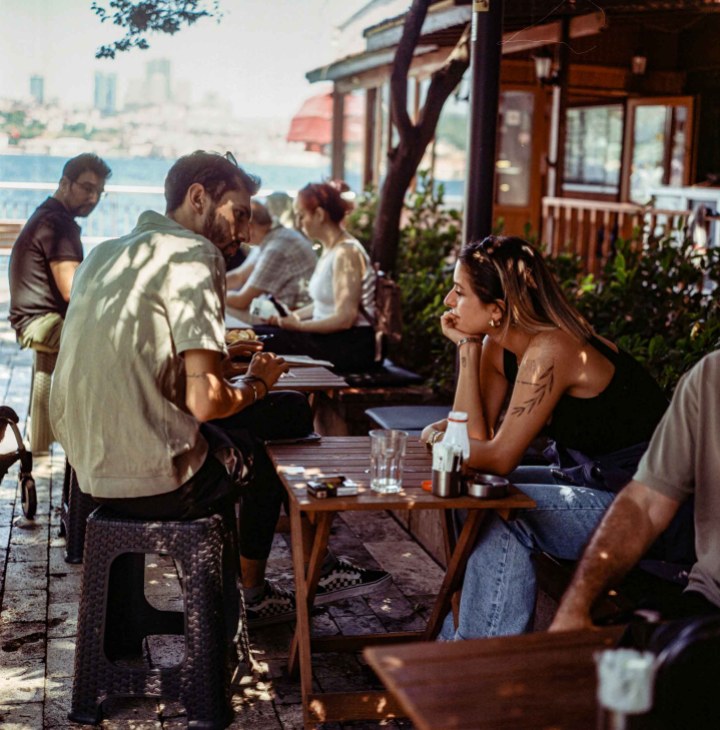
Kuzguncuk – which translates as “little raven” – lives up to the spirit of its fairy-tale name as a laidback haven for artists, architects and academics. This slice of old Istanbul on the Asian shore of the Bosphorus was once a quaint village, home mainly to Greek and Armenian Christians and Jews. In the late 19th and early 20th centuries, a parade of balconied wooden houses was built along its main street, Icadiye Caddesi, with a few stone buildings in baroque and art deco styles thrown in later. There are a couple of hammams and at its heart are the still thriving historic bostan, or allotments, popular in Ottoman Istanbul. Kuzguncuk emptied and became down at heel in the mid-20th century as most of the Christians and Jews left. But its dinky churches and synagogues survive, as have many historic buildings and public spaces. The result is a district that has retained the character of old Istanbul but with a stylish, independent-spirited new spin – though the threat of chain stores is never far away.
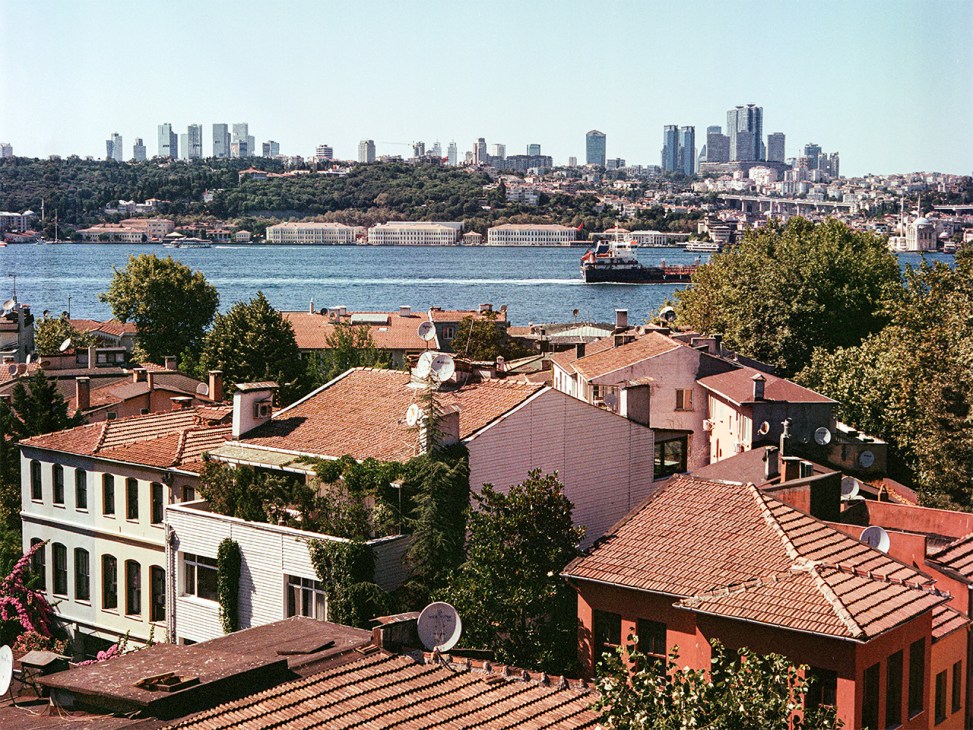
The best streets to live on (and why)
Icadiye is the artery but the grand villas overlooking the bostan on Simitci Tahir Sokak are recommended.
The cost of a property
Spacious two-bedroom flats start from about TRY10 million (about €208,500), although expect to pay more for a terrace or a Bosphorus view. Kuzguncuk Emlak is the best estate agent’s window to look in, at the start of Icadiye. For a restoration project, talk to residents – properties that have an ownership dispute or have been empty for a long time might not be listed but could be available with the help of a good lawyer.
The best grocer, baker and simit-maker
Many premises are turning into touristy coffee shops but the Tarihi Kuzguncuk Firini survives as a place for supplies and to meet friends over a pastry or simit. There are a few more options for grocers – the Kardesler Konsept Market has the finest fresh and packaged produce in the district.
The five galleries or collector’s spots to visit
1. Te Art Gallery
2. Mona
3. Harmony
4. IMOGA Art Space
5. Dada Kuzguncuk (antiques and vintage collectables)
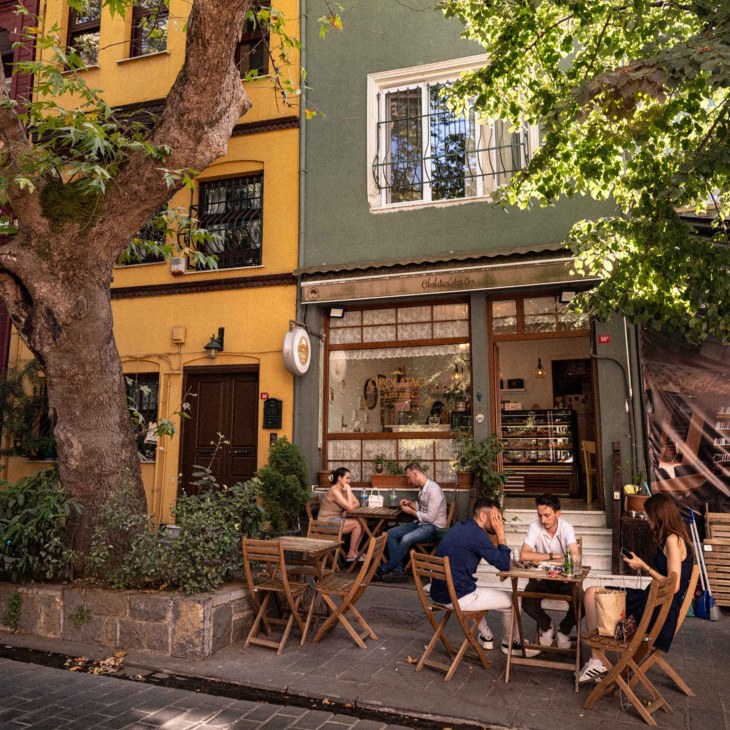
Every shop premises along Icadiye is a small art display, be it a huge, glass-fronted canteen showcasing its kavurma, pieces of roasted veal bubbling in butter, an ice-cream joint with a graphic installation in the window or a parfumerie selling scents mixed by hand in a nearby workshop. There is plenty to remind you that this is a living area too. The eczane, or chemist, which opened at its spot on Icadiye in 1905, serves customers amid its collection of vintage medicine bottles and old photos of the area. Venture into the rooms of the falci, a fortune teller giving readings from a crooked old building on the corner of Tufan Sokak, and you will find an interior preserved like a museum – a window onto the Kuzguncuk of old. On the pavements, sellers offer dried local lavender – the same that powers the parfumerie – from baskets.
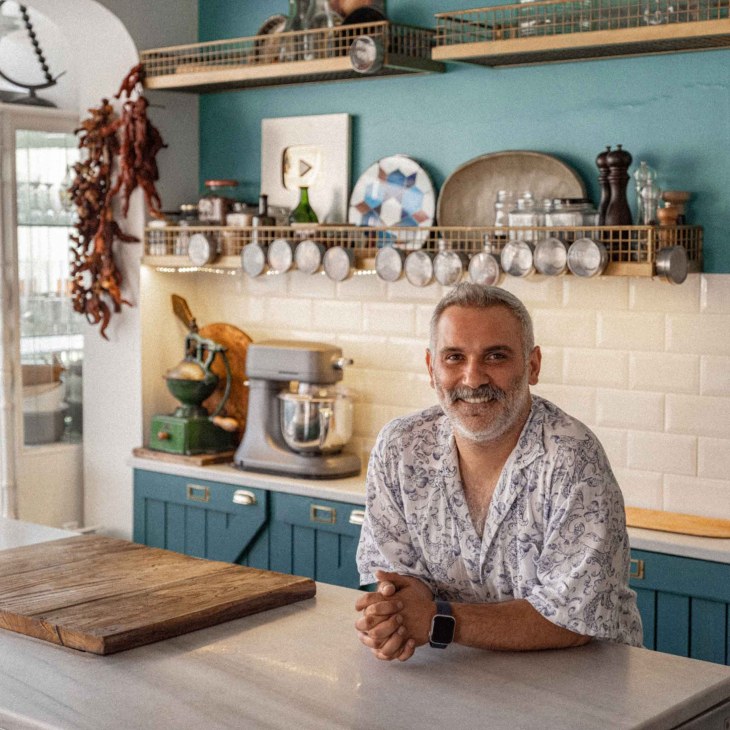
Today’s Kuzguncuklular are custodians, says Refika Birgül, who has been living and working here – and renovating its old buildings – for 22 years. “Decay and regeneration are a cycle,” she says. “But the people who stay here ensure that it is never going in a bad direction.”
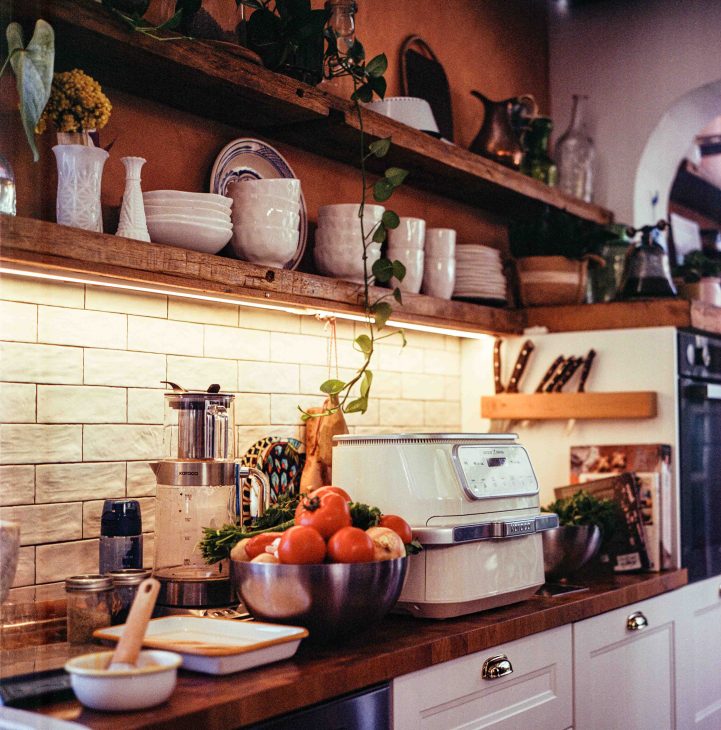
Birgül is the founder and star of Refika’s Kitchen, an online cooking channel that expanded into a cookery book and kitchenware line, all based in Kuzguncuk. The nerve centre of her business is a five-storey stone building dating from 1923; the year is written three times above the door in the Gregorian, Islamic and Hebrew calendars. It was a wreck when she bought it but, with her family and team, she restored its history and rich interior, stripping back the rooms to showcase high ceilings and show-stopping views from wide windows. On the top floor, the roomy studio kitchen opens onto a terrace where you can see all of Kuzguncuk before you. Stained-glass windows up the landing cast the building’s winding internal wooden stairs in bright colours. This is one of a clutch of buildings that Birgul, who also lives here, has renovated in Kuzguncuk.
“If you want the fancy, posh life, in new buildings with all the modern comforts, then Kuzguncuk is not for you,” she says. “But that is the beauty of it.” This spirit is in evidence at the bostan allotments at the top of Icadiye, lined by a row of grand coloured villas. Campaigning residents have ensured that they remain; today there are more than 100 patches divided by the municipality, which distributes its crops to schools, restaurants and residents. It’s also a wonderful place to wander on a sunny afternoon, full of dozing cats and wildflowers. The bostan is the very soul of Kuzguncuk, says Nazli Piskin, a historian and Mediterranean food expert who is based in the area. “It’s not just nostalgic,” she says. “This is a place to reconnect with the seeds, the plants and the animals, to touch the soil.”
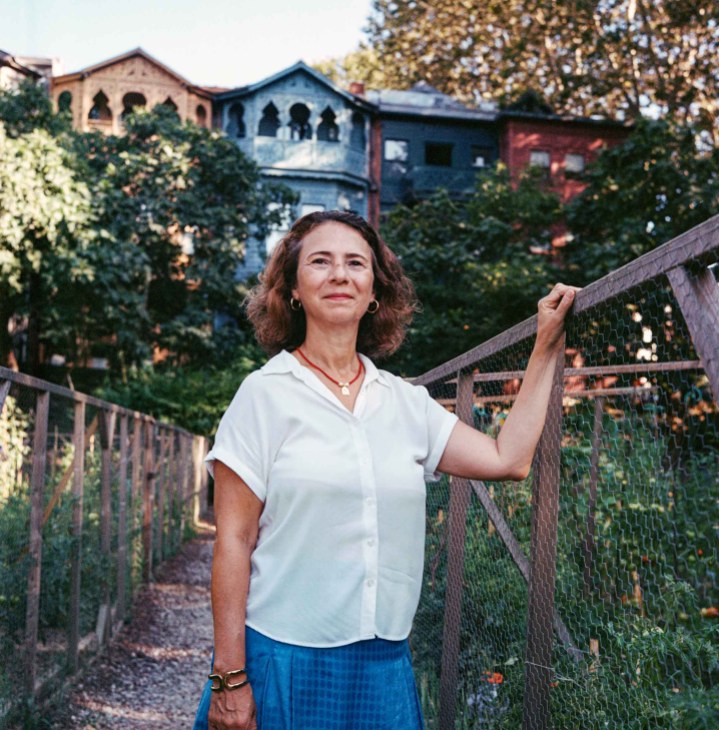
These days it is rarer to find a restoration project here, and prices have soared. Expect to pay several million euros for a yali, one of the old wooden villas on the water that rarely come up for sale. Further from the strait, there is always a steady stream of sale and rentals available, in historic buildings and more ordinary modern apartments. Any foothold will give you a place in Kuzguncuk’s tight-knit community. This is one of the smallest Istanbul wards by population, so expect to see the same welcoming faces on morning strolls down to the Bosphorus.
The running route that shows the area at its best
An early-morning dash up and down the hill will do it. Trace the perimeter of the bostan side and the cross over Icadiye and navigate the side streets, not missing the flight of colourful steps at the top of Bican Efendi Sokak. Finish with the downhill stretch and a tea and simit at the square overlooking the water.
Closest airport and how to get there
Sabiha Gokcen is Istanbul’s second airport and is smaller, closer and calmer than the main hub. A taxi takes about an hour, while the Metro ride from Kadikoy is 50 minutes.
The biggest improvement in recent years
The municipality has upgraded the city’s water transport and there is now a decent number of ferries leaving Kuzguncuk’s small port. There is also a water taxi that offers journeys anywhere along the water.
What the area is missing
For a night on the tiles, the options are limited.
One thing you might only find here:
This is perhaps one of the only places in the world with a working mosque, church and synagogue huddled next to one aother.
Inside Fondation Cartier’s radical new Jean Nouvel-designed home
“This place was almost mythical for us because we waited so long to see it,” says Grazia Quaroni, the director of collections at Paris’s Fondation Cartier pour l’Art Contemporain. The Italian, who has been with the institution for more than three decades, is showing Monocle around the foundation’s new home, across the street from the Louvre’s Richelieu Wing. The building will open to visitors on 25 October.
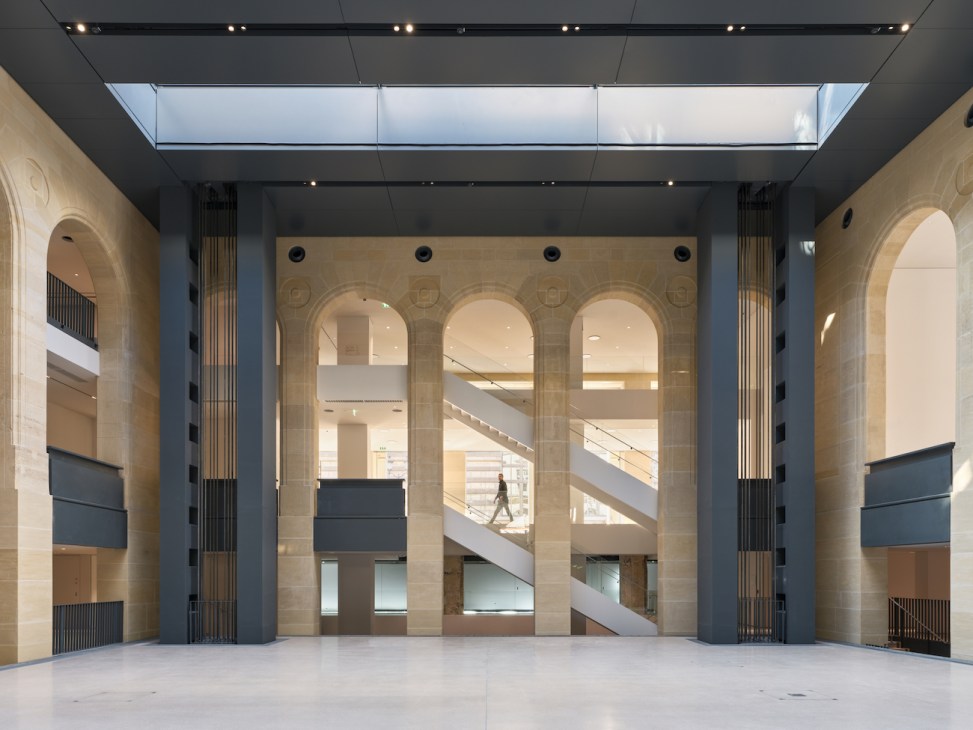
The private foundation – set up in 1984 by the then-president of Cartier International, Alain-Dominique Perrin – was the first of its kind in France dedicated to contemporary art. The opening exhibition in the new space will look back at that 40-year history. It will feature 600 works from the foundation’s 4,500-strong collection, including Panamarenko’s utopian submarine sculpture, complete with a functional periscope, and photographs by William Eggleston.
While the exterior of the historic building, erected in 1855 as the Grand Hotel du Louvre, has been preserved, the interior has been transformed by architect Jean Nouvel. In its centre, five platforms – each large enough to house standalone exhibits – are capable of hoisting monumental sculptures up towards the 11-metre-high ceiling and can be staggered to reconfigure the floorplan of the building. In effect, every exhibition will feature not just new art but a new museum layout. “The potential of the space to make artworks enter into dialogue with one another is immense,” says Quaroni.
In its new home, Fondation Cartier will continue to showcase artworks that take on pertinent human-centric themes, including deforestation, migration and craftsmanship. “The foundation’s DNA won’t change,” says Quaroni. “But this new space allows us and the artists to make every exhibition a platform for widening artistic horizons.”
Comment
Art galleries and museums around the world are facing tricky times. Fondation Cartier’s reconfigurable new exhibition space allows visitors to have a new experience on every visit.
Read next: The Monocle City Guide to Paris, featuring the best hotels, restaurants and retail spots in the French capital
Why Donald Trump’s opponents should strive to better understand his governing style
It is said that today’s leaders – whether in a boardroom or bunker – usually fall into two stylistic categories. Transactional ones concentrate on management, bargaining and calibrated rewards or punishments, often prioritising short-term gains and measurable outputs. Transformational leaders, by contrast, anchor their authority in a broad vision and moral purpose, and seek to inspire followers to accept a shared, higher goal.
These styles shape foreign and security policy in different ways. Transformational leaders can redefine national identity and doctrines – think of Ronald Reagan’s role in reframing Cold War rhetoric or Nelson Mandela’s in conceiving post-apartheid South Africa – by mobilising public purpose and long-term commitment. Transactional leaders – perhaps most famously exemplified by Donald Trump – typically pursue tactical bargains, incremental reforms and contingent alliances: they negotiate, trade and calculate advantage rather than seek wholesale reordering of the international system.
Many believe that what Europe needs is a standout transformational leader – a singular figure capable of, for example, leading the negotiations over Ukraine’s future or bringing peace to the Middle East. By contrast, the US president, who is widely perceived as being wholly transactional, seems to be setting the global agenda. But it is misguided to present Trump as representing one clear leadership style. Instead, he is a paradoxical embodiment of both transactional and transformational. On the one hand, he treats foreign relations as a series of zero-sum exchanges, underscoring a deal-making philosophy that fits the transactional definition. Yet he also, particularly during his election campaign, exhibited transformational traits such as calling for a complete reordering of US foreign policy and global trade.
Perhaps herein lies the effectiveness of Trump’s sometimes difficult-to-articulate style. The late Joseph S Nye Jr conducted a thorough stylistic survey of US presidents in his 2013 book, Presidential Leadership and the Creation of the American Era. He concluded that while long-term economic and military shifts have accounted for much of the rise and fall of US power, crucial historical turning points have also been shaped by key leadership decisions. Indeed, Nye’s striking finding was that highly effective transactional leaders, such as Dwight D Eisenhower and George H W Bush, often proved just as consequential as their more transformational counterparts. By portraying transformational leadership as the sole engine of historical change, opponents of Trump, at home and in Europe, might be looking for the wrong style. The multinational challenges of the 21st century demand hybrid leaders: managers who can negotiate and execute, and visionaries who can build trust and long-lasting coalitions.