Issues
The architects of Sydney Modern: How SANAA redefined the city’s skyline
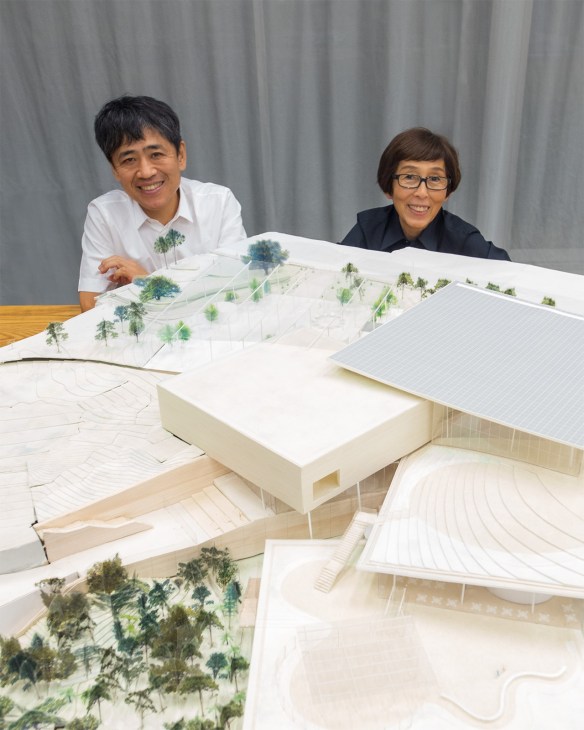
Kazuyo Sejima and Ryue Nishizawa are the formidable duo behind Tokyo architectural studio SANAA (Sejima and Nishizawa and Associates). Founded in 1995, SANAA has been an extraordinarily successful partnership. The pair are famed for their light, fluid structures that sit at ease in their particular landscapes. Memorable works, such as the 21st Century Museum of Contemporary Art in Kanazawa, the New Museum of Contemporary Art in New York and the Rolex Learning Centre in Lausanne, earned them the Pritzker – architecture’s highest prize – in 2010.
Sydney Modern has established itself as one of Australia’s most ambitious cultural landmarks, a stunning extension of the Art Gallery of New South Wales with commanding views across Sydney Harbour. The project, which was certainly one of the most significant since the Sydney Opera House, has become a testament to the vision of its creators, Kazuyo Sejima and Ryue Nishizawa.
Their solution for the historic site, which straddles a highway and incorporates two vast Second World War oil tanks and a grass-covered land bridge, is a series of pavilions that cascade down the sloping ground towards the waterfront. It is certainly one of the most ambitious cultural landmarks to open in Australia since the Sydney Opera House almost 50 years ago. SANAA has two other big projects under construction: New Kagawa Prefectural Gymnasium in Japan and Suzhou Shishan Square Art Theatre and Museum in China. Monocle speaks to Sejima and Nishizawa in their waterfront office in Tokyo on the day that they are announced as the recipients of yet another award, the 33rd Praemium Imperiale.
How was it working on Sydney Modern during the pandemic?
Ryue Nishizawa: It was the first time we’ve had to work remotely. We were lucky that a member of our team went to Australia before it shut down and she just stayed there. As soon as the country opened up, Sejima-san and I went to visit the project. Seeing it in real life for the first time was an amazing experience.
Kazuyo Sejima: During the pandemic we had regular online meetings with the museum people and more frequent ones with the project team. We met Kathryn Gustafson [who designed the landscaping] in Europe. Somehow it all worked out.
The museum is in a remarkable location, right on Sydney Harbour. What did you think when you first saw it?
KS: Honestly, I was a bit hesitant about the site at first. With the bridge over the road and the oil tanks [that had to be preserved], we weren’t sure. But then we realised that it could be an exciting project. We spent a lot of time talking to the museum about how we could make some continuity between the existing [19th-century] gallery building and the new one. We also proposed turning one of the oil tanks into a gallery and that is now an incredible space.
RN: This peninsula is really beautiful: you have the Opera House, the Botanical Gardens and a big park called the Domain. There were also many historical elements to consider. I wouldn’t say that we felt pressure exactly but we wanted to do something good on one of the most beautiful sites in the city. We thought, “How can we make it better?” It was a good challenge.
How did you come up with this idea for a series of pavilions?
RN: Since the ground slopes down, it would have been difficult to make one big box. We made multiple galleries so that people can go down gradually.
KS: And we fit them between spaces so that people can experience the surrounding topography. They can also walk on the roof, which is exciting. I wanted to design a building that creates new experiences for visitors.
RN: One of the interesting things about this museum is that it’s built in a park. Inside and outside are both public. It’s also a thoroughfare: there are people who pass by every day from Woolloomooloo to downtown.
You [Nishizawa] once said that a museum is ‘more than a place to store paintings’. What is the role of an art museum today?
RN: The primary role is still to show art but recently museums have become more multipurpose. They’re also about learning, research and talks. There are so many events at the gallery – both cultural and business – in the lobby and in the restaurant. That’s a new side to museums; they function more like cultural centres.
Sydney Modern is the first museum to be given Australia’s top rating for sustainable design. How important is sustainability in your work?
KS: Sustainability is often judged from the point of view of energy efficiency; it’s important but we’ve tried to look at the issue from different angles by using existing materials and features, and protecting trees. Those considerations affected the design: the entrance pavilion was positioned to accommodate a tree [a moreton bay fig planted by the artist Joseph Beuys]. With the oil tank gallery, we made use of its high ceilings and columns. We tried to respect what was already there.
What is the process of working as a duo?
RN: We always work as a team, as many as 10 people. It’s normal for us. Everyone brings their own ideas. When somebody suggests something good, someone else might take over and make it better. There are many streams of thought. Some of them die; some of them survive; some of them are integrated. It’s very interesting. Nobody knows which one will win. Everything is done through discussion. Sejima-san is like my teacher; we share a language. The pandemic gave us time for discussion. Sejima-san stayed here from morning until evening so that we had time to talk through ideas. It’s a rare situation, which we’d never had before. Before, she was always busy, always travelling. Now I feel that we have too many meetings. The downside of the pandemic was that we couldn’t visit the Sydney site. When we did Louvre-Lens in France, I was there almost every month.
You had an exhibition in Tokyo this spring that looked at the relationship of your work with the landscape – is that an essential ingredient?
RN: Architecture doesn’t move; once it’s built it becomes a part of the landscape so we have to think how we can make them work together, especially in this kind of situation where everybody can see and visit it. Architecture isn’t sculpture. With an object, you think about how to make it look good. Architecture has to become one with the landscape.
Your work has evolved from what you’ve called ‘box architecture’ to more organic shapes. How has your work changed over the years?
RN: During the 1990s our architectural thinking was two-dimensional; we would take a flat drawing and turn it into a building. The big change is our computer tools. Back then we used Cad to draw plans and it was really two-dimensional. Now we have special programmes so we can think about new designs in three dimensions from the beginning. In the old days, everyone came to meetings with a plan to express their ideas; now they bring a rough 3D model.
KS: I must admit that I still like a plan. I don’t design on a computer. Our forms have become more complicated compared to the old days and in terms of the number of engineers we work with. We have to think from many different points of view. We listen to the engineers’ ideas and opinions, and then we develop the design. It’s a collaborative effort.
What are the challenges of building overseas in locations you don’t know?
KS: Every site has its own characteristics. People who have grown up in a place know it best but sometimes an outsider can see something different. It can be challenging [to work in a new place] but it’s also interesting finding what’s possible. This is our first building in Australia. The weather and nature are beautiful but the scale is a lot bigger than Japan and the lifestyle is different. I was surprised to see so many people out running at lunchtime, close to the museum. The way people use a building is different too.
Why do you think that Japan has produced so many good contemporary architects?
RN: It’s not just Japan – there are so many great architects all over the world. Perhaps it’s that Japan isn’t Western so we take a different approach to design. When I go to Europe, I feel architecture is made with four walls. In Japan, this isn’t the only way. In traditional architecture, you don’t have those [solid] walls, which leads to a very different way of thinking. Continuity of space is very important in traditional Japanese architecture and for us too. With Sydney Modern we wanted the architecture to give people the opportunity to walk outside, even on the rooftops.
Last word about Sydney Modern?
KS: When we last visited, the experience on the first and second day was so different. Dark one day, sunny the next. The light conditions make for a very different atmosphere so it will be a changing experience for visitors. We want the museum to be part of the environment, even for people who are just passing or sitting on the terraces.
RN: With the Kanazawa Museum of Contemporary Art, one of our dreams was that people in the city would accept the museum, that it would be a place that they want to use and become part of their town. That’s an important part of architecture for me.
sanaa.co.jp
A photographic tribute to Milan’s sciure: Icons of style, power, and cultural legacy
Fashion is often seen as the preserve of the young. But in arguably the most fashionable city of them all, Milan, ladies of a certain vintage are proving that dressing well is less about standing out, or having the latest ‘in’ logo emblazoned on a T-shirt, and more about cultivating a personal style that relies on sumptuous fabrics, elegance learned through experience and just the right amount of embellishment to turn the daily consumption of espressos and proseccos into a living lesson in how to present oneself. These ‘sciure’ have even become a modern style phenomenon. So who are they? We hit Via Montenapoleone to find out.
Swaddled in furs and cashmere in the winter, linen dresses and silk jackets in the summer, and gold jewellery with permed coiffes all year, the figure of the sciura looms large in the Milanese psyche. In kid-leather gloves, this high priestess of taste can be found sipping a cappuccino at Cova in the morning and an aperitivo at the Salumaio di Montenapoleone or Sant Ambroeus in the afternoon, alternating effortlessly between espresso and prosecco throughout the day. She has a box at La Scala and shops exclusively at independent boutiques, be it for Bottega Veneta leather goods at Antonia or pasta at Rossi & Grassi. She’s elderly, wealthy and rarely spotted beyond the confines of the upmarket neighbourhood of Brera (unless it’s the weekend, when she’s at her second or third home in Brescia). She’s a natural project manager, fluttering around her palazzo, organising elegant dinner parties and bossing around her housekeeper, butler and cook. She is a uniquely Milanese phenomenon, though it is unclear whether she belongs to the city or if the city belongs to her.
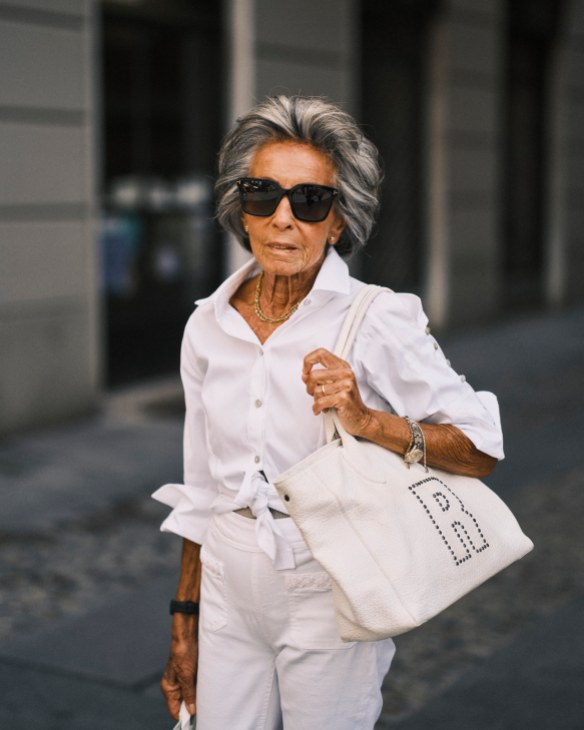
She also, for better or for worse, no longer really exists – at least in such a codified form. This is partly because the type of wealth associated with a sciura‘s rarified lifestyle belongs to a bygone era in European countries, even in aristocratic Milan. Today the Villa Necchi Campiglio is no longer a family home but open to the public as a relic of its time. Despite this, the legacy of Milan’s status as a city of nobility lives on through its distinguished residents and, in particular, its leading ladies. The term itself, sciura (plural sciure), is part of the local dialect and derives from “sciur“, the Lombard word for “mister” or “sire”. Perhaps unsurprisingly, it implies its fair share of negative connotations – a self-entitled, snobbish attitude and an unashamedly elitist view of society – but calling someone a sciura today is more of a hyperlocal joke than an insult. In recent years, the figure of the sciura has even become a social media phenomenon and a kitschy marketing tool for Italian brands such as La Double J and The Attico, or the popular Milanese restaurant Sant Ambroeus. Ironically, this type of publicity is one that a true sciura would shy away from, classifying the limelight as horrifically gauche.
Regardless of the state of the veritable sciura today, it is undeniable that women in Milan above a certain age are particularly stylish, more so than in other Italian or other European cities. As the residents of a fashion and design capital, home to Prada, Armani, Marni and Salone del Mobile, the Milanese embrace the notion of la bella figura to an extreme, taking immeasurable pride in putting their best foot forward and wearing their dignity on their sleeves (even when riding the tram or grocery shopping). “For some, it’s not just fashion, it’s a way of life,” says Giuliana d’Angeli, a Brera native. “It’s our culture and someone who is not from Milan can only attempt to replicate it.”
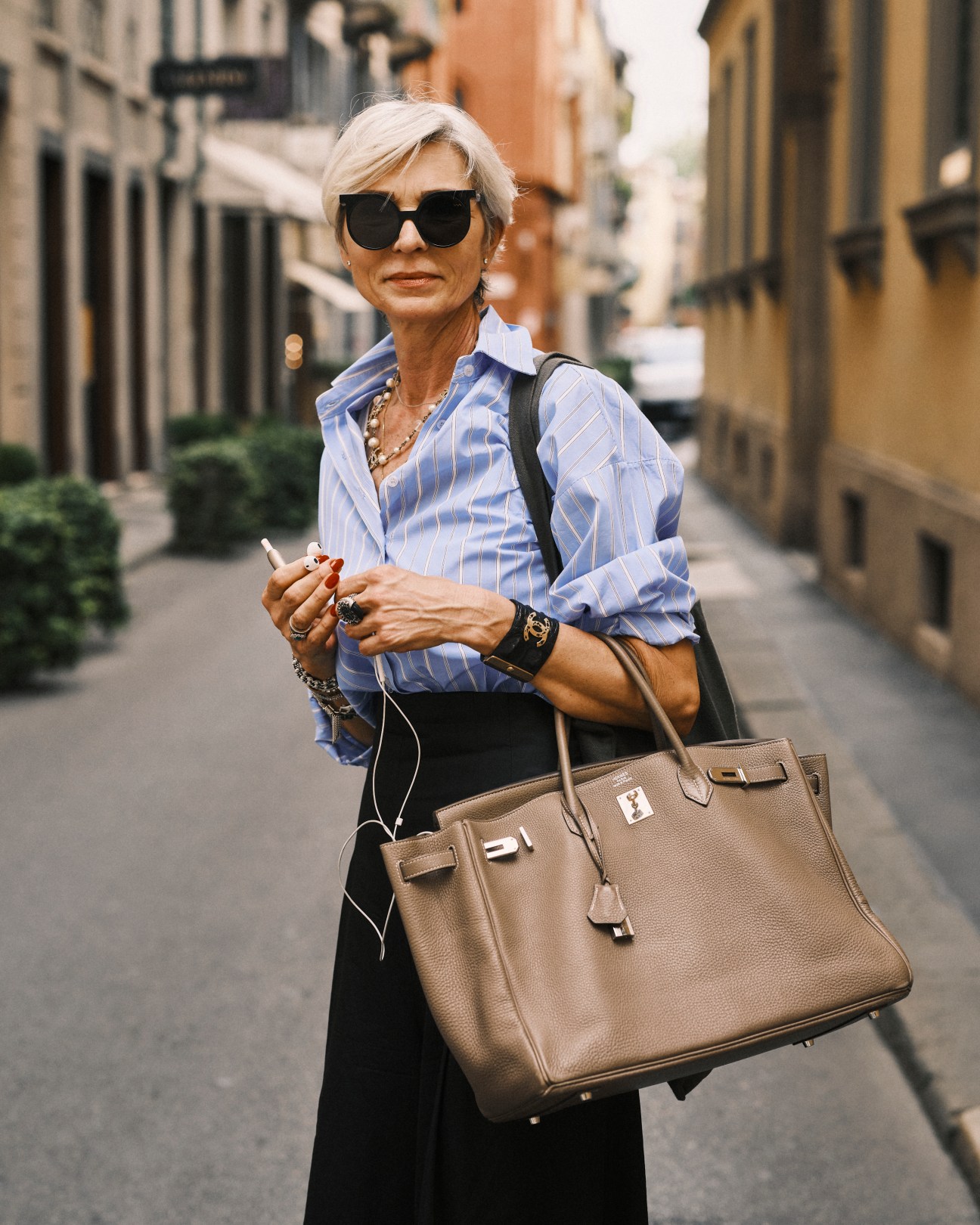
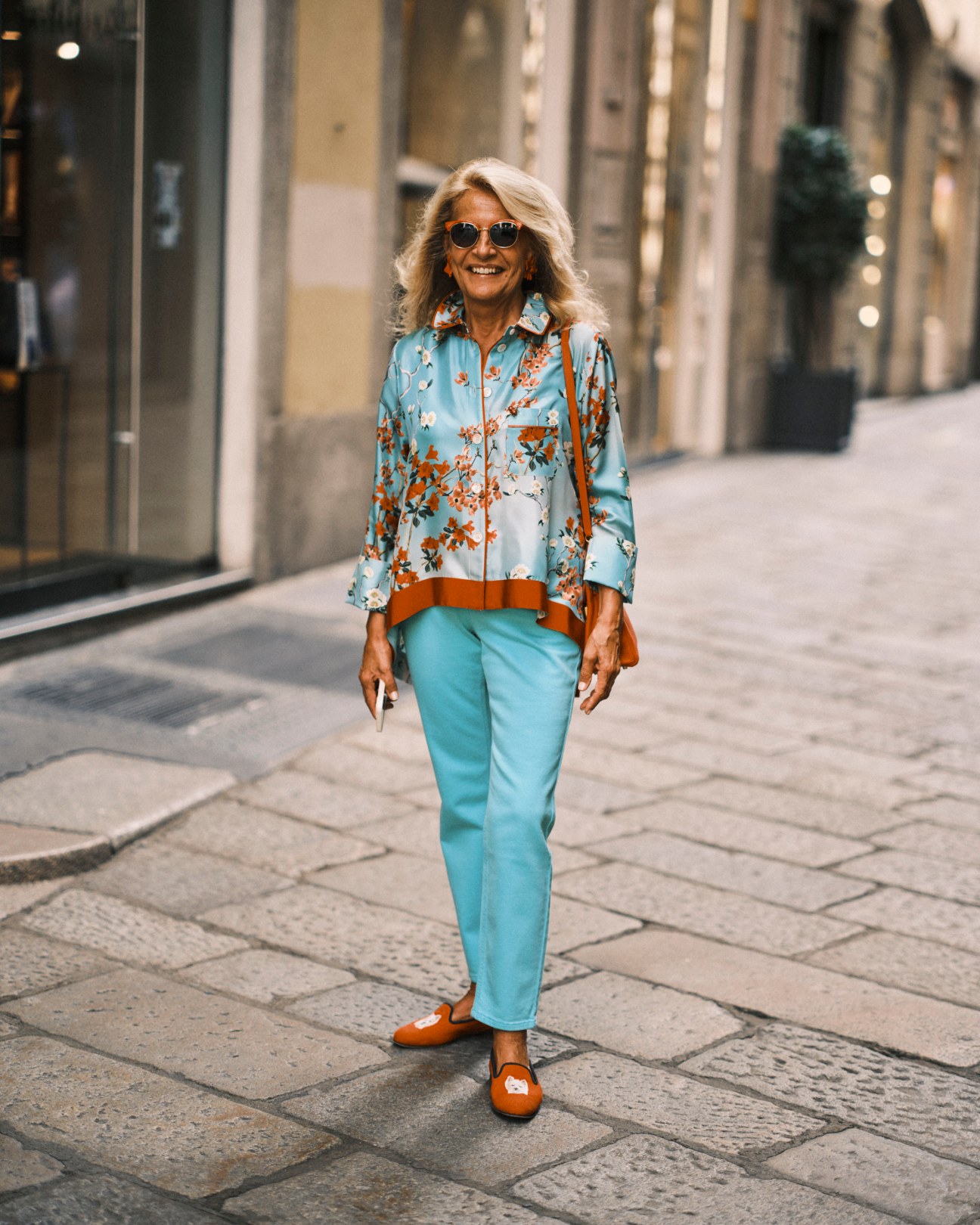
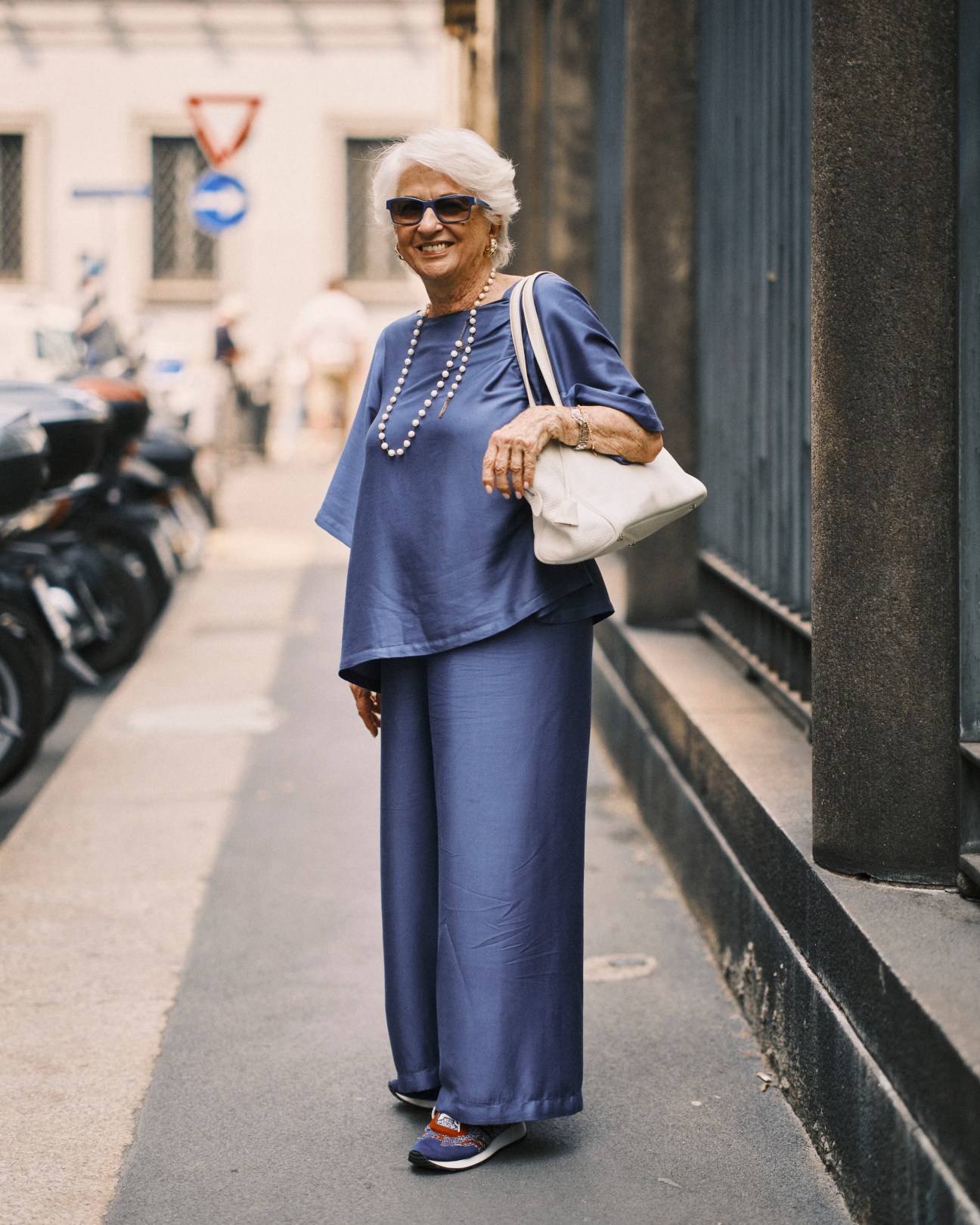
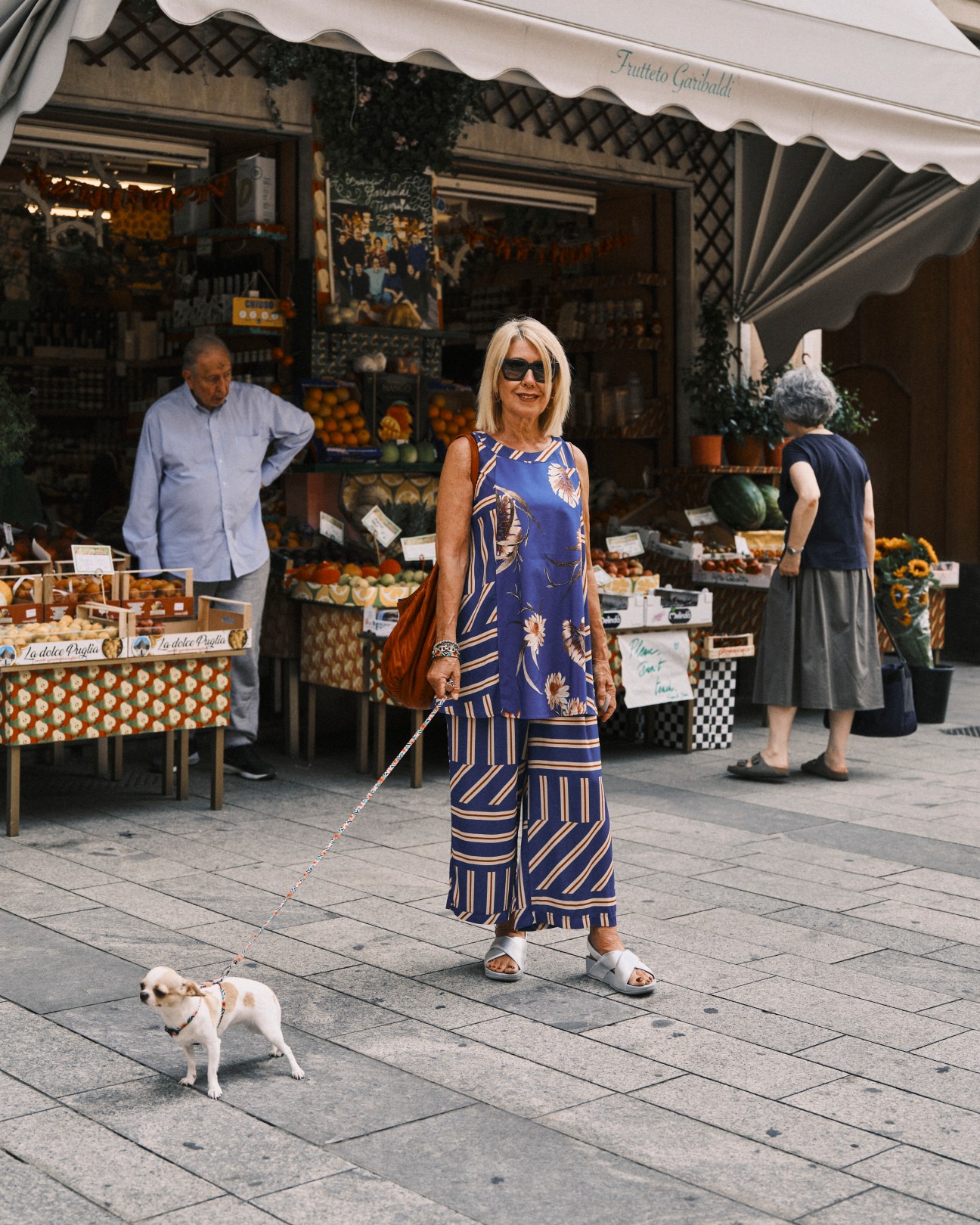
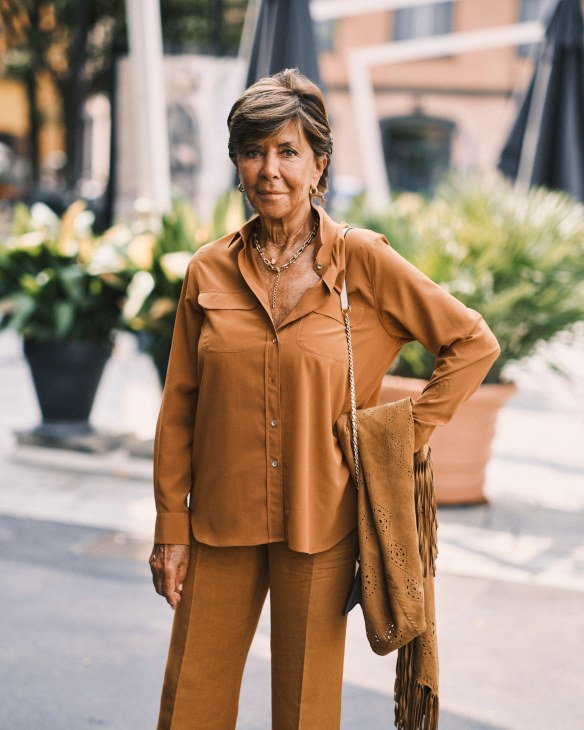
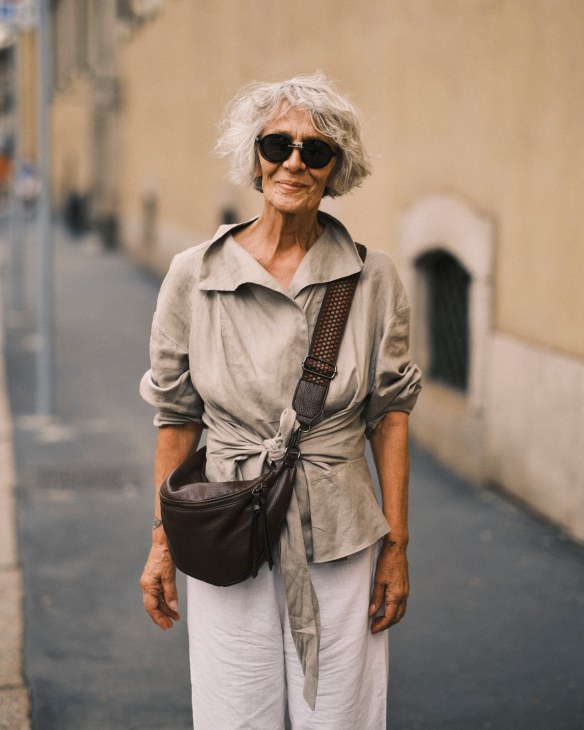
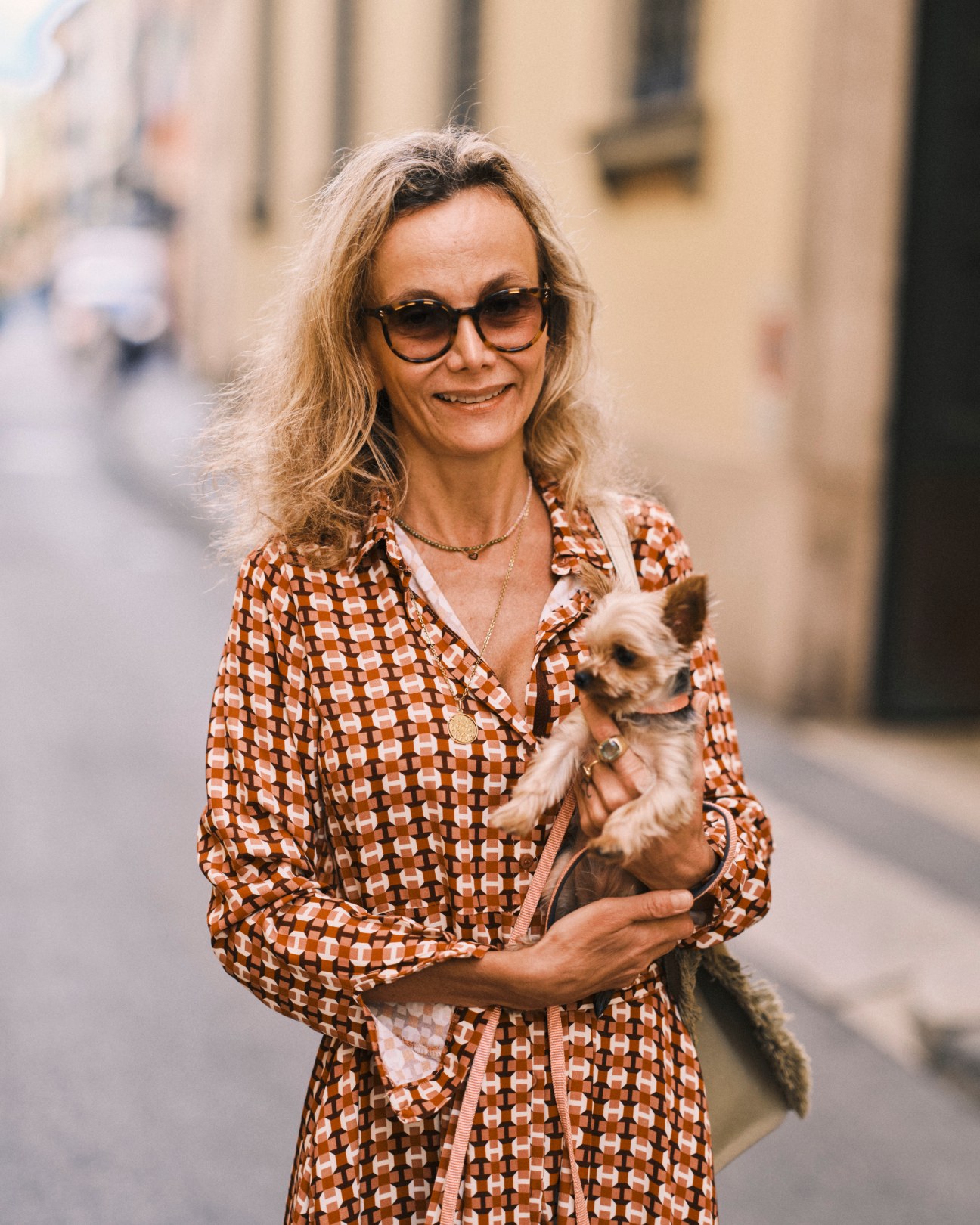
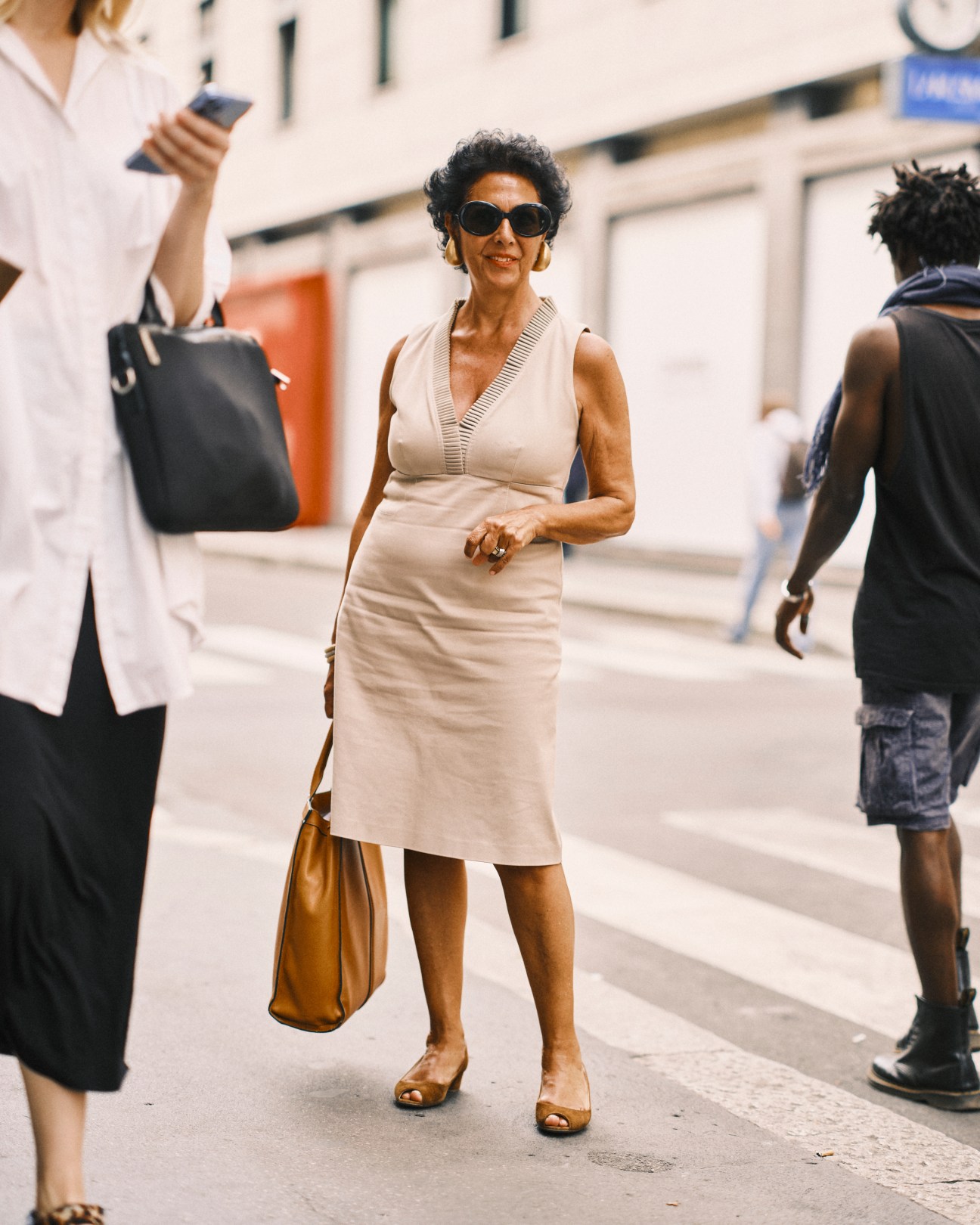
It’s 09.30 on the Via Montenapoleone and Monocle is seeking sciure. We’ve come to Cova, a glitzy café that verges on the gimmicky; in any other city, it would be the preserve of tourists. But this is Italy and the gilded institution is actually frequented by well-heeled Milanese drinking cappuccini served by waiters in tuxedos. Regulars file in, designer bags and sunglasses in hand. They loudly greet each other between even louder phone calls.
As we approach our first candidates for sciure, it transpires that it is a term that many women recoil from. That’s partly because it implies age but also a standardised look and a lack of sartorial originality. “I’m 73 and trying to dress for my age,” says d’Angeli. “But I could never be a sciura because they follow a fashion rulebook whereas I rely on my own instinct. I don’t feel old enough to be considered a sciura. I’ve lived in Milan for 40 years, and the city has disciplined me. I shower then moisturise and put lipstick on every day.” After further terminological discussion, other women will admit that it can be taken as a compliment (depending on tone and context) and it implies that you are exquisite, refined; you have a Milanese attitude and you, my dear, are looking particularly stylish today.
We continue to comb the streets of Brera and find more manicured women in cream dresses, high heels and floral blazers. Some of them nonchalantly carry bouquets of flowers, the day’s copy of La Repubblica or, in one case, a chihuahua named Amalia. Often, a well-heeled husband in Gucci loafers and with a silk pocket square waits patiently in tow as we initiate a discussion with their wives. A rigmarole almost inevitably ensues, wherein suspicion and reluctance to draw attention to oneself is eventually replaced – after considerable flattery by Monocle’s Venetian photographer Andrea Pugiotto – by five minutes of expert posing in front of the lens.


“The only style icon I follow is myself,” says Bianca Fersini Mastelloni, chairman and CEO of communications agency Polytems. “And maybe Audrey Hepburn,” she adds, in her beige Valentino dress and gold doorknocker earrings. Being in the presence of these women is a lesson in perennial chicness and letting personal taste speak louder than any logo.
Despite the fashion world’s obsession with youth and a fast-paced calendar of never-ending novelty, these women’s assurance in their own style and taste is one that younger generations should aspire to as an antidote to passing trends. If there is one thing that these women can uniformly agree on, it is the state of fashion today and how younger Italians dress too casually. “It’s changed for the worse!” “Everyone looks the same!” “Don’t get me started on ripped jeans!” (Nothing sends a shudder through these women like the thought of ripped jeans.) The truisms and advice given to us throughout the day range from paying attention to colour-coordinated details to the importance of wearing tights and jackets in formal settings, including restaurants. Ultimately, these women admit to mourning a loss of formality, where no rules also means no liberty. “What can I say?” one woman asks me with a sense of fatality. “You either have style or you don’t.”
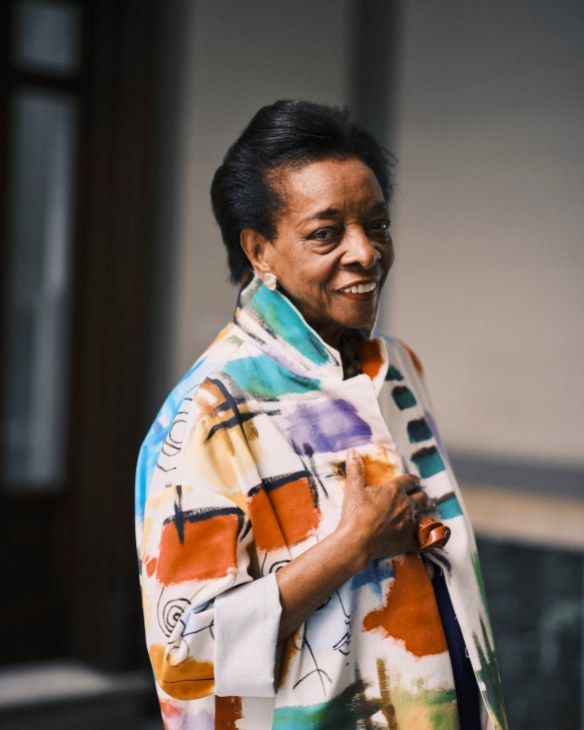
Marva Griffin
Venezuelan-born Marva Griffin has called Milan home since the 1970s. In 1998, she founded Salone Satellite, a part of Milan Design Week that showcases emerging designers from around the world. When Monocle catches up with Griffin over a glass of wine in her Brera apartment, she can’t help but despair at fashion today. “Did you know that people pay to have rips in their jeans?” she says.
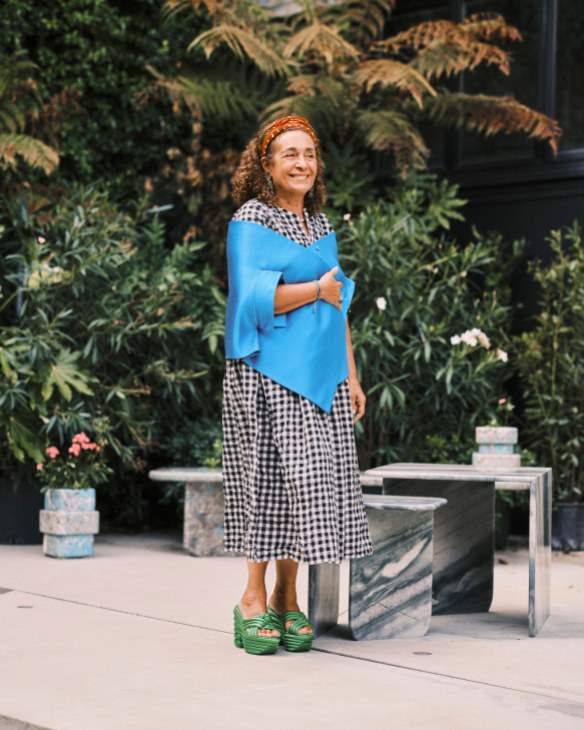
Nina Yashar
Nina Yashar is the founder of Nilufar, an influential gallery that has been bringing contemporary and historic design to Milan since 1979. When we meet her at Nilufar Depot, Yashar wears green Ferragamo shoes, a blue Prada shawl and one of her trademark headpieces.
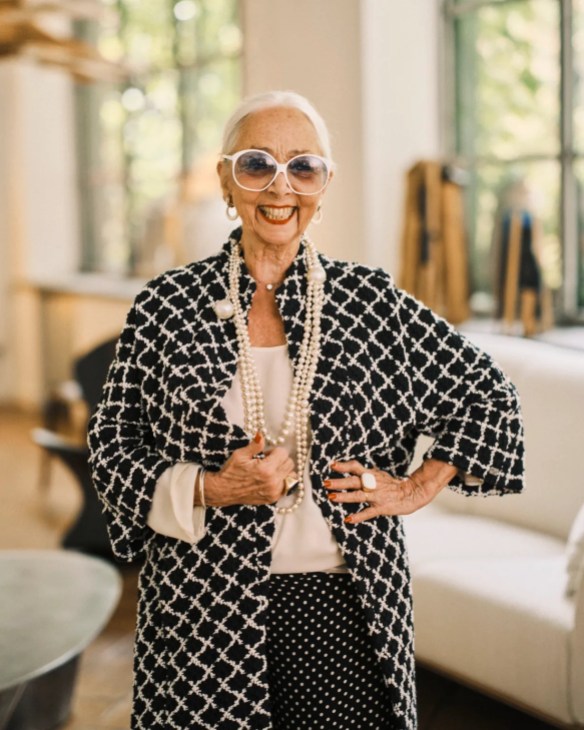
Rossana Orlandi
Rossana Orlandi left her job in fashion for the world of design in 2002. Monocle meets her at her gallery in the Magenta neighbourhood, where she greets us in a vintage Chanel coat and shoes from Milanese boutique Wait and See. “I keep everything – I have owned the same dresses since forever,” she says. “I follow my mood and feelings when I get dressed.”
Read next: The Monocle City Guide to Milan, featuring the best hotels, restaurants and retail spots
Editor’s letter: The mobility innovations steering our lifestyle choices today
If you had to name Spain’s most successful mobility player, you might choose its high-speed rail operator Renfe or perhaps one of its car marques such as Seat. But there’s another brand that’s arguably the nation’s nippiest player on four wheels: Rolser, the maker of personal shopping trollies. In Spain, you see, a product once considered in much of the world to be an accessory sported only by grannies has become a fixture of most households – a whacking 63 per cent of Spaniards now have one parked in their homes.
Founded in 1966, the family company makes more than half a million trolleys a year at its production facility between Valencia and Alicante. Its customers include seniors but also artists, designers, young parents and cool kids. And sales are on a roll across Europe, the US and Asia. You can see the appeal – in a world where young people eschew car ownership, working couples forgo a weekly hypermarket visit in favour of shopping locally and stores discourage the taking of plastic carrier bags, having your own set of retail shopping wheels simply makes sense.

Mobility models move in interesting ways. That’s why this issue, which focuses on how we get from A to B, features not only an Expo dedicated to the Rolser (so handy for delivering magazines!) but also sturdy footwear, a remade East German train with velour allure, Finnish lifts (as in elevators, not a gym manoeuvre) and perhaps one of the dinkiest cars that you’ll ever see, thanks to a nimble-minded Japanese designer. But those aren’t the only ways that Monocle magazine is on the move.
Our September issue, you will soon discover, has a new look. While the livery on the front cover might be unchanged, inside we have gone for a new configuration and added some extra treats to the trolley. At the front of the magazine, for example, we have introduced a new Dispatch section in which we offer a mix of comment, columns and news on everything from travelators (and why they’re about to start moving faster) to how to complete the daily commute in style. As we continue to develop our digital offering and newsletters, we want to ensure that we use print for what it does best: showcase great photography and expansive, fresh reporting.
Our report on Bofill Taller de Arquitectura in Barcelona is a perfect example. This tale of legacy and renewal explores the ways Pablo Bofill has taken the company that his father, Ricardo, started in the 1960s to new heights. Part of his success has come from doubling down on the principles that guided the firm in its earliest days – chiefly that the studio should be a place where artists, engineers and philosophers come together.The studio is housed in a former cement factory so vast that even 60 years later the Taller space is still a work in progress. The images alone will make you yearn to see it.
And here’s some good news for those who have signed up to this year’s Monocle Quality of Life Conference, which takes place this month in Barcelona. We are organising a very special visit to the Taller so that you can see this extraordinary space in person. Need any more encouragement? Visit monocle.com to discover the full programme, including all the inspirational speakers. It’s a highlight of the monocle calendar and it would be tremendous to meet you there.
If you want to share an idea or send me your mobility insights before then, you can find me on at@monocle.com. Unless I’m down the shops with my Rolser.
How can today’s military recruitment strategies win over a generation that won’t fight?
In 2024 global military expenditure hit a record $2.72trn (€2.37trn). While much of this was directed towards the development of 21st century weaponry, militaries are still in dire need of that most basic but increasingly difficult to procure resource: manpower. In Europe, where this personnel shortage is particularly acute, vanishingly small numbers seem to be interested in military service: a Gallup poll last year revealed that only 32 per cent of EU citizens would be willing to fight for their country in the event of a war. It’s a fact that is vastly complicated by the presence of war on the continent. To combat this apathy, governments are spending big on recruitment campaigns. The messaging and imagery tells us a lot about how a country sees itself, as well as the specific challenges that it faces.
Almost all of these ads are aimed at young people for whom patriotism might not be as powerful a pull as it once was. So, gone are the jingoistic slogans of yesteryear – “Your country needs you” and “Follow the flag” – and in their place are ones that appeal to feelings themselves, such as a desire for adventure or self-improvement: “Anything but regular” or “Be all you can be”.
Of course, though pressing, recruitment gaps in Europe and the US are not yet existential. This is not the case for countries at war. In Ukraine, where all men aged between 25-60 are required to register for conscription, there is a huge manpower shortage as the war of attrition with Russia moves towards its fourth year and many seek exemptions from the call-up. While conscription squads roam the streets looking for draft dodgers, the military is also getting creative with its advertising, trying to sell service as something cool and fun, rather than a death sentence.
In Russia, which has also seen forms of mobilisation mixed with a wider recruiting drive, most messaging focuses on the themes of masculinity and material gain. “Monthly payments starting at 204,000 rubles [€2,210],” are the last words to appear on screen in the campaign discussed here, which was released at a time when Russian battlefield losses in Ukraine were estimated to be as much as 700 a day.
In such circumstances, recruiters cannot, perhaps, afford to be anything other than blunt. But how can countries that are not yet at war persuade a cohort of people for whom military service has never seemed like a viable career path to join the army?
Here, we assess seven recent military recruitment campaigns from around the world, identifying how their ambition translates to overall messaging, as well as whether they have been successful with their creative choices. There is generally a widespread understanding in defence ministries across the globe that a military career must be rebranded to appeal to a new generation. But how best to achieve this? Let’s find out.
1.
France
Campaign: Can you do it?
Year: 2024
Agency: Dentsu Creative France, an advertising and public-relations firm based in Paris, which has produced work for Adobe and Ikea.
Messaging: This campaign for the French land army is about emphasising the variety and adventure of military life in the 21st century. The online component stresses that the army offers recruits 117 specialities in which to train, as well as detailed daily life in the force and invited potential recruits to try their hand at fitness events and team-based activities hosted in five French cities, including Paris and Marseille.
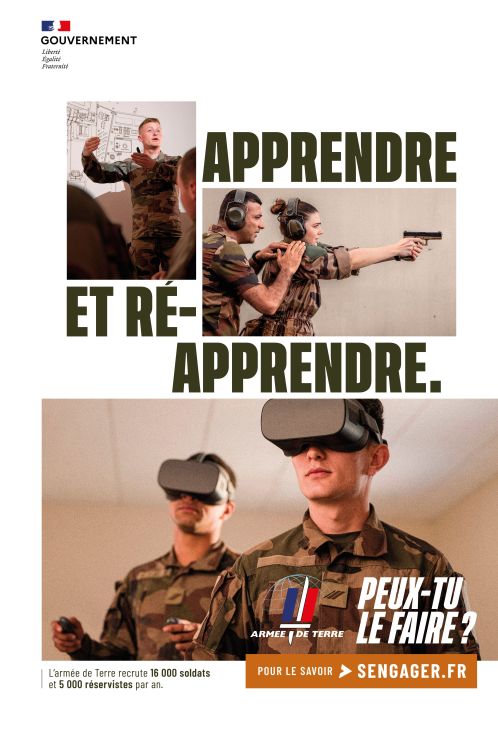
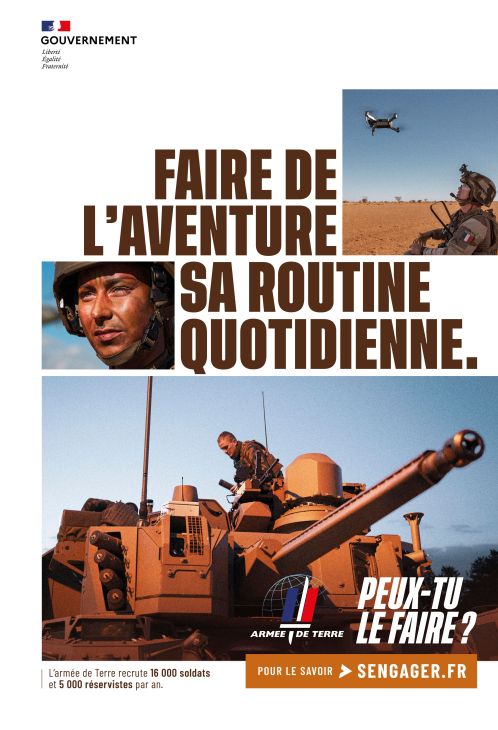
Ambition: Launched in September 2024, the campaign’s objective was to recruit 16,000 new soldiers and 5,000 reservists in the following year.
Does it work? At the time of writing, the French army has yet to release the recruitment figures for the year following the campaign. It certainly succeeds in making army life sound a little more fun than you might suspect.While many young people in Western countries are struggling with unemployment, a social life dominated by technology and a lack of purpose, an adventure and some structure might just seem appealing.
2.
Sweden
Campaign: You have what it takes.
Year: 2024
Agency: Nord DDB
Message: This is the first time that a Swedish military recruitment ad hasn’t featured a single soldier, weapon or battlefield. A woman gives a friend a piggyback across a bridge. Up flash the words, “Marching with a heavy bag…You have what it takes.” Next, we’re in a classroom where another woman is nodding off. Her friend throws a paper ball at her. “Assist your combat partner…You have what it takes,” insists the text. At a time when Sweden is rapidly rearming, this campaign is aimed squarely at young women, who make up less than 20 per cent of new recruits.
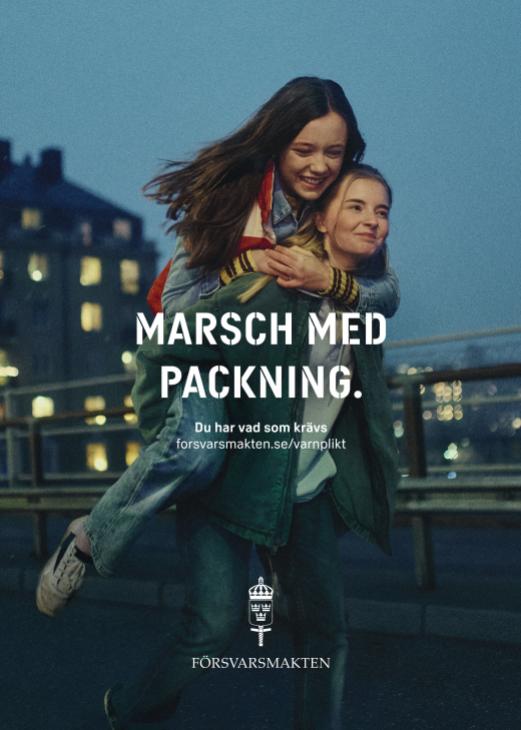
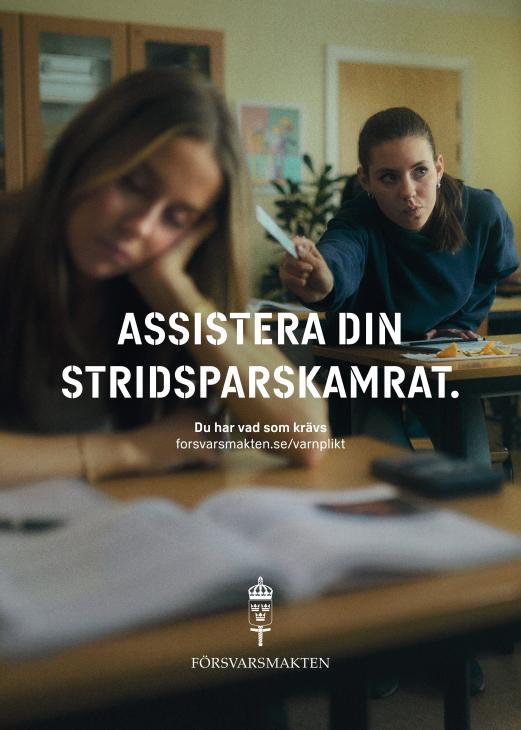
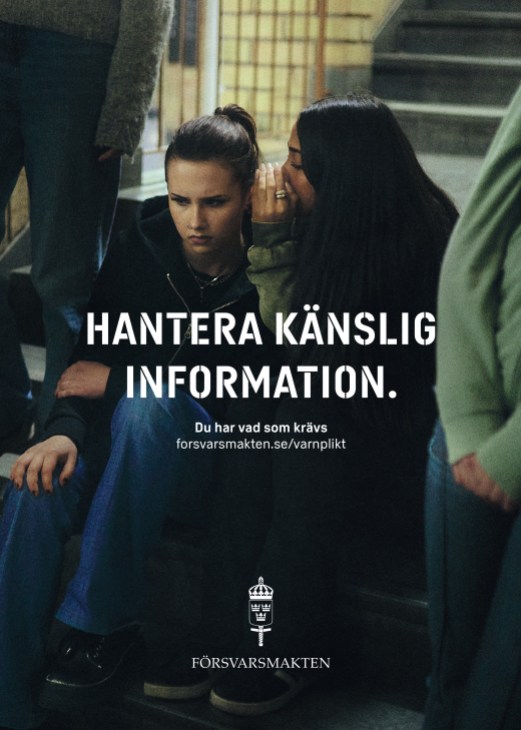
Ambition: The goal of the Swedish Armed Forces is for 30 per cent of its new recruits to be women by 2030. “You have what it takes” was conceived with this plan in mind.
Does it work? In 2024, women made up 19 per cent of the armed forces (the army, air force and navy combined), down from 24 per cent in 2023, but the numbers are heading in the right direction.
3.
Russia
Campaign: You’re a man. Act like it.
Year: 2023
Agency: In-house at Russia’s ministry of defence
Messaging: In this televised campaign, supermarket security guards, taxi drivers and fitness trainers are shown shape-shifting. “Did you really want to choose this path?” a super asks with menace. One flicker of the light and they’re transformed into soldiers, clad in military gear. Questioning the virility and value of everyday jobs, such as those of shopkeepers or chauffeurs, the campaign attempts to shame men across Russia into action, while depicting the military as an antidote to the humdrum existence of modern life.

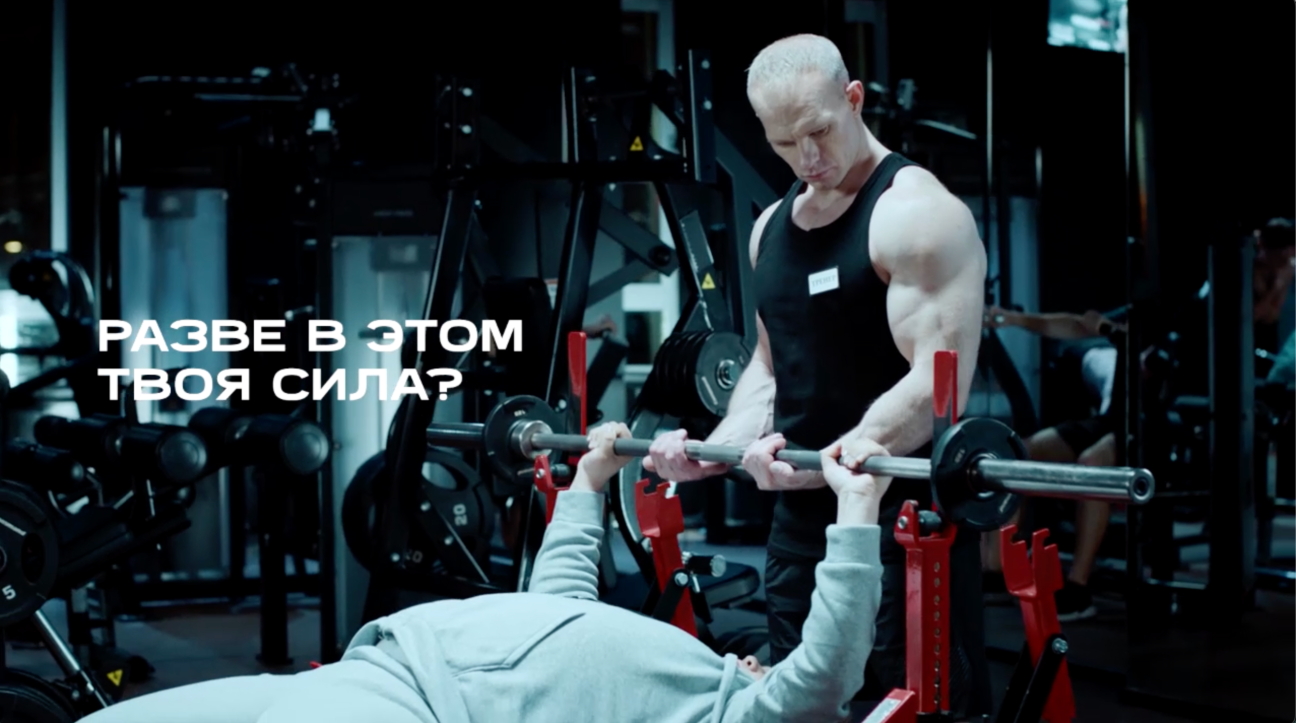
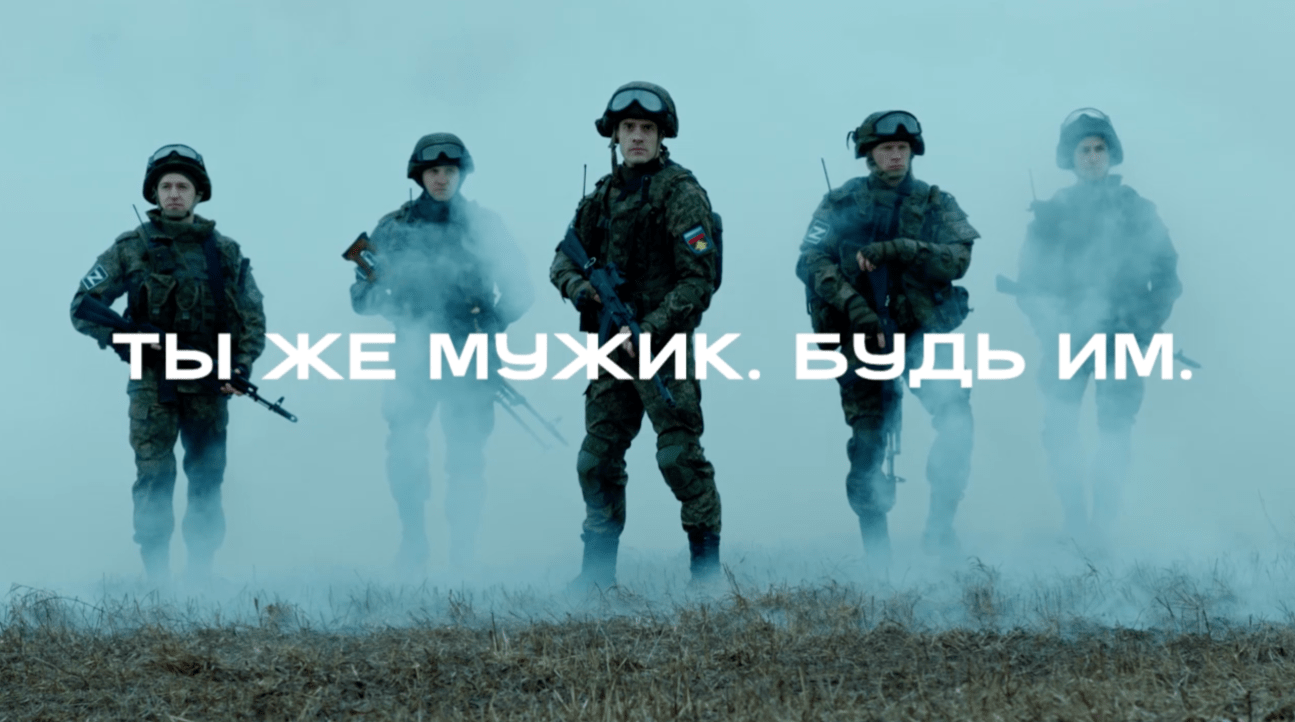
Ambition: To drastically increase recruitment of professional soldiers. Though all Russian men aged 18 are required to complete 12 months of national service, these conscripts cannot be deployed to fight outside of Russia and were exempt from a first round of mobilisation in 2022. When this campaign launched, Russian losses in Ukraine were averaging almost 700 personnel a day. The defence ministry was forced into even more desperate attempts at recruitment, including commuting prisoners’ sentences in return for signing up and offering huge financial incentives.
Does it work? Sort of. The Kremlin avoided a potentially mutinous second round of mobilisation, with Vladimir Putin claiming that 490,000 soldiers were recruited in the 12 months up to December 2023, though he later revised that figure to “more than 300,000”. But as Russia expert Lucy Birge explains, “For most men, the money that they’re offered is the prime motivator for signing up.” This campaign advertises monthly pay of more than €2,000, nearly three times the national average, while the families of men killed at the front receive a payout of €45,000.
4.
Singapore
Campaign: Anything but regular.
Year: 2023
Agency: Tribal Worldwide Singapore
Messaging: With films showing military vehicles racing through vast plains, the Singapore army’s campaign dispels notions of military uniformity or a life of administrative boredom.
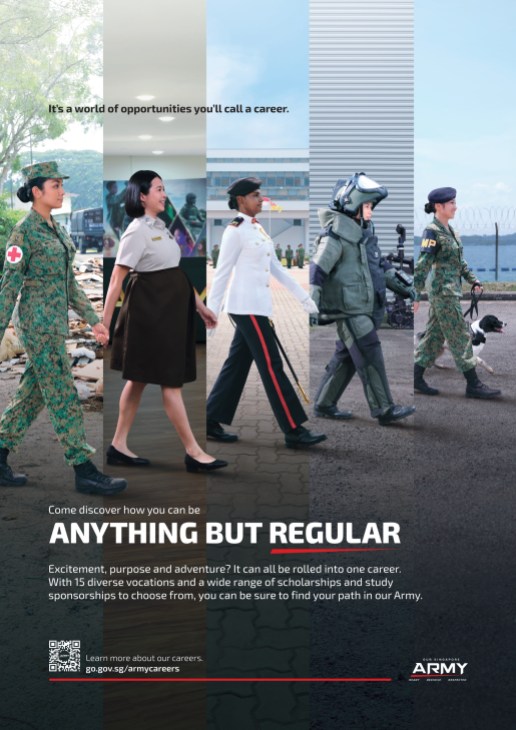
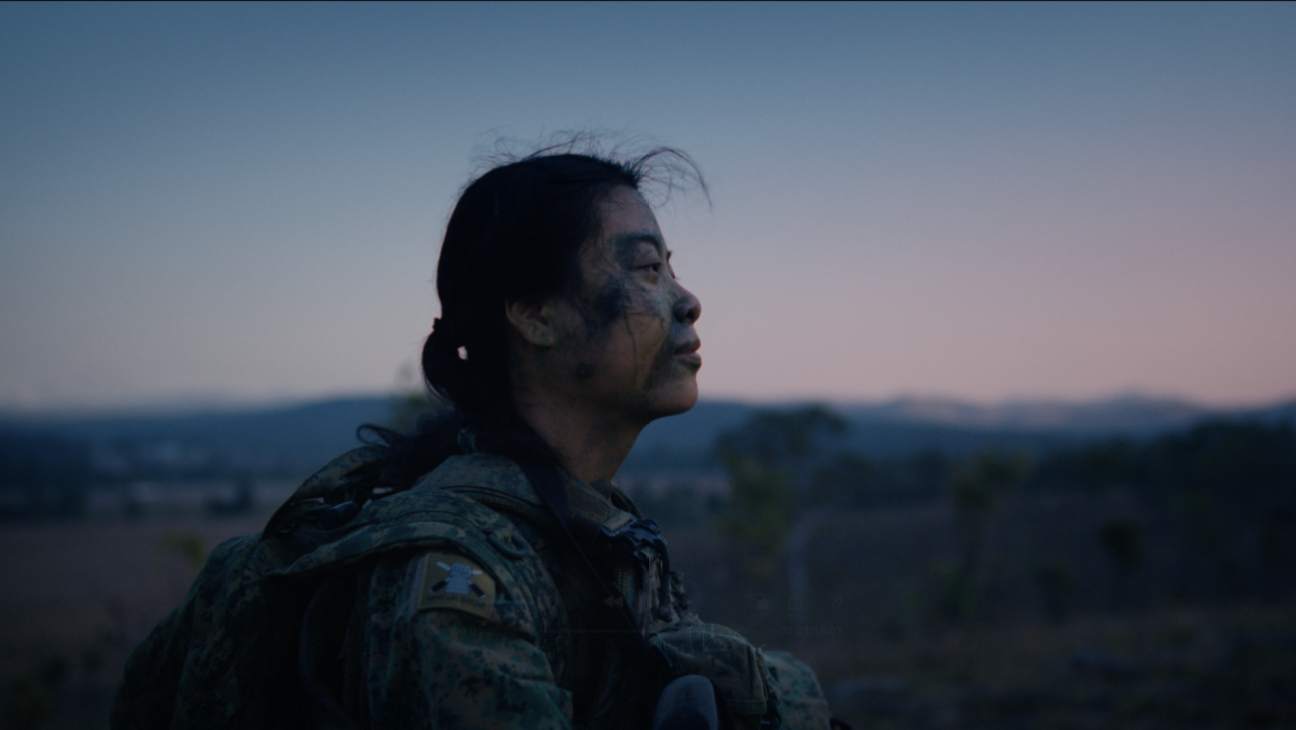
Ambition: Under the Enlistment Act, male Singaporean citizens and permanent residents are required to complete two years of national service when they hit 18 but too few of these conscripts are choosing to remain in the armed forces. This campaign targets Gen Z Singaporeans, breaking down preconceptions of an army career.
Does it work? The army claims there was a 47 per cent increase in voluntary sign-ups following the campaign.
5.
UK
Campaign: Your army needs you.
Year: 2019 – 2023
Agency: Karmarama
Message: Not the most current of the British Army’s recruitment campaigns but a clever departure from predictable messaging. This campaign riffs on the British First World War-era “Lord Kitchener Wants You” posters to subvert stereotypes of millennials as narcissistic, phone-addicted layabouts. It suggests that these traits are well suited to the army: being self-centred signals confidence, while “snow flakes” and “phone zombies” have compassion, focus and technical nous.

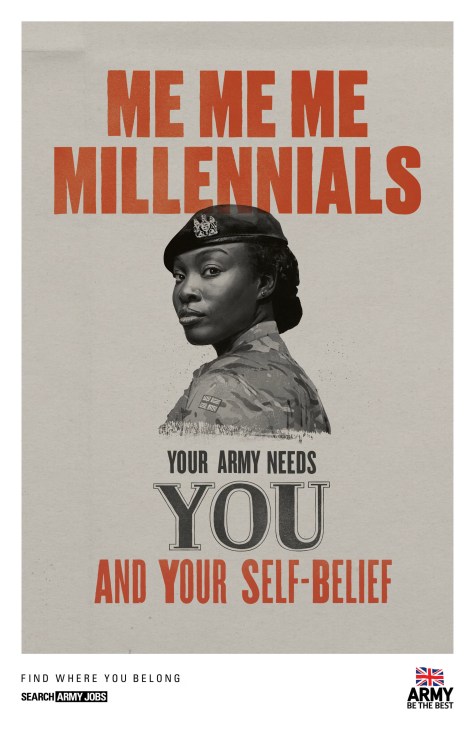
Ambition: “Your army needs you” formed part of a larger series aimed at British youngsters who might have considered their sexuality or religion to be a barrier to an army career.
Does it work? The campaign led to the army’s busiest three-month recruitment period in seven years. It was replaced in 2023 with the more traditional “You belong here” campaign.
6.
Ukraine
Campaigns: Fight in the Third Assault Brigade.
Year: 2025
Agency: An in-house media team of 12 full-time staff.
Message: “We’ll prepare you for any scenario,” reads a slogan emblazoned in orange. In the foreground, a Ukrainian soldier wearing sunglasses lies next to a slain alien; in the background, UFOs contend with anti-aircraft fire. This campaign uses both humour and cinematic imagery to portray military service as fun and adventurous. The message here is that those who enlist need not fear, including, even, an alien invasion. The implicit one is that as a soldier in the Ukraine’s army, they will be heroes fighting for justice and look good doing it.

Ambition: Though a new law introduced last year requires every Ukrainian man aged between 25 and 60 to sign up for some form of military service, recruitment shortages continue to undermine the country’s heroic resistance. This poster could be for an action film, with messaging that plays well with the younger audience that it seeks to recruit. It also evokes a kind of humorous stoicism that many have deployed since Russia’s invasion in 2022.
Does it work? In a sense, yes. The Third Assault Brigade averages about 500 new recruits per month, above the army average. But Ukraine still faces a challenge that frivolity might be incapable of solving, hence a reversion to coercion via conscription squads.
7.
USA
Campaign: Be all you can be.
Year: 2023
Agency: Army Enterprise Marketing Office/DDB Chicago
Message: The US Army is an exciting and stable career choice. You can defend your nation, solve problems, tend to the wounded and plan complex logistics. Serving in the army is a job for the ambitious, curious, adventurous and empowered. The campaign insists that steady wages and benefits including healthcare, tuition, job training and veteran support mean that the US Army is a path to a secure future.
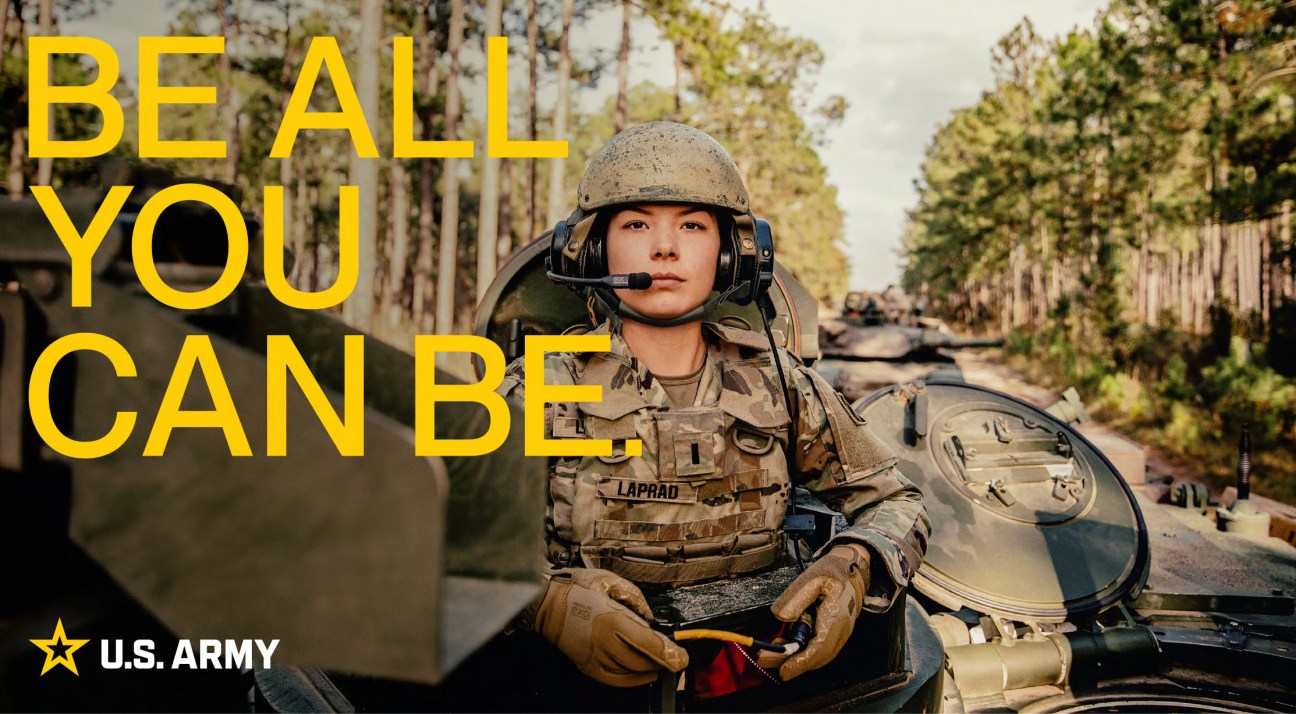
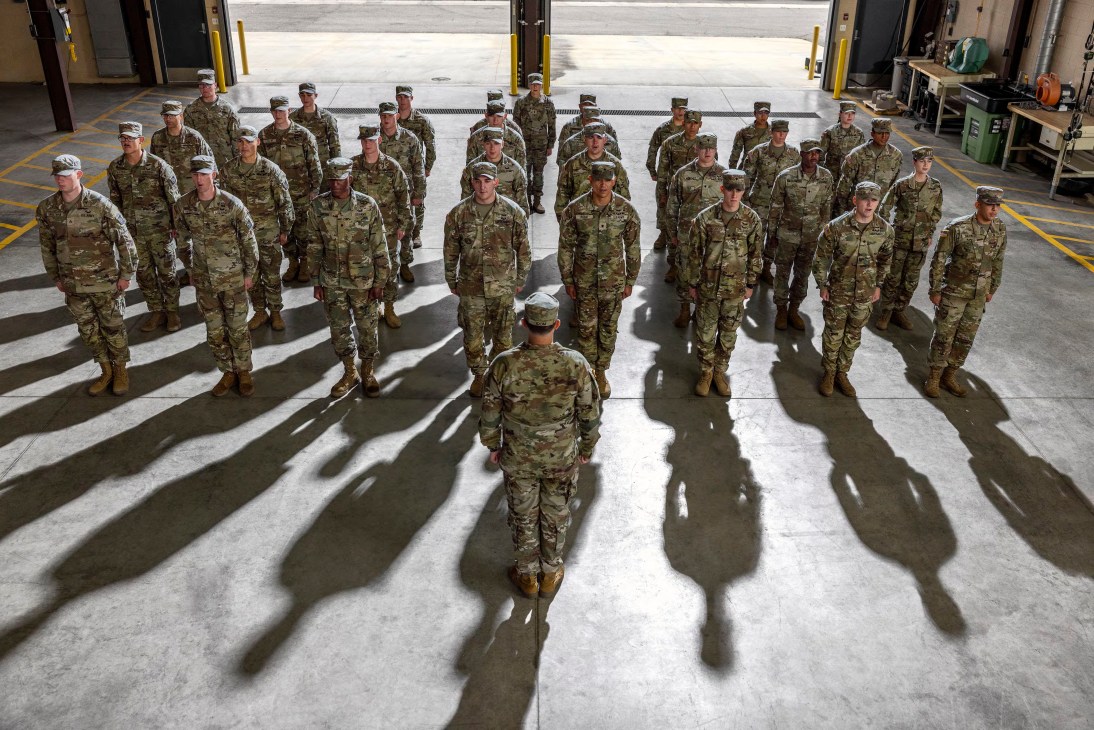
Ambition: This was a return to tried-and-tested messaging after a controversial campaign that experimented with animated portraits of individual soldiers’ emotional lives. By rebooting an instantly identifiable slogan and jingle, the US Army sought to reassure the public that the institution had not strayed too far from tradition and to inspire a Gen Z audience to enlist by appealing to their desire for purpose, identity and impact.
Does it work? Yes. In the two years since the campaign’s launch, brand awareness increased from 50 to 75 per cent, according to the Army Enterprise Marketing Office. In June the US Army hit this year’s recruiting goal four months early, with 61,000 future soldiers under contract.That target was 10 per cent higher than last year’s.


The rise of Rolser: How Spain’s iconic trolley brand is rolling into international hearts
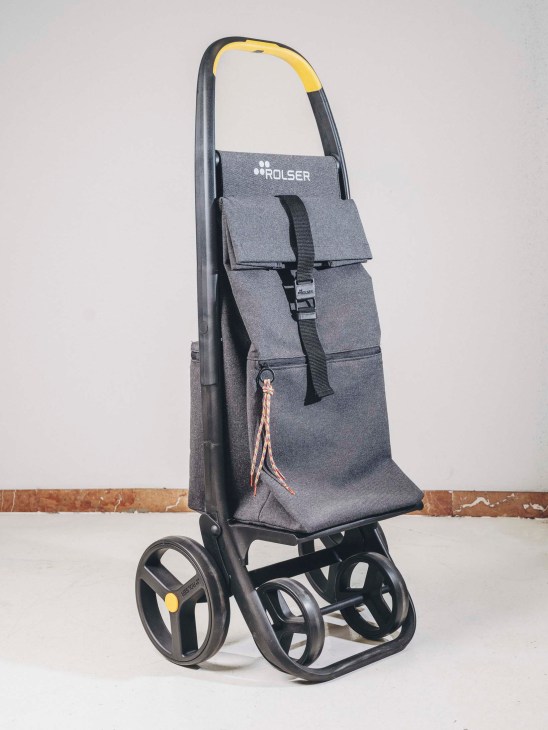
Well-crafted everyday objects often hide their greatness in plain sight. Consider the shopping trolley. Spanish manufacturer Rolser has spent almost 60 years developing sleek, durable designs that make life easier. These fabric-covered, two-wheeled trolleys might be associated with older people doing their weekly shop but you’ll find a Rolser trolley in the homes of 63 per cent of Spaniards, according to the family-run company. Meanwhile, on the streets of Barcelona or Madrid, you’re as likely to spot artists ferrying paint and brushes in their Rolser as you are to see families out for a day at the beach using one to stow umbrellas, chairs and snacks.
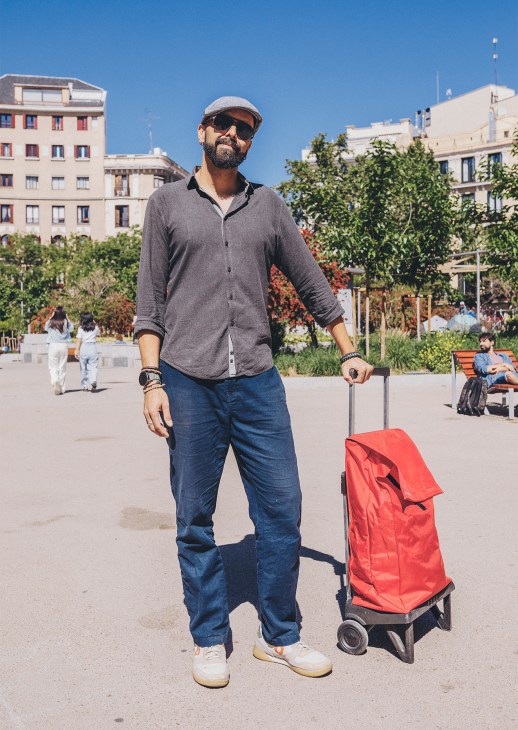
Rolser was founded in 1966 as a maker of palm and wicker baskets. That it is now a fixture of life in Spain attests to its durability as a brand and the reliable quality of its products. Some 80 per cent of the company’s manufacturing takes place at its headquarters in Pedreguer, a town roughly halfway between Valencia and Alicante.
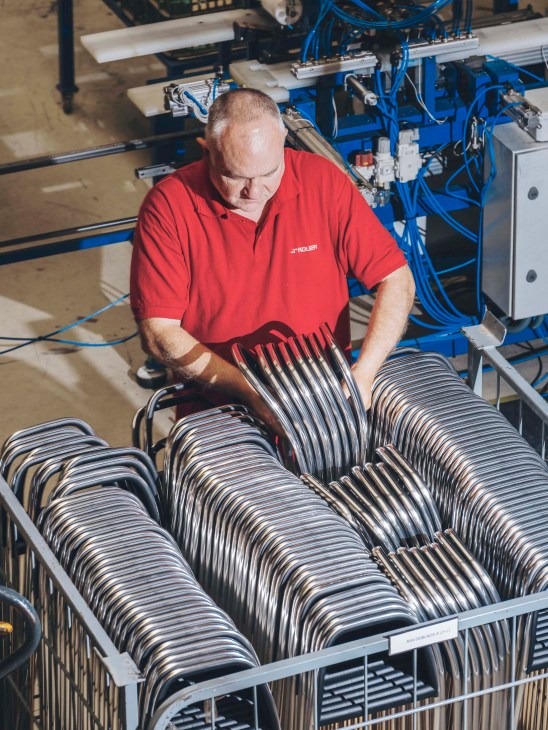
Surrounded by lemon orchards and a stone’s throw from the Mediterranean, Pedreguer is the ancestral home town of the Server family. Cousins Mireia and Vicent Server are the co-CEOs of Rolser and the third generation of the family to lead the business. When Monocle visits, the pair guide us through its 21,000 sq m facility, where we see workers busily feeding aluminium tubing into a purpose-built machine, which cuts and folds the metal into the frames that give the trolleys their distinctive shape. More than 100 employees work in the factory, where some 2,500 units roll off the production line every day. Producing an average of half a million trolleys per year, the company pulled in nearly €20m of revenue in 2024.
Rolser has long been the top choice of discerning Spanish matriarchs, who have a nose for high-calibre goods. But the brand now also ships to more than 60 countries and has a second factory in Vietnam, founded in 2018; there it produces textiles, such as William Morris prints, to serve equally selective consumers in Australia, China, Singapore and Japan.
The heart of the business, however, remains in Pedreguer. “We have very special ties to this land,” says Vicent, over the din of workers snapping wheels onto chassis on a nearby assembly line. “By creating work for the community, we threw our support behind the people of this area and tried to foster an industry that wasn’t tourism. In itself, tourism is good – but over the years local manufacturing has largely been snuffed out.”
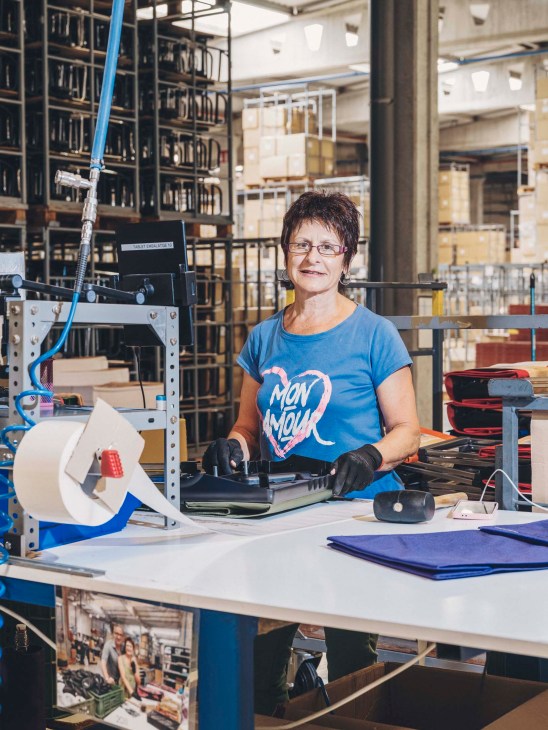
On the factory floor, Olivia Fornés Agulles is rhythmically working on the final assembly and packing of Rolser’s signature trolley, the Plegamatic, which folds up like a handbag and can be draped over the shoulder when empty. This year will mark 40 years since Fornés Agulles joined the company, for which her sister, brother-in-law, nephew and ex-husband also work. “At this point, it’s simply love that keeps me here,” she says with a smile. “I love this company. It has given me so much.”
Mireia tells Monocle that Rolser has a deep culture of co-operation, which starts with the family. “In the end, everyone here has the same aim,” she says. “What people want most is to work in service of a shared dream and to make it a success.” To that end, key departments, such as design and sales, are headed by members of the Server clan and the company’s previous generation of leaders is helping to ensure Rolser’s longevity by advising the new guard and passing down time-tested values (Mireia’s father, Joan, is the company’s president). This approach has kept her wheels on and ensured a stable transition in leadership.
Rolser was the first company in Spain to mass-produce a shopping trolley, and its strong visual branding, coupled with a refusal to manufacture items that didn’t carry the Rolser logo, has made it a household name. Supermarket chains such as Carrefour and popular department store El Corte Inglés faithfully stock Rolser merchandise.
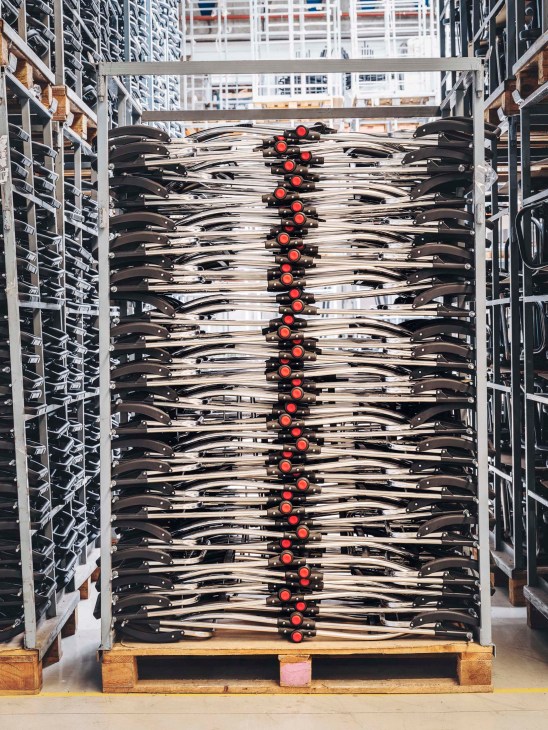
While there are imitators, Vicent says that the company is maintaining its edge by making sure to invest in research and development. “Competition is great because it pushes you,” he says. “We always have two or three major projects under way that normally take about two years to fully develop.”
Such innovations have included treble wheels, which make it easier to take your trolley up flights of stairs, and a version made entirely from recycled materials. Rolser also manufactures ladders and ironing boards; a recent model that’s reminiscent of a surfboard incorporated recycled clothes hangers. (About 55 per cent of the plastic materials used in Rolser products are recycled.)
Mireia is determined to show the world the value of choosing a Rolser trolley over bulky carrier bags. “When I joined the company in 2000, we didn’t have a department that was dedicated to exports,” she says. “We were just selling passively to countries such as France, the Netherlands and the UK.” By 2005, the business had launched an exports division and she began attending trade fairs, such as Frankfurt’s Ambiente, where she could demonstrate the benefits of owning a high-quality shopping trolley to those outside Spain. Rolser’s regular presence at such events has spurred its team to innovate. “Every year we must present something fresh and new,” says Mireia. In 2023 the brand made headway into the US market with a chic yet sustainable model sold at New York’s Museum of Modern Art.
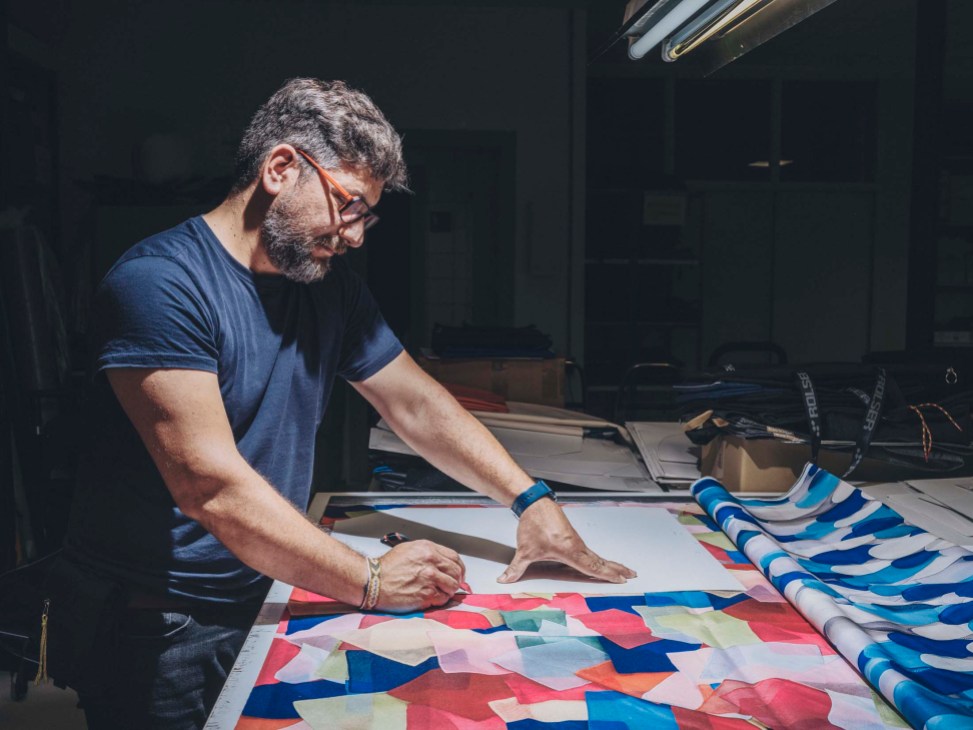
Rolser recognises that an object that makes your life easier should also be pleasing to the eye. But to its design and marketing teams, true beauty lies in customers’ appreciation for their efforts and the ways in which they use the company’s thoughtfully developed wares – whether it’s for a commonplace trip to the mercado or a dash to the beach on a sweltering day.
According to one faithful Rolser user, there is no cargo too precious for these trolleys. One story goes that a jeweller in Valencia was looking to transfer his precious goods to a new shop; rather than attract unwanted attention by hiring an armoured car and guards, he enlisted the help of a group of Rolser-toting grannies. Their shopping trolleys were loaded up with boxes of jewellery, with bunches of leeks placed on top – their green ends innocently poking out from the carts’ uppermost fabric flap. Jewellery in tow, the women walked through Valencia just as they would on any other day, safely delivering their cargo to its new home, with passersby unaware of the treasures held within their Rolsers. It’s a fitting anecdote: there is always more than meets the eye when it comes to an unassuming sets of wheels.
Nacho Martín
Design director, Accenture Song
Barrio de Las Letras
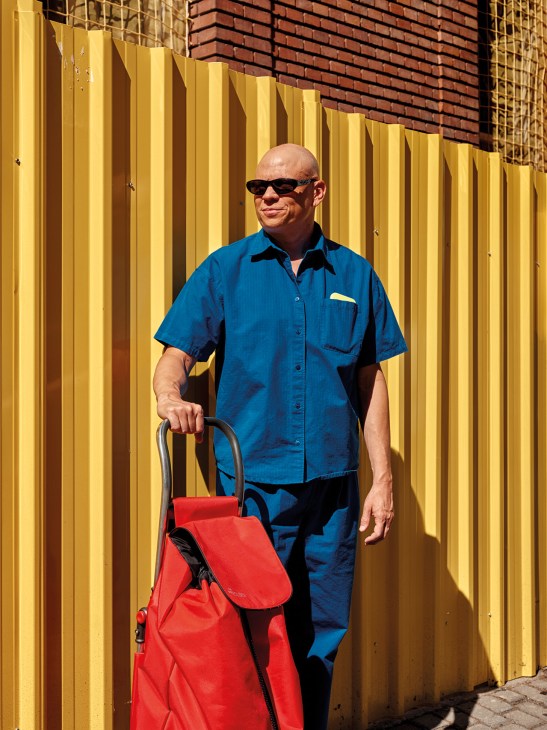
What’s in your Rolser?
Normally food but today I’m moving some heavy design tomes with ease.
Describe you Rolser in a word:
Ferrari.
Heather and Oliver Evans
Specialist guide (toddler still unemployed)
Quinta de Los Molinos Park
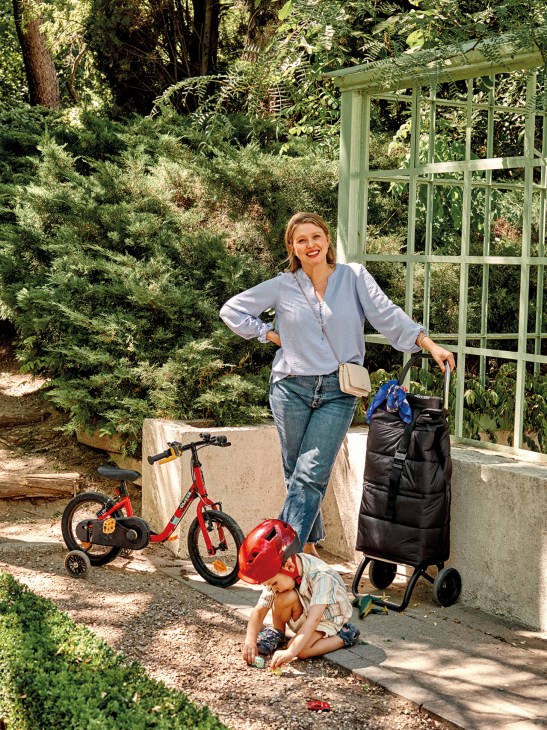
What’s in your Rolser?
Groceries, dinosaurs, cars, water bottles, peace of mind – and today, my son.
How long have you had it?
More than three years. I’ve had other carritos but once I had a child, I needed an upgrade.
Javier Pérez-Viu
Creative strategist and coach
Outside Alma Nomad bakery, Chamberí
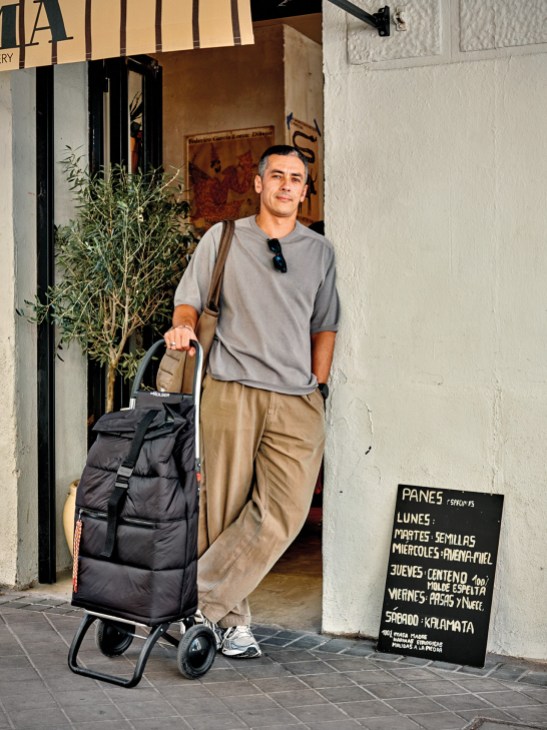
What’s in your Rolser?
Normally it’s sparkling water, tech cables and survival snacks. Today it’s running shoes, electrolytes and a back-up hard drive.
Describe your Rolser in a word:
Faithful.
Daniel Chalmeta
Strategic partner manager, Meta
Outside Mercado Los Mostenses
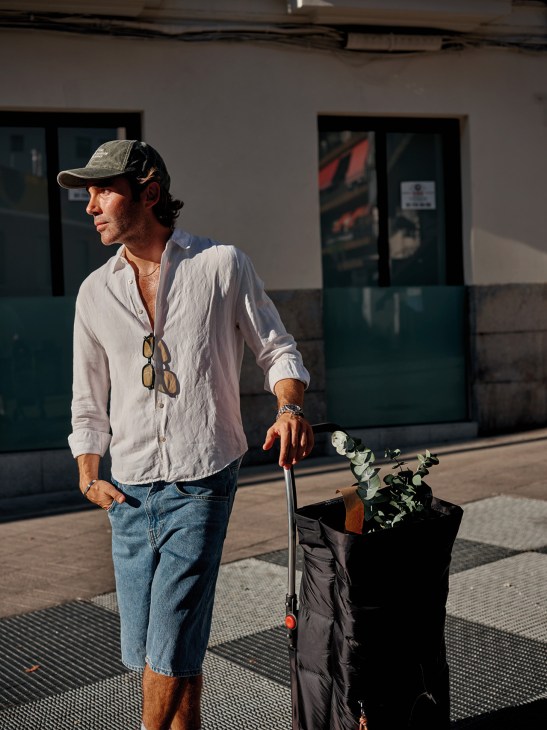
What’s in your Rolser?
Some eucalyptus for my flat, groceries and some new summer clothes I just bought for my birthday trip to the Baleares.
How long have you had it?
It came with the flat when I rented it and I use it more than I expected.
Eva Yatsutko
Painter
Walking through Malasaña
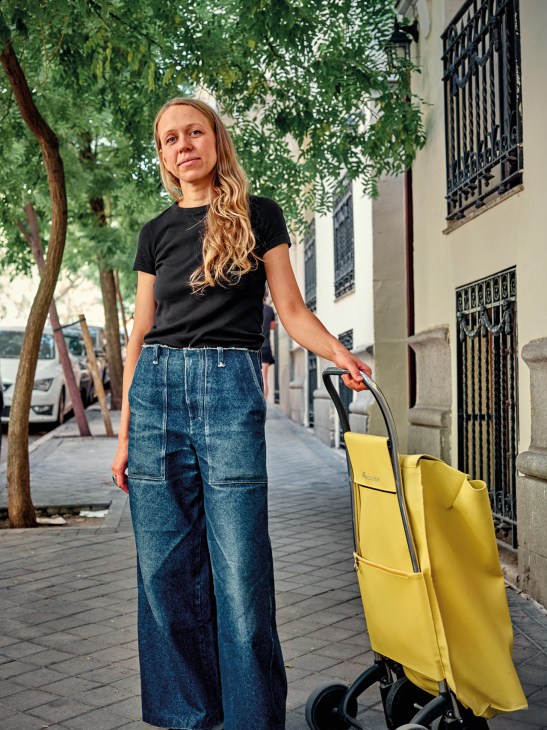
How long have you had your Rolser?
I’m a newbie. Until a year ago I was using only backpacks.
What’s in your Rolser?
Food. Today I’m carting vegan empanadas, four types of cheese, kiwi juice and kefir.
Marisa Santamaría
Researcher, design curator and teacher
Plaza de Olavide, Chamberí
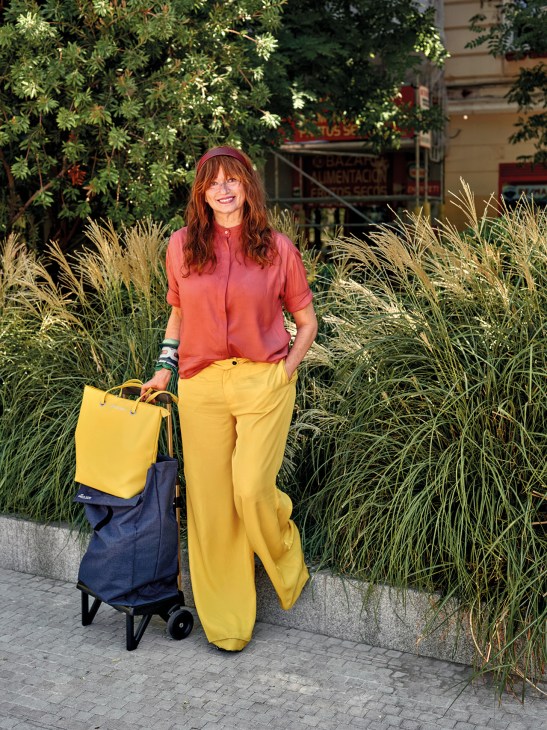
Where are you going?
To fully restock my fridge because I’ve been in Milan for two weeks.
How long have you had your Rolser?
There’s been a Rolser in my house since I can remember. They simplify the heavy slog of daily life.
Jenni Dawes
Future visualisation teacher
Walking through Lavapiés
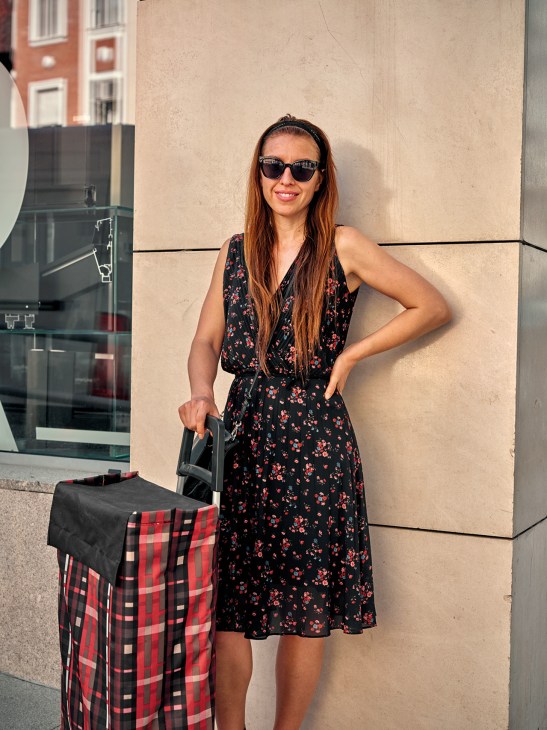
Where are you coming from?
I’m on my way back with all the materials from a workshop I run called How to Remember the Future.
How do you “roll”?
Mindfully.
Yoeri Zavrel
Eyewear designer
Walking through Conde Duque
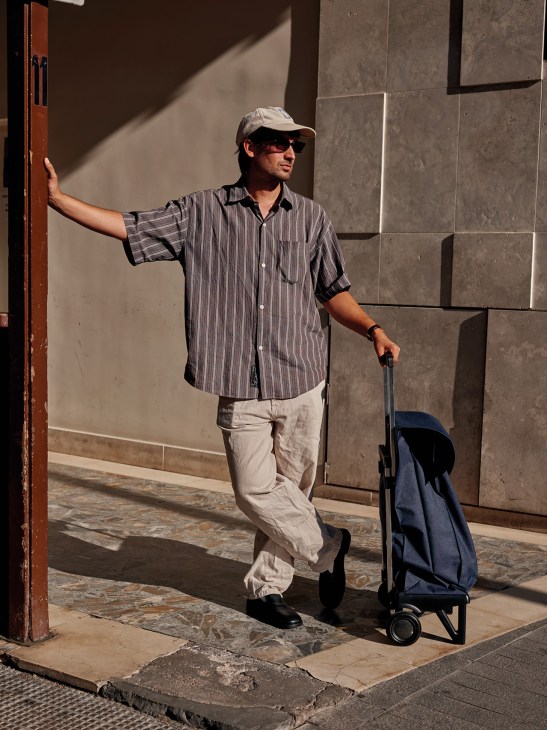
What’s in your Rolser?
Usually market-fresh groceries but today I’m carrying boxes of eyewear deliveries from my brand (Sample Eyewear, if you’re asking).
How do you “roll”?
Like greased lightning.
Mikolaj Bielski
Artistic director, Réplika Teatro
Barrio de Argüelles
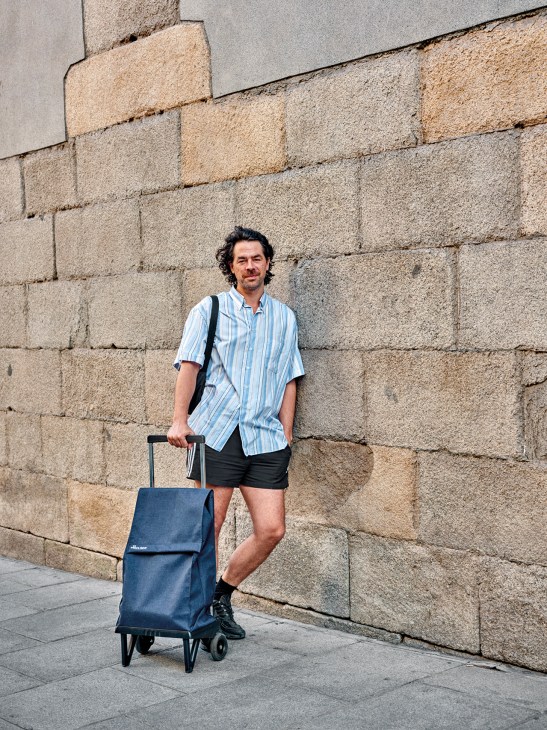
What’s in your Rolser?
Imagination, surprises and uncertainty – props basically.
How do you “roll”?
Slightly overflowing, keeping it together, holding space for small producers.
Fabián Sobrino
Real-estate agent
Leaving Lidl in Malasaña
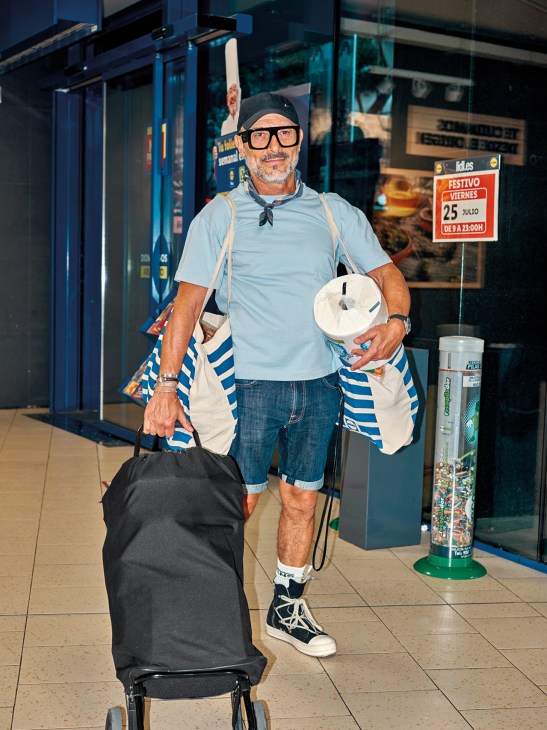
How long have you had your Rolser?
A few years but I wish I’d had it longer – it’s the best.
What’s in your Rolser?
The heaviest things, whatever fits. It’s a good alternative to plastic bags.
Violeta Dai
Art and project director
Outside Mercado Barceló
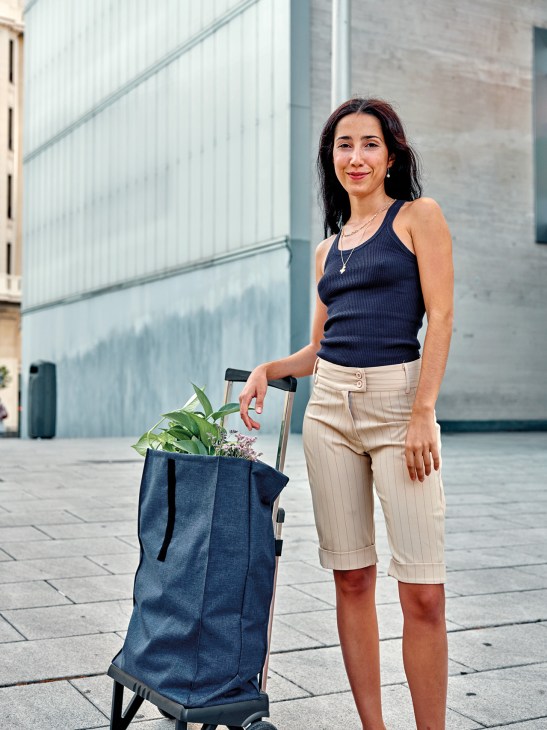
What’s in your Rolser?
Today there are plants, a vase of flowers, a bunch of rocks, a bag of earth and tree bark – for a photoshoot, I promise.
Describe your Rolser in a word:
Señora.
Read next: By opting for the trolley bag, young urbanites are proving that granny knows best
Inside Royal Caribbean’s Nordic-built ‘megaship’ that’s making waves in the shipbuilding industry
At 365 metres long and 20 decks high, the scale of the Star of the Seas is more in keeping with a moveable skyscraper than a boat. At its handing-over ceremony at Meyer shipyard in Turku, owners Royal Caribbean confirmed that it was the largest cruise ship ever built – an honour that it shares with its less-than-humbly-named sister vessel, Icon of the Seas.
What’s on board? Eight themed neighbourhoods, a waterslide taller than most office buildings, an ice rink, a surf simulator and room for as many as 7,000 passengers.
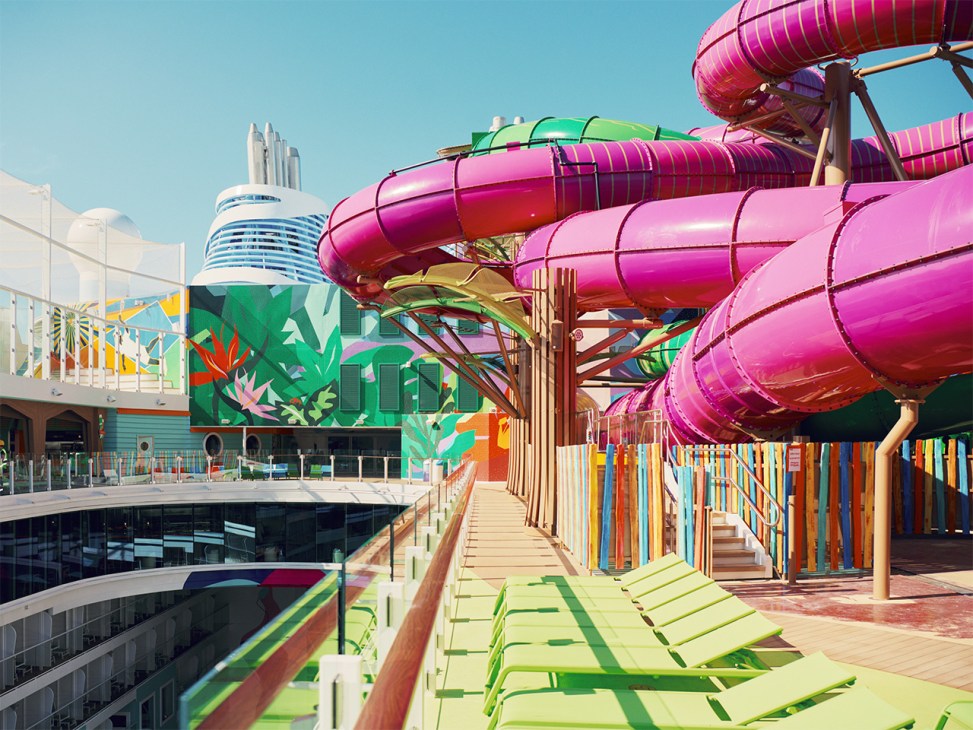
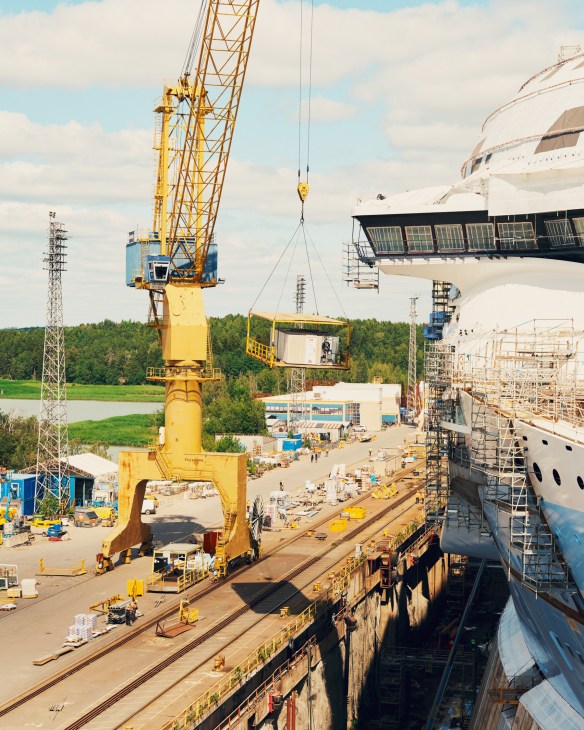
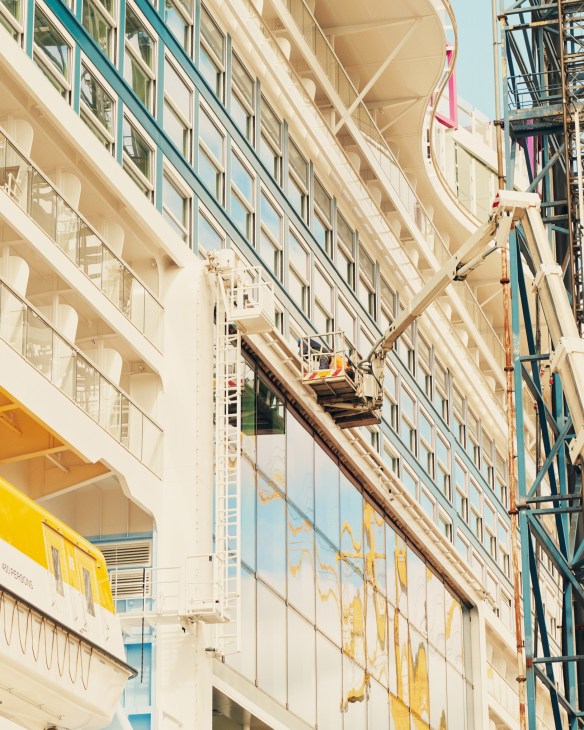
The logic of megaships may seem out of sync with the current trend towards smaller hotels and trips rooted in a sense of place and ‘authenticity’ – a term that’s open to scrutiny – but the cruise industry is buoyant and the vessels seem to be getting bigger as the industry grows.
Washington based Cruise Lines International says that almost 40 million people will take a cruise in 2025, with many more considering taking the plunge for the first time. Size brings efficiency, variety and, if you ask the operators, a sense of total escape. These ships are not only a means of seeing the world but also a destination: a hotel, shopping centre, theme park and tropical island all in one.
Shipbuilding is a major force in Finland. It employs 30,000 people and contributes €12bn to the economy every year. In Turku that strength is matched by momentum. Four more vessels of the same class are in the works, ensuring that shipbuilding – and, as brands see it, world-building – remains a modern point of pride for Finland’s oldest city.
Comment
The scale of ships is one thing and the size of opportunity is another. Luxury brands are testing the water with cruises at various scales, from Explora Journeys and Ritz-Carlton to Belmond, while Four Seasons Yachts and Aman at Sea are set to launch in 2026 and 2027 respectively.
Read next:
Turning the tide: The shipbuilding company reviving a small Midwest town
How Bofill’s radical ‘living space’ became one of Europe’s most visionary design headquarters
It’s difficult to visit Barcelona and not experience the work of Bofill Taller de Arquitectura. The design studio, commonly known simply as the Taller (pronounced “tayer”), is responsible for Barcelona Airport’s Terminal 1, whose sweeping, wing-like roof welcomes international travellers to the Catalonian capital. During your descent, you might spot the Taller’s sail-shaped W Hotel at the edge of the Mediterranean, one of the defining features of the city’s new port area. Then, on the drive from the airport into central Barcelona, you may see a surrealist red structure. Named Walden 7, it’s a striking housing project that combines public and private realms. Though the Taller’s founder and namesake designer, Ricardo Bofill, died in 2022, the firm still looms large in Catalonia.
“But we don’t belong to Barcelona,” says Ricardo’s son Pablo, as he welcomes Monocle to the Taller’s headquarters, La Fábrica, which sits beside Walden 7. The practice, which Ricardo founded in 1963, might be based in Barcelona but Pablo is keen to point out that it has always had a global footprint. (Its projects range from Les Arcades du Lac, a social-housing complex near Paris that was completed in 1982, to Tokyo’s Shiseido office building, finished in 2001.) Pablo has been the firm’s CEO since 2010; under his direction, it has grown from about 50 to 250 people and is now working on projects in new regions, such as West Africa and the Gulf.
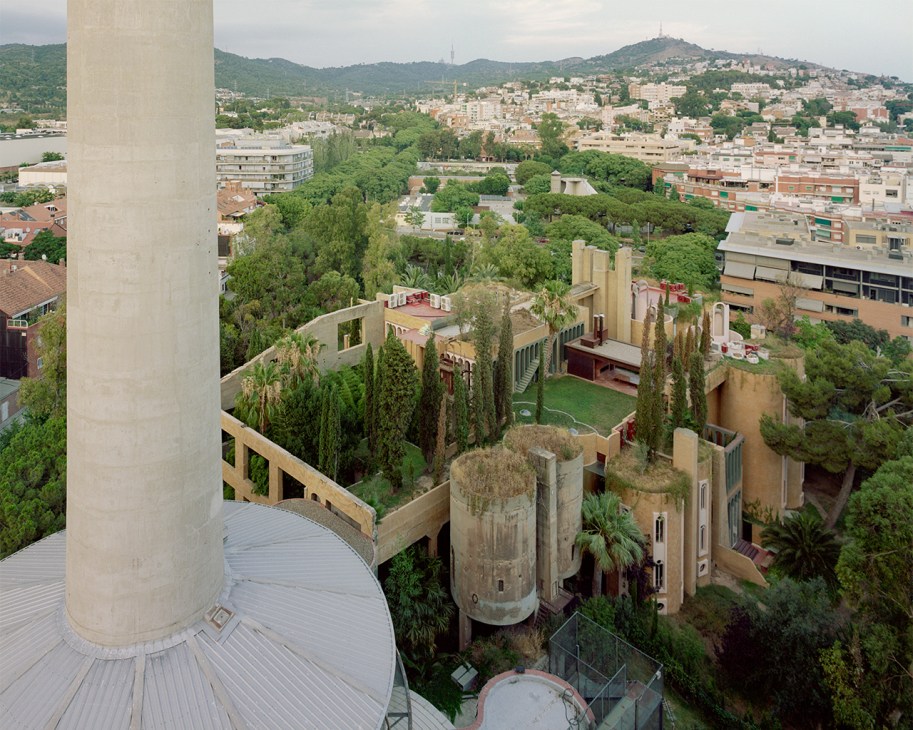
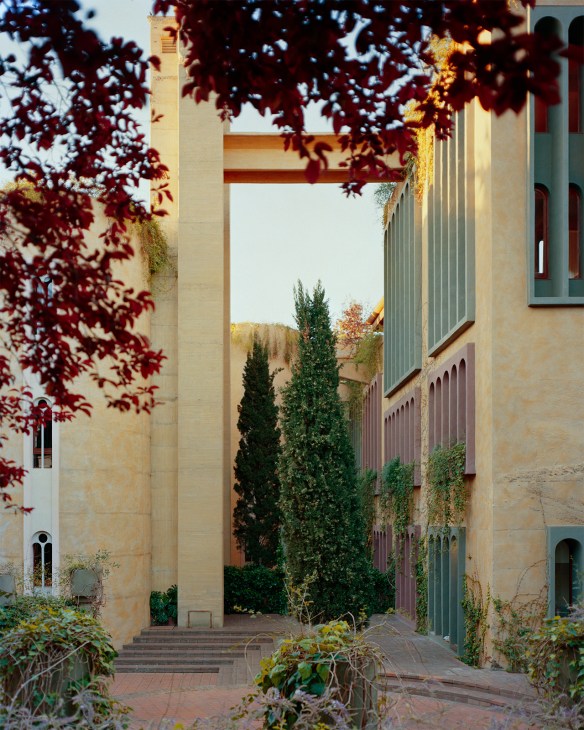
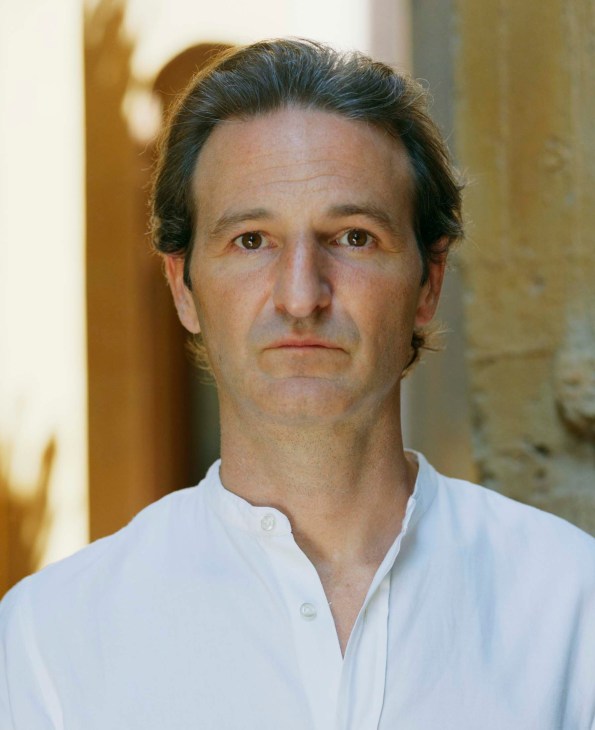
For many, working for a celebrated father might have felt like a natural step. Pablo, however, initially never gave much thought to the idea of building on his family legacy. “I had an education in France, where they taught us that the worst thing possible was to work with friends or in a family business,” he says. “We learned that if you work with friends, you’ll end up with none – and that if you work with your family, it means that you aren’t able to do anything on your own.”
Pablo took that advice to heart. During his twenties, he worked as director of extension at Mixta Africa, which was developing affordable housing in Senegal, Mauritania, Tunisia and Egypt. One of the shareholders was the International Finance Corporation, a subsidiary of the World Bank Group. Ironically, it was an experience that inadvertently set him up to run the Taller. The wheels were set in motion when project opportunities for his father’s studio began drying up after the financial crisis of 2008. “It got to the stage where they only had two or three months of work in the pipeline,” says Pablo. “That was the worst thing possible because my father was someone who lived through the work that he was doing, rather than through his hobbies. Closing the practice would have been a kind of death.” Family discussions naturally turned to what to do with the firm – as well as La Fábrica, a building that had been a near four-decade labour of love for Ricardo – should it be forced to shut up shop.
Ricardo was born in 1939 to an architect-builder father and an arts patron mother. In 1957, during the authoritarian regime of Francisco Franco, he was expelled from Barcelona’s architecture school as a result of his left-wing beliefs. Undeterred, he completed his education in Geneva before returning to his hometown in 1963. Here, at the age of 23, he established his own practice, radically breaking from tradition by assembling design teams composed of artists, poets, engineers, philosophers and sociologists. Within a few years he had built a reputation as a renegade in his field, creating structures that sought to tackle housing shortages and lift spirits.
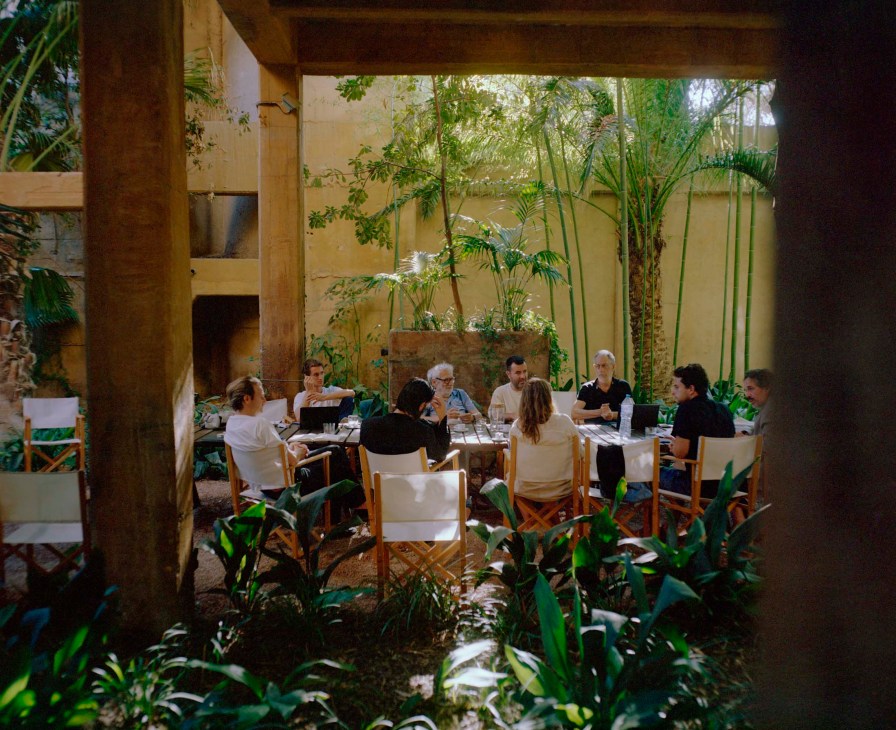
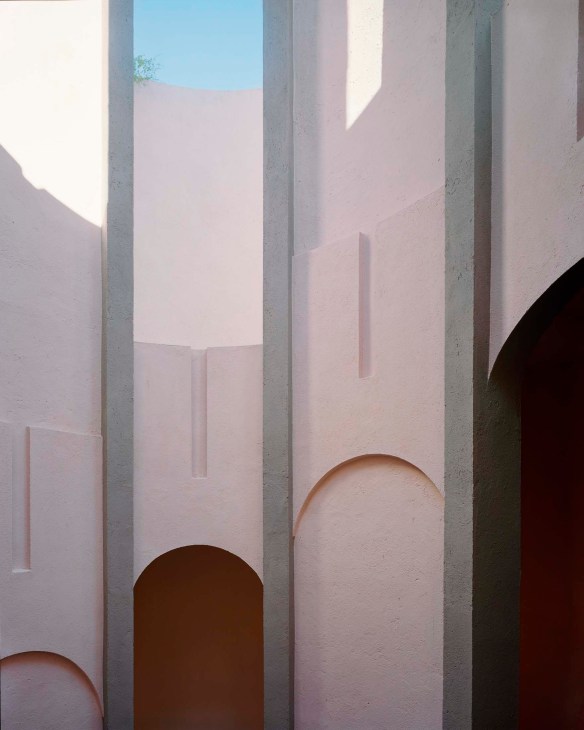
By the early 1970s, Ricardo was on the hunt for a live-work space in which to continue edging his architectural vision forward. His planning concept defied Barcelona’s bylaws, so he looked to the metropolis’s periphery. There, he came across a cement factory that was due to close in mid-1973. He quickly acquired the entire complex: 30 silos, subterranean galleries, cavernous engine rooms and some surrounding acreage. Over the next two years, he oversaw its transformation into architectural offices, archives, exhibition spaces and a private residence. The ambitious renovation involved strategic demolition, subtle additions and the extensive planting of eucalyptus, palm and cypress trees. To enhance the monumental feeling of the industrial building, Ricardo cut tall windows into the space, flooding it with Mediterranean light and creating an atmosphere of contemplative calm. The building incorporated elements from his personal and professional lives, and combined the old and the new. It was a kind of architecture and an approach to work that Pablo eventually decided that he wanted to preserve. “I felt that I had the responsibility to give part of my life to my family and transform the Taller and La Fábrica into a new reality,” says Pablo. “My brother Ricardo Jr, an architect, made the decision to join my father in 2010 and so did I.”
With Ricardo, Pablo and Ricardo Jr (who has since left the practice) steering the ship together, things turned around quickly. They won a major project in Morocco: the Mohammed VI Polytechnic University in Benguérir, which was completed in 2016. This was followed by competition win after competition win and the firm’s workflow improved.
“The most important thing for me during that period was to give life to my father,” says Pablo. “And the only way to do so was to return to the origins of the office. So we started bringing people from different backgrounds and disciplines around the table. At the time, we had no money and not many projects. That actually made things easier because then you can only call on people who are as crazy as you – people who are very passionate about what they want to do and don’t mind some instability.”
In the 15 years since, this motley group has helped the firm to build a portfolio of work that spans continents. When Monocle visits, there’s a meeting for furniture firm BD Barcelona, helmed by its founder, Catalonian furniture designer Oscar Tusquets Blanca. (Pablo is a newly minted shareholder in the venture.) They are gathering in La Fábrica’s El Jardín de las Delicias (Garden of Delights), when artist and architect Guillermo Santomà floats through. An independent creative, Santomà is collaborating with the Taller on a project in Georgia. “I have my own studio but I also work here,” he says. “It’s a place where you share information and grow together.”
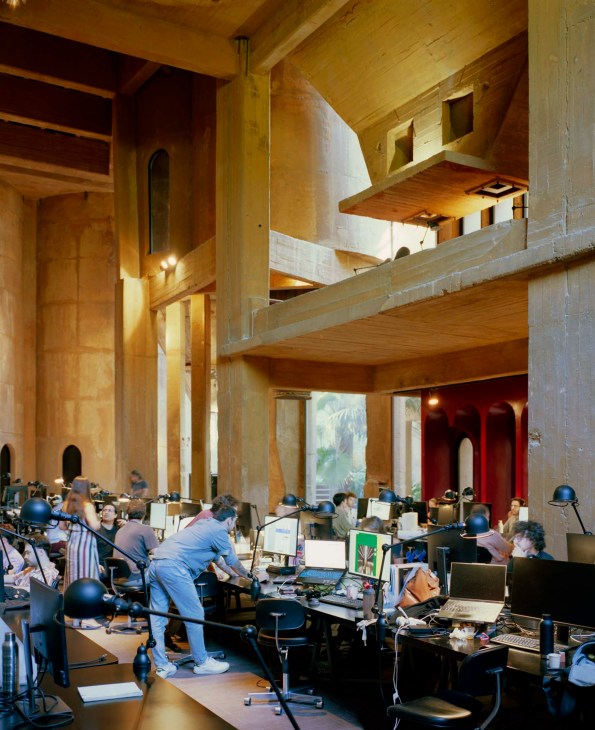
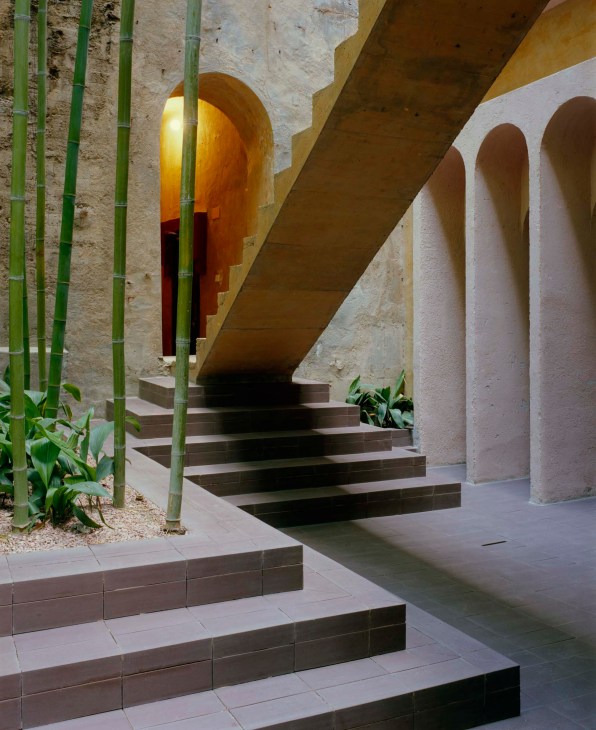
Following closely behind Santomà are students from Porto Academy, who are being given a tour of the space (“Students dream of coming here,” says Taller architect Tamar Briones, who is leading the cohort). Meanwhile, a French design practice has joined some of the Taller team in an open-plan meeting room, where the two firms are exchanging ideas for upcoming projects. “We are always trying to bring interesting people in to help us be better,” says Dimitri Davoise, a partner at the Taller, who is helming the meeting. “The Taller’s outlook today comes from its early years. It’s all about bringing people from different origins and disciplines together to build a project. Influences come from philosophy, poetry and art.”
The return to such an outlook is mirrored in the way that La Fábrica is evolving. Despite making the space usable after its initial two-year renovation in the mid-1970s, Ricardo never saw the complex as a finished project. “It’s a living place – not something that you need to preserve or protect,” says Pablo. “This was defined by my father and transmitted to me. It’s a space where we need to have no nostalgia. It needs destruction and reconstruction, demolition and change.”
Hernán Cortés agrees with the sentiment. “La Fábrica has always been a living space,” says the Taller partner. He has been working with the practice for almost 20 years and says that a surge in projects since 2020 has seen the complex’s physical spaces completely revolutionised. “Everything has changed over the past four years. Private living areas and gallery spaces have been turned into offices to accommodate the growing workforce. This has shifted the energy. Before, it could sometimes feel like a museum. But now it’s really living.”
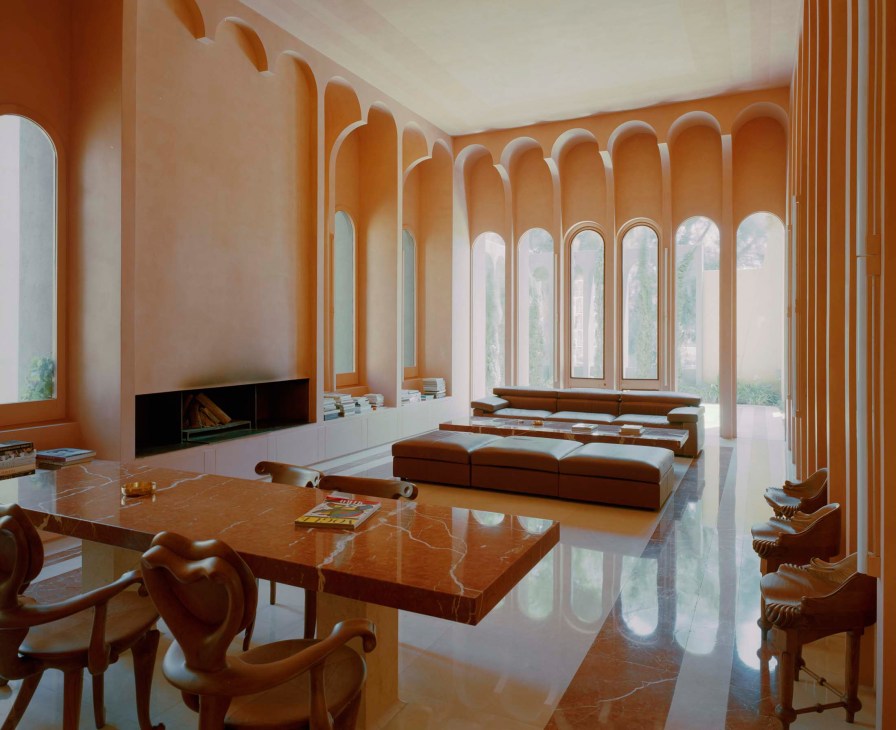

Cortés has been at the helm of some of La Fábrica’s most significant recent renovations. A new exterior staircase, engineered to appear as if it’s floating, leads to a once-abandoned mezzanine area that is now a studio for the Taller’s landscape designers. With no direct access previously, the space had long hovered vacant above La Fábrica’s biggest workspace, which is known as “the Cathedral” and contains four rows of desks furnished with lamps by French manufacturer Jieldé and desk chairs by Denmark’s Engelbrechts. Here, industrial ducts from the mid-20th century have also been given new life as air-conditioning systems. “The factory is active,” says Cortés. “It’s living. Everyone who comes through La Fábrica leaves some of their DNA in the project.”
The kitchen has been completely refinished too, with its original Antoni Gaudí chairs retained, alongside Alessi kettles and cheese graters, as well as bentwood pieces by German firm Thonet. Meanwhile, Ricardo’s private residence has undergone its own transformation. While the bedroom – complete with a bathtub at the foot of the bed – received a simple restoration, other areas were more comprehensively reimagined. The cube hall, which once served as Ricardo’s private space for hosting concerts and dinners, now functions as a full working area with clusters of desks. Above this is a dining space that has been repurposed as a meeting area, while a private rooftop garden has been democratised with a sunken conversation pit, making it the perfect spot for intimate staff lunches beneath the Catalonian sun.
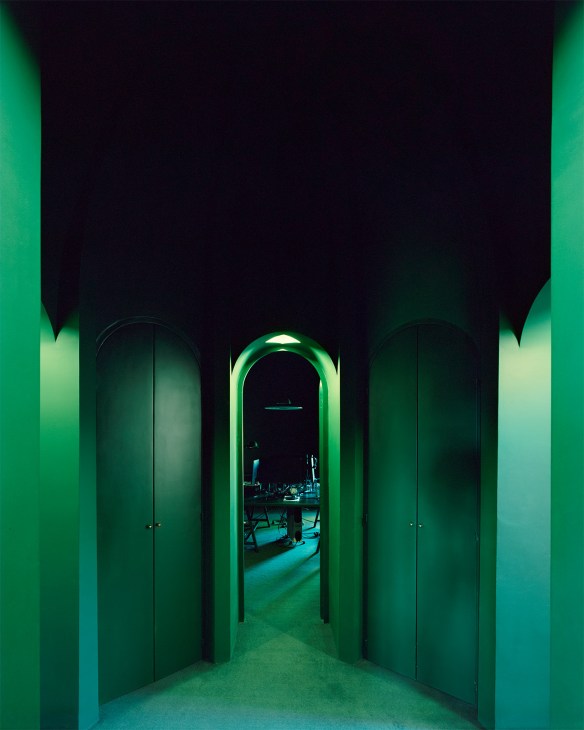
In collaboration with Barcelona-based painter Claudia Valsells, the Taller has developed a new colour palette specifically for its projects, with experiments unfolding across the complex. In one grouping of four interconnected silos, an entire floor has been painted a deep emerald green. The exteriors haven’t been forgotten: the Taller’s resident painter, Panxo Juli, is almost continuously giving the walls a fresh lick, ensuring that La Fábrica’s concrete surfaces continue to experiment with the Mediterranean light. “We painted the façades a few years ago and now we’re trying something different,” says Juli. “So we have been conducting tests to see how we want to reinvent it. The good thing is that at La Fábrica we don’t work as architects with plans but collaborate directly with artisans. We reinvent and destroy until we like it.”
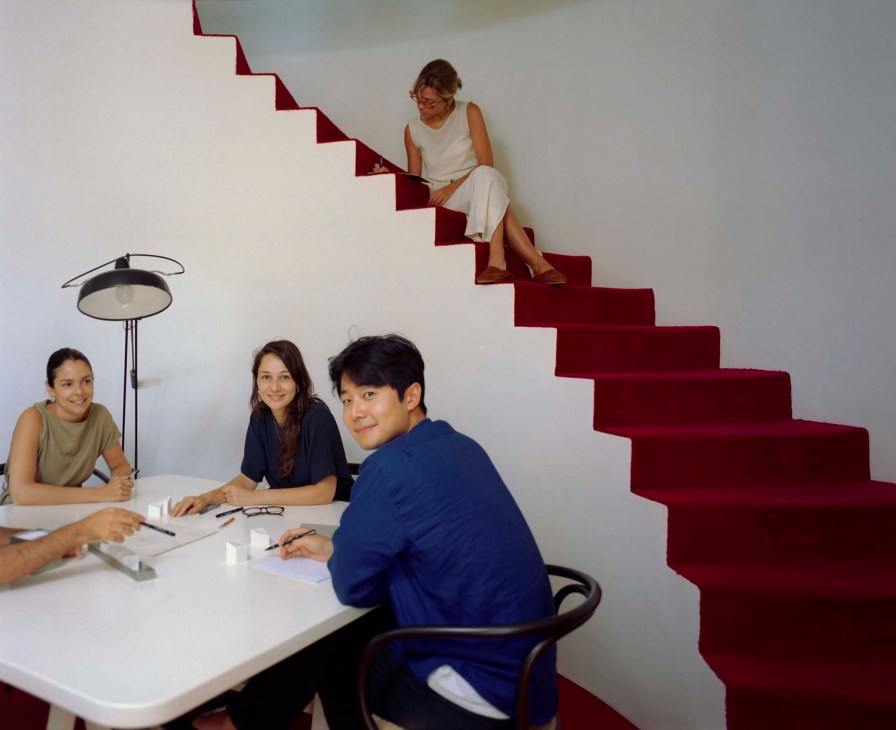
All of these spaces are animated by members of the Taller. Desk assignments don’t necessarily correspond to projects, which means that staff are often on the move between buildings, stopping for lunch beneath a grove of olive trees, practising yoga together on a lush lawn or taking smoking breaks in a central courtyard, balancing cigarettes on the edge of Cubo ashtrays by Danese Milano. It’s a sociable approach to work that leads to chance encounters. In this way, the spirit of the workplace responds to the studio’s ambition that no two days – or, indeed, no two projects – be the same.
“We don’t want to define our approach because then we might end up repeating something that we have previously done,” says Pablo. “We want to work in a way that means that we can give new answers to questions. And La Fábrica embodies this: it’s a laboratory of expression, not a place of conservation or patrimony. On the contrary, it reinvents itself through the reality of what we live through.” By responding to the needs of its users and paying respect to the vision of the practice’s founder in the process, La Fábrica is – like all of Bofill Taller de Arquitectura’s work, from airports to public housing projects – a place to be lived in.
bofill.com
Step inside the Swiss lab where pretend patients find real solutions to hospital design
Every few months in Nidau, a village in central Switzerland, people get together
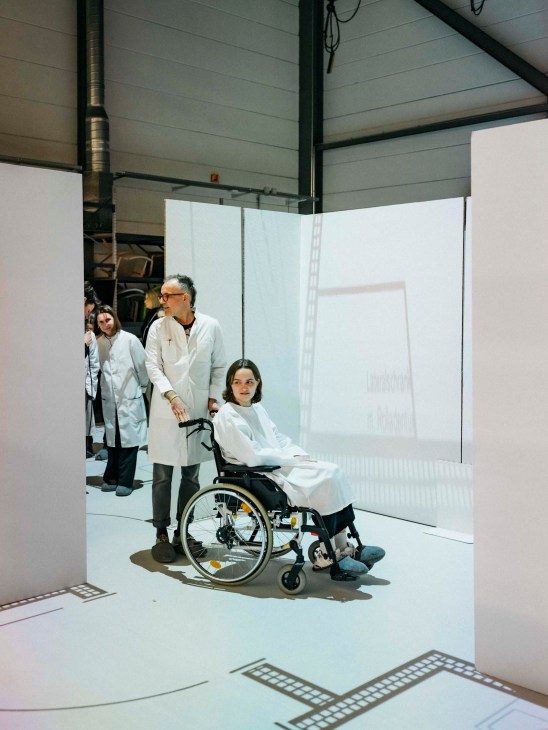
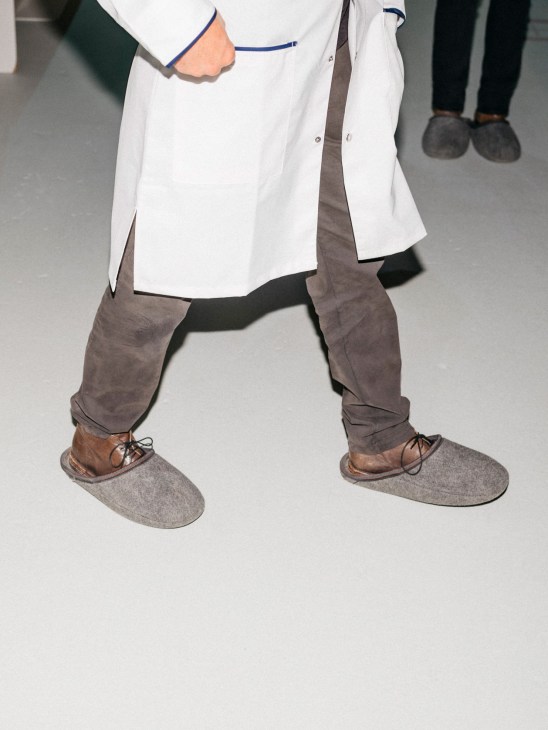
to play doctors and nurses. They gather in a facility the size of a car park, don lab coats and step into an imaginary ward with lightweight walls. A volunteer is chosen to play the patient, another the anaesthetist. “So, you’re here for your shoulder operation?” says someone who
is playing the receptionist.
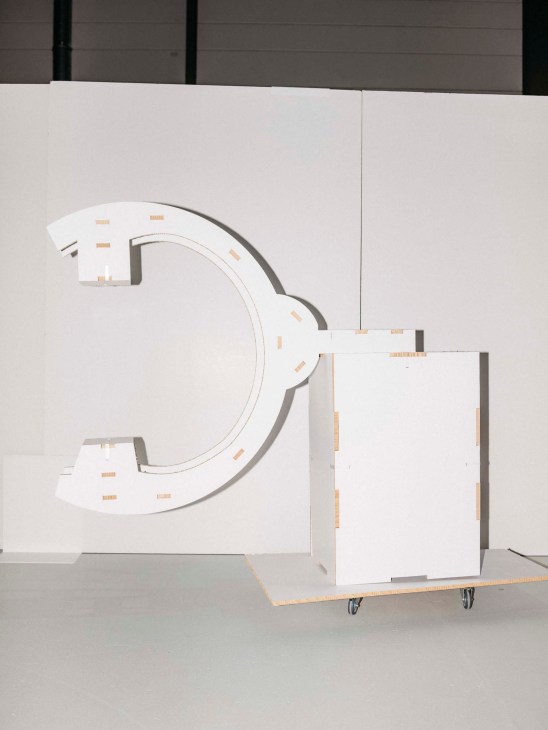
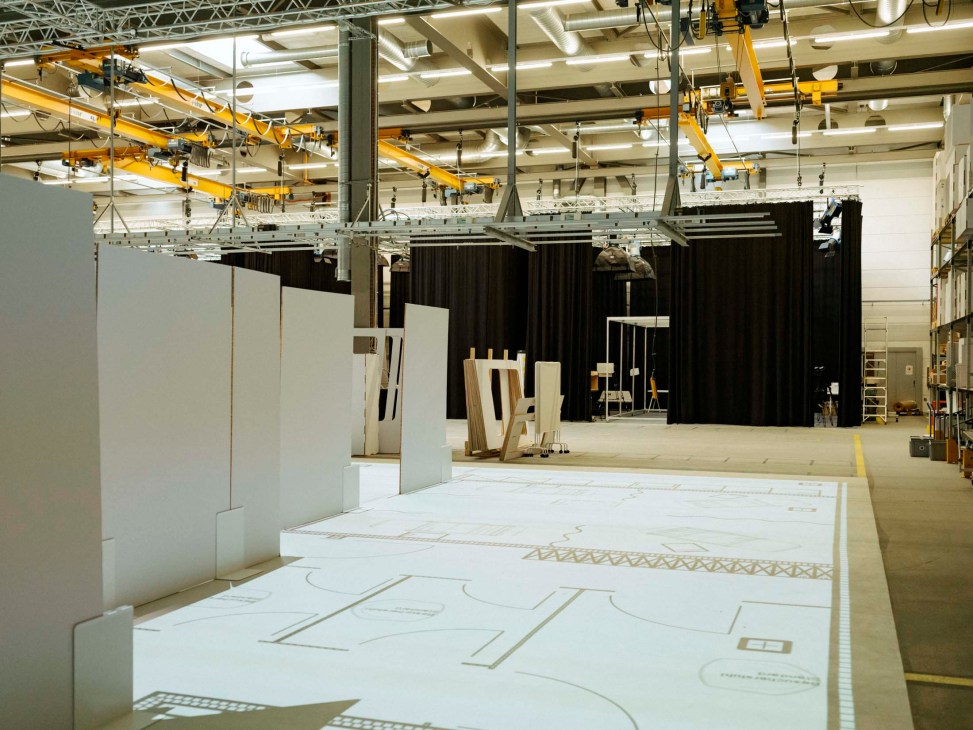
These make-believe sessions are orchestrated by the very real Swiss Center for Design and Health (SCDH), a public-private partnership that is using design to help healthcare spaces become more efficient and human-centred. The SCDH enables architects and developers to physically try new hospital spaces before they are built, using a purpose-made “extended-reality simulation space” that projects the architect’s floor plan at a 1:1 scale. The SCDH then invites real doctors, surgeons and healthcare teams into this facsimile to role-play a day on the ward.
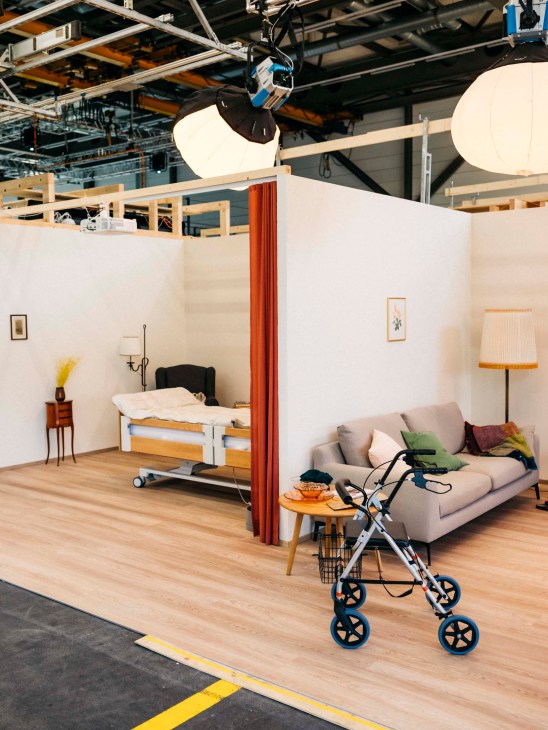
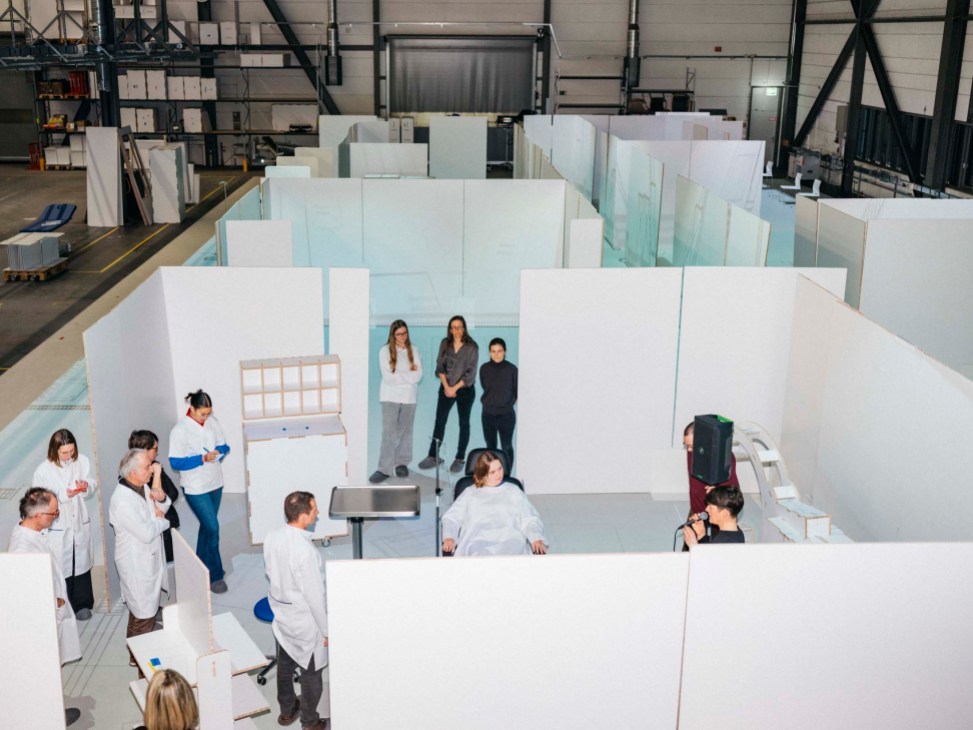
“It’s stress-testing the hospital, avoiding errors in the building,” says SCDH managing director Stefan Sulzer, who co-created the centre. “It soon becomes obvious what works and what doesn’t.” For instance, in a recent simulation, an architect discovered that a standard hospital bed wouldn’t fit down the corridor of an existing floor plan. Catching such problems early, says Sulzer, can save patients down the line.
In the public simulation that Monocle attends, the scenario follows a 75-year-old in a wheelchair (actually a sprightly woman in her mid-thirties) on her journey to the operating theatre. The design faults are soon apparent: the reception-desk counter is too high. “Immediately you have a hierarchy,” says Minou Afzali, the head of research at SCDH. “Also, there are patients within earshot in the waiting room. They can hear everything that’s being said.”
SCDH is also helping companies to innovate in healthcare design, from electric “skylights” offering a sense of daylight to bowls that facilitate one-handed eating. At the core of the centre’s thinking is bringing in the end-user earlier. “A hospital can look fantastic,” says Sulzer. “But let’s test it and ensure that it actually works.”
scdh.ch
Read next: Zürich children’s hospital shows that thoughtful architecture can help patients to recover
Late summer sun? Stunning new luxury escapes in the French Riviera and Milan
Mogo
Milan
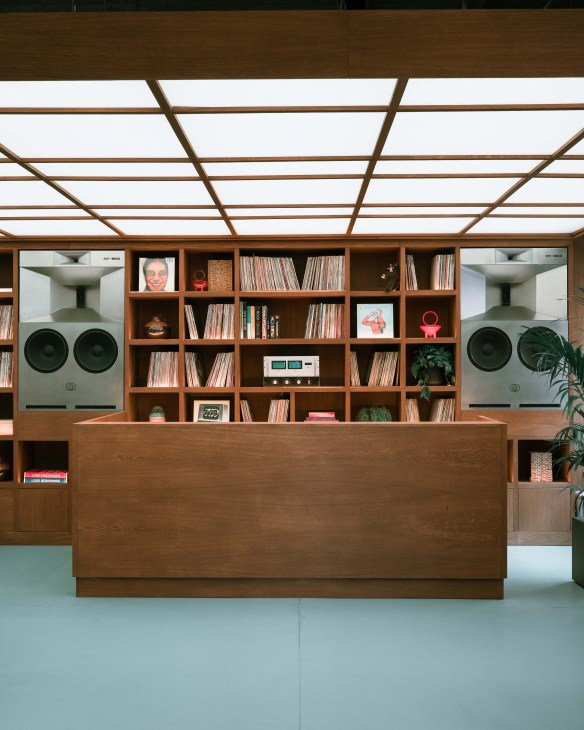
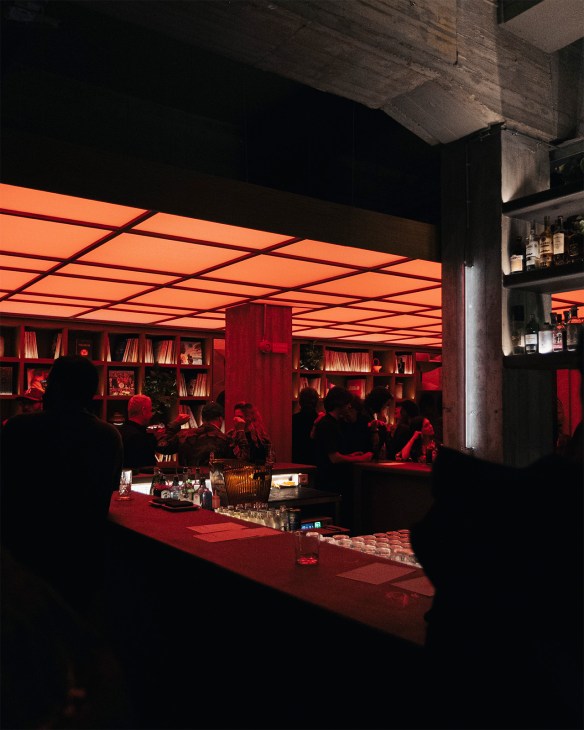
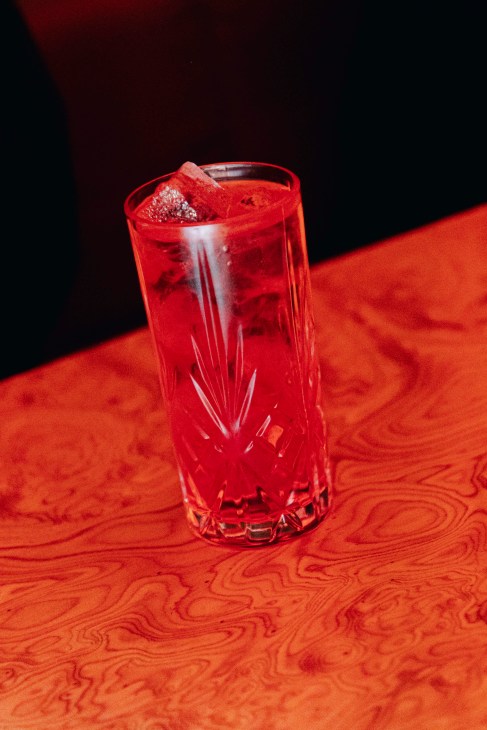
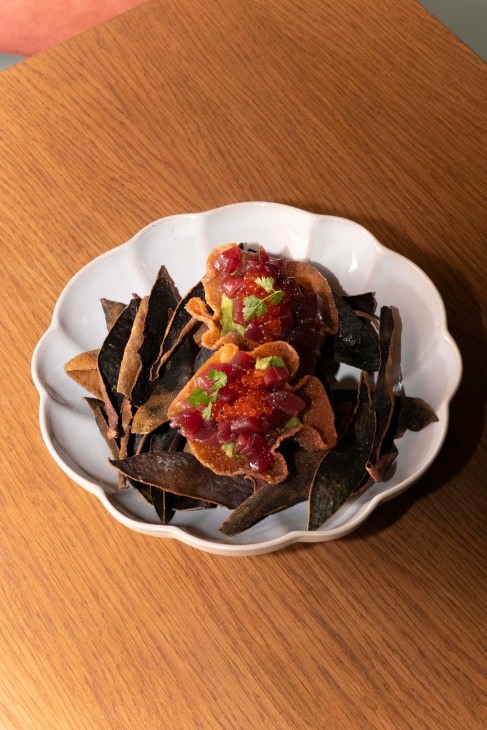
Mogo is the latest opening from Burro Studio and Polifonic, with Yoji Tokuyoshi – the chef known for Milan’s lauded Ristorante Tokuyoshi – as a consulting partner. Designed by Giorgia Longoni Studio, it draws on Japanese listening bars, with global fare by chef Simone Montanaro and a round bar serving cocktails such as the black saffron martini. Its interiors have a terracotta and aquamarine palette, with elements of steel, velvet and washi paper that keep things airy by day and intimate by night. Come for the wagyu burgers with tonkatsu sauce and the udon with pork and seasonal vegetables.
mogomilano.com
Les Roches Rouges
Saint-Raphaël, France
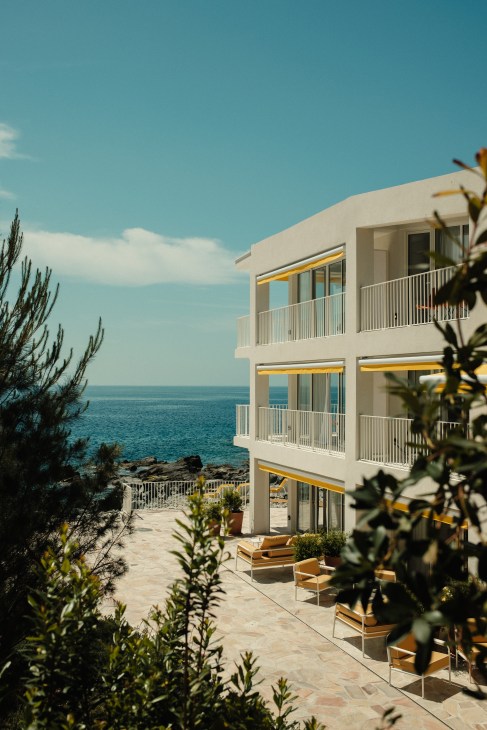
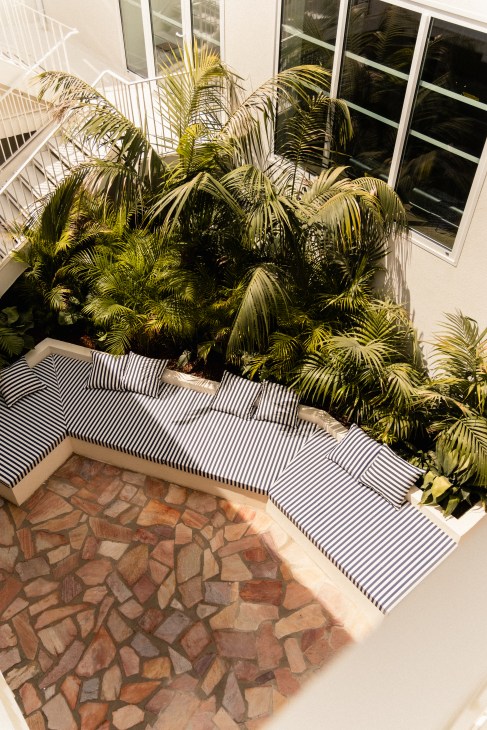
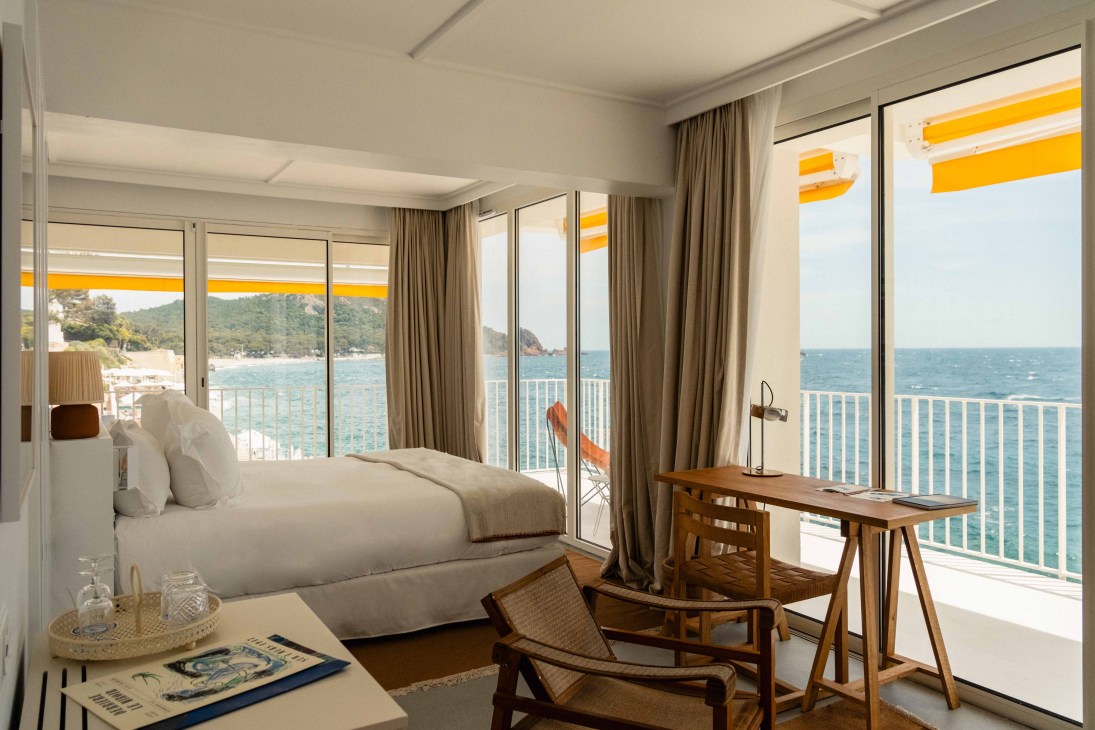
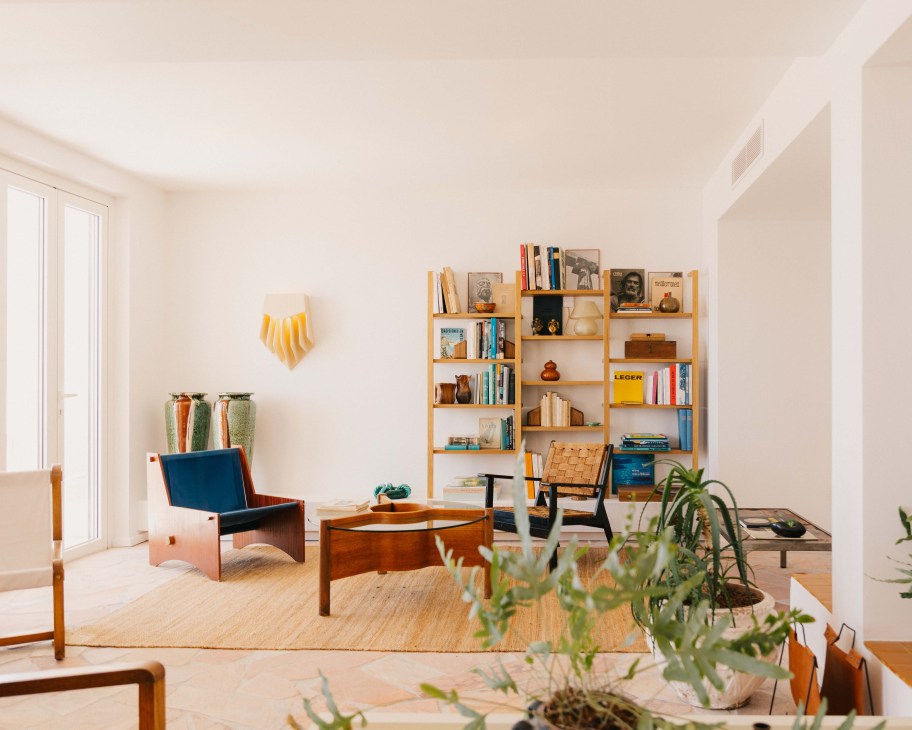
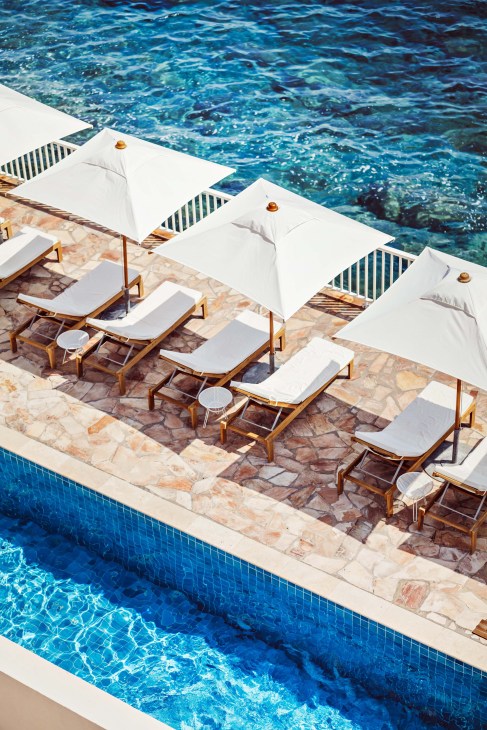
Located between Cannes and Saint-Tropez, 1950s hotel Les Roches Rouges reopened in 2017 after a redesign by Paris-based duo Festen. It quickly became a new Côte d’Azur institution. This summer saw a further expansion and renovation by ASL, including the conversion of a neighbouring building. Each of its 25 guest rooms remains faithful to the originals inspired by Eileen Gray and Le Corbu, featuring yellow awnings, butterfly chairs and sea views. “We designed the structure as simply as possible to let the Mediterranean flow through,” says Antoine Ricardou, co-founder of ASL. “Our aim was to harmonise with the surrounding environment.” The same ethos extends to the expanded outdoor areas, which offer more seafront for lounging on – be it by the rock-hewn seawater pool or at one of the hotel’s three alfresco restaurants.
beaumier.com
Can Penn Station be beautiful again, without becoming a political battleground?
When we’re confronted with someone whose political views differ from our own, we tend to wonder how any sensible person could have come to such conclusions – and so decide that they must be making their arguments in bad faith. This dynamic, known in the social sciences as “affective polarisation”, turns disagreements about policy into moral battles. It also seems to be shaping the debate over the renovation of NewYork’s Penn Station. The busiest rail hub in the western hemisphere is widely regarded as among the worst.
It’s poor by any architectural standard but its inadequacies seem all the more pronounced when you compare it to the beaux-arts masterpiece that it replaced, designed by Manhattan firm McKim, Mead & White. From 1910 to 1963, the original Penn Station was the largest indoor space in New York. Its neoclassical style embodied the American Renaissance, a movement that cast the US as the vanguard of Western civilisation.
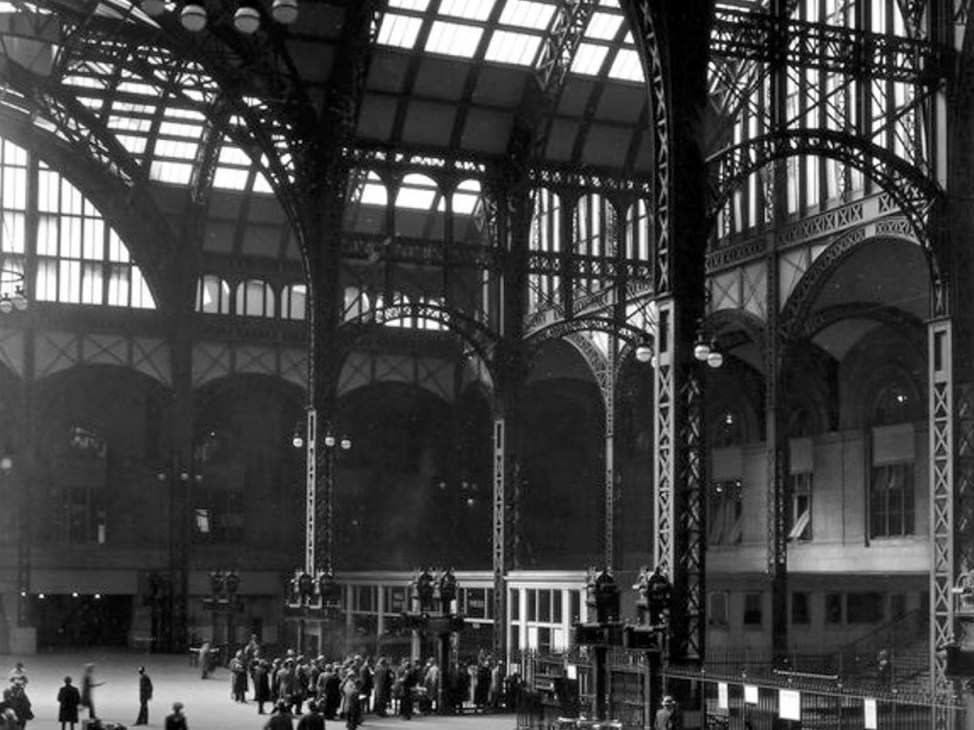
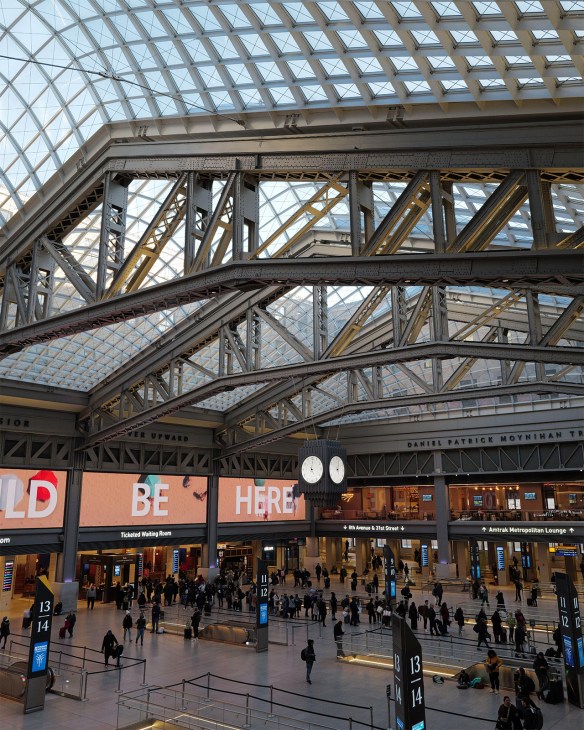
Between 1963 and 1966, the station’s main hall was demolished and replaced by the Madison Square Garden entertainment complex, while most of the station’s infrastructure was forced underground.The destruction of the old train hall prompted an outpouring of public opposition and is still viewed as a big misstep. Public architecture across the globe has since converged on a style that could be dubbed “dated international municipal minimalism” (let’s call it DIMM for short): economical, functional and forgettable structures of glass, steel and concrete.
It’s striking, then, that two of the four shortlisted designs for the new Penn Station buck this trend. One proposal, ReThinkPennStationNYC using the design of RWC Atelier & Co, would almost replicate the McKim, Mead & White design. Another, the Grand Penn plan from the Grand Penn Community Alliance (GPCA), would restore the station’s colonnaded façade as the entrance to a modern train hall with a classically inspired ceiling of vaulted glass. The other designs are typical of DIMM architecture; neither would be out of place in any modern city.
Every proposal has its strengths and weaknesses, and there’s a good-faith debate to be had about which would best serve New York and the wider region. But the discussion risks being overshadowed by politics. Some progressives have been spooked by the aesthetic conservatism of the Grand Penn plan. The GPCA aims to restore classical grandeur to US civic architecture and has aligned itself with the broader reactionary movement that has grown around Donald Trump. Its goal is to “make America beautiful again”, according to Justin Shubow, one of its leaders.
Coverage of the Penn Station renovation in non-specialist media outlets has focused heavily on the GPCA’s political ties and ideology. These might be legitimate concerns but the controversy has come at the expense of a proper consideration of the shortlisted designs’ architectural qualities. The fixation on the politics behind the Grand Penn proposal over its urban-design implications seems to be down to affective polarisation: for some people, the design is tainted by association with conservatives, as though choosing it would mark a right-wing victory in one of the US’s most progressive cities. That is misguided. Whichever design is chosen, the new station will hopefully outlast its backers and the immediate political context. New Yorkers should be careful not to let prejudice predicate yet more DIMM architecture and determine the outcome of a decision that will shape the city for generations.
Read next: The Monocle City Guide to New York, featuring the best hotels, restaurants and retail spots