Issues
Every object has a story to tell – and V&A London’s new storage facility is designed to serve as a museum
At one point during the installation of the Torrijos ceiling in V&A East Storehouse, 12 different parts of the carved wooden roof dangled from chain hoists. With painstaking care, a team of technicians clad in hi-vis and hard hats slowly tried to manipulate them into place.
We don’t often look at ceilings, the sides of buildings or entire rooms, for that matter, and consider them “objects”. The meaning of the word, however, begins to expand as you wander through this new museum-cum-warehouse. V&A East Storehouse is the latest member of the V&A family, a storied British institution founded in 1852 and named after Queen Victoria and Prince Albert. Unlike its existing museums in London, Stoke-on-Trent and Dundee, V&A East Storehouse is more like a storage facility that has been designed to allow visitors inside. There are publicly accessible art storage facilities elsewhere, most notably the Depot of Museum Boijmans Van Beuningen in Rotterdam, but nothing on the scale of this new institution.
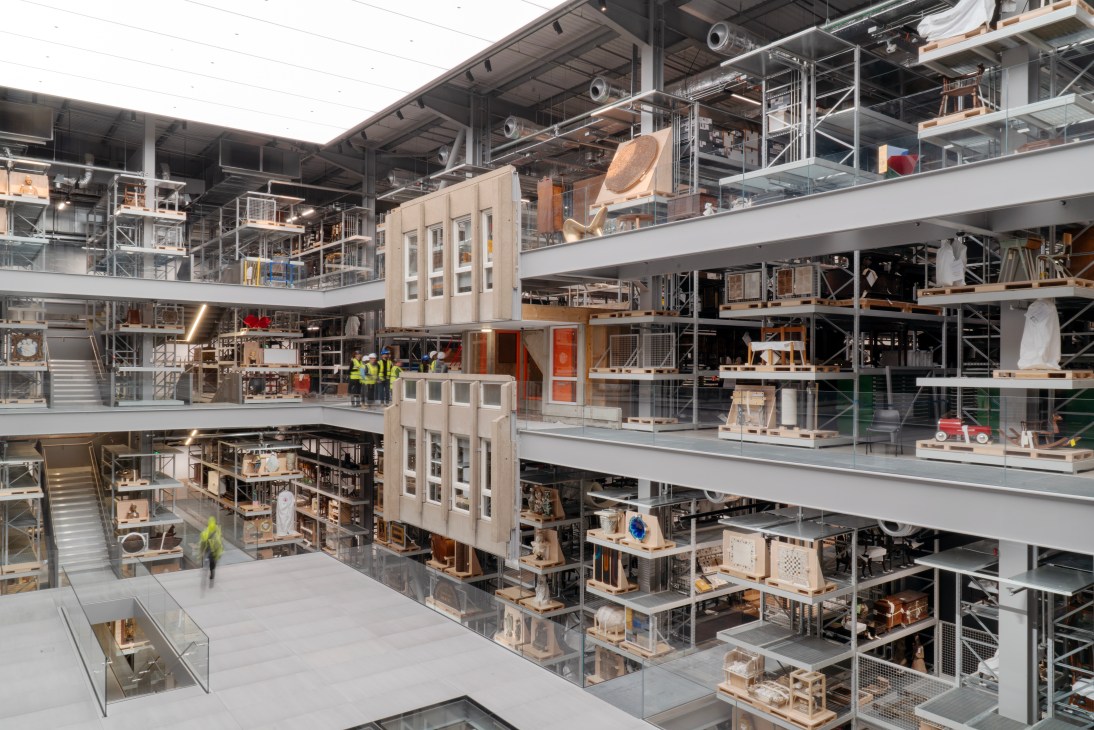
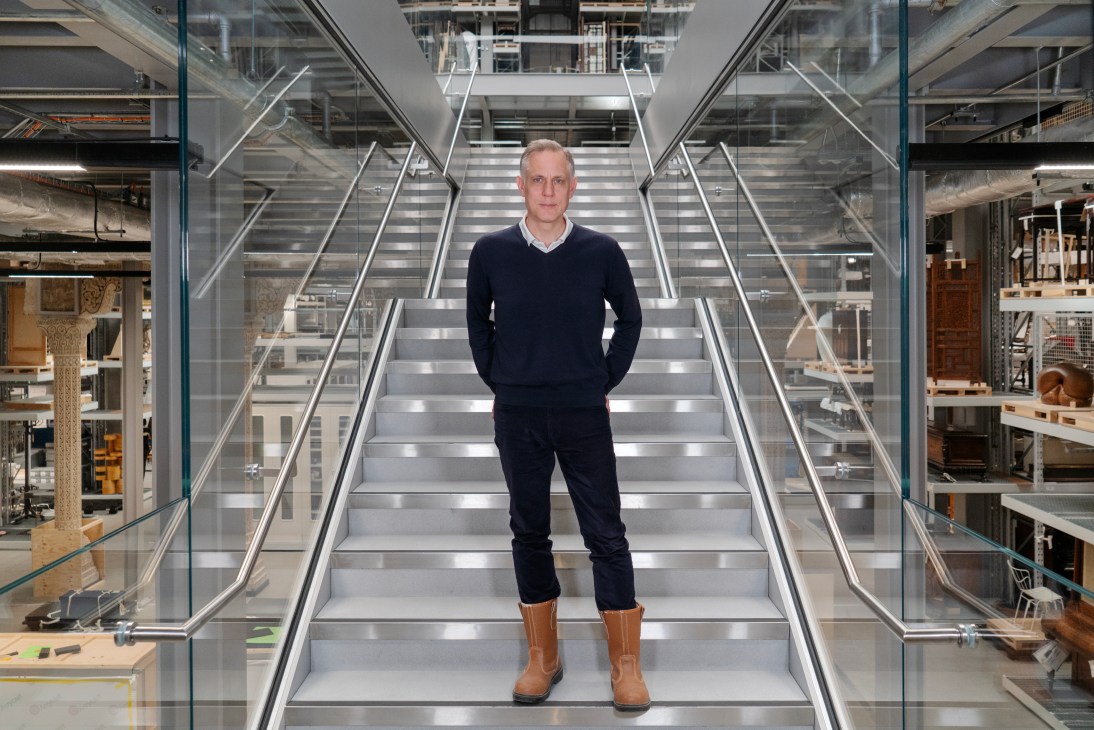
V&A East Storehouse was born, in part, out of necessity. In 2015 the UK government announced plans to sell off Blythe House, a government-owned London storage facility that has housed most of the V&A’s stored collection since the mid-1980s. About 600,000 objects, books and archival collections would have to be relocated; some larger objects, such as the Torrijos ceiling, were being kept in storage in Wiltshire and these were swept along into the plan. “You don’t move a collection of this size and scale very often,” says Tim Reeve, deputy director and chief operating officer of the V&A. “It made us think that we had to go as big and be as ambitious as we could.”
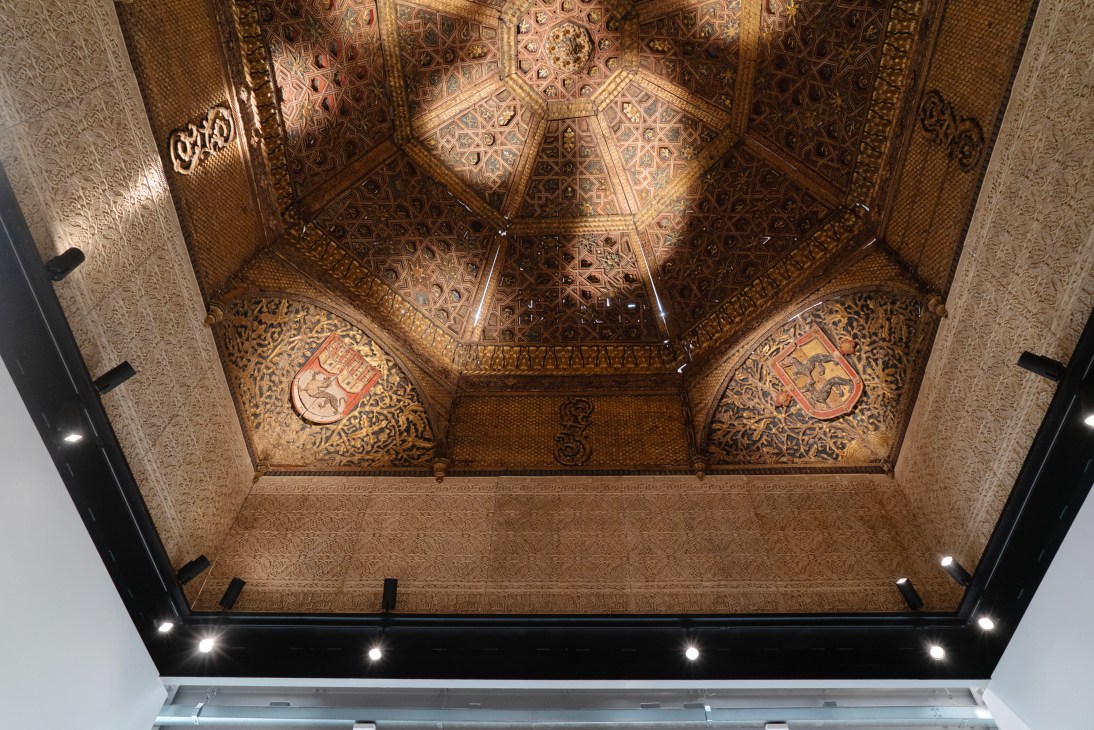
That ambition eventually translated into unboxing the 500-year-old Torrijos ceiling to install its eight interlocking arches and corner pieces (or squinches) here. The ceiling was created in the Spain of Ferdinand and Isabella, for a palace near Toledo. Just before the palace was demolished, the ceiling – one of four – was acquired by a London art dealer and, in 1905, sold to the V&A. For more than 80 years, the Torrijos ceiling was installed in the museum until, in 1993, it was dismantled and packed into 40 large crates.
When the ceiling was unboxed, some of the timber framework had warped and the pieces no longer matched up. “We had some sketchy old plans but there are about 150 pieces. It was just a massive jigsaw,” says museum technician Allen Irvine. “I’ve worked with the V&A for 21 years and that’s one of the most difficult installations we’ve ever had.” Completing the jigsaw – modelling how the octagonal dome fits together, building additional timber to support it, working with conservators and fixing the six-by-six metre ceiling in its tight space – took three months. “It’s an absolutely dazzling piece,” says Reeve. “Now we see it, I think we all feel guilty that it’s been off public display for so long.”
The Torrijos ceiling is one of five “large objects” that have been incorporated into the architecture of this space. They are testament to the ambition of the building’s design as well as that of past V&A collectors. They include an office designed by Frank Lloyd Wright and an example of a fitted kitchen from 1920s Frankfurt. The section of the façade from Robin Hood Gardens, an iconic east London brutalist tower block that was demolished between 2017 and 2025, was the first thing installed here more than three years ago, when the museum was just a building site. Now that 12-tonne concrete façade fragment lives in the centre of V&A East Storehouse, looming over the stairs through which visitors climb to arrive at the collection hall.
It’s a theatrical entrance amplified by the way the space seems suddenly flooded with natural light. But in fact this is provided by a lightbox created with a huge stretched Barrisol ceiling (“If size matters, this is the largest Barrisol ceiling certainly in Europe, maybe even the world,” says Reeve). It gives the perfect illusion of daylight without having to worry about capricious British weather. The museum’s hollowed-out core is the first space that visitors will experience, which makes V&A East Storehouse “a typical building inside-out,” says Elizabeth Diller, a partner at Diller Scofidio and Renfro, the New York-based architect firm behind the project. “In most public institutions, if one goes deeper and deeper into the footprint, one goes into more private spaces,” she says. Here, the further out you move, the less accessible it becomes. The inside-outness of the layout “gives the public a sense of trespass”, says Diller.
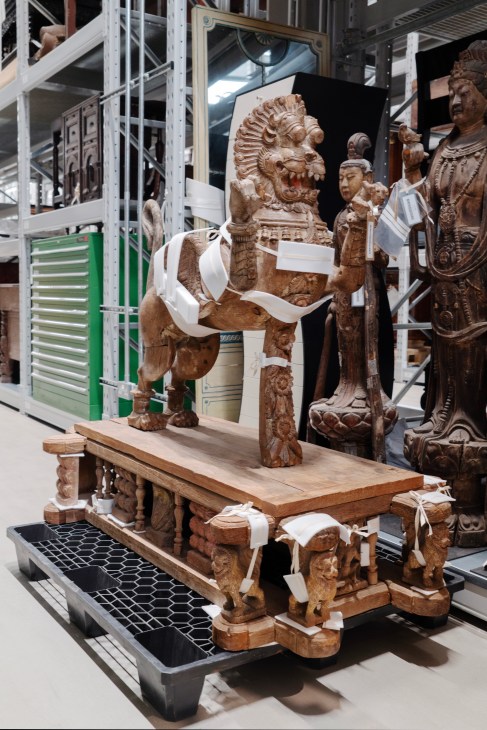
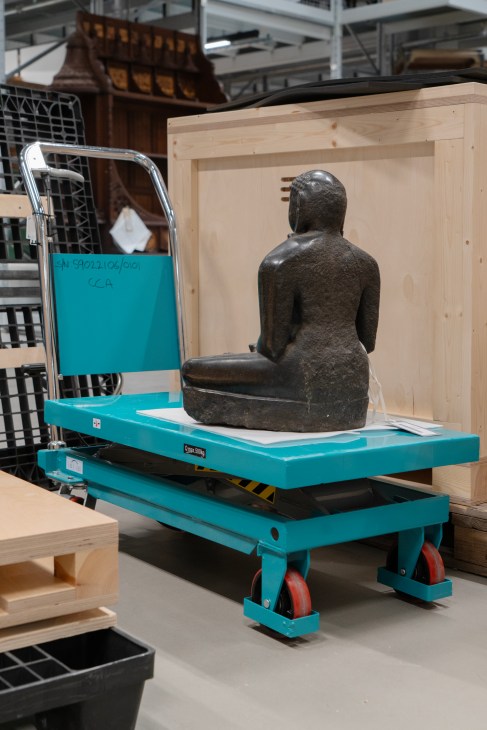
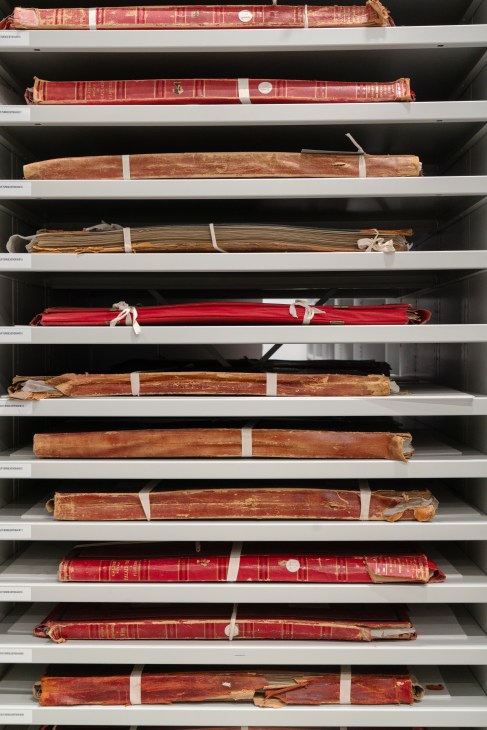
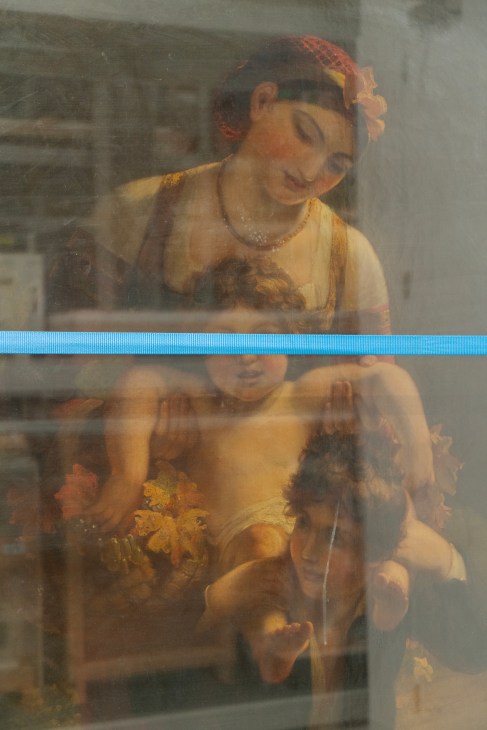
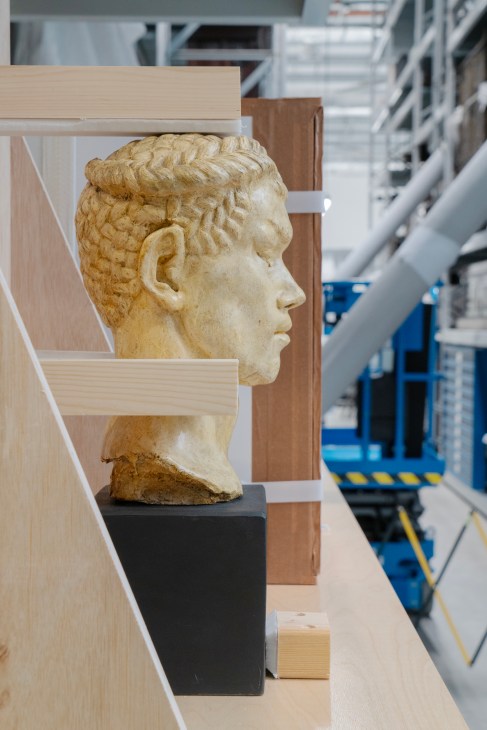
As you arrive, it’s hard to know where to look. The publicly accessible galleys, which surround the central space, are lined with industrial shelving units whose rack ends hint at the variety within. Glance around the room and you’ll see an elaborate Dutch “giraffe piano”, a Memphis Milano lamp, a Venetian bust and a multicoloured rubbish bin extricated from Glastonbury Festival. “There is something for everyone,” says Reeve. Where the objects go and who they sit next to has been lightly curated but visitors will take themselves on a self-guided tour. There’s no exhibition per se, no one story to be learnt or single message to take away. “Part of the motivation of the project, and what gave us great joy, was to figure out a way of expressing the vastness and eclecticism of the collection in a way that could be sublime,” says Diller.
For the displays, the architects “took as a model the eclecticism of a cabinet of curiosities”, says Diller. Made popular in Renaissance Europe, these were rooms in which collectors brought together their prized objects for the enlightenment and entertainment of others. At V&A East Storehouse, the simple, stripped-back appearance of the displays adds to the feeling that you’re drawing back a curtain and going behind the scenes. Objects are displayed in wooden crates and on specially designed palettes. Busts are strapped into place with criss-crossing cushioned seatbelts. Every object has a simple luggage tag tied to it with a code that can be looked up on the V&A’s digital database.
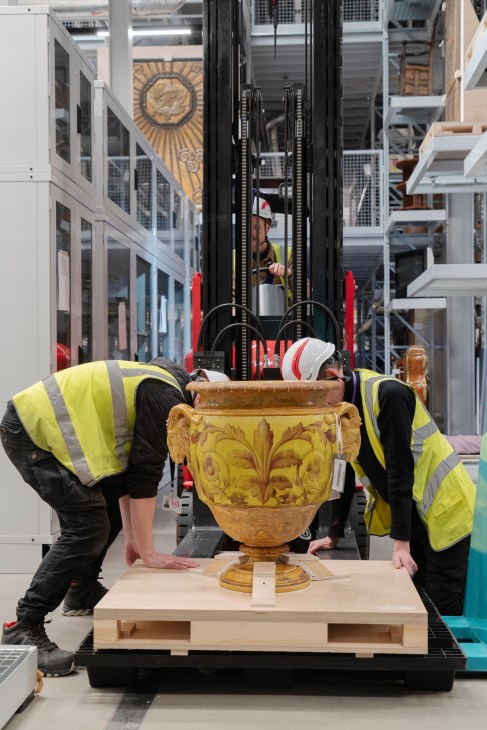
The public experience of V&A East Storehouse as a museum exists side by side with its purpose as a working storage facility. A glass floor in the central area, which gives the illusion of being propped up by a vast and ornate Mughal-era colonnade, gives visitors a view of what’s happening below. There, forklifts and other machinery roam the lower labyrinths of the building (it took over two years, says technical manager Matthew Clarke, to find the necessary equipment to handle heavy objects in narrow aisles without a standard palette size). When Monocle visits, we watch a 19th-century French vase with detailed goat heads for handles being manoeuvred onto a forklift and lifted into place. Once the museum opens, visitors will continue to see the technical team at work as they rotate the displays and move objects for exhibitions or to go on loan.
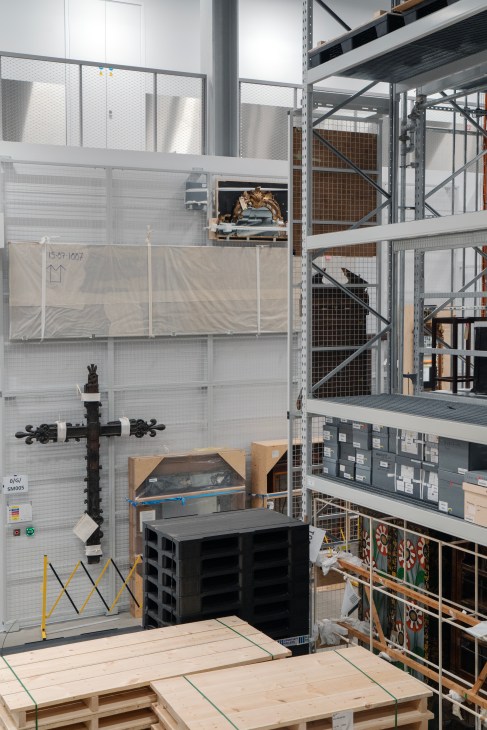
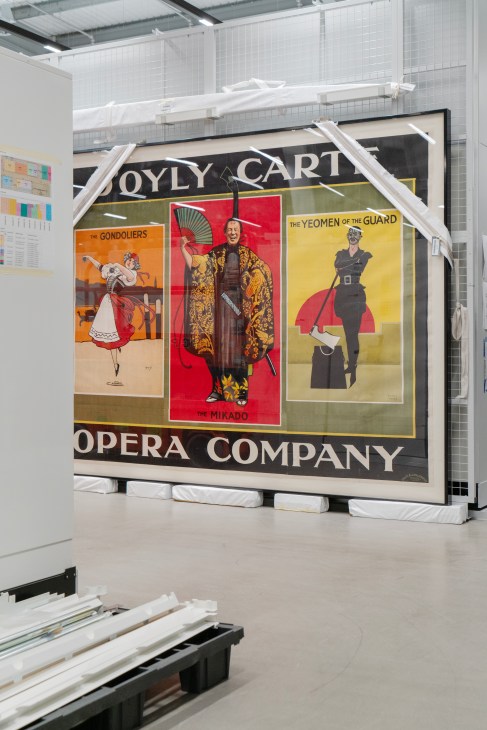
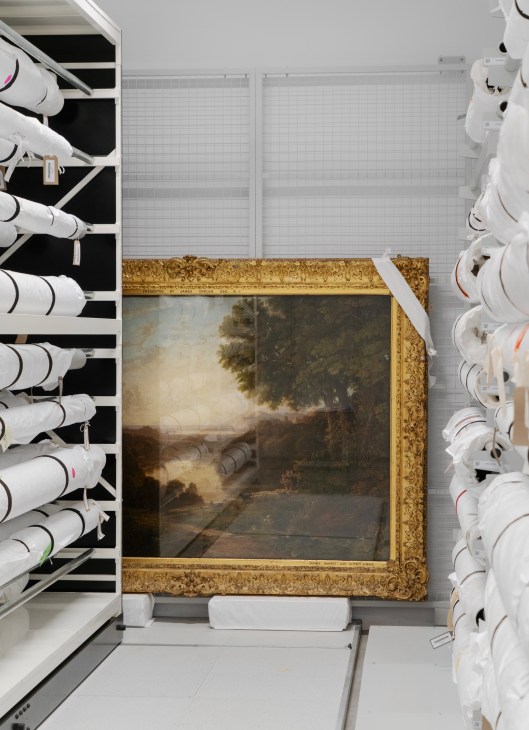
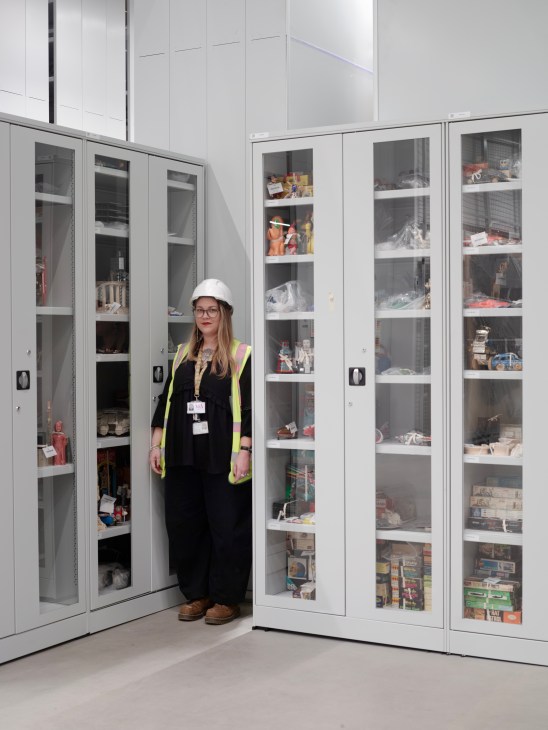
Deeper into the building, there are conservation studios, reading rooms and a cloth workers centre, all of which are publicly accessible. Overlooking the conservation studios is a window for visitors to peek at what’s going on inside. These studios are also equipped with headsets and cameras that conservators can use to give curious visitors more details about what they’re working on. Museum-goers might be used to seeing the work of curators but Reeve hopes to demystify other roles, such as conservators or technicians. “It’s getting visitors into all corners of what we do to care for a collection of this size and scale,” he says.
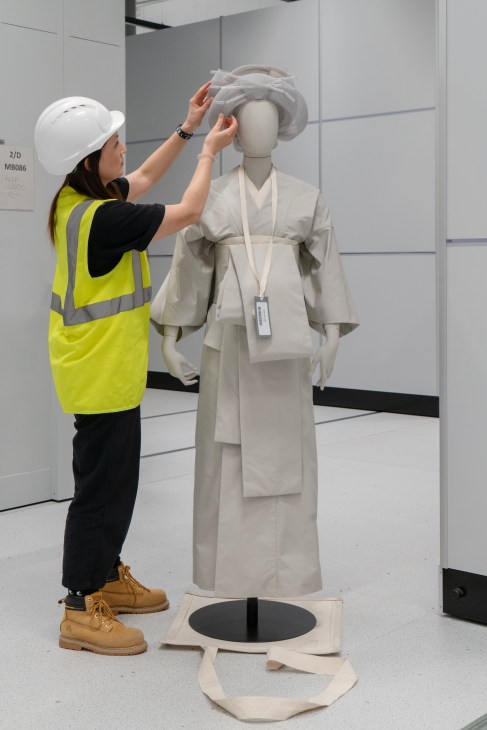
As well as exposing the lesser-known activities of museums, V&A East Storehouse extends an open invitation to visitors to take a closer look at its collection through the Order an Object service. Kate Parsons, director of conservation, collections care and access at the V&A, describes a new part of her role as providing “meaningful and equitable access to every part of every object on this site”. Everything in the building has been logged and anyone can search through the digital catalogue, put up to five objects in a “virtual crate”, then choose a time and date to come in and have a look. “A booking is a booking,” says Parsons. “It’s not a request. You decide you’re going to see these five objects and we enable access.” What that means in practice depends on why an object has piqued your interest. If you’re a cabinetmaker, says Parsons, you might want to see the back of a drawer to find out how it’s been made. If you’re researching shoes for a television drama, you might want a face-to-face with one of the 3,500 pairs here. But you don’t have to be a cabinetmaker or researcher to use the service. “We are very clear that there’s no need for credentials or a reason to look at something,” says Parsons. “People can choose to see things just because it might make them happy.”

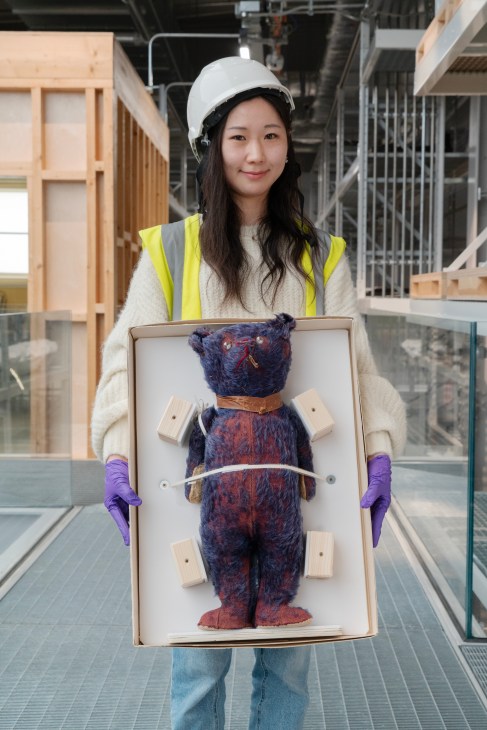
Parsons has just finished the recruitment process for the staff who will enable this access. Those who were chosen didn’t need to have experience in museums. Instead, prospective employees were asked to talk about an object they own that is precious to them and how they keep it safe. “That simple question was amazing in terms of the stories we heard,” says Parsons. Important, too, was recruiting from the local area. “We want people who are living and working in East London to feel like this can be part of their lives, as a hobby but also a profession,” says Reeve. Keeping things local, the museum café is run by East London bakery E5 Bakehouse. And V&A East Storehouse isn’t the only new institution here. Dance venue Sadler’s Wells East opened earlier this year, while the David Bowie Centre will be finished later in 2025 on the Storehouse site. Next year, V&A East Museum, a more traditional museum that will act as a sister venue to Storehouse, will open too. “East London has a great creative heritage,” says Reeve. “But research tells us that a large population in East London are not museum-goers. We want to make them feel welcome here.”
As Reeve walks past one corner of the collection hall, he throws his arms wide, encompassing a Piaggio scooter customised by architect Daniel Libeskind, a drum kit that belonged to Keith Moon and a vase with sphinx-shaped handles. Thousands of miles and hundreds of years of history swept up in one arm span. On show, too, are the straps, screws and supports that hold all these objects in place. “This is what it’s all about,” he says, beaming.
It’s these objects that take centre stage here, and the hundreds of thousands of them at V&A East Storehouse tell us infinite stories. Stories that can’t be heard from outside the locked doors of a closed storage facility. Stories that aren’t just of the objects themselves but of all those who’ve had a hand in helping them along the way. The hands that sketched, stitched, carved, crafted, restored; that used an object, made it famous, threw it away, decided that it was worth keeping or, lovingly, winched it into place.
Hear an audio version of this story with extra interviews on The Urbanist:
Hear four young people reflect on their experience telling the stories of Robin Hood Gardens alongside the V&A on The Urbanist:
Read next: The Monocle City Guide to London, featuring the best hotels, restaurants and retail spots in the UK capital
Underrated pillars of the contemporary-art world
The Archivist
Silvia Omedes
Barcelona
While Spain’s Centro Nacional de Fotografía may be set to open in Soria in 2026, surprisingly, the country lacks a national museum dedicated to photography. In 2001, Silvia Omedes decided to do something to support documentary photographers and established her photojournalism archive and showroom, Fundació Photographic Social Vision, in Barcelona. “We think of our premises as a bubble of resistance because we’re defending important photography that would otherwise never see the light of day,” she says.
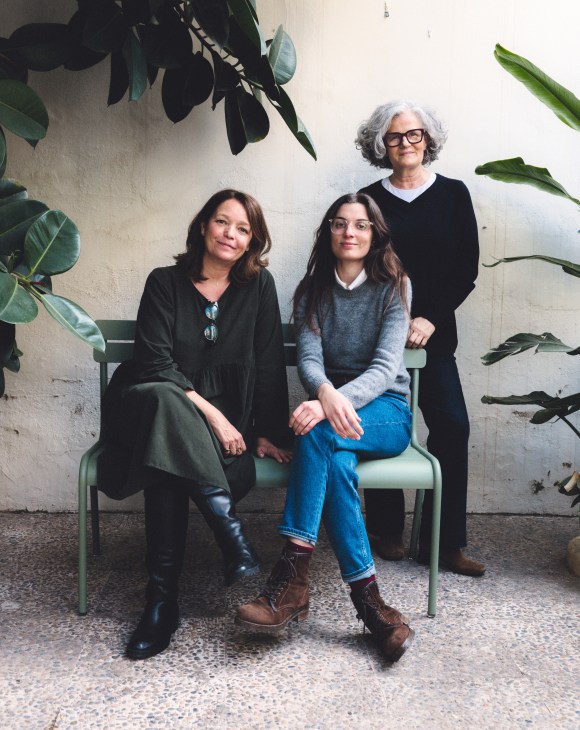
The non-profit focuses on documentary work created between the 1960s and the 1980s, a period that encompassed Spain’s political transition from dictatorship to democracy. “Franco controlled culture to such an extent that we’re still undoing this oppression today,” says Omedes, who thinks that the art form is still not entirely respected in Spain. “At Arco Madrid, Spain’s international contemporary art fair, we still see very little photography,” she says, similarly bemoaning Spanish museums for not showcasing enough of the medium. “If we want to get home-grown photographers into private collections, they need visibility in the public ones first.”
The foundation currently represents 10 archives. It owns the rights to the estate of Joana Biarnés, Spain’s first female photojournalist. Since 2013 the team has been preserving Biarnés’s vast archive by treating the negatives. The foundation is funded partly through its own services, projects and private sponsors, and partly by the Spanish and autonomous governments of Catalonia, and the grant bears Biarnés’s name in honour of her contributions to the canon.


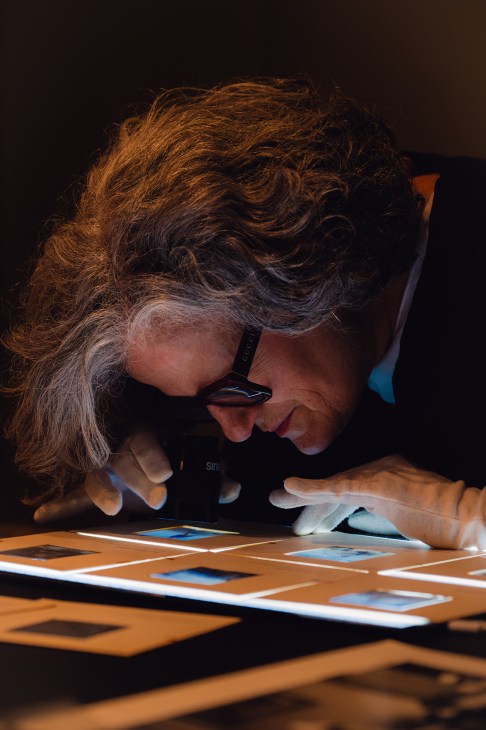
Looking ahead, the foundation’s focus is to digitise its archives so that they can be shared online. “We have had a presence at Anne Clergue Galerie and Les Rencontres d’Arles photography festival but our archives don’t have international visibility,” says Omedes. Lacking the capacity to represent more portfolios, the foundation teaches archive owners how to manage theirs independently. “The government doesn’t offer support so the heirs of large photography collections come to us for help with IP issues, grants and portfolios,” she says. “But we can’t help them all.”
“Politicians are finally listening to us,” says Omedes, who hopes that the archive becomes a lens through which to better understand Spanish society. “Photography teaches us that there’s no future without visiting the past.”
fundacionpsv.org
The Consultant
Edward Mitterrand
Geneva
The Mitterrand name might be synonymous with French politics but Edward, a relative of late president François Mitterrand, chose commercial art instead. His art-dealer father, Jean-Gabriel, established Galerie Mitterrand in Paris’s Marais district in 1988, and together they founded the Domaine du Muy sculpture park in the south of France in 2014.
Alongside these projects, Mitterrand began working on an advisory basis, drawing on his learnings as a gallerist. Mitterrand Art Advisory works with individuals, interior architects and financial institutions. “We’re not in the high-volume market,” he says. “I only advise four or five clients at a time because I continue to dedicate time to the Paris gallery.”
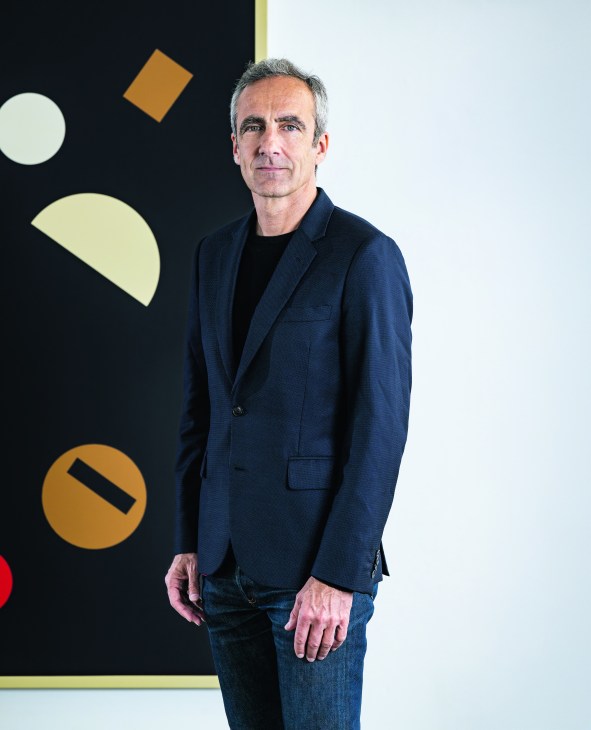
Mitterrand took the helm of Galerie Mitterrand in 2021 from his father. He now works with clients who are curating for the walls of their office or home, ensuring that he develops a thorough understanding of their taste so that he can source works from private owners, dealers and auctions.
Based in Geneva, Mitterrand has direct access to artworks because of his background as a gallerist but his services are independent. The real value of employing a consultant, he says, is in the mitigation of intellectual, shipping and tax risks. “Some buyers think that we should cut the middleman and go straight to the galleries,” he says. “But there’s an element of risk at every stage of the art-buying process.”
And without the same overheads as galleries, advisors are relatively inexpensive. His best tip? “Take it slowly. There are only so many walls in your house and once they’re filled, there’s no going back.”
advisory.art
The Guardian
Ben Jun
Seoul
Since the arrival of Frieze Seoul in 2022, the South Korean capital has been busy establishing its reputation on the international art scene. Now The FreePort, a new storage facility located within the Free Trade Zone, hopes to provide the cutting-edge infrastructure that’s needed to transform the city into a global art hub. Its vice-president, Ben Jun, tells us why now feels like a tipping point for Seoul’s artistic ambitions.
What does The FreePort offer?
We have one of the largest and most advanced art-storage facilities in Asia, covering 40,000 sq m. We’re located within the Incheon Free Trade Zone and directly connected to Incheon Airport, so we’re very convenient. There are biometric access controls, 24/7 surveillance, a climate-controlled environment and even a butler service for high-net-worth collectors and public institutions.
Why does Seoul need this infrastructure?
We are a family business and my father has been in the industry for more than 30 years. We found it hard to use the traditional art-logistics companies here when we needed them and they seemed to focus on their existing clients rather than new ones. We wanted to create a more friendly, personalised service.
What are your long-term hopes for Seoul’s art scene?
We hope to make the city a competitive art centre. We want it to be the next Hong Kong. But we also want to show that our collectors here are not just interested in investment; they’re also people who are really looking for cultural experiences.
thefreeport.com
The Museum Director
Arturo Galansino
Florence
When contemporary artworks are buddied up with their historical ancestors, context is crucial. One of the sector’s evergreen questions is, “How do you show new art in an old place?” Among the museum directors who can be relied on to answer this wisely is Arturo Galansino, the director-general of Florence’s Fondazione Palazzo Strozzi. Galansino is currently presenting Tracey Emin’s wide-ranging Sex and Solitude exhibition within the walls of the Renaissance marvel.
The British artist originally planned to “focus on her new output – a reborn passion for painting and sculpture”, says Galansino. “These are very traditional techniques, so it made sense to represent them in a historical environment.”
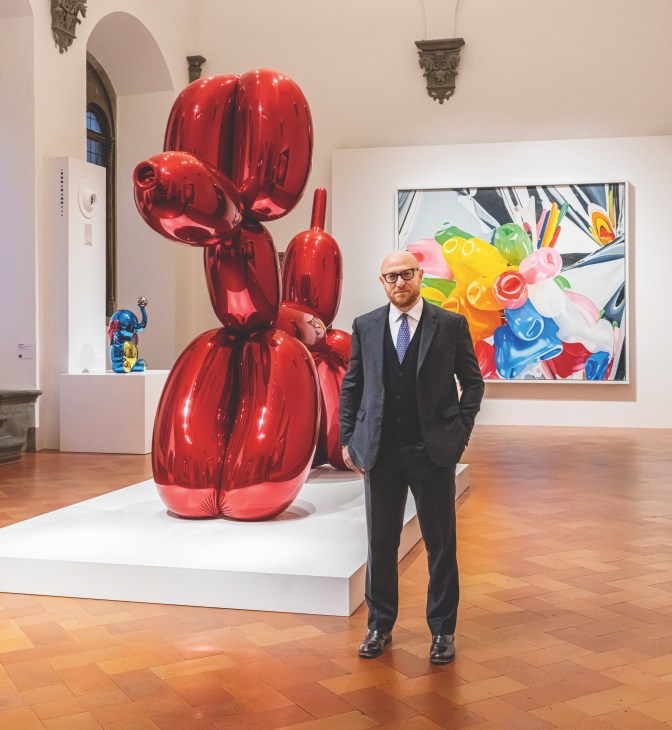
Could the 16th-century Palazzo Strozzi, with its wealth of Renaissance history, encourage an artist to take the long view of their career? “In the end, her show includes more tapestry and embroidery, as well as her work as a poet,” says Galansino. “So the exhibition has become a way to look at her whole career in a thematic, rather than a chronological, way.”
Since 2015, the Palazzo Strozzi has been staging a series of radical shows by titans of contemporary art, including China’s Ai Weiwei, Danish-born Olafur Eliasson and US painter and sculptor Jeff Koons (who visited Galansino the day before monocle speaks to him and is, according to the director-general, “a very good friend of Florence”).
When the Palazzo Strozzi showed Electronic Renaissance – an exhibition by the late, great US video artist Bill Viola that explicitly celebrated the city and its art history – in 2017, the theme of new art in old places truly clicked for Galansino. “In Bill’s case, the Old Masters were so inspirational for him,” he says. “The dialogue between new and old was – and remains – so strong.”
Next up, former enfant terrible Emin will give up the Fondazione Palazzo Strozzi to the 15th-century work of Fra Angelico, the early-Renaissance altarpiece maestro and Dominican friar. “What does Angelico offer us?” says Galansino. “Brilliant perspective.”
‘Tracey Emin: Sex and Solitude’ runs at the Fondazione Palazzo Strozzi until 20 July. ‘Angelico’ opens on 26 September.
palazzostrozzi.org
The Framer
Frame London
London
Frame London’s premises are tucked away in an unassuming corner of east London populated with building merchants, but its humble appearance belies the artistry within. Its founders, Harry Burden, Vicky Bulmer and Emily Taylor, craft wooden, acrylic and aluminium frames for some of the world’s most prestigious galleries and art fairs. “Creating a bespoke frame is as personal as tailoring a Savile Row suit,” says Burden, who, with Bulmer, trained and worked at the Royal Academy of Arts’ framing department until it was dissolved in 2014.
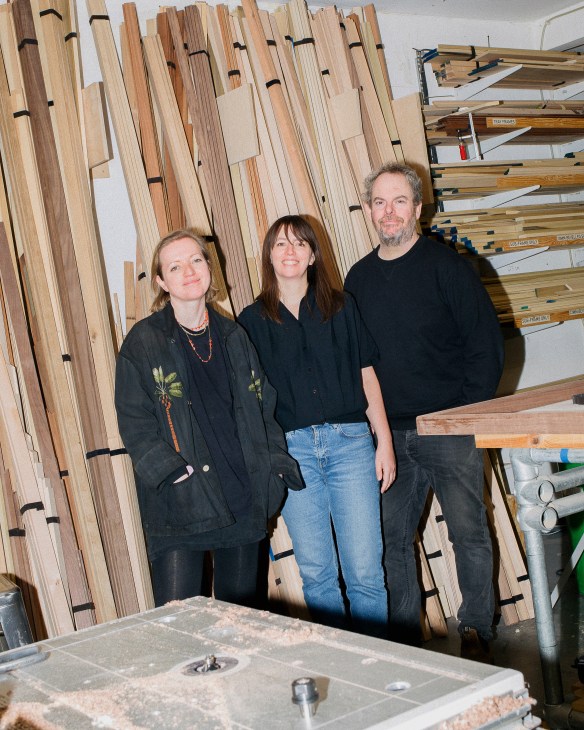

Frame London came next. “After working for an institution, we wanted to have our own service that wouldn’t be driven by commercial targets,” says Bulmer. Their skills in carpentry, framing and mounting made for a successful start-up that has now grown to 12 employees and worked with the likes of New York’s Grimm and David Zwirner, Stevenson gallery in South Africa and Melbourne’s Anna Schwartz Gallery.
Commissions have included a medieval altarpiece framed in situ at London’s V&A and wall paintings in the Houses of Parliament, plus some wacky challenges, such as a fossilised fish and a mummified cat. For artist Caroline Walker, the team made a 3.5-metre-long collapsible frame for a diptych that could travel in two pieces to New York and then be reassembled.
“We want to encourage longevity,” says Taylor. Frame London makes bespoke wood mouldings, finishes and museum-grade conservation wheat-starch glue (for mounting works on paper) in-house. “It’s labour intensive and time consuming but clients know they’re investing in something that will age gracefully,” she says. It shows there’s a healthy appetite for craftmanship. “You might still choose a mass-produced Ikea frame but that’s a different proposition,” says Burden.
framelondon.com
Top tips for framing your art:
1.
Conservation-grade materials such as UV-protective glass will limit damage
to the artworks by pollutants.
2.
Consult a framer when choosing the style. A good bespoke framer will help you to make decisions from a creative, practical and conservation perspective.
3.
Choose the frame for the art, not the space that it’s in. The frame should complement and enhance the artwork, not overpower it.
A fair to remember: Highlights from the upcoming Art Basel in Basel
To differentiate it from its global spin-offs, the Swiss version of Art Basel was rechristened Art Basel in Basel in 2013. Despite the repetitive nature of the title, the fair, on from 19 to 22 June, remains the pre-eminent art event of the year. This year’s edition promises to live up to its reputation with 289 galleries from 42 countries and territories, new sections and a public reception for the first Art Basel Awards, which celebrate trailblazers across the sector.
Outside of the fair, there’s a host of buzzy satellite events and museum shows that are worth a visit, including your last chance to see a major exhibition dedicated to the artist-architect Le Corbusier in Bern. Here, we pick the best of the bunch, take the temperature of the art market with the fair’s director and spill the best spots for a cocktail at the end of a long day in the halls of Messe Basel.
Q&A
Maike Cruse
Director, Art Basel in Basel
This is the second edition of Art Basel in Basel with Maike Cruse in charge. The German-born director previously worked as communications director at Art Basel between 2008 and 2011. Here, Cruse reveals what she’s looking forward to this year, takes a view on the art market and offers her favourite place to go dancing in Basel.

What are some of your highlights?
Nine galleries are participating for the first time in the gallery sector, which is always exciting. I’m particularly looking forward to Galerie Le Minotaure from Paris, which will focus on 20th-century geometric abstraction and works by László Moholy-Nagy, as well as The Third Gallery Aya from Osaka, which is presenting pioneering Japanese female photographers. The new sector, Premiere, will see galleries showcase works from the past five years – ultra-contemporary pieces from emerging voices. There, the Gypsum Gallery from Cairo will bring together two artists whose work is inspired by volcanic landscapes.
What else is new?
This is the first Art Basel Awards, which is an all-year initiative that celebrates boundary-pushing artists, curators, museum patrons and others who are driving the future of contemporary art. In Basel, we will celebrate our 36 medallists and bring them together for public talks and presentations.
How does Art Basel in Basel retain its top spot in the art calendar?
It’s the quality of the fair. We have a rigorous selection process and it’s the Art Basel fair with the broadest programme. This includes galleries presenting modern art but also we have sectors, like Unlimited [dedicated to monumental and immersive works], which are unique in the world of art fairs. Another sector, Parcours, will again be curated by Stefanie Hessler and spread along Clarastrasse. These initiatives help to make the fair such a unique experience.
Your view on the art market today?
What we are seeing at the moment is cautious optimism. There has been a democratisation of the market: we are seeing new and younger buyers coming into it. Art fairs are still one of the main platforms for galleries to meet those new buyers, so they remain very important.
Where do you go out in the city?
My favourite is the Campari bar at the Kunsthalle restaurant. Head to Chez Donati for Italian food, Peng for dumplings or Chanthaburi for the best Asian food. And for dancing, nothing beats techno club Nordstern.
Three new galleries to visit at Art Basel
Art Basel has a strong track record of championing emerging galleries (writes Rory Jones). This year there are 18 new galleries being thrown into the mix. Here, we pick three that are worth checking out.
1.
Gallery Artbeat
Tbilisi
Keeping things close to home, Gallery Artbeat offers a solo exhibition by Georgian artist Nika Kutateladze. His contemplative paintings – typically darkly pigmented, otherworldly portraits – take inspiration from his time spent in small rural communities in the mountains of Georgia. The immersive presentation will be staged in a reconstructed living room typically found in a Gurian village.
Find the gallery in the Statements section
2.
Polka Galerie
Paris
Italian photographers Luigi Ghirri and Franco Fontana will be brought together at the booth of Paris’s Polka Galerie. The Ghirri prints examine landscapes as an extension of the people who inhabit them in his trademark naturalistic manner. In contrast, his contemporary Fontana takes his cue from stylistic movements such as minimalism and abstract expressionism.
Find the gallery in the Feature section
3.
Galerie Eli Kerr
Montreal
The first gallery hailing from Montréal to exhibit at the fair in its 55-year history, Galerie Eli Kerr will show an intriguing installation by Lebanese video artist and writer Joyce Joumaa. Joumaa’s work explores Lebanon’s energy crisis through repurposed circuit-breaker boxes, which showcase photographs of quotidian urban scenes in Beirut and Tripoli.
Find the gallery in the Statements section
Three museum shows to catch
There is plenty to enjoy under the roof of Messe Basel but if you need a break from the hubbub, these are the museum shows to see while you’re in town.
1.
‘Vija Celmins’
Fondation Beyeler, Basel
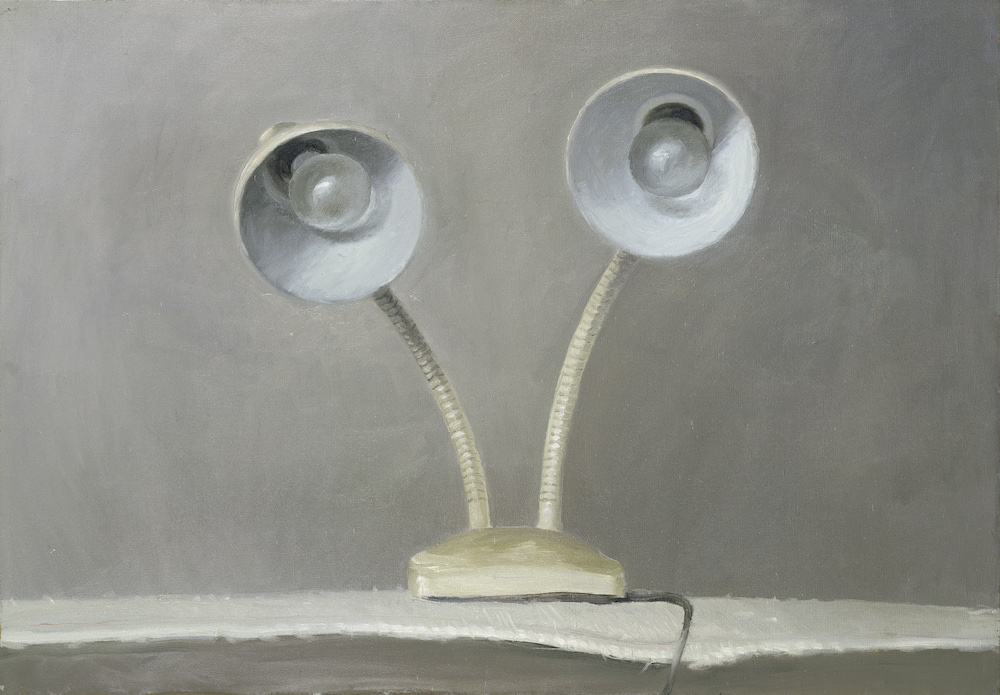
A calming contrast to the fair is always to be found at Basel’s Fondation Beyeler, which has idyllic surroundings. During Art Basel, it will present a comprehensive retrospective of Latvian-born artist Vija Celmins. The show will bring together works from the 1960s to the present day and includes sculpture, painting and drawing.
15 June to 21 September
2.
‘Midnight Zone’
Museum Tinguely, Basel
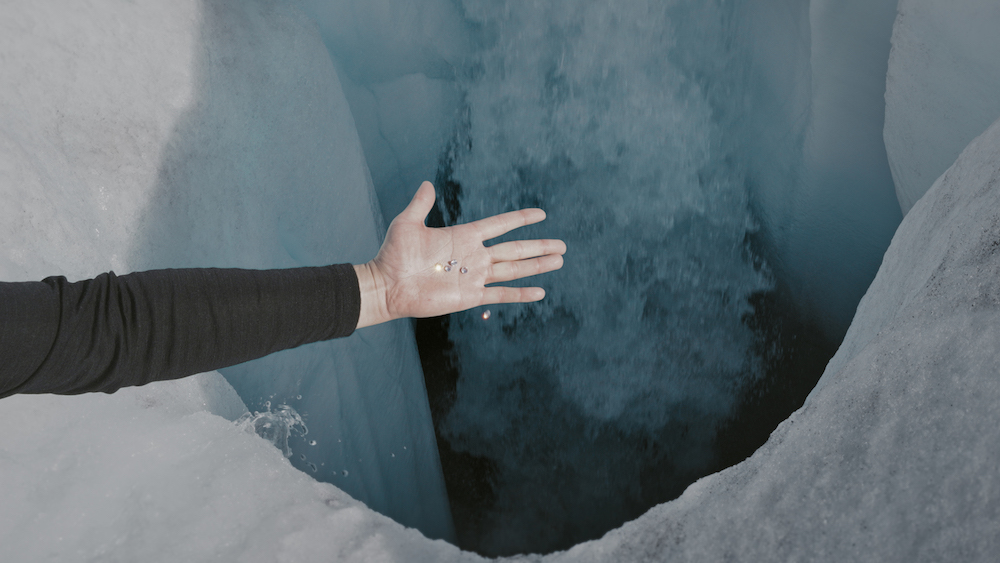
“Midnight Zone”, French-Swiss artist Julian Charrière’s solo show at Museum Tinguely, muses on how humans inhabit the world and how, in turn, the world inhabits us. Underwater ecologies are presented through photography, film and sculpture. All promise to envelop you in a kaleidoscope of blue and encourage reflection on our relationship with the natural world.
11 June to 2 November
3.
‘Le Corbusier. The Order of Things’
Zentrum Paul Klee, Bern
Just an hour’s train ride from Basel, the Zentrum Paul Klee in Bern has devoted a major exhibition to Le Corbusier. The show includes both iconic pieces and unseen works, and is a chance to revel in the sketches and original designs of this pioneer of modern architecture.
Until 22 June

Artist spotlight
Lonnie Holley
The work of American septuagenarian artist and musician Lonnie Holley has gained well-deserved traction in recent years. At this year’s fair, London-based gallery Edel Assanti will present a solo show of his colourful paintings and unusual sculptures made from salvaged materials. Holley’s artistic practice also includes film and music so it’s worth visiting his installations in the Unlimited sector to grasp the diversity of his work. His art reflects his extraordinary life, which includes being incarcerated at the Alabama Industrial Home for Negro Children in his youth.
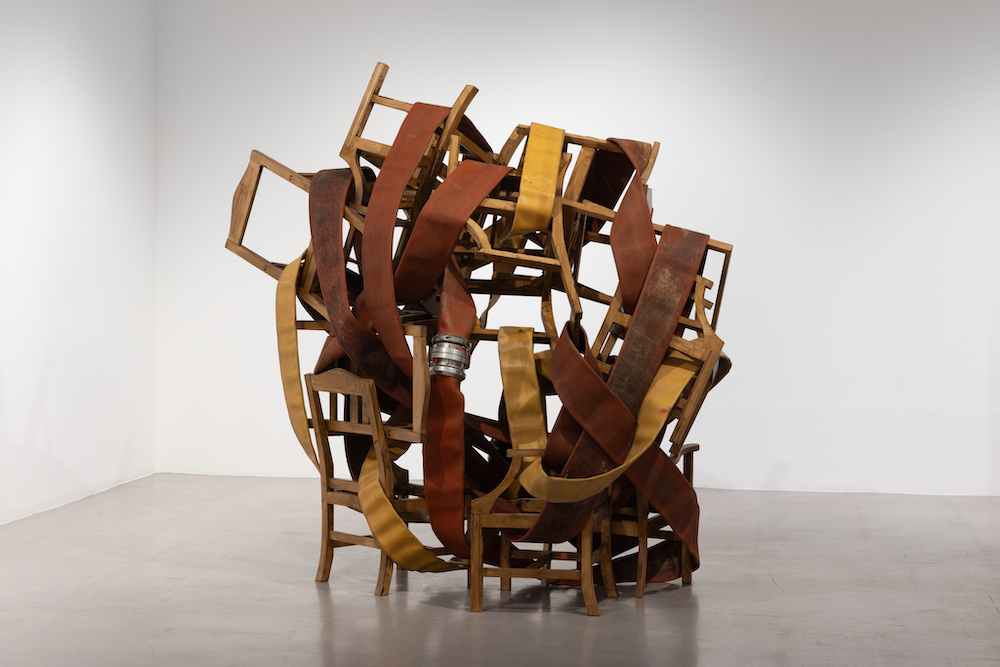
“He is someone who has lived a life that few of us could possibly imagine,” says Charlie Fellowes, co-founder of Edel Assanti. “And he delves into these experiences to unpack them in a way which invites meaningful discourse on race, ancestral memory and our engagement with technology. That is something that we have to cherish.”
Q&A
Lee Cavaliere
Director,Volta Art Fair
Alternative art fair Volta is also known for promoting cutting-edge creativity (writes Millie McArthur). This year, the fair will expand into a new venue at Hall 4.U, Messeplatz 21 in Basel. We speak to artistic director Lee Cavaliere about the legacy and purpose of Volta, what visitors can look forward to at this year’s edition and his favourite restaurant in the city.
How does Volta compare to other fairs?
We don’t see ourselves as a satellite. This is our 20th year and it’s a testament to our agility and connectedness with the emerging and middle market. We’ve also got a lot of greenery, with trees in the aisles. It’s calming.
We have some interesting models of galleries this year. Some started as artist-run spaces. Others are part of a foundation. There
are all kinds of different stories.
How has the fair changed?
We’re now in a bigger venue and we have 70 galleries from 29 countries. It’s still a digestible size, which gives people time to meet the galleries and artists.
What is your favourite spot in Basel?
I love Basel because it’s walkable and you can easily discover things. I love to go to the river for a barbecue and a swim. Another option is Museum Bistro Rollerhof, which has seats on the square by Museum der Kulturen so that you can sit, eat and watch the world go by.
Volta runs from 18 to 22 June; voltaartfairs.com
Ways of seeing: Six must-visit exhibition spaces from South Korea to Switzerland
1.
The conversation starter
MACAAL
Morocco
Othman Lazraq guides us under an arch made from mud bricks – part of a structure that sits below the central atrium of his family’s private museum. “Installing this was a mess,” he says. “Artist Salima Naji built it, brick by brick, one month before our reopening at the start of the year.” Touching the temple-like structure, which emulates ancient building techniques from places such as Mali or the Maghreb, Lazraq offers a clue to the museum’s mission. “This isn’t just heritage,” he says “It’s alive.”
The Museum of African Contemporary Art Al Maaden (MACAAL) opened in 2016 as an extension of the Lazraq family’s art foundation (the family is one of Morocco’s largest property developers). The museum brings its extensive art collection, which now spans 2,500 works, into public view.
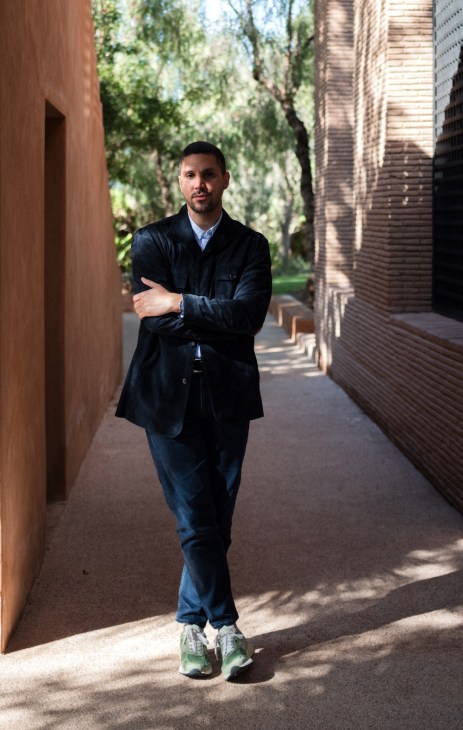

Part of Lazraq’s job as both founder and director has been reconciling political and social sensitivities around history and gender with the collection’s occasionally transgressive content. “Every cultural institution is placed in the middle of social discourse,” he says. “But our approach is always deft and inclusive.” In Morocco, this attitude is vital as the majority of the population has never set foot inside a museum. Special attention has been paid to ensure that the audience’s questions and concerns are answered and assuaged by MACAAL’s friendly guides, and additional information has been designed to deepen dialogue.
After seven years finding its footing, the museum was closed by Lazraq in 2023 as a chance for a structural and conceptual reset. Serendipitous timing meant that the entire collection was safely packaged and stored only two weeks before a magnitude-6.8 earthquake rocked the region. During the two-year hiatus, everything from the museum’s financial model to the curated programme was scrutinised. A scenographer was enlisted to redesign the layout to be more accessible and playful; display cases were lowered to child height and the museum’s artistic director, Meriem Berrada, commissioned video documentaries for each of the permanent collections’ seven sections to provide an additional layer of visual narration.

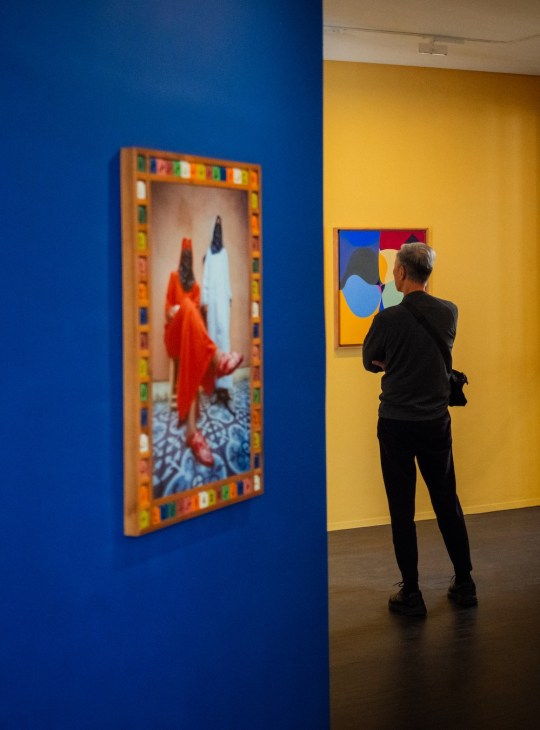

The multidisciplinary and occasionally controversial works (one playful piece explores the taboo subject of folkloric witchcraft) challenge ingrained perceptions around African art but there’s a distinctly celebratory tone here too. “I’m a proud Moroccan but there’s a lot of missing context around who we are and where we’ve come from,” says Lazraq. “I want to make our museum as open as possible, to spark conversations and to stand out as a neutral, safe space for reflection and imagination.”
On the edge of a golf course about 15 minutes’ drive from Marrakech’s medina, MACAAL’s setting is serene. Lazraq, who has led the family’s art foundation for over 15 years (since the age of 21) is always rethinking how the museum can work. Every Friday it hosts a family-style couscous lunch, inviting the community and anyone else who wants to experience culture through the disarming focus of food. “I never wanted to create a highbrow, exclusionary space,” he says, pointing to the employment of “cultural mediators” tasked with bringing groups from schools, women’s associations and social organisations for workshops and visits. “We’re creating a true social ecosystem. Hopefully we’re also becoming a source of inspiration for the next generation.”
macaal.org
2.
The audio-visual space
Efie Gallery
Dubai
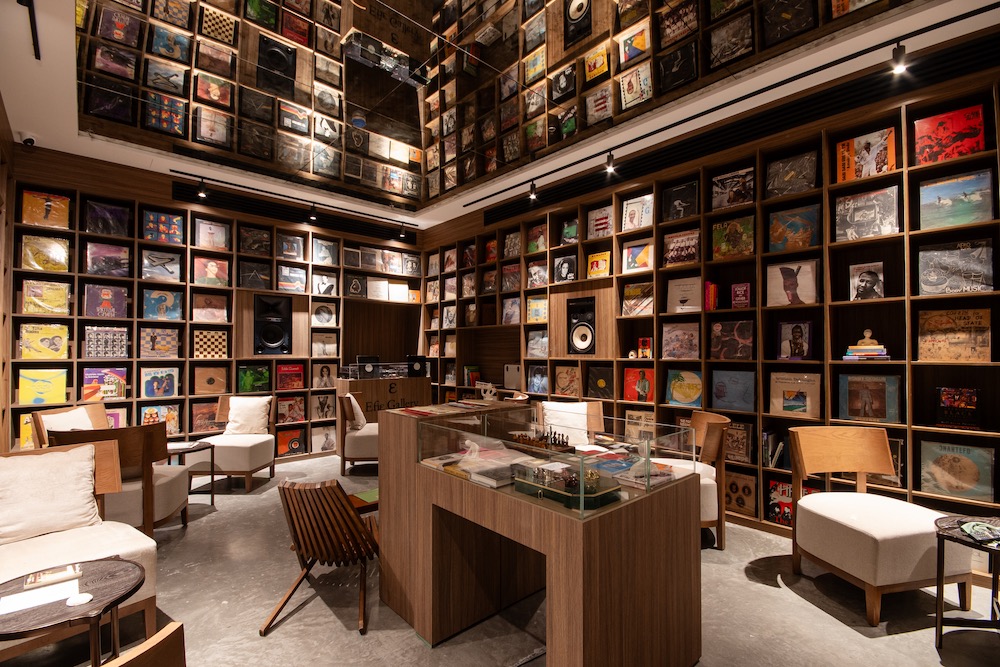
The Ghanaian director of Dubai’s Efie Gallery, Kwame Mintah, doesn’t like looking at art in silence. “Galleries tend to be managed by creative people but they can feel sterile without any music,” he says. Mintah grew up listening to genres such as highlife and Afrobeat and decided to weave those sounds into the artistic experience of his gallery. Founded in 2021 by Mintah with his mother, Valentina, and brother, Kobi, Efie Gallery has had a permanent space in Dubai since 2022. Now the family has moved its operations to a bigger outpost, which will provide more space for their 2,000 vinyl records and diverse roster of visual artists of African origin.
“The commercial art world can be sceptical of unorthodox forms,” says Mintah. He initially wanted to downplay the listening concept but the enthusiastic reception received by a smaller version in the original venue means that it now takes centre stage in the new location. “Growing up in Ghana, art wasn’t contained in galleries,” says Mintah. “It was all around us.” The new space’s immersive listening room has five hi-fi speakers. Visitors will find shellac and vinyl records and cassettes, dating from the 1940s until the present day, including those by Ghanaian musician ET Mensah, a pioneer of the highlife genre. Originating in the 19th century, highlife laid the foundations for many popular genres, such as Afrobeat.
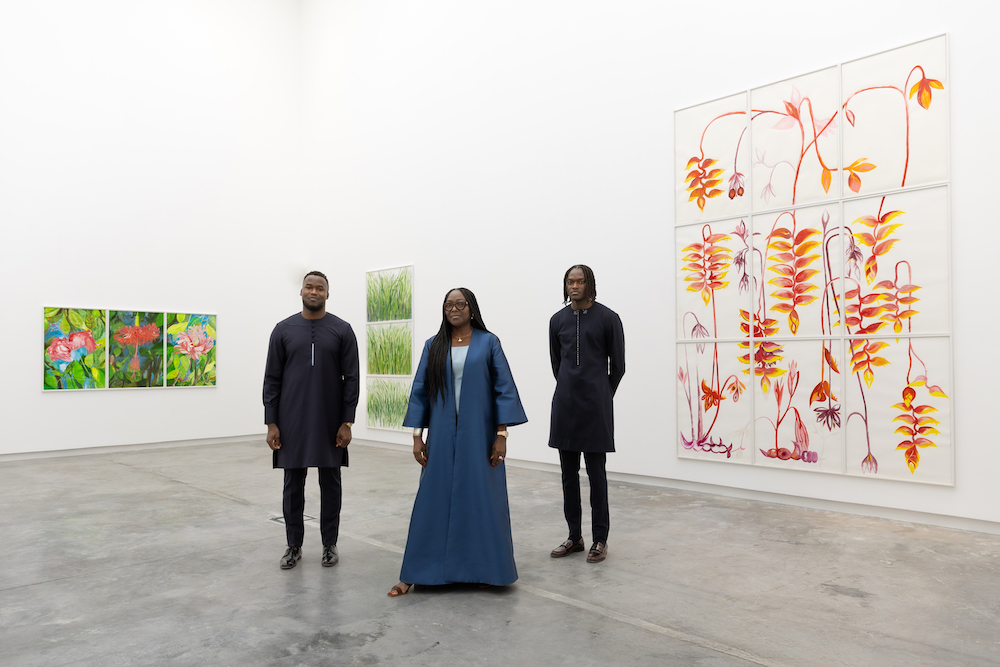
Mintah hopes that the new gallery will bolster the underexplored cultural connections between the UAE and Africa. “Dubai is a blank canvas where you can construct your own narrative of African art,” he says. Efie is showing the likes of Ghanaian sculptor El Anatsui, Kenyan visual artist Maggie Otieno and Ethiopian photographer Aïda Muluneh. Each has curated ambient playlists to accompany their shows.
“The Efie Gallery isn’t a satellite for the African diaspora,” says Mintah. “We want to engage directly with the region. With our unusual gallery concept, we leaned into the unknown. Ultimately we hope to add something fresh to the canon.”
efiegallery.com
3.
The regional showcase
Ichion Contemporary
Japan
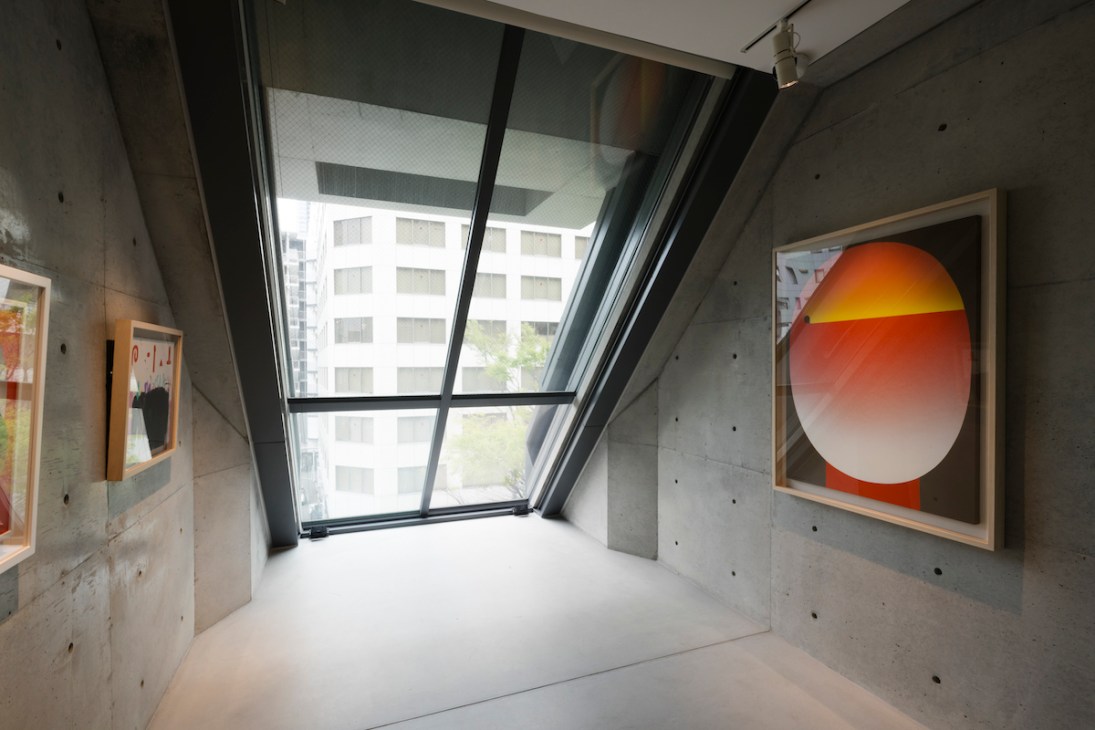
Sandwiched between an office building and a church, Ichion Contemporary’s slim, ambitious architecture celebrates the avant-garde spirit of Osaka. The new gallery, which opened in January, was founded by Ichion Jo, the 35-year-old vice-president of Jo’s Auctions. Originally dealing primarily in Chinese antiques, the Osaka-based auction house has become increasingly active in collecting and trading modern art in recent years, including that of the Gutai group and other works from Kansai.
“We noticed that while Japanese postwar artists were becoming more highly valued, they were not so in the international market,” says Jo. “But after the Guggenheim exhibition in New York (Gutai: Splendid Playground, 2013) their prices jumped in an instant.” Sensing a shift in the market, Jo began researching and planning a gallery to showcase such works. And when a narrow patch of land, barely four metres in width, became available in Nozaki-cho, he approached renowned architect Tadao Ando to turn it into a reality.
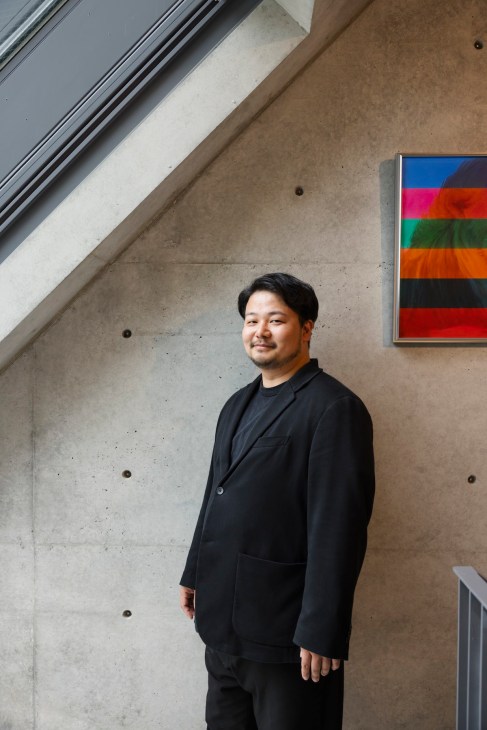
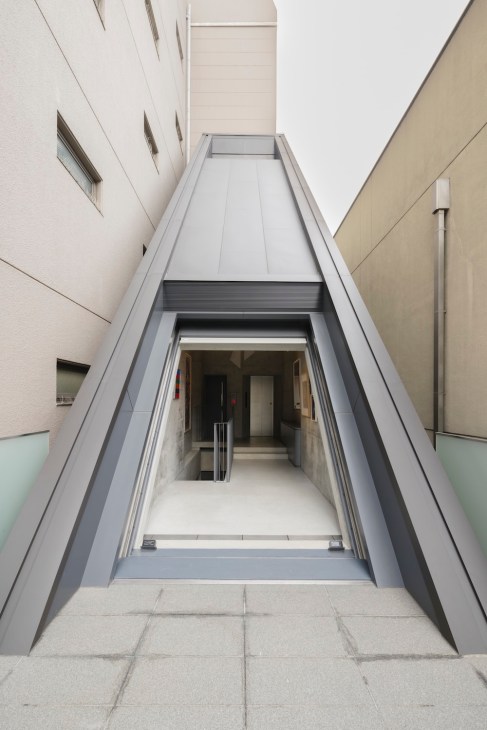

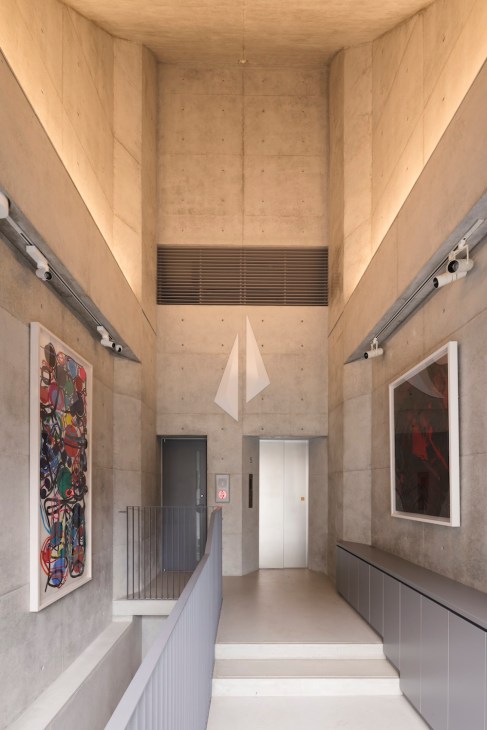
The distinctive concrete building offers a unique experience across six levels, placing viewers close to the works. The inaugural exhibition showcased the Gutai Art Association, while future exhibitions will focus on Kansai’s pioneering avant-garde artists, as well as the emerging talents building on their legacy. The gallery’s unconventional setting and innovative spirit promises new discoveries for artists and audiences alike.
ichion-contemporary.com
4.
The photographic archive
Photo SeMA
South Korea
A building that mimics the contours of a camera aperture makes for a striking architectural statement – and a fitting venue for South Korea’s first public photography museum. Opening on 29 May, the Photography Seoul Museum of Art (Photo SeMA) encompasses about 7,000 sq m across three above-ground and two subterranean levels. The building was designed by Vienna-based architect Mladen Jadric and realised in collaboration with South Korean architect Yoon Geun-ju, director of 1990uao. Drawing inspiration from the mechanism of a camera aperture, the museum’s twisted monolithic form departs from conventional right angles, with walls and floors rising fluidly along a curve. Jadric says that there are more similarities between the practices of architecture and photography than you might expect. “Photography is an image drawn with light and architecture is a play of forms unfolding under light,” he tells Monocle.


Photo SeMA’s director, Han Jung-hee, says that the museum’s mission is “to establish the 140-year history of Korean photographic art”. The institution identified more than 2,000 photographers active between 1880 and 1980 and acquired about 21,000 images and archival materials. “Our goal was to collect landscapes and portraits that offer a visual record of their era,” says curator Son Hyun-jung. Those procurements included the archive of Im In-sik, a photographer of the Korean War, and Park Young-sook, a pioneering figure in feminist photography. Photo SeMA will finally bring into focus the rich history of South Korean photography.
sema.seoul.go.kr
5.
The Italian outpost
Thaddaeus Ropac
Milan
The neoclassical Palazzo Belgioioso is the sumptuous location for Austrian gallery Thaddaeus Ropac’s new Milan outpost. Elena Bonanno di Linguaglossa, its executive director, is brimming with excitement when she shows Monocle around the unfinished site. “I’ve never been able to hold a brush but I’ve always had a curiosity for contemporary art,” she says. “My grandmother worked as an assistant for Belgian painter Paul Delvaux. I was fascinated by the stories she told me.”


For Bonanno di Linguaglossa, taking a role under Thaddaeus Ropac was an easy decision. “There’s no one like him in the industry,” she says. When Monocle visits, the space is still under renovation but the neoclassical crown mouldings and large bay windows overlooking the quiet courtyard give a taste of what’s to come. Works will be exhibited in two grand rooms on the first floor, and sculptures will be displayed in the public courtyard.
Milan has a growing presence of international artists, buyers and gallerists tapping into the community of wealthy collectors who have chosen Italy’s financial capital as their home. “It’s the moment to be here,” says Bonanno di Linguaglossa.
ropac.net
6.
The photographer’s home
Studio Naegeli
Gstaad
Over the past century, the timber-hewn chalets that line Gstaad’s main promenade have slowly transformed into a string of luxury fashion maisons but Chalet Naegeli is a notable exception. Founded in 1914 as an Alpine photography repository, it’s the former studio-residence of photographer Jacques Naegeli, who documented Gstaad’s transition from humble farming village to glitzy ski resort.
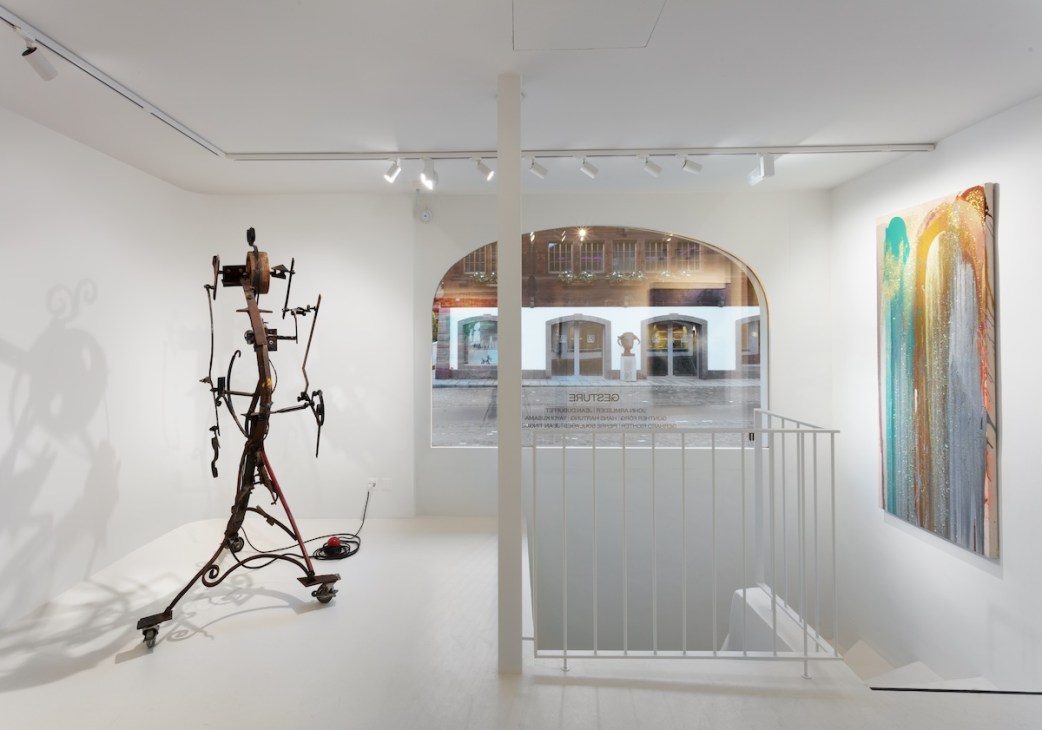
The premises became a bank in the 1970s but, last winter, Naegeli’s great-grandson, Christian Högl, and his wife, Anna, brought the chalet back to life as Studio Naegeli, a documentation project aimed at reviving the photographer’s archive.
The Högls aren’t just looking to the past. The two-storey site will host programmes alongside a global roster of galleries focusing on modern art. When Monocle stops by, the debut collaboration with Galerie Mitterrand in Paris is preparing to open and 15 artworks have been shipped over. These include works by François-Xavier Lalanne, Jean Dubuffet, Günther Förg and Yayoi Kusama.
There is momentum here to refocus Gstaad’s identity around its artistic heritage, and the town has buy-in from an international crowd of holidaymakers. Visitors from France, the US, Canada and Hong Kong pass by when Monocle visits Studio Naegeli. “A lot of visitors here have second homes in Gstaad, so the tourism feels more personal,” says Anna, who previously worked as international liaison for the Moscow Art Fair and as a curator in Bern. “Gstaad is home to a concentrated group of collectors, which encourages a friendly climate for purchasing art.”
Just like Jacques once did, Christian and Anna live above their beloved chalet-gallery. “When Jacques lived here, the house was alive with creative spirit,” says Anna. “We hope to reconnect Chalet Naegeli with its artistic and cultural heritage.”
studionaegeli.com
The hidden waterworks beneath Rome’s world-famous fountain
“Can you guess which way it is to Piazza di Spagna from here?” says Davide d’Alonzo, our guide and technical manager at Acea, Rome’s water-management company. His face is illuminated in the darkness by a large flashlight. “The answer is that you have to look at the way the water is flowing,” he says, pointing into the murky tunnels in the direction of Rome’s landmark square. In truth, it’s not easy to get one’s bearings.
Only moments ago, we had left our personal belongings behind (save for my Monocle notepad and pen), donned white hard hats, dark rubber suits and Wellington boots, and stepped through an inconspicuous door near Rome’s Villa Medici. An impressive spiral staircase takes us down 112 steps to a tunnel 25 metres below ground. We find ourselves beneath the Italian capital’s streets and inside one of Europe’s oldest functioning aqueducts, the Acqua Vergine, whose water has been celebrated throughout the ages for its purity. Dating from 19 bce, it is a masterpiece of classical engineering and Monocle has been granted rare access.

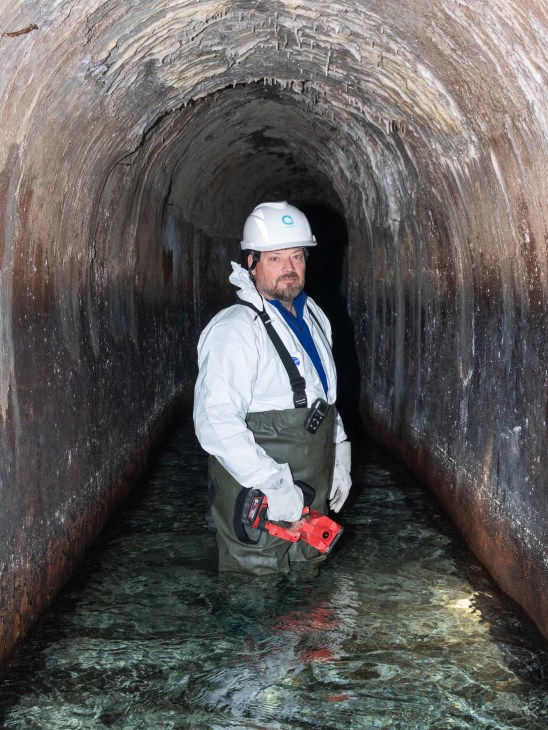
Originally used to meet the needs of the metropolis’s noble families, the aqueduct continues to supply water to the city’s parks and gardens, and performs a task that visitors particularly appreciate: replenishing some of Rome’s most important fountains, from those on Via del Corso to the one in front of the Quirinale presidential palace. As we wade waist-deep through the water, D’Alonzo instructs us to walk slowly without lifting our feet too much. The reason for caution, he explains, is that we are not only moving against the current but also because the water, after travelling for some 20km from its source east of the city, comes out at Rome’s famed Trevi Fountain. And we wouldn’t want to muddy the waters, would we?
Being here is a privilege: while a phalanx of tourists is queuing above ground to take selfies in front of the crystal-clear waters and sculpted travertine of the famed fountain, we are down here with just a couple of guides and our photographer. The only sound is the water dripping from the tunnel’s roof, stalactites hanging overhead. Suddenly we hear a disconcerting rumble that wrests us away from our Roman reverie. “Don’t worry, that’s just the metro,” says D’Alonzo, pointing to parts of the aqueduct that have been strengthened with concrete to counter this relatively recent addition to the city’s subterranean infrastructure. As we wander slowly beneath Rome, D’Alonzo schools us in the history of the Vergine. It was built in just two years by the Romans, who relied on a series of wells for the water supply.
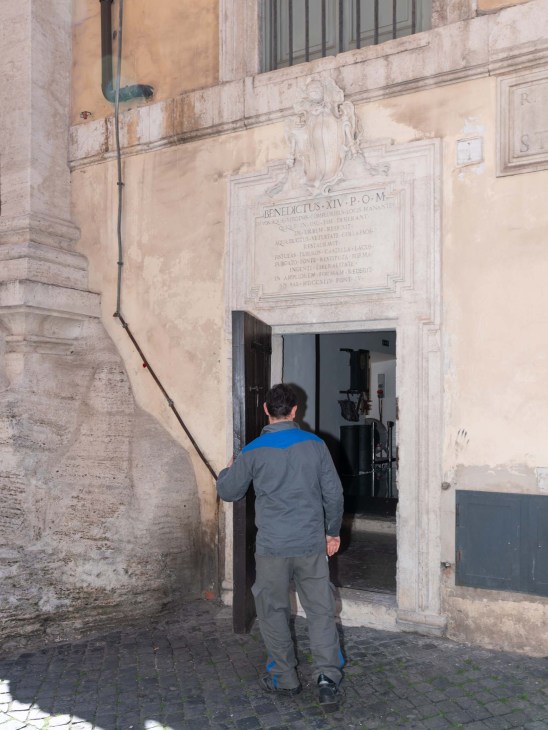

Our day comes to a close with a visit to the water station by the Trevi Fountain, where the aqueduct ends. Inside the building, 18th-century pipes are still visible, their size and pressure dependent on each noble family’s status and ability to pay.
From our vantage point behind the fountain, we look through little windows to see people gathered on the other side of the water. And yet there’s no doubt where I would rather be: contemplating the unseen side of this famous city and the slow passage of the aqueduct’s watery cargo on its 23-hour journey to one of Rome’s busiest squares. The ancient Vergine, quite literally, keeps the city moving.
Interview: Christopher Luxon says debate over New Zealand’s founding document is finished
In 2023, New Zealand’s voters chose National Party leader Christopher Luxon to become their 42nd prime minister. With the country in recession, their decision might be seen as pragmatic – Luxon had decades of experience in the world of business, having served as the CEO of national flag carrier Air New Zealand between 2012 and 2019, before stepping down to run for parliament. He was elected as an MP in 2020 and became the leader of the opposition the following year. His swift rise reflects that of his internationally better-known predecessor, Jacinda Ardern. But that’s where their similarities largely end.
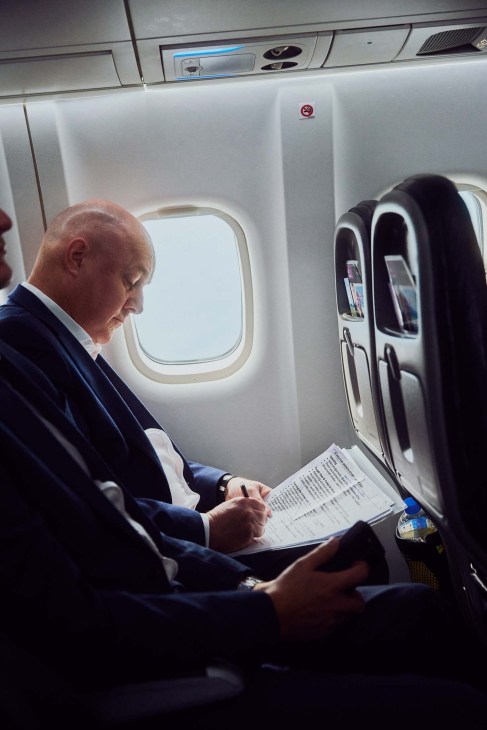
After a period when New Zealand was seen as a bastion of progressive internationalism, the country, like many others, has turned inwards, focusing on domestic issues such as the economy and housing. Another hot topic, which has dominated the first two years of Luxon’s term, is the 1840 Treaty of Waitangi. Some on the right have criticised New Zealand’s founding document for affording too many rights and protections to the country’s indigenous Maori population – a complaint that has led to heated scenes in parliament and protests on the streets.
Late last year, Luxon acceded to the demands of a coalition partner, the right-wing act New Zealand party, to hold a parliamentary vote on rewriting some of the treaty’s principles. The bill caused the prime minister’s personal approval rating to plummet. Just days after it was definitively voted down in April, Monocle joined Luxon on a meet-and-greet trip to the city of New Plymouth, a centre of dairy farming and energy exploration. Following a barbecue at a bee farm, we sat down to discuss Ardern, Donald Trump and the Treaty of Waitangi.
We were surprised to learn that you fly commercial.
Yes, it’s the way to get around in New Zealand. We travel commercial because it’s efficient but it’s also a great way to meet and talk to people. It’s always good to get out there – into the provinces, where people can tell you what’s going on. It’s an important aspect of being a politician, just as it was for me as a business leader. You need to see what’s going on, to hear about the challenges that people are facing and also about the opportunities.
From an international perspective, New Zealand was put on the map by Jacinda Ardern and the progressive, empathetic image that she had on the global stage. Did you take any lessons from her time as prime minister?
Everyone does it differently because you inherit the country at a specific time. You play the cards that you’re given and have to deal with the situation that you have in front of you. In our case, we inherited a pretty poor economy from the Ardern-Hipkins years [Chris Hipkins was Ardern’s successor as prime minister and is now the leader of the New Zealand Labour Party]. That’s why New Zealanders voted them out. It has been challenging to work through a recession and get the country out of that economic mess. But the key thing for New Zealand and its place in the world is that it punches above its weight.
There seemed to be a disconnect with Ardern: abroad, she was seen as a visionary progressive with a strong set of values but, at home, her popularity waned with the economy. What you’re seeing across global politics is that populations are increasingly frustrated with politicians who only have nice bumper stickers and soundbites. Voters want things to get done: they want to see results and improvements to their everyday lives, especially coming out of the coronavirus experience, which left us with high inflation, high interest rates and, in our case, a recession.
Donald Trump’s second term has already had an enormous effect on economies across the globe, particularly through tariffs. How exposed is New Zealand?
We’re relatively well positioned. We believe very strongly that tariffs aren’t good. We are free traders. Alongside Singapore, New Zealand was among the initial countries that established what’s called the CPTPP [Comprehensive and Progressive Agreement for Trans-Pacific Partnership], which is probably the most comprehensive free-trade agreement that the world has at the moment. The free movement of goods and services is a good thing. Therefore, we don’t advocate for tariffs. What we’re trying to do is to ensure that we stay very cool, calm and collected as we work our way through those issues with the US administration. We have a good relationship with the Americans and will continue to have positive and constructive ties with them. We might disagree when it comes to [tariffs] but we can still have a very good relationship going forward.
What are New Zealand’s major exports to the US?
We have three: red meat, wine and dairy. We sell premium products and expect to continue to do so.
What is your relationship like with China? Do you have a lot of eggs in that basket, in terms of both trade and security?
We have a very longstanding and important relationship with China. It is our largest trading partner and we co-operate in areas around trade, the climate and renewables. But we also acknowledge that we have different political histories, cultures and values. China is one of the countries in this multipolar world that is now shaping global politics. So we call out those differences. I have done so with the country’s president, Xi Jinping – publicly, privately, consistently and predictably. Where we have issues or points of difference, we are not afraid to raise them. Of course, we continue to look for areas where we can co-operate but we disagree where we must.
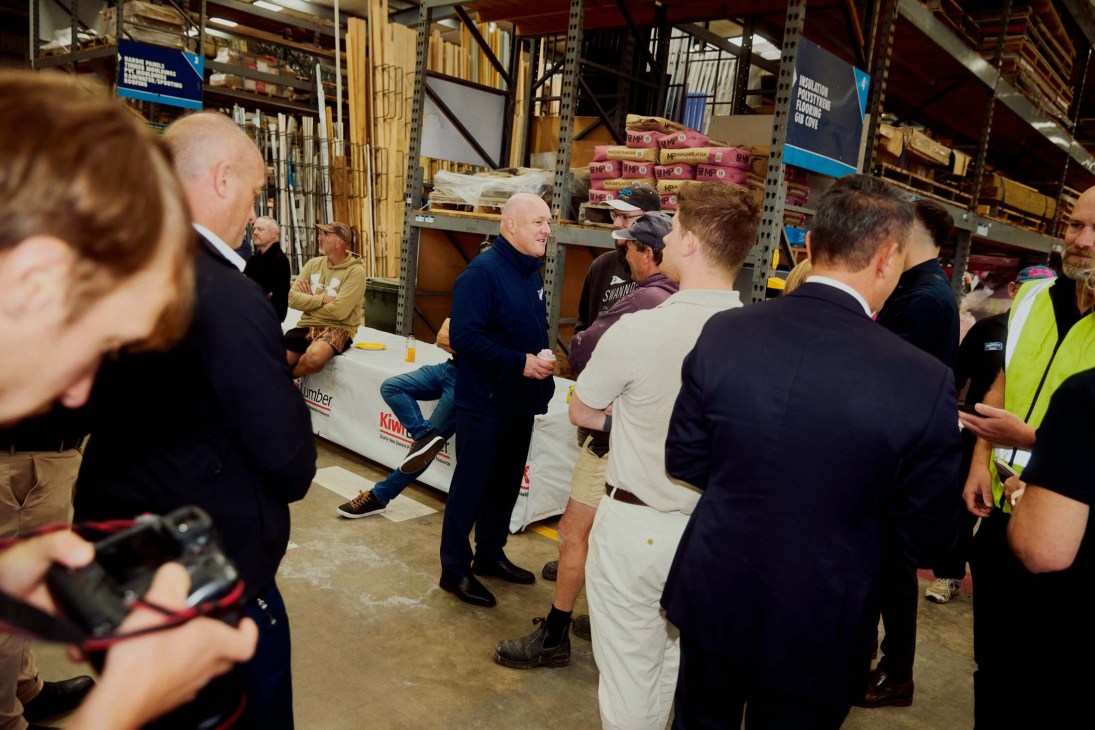
In your eyes, what are the core values that define being a Kiwi?
It’s all about fairness: we just believe that everyone deserves a fair shot. We don’t like it when people rise too high or fall too low, so we keep things pretty even. We’re highly innovative and creative. We’re also very resourceful. We can talk to kings and paupers. We don’t have a lot of time for hierarchy and self-imposed status. We take people as they are.
I have lived in Sydney, then I was in London, Chicago, Toronto and then New York. When you come from a small country, you tend to have a more generalist set of skills. You also value people and understand those who are different from you. So you’re quite happy walking across a room and hearing some of the points of view that others have. Curiosity has served me very well, as has my Kiwi-ness. They have contributed to my success in my business career and my ability to take things on and learn. In the process of doing so, you pick up the good things from other countries and cultures that you see and build them into your game.
How committed is New Zealand to the Five Eyes intelligence partnership with the US, UK, Canada and Australia? Have the recent revelations about the White House’s Signal group-chat leak given you any hesitation?
We are very comfortable in Five Eyes. We have been collaborating with our partners, in an intelligence sense, for a long time. We want to ensure that we are making our own contributions and are following through with investment in our intelligence services but also in our broader defence capabilities as well. We are very proud of these relationships and they’re important for New Zealand. The alliance helps to keep New Zealanders safe.
So, knowing how the intelligence information is handled, managed and cared for by our allies, I have every confidence in Five Eyes. I’m very comfortable with the ways in which our partners use what we provide them with – and also with how we use the information that they give us.
After Washington’s recent decision to cut US international development projects in the Pacific, Australia had to jump in and take over, which it did.What is New Zealand’s role in terms of development in the region? Do you foresee that you’ll have to take on a bigger role – or a greater share of it – in the future?
We think that it’s important for the US to reinstate that funding and to continue with its work in the Pacific. We have raised this with the US administration and made our case. Meanwhile, both Australia and New Zealand have been increasing aid spending in the region. We have deep relationships with the Pacific and I have spent a lot of time there. Auckland is actually the biggest Polynesian city in the world. We understand how the Pacific thinks because, in many ways, it’s how New Zealand thinks. We can grasp its issues and that makes us a very valuable partner.
You have a new golden-visa scheme. Can you tell us a little about it?
One of the things that we need to do in order to lift our standard of living and economic productivity is to welcome more direct foreign investment to New Zealand. There are two parts to this. First, there was our recent Infrastructure Investor Summit, which was about making the pitch to sovereign wealth and pension funds to partner with government to build crucial infrastructure in the country. The second part is to say to high-net-worth individuals, “Look, there are pathways to residency here if you make investments in productivity enhancing assets in the country.”
When we had a similar thing going on in the past, we would get a NZ$2.2bn [€1.2bn] investment from high-net-worth individuals, initially as part of the visa process – but then, once they were here in the market and were comfortable, and had built networks, they would invest almost the same amount of money again. When we have a foreign investor here partnering with a New Zealand firm, there’s an injection of capital that enables growth, and there’s often knowledge transfer as well.
I saw a fantastic business collaboration a couple of weeks ago in a place called Cromwell, near Queenstown. A New Zealand building company had partnered with a Swiss firm on the on-site manufacturing of buildings that were up to four- or five-storeys high. That brought in capital and also some Swiss thinking. Plus, it created opportunities for our products to go out into the world.
Another issue that New Zealand is facing domestically is housing. Between 40 and 50 per cent of Kiwis can’t afford to own their own home. How are you working to mitigate this?
The housing market is complex. First and foremost, we have plenty of land in this country. We are the size of the UK and Japan but with only five-and-a-bit million people living here. So a lot of this is about working with our councils to unlock the land, to rezone it, to allow and plan for 30 years of growth. It’s a supply-side problem. We have artificially constrained supply, which has driven up prices.
The Treaty Principles Bill, which aimed to rewrite some of the points in the Treaty of Waitangi, was recently resoundingly voted down in parliament. What are your reflections on that?
We operate in a mixed-member proportional political system here, similar to in Western European countries. There are six political parties in our parliament, each with strong and differing views. My party is the largest and we formed a coalition government with two minor ones. We have strong alignment on many things but there are areas where we differ and it was part of the coalition agreements that we have to compromise. So we had a debate about the issue. One party wanted to hold a full national referendum on the bill. We found a compromise, which was a first and then second reading in parliament.
Where will you go from here on the issue? The ACT party’s leader, David Seymour, who instigated the bill, has vowed to keep it alive.
No, we’re finished. We’re done. We had the conversation, had the debate and discussion. We’re moving on.
In your opinion, what is the role of New Zealand’s Maori population? And also the Maori language, the Waitangi Treaty and Waitangi Day?
It’s very important. The Treaty of Waitangi is our country’s founding document. It’s about the relationship between iwi – Maori tribes – the Crown and the government. It’s a crucial piece and we have wrestled with it for 185 years. It has made our country much better, much more tolerant. I’m very proud of it.
When I look at the history of race relations in many other countries across the globe, I think that the Treaty of Waitangi has served New Zealand incredibly well. It hasn’t been easy: we’re debating the interpretation of the treaty and what it means in the modern world. But we’re not afraid of those conversations and shouldn’t be.
One final question: the film director James Cameron recently became a citizen of New Zealand. Are you expecting a potential influx of applications from the US?
We’ve got him – I mean, why wouldn’t you want to be a New Zealand citizen? This is the best country on Earth. We welcome people from all around the world. When they come to this country and experience it, and see a way of life that’s different from what they have known at home, you can see them fall in love with it. Kiwis are open and friendly, and welcome everybody. If people can contribute here and they want to be citizens, we welcome them because we are much richer and better in all senses by virtue of the waves of immigration here. I’m proud of anyone who wants to be a New Zealand citizen.
Different strokes: the unique canvas works of Pol Taburet and Claire Oswalt
The art of the eerie
Pol Taburet
Paris
When Pol Taburet was a child, his mother would take him to look around museums. It was a natural choice of activity for her: she was a museum guard at Musée d’Art Moderne de Paris. “She wasn’t educated in art,” says Taburet. “But working all the time in those rooms, you become sensitive to the paintings.” That sensitivity, and an insatiable enthusiasm for the medium, has clearly trickled down.
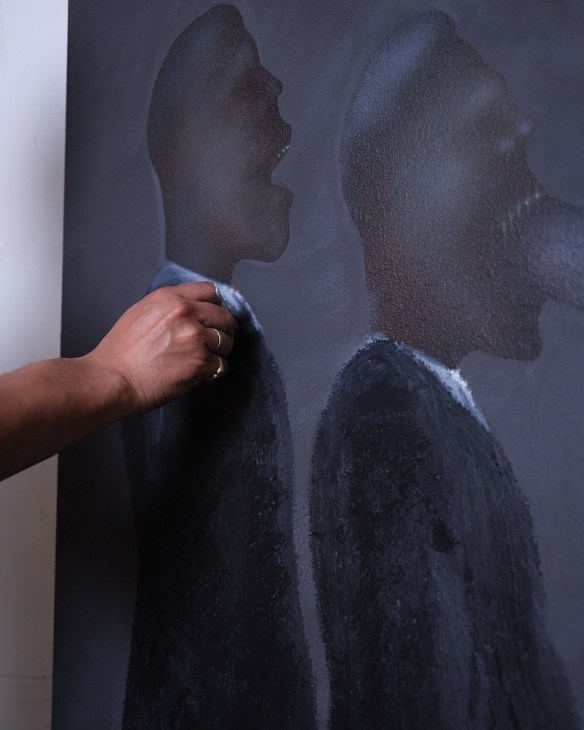
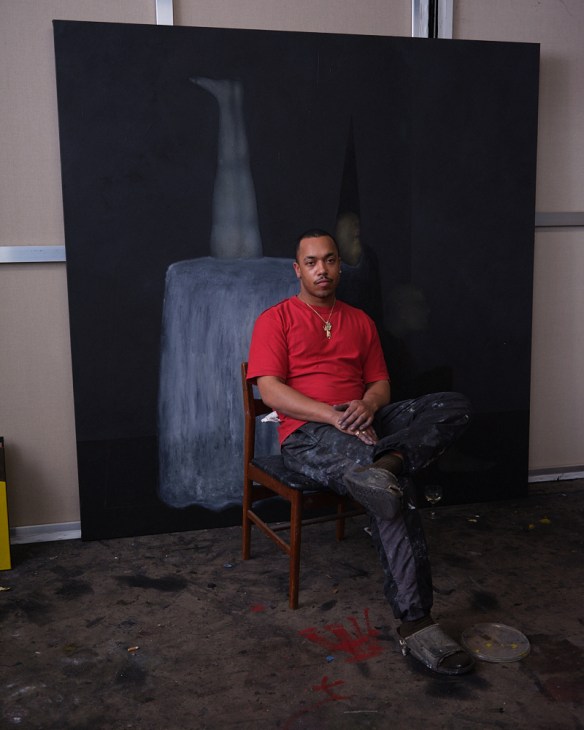
When Monocle visits Taburet’s studio on the outskirts of Paris, we catch the 28-year-old in the middle of a busy period. He’s just wrapped up a solo exhibition at Madrid’s Pabellón de los Hexágonos – huge paintings that were created specifically for the church-like space. Now he’s finalising the paintings and sculptures for a show at Schinkel Pavillon in Berlin. Next, he’ll be off to Brazil to spend two months creating work to display at the São Paulo Biennial from September.
In his paintings, Taburet typically depicts ghostly figures. Sometimes they sit around the bright white of a tablecloth, in other works figures float and body parts freewheel across the canvas. For someone as warm and effervescent as Taburet, the works seem to have a dark underbelly. But he insists that it’s honesty, rather than darkness, on show. “I am trying to paint something real,” he says. Even if there is a sense of violence within the work, there’s a softness to it too. It’s “violence with gloss on top”, he says. “It makes it easier to look at.”
Francis Bacon is an obvious comparison but Taburet has found more inspiration in the likes of Edvard Munch or Roberto Matta. Taburet is also influenced by what he finds in books such as 1993’s L’art Océanien, a doorstopper full of interesting shapes and faces. But if he had to pick one enduring influence, there’s little competition: South Park. “When you want to talk to children, you have to have this efficiency of information,” he says. “South Park is the best for that, only using round, square and rectangle shapes. But so much is happening.” Taburet thinks that it’s this meeting of venerated art history and childish cartoons that has led to his individuality as an artist. He’s humbled by his success and how his work – “this dark humour, these freaky images”– seems to speak to so many people.
Parts of a whole
Claire Oswalt
Austin
Texan painter Claire Oswalt ascribes to the theory that all art is generated by the subconscious. “People often ask me where the inspiration for my colours comes from,” she says from her studio in Austin. “And I have absolutely no idea.” After long stints in Los Angeles and New York, the 46-year-old returned to her hometown. Though the Texan capital is an enclave of creativity and progressivism in a state not famed for such things, it is a very different environment from the two megacities that dominate America’s artistic output. Still, any attempts by Monocle to impose a geographical stamp on Oswalt’s work are politely rebuffed. “I don’t feel like my location has much to do with it,” she says. “There’s a quote from the Wim Wenders’ movie Wings of Desire, in which a character says, ‘‘Behind closed eyes, close your eyes once more.’ And I feel like that’s the place from which I’m working.”
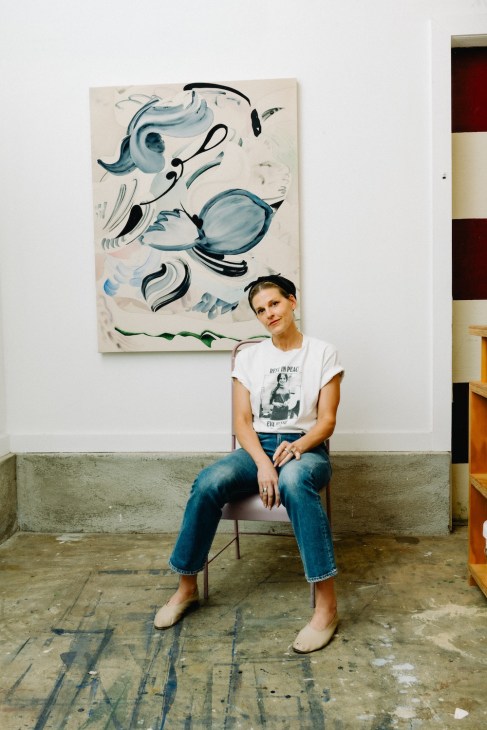
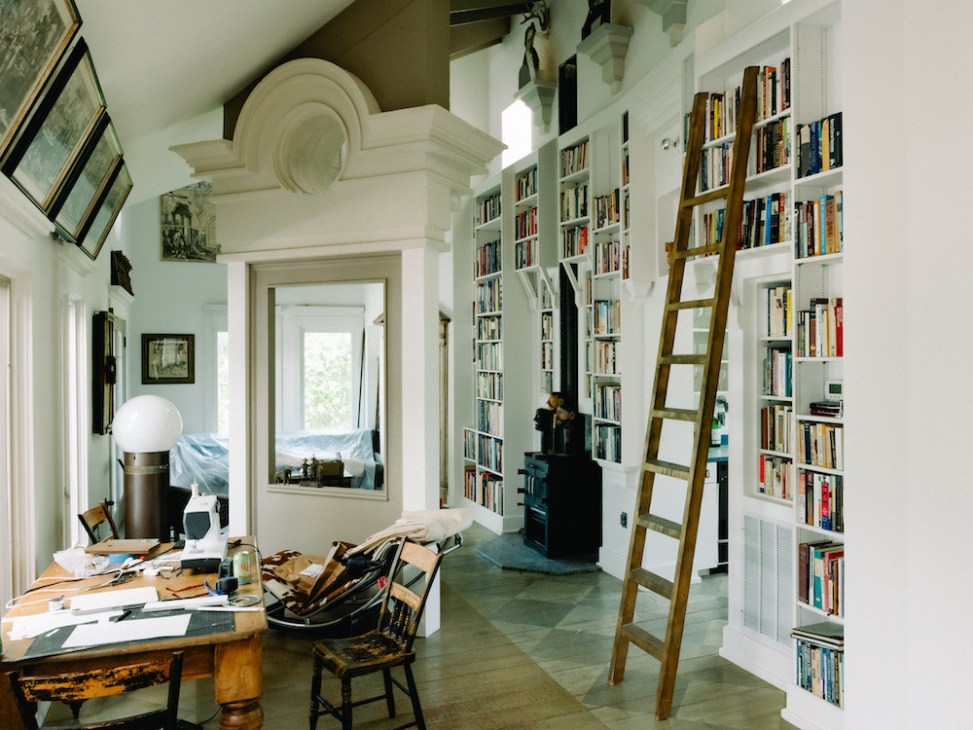
Despite this, the colours of Oswalt’s recent output seem to be more informed by the natural than the interior world. And though the scale of the collaged paintings speaks to the western US tradition of grand vistas, their nature and construction are anything but brash or broad brushstroke. Indeed, each honours “that tiny moment of making that first mark on the paper”. This first mark comes after a painstaking process involving the accumulation of dozens, or even hundreds, of pieces of paper piled high on her studio floor. “It’s quite a live thing,” she says. “When I start to move them around, that’s when these abstract pieces emerge… And the edges of these collage papers become the seams of my work.”
Oswalt attributes the methodical, even mathematical, way of producing work to her grandparents. Her grandfather was an engineer who made stained glass in his free time, while her grandmother was an oil painter. “And that kind of dichotomy of math and painterly aspects carried through for me.”
She describes the final process of bringing all the components of her collages together as symphonic. “I’m fascinated by this idea that, especially in a symphony setting, you can have one instrument, one note, and then you put it all together and you’ve created an opera.”
Why can’t young people dance?
For years the media was obsessed with all the things that the millennial generation was supposedly killing, from fabric softener and home ownership to mayonnaise. But now their successors, Gen Z (those born between 1997 and 2012), have been handed an even graver charge: being unable to dance. In a series of videos that went viral on social media in April, incredulous observers filmed groups of young people standing completely still or glued to their screens on the dance floors of nightclubs. How is it that the so-called Tiktok generation – named for an app that owes much of its success to carefully choreographed dance challenges – is incapable of losing itself to the music?
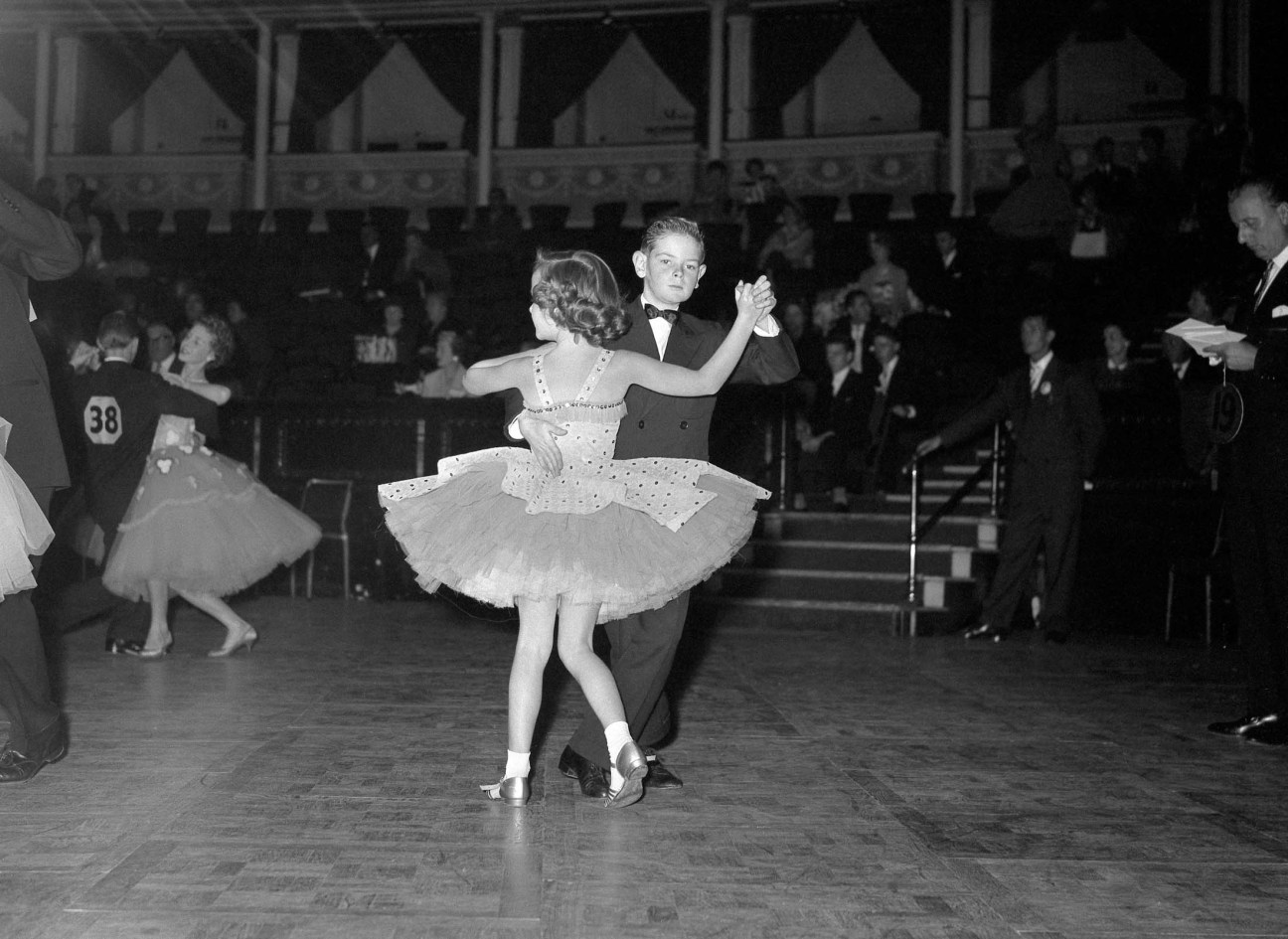
Well, for one, outside of North Korea or a Texas rodeo, dance floors are not made for regimented routines.They’re a place to escape the lines of life, anonymous amid a mass of bodies and beats. This abandon is much more difficult if you’re under constant surveillance, of course. When you grow up under the all-seeing eye of social media, you develop a fear of being filmed doing something stupid. We used to dance like no one was watching; now we dance like everyone is. In Europe clubs are increasingly insisting on placing stickers over phone cameras so that nobody has to worry about ending up a laughing stock the next day.
Then there’s the fact that clubbing is facing an existential crisis, in part fuelled by the younger generation’s general apathy towards nightlife. In the UK alone, some 400 night clubs have closed over the past five years, about a third of the country’s total. We can blame the pandemic for a chunk of that (and we can blame consequent lockdowns for the younger generation missing out on early clubbing experiences) but there are other factors at play. A major one is that young people can’t afford to go out like they used to: Danish nightlife conglomerate Rekom Group’s research suggests that over 77 per cent of British people have cut down on late nights out due to the cost-of-living crisis.
Given that they came of age during successive lockdowns and were thrust into a world in which they can’t afford to go out, how can we expect Gen Z to know what to do in a club once they get there? Many, it seems, can’t even rely on the social lubricant that is alcohol. A recent survey of 18 to 24-year-olds by market-reserach firm Yougov highlighted this cohort as the most sober group among adults, with 39 per cent of respondents not drinking any alcohol at all. And when they are drinking, Gen Z are increasingly drawn to strange concoctions, such as Malibu and milk. I can’t imagine a worse time to throw your body around than after a big swig of any combination of milk and liquor. As for the other kind of white stuff, some reports claim that Gen Z are less likely to consume class A drugs than previous generations. Though some say otherwise, with anecdotal reports suggesting that younger people favour drugs such as hallucinogens and ketamine, both of which aren’t generally associated with the desire to dance.
Ultimately, social media will never tell us the full story. “Every new generation has a subtly different relationship with club culture compared to those who came before them,” Ed Gillett, author of Party Lines: Dance Music and the Making of Modern Britain, tells Monocle. “There have always been boring, sterile clubs full of disinterested people and rubbish dancers.” That said, the current generation of aspiring party people does face a number of obstacles to throwing their hands in the air like they just don’t care. And if the dance floor can so easily be murdered, what chance does mayonnaise have?
Ten disruptors taking aim at modern warfare
The heat is on for Europe to start taking its own defence and security more seriously, with the US signalling that it will no longer be the guarantor of peace on the continent. European defence stocks are soaring as investors watch budgets track up for the first time in years. Countries claim that they want to “buy European” – yet those shopping around for new kit soon realise that while there are big local players such as BAE Systems, Thales and Dassault Aviation, the ecosystem of defence start-ups is less developed in Europe than in the US. There’s clearly some catching-up to do.
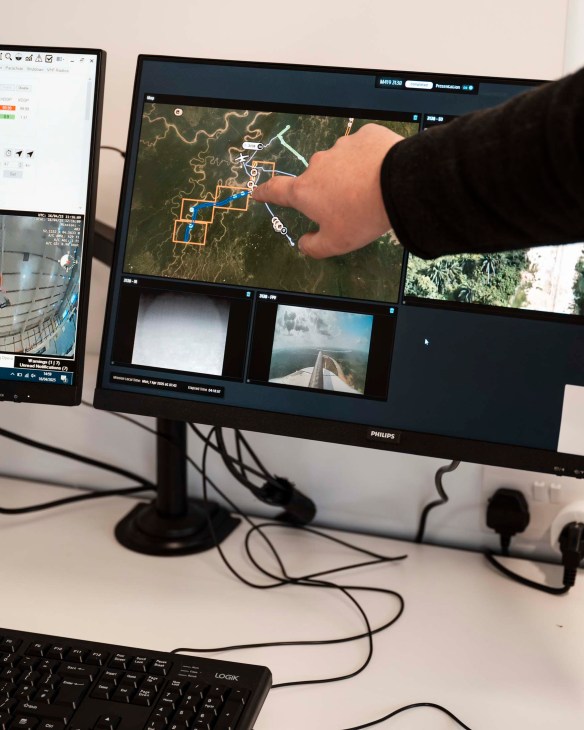
Here, Monocle rounds up 10 firms that could become the vanguard of the continent’s defence industry. Whether they’re creators of armour, walkie-talkies or counter-drone technology, the following have caught the attention of venture capitalists, helping them to scale up to meet the moment.

1.
The up-and-comer
Tekever
Portugal
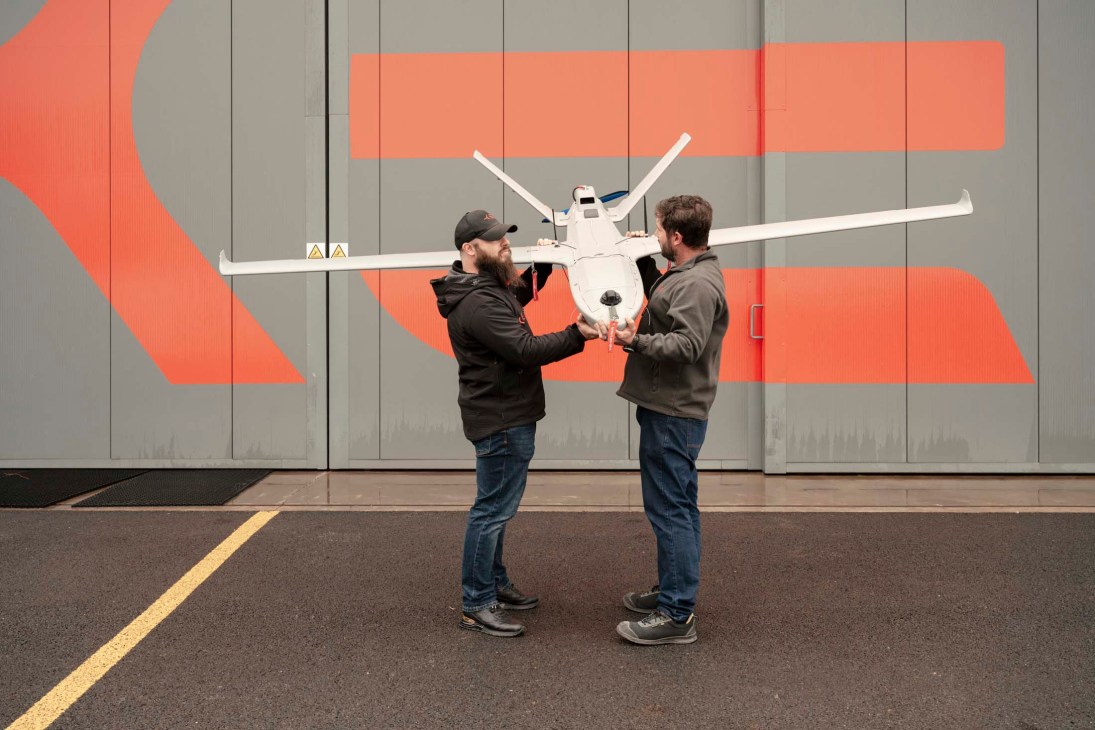
Portuguese defence firm Tekever started out building software before shifting into drone technology in 2010. According to its CEO, Ricardo Mendes, those beginnings planted the seeds of its success. “Good software companies are agile to their core,” he says. “Just look at your phone. You get a new update every two to three weeks and, if you don’t, it starts to lag. That attitude to development is how we approach our work.”
In 2018, Tekever signed its first contract with the European Maritime Safety Agency to run drone patrols over European waters, collaborating with Collecte Localisation Satellites, France’s space agency subsidiary. Russia’s full-scale invasion of Ukraine that began in 2022 boosted business as demand for hi-tech reconnaissance drones soared. Tekever has since expanded its Portuguese presence, rolled out a UK-based manufacturing hub and picked up investment from the Nato Innovation Fund and early SpaceX backer Baillie Gifford.

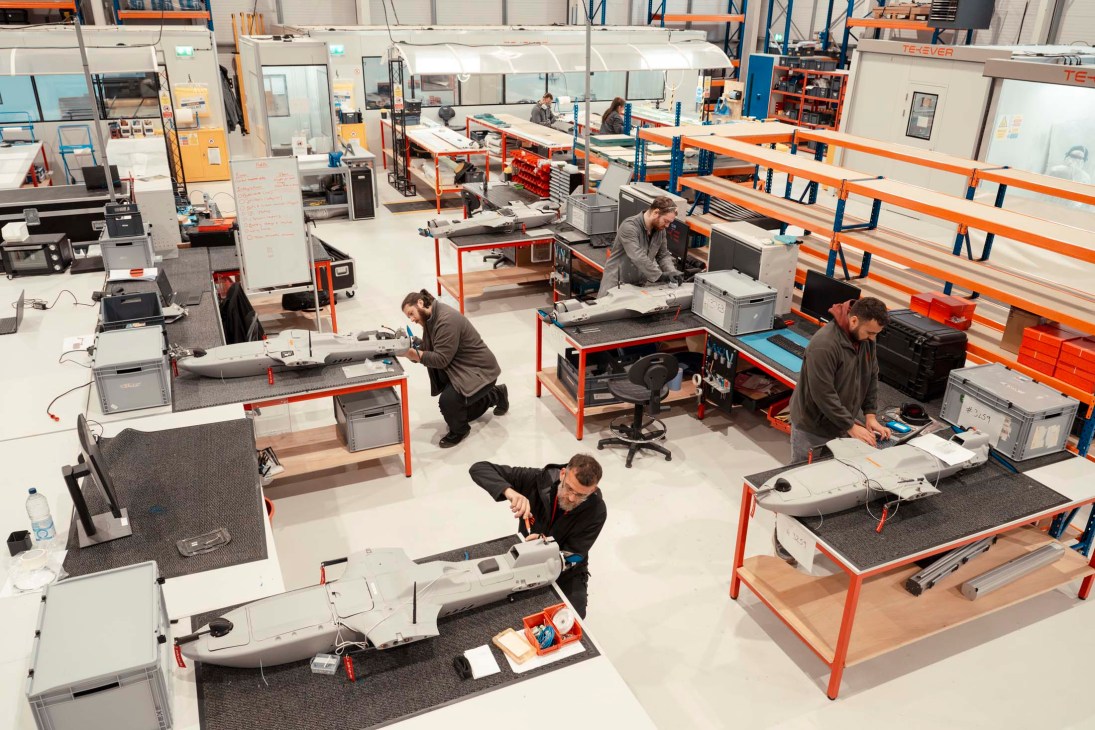
When Monocle visits Tekever’s facility in Wales, which opened in 2023, employees are hard at work on its AR3 surveillance drone. “We manage the entire process,” says Tekever’s deputy head of defence strategy, Phil Hanson. “The AR3 drone being used in Ukraine has gone through more than 100 iterations. We take feedback from customers 24/7, allowing us to update our products rapidly. That’s pretty much unique in the market.”
Tekever might be an emerging firm but it has illustrious neighbours. Nextdoor to the Wales facility is French defence giant Thales; from a meeting room, we catch sight of a 6.5-metre WK450 drone that Thales produced with Israeli military technology company Elbit Systems. That project was retired from service earlier this year amid rocketing costs – well before its scheduled end-of-service date of 2042. “There is a growing frustration with the present way of doing things,” says Hanson, who believes a fresh approach is needed – and which Tekever, with its agility, cost-effective mindset and urge to improve, is practising.
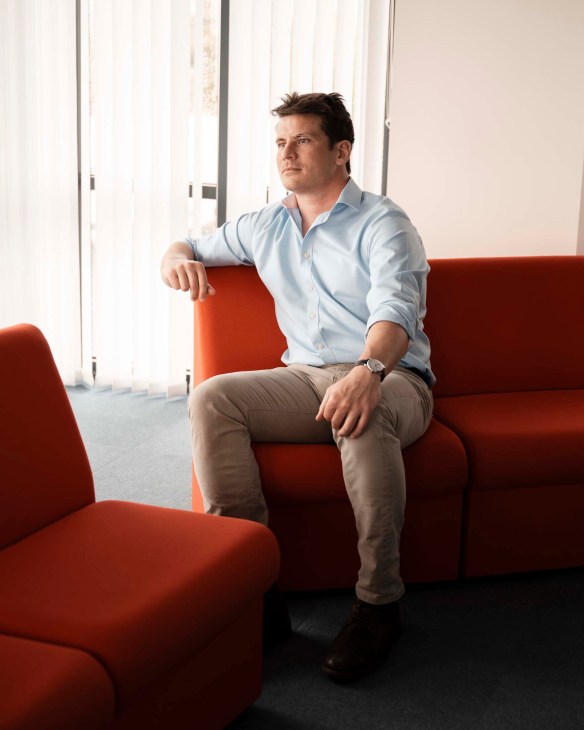
Mendes also believes this is a time of great opportunity for European defence firms such as his. “The nature of war and defence is no longer compatible with long development and procurement cycles,” he says. “The market model has changed and we’re moving away from defence monoliths. What Europe needs now are companies that can move fast, scale up and work together in an ecosystem.”
tekever.com
2.
The delivery guys
Arx Robotics
Germany
Last-mile delivery is a sector that’s full of opportunities, whether that’s doorstep drop-offs or getting military supplies to the front line while under fire. During his time at the start-up incubator lab at Bundeswehr University Munich, which is run by the German Armed Forces, former army officer Marc Wietfeld wondered whether robots could be put to this dangerous task.
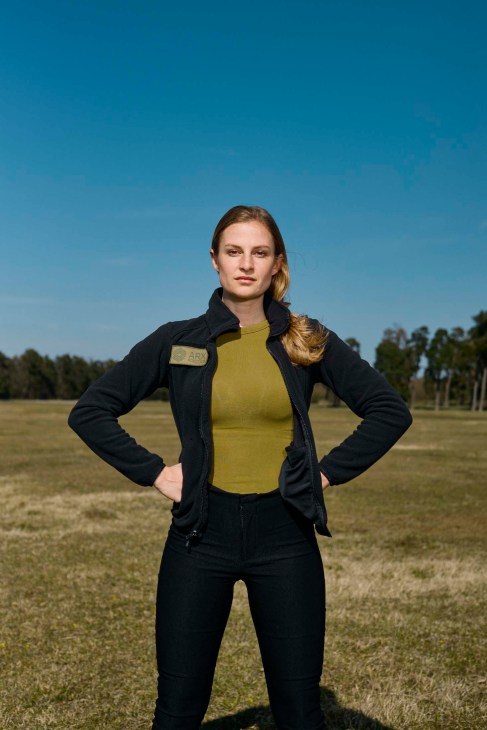
As Wietfeld explored the robots’ potential for logistics, he sought to raise funds for a large prototype. In March 2022 he teamed up with Max Wied, another army officer with a background in finance. Stefan Roebel, who cut his teeth in business at Ebay and fashion retailer Asos, joined in 2023. A few years later, the company they founded, Arx Robotics, has already broken several records, including for funding and deliveries to Ukraine, where its robots now carry ammunition, sensors or aerial drones into combat and wounded soldiers out of harm’s way.
business development
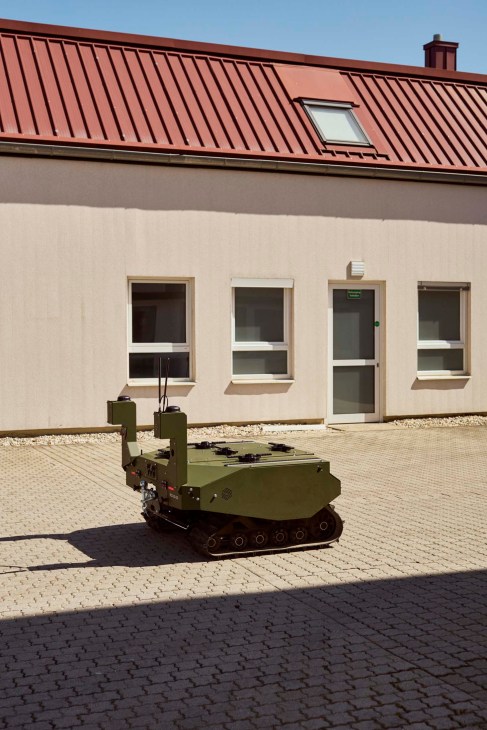
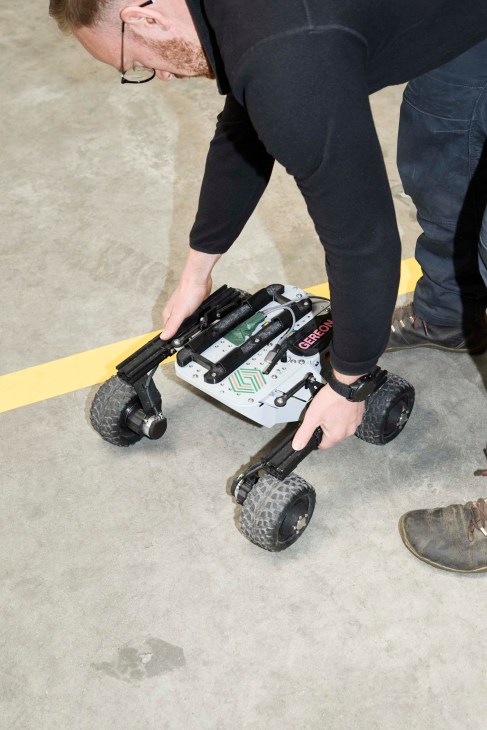
The success of Arx’s Gereon robots is down to their autonomous capabilities, which are facilitated by a mix of artificial-intelligence software, night-vision stereo cameras for a 3D view, and thermal and lidar sensors for obstacle recognition. Crucially, they are also inexpensive to build, as the software easily integrates with third-party products and the hardware is mostly made up of off-the-shelf industry components. Initially, Arx set the cost of a robot at between €30,000 and €150,000, depending on features and sensors. Today, says Wietfeld, “They cost a sixth of our cheapest competitor.”
Arx robots have all-terrain tracks, a maximum speed of 30km/h and a range of 40km. The modular mounted section of the robot can be swapped out by hand in just two minutes and can be modified to carry a stretcher for evacuations, sensors for reconnaissance, a launcher for aerial drones or a basket for supplies of up to 500kg. The firm rapidly attracted supporters and capital. In September 2023, Project A, a Berlin-based technology VC company, invested €1.15m. Nine months later, Discovery Ventures, another VC from Berlin, and the Nato Innovation Fund (see below), along with Project A, put forward joint seed investment of €9m – the largest seed round for a European defence-technology company to date. In early 2025, Arx sent 30 robots to Ukraine. The delivery from Germany was the biggest autonomous ground fleet provided by any Nato country.
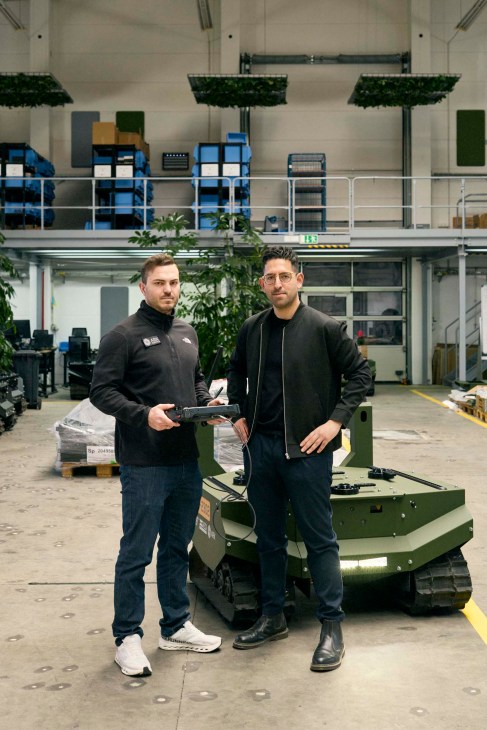
Since then, Arx has established a 10-person team in Kyiv to oversee maintenance and production and gather feedback. It found that limiting the size of the robots to about 1.3 metres makes them harder to detect and more easily deployable by civilian vehicles.
Arx is increasing production in Germany and Ukraine and setting up in the UK, and recently inaugurated Europe’s largest plant for unmanned ground systems in Erding, near Munich, which is becoming a hub for defence start-ups. In April, Arx secured a second funding round of €31m to quintuple its production capacity and raise its workforce from 60 to at least 100 employees by the end of 2025.”
arx-robotics.com
Investing in defence
European venture capital has in the past been wary of investing in start-ups that make products with links to warfare. But the invasion of Ukraine changed that. According to a 2024 report from the Nato Innovation Fund and Dealroom, European investment in the defence, security and resilience sector totalled €4.5bn in 2024, an all-time high. Here are five funds to know.
1.
MD One Ventures
Europe’s first VC firm dedicated to national-security start-ups has backed everything from quieter jet engines to AI.
2.
Nato Innovation Fund
Backed by 24 allies, this fund has deployed more than €1bn in hypersonic systems and next-generation communications.
3.
Scalewolf
The Lithuania-based accelerator invests in dual-use technologies with defence as well as commercial applications.
4.
National Security Strategic Investment Fund
This UK government-supported venture fund has backed breakthrough companies in drones and next-generation defence manufacturing.
5.
Hyperion Fund
This Spanish fund launched in 2024 with €150m growth equity and focuses on aerospace, cybersecurity and AI-related defence firms.
3.
The frontier steward
Frankenburg Technologies
Estonia
Being “mission-driven” has become a cliché among start-ups – jargon trotted out by ambitious founders and written in pitch decks. At Frankenburg Technologies, a defence start-up based in Tallinn, Estonia, the phrase feels more like a battle cry. “We are a single-use company with a single mission: to defend Europe and equip the free world with the technology to win the war,” says Kusti Salm, the firm’s CEO. As he speaks, he presents a prototype of the company’s first product: a missile designed to shoot down drones such as the low-cost Iranian-made Shahed deployed by Russian forces in Ukraine. In contrast to the traditional military-industrial model – which is heavy, slow and expensive – Frankenburg promises guided-missile systems that are 10 times cheaper and 100 times faster to produce.
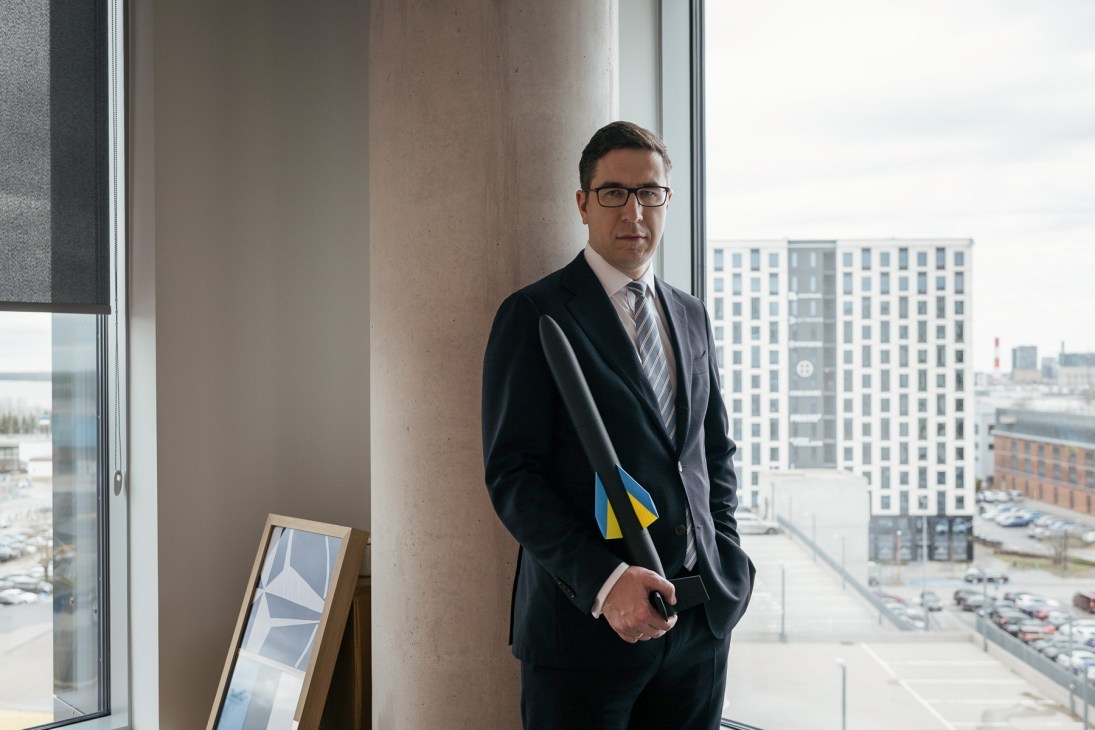
Estonia, once occupied by the USSR, now has more start-ups per capita than any other country in Europe. Frankenburg represents a convergence of that technology-forward spirit with a frontier nation’s understanding of regional security. The company was launched in 2024 by a formidable trio – a former high-ranking defence official in Estonia’s military, a veteran rocket scientist and one of Estonia’s wealthiest entrepreneurs – and has moved with the urgency of a start-up. In just a few months, its valuation has tripled to €150m. Several funding rounds have been announced, with plans to scale operations across Europe. The company is establishing research and manufacturing facilities in Latvia and opening a new headquarters in the UK. The company also has plans to test its missile systems in Ukraine, in co-operation with the country’s Ministry of Defence.
Frankenburg has a staff of about 50. Many of its employees are ex-military leaders and top engineers drawn from the private sector and academia. According to Salm, his team’s modest size makes the company nimble. “We’re faster, more flexible and not locked into outdated models,” he says. While Russian factories churn out low-cost drones by the hundreds of thousands, Europe’s air-defence systems are complex, prohibitively expensive and too slow to scale. “Europe is behind and, unless we invest trillions in defence capabilities, we’ll stay behind,” he adds.
Unlike conventional missile systems, Frankenburg’s products are intended to be scalable, partially disposable and manufactured using commercial components. Many of the sensors in its missiles, for example, are the same as those found in smartphones. The company also relies heavily on 3D-printing and rapid prototyping to slash costs and to iterate quickly. “There is no time to waste,” says Salm. “We can’t afford to move at the pace of traditional procurement cycles. The battlefield is changing now.”
frankenburg.tech
More European defence-technology firms to keep your sights on
4.
Greenjets
UK
Drones might be reshaping battlefield planning but the wasp-like buzzing of an unmanned autonomous aerial vehicle hardly makes for a stealthy entrance. UK-based Greenjets, which was founded in 2021, saw an opportunity to address this and is developing electric-powered jet engines for vertical take-off and landing that emit just a third of the noise.

The company launched its first engine of this kind in 2023. Designed to power the next generation of small unmanned aircraft, the IPM5 was inspired by the helicopter-shaped seeds of sycamore trees, which the wind can carry great distances. Its ducted-fan architecture helps to keep the volume down while making it safer and more secure than conventional engines with open-bladed propellers.
Though it weighs just 750g in total, the IPM5 efficiently provides plenty of thrust. It is now shipping to drone manufacturers. The company plans to eventually roll out models for larger aircraft that are capable of carrying passengers; it has released renders of a futuristic-looking “air taxi” and a timeline to have them aloft by 2028. That might sound ambitious – but there’s nothing wrong with aiming for the sky.
greenjets.com
5.
Pangolin Defense
France
Ballistic-protection specialist Pangolin Defense’s signature vest can take a pummelling. It incorporates glass scales to create flexible ballistic plates that make for comfortable and affordable bulletproof armour. Founded in 2020 by four students, Pangolin Défense received an early grant from the French ministry of defence that allowed it to manufacture everything in the country.

The company now makes 3,000 vests a month, which it supplies to militaries and police forces across the globe, as well as the UN. It has also recently expanded into the US. “Our goal is to win a major national or European public tender before the end of the year,” says co-founder Clément Saglio. “That will get us a seat at the big kids’ table.” The war in Ukraine led to a spike in demand and Pangolin Défense has doubled its revenue over the past two years.
pangolin-defense.fr
6.
Himera
Ukraine
Kyiv-based walkie-talkie maker Himera launched in 2022 to solve a problem: Ukrainian soldiers had few effective, cheap and reliable ways to communicate. “You can have the most sophisticated weapons and equipment but if you can’t co-ordinate, most of that becomes useless,” says Himera’s co-founder Misha Rudominski.

The company offers radio and communication devices that are resistant to external interference, such as that from Russian troops, as well as cheap to produce. In 2024 it announced a deal with Ottawa’s Quantropi to distribute its products in the US, Canada and selected Nato markets. Being based in Ukraine is an advantage to the business. “It has given us the best understanding of how our products work in practice,” says Rudominski. “Our users write to us from the battlefield, reporting any problems. We take that information on board and fix things.”
himeratech.com
7.
Helsinki Shipyard
Finland
Icebreakers are key to navigating the Arctic. Helsinki Shipyard is a historic builder that, until 2023, was owned by Russians and was heavily affected by sanctions. That year it was acquired by Québec-based firm Davie, which has been building ships in Canada since 1825. Its first new vessel, the Polar Max, will be delivered to the Canadian coast guard in 2030. “The door to the Arctic is wide open and the West isn’t winning the race,” says Davie’s Paul Barrett. “We’re looking to accelerate joint shipbuilding efforts on both sides of the Atlantic, with a view to securing the strategic interests of the West in the High North.”
davie.ca
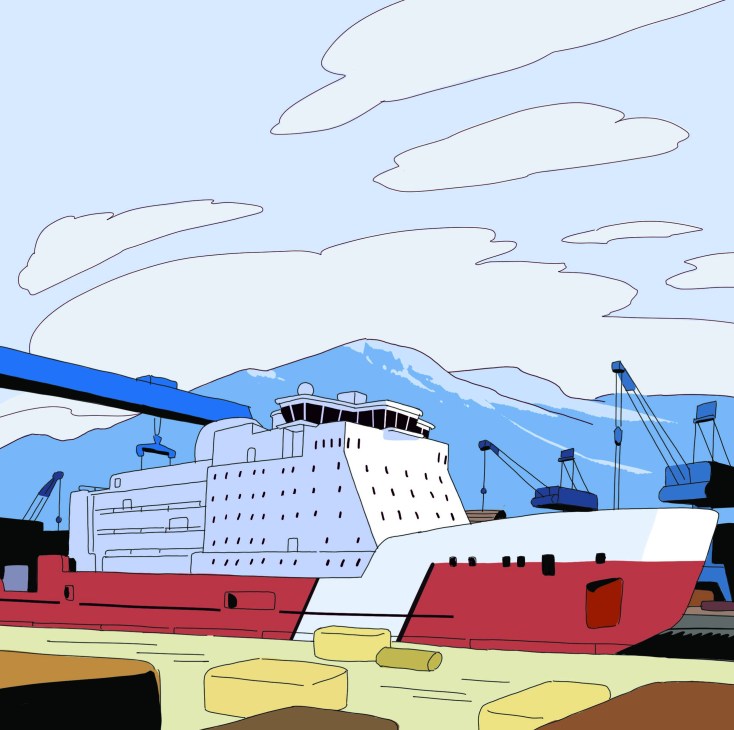
8.
Nordic Air Defence
Sweden
Swedish start-up Nordic Air Defence’s Kreuger 100 is a battery-powered, non-explosive drone interceptor that relies on built-in software to locate its target and knock it out of the sky. It’s named after Swedish tycoon Ivar Kreuger, who built a business empire on matches. “He took something potentially dangerous and made it safe, mass-manufacturable and cheap,” says the company’s business director Jens Holzapfel. “We will do the same with counter-drones. In Ukraine, it’s a numbers game right now. To compete, the countermeasures against drones must be cheaper than the actual threat – or, at least, not exceed its price.”
nordicairdefence.com
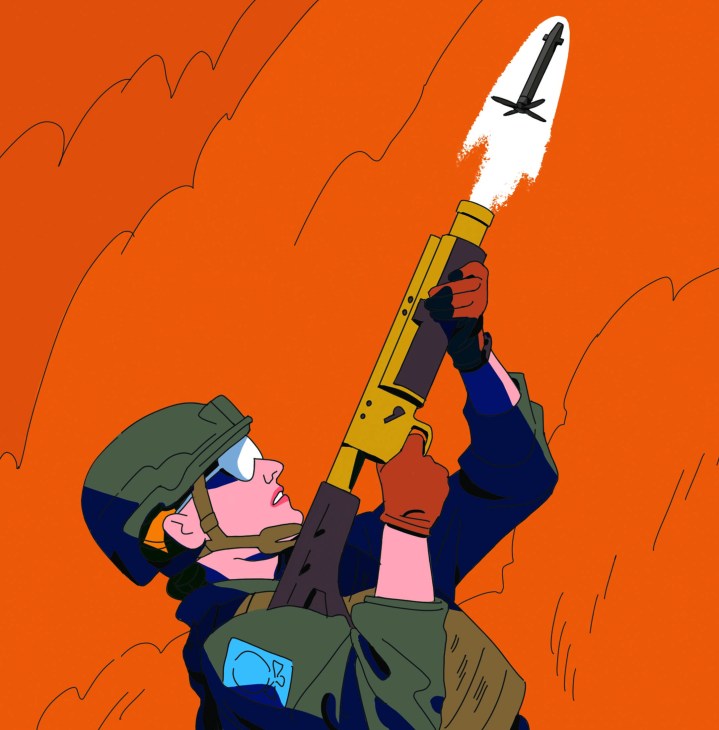
9.
Helsing AI
Germany
Founded in 2021, Munich-based Helsing AI is among Europe’s leading defence start-ups and was valued at €5bn last year. It creates AI software for battlefield planning that’s capable of crunching vast amounts of data from sensors and weapons systems, enabling split-second decision-making. It has also been used to co-ordinate drone “swarms” in Ukraine. Both a technology and a hardware company, Helsing makes products, such as its HX-2 drones, at “resilience factories” designed with local supply chains in mind.

The firm received support from venture-capital fund Accel, an early backer of Facebook and Spotify, and has partnered with French-American space start-up Loft Orbital to deploy Europe’s first AI-powered multi-sensor satellite constellation. In collaboration with Swedish aerospace firm Saab, Helsing is set to upgrade the electronic-warfare capabilities of 15 of the German Luftwaffe’s Eurofighters.
helsing.ai
10.
Space Forge
UK
Space Forge is a young company that is reviving an old idea: manufacturing in space. Its focus is the crystals that go into compound semiconductor chips, which are crucial to the energy-intensive radar and communication systems used by the defence industry, as well as by AI. “All of the things that make Earth a lovely place to live, such as gravity and the atmosphere, are terrible for almost any industrial process,” says Joshua Western, co-founder of Space Forge. Growing these crystals in space, he adds, is far quicker, with a lower risk of impurities.

In the summer, Western’s team will send its Forgestar-1 grower into orbit. Though still testing its product, the start-up has attracted industry interest and is collaborating with US defence giant Northrop Grumman. “Semiconductors are the oil of the 21st century,” says Western. “They underpin all critical infrastructure and whoever has the best material to make the best chip has the biggest edge.”
spaceforge.com
Could Kigali become Africa’s Dubai?
Rwanda might be synonymous with some of the worst crimes in recent human history but the predominant feeling in the country today is that of an optimistic future. Under the aegis of its 68-year-old president, Paul Kagame, who last year won a fourth consecutive election victory with more than 99 per cent of the vote, the country has experienced rapid economic growth, with GDP increasing by about 8 per cent every year since 2007. Rwanda is seen as a beacon of prosperity and peace not just in East Africa but the wider continent and in the past decade has climbed 100 places up the World Bank’s Doing Business index, now ranking second in Africa and 38th globally.
Nowhere in the country is this economic progressivism felt more than in Rwanda’s 1.7-million strong capital, Kigali, which is responsible for 41 per cent of the country’s GDP. Take to its highways and you see an urban centre shaped by an ambitious Plan for 2030, which focuses on sustainable development, as well as the nation’s Vision 2050 roadmap, whose goal is to ensure that Rwanda is a high-income country with improved living standards by the middle of the century. Either side of you are well-swept roads, their neat verges bordering smartly guarded buildings that point to a national ambition to lead a continent in security, business incubation and sports tourism.
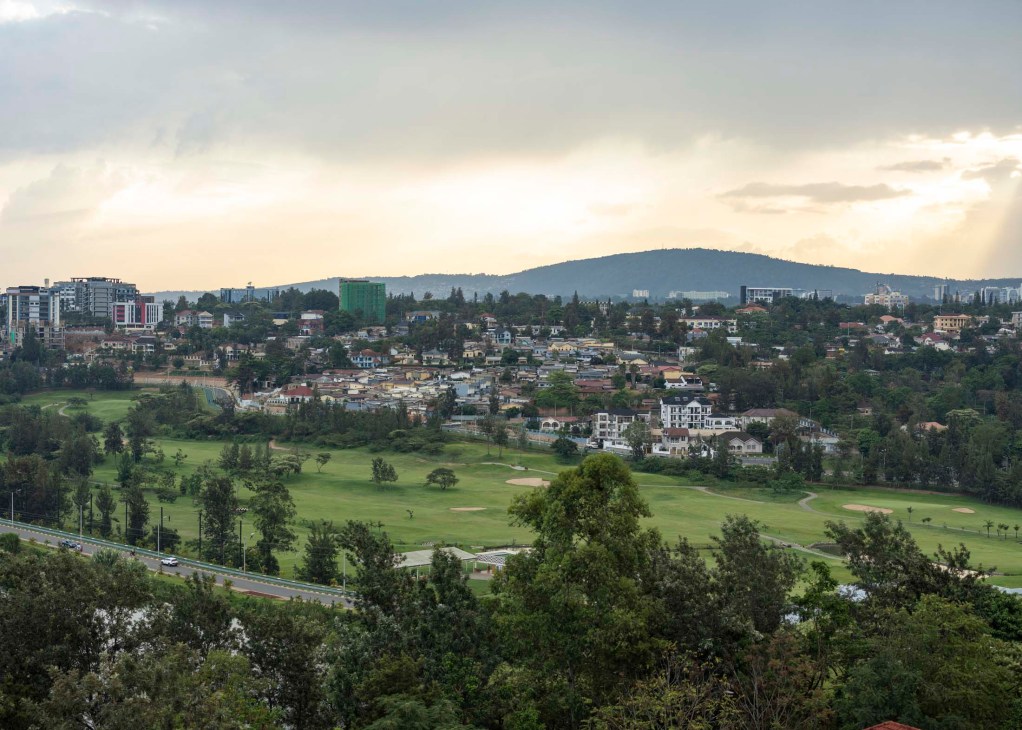
As you’re whisked through the city’s airport, you’ll see dozens of golf balls on adverts, as pristinely white as the terminal’s many pillars. Is this really the capital city of a country that just over 30 years ago was still embroiled in a civil war that caused the deaths of hundreds of thousands of people? Yes, and its impressively landscaped 18 holes are among a few things – an influx of foreign capital, improving infrastructure and a culture of surveillance – that you might judge it to have in common with, say, Abu Dhabi or Singapore.
As with those city-states, observers believe that Kigali’s serenity and stability come at a cost: namely, the suppression of human rights and personal freedoms. Since Kagame’s 2017 victory, according to Human Rights Watch, at least five opposition politicians and four government critics and journalists have died or disappeared in suspicious circumstances, though Rwandan officials deny any wrongdoing. As a visitor, to travel Kigali’s streets is to be awed by their cleanliness but also perturbed by the hushed swivel of thousands of cameras and the watchful eyes of many more uniformed (and plainclothes) policemen. That said, foreign capital craves stability, especially during times of upheaval, and Kigali (like the UAE) is becoming a more attractive prospect. In 2023 it received a large proportion of the €630m of direct foreign investment in Rwanda, most of which came from the likes of Kenya, India, Germany and France.
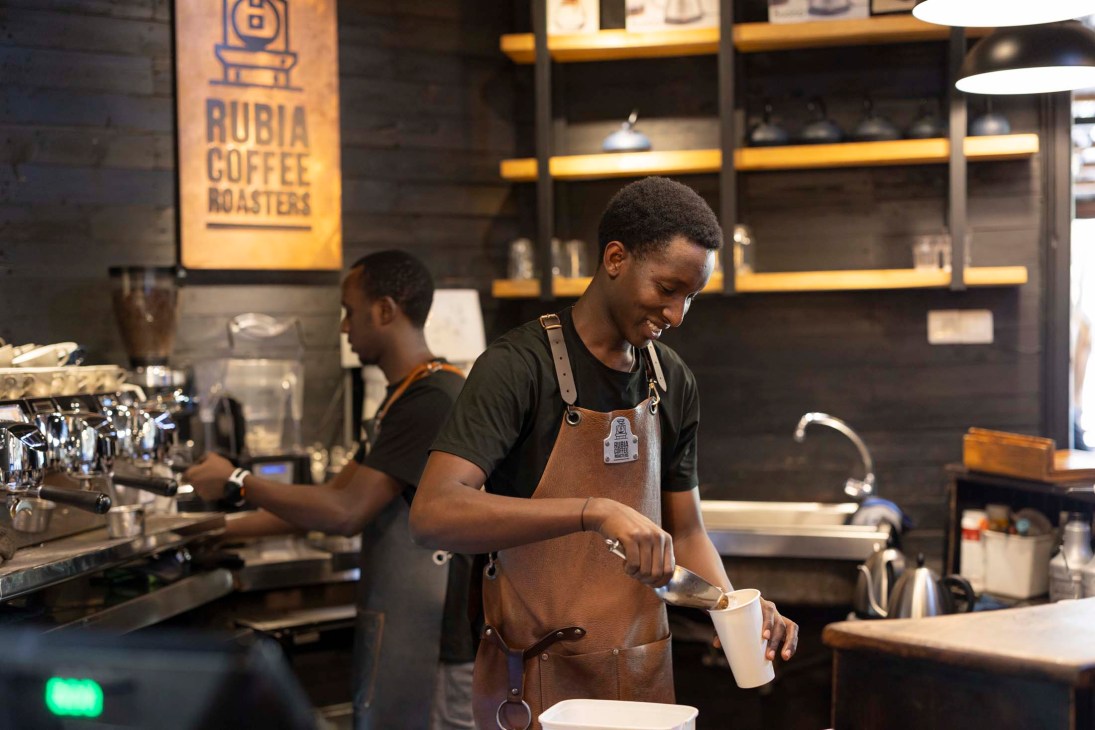
Mayor Samuel Dusengiyumva beams from behind a large desk in his airy city hall office. “The national government and the city have such big plans, for infrastructure, services, health and cleanliness,” he says. Dusengiyumva is a youthful 44 but old enough to have been a teenager during the genocide of 1994 that caused the deaths of 800,000 Rwandans. “Of course, the city is linked to the country’s history,” he adds. “Because of the 1994 genocide, the country shut down and Kigali was the most affected part. The fighting was very intense and the destruction and damage to infrastructure was everywhere.”
Its subsequent transformation didn’t happen overnight. “In 2000 the city was like a village,” says the mayor. “No roads, water not getting to different neighbourhoods – even accessing the airport was a problem because everything else was a priority.”
Talking so plainly of national tragedy would be anathema to political leaders from other countries but Dusengiyumva seems to embody contemporary Rwandans’ attitude that the genocide be invoked to push its citizens forward. “In 2002 the road network in Kigali was 102km for a city of 730 sq km but today we’re at about 700km of roads, with neighbourhoods joined up, the city joined up and people joined up.”
The idea of unity through tarmac is both romantic and practical in the Land of a Thousand Hills (as Rwanda is known). Indeed, at Dusengiyumva’s swearing-in ceremony, he talked of ensuring infrastructure for those still in need. Shortly after taking office he announced a further 40km of new roads to be built in the city. Of course, the mayor’s duties are a little more complex than healing through highways. Dusengiyumva also aims to attract the skills and investment that the city needs to get it off the ground. “Engineers, architects, developers, students, experts in technology and entrepreneurs” are who the mayor lists as requirements for a successful civic strategy.
Meanwhile, the widely derided schemes of European countries such as the UK that involve paying Rwanda to take their unwanted migrants are, anecdotally at least, not viewed so negatively in a country looking to grow and become more multicultural, as well as shake off the negative associations that its name still holds in much of the world. “People ask, ‘How did you do it, after that history?’” says Dusengiyumva. “The answer is that we know the power of vision – if you’re together and connected, you can do anything.”
Norrsken, a business and technology incubator, is all about vision and connectedness too. Founded by Swedish entrepreneur Niklas Adalberth in 2016, it’s a non-profit social-impact foundation. It operates hubs in Stockholm, Brussels, Barcelona and Kigali, which offer shared office spaces, expertise and investment advice. Kigali’s Norrsken House is just a few blocks from city hall. It sits in a downtown that contains international banks and hotels, as well as two of Kigali’s best-known genocide attractions, the Belgian Peacekeepers Memorial and the Hôtel des Milles Collines (the inspiration for the 2004 film Hotel Rwanda). Today the area is alive with joggers, taxis ferrying hotel guests and cafés leaning into a timber-clad Scandinavian aesthetic. Norrsken is a high-ceilinged, light-filled and solar-powered home of bright ideas, shared resources and competitive good humour.
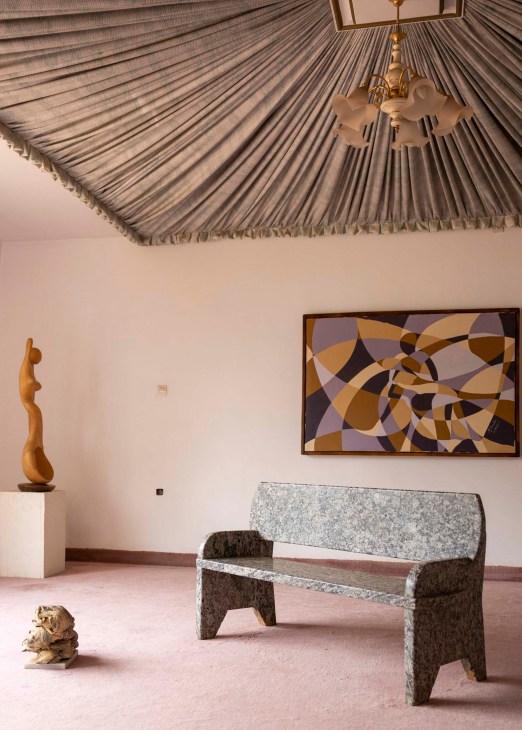
How did Elie Habimana, managing director, start off here? “I began as a computer-science engineer but my first assignment was to build the house, to look after that,” he says. So you turn up for an interview, they tell you, “Congratulations! You’ve got the job!” and then ask you to build the office? “Well, not exactly,” says Habimana, with a chuckle. “I had a background in project management but we are a hands-on organisation.” Kigali’s Norrsken has about 1,400 members and associations with some 350 companies, from local telecoms firm Africa’s Talking to Swiss pharma giant Novartis. Norrsken is a hub for small starters in need of desks as well as for advanced businesses.
“I don’t call any of them start-ups because the range and scale are quite broad,” says Habimana. “The aim for us is to wrap up talent, technology and development. After all, Kigali is positioning itself as a proof-of-concept market.” Habimana cites drone-delivery firm Zipline, which, while US-owned, began in Kigali and now transports medical supplies and agricultural essentials around Rwanda’s less-connected regions. Similarly, AFEX is an agricultural commodities exchange whose founders all met at a Kigali conference.
Back on the streets, things are being built, including the Kigali Green Complex, a 35-floor tower that is set to become the tallest building in the country; Zaria Court, a mixed-use entertainment and retail complex that will incorporate a basketball arena, hotel and restaurants; and, a bit further out, a new international airport built in partnership with Qatar Airways, which has taken a 60 per cent €1bn stake in an aim to make Kigali a regional aviation hub. The dig and clatter of all of this construction meets the traffic’s rumble and the horns of motos, the two-wheeled taxis that will take you anywhere for 50 cents.
But Kigali isn’t Cairo-crazy or Manhattan-mad; it’s an equable rush hour, a calmer commute. At a red light’s lull or on a shaded side street, the sound of the old green forests that the Rwandan capital was carved from by German colonialists in the early 20th century return: the bee-eaters, boubous and firefinches’ songs are more melodic than the ringtones and radios. This is the green and pleasant past that Kigali aims to embrace again among its developments and betterments, to happily mix city and nature.
Mayor Dusengiyumva talks of his aim to restore the city’s nature-rich wetlands, which were once home to more than 1,000 species of birds and bugs. Kigali City and the Rwanda Environmental Management Authority are working on a multiyear regeneration scheme that has planted 17,000 trees and restored the key Nyandungu wetland in the east of the city to alleviate flooding and increase biodiversity.
As we head northeast to the Nyarutarama neighbourhood to meet Bonita Mutoni, the more manicured version of Kigali’s verdure swings back into frame. Mutoni is the founder of Uber Luxe Safaris, a firm she set up in 2012 after working in luxury PR and helicopter leasing, and noticing that there were “wealthy friends of Rwanda for whom there wasn’t a company that could deliver an experience from beginning to end”.

Uber Luxe takes clients to high-end lodges in the Rwandan hill forests that border Uganda and the drc and are home to many of the country’s 1,000 or so gorillas – traditionally the main draw for non-African visitors to this part of the world. The gorillas have been well known to change people’s ideas of how and why they travel, what they conserve and their very attitude to life on earth. “It can be emotional for people, for sure – it certainly is for me,” says Mutoni.
The world can surely agree that the nature is stunning, fascinating and humbling. But what of the governance that makes Kigali a place where such a demanding venture in luxury hospitality could flourish? Without being quite as red-in-tooth-and-claw as the fauna, the power arrayed around Kagame, who has run Rwanda for almost 30 years, is absolute. Could it be that things work… or else? From the perspective of a local business-owner, it seems that the firm approach works. “You sense it as soon as you arrive at the airport,” says Mutoni, whose travels are as extensive as any of her wealthy clients’. “The airport’s right in the city, you get a visa on arrival, it’s easy to navigate and clients spend a day or two in Kigali before going to the hills. The city’s clean and safe. It just works.”
The city’s retail, art and culture offerings are relatively slim but high in quality, while much of the fashion action, such as Haute Baso and House of Tayo, are in the easily accessible suburbs. It’s sport, though, that is the sector most noticeably on the rise in Rwanda – and it’s centred in Kigali. In 2025 the city will host the UCI Road World Championships in September and an early group stage of the Basketball Africa League (BAL, an NBA spin-off), while a Kigali Formula One race has been mooted. “Tourism was all typical leisure or all safari,” says Mutoni. “But since we built the stadium and the arena, the number of sports tourists is just huge. I went to a Rwanda-Nigeria football game recently and it was impressive how many Nigerian tourists – and I mean high-end ones, booking into suites – there were. It was good to see.”
The BAL is also growing – the Armée Patriotique Rwandaise (APR) competes in the league’s Nile division alongside teams from Libya, Kenya and South Africa. “It’s amazing to see so many Africans convene for that,” adds Mutoni. Back in the arena of city governance, however, she is firmly patriotic. “There isn’t anywhere to challenge Rwanda nearby,” she says. “We do business in Kenya, Tanzania and Uganda but Kigali is always the easiest city in all of East Africa.”
As Mutoni pops the cork on some chilled Ruinart, she talks of near-neighbours and an international scene of Africans, especially Nigerians, investing in Kigali property alongside Europeans, Australians and Indians. “Twenty years ago, I knew everyone,” she says. “I grew up in England and it’s a little like that now. We’re becoming a multicultural city. I love it.” After a top-up, Mutoni suggests a toast – and who are we to resist? “We’re working to become the Dubai of Africa – and I think we’ll get there.”
The drive to Kimihurura, in the tight green hills of the old city, is a lolling pleasure after some sparkling refreshment in the gently cooling late afternoon. This neighbourhood, known as Kimmy, has always been something of a leafy enclave for the upper echelons of the old colonials and the wealthy Rwandans and expats of today – people keen on big houses, high walls and guards packing inscrutable expressions and automatic rifles. Gyms, cafés, clubs, restaurants and dog-grooming parlours are sprinkled among the ornate gates of the large, politely recessed villas, which are laden with golden dewdrops and scarlet hibiscus that soften the barbed wire peppering their walls. It’s what you could call classic Kigali: green and pleasant, watchful and calm.
Christian Intwari is a young entrepreneur, NGO founder and event producer who managed the entertainment that went with 2024’s “much-expected” re-election of Paul Kagame. So much-expected, in fact, that any canny event planner could have saved some money by buying the fireworks in bulk four or even eight years in advance. Kagame secured 99.15 per cent of the vote in July 2024 – greater even than Vladimir Putin’s 88.48 per cent from four months earlier. As dusk falls, Intwari’s afternoon “office” has been a corner table at Kivu Noir, one of Kimihurura’s most beloved cafés. It serves cinnamon buns and French toast, boasts of deep coffee knowledge (Rwanda produces about 22,000 tonnes of beans a year) and has wi-fi robust enough to enable every customer to be across a handful of devices at once.
“If we’re talking about neighbourhoods, communities and governance,” says Intwari, “I’d mention the Our Past Initiative, my NGO. We’re interested in bridging the gaps between generations as well as different parts of the city – because the building process of our country is not just building.” Indeed, as Intwari says, across the nation, the last Saturday of every month is a umuganda, a day reserved for communities to meet up and clean their neighbourhoods together. The idea began in 1962 and was revived post-genocide as a way for horrifically divided communities to come together to make things literally and spiritually tidier. The enthusiasm for umuganda is, perhaps unsurprisingly, enjoying a purple patch as Kagame has strengthened his iron rule – though nobody who speaks to Monocle during our three days in the city so much as rolls their eyes at its mention (or of the president’s 99 per cent, for that matter). Nyamirambo is one of the city’s liveliest quarters, a former Arab trading area that’s home to Kigali’s oldest mosque (Muslims make up 2 per cent of the country’s population, while more than 90 per cent is Christian, though interfaith relations are strong). The neighbourhood also houses initiatives such as the Nyamirambo Women’s Center, which aims to counter violence and discrimination against women through a focus on and production of traditional crafts.
Before Monocle’s trip, Kigali had been described as “full of kick-ass women” by a female contact in Kenya, which is seemingly corroborated by the fact that 49 out of 80 Rwandan MPs are female. Nyamirambo is clearly a creative enclave and, under a bright sun, this neighbourhood of everyday fashion shops is a cacophony of competing hawkers and wannabe-winning signage: “Magnificat Boutique”, “Swagger Shop”, “Yes, Please!” Among the hand-drawn signs for saloons and salons, Timothy Wandulu runs the Concept Arts Studio, where he makes work, holds discussions and teaches others how to paint, sketch and collage. “I sketch the city as it changes,” says the paint-flecked Wandulu. “And it’s changing pretty quickly.”
He is certainly correct but it’s change that is taking the Rwandan capital nearer to the future that it aspires to and further from its grim past. It seems that contemporary Kigali is built on solid stuff. Is it down to mayor Dusengiyumva’s good governance? Well, he would say that – but so does everyone else. A liveable city that attracts investors across business and technology, hospitality and leisure, sport and tourism? Is the talk of parallels to Middle Eastern and Asian cities well on the way to being richly deserved?
After all, they do share a certain something in common. On a morning walk or an evening stroll in the quieter, greener lanes of Kigali, you’re lulled by the sounds of the industry of upkeep as much as birdsong. Straw brooms sweep near-pristine streets, fallen leaves are collected from well-trimmed verges, the snip-snip of secateurs administer to well and truly ruly hedges. Kigali’s bloody history is mostly confined to its poignant and powerful genocide memorial; it is not obviously borne out in that emphasis on security, the high gates or well-trained guards.
It might seem like a peculiar proposition but Kagame’s firm grip on power has brought peace and prosperity here. Perhaps peace needs governance, liveability needs safety and investment needs security. Under the jacarandas at dusk, the bee-eaters and firefinches squabble and warble like people but fly off to roost in the same cool branches. The talk here? It’s good.
Rwandan genocide
The 1994 genocide lasted 100 days and led to the murder of at least 800,000 people across the country. The trigger for the massacre was the assassination of the then-Rwandan president, Juvénal Habyarimana, who had led the country since 1973 and whose plane was shot down with a surface-to-air missile on its approach to Kigali airport on 6 April.
Habyarimana’s killing unleashed a wave of violence against the minority Tutsi ethnic group. The president was a member of the majority Hutus, who had long been marginalised under colonial rule, which favoured the Tutsi as a ruling class. After seizing power in a military coup in 1973, Habyarimana maintained the pro-Hutu line and used government propaganda and his deadly militia, the Interahamwe, to spread fear and dehumanise the Tutsis.
The genocide was ended on 4 July 1994 when the Rwandan Patriotic Front (RPF), a revolutionary paramilitary group made up of mostly Tutsi men exiled to neighbouring Uganda, swept into Kigali and overthrew the Hutu government. The RPF was led by Paul Kagame, who remains the Rwandan president to this day.