Issues
Are city kids safer than those in the countryside? The walk to school matters more than you might think
I often daydream about life in the countryside. I picture my children ambling along lanes flanked with wildflowers, perhaps with a pony in tow, and spending time roaming fields, blackberrying and climbing oak trees. The Cotswolds childhood that Laurie Lee describes in Cider with Rosie leaps to mind as I find myself scanning the property pages, looking for a bucolic alternative to my townhouse. Who knew that perusing detached villas that you’ll never buy in the Inner Hebrides could be such a pleasure?
But this romanticism evaporates whenever I visit the country and attempt to walk anywhere. As a committed pedestrian and keen urban cyclist, I’m plunged into panic when countryside vehicles hurtle towards me on byways without pavements, their drivers taking hairpin bends at speed and missing you by a few inches. During a recent weekend trip to Gloucestershire, I was gripped with fear as my young family walked in single file along a narrow lane to the village shop, while cars sped past at 60km/h.
Town mice are not used to this kind of velocity. With pedestrian-friendly low speed limits in London, my children are far freer to roam. “Bye, love you,” they holler as they leave for school every morning, still holding pieces of buttered toast. They set off on foot and sometimes bike, usually with gaggles of friends. Though our east London neighbourhood is far from serene, I feel that they’re safer here than on any rural lane.
Being a parent of pre-teen children involves having a little faith in community. London might be a city of almost 10 million people but its boroughs are made up of village-like hubs: a market street, a grassy green planted with plane trees, usually one or two Victorian schools. The porters, park rangers and corner-shop owners we know and chat to are part of a social infrastructure keeping an eye on youngsters who have a remarkable amount of freedom. With its traffic-limiting policies and 30 per cent car ownership, our area can sometimes hint at Cider with Rosie’s idyll.

London’s state schools encourage children to walk to school independently. There’s a shared sense that kids have the right to go somewhere without being trailed or tracked and that it’s society’s responsibility to support them as they travel in uniforms with rucksacks laden with water bottles and books. They are ushered through the urban community, with parents of younger children (who they usually know) keeping an eye on them and lollipop ladies marshalling difficult crossings. The biggest challenge is the scores of commuters belting along on Lime bikes with the grace and spatial awareness of runaway trains.
There are fierce debates about whether children should be given devices and access to social media but most kids I know are still smartphone-free. Instead, parents arrange their 10-year-olds’ living-room computer-game sessions on group chats. Some mums and dads hover around their children more than others; meanwhile, it’s striking that boys seem to have freer rein.
Voices always whisper reasons to bring children home, lock the door and batten down the hatches but it often feels that the biggest parenting challenge today is how to quieten those worries. After helicoptering our children through their early years, it can come as a shock to find out that the next step is to set them free and teach them how to live in a big city without your supervision.
I was thinking about risk the other day as I taught my nine-year-old daughter how to make pasta. The process of chopping onions with a new Sabatier knife and then watching her manoeuvre vats of boiling water into our sink tested my ability to resist the urge to zoom in and whisk it all out of her hands. I had to stop myself shouting, “Be careful!” at strategic intervals that would have only served to increase the likelihood of trips and spills.
Of course, I could have done all of these tasks myself. But seeing the pride that my daughter took from navigating the dangers of a large colander reminded me how significant such moments are to her sense of self. It was immediately evident in her face (and even stance) that this was an important part of growing up.
To show that I trust her was also vital. Risk doesn’t come naturally to me when it comes to parenting. I could see her stern determination to contend with the task – an urge to be considered old enough to deal with scalding hazards. This is what’s needed in life and love. You won’t find it sitting in front of the TV.
That’s not to say that I would sling my child a Sabatier to play with – for the record, my position on whittling with Swiss penknives has changed after a couple of trips to the accident and emergency department with my 10-year-old son. Even so, I’m constantly pushing myself to trust them more and curb my instinct to shadow their every move. I realise that I can’t solve their problems and that resilience comes from navigating rocky friendships and sinks full of washing up.
With all of this in mind, the six-minute walk to school takes on a greater meaning. It seems that policymakers are increasingly aware of its importance and are giving more thought to shaping children’s pedestrian experiences in cities and villages alike. At a time when children are playing outside less and less, when mental health in the young is declining, creating safe corridors to green spaces where they can scramble up trees and kick a ball is rightly climbing up the political agenda.
I recently asked my son why he likes walking to school and he said that it makes him feel free, grown-up and happy. (Also “sick”, which isn’t a malady but rather London “tween” parlance for “cool”.) In that moment, I realised that our cities have the potential to create young people who feel safe and confident in their surroundings – to the benefit of all. Child-friendly streets aren’t just about slowing down and restricting cars but rather creating environments that support the freedom of youngsters to exist without their parents. This creates diverse, balanced communities that make us all aim to be better and more open.
Cities have a remarkable chance to get it right. So, despite the litter and the noise, the speeding Lime bikes and the theft (I can go on), I realise that my corner of the Big Smoke is closer to Laurie Lee’s vision of childhood than I thought – and that perhaps I need to stop scrolling for houses on countryside lanes.
About the writer: Sophie Grove is the editor of Konfekt, Monocle’s immaculately turned-out quarterly sister publication. If you haven’t subscribed yet, why not? It’s an education in living well.
How the art world repackaged ‘cross-category collecting’ as a clever new trend
The more persuasive a narrative, the greater its power to mislead. For proof, consider the (allegedly) novel trend in my industry, the art world, for so-called “cross-category collecting”.
According to the slightly shaky theory, past generations only collected with a honed interest and tight focus on, say, contemporary portraiture or impressionism. The counterpoint, touted by art folk and auctioneers, is that over the past decade collectors and auctions have become less rigid and more eclectic. They have started, the hype masters continue, mixing art from multiple eras and collectable objects in many mediums into motley wholes. The main reason given? Smartphones, algorithmic newsfeeds and now generative AI’s worrying propensity to flatten reality. Technology, some critics say, is blending every historical epoch, genre and distinction into a smooth, easy-to-slurp slurry.
The narrative’s centerpiece was the sale of Leonardo da Vinci’s “Salvator Mundi”, which fetched $450m (€391m) in November 2017 and became the most expensive artwork ever auctioned. That happened, admittedly unusually, in a Christie’s sale nominally devoted to postwar and contemporary art. Since then, top auction houses have not only continued to selectively sell historical works in marquee weeks of modern and newer art but have also included more unorthodox rarities and sometimes frankly strange pieces, perhaps with an eye on social-media feeds or newspaper headlines. Examples include Christie’s taking bids for “Stan”, an almost complete Tyrannosaurus rex skeleton in 2020; Sotheby’s offering a 1962 Ferrari GTO in 2023; and Phillips consigning the “Thunderbolt”, which bore the faintly ridiculous and Instagram-ready description “the longest gold nugget ever found”, last autumn.

Meanwhile, prestigious galleries such as David Zwirner and Sprüth Magers have daringly presented thematic shows linking contemporary artists with old masters and antiquities. Art fairs have got in on the mixing and meddling too. Frieze Masters launched in 2012 as a historic complement to the brand’s original, contemporary fair. London’s Treasure House Fair emerged in 2023 as a one-stop shop for fine and decorative art, design objects and other collectables. Two years later, contemporary show Art Basel Paris gave the Gagosian gallery special permission to centre its booth on a Rubens painting. The 17th century is suddenly cool again.
This cross-category, mix-and-match momentum is certainly real but its newness is not. At least as far back as Rubens’ day, members of royalty and aspiring elites were assembling wide-ranging collections of art and artefacts from across epochs and cultures. Germanic Wunderkammern (cabinets of wonders) and Italian studiolos brought together human-made objects, marvels of natural history and scientific innovations. Empires ranging from the Mughal to the Qianlong added European prints, paintings, clocks and more to their holdings. People have always gravitated to works that they like rather than adhering to any rigid categories of movement or style.
Private capital certainly followed suit in the 19th century. The Rothschild banking dynasty’s opulent spending on fine art, decorative art, furniture and more from sundry eras and cultures established Le Goût Rothschild (“the Rothschild taste”). It doubled as a template for pushy American industrialists trying to buy their way to international respectability during the Gilded Age. Several contemporaries with revered art collections followed the time-tested strategy, from late Microsoft co-founder Paul Allen’s troves of historic guitars and early computing artefacts to Neue Galerie founder Ronald Lauder’s caches of arms and armour, classic cars and film memorabilia from Casablanca.
This raises the question: why are market forces presenting crossing categories as a fresh turn? Who gains by pretending it’s novel or interesting to like more than one thing? Technology probably plays a role – all context tends to be collapsed on small screens. But I also believe that, in this most disposable, machine-generated moment, Old-World craftsmanship – the allure of owning something that’s time-tested – has renewed appeal. In a small way, it can appease our anxieties about the future or position galleries as gatekeepers of a culture worth preserving. Plus, in an art world whose sales plateaued around 2014, the best story about the value of collecting is whichever one is the most convincing at the time.
About the writer: Tim Schneider is a writer, speaker and consultant on the business of fine art and collectables. He is the founder of independent art-industry newsletter and analysis publication The Gray Market.
A new chapter for Berlin’s Stabi, as a decade-long overhaul seeks to restore Scharoun’s civic landmark
Known as the Stabi, Berlin’s public library was built by West Germany in the hope that it would one day be a focal point for a reunited city. With its spacious reading rooms and five million books, it has since become a favourite place to study for Berliners. A a renovation, set to take more than a decade, will refresh the original design and add an entrance from the east, delivering on its 1960s dream.
Because it grants people from all walks of life access to knowledge, a public library can be seen as a reflection of the value that a society places on education. Such structures are among the most important civic buildings a testament to intellectual freedom, transparency and equity.
It’s these qualities that West Berlin’s Prussian Cultural Heritage Foundation looked to endorse when it built the Staatsbibliothek Potsdamer Strasse. After the partitioning of Berlin in 1945 and the construction of the Wall in 1961, most of the city’s old cultural institutions – the museums, theatres, opera house and state library – ended up in the Soviet-controlled territory of the German Democratic Republic. In response, West Berlin’s technocrats decided to build their own cultural centre from scratch on the razed no-man’s-land next to the Wall.


Called the Kulturforum – and still standing today – it was constructed as a projection of the West’s cultural heft and in the hope that such institutions would one day be the focal point of a united city. The site is home to Mies van der Rohe’s Neue Nationalgalerie, as well as the new Philharmonic, but the largest building by far is the Staatsbibliothek (Berlin State Library), which is now known as the Stabi.
Work began on the golden-hued “treasure house” in 1964 when Hans Scharoun, who had just completed the much-acclaimed Philharmonic nearby, won a competition. The Bremen-born architect had an aversion to symmetry and right angles, conceiving the library as one large reading room with a three-storey-high ceiling and a maze of balconies and mezzanines spanning most of its 230-metre length. Its façade, clad in anodised, champagne-gold aluminium panels, is punctuated by apertures that flood the interiors with natural light. It’s an effect enhanced by a complex geometric ceiling grid similarly dotted with fibreglass bubbles that filter daylight downward, casting an even, glare-free glow over the study desks. Construction took 11 years and Scharoun died before the building’s completion (the project was finished by longtime collaborator Edgar Wisniewski).
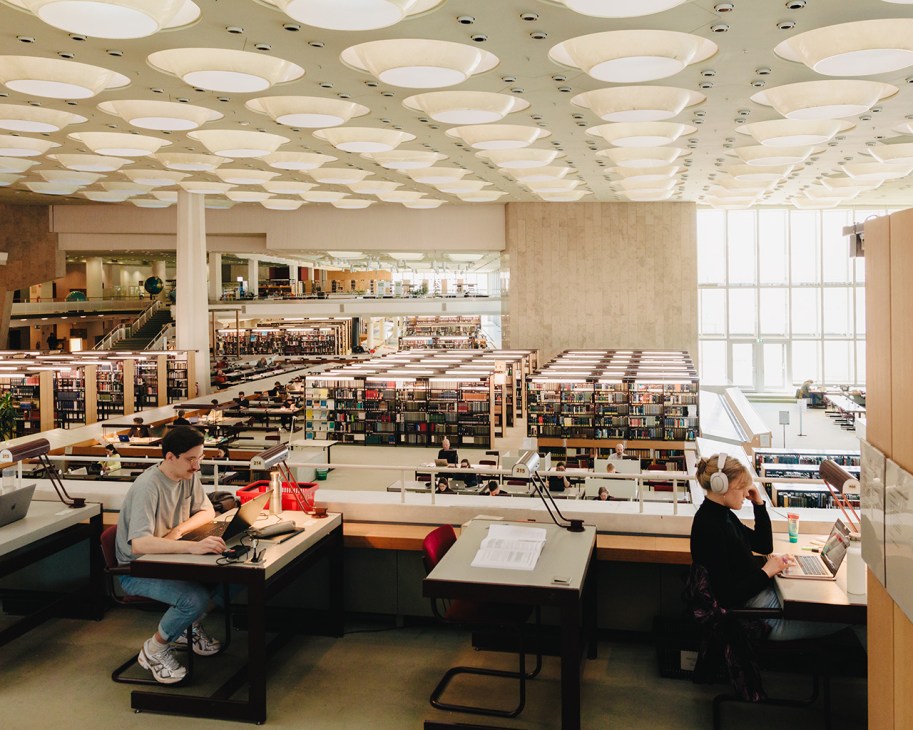
Scharoun never got to see the Stabi win global recognition from world-class architects. Kazuyo Sejima, of Pritzker Architecture Prize-winning firm SANAA, recently took a class of Japanese students to visit Scharoun’s buildings on the Kulturforum. The Stabi is also one of Europe’s key depositories of valuable documents. When the Fondazione Prada in Venice organised a sweeping survey of historical diagrams, the library was the main lender of artefacts. But, most importantly, it’s Berliners’ favourite place to study, with people of all stripes attracted by the long shelves of legal tomes or, more likely, the Stabi’s starring role in the 1987 Wim Wenders film Wings of Desire. (In one scene, the middle-aged angel, played by Bruno Ganz, roams the reading room, leaning over the desks to listen in on students’ thoughts.)
“In Berlin, we have little beautiful architecture, so it’s rare to have this kind of space,” says Filippo Weck, who started frequenting the library in 2020, when he decided to tackle Marcel Proust’s In Search of Lost Time. “You can’t really be a serious person if you haven’t read it. I needed a quiet space with no distractions.”
On his Mondays off from his job at art gallery Buchholz, Weck headed to the Stabi in the morning, left his phone in a locker, sat down near the windows on the lower level of the reading room and made his way through Proust’s seven volumes. It took years but it’s a routine that he is continuing, moving on to Letters from Prison by Italian philosopher Antonio Gramsci.
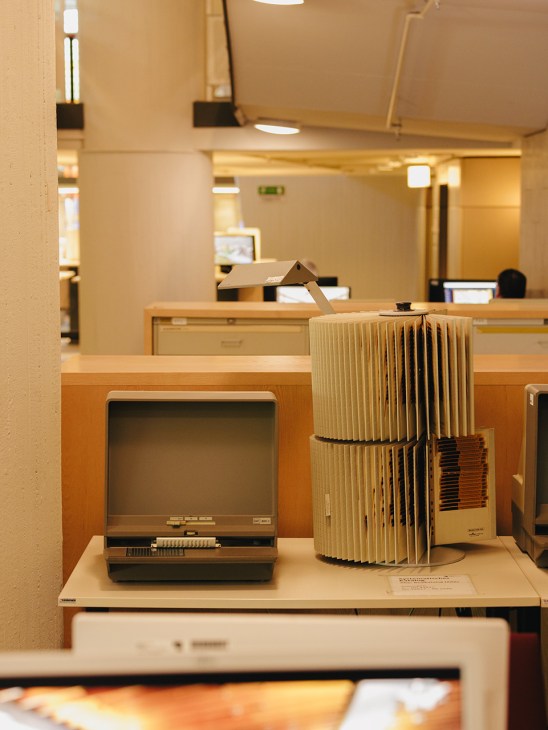
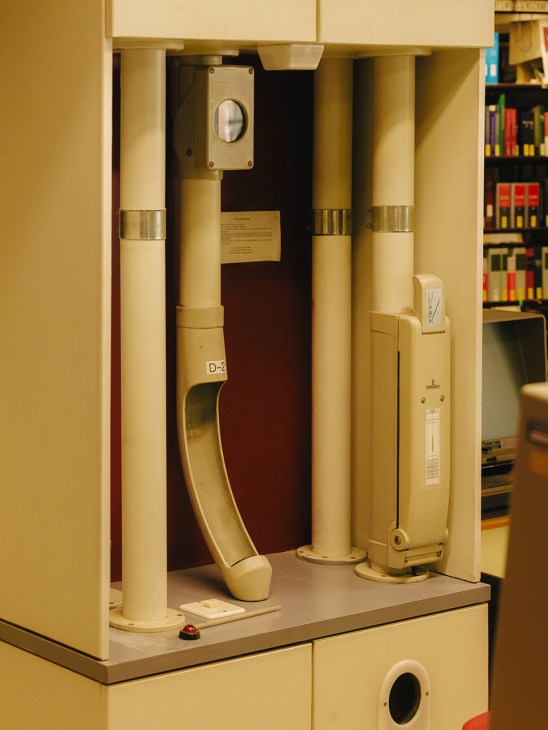
When Monocle visits, the Stabi has welcomed a mix of readers into its soaring, 900-capacity general and specialist reading rooms. Scholars are working on papers and doctoral students type theses, taking their lunches and cigarette breaks in a small park outside (“Whenever one of my friends complains about dating in Berlin,” says Weck, “I tell them to go to the Stabi”). This, despite the fact that after decades of use, wear and tear on the Bücherschiff (or “ship of books”) is starting to show.
Various renovations and refurbishments have taken place over the years, largely to expand the library’s storage capacity. But the information desk is still equipped with clunky 1990s computers, many of the lockers are out of function, some of the ceiling lights flicker and the moss-green floor moquette has developed a greyish hue. The café, meanwhile, has a cigarette machine and unapologetically serves bockwurst with potato salad for lunch.


For years, Berlin has been preparing for a major renovation of the whole heritage-protected building and has slowly been moving the 5.4 million books and periodicals that it houses elsewhere. The renovation is expected to commence in 2030 and will take 11 years (a time span that is not exceptional in Berlin, where the Pergamonmuseum is currently expected to fully reopen in 2037), with the building closed to the public for several years. All of the interiors will be stripped away, the cladding replaced and there will be key changes to the building’s entryways and circulation.
“For me, it is a symbol of democratic architecture,” says Stephan Schütz, partner at Hamburg-based architecture firm GMP, which has been entrusted with the renovation. “You don’t have any clear and straight axes; you always have new perspectives when walking through, and there are no dominant materials.”
Schütz has been working for more than seven years in preparation. In the vast ground floor lobby, GMP will install original furniture and lighting designs by Scharoun – which can currently be seen at the Philharmonic – and create group-working spaces accessible to the public. In the rest of the building, most objects will simply be cleaned and put back or, like the wall-to-wall carpet, refitted according to the original design. “It is more of a refreshment than a real change,” says Schütz. “I think that people will come in after and say that everything is the same.”


There is, however, one intervention that will carry a lot of symbolic heft given that Scharoun designed the library to be oriented entirely to the west, with windows and entrances looking out over the Kulturforum. “This building always had one clear public direction,” says Schütz, explaining that its eastern side was closed off for the simple reason that, at the time, there was nothing there.
Now, right next to the library is Potsdamer Platz, one of the city’s main hubs through which about 100,000 people pass each day, with Pritzker Prize winner Renzo Piano’s Theatre am Potsdamer Platz now adjacent to the building. In response to this changed context, GMP will punch out a new main entrance to the library on this side, building a café and a new, open-air reading terrace. Open to both east and west, the Stabi’s layout is set to accurately reflect its place in the heart of Berlin, finally uniting the city in a powerful display of civic architecture.
Can good design support learning? A Catalonian kindergarten is trying to find out
Escola Casa Nostra sits near the shores of Catalonia’s Lake Banyoles, a 25-minute drive from Girona and a short bike ride from the small town of Banyoles. It traces its origins to the 1920s, when Catholic laywoman Magdalena Aulina launched educational initiatives for local working women and children. The school itself was officially founded in 1967, admitting both girls and boys from the outset.
Architect Pau Sarquella, who attended the school, led its recent redesign. “I was able to see the project through the eyes of the children because I was once there with those same eyes,” says Pau. “Memories came back and that helped us design something special.” After graduating from architecture school in Barcelona, Sarquella moved to Thailand in 2015, where he and Carmen Torres built their first kindergarten in Dum Yai, a village near the border with Laos, in 2018. The next year, they returned to Spain to found Sarquella Torres in Sarquella’s hometown of Banyoles.
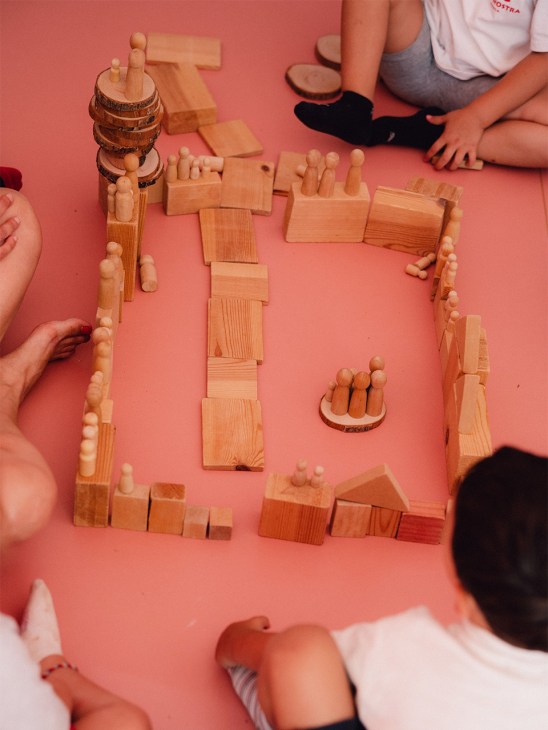
Their philosophy is simple: in early education, the physical environment is often known as the “third teacher”, working alongside parents and educators to shape how a child interacts with the world. By incorporating plenty of natural light, versatile materials and easy-to-use resources, the duo creates well-planned environments that encourage children to work together, investigate and learn.
At Casa Nostra, this begins on the outside. Shaded by acacia trees, the two-storey building is finished in a dusty pink. To Spanish children, the colour is instantly recognisable. “It’s the colour of Frigopie, a popular strawberry-flavoured ice cream,” says Sarquella. Along the roof, a waterspout in the shape of a dragon head hangs from the eaves in a playful nod to Catalan folklore. Legend has it that the Banyoles monster slumbers beneath the lake’s waters.
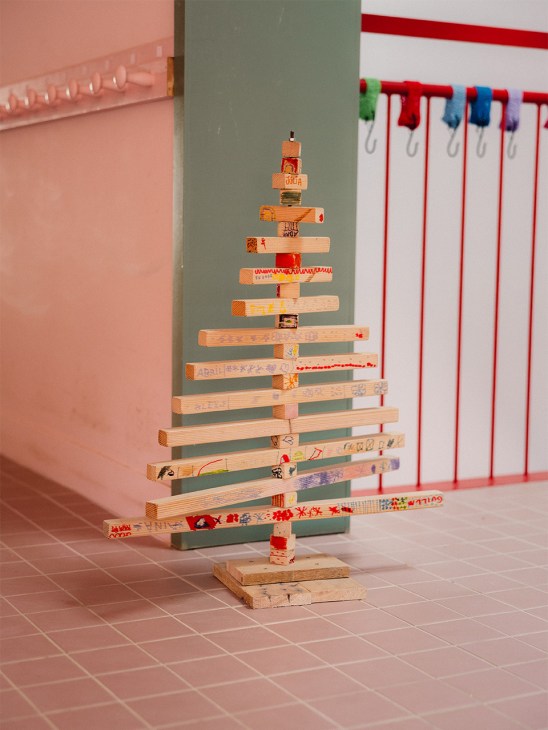
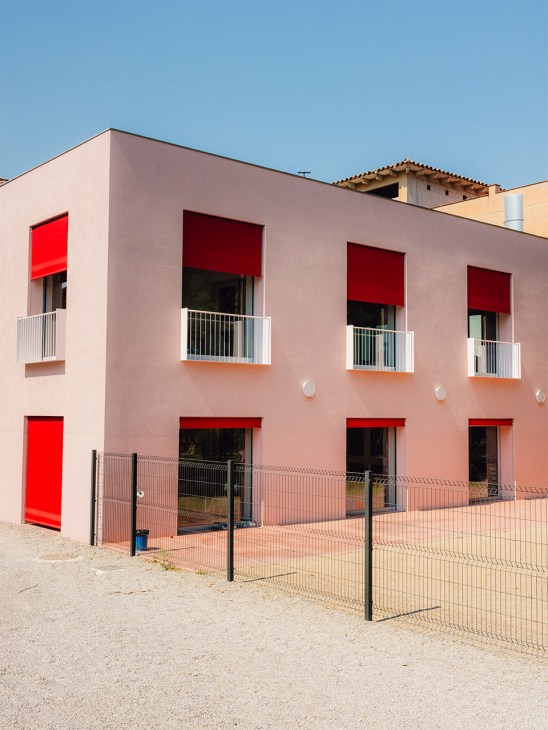
Planning regulations restricted the building’s footprint, which meant that every square metre had to perform multiple duties. More than 90 children are divided by age group: up to three years old on the ground floor and ages three to six above that. Small balconies and a garden make the structure look more like a large house than an educational facility, referencing the school’s name, which translates to “our house”. “It creates a feeling of familiarity,” says Sarquella.
The corridors are wider than average school hallways, designed to double as a library, workshop, art space or somewhere to shelter when a Mediterranean downpour hits. Upstairs, a space clad in matte blue Portuguese porcelain tiles recall the colour of the lake nearby. “We decided to [design] this spare playroom without a roof,” says Sarquella, explaining that it therefore didn’t count toward the strict urban-planning limits. The result is a simple, open-air space that lets the elements in.
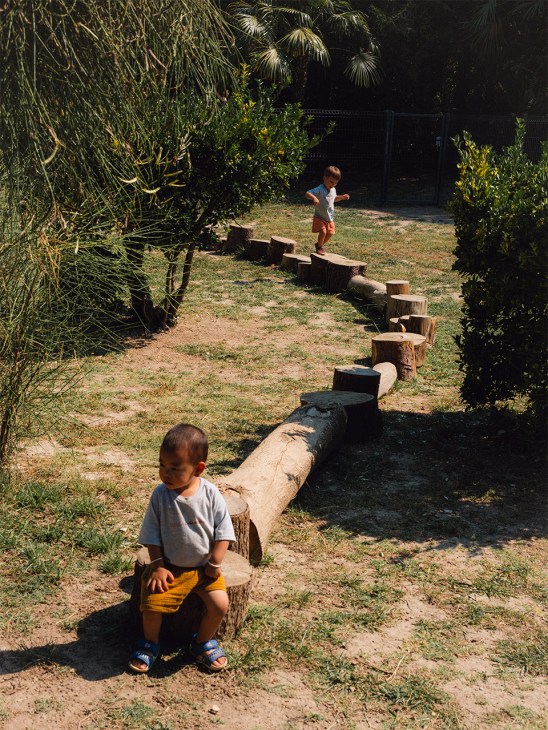
Classrooms are divided by sliding doors. The clear glass on the top half of the partitions allows educators to maintain a visual connection across rooms. “On the bottom part, at a child’s eye level, the glass is replaced by mirrors,” says Sarquella. “For the teachers, it was important that kids could recognise themselves from a young age.” On warmer days, the glass doors retract fully into the walls, dissolving the boundary between the classrooms and the sprawling garden.
By late afternoon, children take the bike path home, past trees and the lake, towards Banyoles. Many will be humming Toni Giménez’s “El Monstre de Banyoles”, a song about the legendary dragon that they learn at kindergarten. The school continues to be a place where memories begin. Like Sarquella, some children might later draw on them for projects of their own.
sarquellatorres.com
Comment: Learning isn’t only about teaching, revising or homework. A well-thought-out learning environment often yields better engagement – and that starts with good design. Carefully considered materials, shapes and colours can deliver much more than mere aesthetics.
Lessons from Margaret Calvert, the designer who helped shape Britain’s road signs
As one half of the duo appointed to redesign the UK’s road signage in the 1950s and 1960s, graphic designer Margaret Calvert oversaw the aesthetics of travel across Britain. Calvert, now 90, was born in South Africa and moved to London in 1950 for school before studying illustration and printmaking at the Chelsea College of Arts. It was here that she was taught by graphic designer Jock Kinneir, with whom she went on to create the typefaces, pictograms and signs that remain ubiquitous across Britain’s roadsides, as well as signage for railways and airports. Calvert also spent 35 years as a tutor at the Royal College of Art, where she served as its head of graphic design until 1991.
After such a long and varied career, some might take a step back to focus on other interests. But when Monocle visits Calvert on a sunny day in her London home, her desk is scattered with freshly drawn sketches in preparation for exhibitions in Tokyo and Kyoto next year. “As a kid, I just loved drawing and I’ve never abandoned my coloured pencils,” says Calvert. Here are some lessons from talking with the design maestro.


A good teacher is one who stays flexible.
“You need to learn to listen and not come across strongly with your opinions or what you’re working on at the moment,” says Calvert. “It’s not about you – it’s about the students.”
Conversely, a good pupil is one who maintains a level of resolution.
It is about listening. You’ve got to show absolute enthusiasm for what you’re doing and not be hesitant in asking questions because they might sound stupid. It’s really just a conversation between two people about an issue that you’re questioning.
Getting out of a creative rut requires help – ideally, a conversation.
The issue is that this kind of block is usually down to a personal problem. I had a student once with this issue and he was just stuck. I always kept my door open and he came to talk to me. I questioned him, we exchanged ideas and I took him through it all very slowly. In the end, he managed to focus and ended up getting a distinction.”
There is plenty of inspiration to be found in everyday moments.
I like to walk around the streets near my home and look down into the basements. I’ll see a cat drinking or a little child playing. And at about 19.00, the light changes and some things will shine and some things will glow. It’s magic, isn’t it?
Art of the game: How softball is bringing New York’s museums together
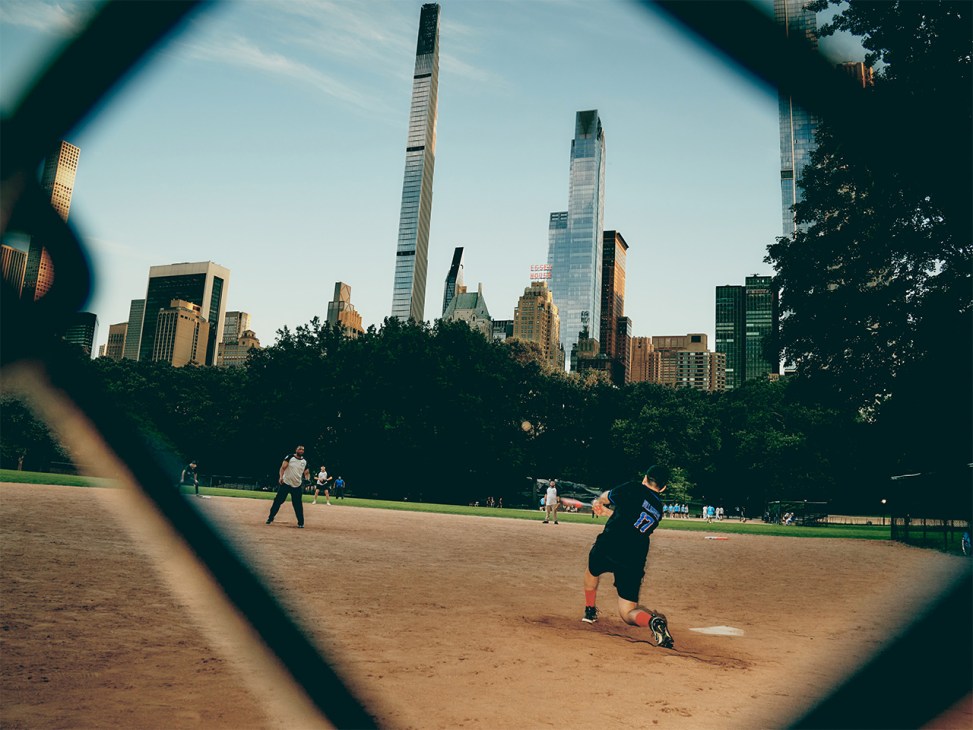
Central Park’s scenic Heckscher Ballfields are filling up with what look like regular amateur softball players. On closer view, the odd team names on their shirts merit a double-take. What are the Mets doing here at 19.00 playing against Solomon’s Sluggers? Or the Blue Chips against a team sporting portraits of Whitney Houston? This is New York’s Arts and Museums League, which is made up of staff from the Metropolitan Museum of Art, the Guggenheim, Gagosian and the Whitney Museum of American Art, respectively.
Art-world softball has a long history: the league has been running on and off since the 1940s. It’s a counterpart to the Broadway Show League, which takes place during the day to accommodate actors’ schedules. “We try to make it work,” says Nicholas Rinehart, a Metropolitan Opera administrator who plays for the Pitch Hitters. “A few weeks ago, one chorus member played half a game and then got in an Uber to go get into costume.”
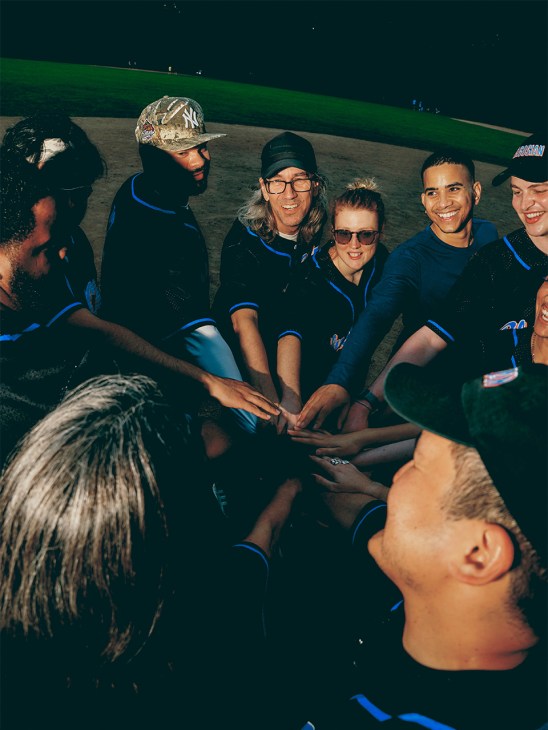
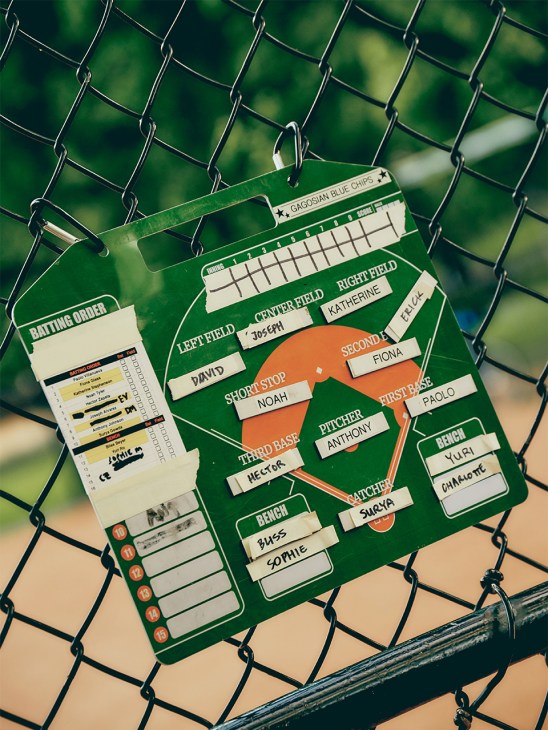
As the reigning champions, the Pitch Hitters’ schedule restraints clearly haven’t held them back since joining the league two years ago. “When we play, our heart is in it,” says Avo Asencio, a retired security guard who picks up shifts in the bag check to remain eligible for the team. It helps that the opera’s stagehands are beefier than the average museum curator.
Institutional identities translate subtly onto the field. Players from Gagosian, one of the world’s leading art galleries, wear personalised jerseys, caps and socks. They play hardball too: in a recent game, a security guard executed a dramatic dive into first base and had to be escorted to hospital with a dislocated shoulder. In contrast, The Highlanders, from the High Line, look slightly scrappier in their grey cotton shirts. “It’s a lot of finding people at their desks and saying, ‘Come on, come play,’” says team captain Jordan Benke, the High Line’s director of art exhibitions. “With new hires, my urge is to test how well they catch.” He has about 100 colleagues from which to draft; the Met has a recruit pool of 2,000.
But whoever bats the best, the real achievement is to level the playing field in a famously highbrow industry. “We have electricians and engineers, chorus members and actors,” says Reinhart. Now, when “Go, Van Gogh!” is chanted from the bleachers, New Yorkers know not to look for a Dutchman. It’s just Moma’s Starry Knights rooting for a home run.
Comment
Team-building exercises don’t have to be consigned to the boardroom. Instead of tedious corporate activities intended to break the ice and encourage workplace collaboration, why not bring staff together to let off some steam the old-fashioned way? It should ensure that no one is left on the sidelines.
If education is only about earning, what happens to learning?
Education should be about the sharing and passing on of knowledge, the pursuit of truth. It’s supposed to teach us how to be civilised and moral. But what was meant to be a resource owned and shared by a community has been slowly fenced off by profit-seeking interests. Today the state largely decides what is taught, by whom and how. It is done so in an increasingly privatised, commodified and financialised manner. What should be a conversation about a public good, something that we all have a right to pursue, has become an industry obsessed with economic output, creating jobs and advancing careers. Far from forging curious minds, it is depleting people’s creative imagination. How did we get here?
Historically, all of the great thinkers about education, such as Jean-Jacques Rousseau, Thomas Jefferson and John Stuart Mill, framed it as a means of liberating the mind and making good citizens. In the UK, that ethos persisted into the 20th century, reiterated in a government report after the First World War, in the Butler Education Act of 1944 and in the Robbins Report of 1963. Successive governments insisted that the purpose of an undergraduate degree was to teach students how to think, not how to make money.

Then, in the 1980s, Margaret Thatcher sought to exclude school subjects that weren’t geared to the labour market and declared that universities should be corporate enterprises run by business-folk, not academics. In 1992 the UK’s colleges for vocational training (“polytechnics”) were converted into universities and universities were reoriented to serve the needs of industry and the economy, rather than intellectual refinement.
Bit by bit, the curricula in all levels of schooling have been revised to cater to the perceived needs of the labour market. The process has become a treadmill, rather than a suitable education for the marathon of life. The tests implemented in those years and more recently are designed to give young people “credentials”, instead of teaching them anything more meaningful. In my book, Human Capital: The Tragedy of the Education Commons, I diagnose a pandemic: “examinitis”.
Education that pays
This educational illness continues untreated and politicians are still playing along. When Rishi Sunak was British prime minister, he said that any degree that didn’t result in increased earnings was a “rip-off”. Another recently deposed PM, Keir Starmer, promised that his party would “modernise the curriculum so that it better prepares students for the world of work”. The latest, Andy Burnham, has gone further and said that secondary schools should change their curricula to suit the needs of local employers. A report prepared by Alan Milburn, a former cabinet member, suggests that courses that don’t yield an economic return should be abandoned. What folly.
In the UK – as in the US and elsewhere – the industry has deserted education in its classic sense, as depicted by Rousseau, Jefferson and Mill. The humanities, arts, philosophy and history are fading, their demise rationalised on the grounds that they don’t yield high monetary returns. Young people receive more years of schooling than any generation before them but are emerging with a shallower grasp of history, literature, civics or culture. Deep reading has collapsed.
Meanwhile, teachers and academics are demoralised and in meltdown. There is a persistent shortage of teachers, not because not enough can be recruited but because droves quit citing low pay, unpleasant work conditions and an inability to pursue their vocation. Many schools now rely on temporary staff supplied for short-term posts from agencies, paid a fraction of the salary of regular teachers. They are often unsure where they will be teaching next or even what they will be teaching. This destroys the ethos of schools as integrated communities – try mustering school spirit and pride in such circumstances.
The situation is even worse in universities, which are required to compete for students and the revenue they bring. More academics are on short-term contracts and more are being culled. In 2024 alone, at least 4,000 academics in the humanities, the social sciences and the arts have been made redundant.
Foreign finance is feasting on what’s left. A Chinese company recently took over England’s oldest school, Thetford, set up in 631, whose most famous pupil was 18th-century philosopher Thomas Paine. After asset stripping, it was declared bankrupt in early 2026, then closed. Having been part of the fabric of our society for hundreds of years, it was snuffed out by someone looking at a balance sheet in Hong Kong.
Outsourcing universities
Another symptom of decay is that universities are outsourcing their teaching. Today many students are gaining qualifications from seemingly reputable institutions without ever setting foot inside them. Universities are contracting out to private “franchised” providers, paying them about three-quarters of the tuition fee and pocketing the balance for rubber-stamping degrees. These providers are driven by profit and that means what one CEO calls “no frills” courses. He told the Financial Times that he had no qualms with his business model being compared with budget airlines and discount supermarkets. This is a denial of what universities were always meant to be – a community of scholars learning from each other.
For all this tumult, it’s not too late to rescue and revive the educational commons. Unchecked, the decay will be accelerated by AI, which is heightening the threat of scary-sounding ideas, from “knowledge collapse” to “cognitive surrender”.
But studying and working in education has given me optimism about our capacity to recover. However, it will require a concerted transformational response, which is why the new government should set up an independent national commission for the revival of lifelong learning.
Education and the ideas that underpin it need to be retaught. Rediscovering Rousseau, Jefferson or Mill might not advance the economic situation on a ledger for private-equity investors – but that is the point. Some things – such as thinking for ourselves – are rather more important than profits.
About the writer: Guy Standing’s latest book, Human Capital: The Tragedy of the Education Commons, is published by Pelican Books. He is a professorial research associate at Soas University of London.
As AI reshapes the job market, a new trove of apprenticeships is in demand
Apprenticeships are back on the agenda. In June, Josh Shapiro, the governor of Pennsylvania, signed an agreement with Germany’s US ambassador to learn from the country’s approach to bolstering vocational training. Meanwhile, the UK’s new prime minister, Andy Burnham, is said to be seeking similar reforms and the Chinese government has urged young people to pursue blue-collar careers to help overturn a centuries-old stigma against vocational training in favour of academia.
This isn’t an ideological shift. There’s a pressing need to fill labour shortages. The skills gap in the US will leave as many as two million manufacturing jobs unfilled by the early 2030s. Add to this the threat that artificial intelligence represents to the job market and you’re left with a peculiar situation: graduates with no jobs, while manufacturing and trade positions are vacant. There’s also the matter of job satisfaction. There’s a feel-good factor to traditional apprenticeships: in the UK, research has shown that young adults on such training schemes have the highest levels of happiness and life satisfaction in their age bracket.
To find out what’s motivating the next generation, Monocle meets some of the apprentices embarking on these schemes – from trainees in Tokyo’s cobbling district to aspirant plumbers in Zürich – as well as the masters guiding their way. We find that learning on the job offers not just fresh skills but also enormous job satisfaction.
Teppei Yoshimi
Shoemaking
Tokyo


After Kobe-born Kenta Miyamoto graduated from secondary school and completed a course at a local shoemaking school, there was only one place where he wanted to study next: Rendo in Tokyo’s Asakusa district. “I have always enjoyed making things,” says Miyamoto. “It feels natural to create something with your hands.” In school, I learnt about Rendo’s technique. It’s the most renowned leather shoemaker in Tokyo and I wanted to work there.
When Monocle visits the shoe brand’s shop, we find Miyamoto working under the instruction of Rendo’s founder, renowned designer Teppei Yoshimi. The shoemaking master has himself been on a long craftsmanship journey – he began as a pattern maker, before starting to repair leather shoes in his shop and then creating his own Oxfords, loafers, monk straps and Tyrolean suede shoes. Pairing classic British silhouettes with Japanese tailoring methods, he earned an enviable reputation for his skilful patternmaking. It was this that inspired Miyamoto to seek out a position under Yoshimi. “I have learnt a lot from him about pattern design,” says the student. “One day I want to develop my own style too, also learning from Europe’s traditional shoemaking culture.”
Despite Yoshimi’s success and Miyamoto’s enthusiasm, the outlook for Japan’s wider craft sector isn’t particularly rosy. In step with elsewhere in the world, Japan’s shoemaking schools have fallen in number. In 2000, Asakusa, Tokyo’s traditional shoemaking centre, had three schools with 70 students graduating a year. Today just one remains, with fewer than 20 students.
In the world of luxury fashion, however, provenance and skilled craftsmanship remain highly sought after. Japan’s shokunin (artisan) culture is defined by a patient commitment to perfection, making the country’s craft products desirable to high-end brands seeking to differentiate their products from those of their competitors.
This has emboldened Miyamoto to broaden his career aspirations. He is currently putting the finishing touches on his application to train under a European shoemaker. Though that means Yoshimi will lose a helping hand in the workshop, the master is supportive of his young apprentice’s ambitions. “He needs to get out there and learn,” he says.
Reto Stähli
Plumbing
Zürich


“In 2025 we had more apprenticeship applications than we could accommodate,” says Reto Stähli, the co-owner and managing director of Swiss plumbing and heating service provider Stähli Haustechnik. Based just outside Zürich, Stähli’s apprentices learn everything from how to provide maintenance services to how new-build housing projects come together.
Interest in his firm remains consistent. “Last year we had more than 100 applications,” he says. “It was quite remarkable. I advertised on two or three job platforms again and the response was incredible.”
When Monocle meets Stähli, he is training one of his recruits, Hakim Beloukarif, in the intricacies of kitchen piping. Beloukarif is among the 70 per cent of teenage Swiss school leavers to opt for an apprenticeship following compulsory education – something that sets the country apart from other wealthy nations. There are more than 200,000 apprentices in training in Switzerland and about a third of all companies here offer training programmes of this kind.
Every year, Stähli’s team welcomes an average of four new apprentices. “Some professions are disappearing – in large companies such as banks and insurance providers, they have been using AI telephone systems for a long time,” says Stähli. “There are fewer service counters too. People will have to reorient themselves somehow.” Stähli believes that there will long continue to be a healthy appetite among the younger generation for experience at his type of business. “There are many people exploring the prospect of a career in the construction industry. This kind of labour still has a future.”
In countries where apprenticeships aren’t as widespread, employers often fear making financial losses by taking on new starters. Stähli has a pragmatic approach to the issue. “We have to train young people,” he says. “They are our future.”
Tim Phillips
Boatmaking
Sorrento, Australia


A 90-minute drive from Melbourne, boatbuilding business the Wooden Boatshop is an epicentre for apprenticeships. “We are flooded with requests from people who want to work here,” says its director, Tim Phillips. A shipwright who was himself once an apprentice, Phillips set up the company in the Australian seaside resort of Sorrento more than 40 years ago. Since then, trainees have travelled from far and wide to study with him, including those from the US, France and the UK. “We build everything by hand, from the wood for the shell to the sails and upholstery.”
With a rise in digital work, craft-led skills now have an appeal that goes beyond mere job security. At the age of 40, Andrea Rothwell is halfway into her four-year apprenticeship in sailmaking and upholstery. “I wanted a career change,” she says. “I had an e-commerce craft-supply business and a small shop. I grew up around boats and sailing most of my life, so the Wooden Boatshop was on my radar.” Others echo her enthusiasm, including Tim’s son, Will Phillips, who is also part of the business. “It’s a creative outlet,” he says. “You think about complexity and see things progressing – with everyone contributing – and in the end, you have a boat.”
Tim says that the latest technology has a place in his business but not in the workshop itself. “We use AI in the office, because it helps us with admin and daily tasks,” he says. “But it can’t be used for work on the floor.” Tim walks Monocle out onto the latest addition to his facilities: a 13-metre-tall boat storage shed by local architecture practice March Studio. A façade consisting of hundreds of weathered-steel rhombuses tinkles in the wind.
The Wooden Boatshop’s influence extends beyond its buildings. “We are the largest business of our kind in Victoria,” says Tim. A handful of smaller businesses have started up around the state in recent years, some run by his former apprentices or workers. “We trained them,” he adds, with a smile.
Lisbon’s Beato and Marvila neighbourhoods are finding new life as cultural hubs
On a warm evening in east Lisbon’s Beato neighbourhood, the terrace at Casa Capitão fills long before the night’s programme begins. The city’s creatives brush past each other in the former military-supply complex. Today visitors have come to eat octopus carcaça sandwiches, see an exhibition or take part in the book club that spills onto the terrace. Others are here for a performance by Brazilian singer Julia Mestre, after which the basement dancefloor will welcome a noticeably younger audience.
There’s no sign of any of this activity from the street. Architect Miguel Marcelino, who revitalised the building before it reopened last year, gave it no single main entrance. Instead, navigating from room to room requires moving between stairs and courtyards, always in the open air. Inside, the rooms are used for all kinds of functions. In the venue’s first year, it has hosted Australian writer McKenzie Wark, American poet and musician Saul Williams and Portuguese musicians Capicua, B Fachada and Linda Martini.
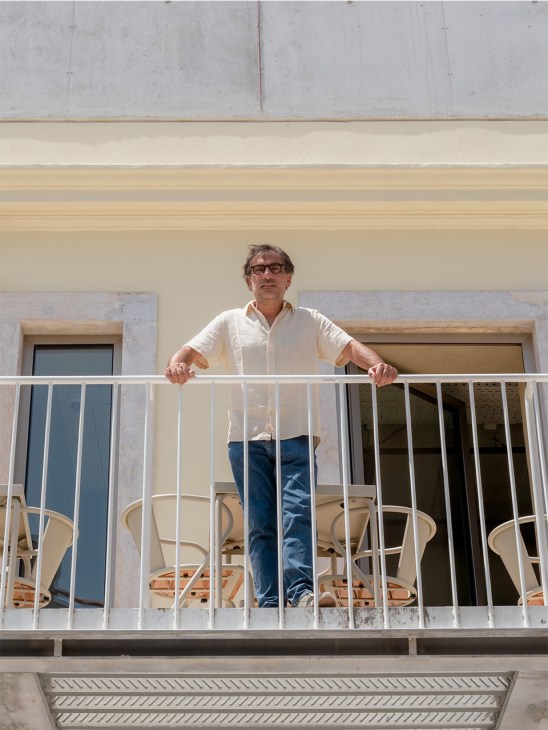
Casa Capitão is the latest project from Cultural Trend Lisbon (CTL), the team behind acclaimed (and sadly now closed) nightclub Musicbox. The new space has given CTL a larger home after almost two decades in Lisbon’s Cais do Sodré district. With tourism and transient events reshaping that neighbourhood, the organisation wanted somewhere with a different rhythm. “Cities need places of regular encounter, not just festivals,” says CTL’s co-founder Gonçalo Riscado. “People come because of the programme here. Tourism hasn’t reached us yet.”
CTL’s move mirrors a wider shift. Adjacent neighbourhoods Beato and Marvila were once Lisbon’s industrial heart, home to soap, match and rubber factories that were shut down during the deindustrialisation of the riverside in the late 20th century. The area was abandoned for decades but it has recently been undergoing change faster than almost anywhere else in the city.
A short walk from Casa Capitão, there are new residents on the quiet Rua Capitão Leitão. Neighbours rather than competitors, the galleries here – including Francisco Fino and Bruno Múrias – co-ordinate exhibition openings, encouraging visitors to move from one spot to the next.
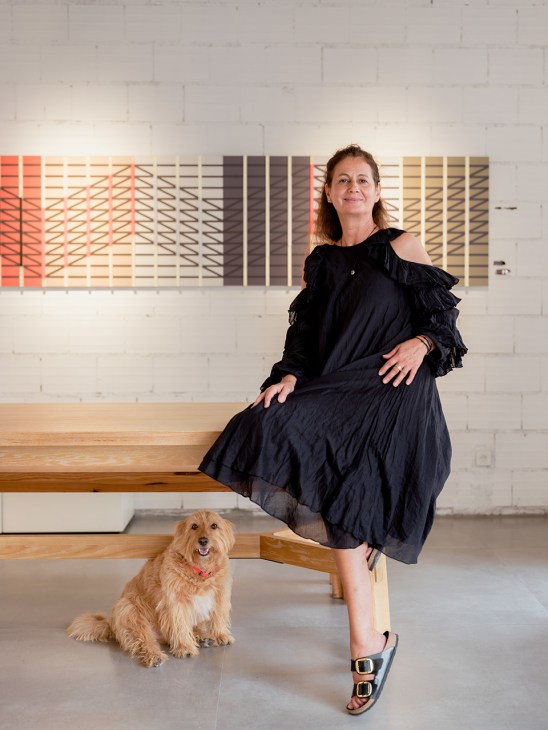
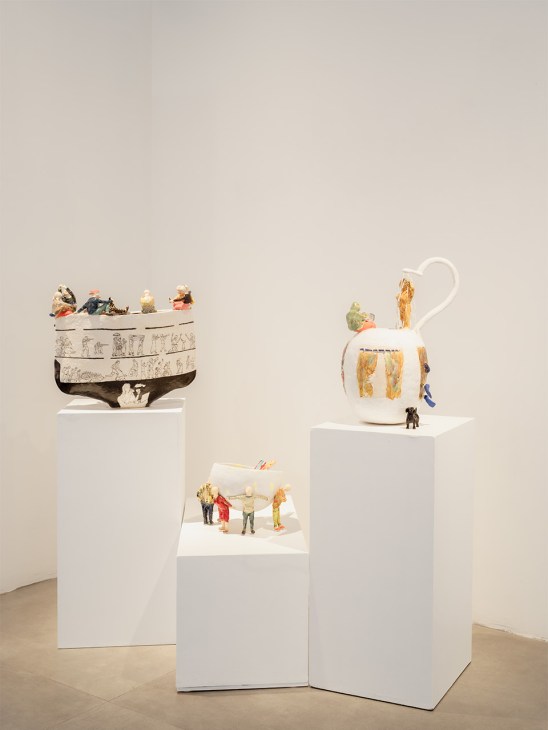
Among the arrivals is Módulo Twist, which was opened in 2024 by visual artist Luis Carballo and curator Maria Assunção Albuquerque. The couple were collectors before entering the industry. “I’m still an apprentice gallerist,” says Albuquerque, with a laugh. The gallery name nods to Lisbon’s pioneering, historic Galeria Módulo; the “twist” reflects how the gallery also houses Carballo’s own atelier, as well as the welcoming approach with which the duo host visitors.
Rather than chasing established names, Albuquerque backs the artists she believes in, among them Portuguese ceramicist Sandra Lori and Spanish sculptor Iván Prieto. In September, the gallery hosted an exhibition of work by Galician Tatiana Medal, part of a programme that the pair see as a bridge between Galicia and Portugal.
As well as the presence of Carballo’s studio inside the space, the gallery’s modular walls are adapted for every new show. Regulars, says Albuquerque, are always intrigued to find the room refreshed. The building wears its history: a mansard roof holds apartments at the top, while the ground floor now belongs to both Galeria Módulo Twist and another painter’s atelier, Coletivo Amarelo.
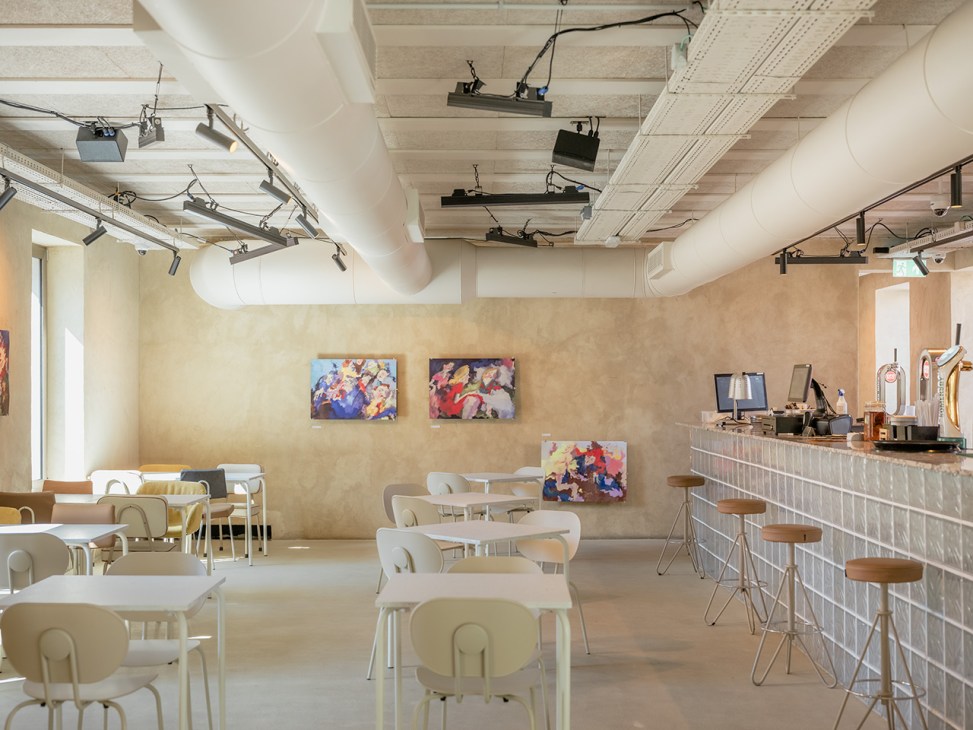
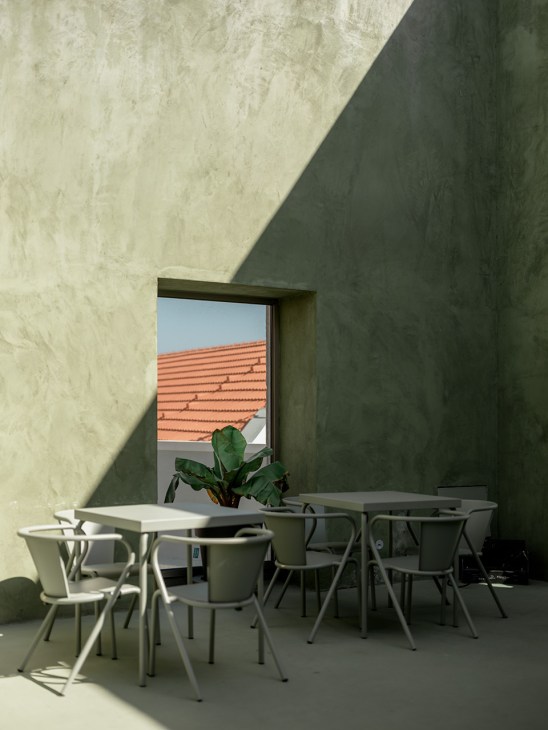
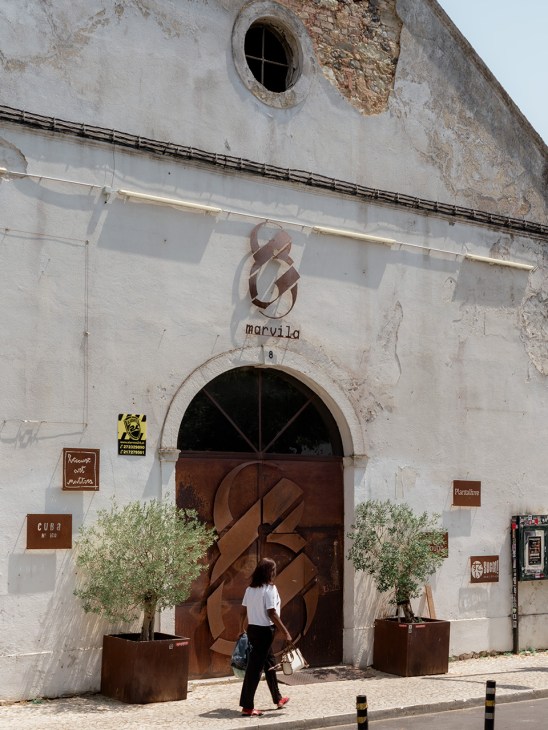
Continuing east, Rua do Açúcar is named after the sugar factory that once stood here. The buzzy street is the backbone of Marvila’s revival. The former warehouse, which belonged to Portuguese film director António da Cunha Telles, now houses the Paulo Claro Theatre, while the Portuguese Contemporary Ballet Company’s HQ is next door. At the end of the street, on Praça David Leandro da Silva, wine warehouses have been reborn as 8 Marvila, a complex of shops, galleries and restaurants.
Nearby is Underdogs, its grey, concrete exterior punctuated by a small poster that hints at what’s inside. The gallery was founded by street artist Vhils and Pauline Foessel. They set up shop here in 2013, when the neighbourhood was still lined with empty warehouses, and helped to establish Marvila as a destination for contemporary art.


While urban art remains at the core of Underdogs, its programme has steadily expanded to include modern artists from Portugal and abroad. This month the gallery is taking a different approach. Instead of unveiling a finished exhibition, Portuguese artist Ana Malta will transform the space into a working studio. Visitors will be invited behind the scenes as new paintings gradually take shape. “People usually only see the final result,” says Sara Eugénio, the director of Underdogs. “Here they will be able to witness the creative process.”
Away from the hubbub of Marvila’s main streets, the yellow shipping-container-turned-waterfront kiosk Lamiré overlooks the Tagus. Since 2023, it has served the artists, cyclists and residents who gather here on the riverbank with cold beers and poke bowls. The three founders – Diogo Roque, Eduardo Moita and João Pintão – are friends who met while surfing. “The kiosks by the river are mostly for tourists but there was nowhere really made for locals,” says Roque.
Behind Lamiré is Prata Riverside Village, a development by Italian architect Renzo Piano that is turning the former Braço de Prata munitions factory into housing. Its curved ceramic façades evoke the sails of the ships that once crossed this river. The last of the residences should be completed later this year. The transformation of this area, it seems, is not finished quite yet.
Address book: where to visit in Beato and Marvila
From former wine warehouses to craft breweries and modern galleries, this stretch of Lisbon has become one of the city’s most creatively dense corridors. Here’s our pick of the attractions that are worth the trip east.
Culture
8 Marvila
This former wine warehouse is now a 22,000 sq m cultural hub with shops, galleries, restaurants and padel courts.
Praça David Leandro da Silva, 8
Arco Marvila
Founded in 1973, this independent art school offers courses in everything from drawing and ceramics to film and jewellery.
Antigo Mercado de Xabregas, Rua Gualdim Pais
Coletivo Amarelo
A gallery and curatorial platform with a focus on emerging Brazilian and Portuguese artists.
Rua Capitão Leitão, 74
Eterno
This sister gallery of Underdogs, run by the same group, explores the boundaries between physical and digital art.
Rua Maria José Nogueira Pinto, 12
Galeria Bruno Múrias
This gallery represents 12 Portuguese and international artists across painting, sculpture, film and performance.
Rua Capitão Leitão, 10-16
Galeria Francisco Fino
A former oil and wine factory that has been turned into a modern art space.
Rua Capitão Leitão, 76
Little Chelsea
Part photography gallery, part vinyl bar and part vintage boutique, this space is a love letter to New York’s celebrated Chelsea Hotel and the rebellious spirit of the city during the 1970s.
Rua Capitão Leitão, 40
Teatro Paulo Claro
The new home of theatre company Artistas Unidos, which is named in honour of actor Paulo Claro.
Rua do Açúcar, 37
Drink
Dois Corvos
The first brewery to settle in Marvila is still pouring from 17 taps of house beer in its original taproom.
Rua Capitão Leitão, 94
Fermentage
A brewery that combines traditional methods and experimental recipes. Also on the menu are pizza, arcade nights and live music.
Rua Capitão Leitão, 1B
Musa
Craft brewery and taproom with a music-inspired beer list and a sunny outdoor terrace.
Rua do Vale Formoso, 9
Eat
Clube de Vídeo
An Italian tasca with vintage décor and a pasta menu that’s updated daily.
Rua do Grilo, 98
Shop and do
Cantinho do Vintage
An outpost of Lisbon’s favourite vintage warehouse, with mid-century Nordic furniture, old signage and curios brought in from across Europe.
Praça David Leandro da Silva, 8
Studio Marvila
This is a ceramics studio and natural wine bar all in one: throw pots on the wheel, then stay for a glass of biodynamic wine.
studiomarvila.com
Rua Capitão Leitão, 64
Lisbon’s Gulbenkian Museum reopens after renovation, with its original vision restored
Xavier Salomon landed in Lisbon nine months ago to become the director of the Calouste Gulbenkian Museum but the dark-oak bookshelves in his office are still empty. “I keep joking that I’ve been living out of boxes because the focus has been entirely on the museum,” he says with a smile. Rome-born Salomon arrived in the Portuguese capital from the Frick Collection in New York, tasked with overseeing a major renovation. “It’s a huge honour and responsibility to reshape a museum for the next 50 years,” says Salomon. “There isn’t going to be another redo of the Gulbenkian anytime soon so you have to think carefully about everything that you do. It’s part of a legacy.”
Opened in 1969, the Calouste Gulbenkian Museum is a modernist masterpiece in Avenidas Novas, just north of the city centre, set within capacious landscaped gardens, woodland and ponds. The museum houses the private collection of the namesake Constantinople-born Armenian businessman, collector and philanthropist who made his fortune brokering deals between European interests and oil companies in the Middle East. In almost every deal he secured himself a commission, which earned him the nickname “Mr Five Per Cent”.
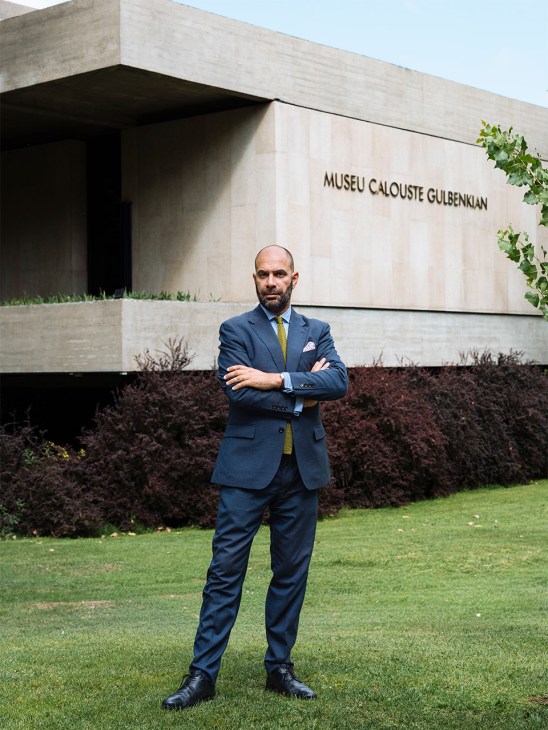
Gulbenkian was thought to have been the richest man in the world when he died in 1955. In his will, he stated that his fortune should be used to establish a foundation in Lisbon (where he lived in his final years) to improve its citizens’ quality of life via art, education, science and charitable work. Today, the campus includes the foundation’s HQ, with a 1,200-seater auditorium that is home to the Gulbenkian orchestra and choir. There’s also an art library, modern-art centre and the museum itself, ensconced by lush greenery and water features.
When Monocle visits, the museum’s team is completing final touches before reopening the doors after a 16-month renovation. It’s a sunny morning and a queue of a few dozen people forms outside, eager to explore the revamped institution. “This project was all about restoring the original vision for the museum, while upgrading the technical infrastructure – lighting, ventilation, security and the displays,” says Teresa Nunes da Ponte, one of the architects who led the renovation. “Over the years, the museum had several interventions and we wanted to strip it back to how it was intended; to let the materials speak for themselves and treat the architecture of the building as an art piece in itself.”
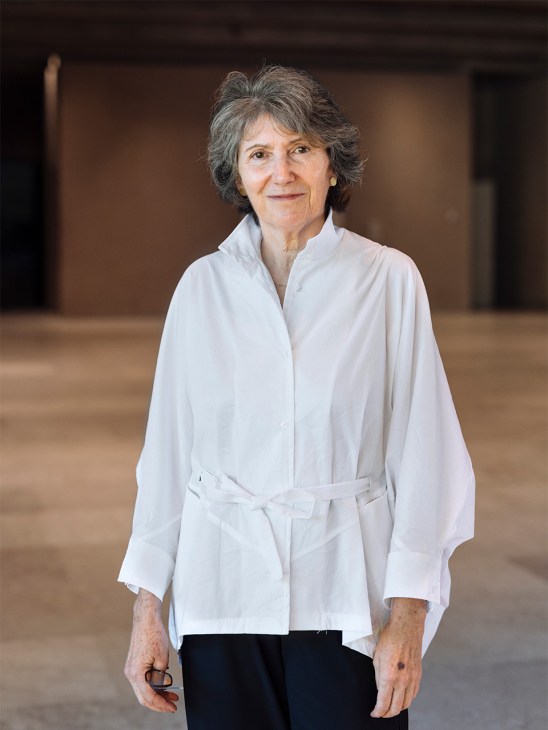
A key moment came when the team found photographs from the 1970s of the museum in its original state. With no paint on the walls, the building’s materials – warm wood, cold stone, bronze and glass – shine through. “There are no hard corners,” says Nunes da Ponte. “As you move through the exhibition, you can peek at what’s coming next. Now, it’s not just about the physical space; we are almost restoring the museum’s original atmosphere and feel.”
The renovation was already halfway through when Salomon joined the museum so any input that he had needed to be added quickly. He had two clear propositions: the first was to keep the windows as unobstructed as possible to maintain a relationship between the interiors and the gardens; the second was to bring back the European galleries’ green carpeting. The latter choice wasn’t merely aesthetic but also to help provide a different feel as visitors crossed between rooms and to reference the vibrant tones of the garden. “There’s this idea that carpets are old-fashioned and ugly but as soon as I started to see it laid down, I knew that it was right,” says Salomon.


The museum reopened to the public on the same day that the Calouste Gulbenkian Foundation marked its 70th anniversary. “When it was decided that we should do a renovation, it was important that it was done soberly and elegantly,” says the foundation’s president, António M Feijó. The literature and humanities scholar believes that the institution’s discreet nature is its greatest strength. “I always like to say that our museum is a ‘cold’ institution – not a ‘hot’ one – meaning that we should let the objects shine by themselves,” he says.
The museum is home to more than 6,000 objects, with 1,000 making up the permanent collection. The pieces span Egyptian antiquities, Islamic art and the work of European old masters; Chinese porcelain, sculpture, tapestries and jewellery. “The collection is finite and we can’t add anything to it because it’s based on what the founder collected,” says Feijó. “He personally chose every piece. It all had to be in mint condition and he never failed in his appraisal of items. His taste was impeccable.”
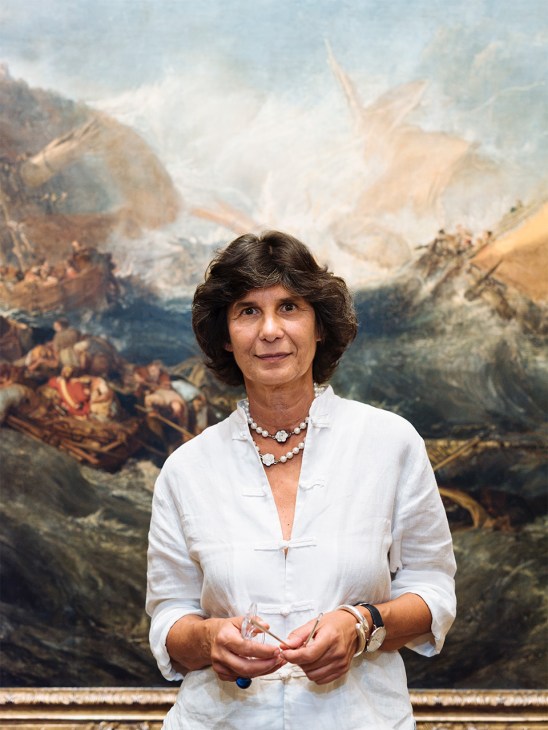
One of the biggest transformations comes at the end of the museum, when you turn into the René Lalique Room, which houses the largest collection by the jeweller outside of his native France. The cabinets are curved in a nod to the art nouveau and art deco turns of Lalique’s work. “We have on display his best piece of work, the ‘Dragonfly’ corsage ornament,” says the museum’s head of collections and senior curator, Luísa Sampaio. She is the longest-serving member of staff, having started as a receptionist in 1989. After seeing many other changes made in the past, she was apprehensive about the renovation but her doubts dissipated once work began. “There’s an enormous cohesion between such diverse areas and cultures,” she says. “In all of them, we have recovered that original ideal of the 1969 museum. I think that the public won’t be disappointed.”
As staff line up to welcome the first visitors, Salomon stands by the door. In lieu of a speech, he offers a handshake and a smile to everyone as they enter. “As a director, I’m just shepherding the place and making sure that everything works,” he says. “The public are the real owners.”
Celebrations of the Calouste Gulbenkian Foundation’s 70th anniversary continue through 2026.
gulbenkian.pt
Three works to see at the Gulbenkian
Planning a visit to the Calouste Gulbenkian Museum? Xavier Salomon highlights the pieces not to miss.
1.
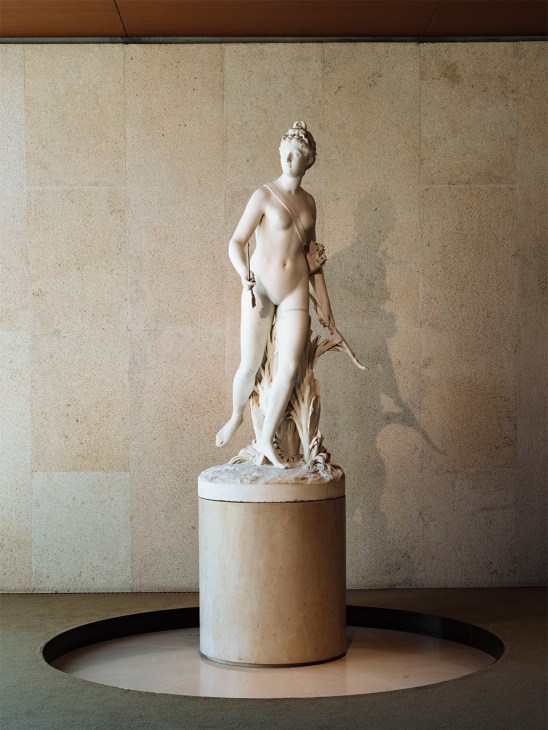
‘Diana’ by Jean-Antoine Houdon
Paris, 1780
“This is a masterpiece by the French sculptor, a statue of the goddess Diana. It’s as if she has just come in from the gardens. It’s the only single object that has a room by itself and that area captures the entire essence of the museum because you have the work of art, the architecture and nature through the window.”
2.
Mosque lamps
Egypt, Mamluk period, after 1321
“The glass lamps are one of the areas of absolute excellence in the museum – we have this group of about 10 mosque lamps from the Mamluk period. It’s the most important collection in the world of these objects in terms of quantity, quality and historic importance. When you see an entire room of them, with the light shining through the glass, it’s incredibly overwhelming.”
3.
‘The Ship of Fortune’ tapestry, from ‘Children Playing’ by Giulio Romano and Nicolas Karcher
Mantua, 1540-1545
“This is a museum where decorative arts have huge importance. These tapestries were incredibly intricate to make. They are between 500 and 600 years old, in impeccable condition and incredible to look at. They are among the items that set this museum apart.”
Join Monocle at The Calouste Gulbenkian Foundation
Monocle’s Quality of Life Conference will be held at The Calouste Gulbenkian Foundation from 3 – 5 September.
During our annual three-day conference, we look at what makes great cities, how we can create inspiring businesses and discover new ideas and benchmarks for personal success.
One of the reasons the conference has flourished is that it brings together an extraordinary mix of people from around the world. The conversations don’t stop when a panel ends; they continue over lunches, dinners and throughout the host city, where delegates, speakers and Monocle’s editors spend time together.
Learn more about the Quality of Life Conference and why Lisbon is an ideal backdrop here.