Tread carefully: Why tyre trouble in the French countryside doesn’t mean the wheels have to come off
There’s an unspoken agreement on our epic Christmas drives from London to Palma. Wait, what am I on about, it’s very spoken. The other half makes it clear that he wants to do most of the driving and for me to manage the snacks, the dog and the music. He claims that it’s because he’s a bad passenger. What he means is that my driving strikes the fear of God into him: lane drift, looking at the passing landscape, not knowing what any of the buttons do. He’s harsh. But just before Christmas, as we came to the final stretch of day one, he admitted to needing a break and suggested that I do the non-motorway section to get us to our hotel in the town of Montluçon.
The town has, it transpires, used many road-design devices to slow down its urban traffic, including a system of chicanes featuring high-kerbed traffic islands. I know this because I hit one. With ambition. The car swerved but somehow no harsh words were said. A night at the Château Saint-Jean hotel was enjoyed. The following morning, a valet returned our car and we were off, with me not even pretending that I was getting anywhere near the steering wheel.
We pulled on to the motorway. “There’s a funny sound; can you hear it?” asked owl ears. I couldn’t but I needed to restock the snacks (it’s vital work) and the dog said that she wanted a croissant, so we pulled into the next service station and I did a car check. Oh dear. There was a blister on the tyre that had kissed the kerb. Don’t imagine a diddy thing on your toe, think plague-like bulla, a gargantuan pustule the size of an on-heat baboon’s radiant bottom.
We did some Googling (“your tyre might blow and you might die”). There was a call to our expensive breakdown cover provider (“bad luck, you must phone the police if you are on a French motorway. Bye.”). There was a family debate. It was a Sunday, just before Christmas but we were not far from the city of Clermont-Ferrand, home of Michelin, so surely we could drive slowly and find a tyre shop? It seemed that there was one which, via Whatsapp, we ascertained would be able to replace our warty ring of rubber. We limped along, lazy hedgehogs undertaking us on the hard shoulder.
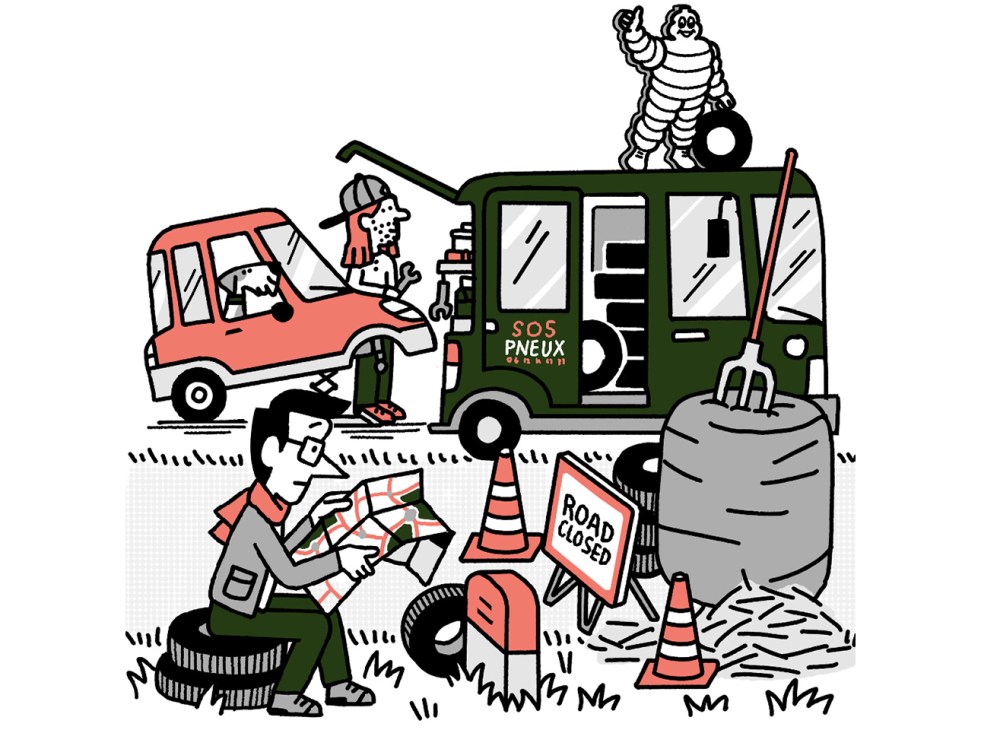
The tyre “centre”, however, was a bit of a surprise. It was a van, with broken wing mirrors drooping like dislocated limbs, parked on a road in an industrial part of town. In the back of the vehicle was squeezed a contraption capable of removing tyres from their hubs, another for balancing wheels. Oh, and the tyre that we would be purchasing was second-hand. We had no choice. Some two-and-a-half hours later (there were others in the same predicament ahead of us in the queue), we were on our way again. Our old tyre added to a pile by the repair truck.
Now we had a hard deadline for completing this second day of driving – a place on a ferry departing from Barcelona that evening. But even with the lost time, we would still be at the port two hours before it departed. Except that, after a few kilometres on the motorway, we hit a diversion. All the traffic was being siphoned off to a road that, judging by the satnav, would take us cross country – and for some distance. Back to Google, “Protesting French farmers are blocking the highway.”
Over the next two hours, we eased along narrow tracks, drove convoy style through forests and saw villages that I dearly hope never to see again. Every time that it looked like we might be about to rejoin the highway, the slipway was barricaded by bags of manure and piles of old tyres (I have a suspicion of who might have been supplying the farmers). Though not a single person was defending the barriers – there wasn’t a rustic rebel bearing a muscular arm and a pitchfork in sight.
Finally, there was a tyre-free motorway access point but by now the satnav said that we would arrive in Barcelona port only 35 minutes before the ship left and our ticket said that you needed to be there 90 minutes ahead of schedule. “We can do this,” said the other half bravely, before adding, “but no coffee stops, no loo breaks”. I looked at the dog. We crossed our legs.
And so, we drove. We wove. We began to make up time. We crossed the border into Spain. Signs for the port appeared. The dog’s and my legs were clenched like nut crackers. And, suddenly, there we were on a winter night in Barcelona joining the back of a line of cars snaking into the belly of a ferry. In the cabin we opened a bottle of champagne.
To read more columns by Andrew Tuck, click here.