
Not everything has to be perfect – seeing the hand behind the artistry is the biggest luxury of all
Since the first issue of Monocle we’ve been arguing that nations need to hold on to their manufacturing skills. We’ve promoted the value of craft and preached that learning a trade is as valuable as studying for an academic degree. As we edge ever closer to our 20th anniversary, these ideas seem more pertinent than ever.
In that very first outing of Monocle, the March issue of 2007, our Americas bureau chief Ann Marie Gardner headed to the town of Berlin, Wisconsin, to visit shoemaker Russell Moccasin, a company that was thriving while other footwear producers across the US shuttered because of outsourcing to China. Russell Moccasin, which had become a hit in Japan, also remained strong by embracing its niche and not competing on price.
If you want to know how the company is faring, visit its website. The first thing that flashes up is a warning that, due to the high demand, it has paused orders on its Premier Build boots. For more than 125 years this company has stayed relevant by sticking to its guns, as it says on its site, “from our small town of Berlin, Wisconsin, we serve new generations of Russell customers, each lacing up to make their own mark.” How do we bottle more of this spirit? Because we are going to need it.
In recent weeks I’ve had conversations with friends and contacts in which they have aired their growing frustrations with the deadening impact of AI on their work. It’s not that their companies are about to let them go, it’s just that everything they do has become that little bit duller. One friend tells me that they are leaving their banking job to enrol in a gardening course. An amazing woman in property informs me that she’s taking time out to study fine art. Another in finance that she must prove to her managers that she is using AI tools every day or face being reprimanded. She too says that all she wants to do is use her hands – baking, gardening, basket-making, she’s game for it all.
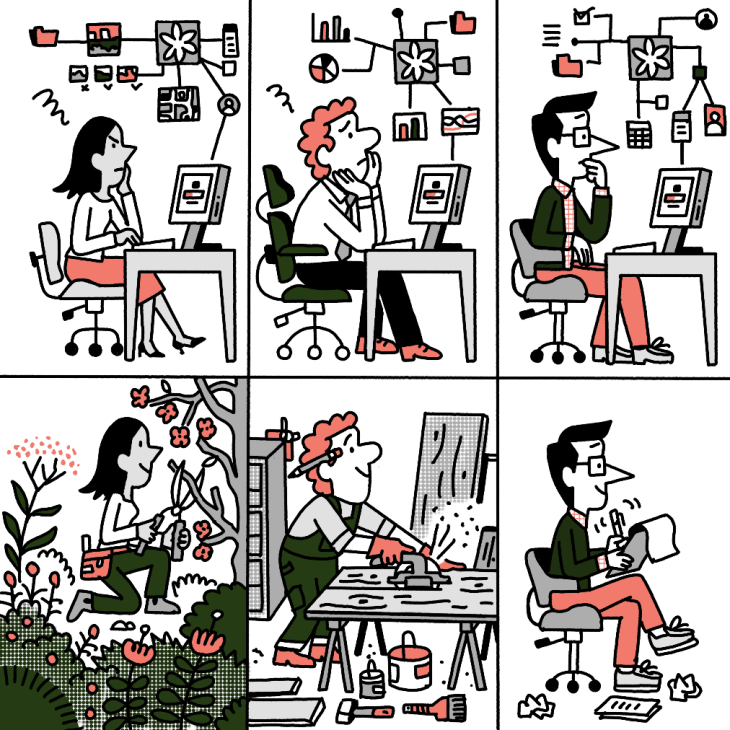
Let’s be clear: AI is here to stay. It will change our lives in many instances – say, medical research – for the better. But unchecked, its adoption never questioned, it threatens to dull our days and dim our minds. At Monocle, as at most publications, we have strict rules about how AI can be used. If someone is using AI when developing code for the website, please be my guest, but it must never be used to write or polish our journalism. I am sure that there will be some tests ahead as we defend this position.
Another editor, holding the same line, tells me about some of her writers who are suddenly filing impeccably polished copy. So why doesn’t she just run it? “As soon as you read it you know that something is off – it’s plastic,” she says. It’s writing with botox and fillers – wrinkle-free and not real.
And here’s the other thing that AI’s march seems to be counterintuitively encouraging us to value: the joy of the imperfect. When everything becomes uniform, the subtle variations that come from somebody using scissors to cut leather, to bake individual batches of biscuits or even make a magazine, are surely more important than ever.
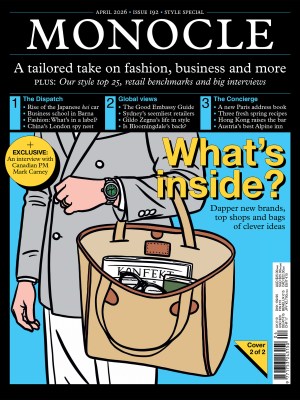
This is not the call of a Luddite or about being rinky-dink. Far from it. Just open our latest issue and you’ll see the watchmakers who make Switzerland tick and brands such as Chanel and Hermès that have created powerful businesses from believing in craft, in the human eye. But today, just as when we first reported on Russell Moccasin, we need to go against the grain, make things, use our hands and say no to the flattening of skills and experience.
To read more columns by Andrew Tuck, click here.
Further reading:
– AI hasn’t created a new problem for publishing – it has simply clarified an old one
– As AI continues to serve up slop, legacy media is back on the menu