‘Don’t use us to attack your neighbours’: The chairman of Euronews on the role of the media during global conflict
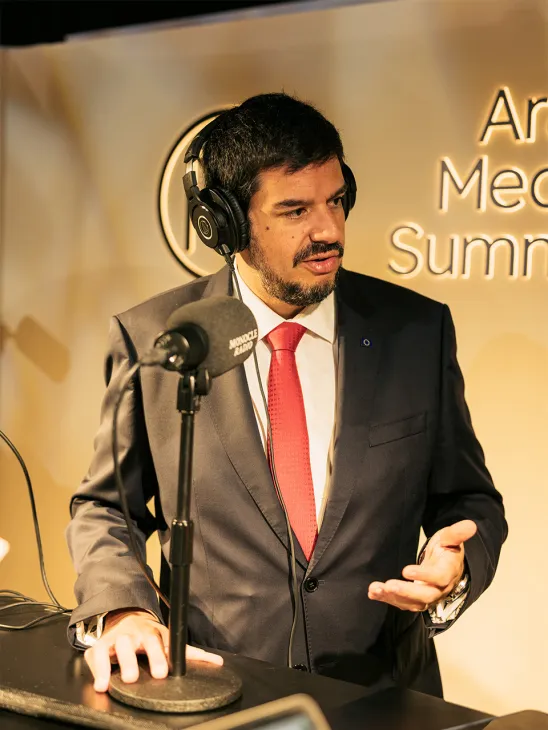
Speaking to Monocle Radio at Dubai’s Arab Media Summit, Euronews chairman Pedro Vargas David makes the case for more curious European media and why expansion to the Middle East matters now more than ever.
Pedro Vargas David has a request for the Middle East’s rival capitals: stop trying to settle scores through the newsroom. The chairman of Euronews argues that attempts to damage a neighbour’s reputation leave the whole region looking worse to European audiences. His own industry could also do with less infighting. Broadcasters, he says, have allowed technology companies to “eat their lunch”.
Speaking to Monocle Radio at Dubai’s Arab Media Summit, the television executive makes the case for a more curious European media and explains why television still has plenty of life left in it – provided that it learns to spend less. He is unabashedly open about the industry’s blind spots, sharing that if he’s in a room expecting questions about Iran, it’s the conflict in Sudan – largely ignored by the European media – that dominates the discussion instead.
Pedro, what should international broadcasters still be learning from local media?
We don’t fully understand what concerns the population and the media in this part of the world. I thought that we would be talking about Iran throughout the session that I was in yesterday but the questions were all about Sudan, Libya and Egypt. I thought, “Where do you live?” Then I thought, “Wait, where do I live?”
I only wanted to talk about Iran but they wanted to talk about Sudan. I have to respect that. It’s sad that we don’t cover Sudan properly in Europe. We don’t know what’s happening. We honestly don’t really care.
Middle Eastern countries have to stop bad-mouthing each other and using all the tools available to attack each other. Don’t use us to attack your neighbours. At the end of the day, you all lose. Do European audiences really distinguish between country A and country B in the region? The elites, yes. The vast majority, no.
Why has Euronews been expanding its presence in the Middle East?
At Euronews, we see ourselves as the voice of Europeans. But we also have a big presence beyond the continent, including an Arabic service. The Middle East is Europe’s close neighbour. It has always been part of our DNA.
We have expanded our offices and our editorial presence in the Middle East, becoming much more active on the ground. During the conflict, we have had permanent staff in almost all of the relevant capitals. Why? Because this matters for our audiences. What happens in the region has a direct impact on our petrol prices and on our tourism. We need to know what’s happening in this part of the world.
If I take my chairman’s hat off and put my citizen’s hat on, I recognise that we also need to understand these countries better and engage with them differently. We have perhaps had a bit of a colonial mindset for too long.
As the UAE became part of the story, did your reporters face constraints?
Our reporters didn’t give us any indication of constraints. At the same time, we are a responsible media channel. It’s not our place to show the location of strategic targets so that potential enemies can come and shoot at them. Are we going to pretend that the Gulf countries are the only ones that put restrictions on journalists during wartime? Every nation does that. It’s a matter of national security, which takes precedence over other interests.
We were not influenced. We were not asked to say this or say that, to put out a certain narrative. Our journalists reported freely on the conflict, with the limitations that any war scenario would bring.
Has covering this war differed from reporting on Ukraine?
I don’t think it has. And I don’t think it should. A death in Ukraine is tragic. A death in the Middle East is just as tragic. We were broadcasting live during bombings in the region. Our staff in Doha had to get down on the ground as missiles flew overhead. We report on reality: the destruction and the consequences.
Isn’t television increasingly a screen for Netflix and Amazon Prime?
The device is still there. How Euronews makes its money – whether from carriage fees or from Netflix – is a discussion that we’ll have.
The only reason that we’re not getting the money that we should from the likes of Google and Netflix is because the media has not organised itself properly. We spend too much time fighting each other rather than creating a united front and saying, “Enough. You’ve eaten our lunch.” It’s much easier to attack a rival and criticise an opponent. I would make the same recommendation to my sector as I would to the Middle East.
Your reporters are now broadcasting from mobile phones. How lean does TV news need to become?
I believe that traditional TV still occupies a huge space. Most people still organise their living rooms around it, with their TV in the centre.
At the same time, we have to be efficient with costs. We can’t just say, “Bring back my carriage fees. Bring back all my money.” We have to live in the future. We have to control costs and be tough on investment decisions. You don’t need €10m or €20m studios to broadcast the news. You can do amazing things at lower costs. With a low cost base and an intelligent approach to generating revenue, there are 20 or 50 years of business ahead of us. Of course, we have to reinvent the business every day but the opportunity is there.
Listen to the full interview with Pedro Vargas David on ‘The Monocle Daily’.