For democracy’s sake, France’s centre-left should reopen ‘bars-tabacs’
Where ‘bars-tabacs’ close, votes for the far-right rise. Why not bring them back?
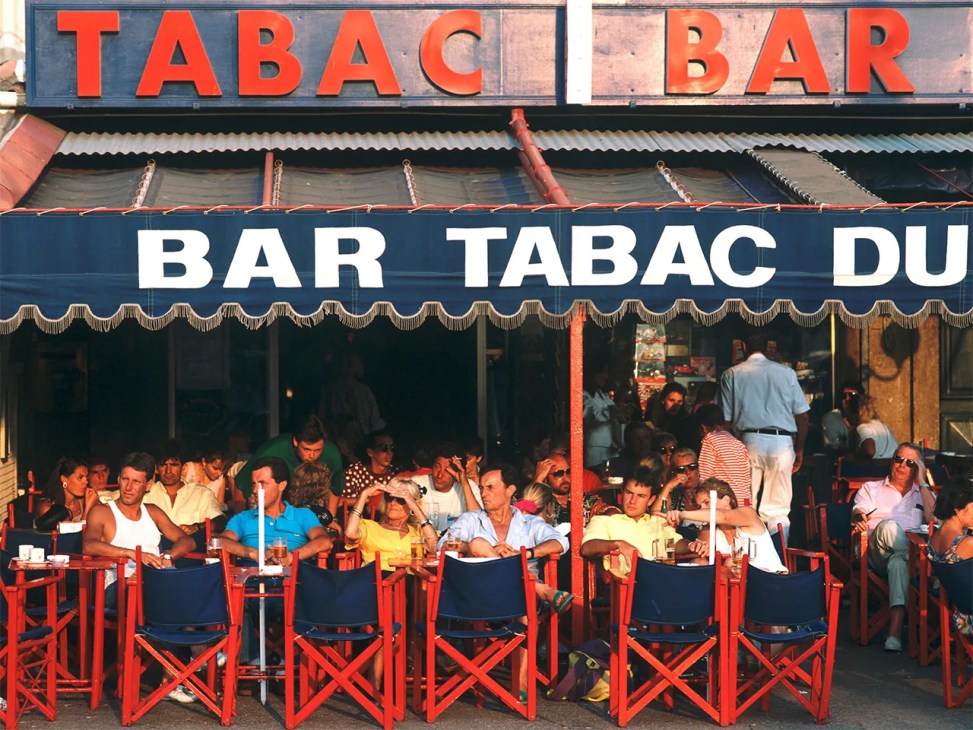
Bars-tabacs, bars that sell scratch cards and tobacco products among other paraphernalia, are closing across France. There was once a time when almost every village had one. Now barely a day goes by that I don’t pass by a boarded-up bar with faded, peeling letters spelling out tabac. Where these institutions have closed, votes for the Jordan Bardella-led Rassemblement National (RN), France’s most prominent far-right party, have risen sharply. Bars-tabacs were never hotbeds of liberal thinking like Viennese cafés – but here lies the opportunity. Should Renaissance, president Emmanuel Macron’s party, and the left begin to court the boozing, smoking and gambling sect of France’s population by reopening them?
A study conducted by the Centre for Economic Research and its Applications (Cepremap) found that some 18,000 bars-tabacs had closed across the country between 2002 and 2022. It revealed that while the initial effect of their closure on the far-right vote was small, as time went on, the RN vote increased dramatically in affected districts.
With the next presidential election set for mid-April and early May 2027, France faces the very real possibility of a far-right president for the first time in its history. The RN already saw dramatic gains in the March 2026 local council elections.
There’s a comforting universality to bars-tabacs in France. Similarly to an airport bar, the laws of time are different. Go mid-morning and there will be plenty of customers drinking lager, while others are still nursing an espresso. There’s always a wall of tobacco products and countertop shelves filled with scratch cards. More often than not there’s also a TV showing a sports match or horse race. But much like the airport saloon, a bar-tabac isn’t the first place where I’d personally choose to announce my political leanings. The discourse in these establishments is, in my experience, generally more right-leaning.
I called on friends that come from regions with particularly dramatic increases in votes for the RN in the 2022 presidential elections: the Gard, Pas-de-Calais and Lozère. Marine Le Pen won the majority in the first two and took home almost 46 per cent of the second-round vote in the third. All had seen the number of local bars-tabacs decline significantly over the past few decades.
Each source told me the same thing: the bar-tabac is often the only place to socialise in rural areas. Everyone goes, regardless of their social class or economic means because it’s quite simply the only place nearby. It’s regularly the last place to shut down, a symbol of the final death knell for a once-thriving village high street. If there’s no bar, there’s probably no library, no cultural centre and no restaurant. The friend in Lozère reported the most significant drop in her town: from 15 bars to one between the 1960s and the present day.
Without a space such as a bar-tabac to come together, villagers inevitably spend more time alone. Instead of going to his local, where someone might contradict him, Jean-Claude stays at home (“likely watching CNews,” [France’s most-watched, far-right-leaning news channel], says one friend).
In the run-up to the previous French presidential elections in the first trimester of 2022, a disproportionate amount of airtime on news channels was accorded to far-right candidates, namely Le Pen and Éric Zemmour, the leader of Reconquête (France’s other major far-right party). Centre-right and far-right candidates consistently held the most airtime during the first 12 weeks of 2022, with only the 13th week, right before the first round of voting, bucking the trend.
Centre-left candidates are missing a trick. Voters miss their local bar-tabac and the RN are weaponising the isolation caused by these closures. “La France des oubliés” (forgotten France), the idea that rural parts of the country have been left by the wayside, was a political slogan successfully used by Le Pen during the 2017 and 2022 presidential campaigns. But since Cepremap found that the effect was also reversible – where bars-tabacs opened, the vote for the RN decreased – the answer to beating Bardella next spring might just lie in betting big on the bar.
Anna Richards is a Lyon-based writer. For more opinion, analysis and insight, subscribe to Monocle today.
Further reading:
– What Macron’s Dior habit says about the politics of presentation and the smell of success
– In Italy the real dolce vita experience is at the village ‘sagra’
– The villages of Spain’s fast-emptying rural heartlands have plenty to teach us