Israeli ambassador to the UAE, Yossi Avraham Shelley, on what it will take to end strikes on Lebanon
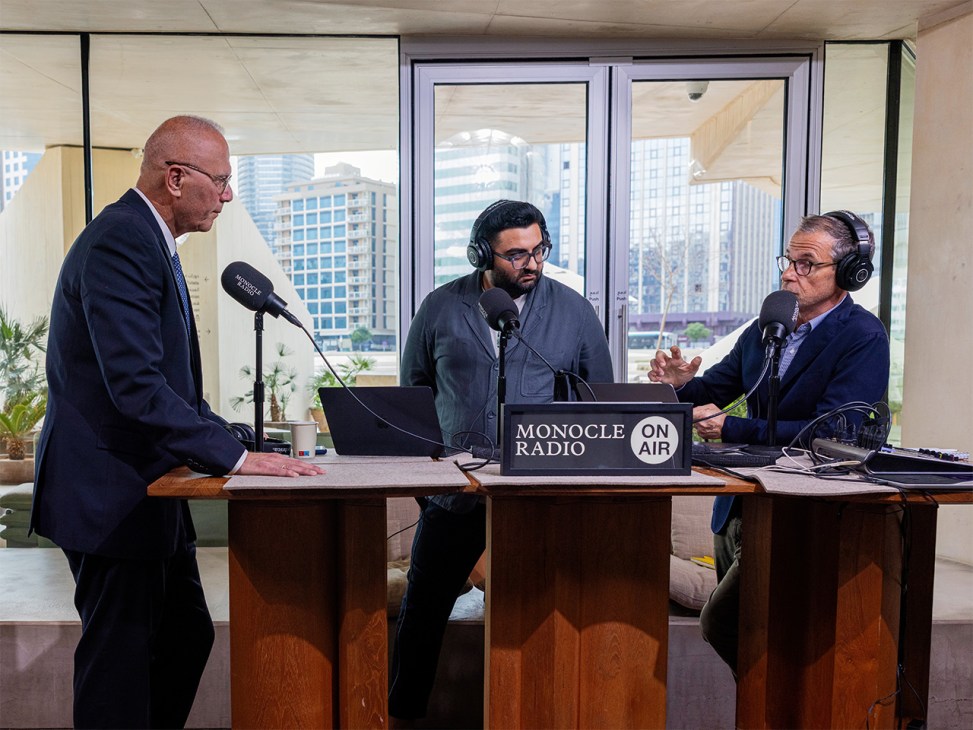
Israel’s ambassador to the UAE, Yossi Avraham Shelley, joined us on Monocle Radio’s ‘The Briefing’ to discuss the talks between the US, Israel and Lebanon as missile attacks continue.
As Israel deepens its military campaign against Iran and its regional proxies, its ambassador to the UAE, Yossi Avraham Shelley, gives his first interview since the conflict began. Speaking on Monocle Radio’s The Briefing, he strikes an uncompromising tone: Tehran’s nuclear ambitions and ballistic-missile capabilities, he argues, remain an existential threat that Israel cannot afford to leave unresolved.
Yet the theatre stretches beyond Iran. Despite the announcement of a ceasefire, Israeli strikes have continually hit Lebanon despite mediators, including Pakistan, suggesting the agreement extended to that front. Ambassador Shelley maintains that Lebanon constitutes a separate conflict and points to Israeli warnings issued ahead of the strikes – including text messages and leaflets – as an attempt towards mitigation.
His remarks come on the same day that Israeli and Lebanese officials were set to meet in Washington for their first high-level talks in decades, a development that signals tentative diplomatic movement even as hostilities continue across the region. For ambassador Shelley, however, any progress with Lebanon hinges on confronting the role of Hezbollah, which he describes as both a dominant force within the country’s government and a proxy for Iran. In his view, meaningful diplomacy cannot advance while Hezbollah retains military and political influence – ultimately placing Lebanon within the broader confrontation with Tehran.
The conversation also turned to the resilience of the Abraham Accords, a set of agreements signed in 2020 between several Arab states and Israel. Despite the pressures of the war, Shelley insists that ties between Israel and the Emirates are not only holding but strengthening, framing the relationship as part of a broader alignment against what he describes as destabilising forces in the region.
This conversation has been edited for clarity and length.
There are talks taking place in Washington between Israeli and Lebanese officials – the first such discussions in decades. Are you hopeful anything will come of them?
Someone has to take responsibility. We never had a real fight with Lebanon as a country. There are no territorial issues – in 2000 we left what we call the Litani region. So we can move forward. But Hezbollah is the problem. It is a terrorist organisation and that is what prevents progress.
So are you optimistic about these talks?
We have to be optimistic. But first, we have to finish the problem with Iran. If that is resolved – if Iran is defeated or agrees to new terms – then we can move towards a different Middle East.
Where do you think things stand now with Iran? Would Israel accept the situation as it is today?
No, of course not. We didn’t start this. Iran attacked us [with] more than 400 ballistic missiles. That’s a fact. There are two major problems: one is the nuclear facilities. You cannot allow a regime that supports terrorism to have nuclear weapons – they would have immunity and could threaten everyone. The second is ballistic missiles. People don’t understand what that means. A [one tonne] ballistic missile is like throwing a bus onto your house. People cannot survive that. This is about our future. We cannot let it continue.
But negotiations were ongoing before the conflict escalated. Why act during that period?
Iran is the only country that openly says it wants to destroy Israel. This is not a normal conflict – it is an existential threat. We have problems with neighbours, yes, but those can be resolved. We have peace with Egypt and Jordan. But if someone says they want to eliminate you, you cannot just wait. You have to act.
Has Israel underestimated the strength of the Iranian regime?
I don’t agree that they are strong. This is a regime that rules by force. The potential for change is with the Iranian people. What we want is to eliminate their capability to destroy us – that is the objective.
Have you achieved that?
We have reduced their capabilities by about 60 to 70 per cent. We destroyed key nuclear-enrichment facilities, the centrifuges. That is very important. But we cannot play a cat-and-mouse game where they rebuild deeper underground. They don’t want to stop.
If you’ve achieved that much, why does the war continue?
Because this is not an attack, it’s a defence. We want one thing: for them to stop. If they say, ‘Here is the nuclear programme, we [will] stop,’ then it’s over. But why continue building missiles with a range of thousands of kilometres? That means: if you don’t obey, we will attack you. That is the threat.
A ceasefire was announced but Israel continued strikes in Lebanon. Why?
The ceasefire did not include Lebanon. Lebanon is another conflict. Hezbollah is a proxy of Iran and we cannot allow it to establish itself like that.
But civilians were killed in those strikes, [including] women and children.
If terrorists are operating from within civilian areas, that is the reality we face. Before we attack, we warn people – we send messages, flyers, telling them to leave. But Hezbollah is embedded there. That is the situation.
The Abraham Accords have held through this conflict, despite tensions. Has that surprised you?
The Abraham Accords have faced challenges from the beginning. This is another test. And you can see [that] they are holding. The UAE was attacked as well. Why? Because it is a friend of Israel. We share goals: protecting our people, growing our economies. These are strong foundations.
Do you think ties with the UAE will be stronger after this conflict?
Yes, for sure. We have mutual goals – economic growth, security, stability. Not only with the UAE but with others as well. People want to work with those who build, not those who destroy.