At the Munich Security Conference, amid polite applause and private panic, the western alliance eats itself
In his opening address to the Munich Security Conference (MSC) on Friday morning, the German chancellor, Friedrich Merz, described the event as a “seismograph for relations between the United States and Europe”. Since its inception, this talking shop, attended by the world’s highest-ranking political, military and business leaders, has usually been a weekend of hearty feasts and even heartier agreement. Indeed, if anything was likely to show up on Merz’s seismograph it would probably be as a result of an overenthusiastic post-schnapps backslap. But last year, US vice president JD Vance sent tremors through the main hall of the five-star Hotel Bayerischer Hof – the aftershocks of which are still being felt. Vance, whose position essentially made him the guest of honour, stood up at the lectern on the opening morning with the intention of taking down his hosts. He called out Europe’s leaders for being undemocratic, degenerate and complicit in their own cultural demise, in a speech that set the tone for a dizzying 12 months of transatlantic rupture. This year’s event, following a few weeks after the Greenland crisis pushed the alliance to the brink, felt like a very public way of processing some of the continent’s grief.
On the eve of the conference, the event’s organisers published their annual report assessing the state of international relations. Its title was “Under Destruction” and it made no bones about where it believed the main source of our present instability comes from. “The world has entered a period of wrecking-ball politics,” reads the report’s first line. “At the forefront of those who promise to free their countries from the existing order’s constraints and rebuild stronger, more prosperous nations is the current US administration.” Such directness, it was thought, would set the tone for an MSC during which Europe’s leaders would begin the rhetorical fightback against Washington.
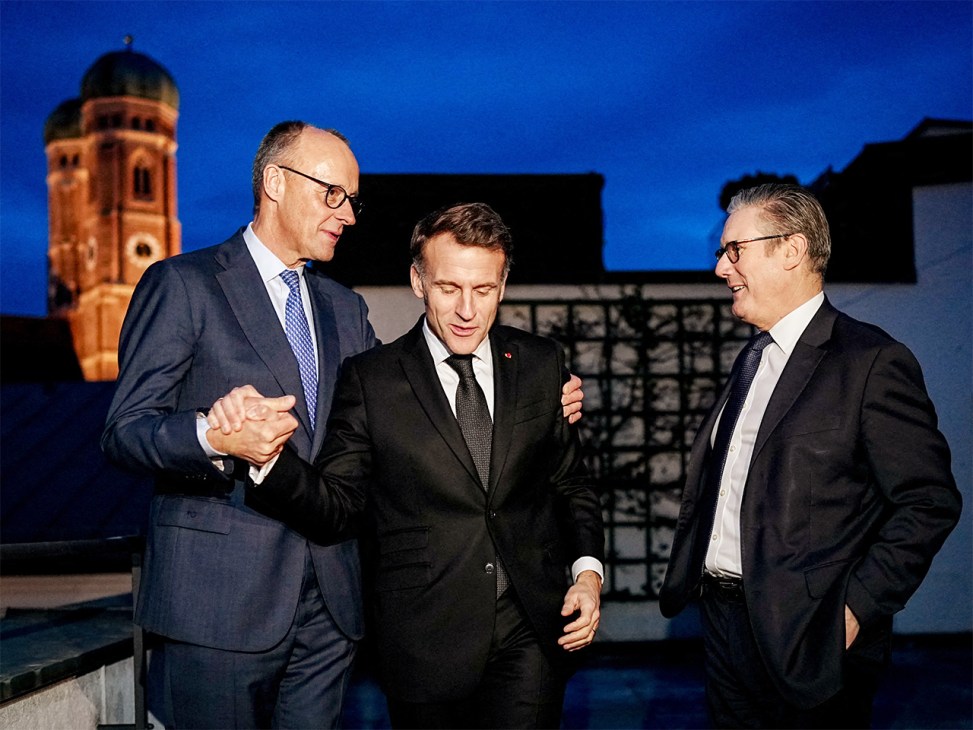
Merz’s speech, brought forward on request from the traditional Saturday slot reserved for the incumbent German leader, began with an unsparing assessment of the present world order. “If there had been a unipolar moment after the fall of the Berlin Wall, a unipolar moment in history, it has long passed,” said Merz, who always seems to be looking over the top of his glasses like a long-suffering accountant going through your receipts. “The United States’ claim to leadership has been challenged and possibly lost.” He went on to explain – to anyone without a firm grasp of German history – why his country cannot “go it alone” and would always seek to move as one with its allies. All of this felt like the build-up to, at the very least, a forthright repudiation of recent American behaviour. But instead, mindful perhaps of the decorum expected of him as host, Merz reverted to MSC-standard, insisting on the primacy of the western alliance.
After an underwhelming first round, the Europeans that I spoke to still seemed up for a fight, or at least a bit of light cussing. At an event featuring the preposterously folksy South Carolina Republican, Lindsey Graham, the US senator exclaimed: “Who gives a shit who owns Greenland?” Someone behind me scoffed, “I think Denmark does”. If Merz wouldn’t give the people back some fighting pride, then it was up to zany Uncle Manu to speak for a continent. The French president, whose sideburns seem to grow longer as his own influence wanes, was his usual boisterous self. He touted Europe’s response to Trump’s threats to annex Greenland as “politely declining unjustified claims on European territory”, without quite managing to shake the half-smirk he always appears to have on his face. In the end, Macron’s speech passed fairly uneventfully.
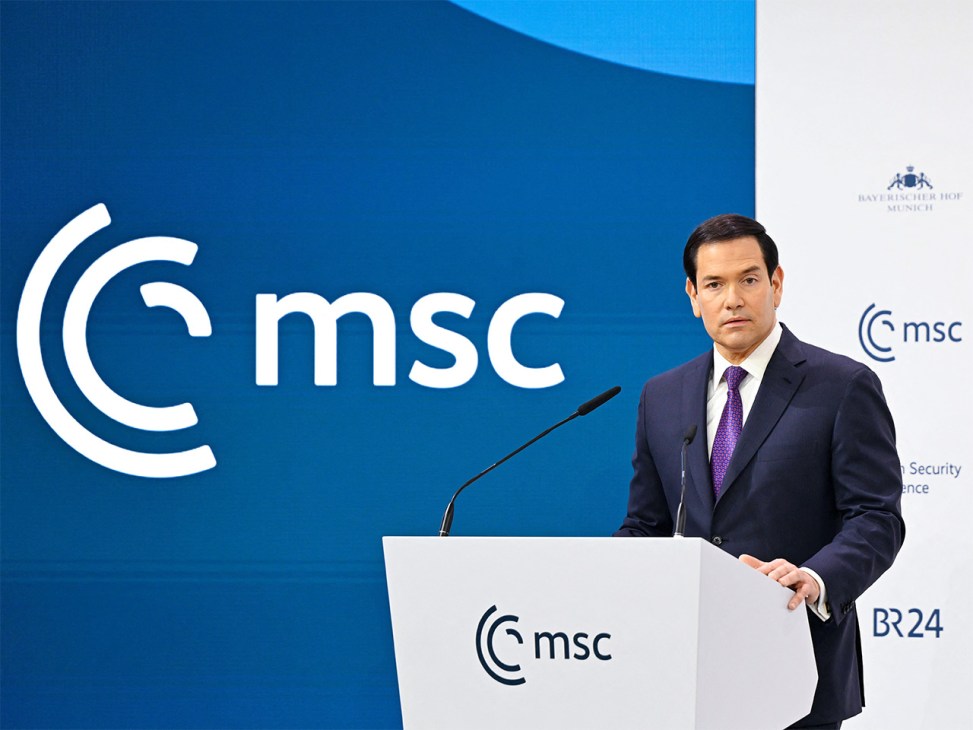
As the attendees retired to their evening’s bratwurst, there was a feeling of bathos that only the pulling of punches can bring. Still, perhaps the upside of this would be a repentant US secretary of state Marco Rubio mending ties in the weekend’s showpiece speech. America’s chief diplomat has sometimes appeared sullen and shrunken since taking up the role. But on Saturday morning he delivered the most articulate expression of the current US administration’s thinking that has been made yet. He declared an intention to renew the western alliance, an endeavour in which he said it was hoped Europe would be closely involved. Rubio called his country a “child” of the continent while praising it as the birthplace of Western civilisation. “Ultimately our destiny is and always will be intertwined with yours,” Rubio said. Then, like all middle-aged Americans of European stock, he revealed himself as an amateur genealogist, invoking 18th-century forebears from Sardinia and Spain. The speech, which also mentioned Mozart, Shakespeare and The Beatles, was intended to flatter Europe’s cultural sensitivities – but since it also derided the continent for being weak, in hock to a “climate cult” and ashamed of its own heritage, it had the same scolding flavour as Vance’s, and was perhaps more unsettling for being delivered soothingly. It also failed to mention Ukraine, an omission compounded by Rubio’s skipping a meeting with Volodymyr Zelensky the night before.
So as the MSC circus packs up its lanyards and Heckler & Koch UMPs, where does this leave the transatlantic alliance? Although Mark Rutte, Ursula von der Leyen and UK prime minister Keir Starmer were quick to characterise Rubio’s speech as a much-needed olive branch, outside of the keynotes and fireside chats, there was a more unguarded sense of how bad US-Europe relations have become. The firmest rebuke to US rhetoric came from the EU’s foreign policy chief, Kaja Kallas, who joked on Sunday morning that, “contrary to what some say, woke decadent Europe is not facing civilisational erasure.” For those still keening for a return to the status quo ante, hope was offered by the large Democratic Party contingent in attendance, including California’s governor, Gavin Newsom, and New York congresswoman Alexandria Ocasio-Cortez, both of whom insisted that current US foreign policy was an aberration rather than the new normal. An alternative vision was offered by Wang Yi, China’s foreign minister, who, with a smile slightly more restrained than Macron’s, said, “multilateralism should always be promoted and strengthened. It must not happen that some countries dominate others.” You don’t need a seismograph to work out who he was referring to.