Georgia’s controversial prime minister Irakli Kobakhidze on EU integration, corruption and democracy
At the World Governments Summit, the country’s leader spoke to us about navigating the ongoing Russia-Ukraine war, protests at home and a stalled European future.
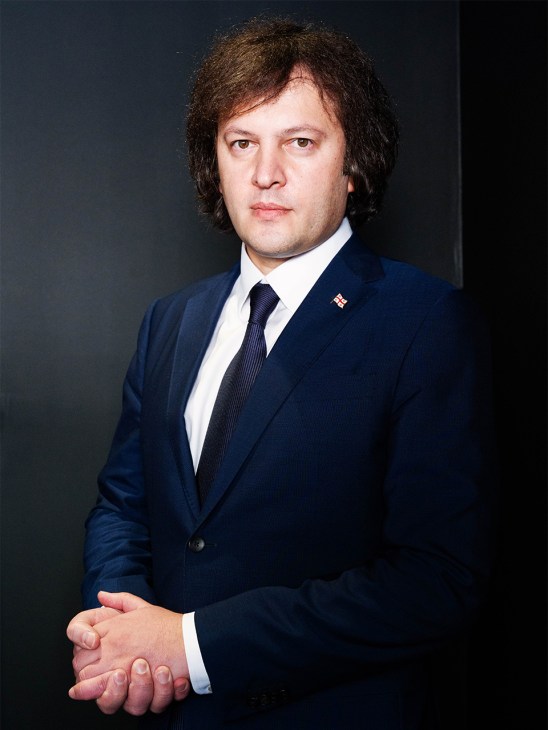
Georgia’s prime minister, Irakli Kobakhidze, arrived at the World Governments Summit carrying more baggage than most. At home his government is facing sustained street protests and mounting criticism over a parliamentary election that international observers said was competitive but flawed, amid allegations of voter intimidation and uneven enforcement. Abroad, Georgia’s once-clear European trajectory has become muddied. Though granted EU candidate status in late 2023, the country’s accession process has since stalled, with Brussels raising concerns over democratic backsliding, judicial independence and legislation that critics say echoes Russia’s restrictive “foreign agents” laws.
In Dubai, Kobakhidze set out a markedly different picture. He presented Georgia as a pragmatic, peace-minded state navigating life next to a belligerent Russia – one that occupies roughly 20 per cent of Georgian territory – while remaining firmly committed to EU membership. He rejected claims of electoral malpractice, arguing that Georgia outperforms other candidate countries on corruption and democratic standards, and framed strained relations with Brussels as a failure of communication. What is clear from speaking to Monocle is that Georgia’s leadership understands its moment, which is caught between geopolitics, domestic dissent and an increasingly sceptical European audience.
Listen to the full conversation with Kobakhidze on The Globalist. The following interview has been edited for clarity and length.
Prime minister, let’s start with the recent trilateral talks between Russia, Ukraine and the US. Are you optimistic about the outcome?
We are looking forward to the success of the negotiations because there is an ongoing war in our region, in Ukraine, and it affects the situation in Georgia. That’s why we are supportive of any attempts to find the solution for this conflict because peace is crucial for everybody. Peace is crucial for the region and for the Ukrainian people because they are suffering.
We spoke to a very senior diplomat yesterday who shared that the reason they could host these trilateral conversations is because the UAE hasn’t taken a stance in the conflict. Can you tell us a little more about Georgia’s stance and how the positioning evolved over time?
Georgia’s position is clear about this conflict. From the very beginning, we supported all the relevant decisions and resolutions advocating for Ukraine’s sovereignty and territorial integrity, and condemning Russia’s military aggression. This position has never changed. We are committed to the international law principles and we are always vocal about that.
We have our own problems. Twenty per cent of our territories are occupied by the Russian Federation. We understand very well what war means. That’s why peace is crucial – for the region and for development. There were conflicts in the South Caucasus region and Georgia was always playing a positive role in terms of supporting the peace around us. Our choice is to be pragmatic and this approach works.
We have had to face four different wars since the 1990s. After the collapse of the Soviet Union, there was the Civil War in the beginning of 1990s, [then there were] two wars in two regions of Georgia, [followed by] the Russian-Georgian war in 2008. We learned a lot from this history after the restoration of our independence and we understand that peace is the most important thing for ensuring the country’s development.
In Western media, there’s a tendency to cast things in black-and-white terms: pro-Russia or pro-Ukraine. Are you saying that there’s actually an advantage for Georgia to take a more nuanced position to continue talking with Moscow? Is there an opportunity to leverage that to deliver better outcomes for Ukraine but also, crucially, for Georgia?
In general, we want to have relations with everybody. With regard to Russia, we have had no diplomatic relations after the occupation of our two historic regions. [That is] a special case. We have our challenges with the EU. We had more challenges with the US under the previous administration but now the situation has changed. There are no tensions after the inauguration of the new US president. But we have special challenges with the EU that have no solid ground. We understand the reasons behind [our challenges with the EU] but we are committed to our goal of becoming a member.
Is that still the ambition then, to become a part of the EU, even though your relationship with Europe is fraught? How are you working to become part of the EU Commission?
We are patiently waiting for a change in attitudes and policies.
What would you say directly to the EU as a plea to join the commission?
The best [approach to] politics is to talk to each other. When one side chooses not to talk, it demonstrates weakness or negative goals behind the policies. We call on the European bureaucracy to start talking publicly and transparently about all of the issues. We are fully open for negotiations but they should be [conducted] in a transparent way so that the public can follow the discussions.
You must be frustrated by the fact that you still have this fraught relationship with Europe. You’re trying to get into the EU but it’s being blocked.
We are disappointed because if you look at all international rankings, Georgia is the best among all candidate countries. With regard to [our] level of corruption, we are doing better than all candidate countries and we are doing better than eight or nine EU member countries. It’s the same with the level of democracy, human rights, political pluralism and media pluralism. If you look, for example, at Georgia, Moldova and Ukraine, there is a huge difference [between them].
You mentioned the corruption rate in Georgia being considerably lower than some of your neighbouring countries but there has been scrutiny around your country’s recent elections. In particular, over voting and voting calculations. How do you respond to that? Have you been wholly transparent around the elections?
That is a good example showing that transparent talks are important, because we can talk about how [elections] have been held in Georgia. We introduced electronic counting, electronic registration and electronic procedures to the elections, so there is no reason to put the results under question.
Georgians went to the election precincts and voted through electronic machines; they got registered through machines. The commission members were just pressing the button and printing the checks reflecting the results. There was no technical possibility to manipulate anything in this election. We invited all the international observer organisations, including the CEC, the European Parliament, the peace delegation and all others. Nobody was able to provide any evidence – not systemic, not even essential – of manipulation. So that’s why we are saying [that we want] an open conversation about how the elections have been held in Georgia.
Read more from World Governments Summit
• Amid heightened geopolitical tensions, the World Governments Summit is a masterclass in soft power
• Neutrality is not passive: Dr Anwar Gargash explains the UAE’s diplomatic stance