How relaxing are Japan’s electric baths? The answer might shock you
Hidden among Japan’s steaming bathhouses is a tradition that has bathers quite literally buzzing. Despite what you think about combining water with electricity, the “denkiburo” proves that some rules are made to be broken.
On a recent visit to Daikoku-yu Onsen (hot spring bath) in Tokyo, I noticed a doorway left ajar in the back corner of the room. A rather relaxed-looking woman exited with a smile beaming across her face. Naturally, I wanted whatever she had. I made my way through the bathhouse steam until I encountered another tub, lowered myself in and began to tingle. Perhaps it was a special mineral-rich water? But I didn’t really question it until my fingers began to involuntarily curl towards my palm.
Now, there are certain truths we know to be self-evident: look both ways before crossing the road, don’t stick a fork into a socket and never mix electricity with water. And yet I had inadvertently discovered the denkiburo. Denki means electricity, buro is bath.
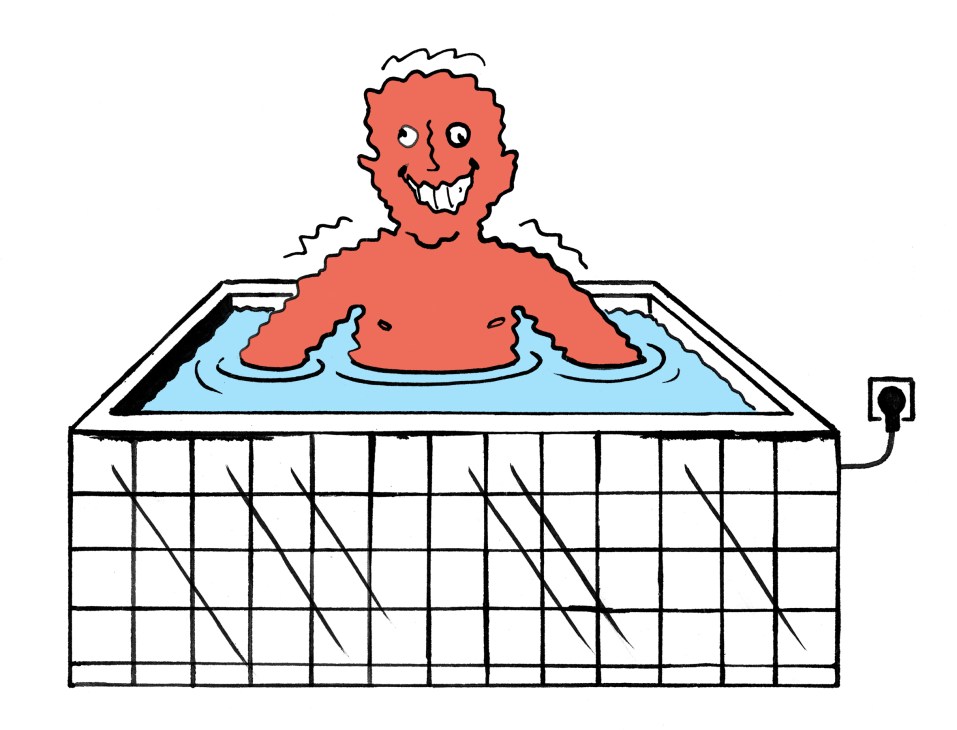
Electricity transformed daily life during the late Taishō and early Shōwa periods in Japan. Alongside lighting, radios and transportation, electricity was also thought to have benefits for the body. The therapeutic effects of electrical stimulation were already in vogue when inventor Kiyoshi Fujimoto saw an opportunity to combine it with Japan’s beloved bathing rituals.
Fujimoto launched the first electric bath in Osaka, and while they never became as universal as a hot bath or cold plunge, the denkiburo is now a common fixture in sentos (Japanese bathhouses), particularly as a novel selling point in the Kansai region. The feeling is akin to pins and needles, the intensity of which depends on voltage and personal preference. It might not be particularly reassuring, however, to hear that denkiburo are unregulated.
The bath itself is outfitted with two or more electrode plates of opposite polarity, generating a small electric current that shocks the body, allowing the muscles to contract and release. This promotes circulation and lymphatic movement as well as loosening tense muscles. If you have cold feet, shoulder stiffness or lower back pain, it might be worth getting into the tub.
When my father was a student in Kyoto, he and his friends swore by the denkiburo – they had their own name for it, which I won’t divulge but derives from the shrieks you would hear from the otherwise quiet ojisan (middle-aged men) upon entering. Despite the occasional yelp, the men and women of his generation persist, convinced of the health benefits. Young people, however, tend to be concerned that the denkiburo poses some sort of risk (who’d have thought?). As for me, I have some training to do before I can emerge from the electric bath with the nonchalance of the woman at Daikoku-yu. But I’m willing to put in the practice. After all, this might just be the next trend that takes over your favoured sauna or onsen. See you in the tub.
Pria Koll is a Tokyo-based writer. For more opinion, analysis and insight, subscribe to Monocle today.