‘The rules-based order is over’: What Trump, Iran and Ukraine tell us about the future of international relations
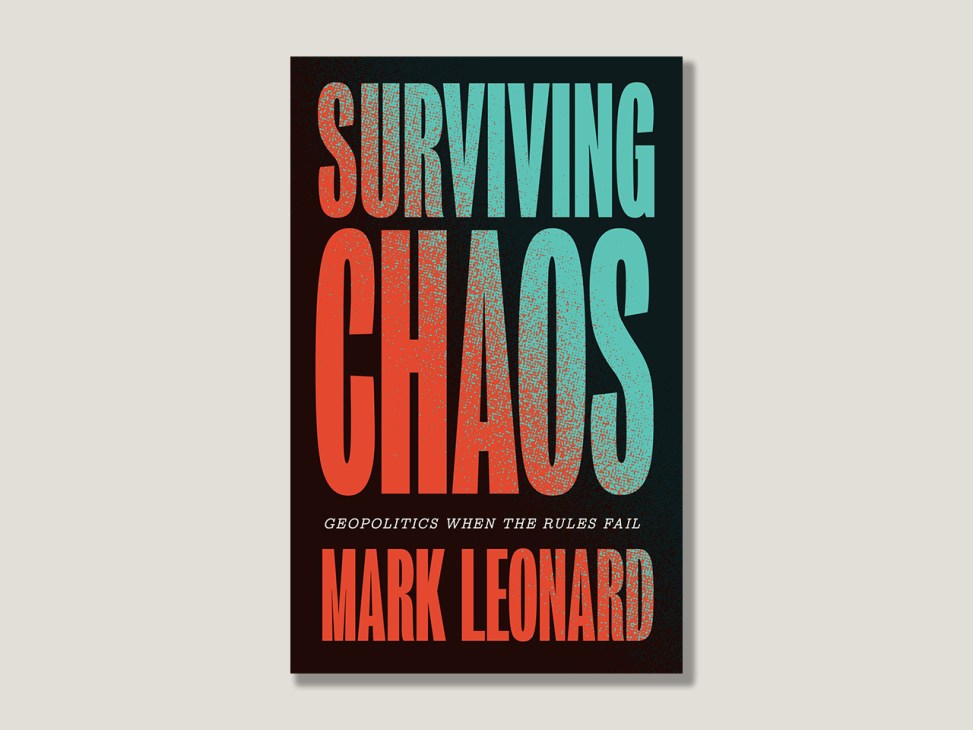
The author of Surviving Chaos: Geopolitics When The Rules Fail, Mark Leonard, shares his view on how to navigate a multi-polar world where yesterday’s assumptions are quickly becoming out-of-date.
Over the past century or so there have been three serious attempts to establish what is generally referred to as a “rules-based order”: a framework by which international relations and disputes might be managed by means other than violence. The first two of these – the League of Nations and the United Nations – were responses to world wars. The third, and more amorphous, followed the end of the Cold War in the early 1990s. It included such milestones as the US leading a coalition equipped with a UN Security Council resolution to evict the Iraqi military from Kuwait in 1991, and the establishment of the World Trade Organisation in 1995. It was a period in which globalisation, powered by the nascent internet, was largely regarded with optimism. In retrospect, it feels more like hubris.
The difficulty with any rules-based order is that it will always principally burden and constrain the great powers, who are obliged to throw their weight around in the service of the common good. As has been repeatedly demonstrated this century by Russia, the US and China, great powers tend to regard rules as either a nuisance or as irrelevant. Nobody wanted Russia to invade Ukraine. Nobody but Israel appears enthused about the American operations in Iran. Everyone would prefer it if China desisted from pestering its neighbours. But who is going to stop them – and how?
These are among the questions considered in Surviving Chaos: Geopolitics When The Rules Fail, a new book (out April 2026) by Mark Leonard, director of the European Council on Foreign Relations. The book posits that we have embarked on an age of what Leonard calls “un-order”: a multi-polar world in which yesterday’s assumptions could start seeming old-fashioned quite quickly.
Mark Leonard spoke to Monocle’s Andrew Mueller on The Foreign Desk. The following conversation has been edited for clarity and length.
If we look at what is happening in Iran and Ukraine, is this what the ‘un-ordered’ multi-polar world is going to be like?
What’s happening in the Gulf tells us that the rules-based order is over. Those basic ideas of how countries should operate, of the sovereign equality of states… they’re all for the birds. What we’re seeing is a much more chaotic and disruptive situation. The progress from a military conflict to one in which people are [manipulating] global energy markets and supply chains – almost all the different things that tie the world together have been turned into tools of political power.
Where does this cycle of crisis end?
I don’t think it will end. It’s very easy to see Donald Trump as the cause of global chaos. In just the first few months of this year, he has launched an attack on Venezuela, threatened to annex Greenland and now he’s in Iran, and so many people think that chaos comes with an orange face. But he’s more a symptom of the fundamental things going on that are pushing the world towards disorder and chaos. These big structural changes are turning all of our assumptions upside down.
In your book, you write that we need to move away from thinking that international organisations will protect our security. Isn’t that a recipe for a world of armed camps?
I look at two ways of thinking about order and I contrast them. One is the idea of architects, who try to build structures and institutions that can protect us. Another is what I call artisans. They’re people who, rather than thinking that you can build these big structures and institutions, try to understand where the world is going and surf the wave of chaos, making [themselves] more resilient, more adaptable and better able to find a way through uncertainty. [They] test things out, [take old things] and reinvent them for new purposes. [They’re] more nimble and more experimental, and see the world as a laboratory.
It’s the artisan’s approach that allowed China to guess where the world was going, as far as technology is concerned, and to forge ahead in areas such as electric vehicles, AI and green technologies. The big challenge, particularly for Europeans, is how to get out of a mindset in which our goal is to preserve the status quo, towards one where we try to understand where the world is going and how we can still be standing at the end of the enormous changes that are coming our way.
Where does that leave countries that aren’t emergent superpowers? Are we back in a Thucydidean world where the strong do what they can while the weak suffer what they must?
One of the big advantages of the EU is that it allows small and medium-sized countries to huddle together, to have scale and to set their own terms. Rather than thinking about having global institutions, they can do things together. However it is true that we are seeing power return to the stage as the main way that decisions get made, it’s more important than international law and institutions. I don’t think it’s a positive thing at all but if you want to be able to protect yourself in that kind of world, it does mean that you need to be able to speak the language of power.