Playing God in Davos: Why the US is putting faith centre stage
Things are getting icy in Davos. Despite only touching down at the World Economic Forum (WEF) later this morning, US president Donald Trump has been dominating discussions along the Promenade all week. Shortly before departing Washington, private texts between Trump, Norway’s prime minister and France’s president went public. Soon afterward, the US president published an AI-generated photo of himself seated before Europe’s leaders with a map showing the US flag over Greenland, Canada and Venezuela. Most of those leaders will be at the conference – Norway’s Jonas Gahr Støre announced that he would attend after the messages were revealed. It’s safe to say that the president is in for a frosty reception.
Alongside the US president comes a 300-strong entourage composed of cabinet officials, advisors, business partners and family members, all hoping to spread the gospel of American patriotism to business tycoons, political leaders and WEF veterans. Team USA’s international outing comes as the country’s 250th anniversary celebrations begin to ramp up, so its chosen command centre in Switzerland had to befit the occasion. USA House has set up shop at Davos’s English Church, poignantly renamed “The Sanctuary” for the duration of WEF. While it’s not the first time that the church has been used during the summit, it’s impossible not to note the irony behind the choice of venue – a place built for shelter, comfort and guidance will now house a nation that’s threatening allies, disrupting the status quo and generally relishing the chaos that it causes.
Inside the church, a packed programme of talks and discussions focuses on faith and leadership. Outside, the façade is adorned with banners that read “Freedom 250”. It’s a manifestation of the White House’s America First policy, a holier-than-thou attempt at asserting global dominance. Perhaps if a delegation from George Washington’s administration came to Davos 250 years ago, the politicking would look similarly pious.
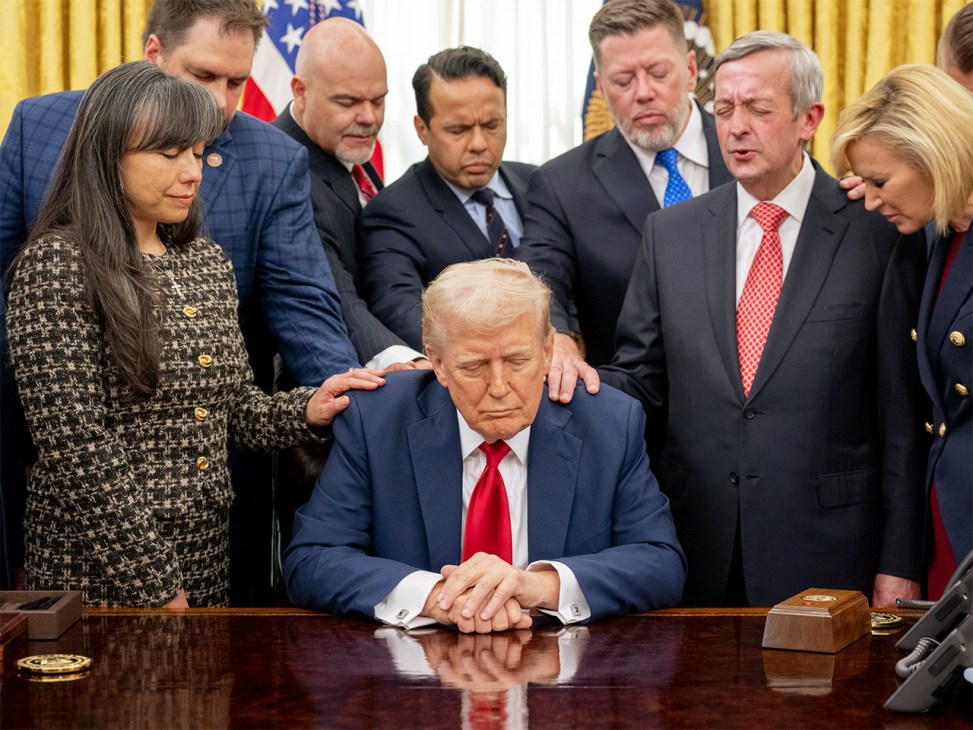
It’s not news that Trump is a president who knows how to appeal to conservative Christians, a core part of his support within the Republican party. He has established faith-based entities and launched a programme urging Americans to pray for their country. And who can forget that group of faith leaders praying around him while he sat at the Resolute desk? But divine messaging on the global stage, in such a secular setting, is a surprise.
When I stopped by a session on faith and leadership that started at 07.15 local time, the queue to get in went around the building. A panel of speakers discussed the role that faith has played in both their personal lives and how it can help to foster unity. “People came to the US because of freedom of religion,” says Keith Krach, the CEO of Freedom 250, who Trump appointed to lead the organisation in charge of anniversary celebrations. “You can see in history that Abraham Lincoln led on his faith, that 9/11 brought people together because of their faith. And when we look back at this anniversary year and the next 250 years, faith is going to play even a bigger role.” Nobody had the heart to tell Krach that people are losing faith with the US more than ever. Among the pews in the 19th-century church, lit in shades of red and blue, you had to wonder whether a Catholic confessional would have been more appropriate.
Carlota Rebelo is Monocle’s senior foreign correspondent. For our live coverage from Davos, tune in to ‘The Briefing’ on Monocle Radio.