
Dispatch from New Delhi: Monocle in conversation with leaders in aerospace, energy and engineering
Monocle joined Hitachi Energy to discuss how infrastructure and innovation are driving progress in India and across the world.
The week in which Monocle arrived in New Delhi was an eventful one. The downtown streets were swarmed by the Cockroaches (officially the Cockroach Janta Party), the self-deprecatingly named protest movement spearheaded by a restless cohort of Indian youth – and authorities went to considerable lengths to deter them.
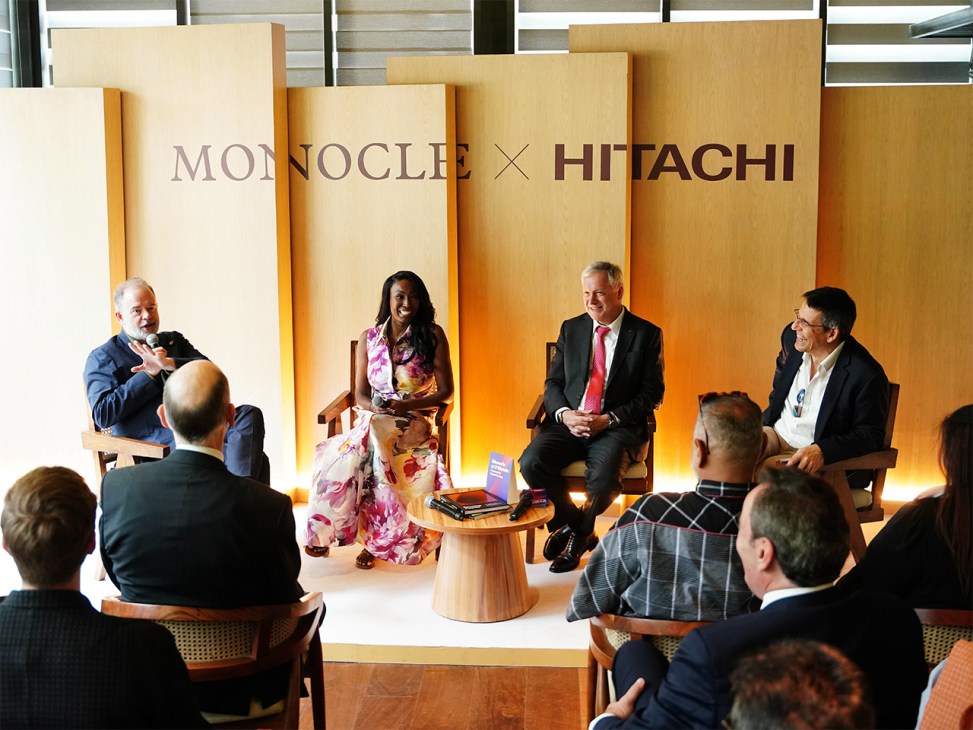
On the weekend before Monocle set up shop at members club D’Monde in association with our sponsors, Hitachi Energy, much of the city’s metro was closed, mobile internet access was suspended, and roads were blocked by police and paramilitary checkpoints. Nevertheless, Delhiites found their way to our coffee mornings, our cocktail evening and to our panel discussions.
The set-piece conversations included contributions from Nobel physics laureate Didier Queloz, Hitachi Energy CEO Andreas Schierenbeck, American aerospace engineer Aisha Bowe, and Indian aerospace engineers and entrepreneurs Srimathy Kesan and Susmita Mohanty. They were hearteningly bullish on India, in particular, and the future generally.


It might seem counterintuitive to think of India as a laboratory for new ideas. At 3.3 million sq km and with an estimated population of 1.4 billion people, the country is unfathomably enormous. It is infernally complicated and obdurately maintains a tradition of barely penetrable bureaucracy (the greatest murmur of approval elicited by our guests was via Queloz’s suggestion that India ruthlessly streamline its visa procedures). But this country is nevertheless ahead of some curves.
Not far from us, Bloomberg hosted its annual New Economy Forum, where I spoke to the editorial director of Bloomberg New Economy, Erik Schatzker, who noted that the time for India’s long-standing policy of strategic non-alignment might have come. “Other countries,” said Schatzker, “are coming to the same conclusions that India came to long ago about the reliability of the superpowers.” Benefits that Canada, the UK and Europe have long enjoyed “are fast disappearing because the US has unilaterally decided to stop underwriting that system,” Schatzker continued. “India is affected but not to anywhere near the same degree as a country such as Canada, for example.”
Even those dissenting from India’s current direction are confident in its ability to go its own way. For this weekend’s episode of The Foreign Desk, I visited the office of Shashi Tharoor, the veteran politician, diplomat and author, who is currently a member of parliament for the opposition Congress party. “We tend not to be terribly impressed by foreign examples,” Tharoor said. “And everything we’ve seen in India in these last 79 years has very much been of an Indian model. And we’ve been through everything: one-party dominance, coalition governments, the rise and fall of governments in matters of months. India has found its own way of adjusting to new realities each time, and this will be no exception.”