Viktor Orbán’s 16-year rule is over – but can Péter Magyar return Hungary to the European centre ground?
Though Hungarians have welcomed the Tisza leader’s decisive victory, questions remain over his populism and Fidesz roots.
On Sunday night, with most of the votes counted, it became clear that Hungary’s prime minister, Viktor Orbán, had suffered a crushing electoral defeat. Péter Magyar, his victorious challenger, stepped onto a stage by the Danube in Budapest and told a sea of cheering supporters, “Together we liberated Hungary.” Celebration continued deep into the night, the air reverberating with the sound of motorists honking their horns. For long stretches, it was almost impossible to cross the river, with bridges and public transport clogged with crowds of young people, many of whom had voted for the first time. Across the city, bars stayed open late. Music played from open windows and parties spilled out onto the street.
Such was the outpouring of relief after 16 years of rule by Orbán and his Fidesz party. During that time, corruption became endemic, healthcare and education frayed and the economy stalled, paralysed by a system that rewards cronyism. All the while, Orbán constructed what he described as an “illiberal” state, with a tamed media and judiciary, a fixation on “traditional” values and a foreign policy friendly to Vladimir Putin’s Russia and the European far-right.
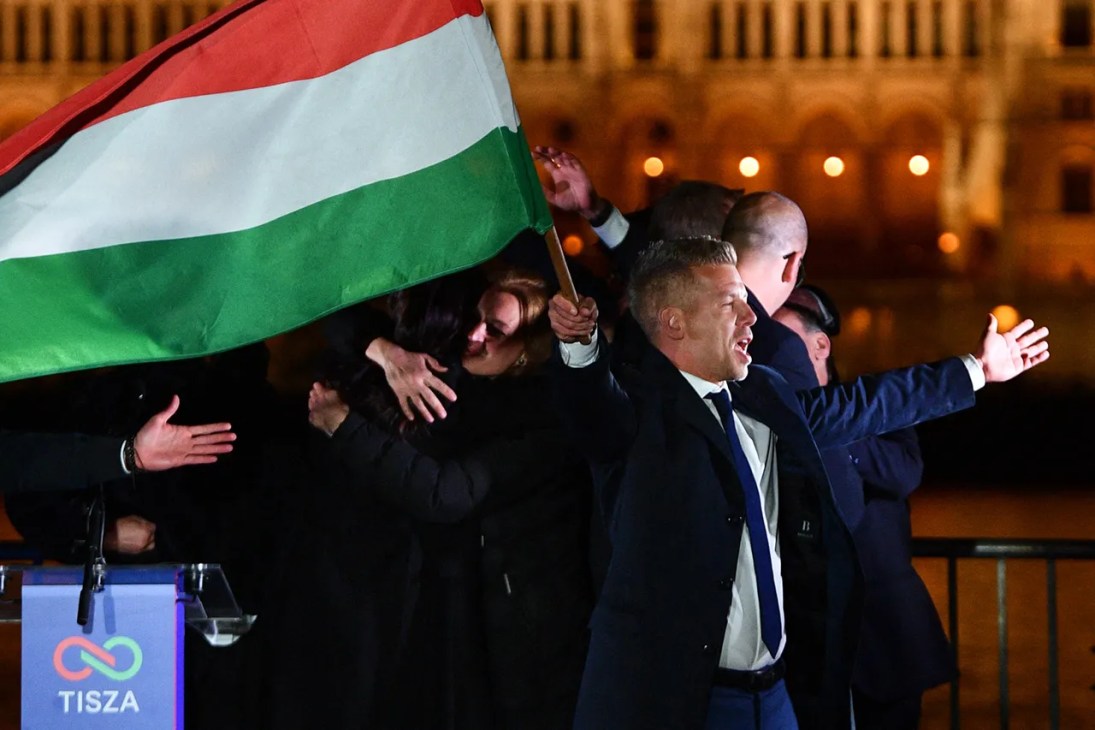
Magyar now promises to reverse this and return Hungary to the European fold as a reliable partner. Indeed, his rise began with Europe, when his party, Tisza, contested the European Parliament elections in June 2024. Speaking to me after a rally in western Hungary at the time, Magyar said, “I want to change Hungary completely. The Hungarian people are tired of the lies, corruption and propaganda.”
The 45-year-old Magyar was born into a family of lawyers and reportedly kept a photo of Orbán in his room as a boy. He earned a law degree at the Pázmány Péter Catholic University near Budapest before becoming a diplomat in Brussels and part of the establishment.
He came to prominence in February 2024 when a corruption scandal involving the granting of a pardon to a sexual abuser brought down two Fidesz figures: one was Hungary’s then-president, Katalin Novák, and the other was Magyar’s ex-wife, former justice minister Judit Varga. Until then a staunch ally of Orbán, Magyar turned against him.
Tisza went on to win almost 30 per cent of the vote in the EU elections – impressive, though everyone suspected that this was only a rehearsal for a far larger prize, which Magyar has now claimed. His victory was the result of relentless campaigning, during which he criss-crossed the country many times over, delivering as many as seven speeches in a single day. As one Tisza voter told me during the celebrations on Sunday, “Everyone saw this, so we hoped and believed.”
Even amid the jubilation, however, there was some scepticism. Many voters see parallels with the past and are suspicious of Magyar’s populist-lite style and his Fidesz origins. In his victory speech, he promised to rid the country of corrupt officials. But an uncomfortable question hangs in the air: now that Tisza has secured a two-thirds supermajority in parliament, giving it sweeping powers, will Magyar go after Orbán himself?
As the transition begins, he faces a difficult task – perhaps harder than winning the election. During his years in power, Orbán built a system that penetrated Hungary so deeply that it’s hard to see beyond it. As another former Fidesz insider once told me, “There’s no playbook for getting out of Orbán’s playbook.” So, as the emotions settle, what’s next for Hungary?
Alexei Korolyov is Monocle’s Vienna correspondent, reporting from Budapest. For more opinion, analysis and insight, subscribe to Monocle today.