Can building Africa’s largest airport turn Ethiopia’s fortunes around?
For many Ethiopians, a drive to Bishoftu – a town about an hour outside Addis Ababa – has long been a gentle escape from the capital’s frenetic pace. The climate is cool and the landscape softened by scenic crater lakes and a sweep of cultivated green. But Bishoftu’s serenity might soon be a thing of the past as the area is destined to be the site of Africa’s largest airport. A vast aviation hub, it’s designed to handle 110 million passengers a year, a number that surpasses even Atlanta, currently the world’s busiest.
The new airport, designed by Zaha Hadid Architects and scheduled to open in 2030, is intended to relieve Addis Ababa’s Bole International Airport, which prime minister Abiy Ahmed Ali says will reach capacity within the next two to three years. Hemmed in by the city’s relentless growth, Bole has no room to expand. Bishoftu, by contrast, offers space and, more importantly, the chance for Ethiopia to reposition itself as the continent’s principal aviation crossroads.
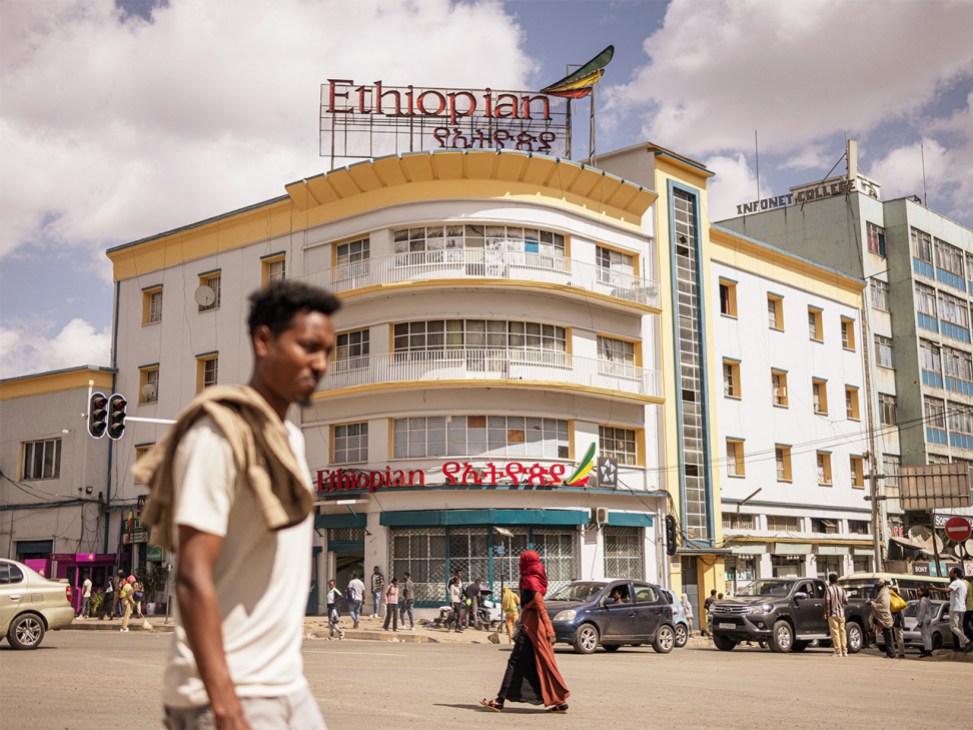
“If Ethiopian Airlines intends to compete on a global rather than continental scale, it must eventually double and even triple in size,” aviation consultant Sean Mendis tells The Monocle Minute. “That is impossible without a home base capable of supporting it.” The flag carrier already dominates Africa’s skies. Ethiopian Airlines is the continent’s largest and most profitable, serving 145 destinations across five continents with the newest and biggest fleet in Africa, more than twice the size of its nearest rival, EgyptAir. Its rise has been anything but accidental. “Despite being state-owned, the airline has consistently operated as a commercial institution rather than a political instrument,” says Mendis. “No other African flag carriers have been afforded the governance stability or long-term strategic patience required to achieve this.”
Geography, too, is on Ethiopia’s side. Addis Ababa sits neatly at the intersection of Africa, the Middle East and Asia, the world’s fastest-growing aviation markets, while remaining within easy reach of Europe. Bishoftu’s lower altitude will also allow long-haul flights to North America to operate without the payload penalties that currently limit range and profitability. New highways and a high-speed rail link will stitch the airport into the capital, turning what is now a provincial town into the nerve centre of a global network.
But will the airline’s track record and Addis Ababa’s central location be enough to make the new airport a global player? It faces little serious competition within Africa but the mega-hubs of Dubai and Doha continue to siphon off African long-haul passengers, while Saudi Arabia’s aviation push is gaining pace across the Red Sea. Istanbul, driven by Turkish Airlines’ steady march, has become a favoured gateway for African travellers who are heading to Europe and beyond. Meanwhile, Gulf carriers continue to deepen their reach through codeshare agreements with African airlines. Ethiopia, Africa’s second-most populous country and one of its fastest-growing economies, remains politically brittle and unevenly secure. Abiy’s ambitious programme of reform and state-led development has advanced in parallel with a tightening of the democratic space and periodic crackdowns on dissent. The Bishoftu project will displace some 15,000 people, with compensation still unresolved. Looming over it all is the lingering risk of renewed conflict, particularly with neighbouring Eritrea.
Still, the political and economic situation seems only to have increased the prime minister’s appetite for grand projects. “Ethiopia has a track record of delivering large-scale infrastructure,” says Mendis, pointing to the continent’s largest hydroelectric dam and Addis Ababa’s sweeping urban-renewal schemes. For Abiy, the airport is also a political wager that investment, connectivity and momentum can help steer a nation of some 130 million back towards stability after years of internal turmoil. The new airport, expected to cost at least $12.5bn (€10.5bn), will be financed largely through international capital rather than the national budget, insulating it from domestic fiscal strains. Ethiopian Airlines, which will build and operate the facility, is expected to contribute about one fifth of the total, alongside a consortium of domestic and international lenders. The airline group has been profitable for nearly two decades and last year reported record revenues of $7.6bn (€6.4bn), an 8 per cent increase year on year. Abiy is tethering his country’s success to that of its flag carrier and hoping that both will take off.
Florian Siebeck is Monocle’s Frankfurt correspondent. For more opinion, analysis and insight, subscribe to Monocle today.
Read next: Addis Ababa’s recently renovated Africa Hall is a symbol of the continent’s unity