Inside Tengah, Singapore’s first purpose-built eco-friendly town reshaping public housing
We visit Singapore’s ecologically sustainable, tech-enhanced neighbourhood of Tengah to find out how the new town is bringing a community together.
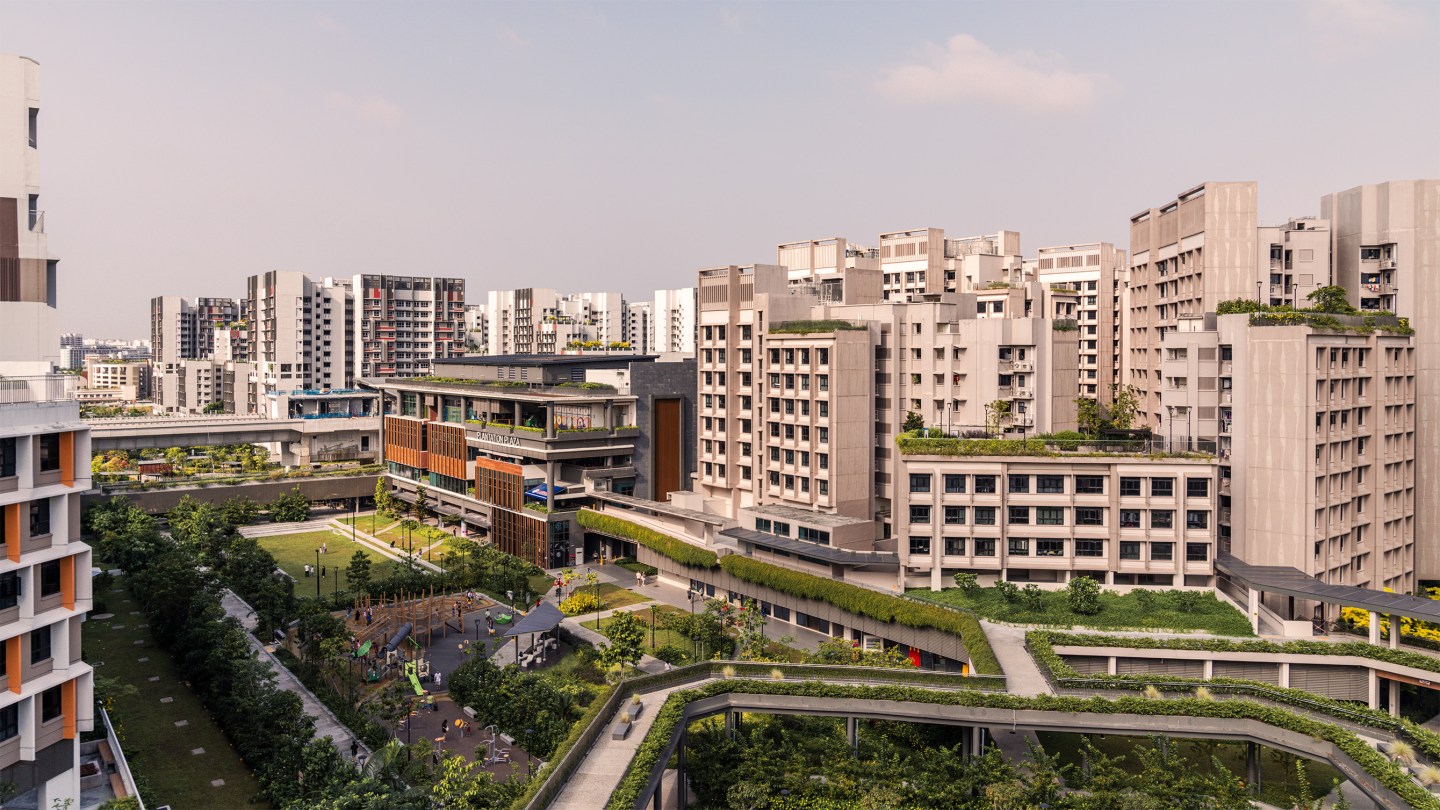
When Farhani Hanafi-Shuy was hunting for a home with her partner in 2019, she knew that there was one public-housing development that she was willing to wait years for. Tengah in Singapore’s West Region was pitched by the city-state’s Housing & Development Board (HDB) as its first smart and sustainable town. On what was once a military training ground, 700 hectares of land would be turned into a walkable, eco-friendly neighbourhood with about 30,000 residential units. Unlike most of the older public-housing estates, Tengah would be enveloped in nature, flanked by a 5km forest corridor linking the Western Water Catchment area to the Central Catchment Nature Reserve.
The development’s proximity to lush, layered landscapes was a big draw for Hanafi-Shuy. “It’s rare to come across a neighbourhood with so much greenery these days ,” she says. “That’s why this project felt like a perfect find.” The prospect of living in the first HDB town to be developed entirely from scratch in about 20 years was also attractive to her.
The ambitious project draws from Singapore’s long history of creating public housing. In the 1960s the nation faced an acute overcrowding crisis; the state responded by selling heavily subsidised government-built homes – known as HDB flats – through a 99-year leasehold system. In 2001 it introduced the Build-to-Order (BTO) scheme, under which new high-rise estates are constructed in accordance to demand. Buyers typically wait three to four years for their flats to be ready but the units are priced below market rates. Today about 80 per cent of the population lives in HDB flats, attesting to the public-housing system’s success.
Ten years after Tengah’s announcement – and following delays related to the coronavirus pandemic – half of its homes have been completed, with a town centre, clinic and train stations still to come. Twelve months since she finally moved in, Hanafi-Shuy says that the long wait was worth it. “Unlike in my former estate, everything that I need is now only a short walk away and the paths aren’t disrupted by cars,” she says. “You’re guaranteed to see a garden along the way.”
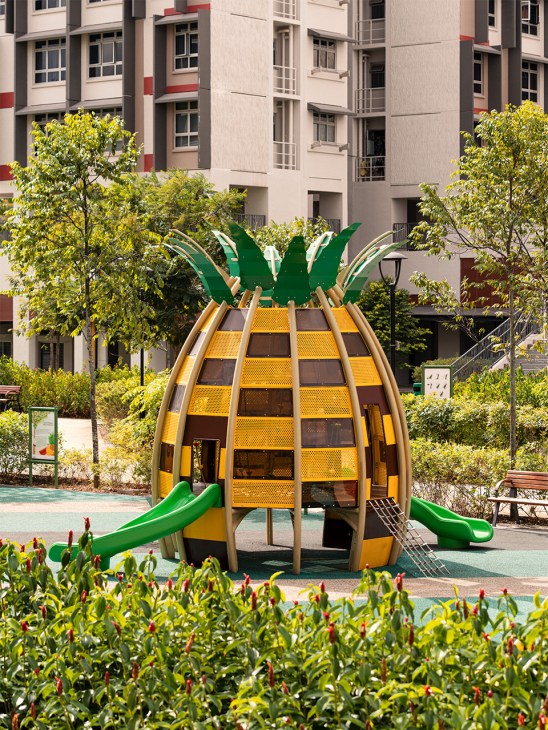
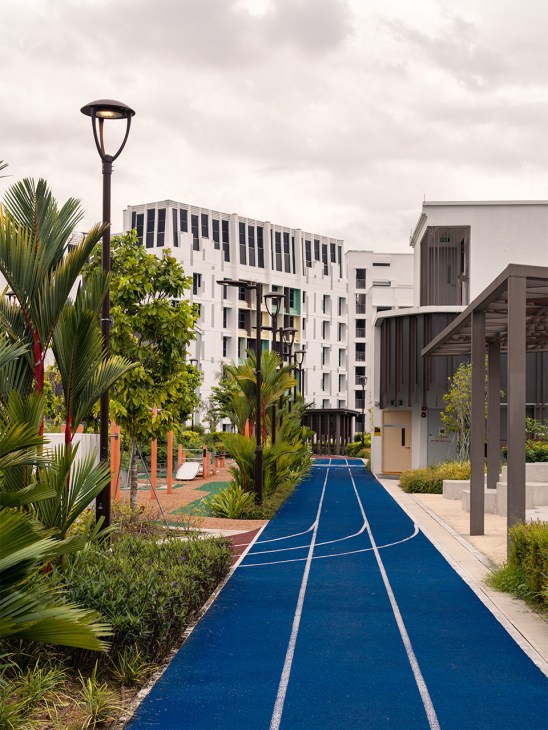
Exploring Tengah on foot leaves a striking impression. Two “community farmways” – 40-metre-wide, 1.3km-long tapestries of pavilions, nature-themed playgrounds and fitness areas, all amid luxuriant flora – blur the line between a housing estate and a park. The playgrounds are positioned beside the fitness areas and outdoor seating to foster a sense of community and strengthen ties between different generations. These spaces show how HDB’s role has evolved: while building affordable homes remains a central goal, it now also focuses on placemaking grounded in compassionate design.
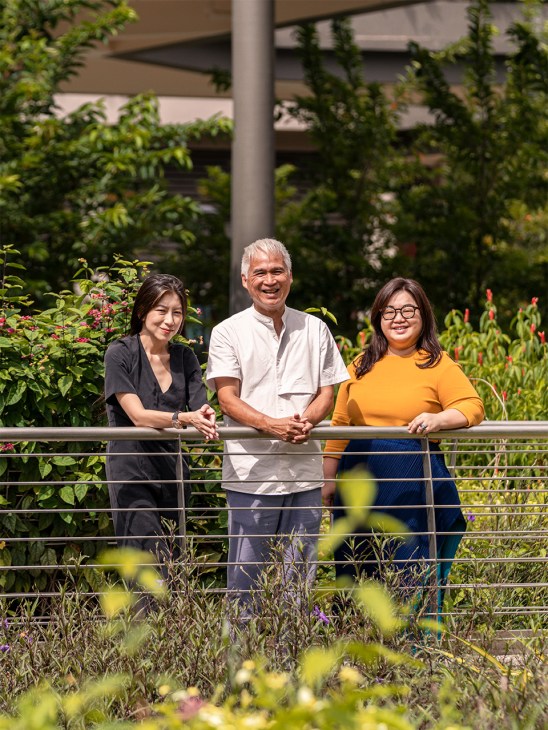
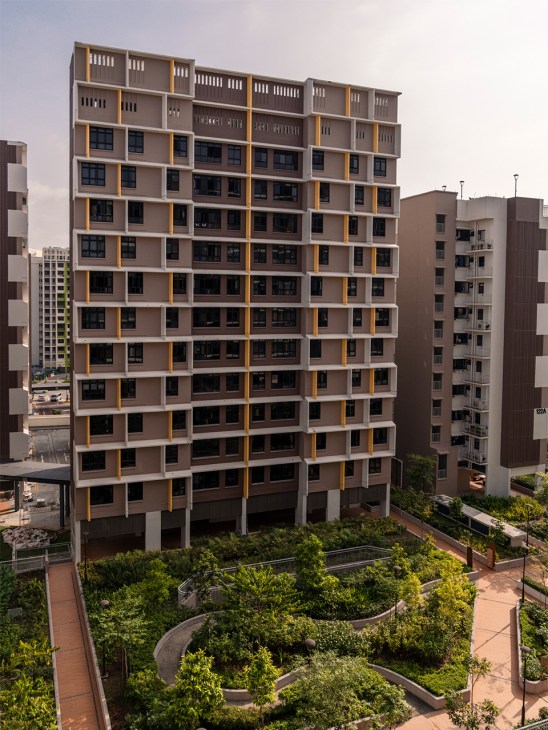
When Singapore-based multidisciplinary design firm DP Architects was tasked with shaping a 360-metre-long green spine within one farmway, it saw an opportunity to establish a focal point for the Plantation District (the first of Tengah’s five districts to be developed). “We drew inspiration from Singapore’s 1950s agricultural heritage by weaving pepper and nutmeg motifs into the estate,” says Guo Zi Ang, a senior associate director at DP Architects. At its heart is a diamond-shaped quadrangle featuring abstract pepper-leaf forms and an elevated platform that stretches outwards via sky bridges.
These walkways wind up towards pocket gardens dotted among the towers on the third storey. Though public spaces, commonly known as “void decks”, are usually found on the street level of HDB estates, DP Architects planted these leafy hideaways higher up to increase residents’ “sense of ownership” over them. “These raised ‘community living rooms’ offer more privacy, as non-residents are less likely to wander upstairs,” says Chai Yee Foo, the director of the practice.
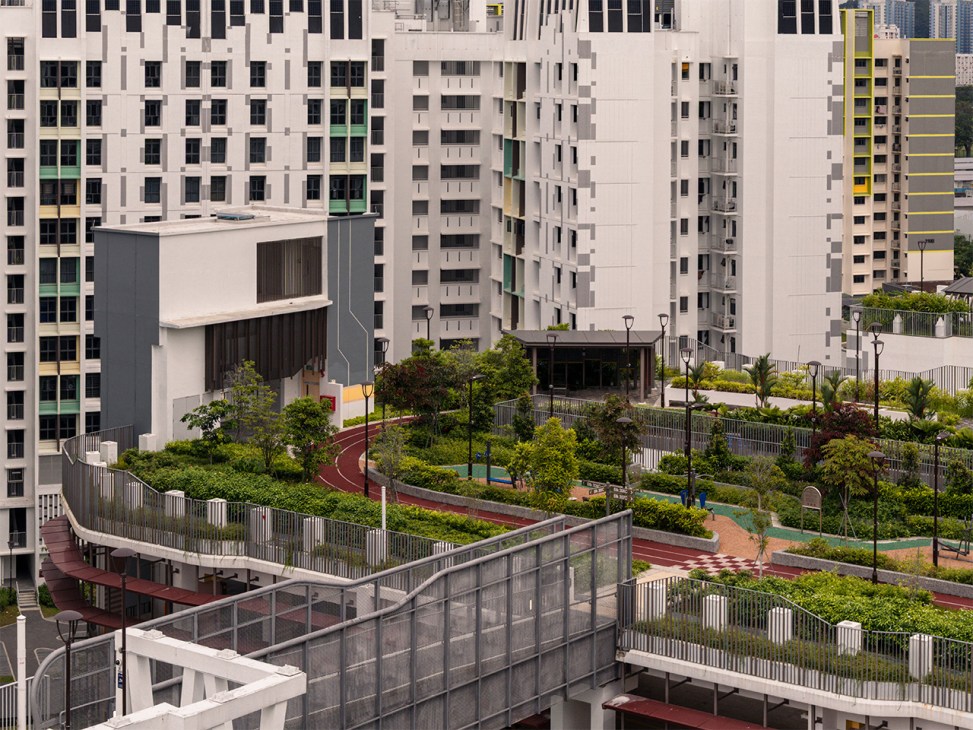
Another unlikely social hub is a diamond-shaped courtyard on top of a multi-storey car park, nestled within four housing blocks. “We have adapted the traditional courtyard concept – commonly found in Chinese homes and prewar shophouses – for a larger urban scale, in the hope of encouraging neighbourly interaction,” says Foo. It is flanked by terraced gardens that turn rainwater run-off into cascading waterfalls after a downpour. Tengah’s green patches don’t just look pretty; they serve as natural sponges to filter storm water and reduce the risk of flooding. Given the rise of flash floods, such design decisions have become essential parts of Singapore’s urban infrastructure.
HDB has also carefully considered the home interiors. When architectural designer Linwang Zhang moved into Tengah, she immediately noticed the recessed, double-glazed windows in her residence. The development is near a military airbase so these help to dull the rumbling of overhead aircraft. “This might be the first time that I’ve seen a combination of casement and sliding windows in an HDB home,” says Zhang. “They reduce noise and keep out wind-driven rain without compromising on ventilation.”
Every home also comes with features such as a pneumatic waste-conveyance system that uses high-speed air suction to transport household waste and recyclables to a centralised facility, improving hygiene and reducing the manpower needed for rubbish collection. Meanwhile, a system of smart sockets gives residents a breakdown of their energy consumption through an app.
Tengah’s most ambitious new feature is the development’s centralised cooling system (CCS). Billed as an energy-efficient alternative to conventional air conditioning, it circulates cold water from shared rooftop chillers to individual flats.
Such cooling and heating systems have been in operation in several of Singapore’s public and commercial buildings (including at the Marina Bay Financial Centre) since 2006 but not in residences. There were initial teething issues – some of the first residents apparently experienced leaks and condensation – but the SP Group, the company overseeing the CCS, quickly made the necessary adjustments. “Everything has since stabilised,” says Yen Ching Tee, the managing director of SP Home Cooling.
Ultimately, the success of any new town is measured less by its systems than by its people. And for Hanafi-Shuy, her experience of Tengah’s community has been worlds apart from that of her previous neighbourhood. “I didn’t know my neighbours in my old area but the people here have been very welcoming,” says Hanafi-Shuy. “I started playing pickleball at an open-air court nearby and the retirees are always ready to help beginners pick up the sport.”
Zi Yang Wong, who moved into Tengah with his wife more than a year ago, feels the same way. He quickly found like-minded people through a badminton group. “If I had moved to an older estate, I don’t think that I would have found such a great community,” he says. The town’s groundbreaking design and infrastructure have fostered residents’ strong sense of place. At a time of property crises across much of the globe, Tengah is a testament to what great public housing can be.
Tengah’s smart solutions:
Centralised cooling: Homes are connected to an energy-efficient, centralised cooling system that uses chilled water to remove heat – a cost-effective and less wasteful alternative to conventional air conditioning.
Pneumatic waste conveyance: Tengah’s automated waste-collection system uses high-speed air to transport household waste to a central location via an underground pipe network.
Technology-enabled homes: Residents can monitor energy use with a mobile app connected to a system of smart distribution boards and sockets.
Rooftop revival: The upper levels of a few multi-storey car parks have been transformed into recreational spaces, complete with running tracks, playgrounds and pavilions.
Rain gardens: Planted depressions in the land collect rainwater run-off from paved areas such as footpaths and remove impurities, before channelling the clean water into nearby streams, rivers and lakes.
Pocket gardens: On the apartment buildings’ third storeys and rooftops, you’ll find pocket gardens that serve as semi-private spaces for residents.
This article is from Monocle’s March issue, The Monocle 100, which features our editors’ favourite 100 figures, destinations, objects and ideas.
Read the rest of the issue here.