

Are seaplanes making a comeback? These next-generation aircrafts companies are poised to make a splash
In countries from Canada to Japan, carriers are seeking to redefine the capabilities of amphibious aircraft. Are we seeing the beginnings of a seaplane renaissance?
Aircraft that take off and land on water have long been costly, niche and reserved for hard-to-reach locations or luxury resorts. But advances in technology are sparking renewed interest. Could the next generation of seaplane finally be ready to take to the skies?
Norwegian company Noemi Aerospace’s emission-free model could kick-start a sea change – and at a fraction of the expense of its predecessors. “If we can deliver cost efficiency in a quieter, more luxurious modern aircraft that gives the passenger a better experience and is better for the environment – and allows the operator to make more money – we will have a win-win formula,” says Noemi’s founder and CEO, Eric Lithun. “The same aircraft can carry passengers, cargo or VIPs and be adapted for firefighting and military applications.” Noemi plans to offer its seaplane with conventional engines, electric motors and hybrid options to suit a variety of locations and available infrastructure. But like many upstart outfits, the company still has some runway to cover. Its first full-scale flight isn’t slated until 2027.
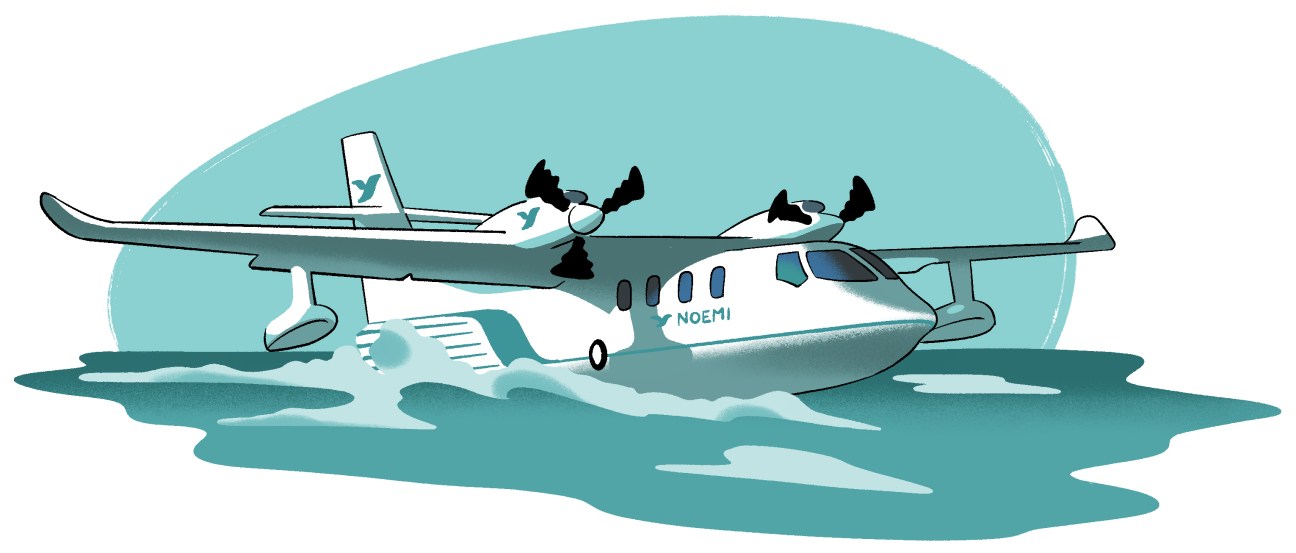
The problem isn’t one of enthusiasm but rather of economy. “Aviation is a difficult business in which to make money,” says Lithun. “And conventional seaplanes are three times more efficient at losing money,” he adds. Other turbulence to be circumvented includes the additional weight and drag created by floats and the maintenance costs that accompany saltwater environments (the sea wreaks havoc on engines). Make improvements in these areas, however, and the business case becomes much clearer – especially since it’s easier to maintain electric motors.
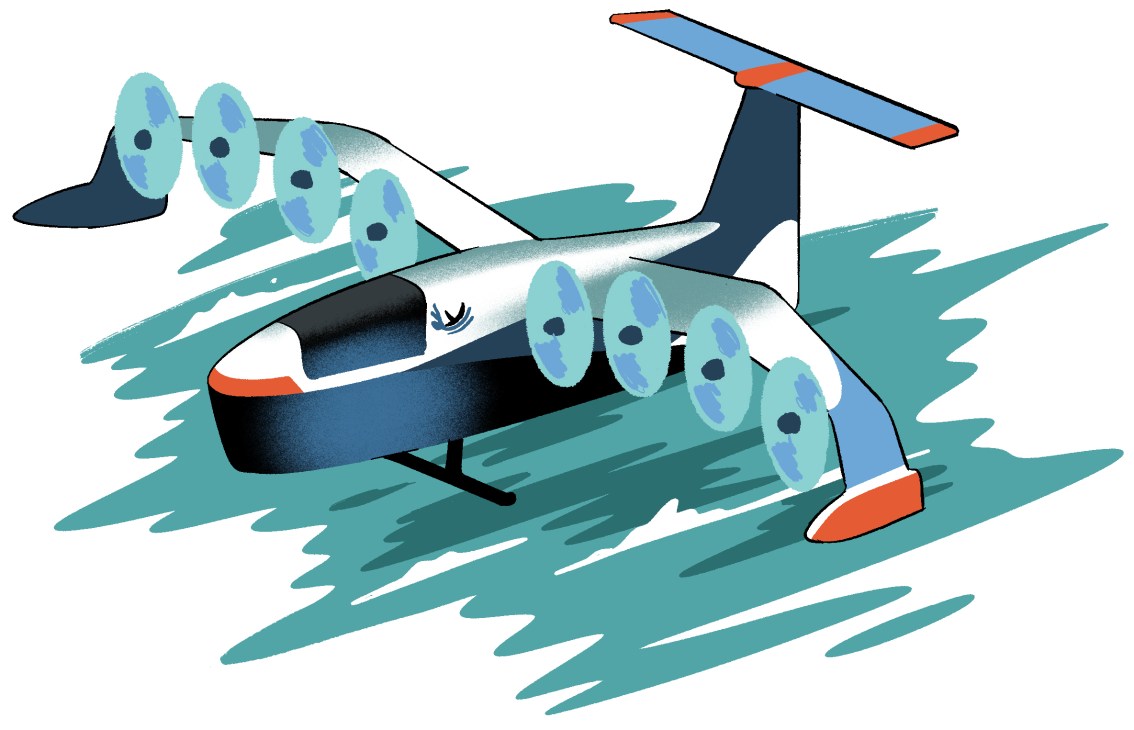
Other innovations in the sector are challenging the very definition of an aircraft. In Switzerland, Jekta is testing a scale model of a far larger amphibious vehicle: the 20-seat PHA-ZE 100. With this flying boat, the Payerne-based aircraft manufacturer has also been exploring hybrid, hydrogen-fuel-cell electric propulsion, which could provide greater range than batteries alone. A scale model has already undergone water and flight testing, though entry into commercial service remains several years away.
Across the border, Germany’s Dornier Seawings continues to put its distinctive, composite-hulled Seastar amphibious aircraft through its paces. And in the US, Regent has a vast manufacturing facility where it’s working with transport companies and carriers including Japan Airlines to build something that isn’t technically an aircraft at all: its electric “seaglider” is designed to skim a few metres above the water at speeds of up to 300km/h. In effect a boat that flies, the Viceroy Seaglider is certifiable as a marine vessel (indeed, it’s flown by mariners rather than pilots) but boasts some of the advantages of a seaplane. Like its future-facing counterparts, a full-scale passenger vehicle has yet to complete a proper commercial mission but optimism abounds. “This is the first of its kind,” Billy Thalheimer, the CEO of Regent, told Monocle at the 2025 Dubai Air Show. “You could argue that it’s really the first new mode of transportation since the helicopter – something that floats, foils and flies.”
More conventional seaplane models, such as the rugged Twin Otter made by De Havilland Canada, are capturing the industry’s attention too. The company has been buoyed by the production of its far larger Canadair waterbomber, the new DHC-515. Demand for the so-called “Super Scooper” has risen significantly as a result of the wildfires that have ravaged Europe this year. Production is now under way for clients in Croatia, France, Greece, Italy, Portugal and Spain. As wildfires become more frequent and severe, the emergency role of seaplanes is expected to keep increasing.
In theory, the seaplane market should be a simple sell. Conventional aviation is expensive and requires a lot of infrastructure. Airports need enormous tracts of land, runways and costly ground equipment, as well as lengthy journeys to and from the cities that they serve. Seaplanes, by contrast, bring much of their infrastructure along for the ride. If you can combine a suitable stretch of water with a dock, you’re 80 per cent of the way towards creating a suitable airport.
Nowhere has demonstrated this way of working better than the Maldives, where seaplanes are an integral part of the national transport infrastructure. Trans Maldivian Airways operates 66 Twin Otters and, at its busiest, more than 400 flights a day, connecting Malé with resorts scattered across the country’s atolls. Many of those islands have neither the space nor the need for a conventional airport.
Islands are ideal test locations for seaplanes but there has also been some success with the concept in urban contexts. Canada’s Harbour Air has built a network in and around British Columbia that connects cities such as Nanaimo, Seattle and Vancouver. Its downtown-to-downtown services demonstrate one of the seaplane’s most attractive qualities: it can bypass the hassle of using airports on a city’s outskirts. But other carriers such as Tailwind Air, which attempted to regularly connect Manhattan’s East River and Boston Harbor, have fallen by the wayside because of spiralling costs. Tailwind filed for bankruptcy in January.
“We don’t view seaplanes as niche,” says the CEO of Harbour Air, Bert van der Stege. “They’re an essential service for coastal communities and commuters, providing a fast and reliable connection. Seaplanes remain the best and quickest way to access remote and premium locations, whether in the form of scheduled flights to popular destinations such as Whistler or a private charter for a beach drop-off at some of the province’s most remote luxury resorts.”

So is this a seaplane renaissance, as new technologies redefine the capabilities of waterborne aircraft? Or another spike in floatplane optimism that’s doomed to disappoint? The answer isn’t clear. After decades of such services being confined mostly to places that have no realistic alternatives, manufacturers are asking whether updated propulsion, fresh designs and tweaked operating models can make them relevant beyond where they are strictly necessary.
There will always be reasons for caution. The history of aviation is littered with futuristic aircraft that attracted headlines and sizeable orders before disappearing. The common thread running through these projects, however, is that each positions the seaplane as a solution that uses existing infrastructure. It’s not a panacea but, with the right lift, the world’s waterways might begin to look less like obstacles than infrastructure that’s crying out to be used. All of which suggests that the hitherto bumpy ride for seaplanes could yet give way to a soft landing.
Companies to watch
Noemi Aerospace
Short for “no emissions”, this Bergen-based firm has created the TAC-1 prototype for electric seaplane flights. “The important thing,” says Noemi’s founder and CEO, Eric Lithun, “is that it’s one platform for multiple missions.”
noemi.aero
Jekta
Something exciting is happening in Payerne, a sleepy municipality in the Swiss canton of Vaud. Jekta is developing a 20-seat amphibious model, the PHA-ZE 100, with 10 electric motors distributed across its wing.
jekta.swiss
Regent
Rhode Island-based company Regent received €211m in Series-B funding in August 2026. Expect this to accelerate progress on its Viceroy Seaglider project – a ground-effect vessel that operates exclusively above water.
regentcraft.com
Three more to watch
Harbour Air
British Columbia’s Harbour Air is partnering with Washington State’s Magnix to build the world’s first fully electric commercial seaplane fleet. The companies are starting by retrofitting the De Havilland DHC-2 Beaver.
harbourair.com
De Havilland Canada
The De Havilland Twin Otter has been in the skies for 60 years but demand for the firm’s firefighting DHC-515, or “Super Scooper”, is what has been filling its order books this year.
dehavilland.com
Dornier Seawings
The Seastar is a composite-hulled twin-turboprop amphibious boat that German-Chinese firm Dornier Seawings hopes will move seamlessly on runways and over choppy waters.
dornierseawings.com