The creator of ‘fomo’ on how to make better decisions in times of uncertainty
Patrick J McGinnis coined the term ‘fear of missing out’ more than two decades ago. Today he shares tips for using it to become a better leader.
We’ve all felt it: the pressure to go somewhere despite being tired. The fear of missing out or “fomo” is as big a part of modern life and can lead to burnout or larger consequences, such as rash decisions being made without fully examining the options. The phrase can be attributed to Patrick J McGinniss, who coined it while at Harvard Business School in 2004. At the time, McGinniss used the uncertainty of the years after September 11 to take full advantage of Harvard’s social, academic and career-building offerings but realised that attending everything wasn’t a fulfilling pastime.
McGinniss, now a venture capitalist, podcaster and author, went on to write a book on fomo, which presents a framework for how to use the phenomenon to make better decisions. He has spent years studying how this feeling – and its sister affliction, fear of a better option or “fobo” – show up in business and government dealings, as well as how people can use the impulses to their advantage.
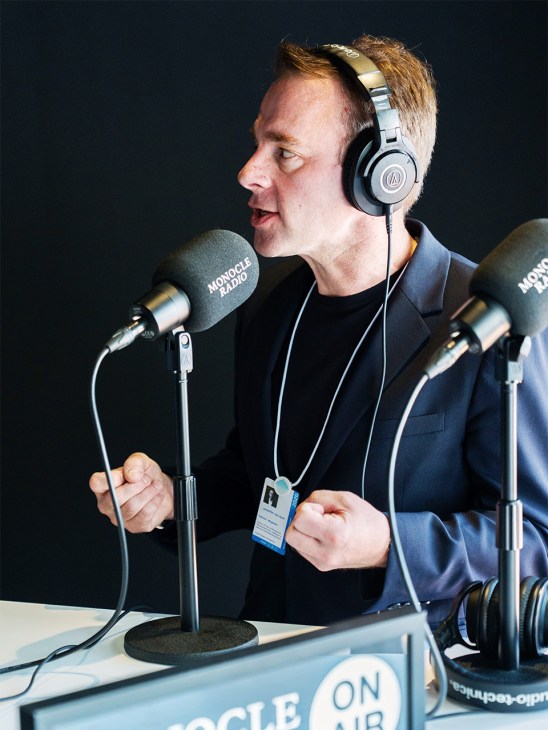
Monocle’s Andrew Tuck and Tom Edwards spoke to McGinniss at the World Governments Summit in Dubai. This transcript has been edited for clarity and length.
You invented the phrase ‘fear of missing out’ or ‘fomo’. Tell us a little bit about how it originated and why it has gained global traction.
I invented the phrase when I was a student at Harvard Business School. I arrived there shortly after September 11 and having experienced that in New York at the time, I remember thinking, ‘I’ve got to live every day like it’s my last.’ Harvard Business School is an incredibly choice-rich environment, so I went to every class, every job interview, every party – and at some point, I realised that all of that opportunity was making me anxious and I had a fear of missing out. I shortened [the phrase] to fomo, then wrote an article in the school newspaper in 2004 and moved on with my life. Years later a journalist traced the phrase back to me and the rest is history.
In recent years you’ve elevated the phrase to talk about how it impacts government and business decisions. Sum that up for us.
Over the last decade and a half, I’ve spent a lot of time studying fomo and talking to big decision makers in business, finance, marketing and government. What I have seen is that this is deeply embedded in our psychology. As a result, when people feel fomo, even though they may not recognise it, they see an urgent opportunity in a time of uncertainty and they feel like they have got to move quickly.
The easiest way [to do that] is to copy somebody or do something that is not very well thought out. As a result, people put policies in place that don’t work. You end up having a situation that is sub-optimal that oftentimes wastes money and time.
What you’re saying is that fomo can do serious, long-term structural damage on a governmental or international level. But if you don’t move at a reasonable speed, you risk falling behind. How do you know which gear to be in?
What tends to happen when we make decisions based on fear is that we end up with sub-optimal outcomes. The challenge that we have to face is: how do we get out of the fear place and into the facts place? [My first piece of advice is:] step back and think about your priorities. Gather data from other people. It’s not fomo to observe other places or to bring in experts. [Engaging in] evidence-based decision making, even in times of uncertainty, [can produce good] ideas.
When you formulate a policy, ask: would I have formulated this policy if country X had not done that thing? If you are simply looking at other countries as the basis [for our decisions], then we’re in a bad place. I always tell policymakers that a lot of decisions are reversible. So feel free to move faster on the things that you can actually change in the future. When it comes to something that you cannot [change], put on the brakes, gather more data and come up with a hypothesis.
If you communicate the trade-offs to the general public, you normalise uncertainty. [When] you come up with policy objectives to communicate, you will bring people along with you. You may be wrong but you will have [developed those objectives] in a way that is transparent and convinces people that you have put some thought into it.
It seems like fomo could be useful to make decisions about where to eat for dinner but could be dangerous for, say, a venture capitalist who needs to handle millions of dollars quickly. How might people incorporate this framework to making decisions in their own lives?
I think about high-stakes, low-stakes and no-stakes decisions. No-stakes decisions are [ones] such as, where am I going to go to dinner? I simply outsource [those decisions] to the person who loves choosing or to ChatGPT. For low-stakes decisions, which are things that I will probably not remember [in detail] having decided in a couple of months, I go to third parties and experts; people who [who have niche expertise], such as the guy who wants to help you choose your television.
I like to think of decisions like investments [and consider three crucial questions]: how am I allocating my time, money and attention? What is the due diligence I must do to build a case? And [can] I surround myself with a diverse set of people to question me? We all know that diverse teams make better decisions.The goal is to surround yourself with people who won’t just agree with you.
That has always been my goal, I have a tonne of fomo every day. My work is to manage my own fomo and all of yours.
In addition to fomo, you’ve developed a sister phrase: ‘fobo’. Tell us more about that.
Fobo is something that listeners and readers of Monocle will probably feel deeply. It [stands for] ‘fear of a better option’. While fomo is something that lots of people have, it can be very frivolous. It’s something that people can manage. Fobo is something that tends to increase when you have more resources and options. People who are successful tend to deal with fobo.
When you have fobo, you have acceptable options in front of you but you’re looking for the perfect, riskless decision and you keep on looking. We live in a time when people have more options than ever before. I call this an affliction of abundance. People have worked very hard for the things that they have but they cannot enjoy them when they have fobo. Nobody ever says, ‘What a great [indecisive] leader.’ It is our challenge in the modern age to be decisive, to know what we want and then to choose those things. Fobo pulls us away from that. [It’s important to] have an opinion and to express it. And you must listen to the other side. If you do that, not only will you learn something and conquer your fomo and fobo but you’ll probably make a better world and solve some problems.