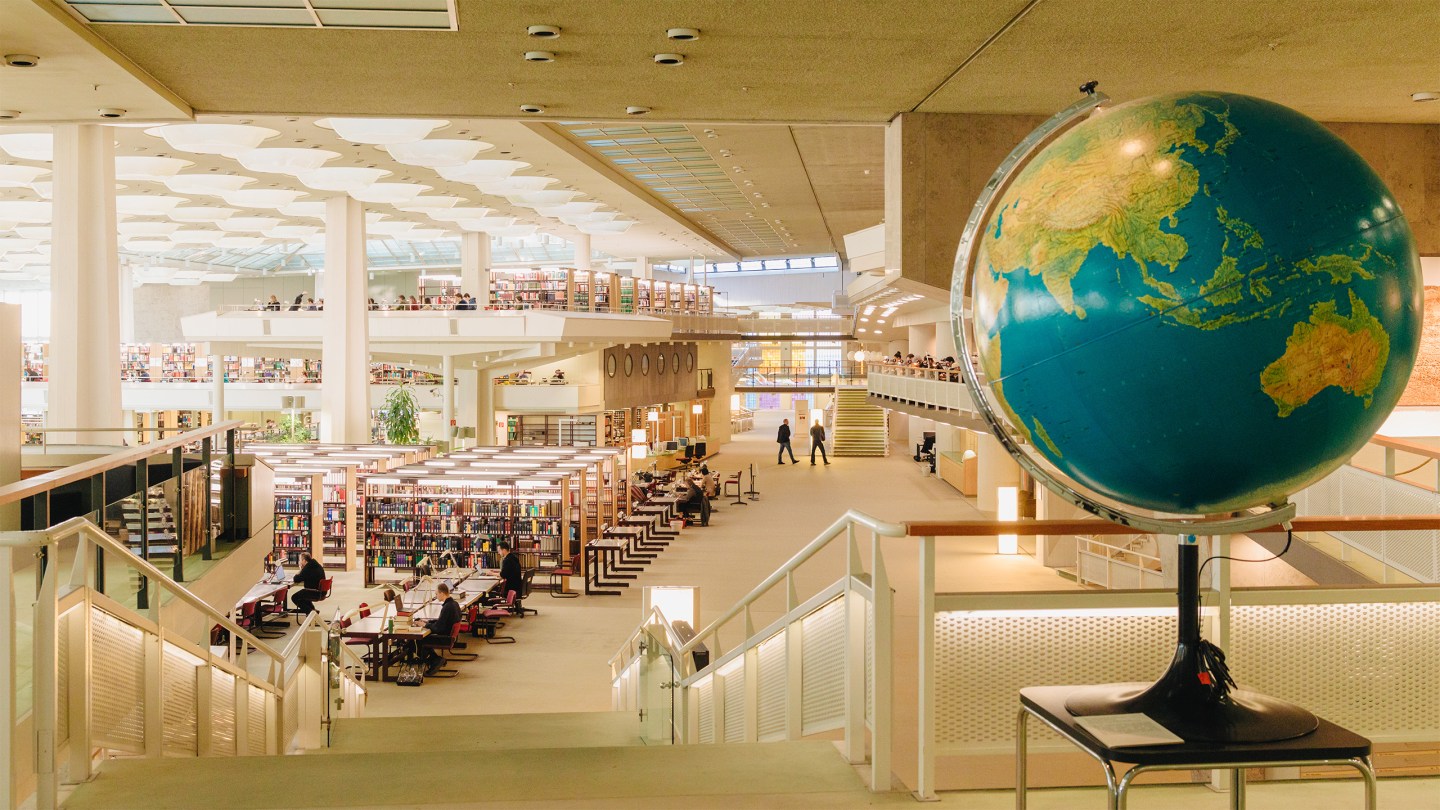
A new chapter for Berlin’s Stabi, as a decade-long overhaul seeks to restore Scharoun’s civic landmark
We settle down in the spacious reading room of Berlin’s beloved public library, as it undergoes a renovation that will finally deliver on its 1960s ideals.
Known as the Stabi, Berlin’s public library was built by West Germany in the hope that it would one day be a focal point for a reunited city. With its spacious reading rooms and five million books, it has since become a favourite place to study for Berliners. A a renovation, set to take more than a decade, will refresh the original design and add an entrance from the east, delivering on its 1960s dream.
Because it grants people from all walks of life access to knowledge, a public library can be seen as a reflection of the value that a society places on education. Such structures are among the most important civic buildings a testament to intellectual freedom, transparency and equity.
It’s these qualities that West Berlin’s Prussian Cultural Heritage Foundation looked to endorse when it built the Staatsbibliothek Potsdamer Strasse. After the partitioning of Berlin in 1945 and the construction of the Wall in 1961, most of the city’s old cultural institutions – the museums, theatres, opera house and state library – ended up in the Soviet-controlled territory of the German Democratic Republic. In response, West Berlin’s technocrats decided to build their own cultural centre from scratch on the razed no-man’s-land next to the Wall.


Called the Kulturforum – and still standing today – it was constructed as a projection of the West’s cultural heft and in the hope that such institutions would one day be the focal point of a united city. The site is home to Mies van der Rohe’s Neue Nationalgalerie, as well as the new Philharmonic, but the largest building by far is the Staatsbibliothek (Berlin State Library), which is now known as the Stabi.
Work began on the golden-hued “treasure house” in 1964 when Hans Scharoun, who had just completed the much-acclaimed Philharmonic nearby, won a competition. The Bremen-born architect had an aversion to symmetry and right angles, conceiving the library as one large reading room with a three-storey-high ceiling and a maze of balconies and mezzanines spanning most of its 230-metre length. Its façade, clad in anodised, champagne-gold aluminium panels, is punctuated by apertures that flood the interiors with natural light. It’s an effect enhanced by a complex geometric ceiling grid similarly dotted with fibreglass bubbles that filter daylight downward, casting an even, glare-free glow over the study desks. Construction took 11 years and Scharoun died before the building’s completion (the project was finished by longtime collaborator Edgar Wisniewski).
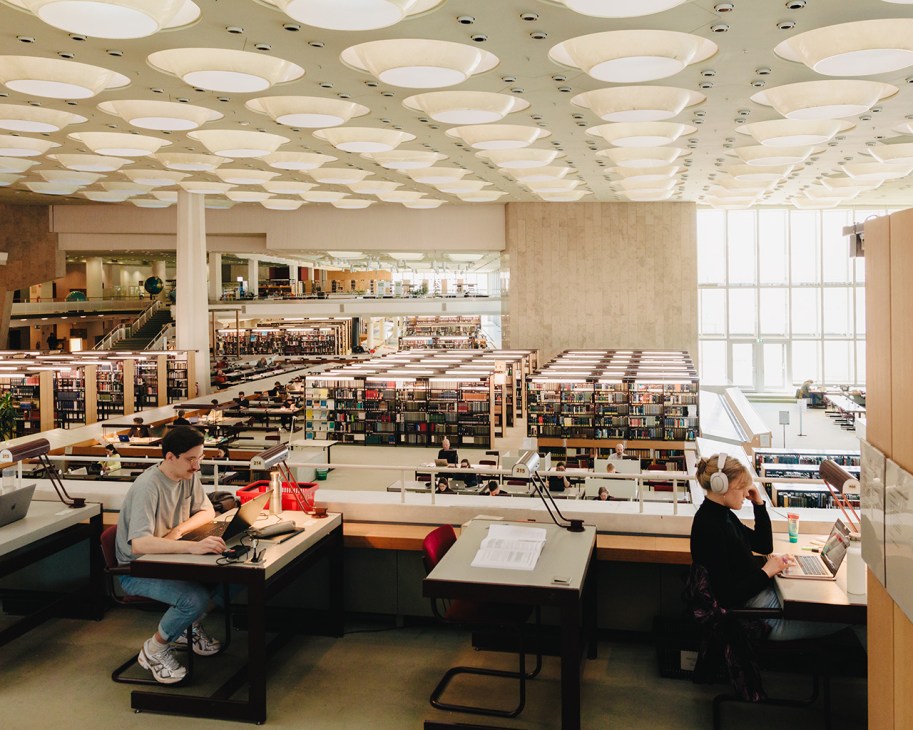
Scharoun never got to see the Stabi win global recognition from world-class architects. Kazuyo Sejima, of Pritzker Architecture Prize-winning firm SANAA, recently took a class of Japanese students to visit Scharoun’s buildings on the Kulturforum. The Stabi is also one of Europe’s key depositories of valuable documents. When the Fondazione Prada in Venice organised a sweeping survey of historical diagrams, the library was the main lender of artefacts. But, most importantly, it’s Berliners’ favourite place to study, with people of all stripes attracted by the long shelves of legal tomes or, more likely, the Stabi’s starring role in the 1987 Wim Wenders film Wings of Desire. (In one scene, the middle-aged angel, played by Bruno Ganz, roams the reading room, leaning over the desks to listen in on students’ thoughts.)
“In Berlin, we have little beautiful architecture, so it’s rare to have this kind of space,” says Filippo Weck, who started frequenting the library in 2020, when he decided to tackle Marcel Proust’s In Search of Lost Time. “You can’t really be a serious person if you haven’t read it. I needed a quiet space with no distractions.”
On his Mondays off from his job at art gallery Buchholz, Weck headed to the Stabi in the morning, left his phone in a locker, sat down near the windows on the lower level of the reading room and made his way through Proust’s seven volumes. It took years but it’s a routine that he is continuing, moving on to Letters from Prison by Italian philosopher Antonio Gramsci.
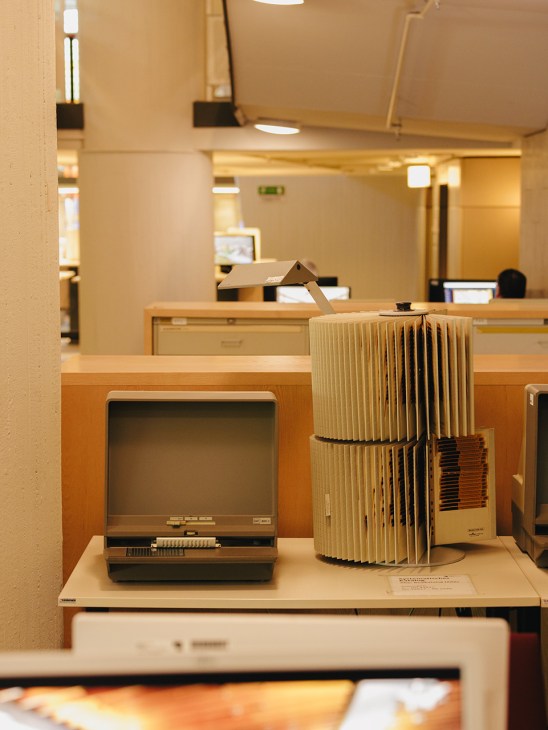
When Monocle visits, the Stabi has welcomed a mix of readers into its soaring, 900-capacity general and specialist reading rooms. Scholars are working on papers and doctoral students type theses, taking their lunches and cigarette breaks in a small park outside (“Whenever one of my friends complains about dating in Berlin,” says Weck, “I tell them to go to the Stabi”). This, despite the fact that after decades of use, wear and tear on the Bücherschiff (or “ship of books”) is starting to show.
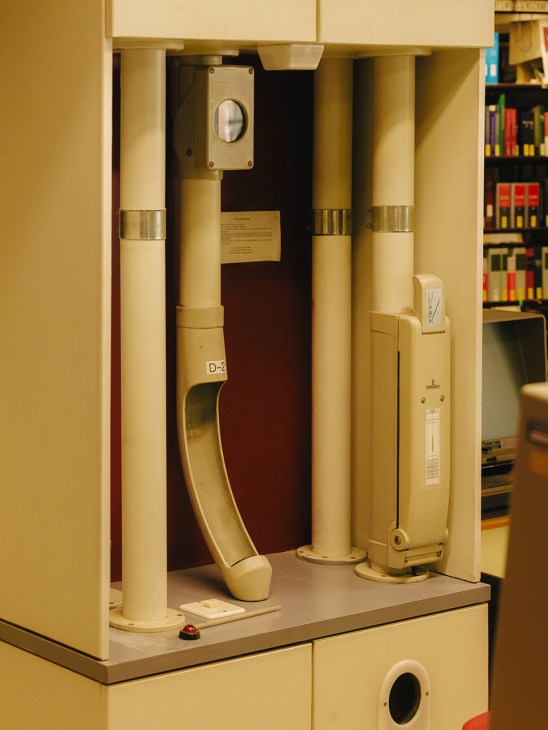
Various renovations and refurbishments have taken place over the years, largely to expand the library’s storage capacity. But the information desk is still equipped with clunky 1990s computers, many of the lockers are out of function, some of the ceiling lights flicker and the moss-green floor moquette has developed a greyish hue. The café, meanwhile, has a cigarette machine and unapologetically serves bockwurst with potato salad for lunch.


For years, Berlin has been preparing for a major renovation of the whole heritage-protected building and has slowly been moving the 5.4 million books and periodicals that it houses elsewhere. The renovation is expected to commence in 2030 and will take 11 years (a time span that is not exceptional in Berlin, where the Pergamonmuseum is currently expected to fully reopen in 2037), with the building closed to the public for several years. All of the interiors will be stripped away, the cladding replaced and there will be key changes to the building’s entryways and circulation.
“For me, it is a symbol of democratic architecture,” says Stephan Schütz, partner at Hamburg-based architecture firm GMP, which has been entrusted with the renovation. “You don’t have any clear and straight axes; you always have new perspectives when walking through, and there are no dominant materials.”
Schütz has been working for more than seven years in preparation. In the vast ground floor lobby, GMP will install original furniture and lighting designs by Scharoun – which can currently be seen at the Philharmonic – and create group-working spaces accessible to the public. In the rest of the building, most objects will simply be cleaned and put back or, like the wall-to-wall carpet, refitted according to the original design. “It is more of a refreshment than a real change,” says Schütz. “I think that people will come in after and say that everything is the same.”


There is, however, one intervention that will carry a lot of symbolic heft given that Scharoun designed the library to be oriented entirely to the west, with windows and entrances looking out over the Kulturforum. “This building always had one clear public direction,” says Schütz, explaining that its eastern side was closed off for the simple reason that, at the time, there was nothing there.
Now, right next to the library is Potsdamer Platz, one of the city’s main hubs through which about 100,000 people pass each day, with Pritzker Prize winner Renzo Piano’s Theatre am Potsdamer Platz now adjacent to the building. In response to this changed context, GMP will punch out a new main entrance to the library on this side, building a café and a new, open-air reading terrace. Open to both east and west, the Stabi’s layout is set to accurately reflect its place in the heart of Berlin, finally uniting the city in a powerful display of civic architecture.