Australia wants tech giants to fund journalism – but is it too little, too late?
The country’s efforts to rein in the tech giants and safeguard journalism for the sake of democracy is a noble endeavour – but the dice are stacked in the social-media giants’ favour.
Every time that Donald Trump wades into the press pool we’re reminded that the First Amendment exists only to blow hot air into his already ego-filled floaties. Use it to criticise, satirise or contextualise him or his retinue of risible sycophants and you’re in the deep end. But you don’t have to be Jimmy Kimmel or The New York Times to attract Trump’s scorn for free speech and the Fourth Estate, which he has described as “enemies of the people”. This is no longer even a domestic issue, it’s an export.
Last week, Australia’s prime minister, Anthony Albanese, risked a fresh round of Trump tariffs by moving forward with the proposed News Bargaining Incentive (NBI), a plan to prise revenue from US tech giants in order to fund Australian journalism. But is this a clever policy to shore up democratic institutions or a lightning-before-death effort that could just as easily expedite the decline of traditional media?
The news comes just days after the US president threatened the UK, on the eve of King Charles III’s visit to the White House, with a “big tariff” over its tech crackdown. Unlike the UK’s digital services tax, which it introduced in 2020 and imposes a 2 per cent levy on the revenues of several tech behemoths, Australia’s NBI requires the likes of Meta, Google and Tiktok (among other large social media and tech platforms) to make commercial deals with Australian media outlets or be forced to pay a 2.25 per cent charge on local revenues. If voluntary deals aren’t struck, the Commonwealth will collect the levy and pass it on to media companies.
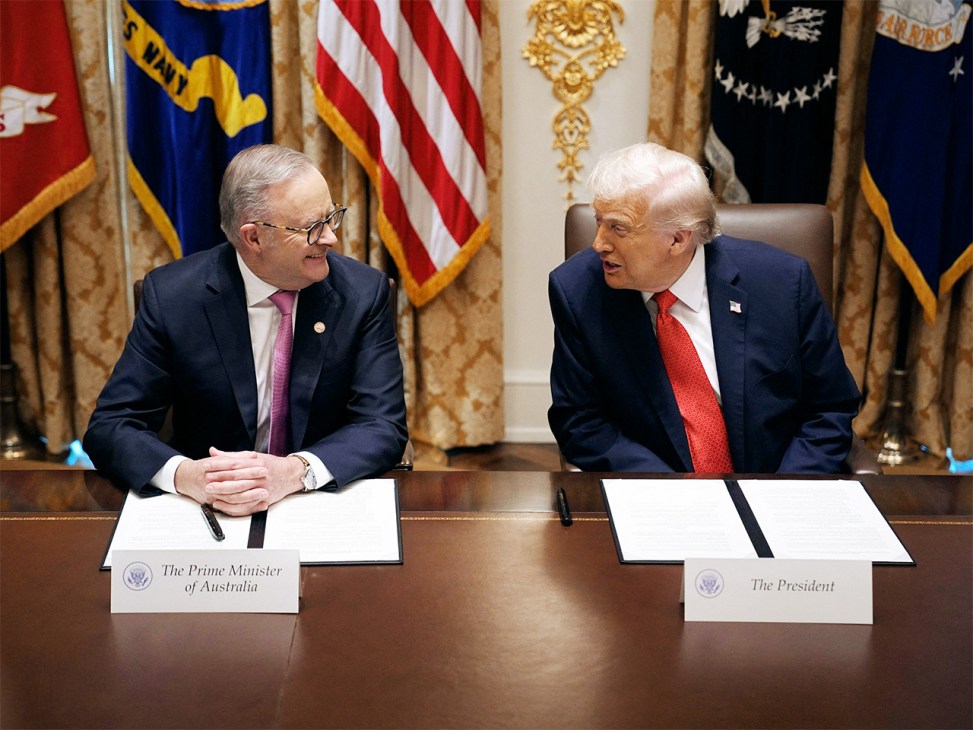
The US has already threatened countries that “discriminate” against its tech companies by demanding that they pay for the content that they use, hence why the Albanese administration is doing its best to show that such a measure is not a tax. “This is not about government revenue,” says Albanese. “Every single dollar will go back to journalists. We think that investment in journalism is critical to a healthy democracy. It matters.”
It is a moral stance that will mist up the eyes of even the most hardened sub-editor. But the snag is that the policy rests on an assumption that no longer holds: that tech platforms still need the news to keep people around. The harsh reality is that they increasingly don’t. Canada’s Online News Act went into effect in December 2023 and Meta has been blocking news links on Facebook in the country ever since. Yet the expected slump in engagement failed to materialise. It turns out that people on Facebook are more interested in AI-generated slop, conspiracy theories and the photo dumps of their racist relative’s recent Caribbean cruise than they are in good journalism or the news of the day.
Just like AI, these tech giants rose to prominence – in no small part – on the back of journalistic content. Now they’re big enough to do without the news and so the press is left holding nothing but its integrity (a noble commodity but increasingly hard to monetise).
One thing is certain, Trump is no friend of the free press and he made his feelings quite clear at April’s White House Correspondents Dinner. Ostensibly, the event is when Washington honours the First Amendment by celebrating journalism and letting a comedian roast the president in a symbolic display of executive humility before the Constitution. Not this year. Instead of a comedian who might tell the truth, Trump opted for a magician who deals in deception. The president sat gloating over a press corps whose members he has threatened to imprison and whose organisations he is actively suing. Meanwhile he has turned the Pentagon into a closed shop, made a mockery of CBS and defunded NPR, PBS and Voice of America.
The risk of Australia’s stance is not only that Trump will level tariffs at the nation but that the Australian government’s stick for tech giants will backfire. Meta already ditched its commercial deals with Australian publishers in 2024 and rather than pay to play, the company will probably block the news on its platforms as it has in Canada. The result would be a reduction in web traffic for already struggling Australian media outfits, further broadening the vacuum in which misinformation proliferates.
All of which leaves Albanese on a sticky wicket. The NBI is a principled if flawed attempt to rebalance the relationship between tech platforms and the press. But it might also be strategically naive. If the platforms refuse to play, Australia will be left not only facing possible tariffs from Washington but having also confirmed that you can’t save journalism by passing a hat around Silicon Valley.
Tech conglomerates should pay to support democracies where free speech gives everyone a voice from which they can profit. But while the NBI could’ve been a game changer, once, unfortunately it is no longer 2016. The tech sector hijacked revenues from traditional media so long ago that it has no intention of paying reparations now. Meanwhile, over on the platforms themselves, conspiracy theories abound as to whether Trump plotted the lone-gunman attack on the WHCD to substantiate his desire for a ballroom so narcissistic that it would make Napoleon blush. The event’s low security, Trump’s late agreement to attend (he has previously avoided the dinner) and his general nonchalance at apparent gunfire are all highly suggestive. Perhaps there is some sort of institution with a history of exposing presidential scandals that could investigate? Perhaps, as Albanese points out, journalism matters.
Blake Matich is Monocle’s digital sub editor. For more opinion, analysis and insight, subscribe to Monocle today.