How Vienna’s Jugendstil revolution built a design legacy that endures
The Austrian capital’s vibrant creative identity is all thanks to an artistic movement that flourished more than a century ago.
Vienna Design Week is the perfect occasion to reflect on the Austrian capital’s design pedigree, one that truly came into its own in the late 19th and early 20th centuries. The city is often described as grand but a little dowdy – fair enough, given that it once sat at the centre of an unwieldy empire, with an ageing emperor on the throne (Franz Joseph I, he of the magnificent moustaches). Yet it was perhaps in the waning years of Austria-Hungary, in the decade or so before the First World War, that the city found its truest expression: the gilded architecture of Otto Wagner and the languorous, decadent canvases of Gustav Klimt and Egon Schiele – grand, yes, but never dowdy. “Vienna 1900”, as the curators like to call it, was also an intellectual powerhouse: the world of Freud’s freshly minted psychoanalysis and Wittgenstein’s gnomic philosophy.
Klimt and Wagner were early members of the Secession, the breakaway art movement established in 1897. Its headquarters was a gleaming white pavilion by Joseph Maria Olbrich. Capped with a dome of golden laurel leaves, it remains one of the purest statements of Jugendstil – the German term for art nouveau, often used interchangeably with Secession itself. Inside hangs Klimt’s celebrated “Beethoven Frieze” – one of the style’s supreme expressions in the visual arts.
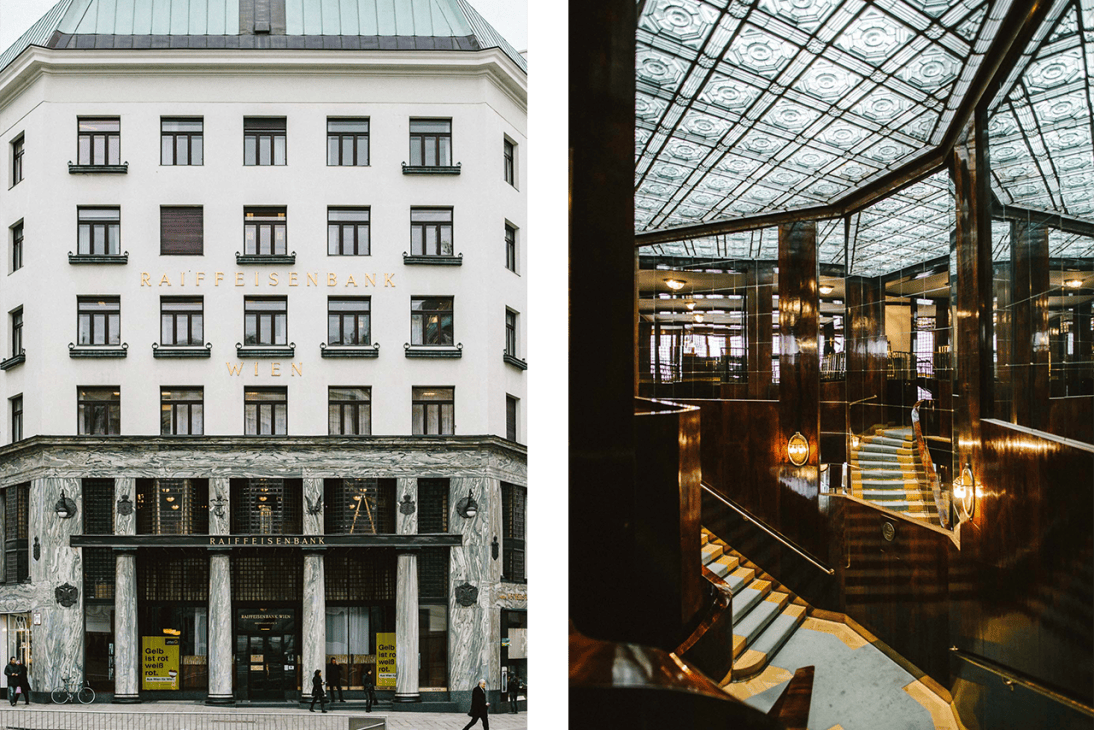
Wagner, for his part, created architecture that still shapes the city’s fabric. His pair of residential blocks by the Naschmarkt, just down the road from the Secession Building; his station pavilions for what would become the Vienna U-Bahn; and the luminous Church of St Leopold, rising from the grounds of a former hospital at the city’s edge, all exemplify Jugendstil’s taste for floral motifs, angelic statuary and wrought iron. Adolf Loos exemplified the era’s countercurrent, preaching a radical simplicity and famously declaring all ornament a crime. His Looshaus (pictured), notorious for its bare façade, caused a scandal among contemporaries and is now regarded as a precursor to the modernism of Le Corbusier and Mies van der Rohe.
Design, too, was remade. In 1903, fellow Secessionists Koloman Moser and Josef Hoffmann established the Wiener Werkstätte co-operative. Working across jewellery, furniture, interiors, fashion and glassware, their characteristic geometries and refined forms would go on to influence the Bauhaus. One of the Werkstätte’s most ambitious commissions (and a perfect expression of its cross-disciplinary approach) was a sanatorium at Purkersdorf, on Vienna’s fringe, designed by Hoffmann. He oversaw every detail, down to the chairs, including his celebrated Sitzmaschine (or machine for sitting), a reclining armchair with a trademark grid design. This and other pieces are now held in collections worldwide, not least in Vienna’s own Museum of Applied Arts.
But not everything from that age has been relegated to the museum. Furniture-maker Wittmann still produces Hoffmann’s Kubus armchair, while glassmaker J & L Lobmeyr continues to manufacture Wiener Werkstätte-designed glassware. More broadly, that fin-de-siècle spirit – a sense of stylistic renewal coupled with a return to craftsmanship – continues to animate Vienna’s artists and artisans today. Now the city’s contemporary design scene is flourishing – but that’s only possible because it was built on a solid foundation.
Alexei Korolyov is Monocle’s Vienna correspondent. For more news and analysis, subscribe to Monocle today.