Ateliers Marcel Carbonel, the figurine workshop carrying on the legacy of Provençal santons
‘Konfekt’ meets the brothers running Ateliers Marcel Carbonel, a workshop working to preserve the Provençal Christmas tradition of santons alive.
“It feels a bit like playing with Lego,” says Baptiste Vitali as he opens drawer after drawer filled with colourful clay figurines. Vitali is showing Konfekt (Monocle’s sister publication) around Ateliers Marcel Carbonel, a 90-year-old workshop in Marseille that he and his brother, Hugo, took over from the founder’s family in 2021. The atelier’s niche is the santons of Provence: intricate figurines used in the nativity scenes that many French families create in the run-up to Christmas.
With his stylishly stubbled face, Vitali looks more like a start-up CEO than the head of a history-steeped craft studio but when he explains to Konfekt what attracted him and his brother to this workshop, he speaks with passion and commitment. “We wanted to keep a local institution and tradition from dying,” he says.
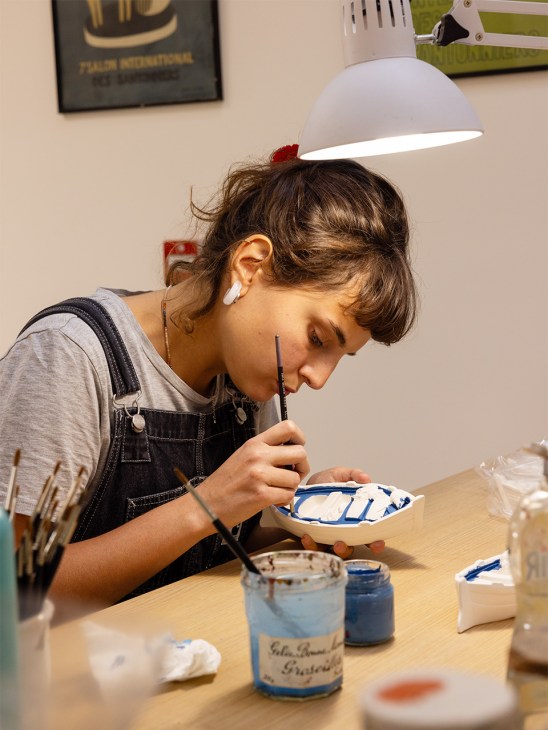
Santons date back to the French Revolution, when political leaders closed churches and banned the celebration of Midnight Mass. To make up for the loss of public Christmas festivities, the people of Provence began displaying nativity crèches at home, populating them with miniature characters that were modelled from papier-mâché, breadcrumbs, cardboard and cork, then, later, red clay. But rather than sticking to the biblical line-up and landscapes, they included villagers whom they encountered in their everyday lives: the fisherman proudly carrying the catch of the day, the milkwoman, the dapper mayor and the chic arlésienne with her chignon hairdo.
These tableaux of Provençal life quickly gained popularity across France, with hundreds of ateliers in and around Marseille catering to the nationwide demand for santons during the craft’s heyday. Today, some 120 ateliers remain in the region and, though many pieces are passed down from generation to generation, there’s still plenty of demand for new ones – be it to add to the family collection or to start a set from scratch.
When Konfekt visits, the atelier is in the bustle of the pre-Christmas season. With a team of between 15 and 25 staff, depending on the time of year, it’s one of the largest santon workshops in Provence. Unlike with most of its competitors, no part of the process is outsourced to home-based artisans. “In a few weeks, it’s likely that we’ll come in on a Monday morning and find 1,000 online orders waiting for us from the weekend,” says Vitali, looking at his watch to check the date. “We have to ensure that our stock is ready before the rush hits. In the past, santons were very roughly made. But Marcel Carbonel attended a beaux-arts school so he helped to elevate the craft.”
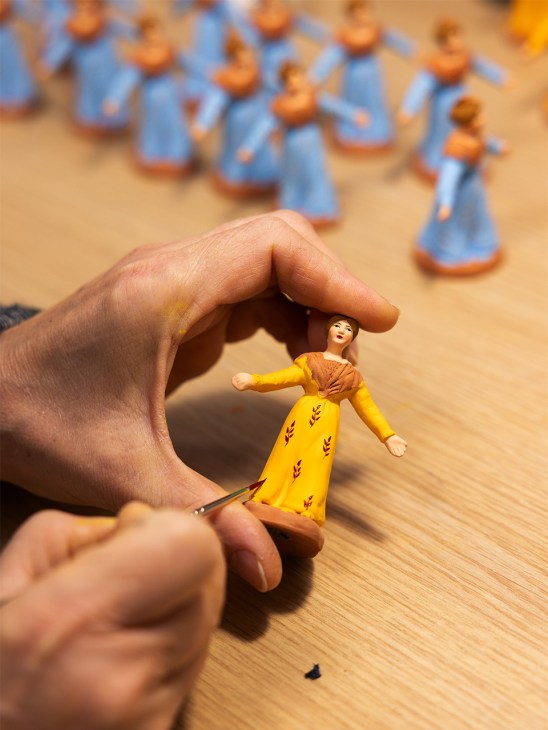
The founder’s background in fine art also explains why all of the gouache colours are made in the workshop, following recipes originally conceived by Carbonel. The result is a palette of vibrant yet nuanced colours that shop-bought paints could never achieve. When these are paired with the original mother moulds, it means that a figurine made today can look exactly like one from 90 years ago.
Despite the continuity of the collections, new models are introduced every year. For 2025, the additions are a pregnant woman and a future father holding a wicker bassinet. Because there are many collectors of the atelier’s work, these additions are usually the year’s bestsellers. Meanwhile, people tend not to replace the santons that they already have, regardless of their condition. “Even if they are missing an arm, they are still kept because they remind you of that Christmas in 1980 when your son dropped Joseph as a little boy,” says Vitali. “A santon is a memory.”
This article is from the journalists at our sister publication, Konfekt. The perfect gift of sharp dressing, drinking, dining, travel and design. Explore gift subscriptions here.