Can good design support learning? A Catalonian kindergarten is trying to find out
Architecture firm Sarquella + Torres led the redesign of the school complete with extra-wide hallways that pull double duty and a dragon head-shaped waterspout hanging from the eaves.
Escola Casa Nostra sits near the shores of Catalonia’s Lake Banyoles, a 25-minute drive from Girona and a short bike ride from the small town of Banyoles. It traces its origins to the 1920s, when Catholic laywoman Magdalena Aulina launched educational initiatives for local working women and children. The school itself was officially founded in 1967, admitting both girls and boys from the outset.
Architect Pau Sarquella, who attended the school, led its recent redesign. “I was able to see the project through the eyes of the children because I was once there with those same eyes,” says Pau. “Memories came back and that helped us design something special.” After graduating from architecture school in Barcelona, Sarquella moved to Thailand in 2015, where he and Carmen Torres built their first kindergarten in Dum Yai, a village near the border with Laos, in 2018. The next year, they returned to Spain to found Sarquella Torres in Sarquella’s hometown of Banyoles.
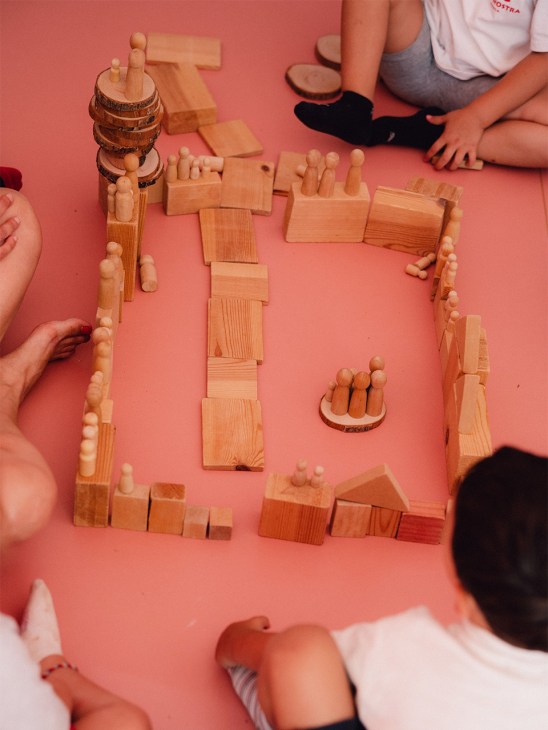
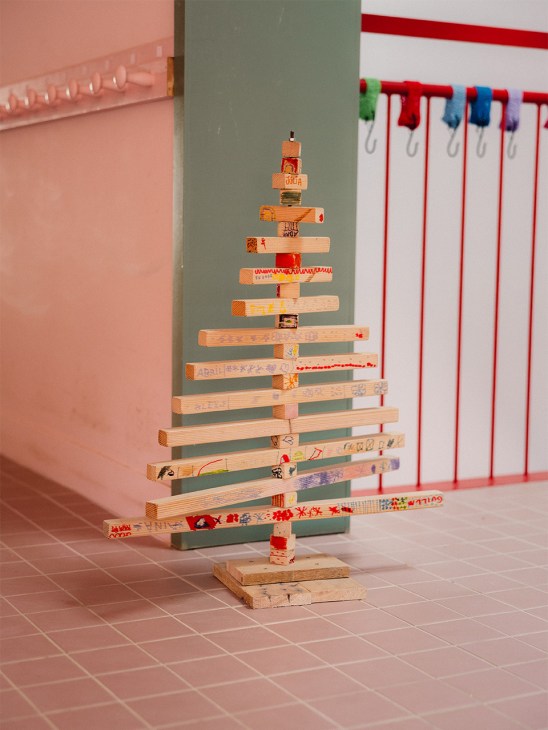
Their philosophy is simple: in early education, the physical environment is often known as the “third teacher”, working alongside parents and educators to shape how a child interacts with the world. By incorporating plenty of natural light, versatile materials and easy-to-use resources, the duo creates well-planned environments that encourage children to work together, investigate and learn.
At Casa Nostra, this begins on the outside. Shaded by acacia trees, the two-storey building is finished in a dusty pink. To Spanish children, the colour is instantly recognisable. “It’s the colour of Frigopie, a popular strawberry-flavoured ice cream,” says Sarquella. Along the roof, a waterspout in the shape of a dragon head hangs from the eaves in a playful nod to Catalan folklore. Legend has it that the Banyoles monster slumbers beneath the lake’s waters.
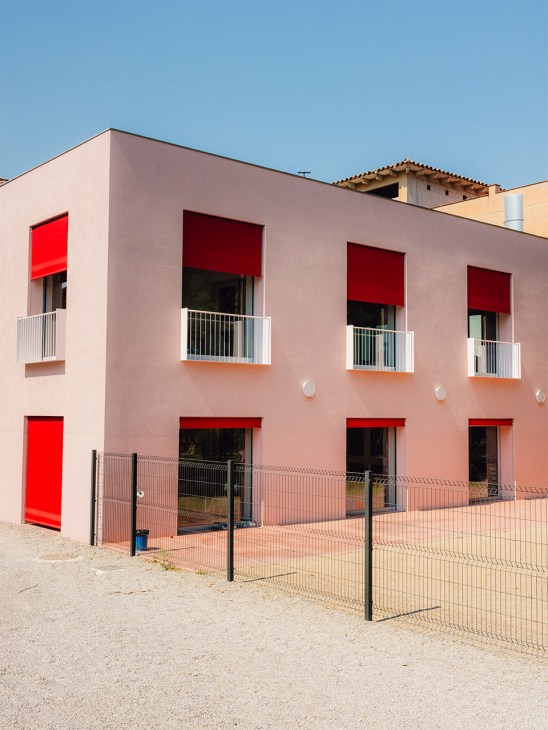
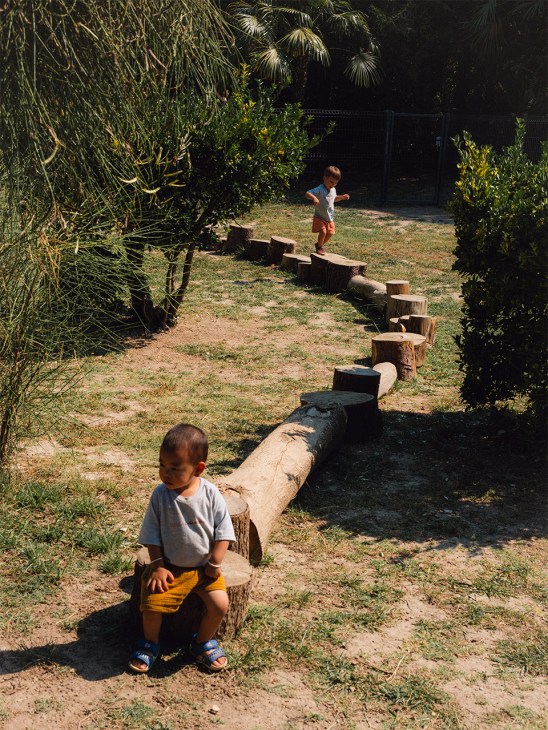
Planning regulations restricted the building’s footprint, which meant that every square metre had to perform multiple duties. More than 90 children are divided by age group: up to three years old on the ground floor and ages three to six above that. Small balconies and a garden make the structure look more like a large house than an educational facility, referencing the school’s name, which translates to “our house”. “It creates a feeling of familiarity,” says Sarquella.
The corridors are wider than average school hallways, designed to double as a library, workshop, art space or somewhere to shelter when a Mediterranean downpour hits. Upstairs, a space clad in matte blue Portuguese porcelain tiles recall the colour of the lake nearby. “We decided to [design] this spare playroom without a roof,” says Sarquella, explaining that it therefore didn’t count toward the strict urban-planning limits. The result is a simple, open-air space that lets the elements in.
Classrooms are divided by sliding doors. The clear glass on the top half of the partitions allows educators to maintain a visual connection across rooms. “On the bottom part, at a child’s eye level, the glass is replaced by mirrors,” says Sarquella. “For the teachers, it was important that kids could recognise themselves from a young age.” On warmer days, the glass doors retract fully into the walls, dissolving the boundary between the classrooms and the sprawling garden.
By late afternoon, children take the bike path home, past trees and the lake, towards Banyoles. Many will be humming Toni Giménez’s “El Monstre de Banyoles”, a song about the legendary dragon that they learn at kindergarten. The school continues to be a place where memories begin. Like Sarquella, some children might later draw on them for projects of their own.
sarquellatorres.com
Comment: Learning isn’t only about teaching, revising or homework. A well-thought-out learning environment often yields better engagement – and that starts with good design. Carefully considered materials, shapes and colours can deliver much more than mere aesthetics.