‘Most have lost touch with the reality of the built world.’ Australian designer Henry Wilson on why working with independent makers matters
In a market overrun by banal mass production, the Sydney industrial designer talks sand-casting, working with small foundries and why he would rather live with an object than simply admire it.
“I grew up with an architect mother who would cart me along to her studio and sample rooms, where I would collect little bits of material,” says Henry Wilson. The Sydney-based industrial designer is recounting how he became one of Australia’s top contemporary talents. “There was endless stuff that I was making and playing with: my radio-controlled car, for example, or a trailer to tow round the garden behind the dog.”
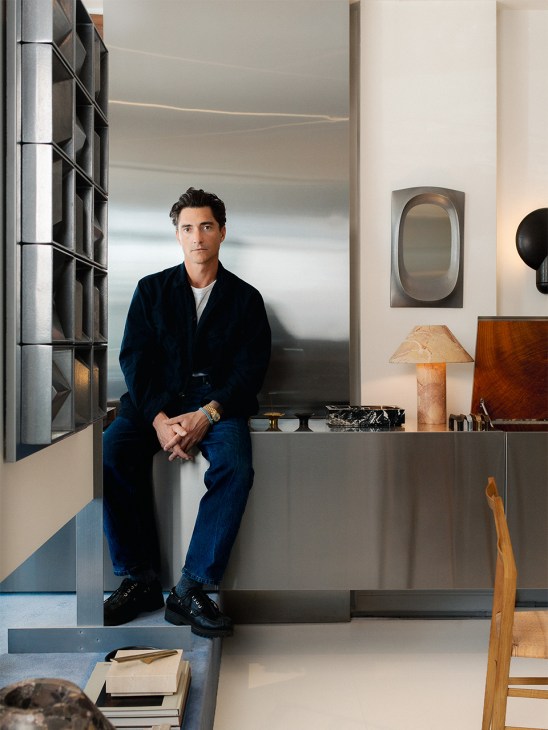
Today he produces furniture, lighting, homewares and more from his Paddington studio and showroom – housed in a low-rise 1926 brick building tucked beneath an old scout hall, finished with stainless-steel plinths and panels. His client list includes Aesop and Sydney’s Ace Hotel, with works shown at Maison & Objet in Paris and the Museum of Applied Arts and Sciences in Sydney. Wilson’s practice remains rooted in craftsmanship and his early interest in materiality. Here, he tells us about sand-casting, small foundries and why he would rather live with an object than simply admire it.
What is your earliest design memory?
As a kid, I was obsessed with how things went together, though there wasn’t an aesthetic angle to it yet. In hindsight, my parents were feeding that appetite – my mother especially. She’s also an art collector and used to drag me around museums. I probably went reluctantly at the time but it planted something in me that evolved.
What drew you to the idea of making things?
Initially, it was very practical. I was obsessed with utilitarian things, which is how I became interested in sand-casting, a method that uses packed sand to shape molten metal into custom parts. I loved the practicality of cast pieces that solved a problem and could be replicated. I found an extraordinary beauty and rawness in this centuries-old process.
Does the process dictate what you produce?
Totally. We’ll propose a casting or polishing process and get pushback from the foundry – “This is too thin; we’re getting holes here” – and we’ll rethink the form. It’s a constant back and forth. I also don’t want to make something that’s a pain to produce. You must consider the person making the object, the person who will use it and the person who will eventually be left with it. You have to ask: will they repurpose it, sell it or get rid of it? I try to keep an object’s uses abstract enough that it can find its way into different parts of your life. Take my little key tray: I have seen it holding coins, buttons and someone’s phone, as well as keys. I don’t want these things to be too prescriptive.
You collaborate with smaller, local foundries. Why is it important to keep working with such makers?
In Australia, it’s a real issue. The foundry that I have been working with for more than 10 years is now overseen by the son, who took it over from his father. It’s tricky business because a lot of the componentry is now moving to China. There has been a brain drain and we simply don’t make things any more. I see this in manufacturing generally and even among architects. If you want to do anything special, there’s only a handful of places left that can help you. That’s a real shame because it limits your thinking. It surprises me how impractical people have become. Try explaining how a wall plug works to someone and you’ll get blank stares. Most have lost touch with the reality of the built world. It has become something that they just walk through.
How has working and studying around the world shaped your practice?
I studied at the Design Academy Eindhoven and, honestly, the biggest part of my education there came from visiting flea markets across the Netherlands and Germany. In Berlin 15 years ago, you would find postwar artefacts. You couldn’t imagine these beautifully made objects being produced in bulk today – penknives with folding mechanisms, scissors for cutting candlewicks, knives and forks for specific fish. We don’t necessarily use these things any more but they’re worth looking back to – sometimes out of pure curiosity; sometimes because their ideas might find their way into a new product. Industrial designers are drawn to that kind of observation, building on what’s gone before.
Does the passage of time also help us to appreciate our objects and furniture more?
A lot of the resonance that our products have comes from the fact that they change. Take our hardware line: we initially started making these door pulls as one-off pieces because manufacturing had become so roboticised that you could barely tell an Ikea kitchen from the work of the fanciest Italian cabinetmakers. So we wanted to make hardware rooted in mid-century proportions but left unwaxed and untreated. This means that the dishwasher pull wears differently to the pantry pull, because one is grabbed with wet hands. People love the way that such details give their home a little more life. You see this in older European houses, with solid brass hardware worn bright. You wouldn’t come in and rip off those handles. That’s what we’re trying to put into homes: a sense of timelessness that grows with people. We joke in the office that if you don’t like the finish on your bronze lamp, just wait a week.