

In designer Gabriel Tan’s Porto townhouse, home and studio find common ground
The Singapore-born designer and founder of homeware label Origin Made has combined his workspace and family’s residence across his exquisitely functional townhouse conversion in Portugal.
When Gabriel Tan moved into a tall, narrow townhouse in Porto in 2020, he didn’t expect his horizons to broaden significantly. The Singapore-born designer had already made a name for himself designing for the likes of Kyushu-based furniture brand Ariake and The Conran Shop, which has a strong retail presence in Japan and South Korea. But it was in Portugal that his career took a new direction with the creation of his craft-inspired label, Origin Made. “I underestimated how much your environment shapes your work,” he says, explaining the pull of the country’s manufacturing heritage. “If I had known that it would have had such a big impact on me, maybe I would have come earlier.”
Origin Made’s studio and showroom occupies the ground floor of Tan’s Porto home, to which he welcomes Monocle on a crisp autumn day. The brand is based in a long room with stone walls and exposed wooden beams. “There used to be a separate entrance for residents who live upstairs and for whoever rented the shopfront, which made this space into a dark corridor,” says Tan. With two independent circulation routes running through it, the floor had originally been split down the middle. Tan removed the dividing wall, allowing natural light to travel its full length. Now, at one end, furniture including a wood-and-rattan table and cord-woven stools is neatly arranged alongside smaller, more sculptural pieces, such as metal candleholders and ceramic vases. At the other end, Tan’s desk faces a window looking onto a small but lush back garden. Between them, a handful of staff are working quietly around a shared table.


The pieces on show have an earthy quality but they’re far from rugged. Some are Tan’s creations; others are by international designers working with Origin Made – all are produced in small workshops and factories in and around Porto. This proximity to manufacturing, something that Tan had been missing in Singapore, was what had initially drawn him to the city. “A lot of the time, the design changes when you are meeting face to face,” he says. “The live prototyping at a factory is so valuable.”
Tan bought the 19th-century townhouse in 2018 after a tip from friend and fellow Porto-based designer Christian Haas. He had caught wind that the home’s previous owner, a French travel writer, was looking to downsize. The location, Rua do Almada, has long been associated with commerce and workshops. Its typical buildings, with street-level workspaces, were exactly what Tan was hunting for. “It’s not such a common feature in the city; more often there’s this semi-basement and then you go straight upstairs.” He enlisted Porto architect Patricia Leite, whose practice conveniently occupied the shopfront at the time and who had previously worked on the building, to help with the renovations. Much of the original structure – including the façade, stone walls and central U-shaped staircase – was kept intact. From the outside, the townhouse blends seamlessly into the street. “We didn’t want to be too loud,” says Tan. By comparison, the interior works were substantial, taking nearly two years. Rooms were expanded beyond the original footprint and an entire new floor was added. “We turned a two-and-a-half-storey house into four storeys, with two balconies at the top.”

Moving up through the house, the spaces become increasingly private, from the studio to the common spaces directly above and the bedrooms on the top two floors. The palette of whites, beiges and pale timbers throughout – naturally lit through large windows out front and back, plus a central skylight – gives the house a sense of stillness.
The first-floor kitchen, with ash-wood carpentry and a generous central island, looks across the garden and is shared at lunchtimes between the family and studio employees.
In the evenings, sensory cues of home – the smell of dinner being prepared, the sound of children settling in – signal the end of the working day. “If your office is elsewhere, you can easily stay until late,” says Tan, whose wife, Cherie, co-founded Origin Made. “But as soon as we come upstairs, we feel that we’re leaving work behind.”
That might be true but there’s not much chance of escaping Tan’s work here: every piece of furniture was either carefully curated or designed by him. “We sold all our stuff in Singapore when we came and just brought some clothes here,” he says. This is evident in the uncluttered interiors, with no odd family heirlooms or trinkets atop shelves. There’s a sense that little has ended up here by accident: artworks are similarly consistent, all by Lisbon-based Polish artist Tomek Sadurski, whose abstract floating curves pair well with Tan’s preference for soft forms.
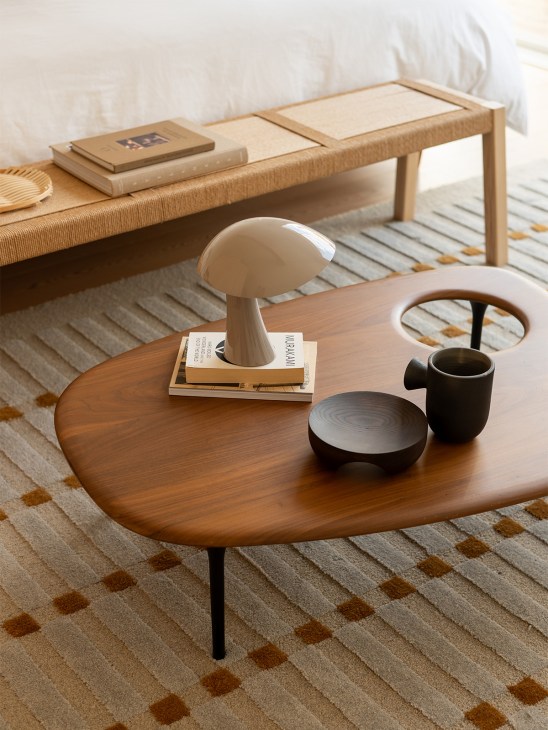
Still, each piece tells an individual story and together they demonstrate the prolific nature of Tan’s Portuguese chapter so far. It was also while in the Iberian country that his designs began to enter the catalogues of heritage international brands such as Herman Miller and Louis Poulsen. His modular Soft Stone sofa, launched in 2026 for Munich-based Classicon, sits alongside the prototype armchair that led to its development. “It was created with a local upholsterer,” says Tan. The design was inspired by stone structures in the landscaping of a nearby park. “I used to go there a lot during the pandemic and use it as my outdoor office. I would sit on the stones to sketch and think, what if they were softened?” Around the dining table, several versions of Origin Made’s Almada chair, made in collaboration with a cord weaver in nearby town Paços de Ferreira, show how much a design can change during the creative provess. Each iteration varies slightly – the distance between the legs, the weaving pattern on the seat – before arriving at the in-production version. “As a small brand, you can do this – you are more agile,” he says. “Bigger brands have more established distribution channels and dealers get upset if you change the design a lot.”
That agility extends beyond Tan’s designs. Working at a small scale also gives him freedom to rescue and champion other people’s work – pieces that might otherwise have gone by the wayside. The three spherical oak lamps by Finnish designer Jenni Roininen that hang above the dining table, for example, had been discontinued until Origin Made took over production. A sculptural vase, its surface ribbed with what look like finger marks, was developed from a handmade original that Tan saw at a friend’s house. He liked it enough to bring its creator, Ruben Costa, into the brand’s catalogue, 3D-scanning the piece and developing a mould that enables it to be reproduced in batches of 50. “The way that we approach collectible design is not through limited runs but small runs,” says Tan. “We aren’t making 10 and stopping. Our goal is to keep the product’s lifespan as long as we can.”

Upstairs, these craft-inspired pieces are set against a greater variety of aesthetics. Two wedge-shaped column lamps that Tan designed with a Japanese washi artist stand amid his leather, glass and metal collection (a desk, bedside tables and screen) that was created for B&B Italia in 2023. “They can coexist,” he says. It’s also up here where the house’s architectural details are most evident, with ash frames around doors and windows, recalling the detailing of Japanese interiors. “We also removed the fake ceilings to expose the original pitched roofs,” he says. The bathroom, which Tan says took the longest to complete, is a stripped-back, raw space in a grey terrazzo with a shower suspended above a monolithic bathtub. Narrow horizontal openings directly below the ceiling direct in natural light from the skylights, illuminating otherwise enclosed rooms.
In the bedrooms, Tan’s grip on the interiors loosens. There are a couple of vintage pieces, including a dark-green armchair (perhaps the only coloured piece in the house) from Swedish brand Dux that was given to him by a friend and a Thonet chair that used to stand around the dining table before being replaced by one of his designs. Two acoustic guitars and a standing bike also hint at the family’s pastimes. In the children’s room is one of his more whimsical pieces: a floor bed shaped like a car, made for his son. It’s a reminder that while Tan’s residence might serve as his studio, with colleagues sitting around the kitchen table, it’s also a place for his family, which has grown up in Porto as much as Origin Made has as a brand and Tan as a designer.