“It’s rare to find this kind of building in Paris.” Inside Antoine Ricardou’s Montmarte apartment
There is an art to apartment living. With pared-back interiors and efficiency prioritised in fit-out, furniture and more, this benchmark example makes a compelling case for living the high life.
“I need to be in the sky,” says Antoine Ricardou, co-founder of Saint-Lazare, a design studio in Paris that has worked with brands such as Cartier and the Centre Pompidou. In the open-plan kitchen and lounge on the top floor of his three-storey Montmartre apartment, you feel as though you’re floating above the city. “I see it as a lighthouse,” says the architect and designer. “There’s a beautiful phrase in France for this kind of place: nid d’aigle – the eagle’s nest.” The room has a loft-like feel, with a pitched white ceiling, exposed beams and windows flanking both sides. Step onto the terrace and your gaze falls onto the Basilique du Sacré-Coeur, which is so close that you can almost touch it. “It feels very poetic when you hear the bell,” he says.
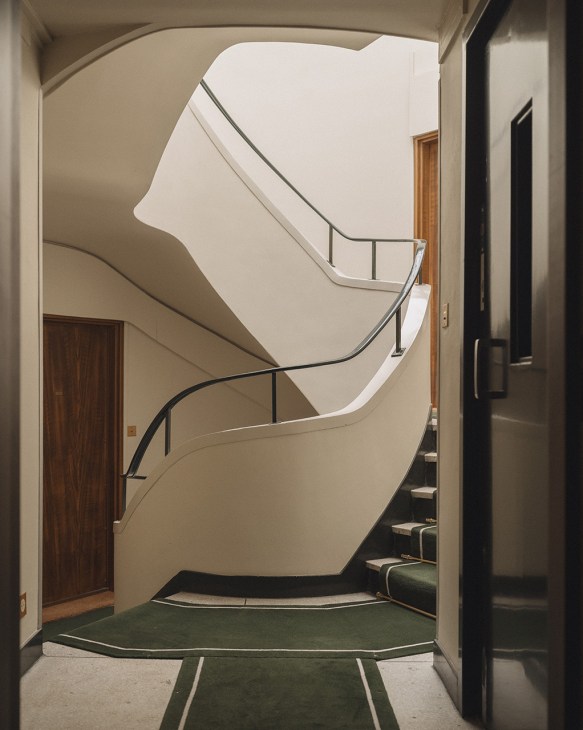
Though located in a quintessential Paris neighbourhood, this is far from your typical apartment in the French capital. Rather, the entrance and stairwell look like something that you might find in Milan: terrazzo floors, plywood walls and a spiral staircase that winds up four floors. “It’s rare to find this kind of building in Paris,” says Ricardou. Unlike much of the rest of the city, which Napoleon III tasked Georges-Eugène Haussmann to redesign in the mid-1800s, Ricardou’s building was constructed after the Second World War. Little money was available so its design had to be more about function than form: no ornamental façades and wrought-iron balconies, which, says Ricardou, resonates with his own ethos. “At Saint-Lazare, we try not to be decorative but narrative-led and functional.”
Ricardou has long been a fan of this mid-century style and immediately fell in love with the building when he first visited. But what drew him to this hilltop wasn’t simply the complex. He grew up in Montmartre, the neighbourhood where his great-grandfather had settled after emigrating from Germany at the end of the 19th century, purchasing buildings and pioneering development. “Montmartre was a little hill on top of Paris with no major construction, only eclectic houses for artists,” he says.
The area hadn’t yet been annexed by the city so, while Haussmann set about transforming Paris’s narrow streets into wide boulevards fronted by buildings with grand exteriors, Montmartre maintained its village-like feel. “It was quite audacious and risky,” he says of his grandfather’s decision to develop in an area that was far from popular. “You couldn’t have imagined that this district would become so renowned and beautiful.” Today his relatives still own a few apartments in the area, in buildings with the family name, Gries, engraved on the façade.
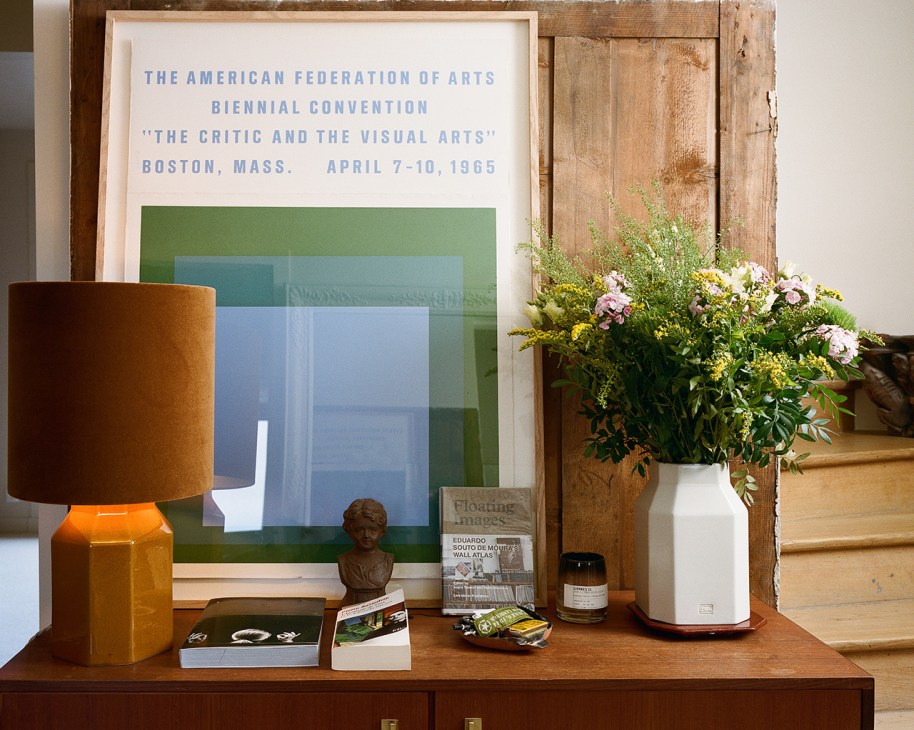
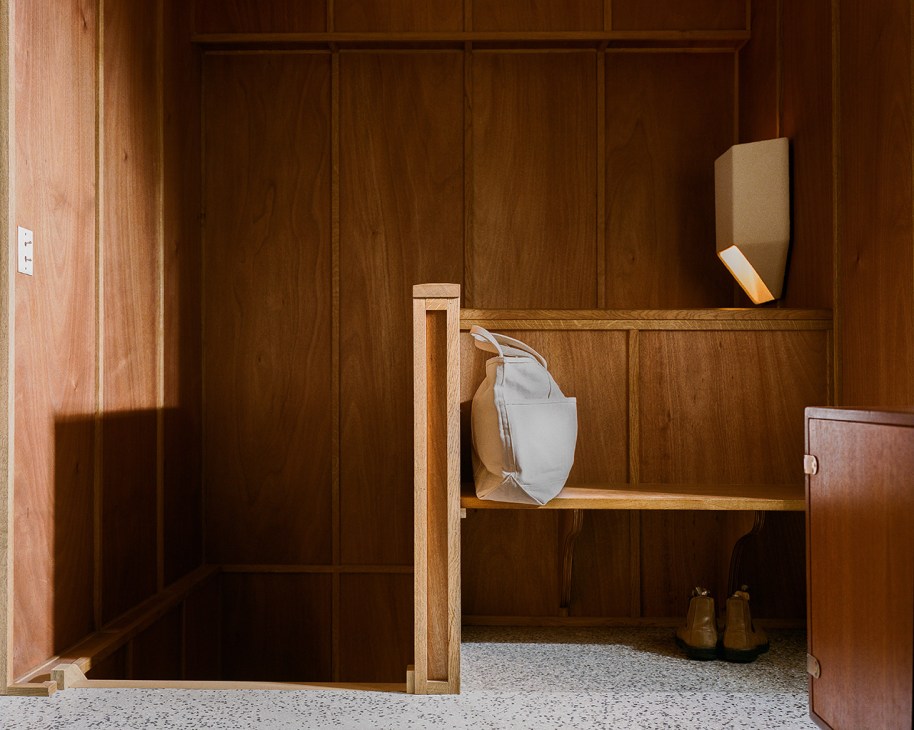
Ricardou has followed in his grandfather’s footsteps. He has acquired neighbourhood institution Au Rêve, a café and bar that first opened in 1921, plus his apartment, which was originally two separate residences before Ricardou combined them. He purchased the first apartment 15 years ago as a two-floor space, then acquired the one below, connecting them with a wooden staircase that drops from the entrance hall to two further bedrooms. “It’s 150 sq m, which is very big for a French family but not very big for a family of five people,” he says. The wood-panelled vestibule on the second floor is inspired by Ricardou’s childhood spent in the Pyrenees, as well as the plywood in the building’s entrance hall. “This floor is connected to this building’s aesthetic,” says Ricardou. Rather than using cheap plywood, which was common in the 1950s, he turned to oak for the wall panels and African okume plywood for the staircase. “The homely feeling is important,” Ricardou says, explaining that it’s best achieved through warm lighting. “Every little space should be well lit. There has to be an umbrella of light in a dark room.” On top of the credenza in the hall is a mustard ceramic Saint-Lazare lamp topped with a cylindrical shade, one of the products for which the studio has become known. “A good designer should start with designing a lamp,” he says.
On the same level, the main bedroom has a terrace with city views. The bed, set on a creamy wool carpet, is surrounded by wood panelling and shelving that holds stacks of books, framed photographs and more lamps. There’s also an office but the star of the level is the bathroom, with terrazzo floors, marble-tiled walls and windows that look out onto Paris. “If I were the architect of this building in the 1950s, I would have done the bathroom like this,” says Ricardou. The porcelain bathtub, which doubles as a shower, was sourced from a garden on the western side of Paris. It’s now dressed with heavy, dark-mustard curtains that can be drawn during the colder months, which is what people living in this apartment would have done in the mid- 20th century. “It was a technique that you can find in old castles and houses, which were impossible to get too warm,” he says.
While one set of wooden stairs on the entrance level leads you straight to the lower bedrooms, the other takes you to the top floor, where Ricardou’s family members spend most of their time. To get there, he leads Monocle all the way up the narrow staircase, moving from the dark, moody entrance to a bright, loft-like space, crowded with books, paintings, photographs and objects.
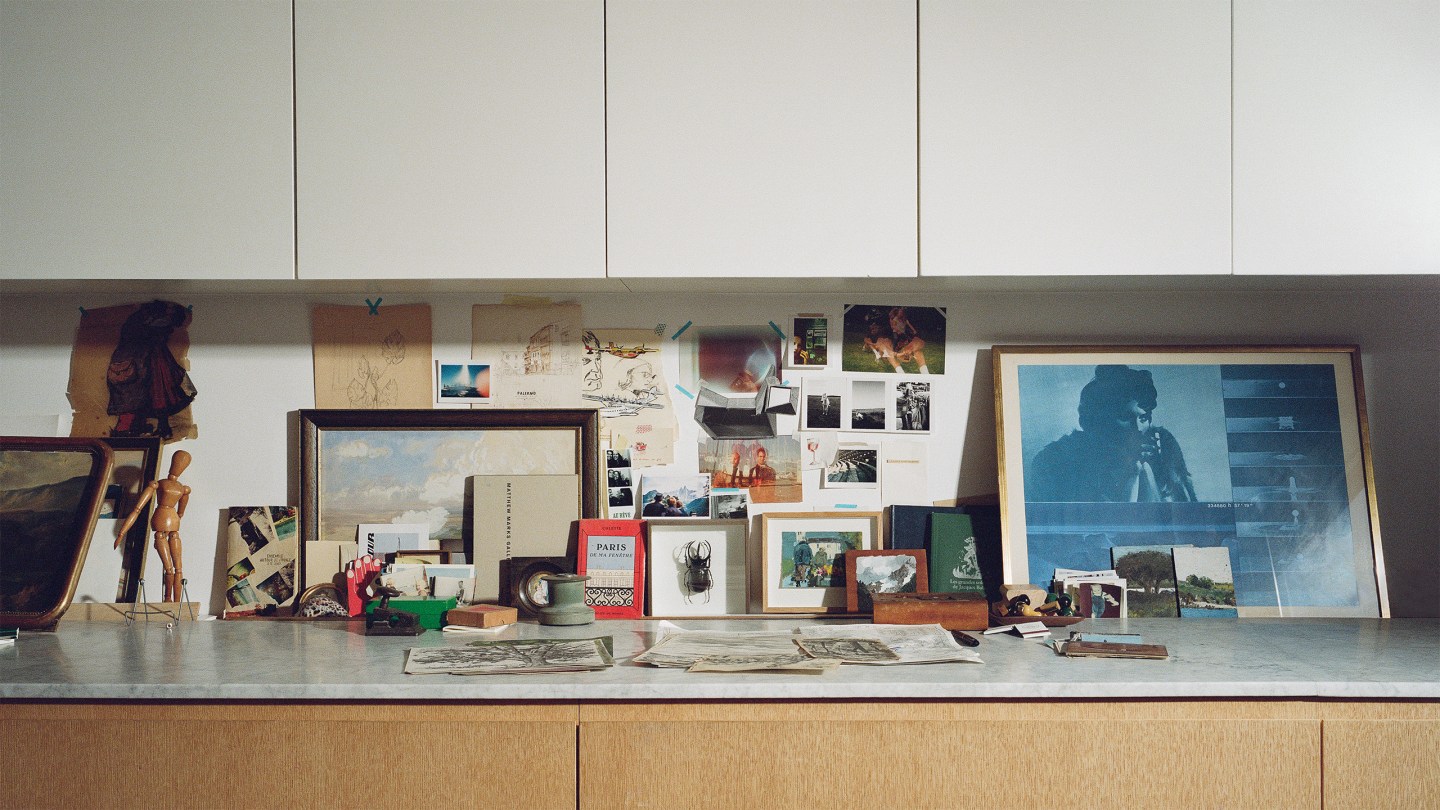
This is the heart of the home, where Ricardou’s wife, Gwenaëlle Grandjean, and their children like to gather around a large table that doubles as a kitchen counter and workspace. “I love drawing while my kids are in the same space,” he says. “Or we’ll cook together here.” One person might be working while another prepares dinner but the point is that they’re together, even when they are not actively engaging.
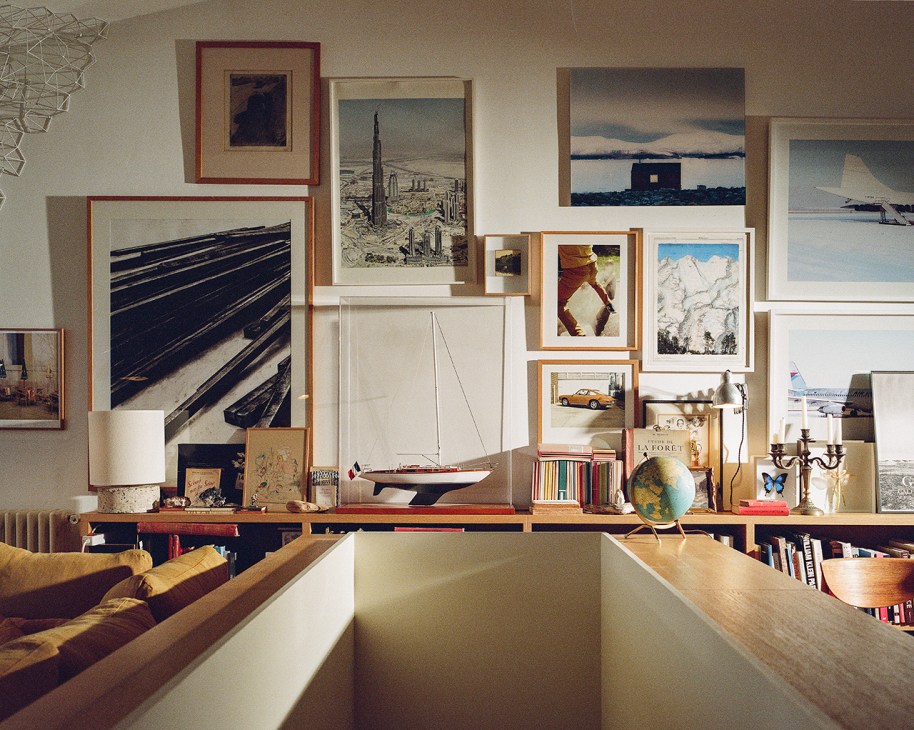
In the living room, Ricardou’s love for mid-century design is on show: there’s a 1960s table by Johannes Andersen, with teak wood chairs from 1965 by Danish designer Peter Hvidt. Above it is a lamp by Denmark’s TH Valentiner. In the lounge area sit rope armchairs created by French modernist designer duo Audoux-Minnet in the 1940s. On one shelf is a sailing boat model by Yves Gaignet, a yacht-model specialist based in La Rochelle. Proudly displayed in a light box, the object is a replica of Ricardou’s own sailboat, The Tina, which was designed by Dick Carter in 1969. “We restored the boat ourselves and it now sails in the Mediterranean,” he says. “Having this model in front of me allows me to escape and sail a little in my mind.” Other pieces include an image by Belgian photographer Harry Gruyaert and a drawing by conceptual artist Bernar Venet.
After curating the artworks for the Nomad Hotel in London, Saint-Lazare has established itself as a go-to name in art programming. This is evident on these walls, where varied works harmoniously coexist. “We have been collecting a lot of art, photos and drawings,” he says, noting that he often moves the pieces around. “We mix everything. We don’t hang things on the wall based on the price. It’s about our own private narrative.”
On this sunny day in Paris, the doors to the terrace are unlatched. If you look down, you see the building’s shared garden. Ricardou’s terrace is lined with plants – designed by his wife, who runs landscape design studio Atelier Lamarck – in a way that resembles a hedge overlooking the city. “It’s important for us to be surrounded by greenery,” says Ricardou. “Someone once told me that in Paris, it’s better to have a good balcony or terrace on the same floor, rather than a rooftop. It’s clever: you never go onto a rooftop but when you have a terrace connected to a room, it feels fully open.” With the doors flung open and the sun streaming in, the views of the city stretch out beyond the plants. From this vantage point, it feels as though Montmarte belongs entirely to you.