Capital punishment: Colombia’s new right-wing leader is turning his back on Bogotá
Colombia is the latest country to fall under the spell of Donald Trump-style populism. Can incoming presidential firebrand Abelardo de la Espriella fix the nation’s fiscal and internecine struggles?
Before being elected president of Colombia last month, Abelardo de la Espriella, a 48-year-old criminal defence lawyer, had been living amid Miami’s splendours with his wife and four children. He became a US citizen, donated enough to the Republican Party to be invited to Mar-a-Lago, and then returned to Colombia’s Caribbean coast, from where he hails, to announce his presidential candidacy. On Friday 7 August, he will be sworn in.
His victory reflects more than just the appeal of an extravagant personality. Colombians voted against the continuation of Gustavo Petro’s presidency and the growing insecurity associated with his tenure. Faced with a staunchly socialist senator, they chose De la Espriella, the lawyer of choice for dodgy Colombians seeking plea bargains with the US. Colombians preferred a political novice with a lavish Florida lifestyle to a seasoned figure of the left.
The choice further contorts the political balance of the Americas. De la Espriella’s programme is firmly on the radical right, recalling Donald Trump, Javier Milei and El Salvador’s president, Nayib Bukele. He speaks of cutting state spending, abandoning the 2016 peace accords with the Revolutionary Armed Forces of Colombia (FARC) and restoring relations with Israel. He disparages the UN and promotes religion and traditional family values. At last week’s inauguration of Peru’s new right-wing president, Keiko Fujimori, De la Espriella’s vice-president shook hands with Argentina’s Milei, who confirmed that he would attend Friday’s ceremony. This is not a pack that has any plans to work with the left. Cuba and Nicaragua will be cut further adrift from the region while the White House has earned another friendly neighbour.
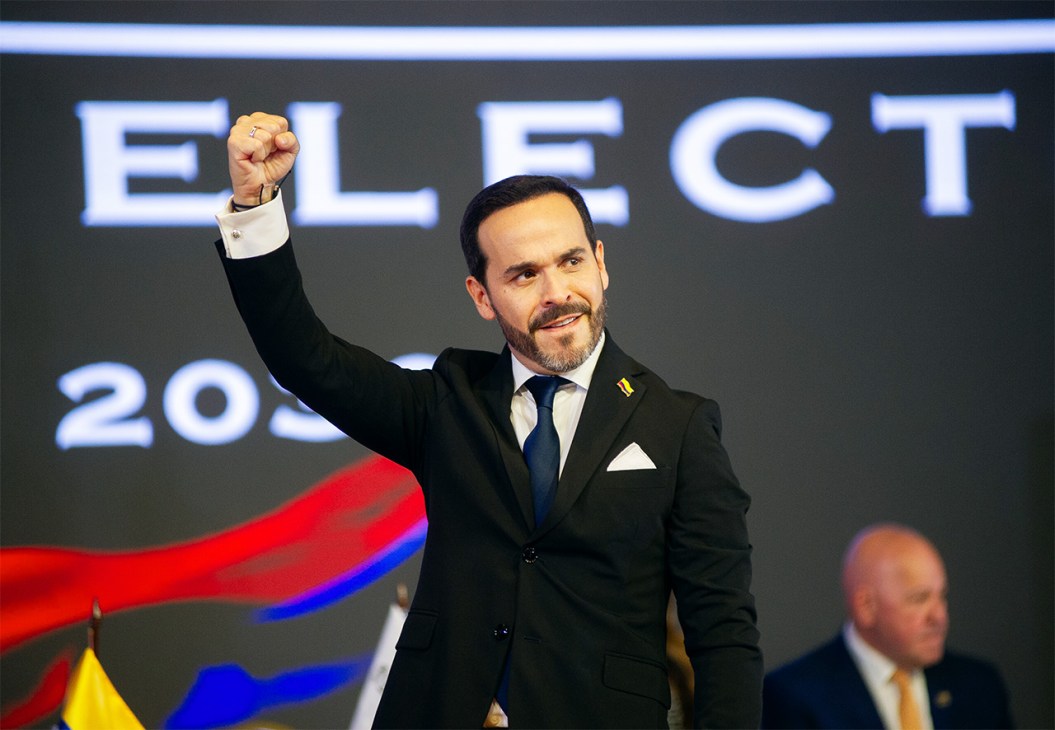
True to what he calls “De la Espriella Style”, the president-elect’s campaign wardrobe boasted slim-fitting suits, linen shirts, football jerseys and dark sunglasses. Travelling by private jet, he promised with considerable fanfare and effective right-wing showmanship to wrest power from the political establishment and the capital of Bogotá.
Wherever De la Espriella campaigned, he voiced a powerful national grievance: that Colombia is governed by a distant capital that neglects its regions. He has said that he will not move into the presidential palace, instead taking the presidency around the country (a move we’re also seeing from new UK prime minister Andy Burnham). Foreign affairs and international travel, he says, will largely be handled by his vice-president.
He has also made clear that his victory enjoyed the approval of Trump and US secretary of state Marco Rubio. To demonstrate his closeness to Washington, De la Espriella sent his veep to the White House in mid-July with a pledge to fight organised crime and drug trafficking, while presenting Colombia as an attractive destination for foreign investment. Under his rule, Colombia will become the “country of miracles” – at least that’s what he keeps repeating.
But much remains uncertain. Only last week, De la Espriella announced that he will take his oath in the city of Cali. He has not visited Bogotá since the election, and said that he will convert the presidential palace into a museum. Barranquilla, a northern city where he lives with his family, will now become an alternative capital.
De la Espriella is taking devolution to an entirely new level. But the Caribbean disruptor-in-chief personifies a genuine national sentiment. With theatrical effectiveness, he voices one of Colombia’s most persistent complaints: that it is ruled by a snobbish clique that cares little for the rest of the country. De la Espriella presented himself as a prodigal son, promising each region the attention that it has long been denied.
His fiercest opponent is the outgoing president, Petro, who is urging his well-organised supporters to mobilise if his government’s achievements are reversed. Petro even raised the prospect of hunger strikes and national protests that could paralyse the country.
It is still too early to know how De la Espriella will handle the more concrete challenges. Colombia’s debt and deficit are at unprecedented levels, and he might need to find about $30bn (€26bn) to cover the fiscal shortfall. Some 30,000 members of armed groups linked to drug trafficking and organised crime control large stretches of the countryside. An unusually severe El Niño effect on the climate could also strain the power system and threaten blackouts. And, from Friday, Colombia will have a right-wing president, but also, for the first time, a highly organised left-wing opposition.
Wherever De la Espriella chooses to govern from, he will confront a central fact of Colombian democracy: the country has institutions capable of frustrating a leader’s wishes. Neither his impulses nor his supporters’ expectations have the force of law. That restraint will matter. He will succeed only if he delivers something concrete without weakening the institutions that stand between presidential power and presidential whim – and without leaving Colombia, literally or politically, in the dark.
Silvana Paternostro is a Colombian-American journalist and Monocle contributor. For more opinion, analysis and insight, subscribe to Monocle today.
Further reading:
– One drug-smuggling scandal shouldn’t bring down brand Thailand
– Trump’s new Air Force One plane is bringing the president down to earth
– Who is Andy Burnham? From Manchester mayor to the UK’s seventh prime minister in 10 years