
Jaguar Land Rover has supplied the British Army for eight decades. Will it win the race to build the West’s next light mobility vehicle?
JLR’s Defender has hit a roadblock. As unexpected competitors emerge, the carmarker’s contract to supply the next-generation military model is not a done deal.
All militaries communicate through jargon dominated by TLAs (three-letter acronyms). A TLA at the centre of much discussion is the LMV, which stands for “light mobility vehicle”. The most emblematic LMV is the Land Rover, which has been moving British soldiers around battlefields and bases since shortly after the Second World War. Jaguar Land Rover (JLR) is now phasing out its latest military model, the Land Rover Wolf, and competition to become its successor is fierce: the British Army’s present contingent is some 5,000 vehicles strong and the contract to replace it could be worth more than £2bn (€2.4bn).
“We are really proud of our deep association with the military,” says Patrick McGillycuddy, JLR’s global managing director. JLR is hoping that the UK’s Ministry of Defence will recognise the virtues of continuity and award the business to its Defender Wolf Series II. “But we absolutely take nothing for granted,” he adds. “We will make sure that we build a very compelling and capable vehicle, and a very compelling and capable bid.”
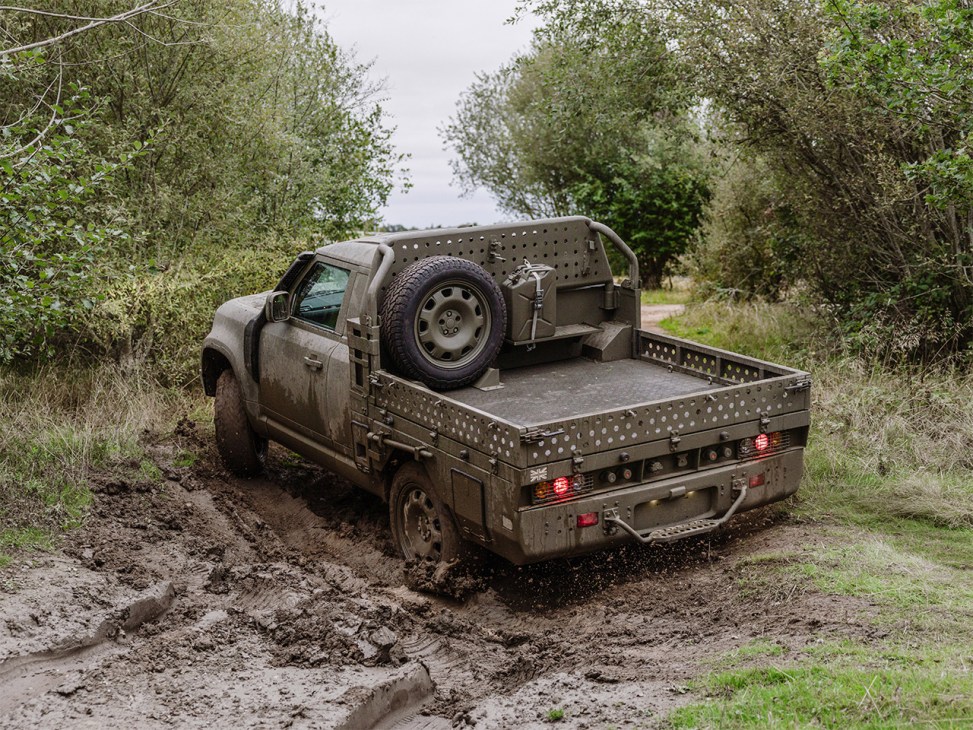
The tender issued by the UK Ministry of Defence calls for a common LMV platform that can be adapted to nine different roles: general purpose vehicle, battlefield ambulance, tactical mobility vehicle, utility vehicle, enhanced protection vehicle, command and control, equipment support vehicle, troop carrying vehicle and mission systems vehicle. Each of these LMVs inevitably has its own subsidiary TLA (GPV, EPV, C2V et al). JLR’s bid embraces 26 variants; its Defender Defence Division is overseen by retired Lieutenant Colonel Stephen Webb, who was awarded the Military Cross in Iraq.
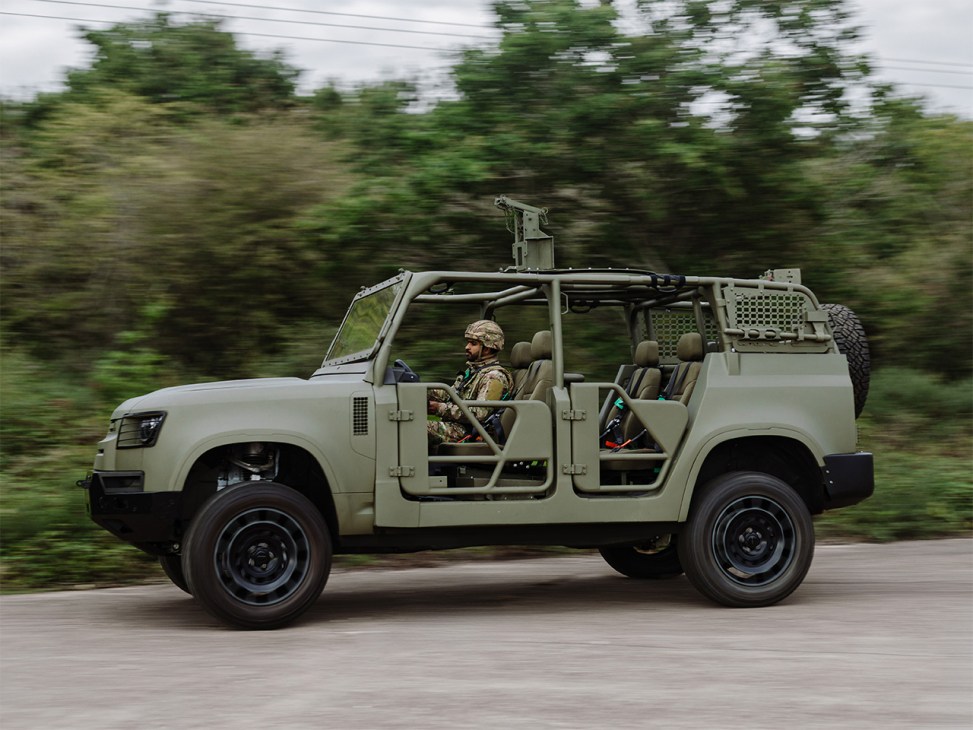
“The Wolf Series II,” says McGillycuddy, “is built on our Defender D7X architecture, which is incredibly capable as a standard vehicle. It’s the car that we know and love, which we have been selling around the world very successfully for the past six or seven years. In its standard guise, it can meet a lot of the MoD’s requirements in terms of capability. And then we make some upgrades to the base chassis for those additional payload requirements across the nine different variants. And we will do all of the building and conversion work ourselves. We will not bolt anything on. We will engineer it, and we will code it.”
A particular challenge in building LMVs, as opposed to more utilitarian military equipment, is that these vehicles also have to serve as civilian cars on civilian roads. “So they have to have all the safety systems of a modern car on the road today,” says McGillycuddy, “but at the press of a button, when that car goes off-road into a battlefield environment or training exercise, the soldiers are able to disengage those autonomous safety features.”
Six other companies are in the race to replace the model: Grenadier; Rheinmetall; Babcock/Supacat; two American consortiums; and Fering Technologies, a London-based newcomer that is pitching the only hybrid-electric in the contest, the Pioneer X. But as a potential consolation to those that the MoD does not end up selecting, several countries are currently looking to modernise their LMV fleets, such as Greece, Canada, Turkey, Austria, Italy and Germany. Western carmakers would want this business at the best of times. But these are not the best of times.
Many of Europe’s venerable manufacturers’ market shares are being eaten by China, a country that – until recently – they regarded as the promised land with a huge, profit-driving enthusiasm for prestigious brands such as BMW, Audi and Mercedes-Benz. The electric-vehicle revolution has upended this dynamic. Many Chinese and European motorists are happy to drive a BYD, Chery, Jaecoo or some other make that they had never heard of five years ago, which works at least as well as Western vehicles for a cheaper price. In the first half of 2026, BYD was the 13th-biggest seller of new electric vehicles in Germany, in reaching distance of the menacing Opel and, perhaps, Audi in the top 10.
The consequences can be seen in a spate of recent gloomy headlines about European brands: 4,000 jobs gone at JLR; Volkswagen to lose 100,000 jobs and close four German plants before 2034; BMW to lose 8,000 jobs globally; Porsche a total of 9,000 by 2035. European manufacturers have good reason to hope that their defence ministries might recognise that buying Chinese is something of a false economy. That said, it was revealed this year that the UK’s Ministry of Defence has more than 1,700 Chinese-made cars in its non-combat fleet, many adorned with dashboard stickers reminding drivers not to plug in MoD devices or talk about work. Given this level of rigour, Europe might have to brace itself for the possibility of a future scenario when troops dispatched to the frontline discover that their vehicles mysteriously refuse to start. (Investigations have already occurred in the UK, Denmark and Norway into whether Chinese-supplied electric buses might be fitted with remotely operable kill switches.)
UK prime minister Andy Burnham has repeatedly spoken of his belief that the state should buy British, which, in the context of the LMV programme, would appear to make strategic, economic, political and logical sense, though JLR is correctly cautious.
“We’re aware of our competition,” says McGillycuddy, “and we respect our competition. But we’re focused on what we can do, especially the sovereign capability that we bring. So designed and engineered in Britain, all the conversion work will be done in Britain and, while it’s manufactured in Slovakia, 75 per cent of the Defender’s value comes back to the UK.” The next step is further trials. “It’s an assault course, for want of a better expression,” adds McGillycuddy. “The cars are sent around various courses, inclines and descents to test the capability of the car-carrying loads. That’s an inherent strength of ours. We’ve been doing this since 1948.”