
The French city betting that design can succeed where industry failed
Once a hub of arms manufacture and coal mining, Saint-Étienne is betting on creative industries to secure its future. We visit its design quarter to meet the people leading the transformation.
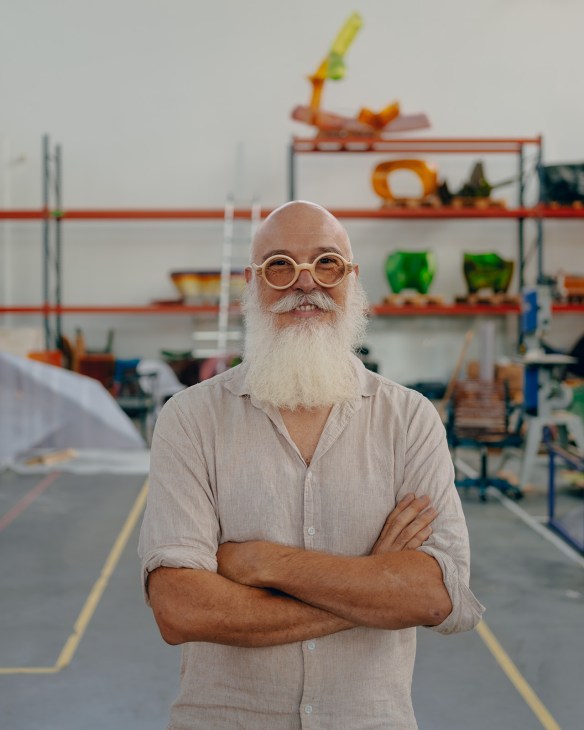
Business was going well for French architect and designer Guillaume Crédoz. He had built a successful practice in Beirut and was overseeing a team of 36. In 2014 he started to construct 3D printers, a technology with which he had been experimenting for decades. Then, in 2019, the country’s financial crisis began. Crédoz’s money was invested in Lebanese banks and he lost everything. After the Port of Beirut explosion in 2020, which destroyed part of his home, he decided to move back to France.
He ruled out places such as Paris and Lyon, deeming them unaffordable. Then he remembered Saint-Étienne, a metropolitan area of some 400,000 people where he had exhibited in the past. “People said that the creative industry would save this city and I took them at their word,” he says. “I came with nothing, saying, ‘Please give me something.’”
Crédoz presented his work to the leadership of Saint-Étienne’s Cité du Design, a design quarter largely funded by the metropolitan government and earmarked as a future economic driver. Known for its historic red-brick-and-stone buildings, it’s home to the Saint-Étienne Higher School of Art and Design (Ésad Saint-Étienne), which moved here in 2009 and has served as a springboard for development. The quarter now houses the National Gallery of Design, the first venue in France that is dedicated to public design collections, as well as several exhibition halls, office space for creative companies and a restaurant. Two more phases are mooted, with the aim of adding retail, more restaurants and a hotel.
Crédoz came armed with a proposal: he would give students at the university access to his 3D printers in return for affordable workshop space. Larger, more market-driven cities might have rejected the idea but Saint-Étienne took up his offer and he was able to establish a new start-up, Post Industrial Crafts. After incubating it for two years in the Cité du Design, he moved the company headquarters to a large 1940s warehouse – a former foundry with a concrete, barrel-vaulted ceiling.
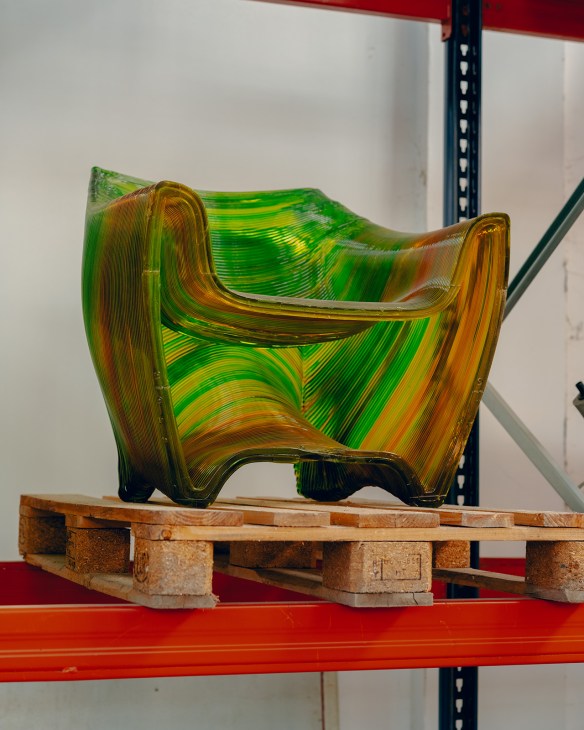
It’s safe to say that Crédoz is back on his feet. In the new digs, towering robot arms attached to extruders are linked with proprietary software. One of them moves slowly around a circular object as it adds a fresh layer onto an object’s surface. Post Industrial Crafts focuses on large-scale printed design pieces, from lamps to benches, using colourful, recycled plastic. Crédoz has raised €1.2m and is inundated with work; he is building a play castle for a park in Lyon and bidding for an airport-wall project in California.


Saint-Étienne’s design ecosystem has played a significant part in his success. To many in France, however, the idea that the city has a design scene at all might come as a surprise, in part because of its industrial reputation. Often compared to Manchester or Pittsburgh, Saint-Étienne was once an arms-manufacturing hub with a history of making weapons that can be traced back to the 14th century. France’s national arms factory, the Manufacture d’Armes de Saint-Étienne, was established here in the 18th century, bringing plenty of factory jobs and helping to forge the city’s blue-collar identity. It operated on a newer site from 1866 until 2001; a few years after it was shuttered, its buildings were redeveloped as the Cité du Design.
Coal mining also left a huge mental and physical imprint on the city. The industry provided raw materials for Saint-Étienne’s metallurgy and textile factories. Today, if you gaze up from the Grand’Rue, a thoroughfare that stretches from north to south, you will notice a series of hillocks. Many of these were originally deposits from excavation. The city’s largest mine, Couriot, closed in 1973. Crédoz’s 3D-printing warehouse now stands on this site.
With the end of coal production, Saint-Étienne suffered an economic slump and entered a prolonged period of soul searching. Even today, shuttered shops in its centre point to tough times. But it has something that many wealthier metropolises do not. Crédoz recalls the lifts that he used to receive when he couldn’t afford to buy his own car and the way that people rallied round him. “It’s not competitive here,” he says. “I received a lot of help from everyone.” In this football-mad city, community still matters and it’s a quality that Saint-Étienne can leverage as it seeks to build up its design scene.
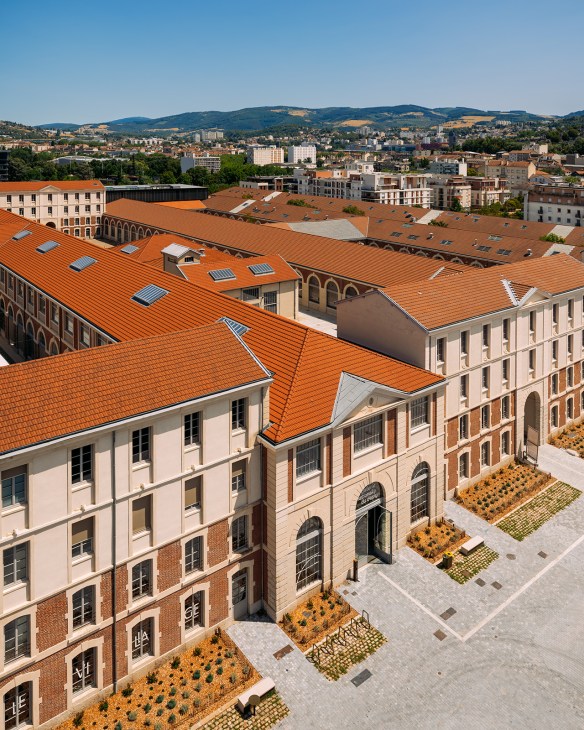
“We are a very horizontal city where everybody has a chance to engage and make a change at their own level,” says Yannis Bekhti over lunch at the Cité du Design’s La Fabuleuse Cantine, a business with a mission to combat food waste. A former policy and economic adviser in the Middle East and North Africa, Bekhti is now the president of the entity that oversees the design neighbourhood and its school. He is also the deputy mayor in charge of managing the city’s image. Like many people involved in developing Saint-Étienne, he says that the focus on design is based on the city’s pre-existing skills and the sector’s strong links to the past.
Some of the industries that have historically thrived in Saint-Étienne – including ribbon-making, particularly for chocolate boxes – have given it a transferable savoir-faire, says Bekhti. Even arms manufacture required designers, which was a key factor behind the creation of one of France’s first drawing schools in the city in 1803. The establishment was renamed several times before becoming Ésad Saint-Étienne in 2006. “This is where the link is, between our industrial heritage and our contemporary relationship to design,” he says.
The metropolitan government also has a track record of serving as a patron of architecture. In the 20th century Eugène Claudius-Petit, the mayor Ferminy, a town just outside the city limits, commissioned modernist master Le Corbusier to design several buildings in the city, though only one of these was completed during the French-Swiss architect’s lifetime: the Unesco-recognised Firminy cultural centre. The futurist Église Saint-Pierre was built in fits and starts, and finally completed in 2006. Le Corbusier laid the foundation stone for Unité d’Habitation, a huge housing block that he called a “vertical town”, but died shortly afterwards, leaving the work to be finished by his former assistant André Wogenscky.
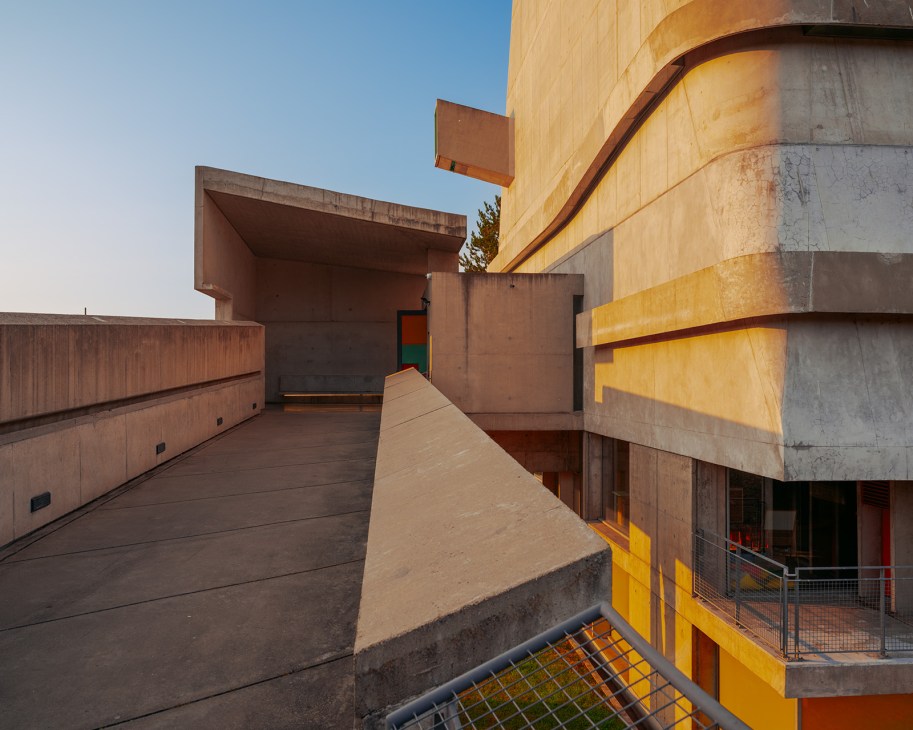
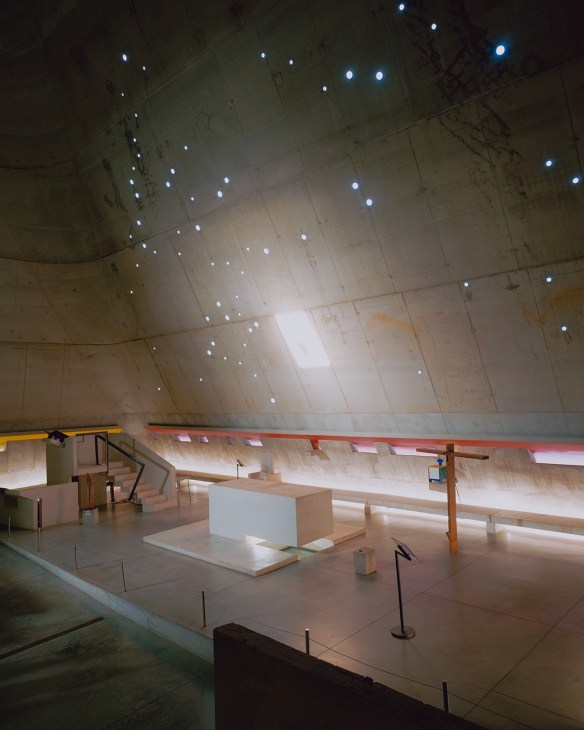
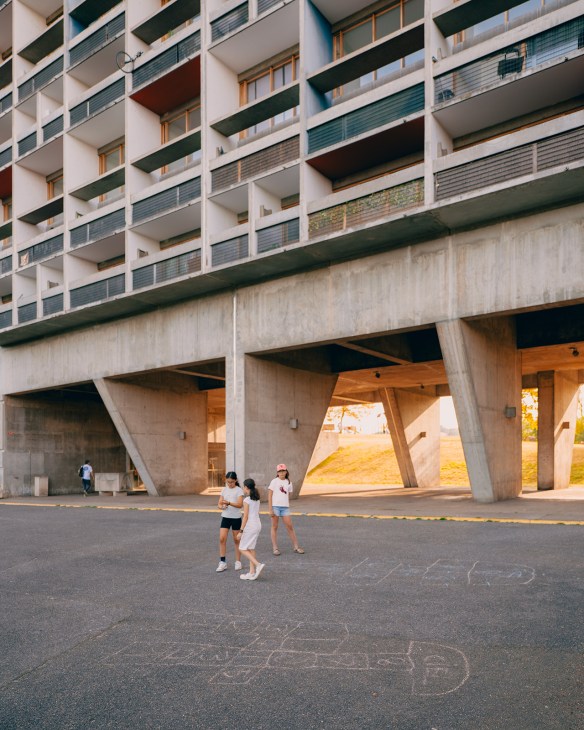
This past helps to explain why Saint-Étienne already punches above its weight. Since 1998 it has held the successful International Design Biennial, with each edition attended by tens of thousands of visitors. In 2010, Unesco recognised Saint-Étienne as France’s only Creative City of Design.
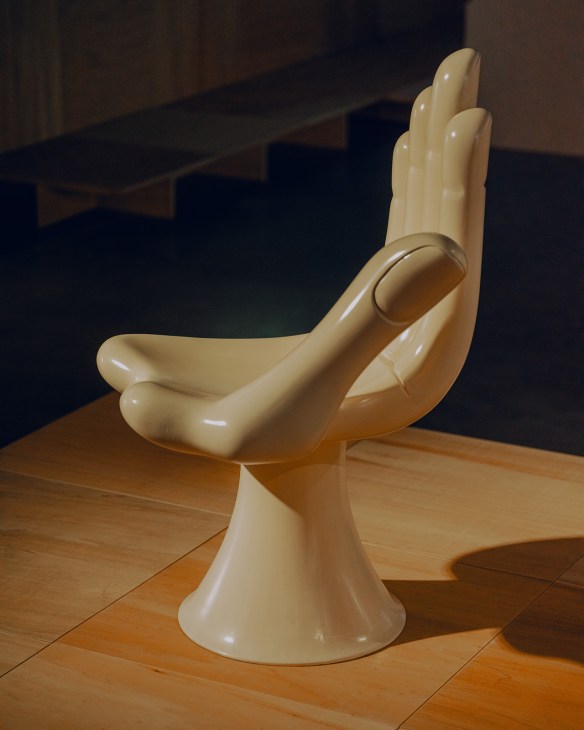
Its creative history features heavily in Design en Main: Du Langage à l’Objet (“Design in Hand: From Language to Object”), the inaugural exhibition at the National Gallery of Design. The wood-panelled exhibition space is split into six sections that explore the hand’s relationship to design. “With Bare Hands” looks at the city’s ribbon-making, arms and mining industries; “Lending a Hand” focuses on the eye-catching graphics and products of Manufrance, a Saint-Étienne-based mail-order business that was popular in the 1970s; and “Losing a Steady Hand” showcases a fun collection of postwar domestic appliances, arranged on a mirrored surface.
The gallery’s director, Aurélie Voltz, says that the space has a responsibility to capture the “history of society”. The idea behind what she calls “this special venue for design” is simple: making exhibitions accessible and reminding audiences that design is a part of daily life. Related to the latter is the way that design can trickle down to other parts of the economy. “Saint-Étienne is the right place to talk about this,” says Voltz. “In formerly industrial cities, culture is the most important vehicle for helping a city to move on.” The exhibition borrows from the permanent collections of institutions such as Bordeaux’s Musée des Arts Décoratifs et du Design and Paris’s Centre Pompidou.
The building’s layout was conceived to entice visitors to physically engage with design. They first encounter Le Seuil, a space to chat, read and sit on chairs by the likes of Enzo Mari and Marcel Breuer. Upstairs, a mezzanine viewing gallery features modular furniture from French design studio Marie et Alexandre.
Éric Jourdan, the director general of the EPCC Cité du Design Ésad-Saint-Étienne – the body that oversees the city’s design ecosystem – recognises that there’s still plenty of work to do to convince people that design has a central role to play. While it might not have the funding of the major Paris-based institutions, Ésad Saint-Étienne is renowned for its hands-on workshops that span everything from woodwork to printing. Its graduates have the potential to stay on and play an important part in Saint-Étienne’s future.
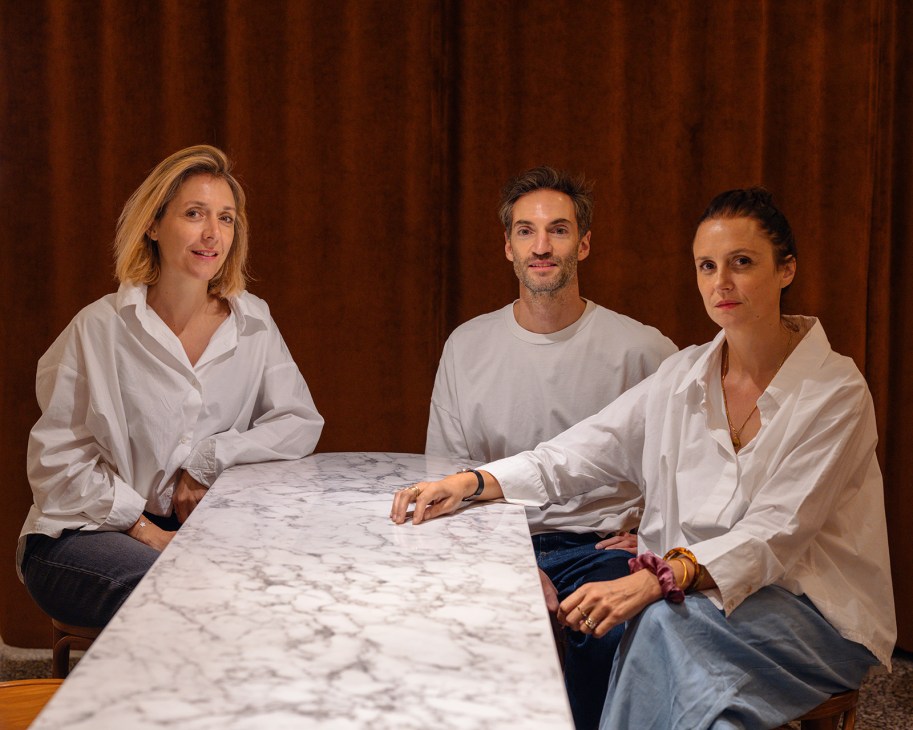
Sticking around in the city has worked out for design studio Numéro 111, founded by Ésad Saint-Étienne alumni Sophie Françon and Jennifer Julien, alongside architect Grégory Peyrache. The trio first started working together 15 years ago at the International Design Biennial. Their project portfolio includes the Cité du Design shop, street furniture for the biennial and recently completed interiors for a café called Dussap, where Monocle meets the Numéro 111 team for coffee. The practice is proof that being outside design’s traditional echo chambers isn’t a problem – and can even be a creative advantage. “We are near Lyon, the Alps and Paris,” says Julien. Peyrache adds that being based in a postindustrial city means that there are plenty of skilled craftspeople with whom they can collaborate. Alongside designing pieces for luxury furniture company Ligne Roset, Numéro 111 is also working on projects such as a hotel in Provence and a riad in Morocco.
Numéro 111 is being joined in Saint-Étienne by many other designers who are either moving back home or settling from other parts of the country. They are motivated not just by the city’s efforts to make design part of its economic future but also by the simple fact that things remain affordable here. Ésad Saint-Étienne’s former home, where it was based before its move to the Cité du Design in 2009, has been converted into 30 studios for early-career designers. Every year, the city funds four graduates’ annual rent. We visit the large studio that Louis Chevalier and Mathilde Garcia share in the building. They have space for facilities including a showroom and a metal-welding area, where Chevalier can work on his architectural pieces, manipulating industrial forms. “We pay €250 rent a month,” says Garcia, who makes decorative pieces. “As we start our professional careers, it’s the best place.”


A five-minute walk from the Cité du Design, Anaïs Borie, another former Ésad Saint-Étienne’s student, is hand-cutting stained-glass pieces for a new commission. Borie spent a decade living in Eindhoven but she recently felt the urge to come home. In Saint-Étienne, she was able to buy a ground-floor studio that was previously a long-shuttered shop for less than a garage would cost in many cities. “I didn’t want to worry about moving from workshop to workshop,” she says. “Here, I can have a more settled practice.”
Borie, whose influences include art nouveau and science fiction, currently has an exhibition called Brèches Fertiles at the Cité du Design’s La Platine, a space dedicated to the work of emerging creatives. As well as the main objects on display – several of which were made in collaboration with nearby metal workshop Tôlerie Forézienne – she designed everything else, including the sets and the sound. It’s already paying off. The piece that she is currently working on in her studio was commissioned by a visitor to the show.
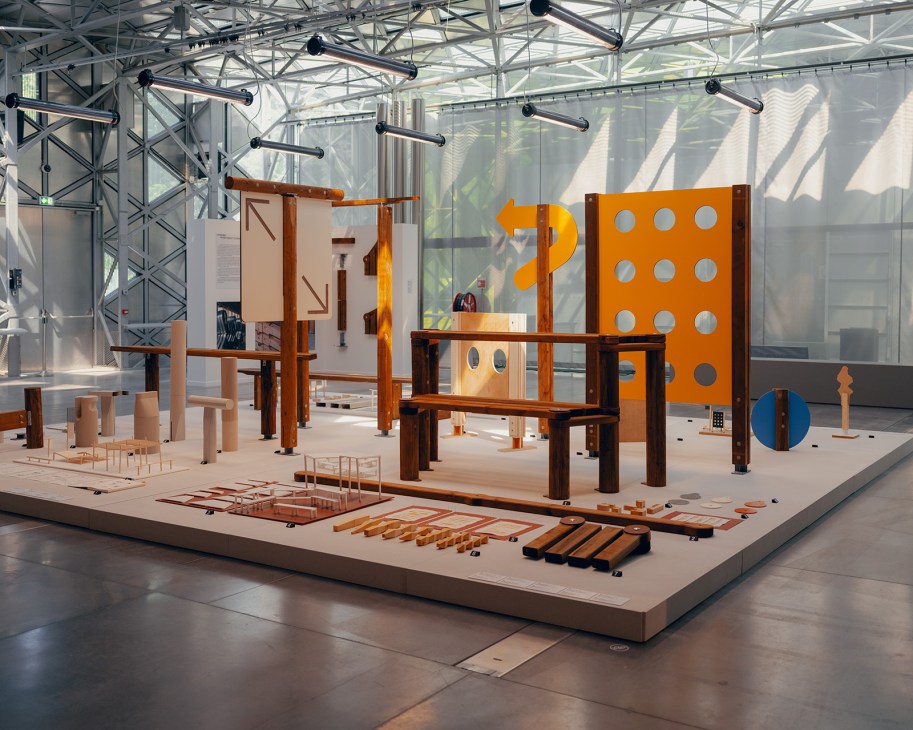
Stories such as Borie’s are encouraging – and evidence that Saint-Étienne’s punt on design is reaping rewards. Still, for all the encouraging green shoots, the city doesn’t claim to have its future entirely mapped out. But plenty of the necessary pieces are now in place. Some might suspect that Saint-Étienne is taking on too much risk, giving grants to businesses seeking to hire designers to improve products and talks about how design can improve public services. For Bekhti, though, it’s about making the city more resilient – and he’s in little doubt about the value that all of these efforts are bringing. “I believe that creative industries such as design will be viable tomorrow,” he says. “At a time when AI is challenging our perceptions of the world, we need to go back to what makes us human.”
Saint-Étienne timeline
1764: Royal arms factory, Manufacture d’Armes de Saint-Étienne, is established
1803: The city’s school of drawing is launched
1866: A new arms factory site opens
1886: The Gauthier brothers create the first French bicycle here
1987: The Musée d’Art Moderne et Contemporain de Saint-Étienne Métropole opens
1998: Saint-Étienne’s holds its first International Design Biennial
2005: The Cité du Design concept is born
2009: The formal inauguration of Cité du Design
2010: Saint-Étienne joins the Unesco Creative Cities of Design network
2026: National Gallery of Design opens in June