Trump’s new Air Force One plane is bringing the president down to earth
The president’s Qatari-gifted Boeing 747-8 might be more risk than reward.
Air Force One, not actually a plane but the radio call sign for any aircraft carrying the US president, has traditionally been a quiet, if staid, part of the national landscape. Until recently that call sign would typically apply to two 40-year-old Boeing VC-25A (modified 747-200B) jets. Their most prominent feature of late, has arguably been the “air stairs” from which presidents climb and descend, waving and smiling. These are not only a stock image in news broadcasts but have become, with elderly presidents such as Joe Biden and Donald Trump, a measure of their fitness, with any stumble or slowness dissected and analysed by online commentators.
As he has done so often, Trump relishes a controversial revamp of a quiet, staid fixture of the national landscape (see the Kennedy Center). It began, of course, with the gifting of a plane (a Boeing 747-8) from the Qatari royal family: a constitutionally questionable $500m (€437m) “flying palace” transferred to a sitting US head of state with, apparently, no strings attached. The plan is to convert the plane into a new “bridge” VC-25B that will ultimately be squirrelled away at Trump’s yet-to-be-built presidential library. The whole tab is being paid for, curiously, by siphoning funds from a programme to modernise and upgrade the US ballistic-missile arsenal.
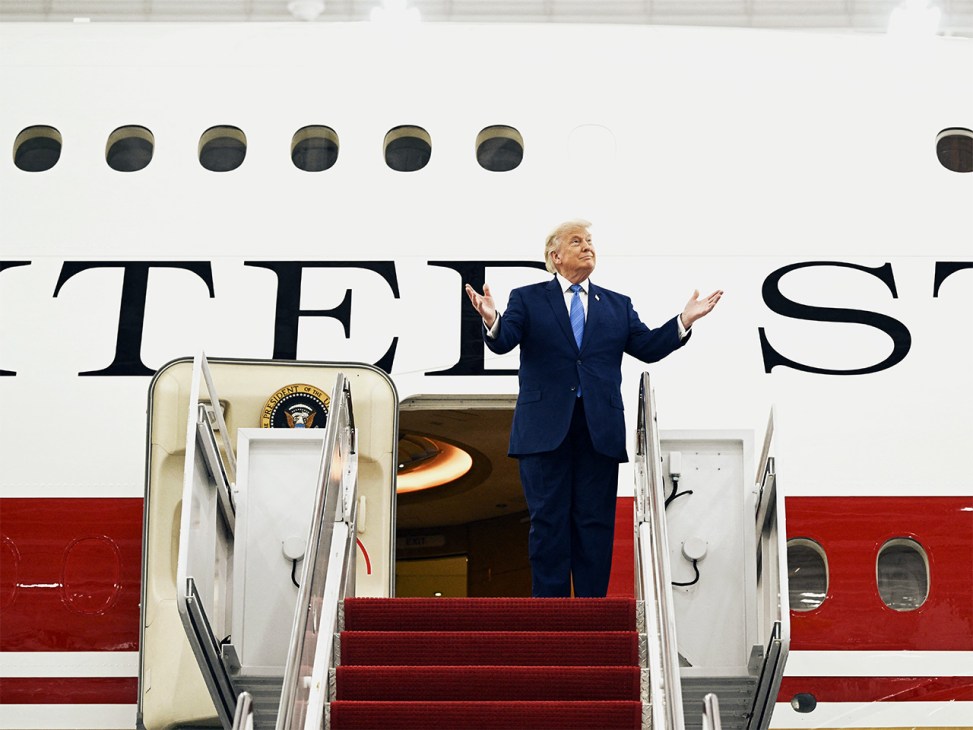
Then there was the jettisoning of the plane’s iconic livery – a storied collaboration between designer Raymond Loewy and John F Kennedy – in favour of a “more American” design. It’s heavy on the blue, a shade the Air Force warned could have thermal impacts. The result is rather as if you had asked ChatGPT to “give me the airplane livery version of a trad Republican politician’s suit, including the gold lapel pin.” The discreet US flag on the tail? Let’s make it bigger and let’s make it wave like some soda-pop ad for “America 250”.
But ethics and aesthetics aside, the unprecedented rushing of the plane into service (at what contractor L3Harris dubbed “maximum velocity”) raised myriad security questions. A Boeing 747-200B has anywhere between five and six million parts. Was 10 months sufficient to “scrub” the plane, even as it was being overhauled for its presidential-airlift role? As is so often the case with Trump projects (e.g. the Reflecting Pool), corners were cut. Unlike the historic Air Force One fleet, the new plane does not have the ability to refuel in midair and only possesses one set of embedded air stairs (instead of the traditional two). This means passengers and crew have to rely upon on-the-ground infrastructure to board and deplane. Air Force One planes are “speckled with missile approach warning sensors and many laser countermeasures turrets,” according to TWZ. These have not been seen so far by analysts in photographs taken from test flights of the new model. The old planes are also hardened against missiles and the electro-magnetic pulse [EMP] of a nuclear blast. “It is very unlikely, if not impossible,” TWZ notes, “that this aircraft was hardened against EMPs in the timeframe required for fielding it.”
All these suspicions came bubbling to the surface earlier this week when the president, at the behest of the Secret Service, switched to a legacy Air Force One plane for his return from the Nato Summit in Ankara. Was there a security threat or, as the president claimed, did he just want to send the plane on a victory lap of US bases? Is the plane truly fit for duty – not just to transport the president but also to serve as a mobile command post – in hazardous foreign skies or is it just a ceremonial trophy plane?
The fact that another plane was on standby speaks to the seriousness of the enterprise. As the national security historian Garrett Graff has noted, the plane from which the president steps down to the tarmac is just one in a shadow air force. Apart from the primary plane and the backup plane, the president is typically accompanied by Marine One helicopters. “The US,” says Graff, “is the only country in the world that provides full helicopter lift capability to its head of state when travelling abroad.” Then there are Boeing E4-Bs, or the “National Airborne Operations Center,” capable of litigating nuclear war from the skies. There are even, Graff notes, a “secret fleet of unacknowledged planes,” unmarked Gulfstream jets, a sort of back-up to the back-up.
All of which is why the seemingly feckless addition of a foreign-sourced Air Force One plane, with a breakneck overhaul, seems so remarkable, and why the events in Ankara muddy the waters. “There are certainly times when presidents have flown on other aircraft – for instance, on unmarked cargo jets into war zones – and occasionally a president will switch to a back-up aircraft mid-trip if there’s a serious maintenance issue,” Graff told me. “But this mid-trip switch stands out for suspicion.”