‘We don’t need to shout to reach the right people.’ Agnona’s CEO and creative director on the luxury brand’s next chapter
We speak to Stefano Aimone, who shares the inspiration behind the label’s latest collection, how to choose the right market and the brand’s distinctly Italian approach to fashion.
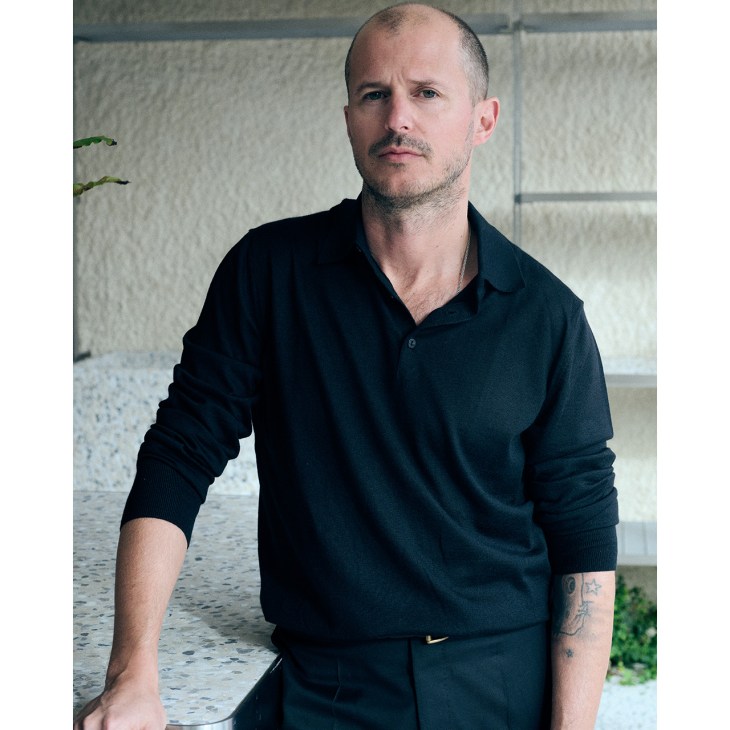
Since acquiring Agnona in 2020, Stefano Aimone – the label’s CEO, creative director and sole owner – has doubled down on the luxury Italian brand’s heritage and textile expertise. He has also solidified its presence in Milan with a flagship on Via Santo Spirito and headquarters on Via Archimede. This season, Aimone presented his latest womenswear and menswear collections, which feature double-faced cashmere coats, wraparound shirts and silk sets. Here he discusses why beauty should be a part of everyday life and resisting distribution for distribution’s sake.
How do you balance being both creative director and CEO?
The positions enrich each other. There are moments when you have to change your way of thinking very quickly. One conversation can be about a fabric, technique or the proportions of a coat. The next can be about retail or the future of the business. But for me, they are not separate worlds. As creative director, I am thinking about what Agnona should represent and as CEO, I have the responsibility to make sure that this vision has longevity.
It also means that there are fewer layers between an idea and its execution. I can ask: “Does this feel right for Agnona? Does it make sense for our customer? Is it something that we will still believe in five or 10 years from now?” If the answer is yes, we can act on it. I think that creativity becomes stronger when you understand the reality around it, that business becomes more interesting when it is guided by a very clear creative point of view. The balance between commerce and creativity is delicate and continuously in flux.
Where do you see the opportunities today for an independent brand such as Agnona?
Independence gives us the freedom to be very precise about who we are and today that is incredibly valuable. Since acquiring Agnona, I have felt that we are in quite a rare position. There’s something almost embryonic about it: the possibility to shape a house with the curiosity, energy and freedom of something new but within a shell that has been refined for more than 70 years. We are not starting from zero. We are starting with extraordinary knowledge, history and material expertise. In a way, Agnona feels both young and mature at the same time, which gives us enormous creative freedom.
It’s not about becoming bigger for the sake of being bigger. It’s about becoming stronger and more distinctive. We can make decisions based on what feels right; invest in extraordinary materials, craft and innovation; and remain very close to the people who make and wear our clothes. We can choose quality over volume and longevity over immediacy. We don’t need to shout to reach the right people. Luxury is about being personal, discovering something exceptional, understanding how and why it was made and wanting to live with it for many years.
Agnona was founded in 1953, so I am very conscious of what we have inherited – but also of what we have left behind. Our responsibility is not simply to preserve that heritage but to keep it alive, question it, experiment with it and allow it to evolve. For me, that is perhaps the greatest opportunity of being independent – to have the freedom of a new beginning without losing the wisdom of age.
Which markets are the most interesting at the moment? Do you see more opportunities in a direct-to-consumer approach or through department stores and wholesale partners?
For us, it’s less about pursuing markets simply because they’re large than identifying places where there is a genuine understanding of Agnona, of material, craftsmanship and seasonality.
Italy is naturally very important to us and opening our new flagship in Milan this year was a significant moment. Milan is our home, so it was important to create a space where people could enter the world of Agnona to experience the materials, the architecture and the collection together in one environment. The shop is a physical expression of the house, of where we are going, with links to art, culture and authenticity.
Gstaad is the next important step for us. Agnona has a natural relationship with its landscape, climate, international community and, of course, its appreciation of exceptional cashmere and pieces that are luxurious but designed to be lived in. I’m interested in opening shops and working with teams that Agnona feels culturally and emotionally at home in, rather than simply accumulating addresses.
South Korea is also a strong market for us. It’s home to an extremely sophisticated customer base with a deep appreciation for quality, fabrication and design – and the subtleties of what we do. Agnona has its own presence in Seoul alongside some very strong retail partners.
In the UK, Harrods is a very special partner for us. Agnona’s concession gives us a home from home in London, now within the newly developed first-floor womenswear environment. Harrods provides exceptional care to its international and domestic customers, which makes it an important expression and custodian of the brand in the UK.
I am less interested in defining the business as direct-to-consumer or wholesale than in thinking about the quality of Agnona’s presence. The two models are different expressions of the same ecosystem and I think a healthy brand needs both intimacy and discovery. Our own shops allow us to build the world of Agnona with absolute clarity but there is also real value in customers encountering us within a highly considered, multi-brand environment. Department stores place the house in a broader cultural and commercial conversation and, with the right partner, can bring relevance and perspective that you can’t replicate on your own.
It’s important today to resist distribution for distribution’s sake. Where it is present, how it is presented and what surrounds it all contribute to the perception of a house. In that sense, distribution is also a creative decision. For Agnona, the ambition is therefore not ubiquity but relevance: a considered network of our own spaces and exceptional partners, each contributing something different to the way that customers discover and experience the house.
What was your ambition for the latest collection?
I wanted the collection to have a feeling of movement. We called it “Coast to Coast” but the journey is not only about travelling from one geographical point to another. It’s about how the motion and process of travel change your state of mind.
It begins in the city and gradually becomes more relaxed as you move through the countryside and towards the sea. The wardrobe changes with that journey, beginning with the precision of lightweight double cashmere and tailoring. Then linen, silk, perforated leather, crochet and embroidery bring more air and freedom into the clothes. It’s a journey from contained and curated to relaxed and reflective.
My ambition was to create a complete summer wardrobe that could move with a person rather than dictate how they should live. There is sophistication but also a sense of ease. For me, successful design and relevant luxury garments should give you that freedom.
How would you describe Italian sensibility in fashion?
I think that there is an Italian instinct for bringing beauty into everyday life. It’s not necessarily about formality or decoration. It can be the proportions of a jacket, the feel of a fabric, the way that someone sets a table or the particular light in a room. A joy in creating and sharing beauty in an everyday environment.
There’s also a strong relationship between the hand and the eye in Italy. We have generations of knowledge about textiles, tailoring, leather and manufacturing but I’m interested in when knowledge doesn’t become nostalgic. Craft has to remain alive, which is why I knew that it would be important to build the atelier, archive and rooftop greenhouse as part of the new Agnona HQ – a trifecta to create, grow and learn.
Agnona respects extraordinary materials and techniques but we don’t want them to feel precious in a way that makes them untouchable. You should wear the cashmere, travel in it, live in it. Perhaps this approach is quite Italian too: beauty should be part of life.
agnona.com