The 10 best spring/summer 2027 collections at Milan Fashion Week Men’s
From Ralph Lauren and Kuon’s crossover of American and Japanese sensibilities to Dunhill’s 1970s style and Prada’s pared-back luxury, Monocle picks out the best looks for spring/summer 2027 from Milan Fashion Week Men’s.
The spring/summer 2027 edition of Milan Fashion Week’s menswear edition delivered collections that offered something for every occasion, from the Americana-inflected vision of Ralph Lauren to the movement-ready clothes of former dancer Saul Nash. Beyond the runway, the city’s showrooms offer the opportunity to get up close to the designs and feel the quality of Italian manufacturing – namely made-in-Marche loafers and Florentine cashmere. Here are Monocle’s top-10 moments from the week.
1.
Saul Nash
A former dancer, London-based Saul Nash has carved an appealing niche for himself in the menswear market, blending sportswear and tailoring while experimenting with innovative performance fabrics. Put simply, he offers clothes that enhance motion instead of restricting it. For spring/summer 2027, he continued exploring his “movement-based” design philosophy, looking at archival imagery of sports figures and pin-ups, and translating them into garments that were both functional and elegant: a raincoat cut like double-breasted trench; a suit jacket with an elasticated back nodding to fencing uniforms; and nylon twinsets in shades of burgundy and yellow. “Growing up in London, there was a unique story to be told around the men who wear sportswear and elevated perceptions around them – I’m always fascinated with what we deem formal versus casual,” says Nash after dancing down the runway to take his bow.
His growing presence in Milan over the past few years comes as a breath of fresh air to the city’s calendar, which is mostly dominated by longstanding brands. “Milan has been the first step to help me imagine what my brand looks like beyond technical wear, and look at [my expertise] through a lens of tailoring,” adds Nash.
saulnash.com


2.
Brioni
This season, Brioni’s in-house design team led the charge in the absence of a creative director (Austrian designer Norbert Stumpfl exited last December and has yet to be replaced). As is often the case when brands find themselves in an interim period, the instinct is to reaffirm house codes rather than rock the boat. At Brioni, this means a reinforcement of the label’s bespoke tailoring offerings with Brioni Maestria, a new project that aims to provide further opportunity for customisation. The label also looked to its Roman origins with a palette inspired by the city’s hues – eucalyptus green, faded reds and travertine beige to name a few – as well as the relaxed, unlined silhouettes favoured by residents of the Italian capital. Highlights from the collection include a butter-soft suede blazer and a jacket with pockets designed to hold a newspaper and a pen, as well as roomy weekender bags for city escapes. As the brand awaits its next chapter, its design team is guarding the core belief that good menswear revolves around functionality and high-quality fabrics but also keeping a sense of ease, alla Romana.
brioni.com


3.
Malo
Italian knitwear label Malo was founded in Florence in the 1970s by brothers Alfredo and Giacomo Canessa. From their Tuscan atelier, the duo created some of the world’s finest cashmere sweaters – and were among the first to offer coloured cashmere – but it struggled to keep up with market pressures in the 2010s. Now, it has been acquired by American investor David Glickman via his private-equity firm Glickman Capital and is being relaunched with an ambitious plan, which includes a new retail space on Milan’s Via della Spiga and a growing collection of knitwear, shirting and sharp outerwear.
Behind the new collections is longtime editor-turned-CEO Michelle Kessler-Sanders, who has successfully sprinkled a fresher, more fashion-forward touch to Malo’s signature cashmere offering – quickly turning the label into the one to watch in the Italian fashion capital.
malo.com


4.
Dunhill
“I started the collection with a series of blue blazers, almost like a love letter,” said Dunhill’s creative director, Simon Holloway, at the brand’s Milan presentation. “There are three in these gorgeous bright colours, made in worsted cashmere, which is woven in Huddersfield. They’re styled with silk-cotton turtlenecks, very much inspired by a photograph of Roger Moore from the early 1970s.”
Since taking the reins in 2023, Holloway has been an unapologetic champion of British sartorial codes, delving into Dunhill’s 133-year strong archive for inspiration. (This season, for example, a vintage lighter with a playing-card motif is echoed on smoking jackets, robes and velvet slippers.) There’s an overt touch of James Bond this season, with eight-button navy blazers mingling with speedboat-ready linen shirts and belts made of rope. Elsewhere, the influence of the British painter Lucian Freud can be seen in the way a cashmere-silk scarf is worn with a pale-grey linen suit. “It reminds me of how he wore scarves as an alternative to a tie,” says Holloway. “There’s a loose tie knot in the way that he did it, which is quite charming.” Rich in references and reverence for the brand, Holloway is reviving the Dunhill universe for a contemporary consumer.
dunhill.com


5.
Ralph Lauren
Ralph Lauren brought his trademark American prep to Milan, staging a two-collection show at his brand’s sprawling palazzo on Via San Barnaba. Up first was the designer’s formalwear-focused Purple Label with a series of silk-blend beige and pinstripe suits, paired with sunglasses and the occasional beret, as well as reversible leather jackets and open-weave linen knitwear. A limited-edition series, made in collaboration with Japanese design house Kuon, included indigo-hued longline coats and blazers featuring sashiko embroidery and patchworks – a compelling case for more crossover of American and Japanese sensibilities. Then came the second act of the show: Polo Ralph Lauren. With classic collegiate pieces (namely varsity jackets, polo shirts and baseball caps), models evoked the halcyon days of tertiary education with silk ties worn as belts, argyle jumpers tied around shoulders and oversized totes filled with bouquets. Ultimately, this two-part presentation encapsulates Ralph Lauren’s kaleidoscopic, romantic vision of the modern-day American man – one that might involve a summer day spent at a Hamptons beach before a more formal occasion in the evening that calls for a suit. Traditional in many ways but not overly wedded to formality, such is the American brand’s recipe for success.
ralphlauren.com


6.
Prada
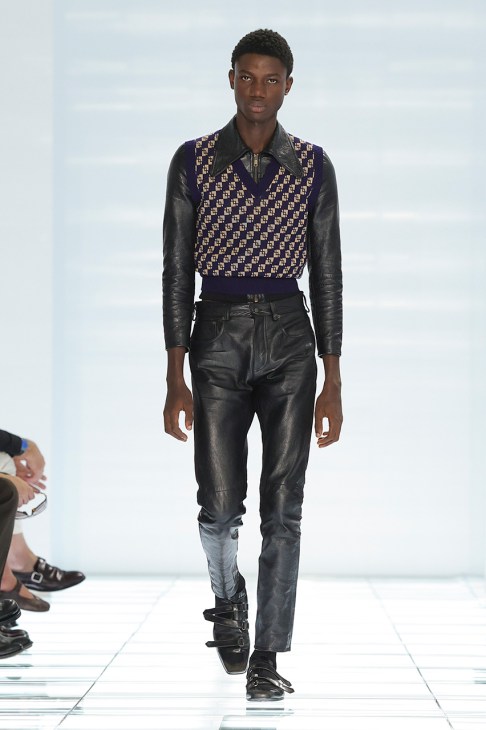
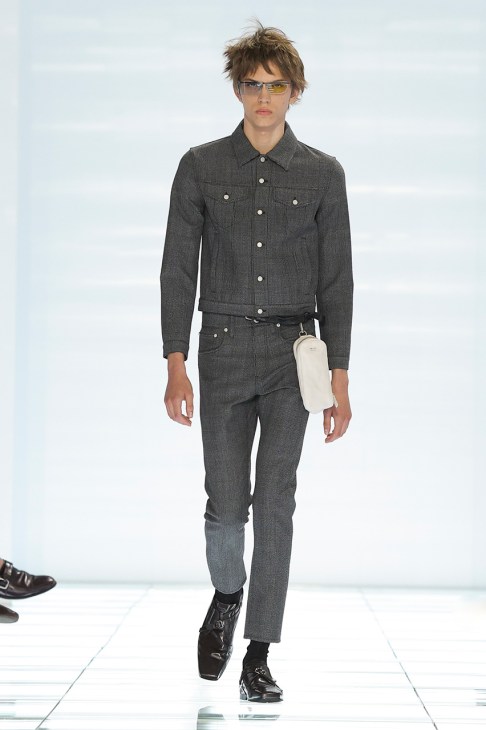
Miuccia Prada and Raf Simons stripped things back for their latest collection, starting with the transparent runway set: the art deco carpets of previous seasons were replaced by fluorescent white tubes, glass and concrete columns. The opening look consisted of a white denim set with a classic black blazer layered over it. Denim, after all, is the most universal of garments, adopted by sailors and workers long before it became a fashion item, as Prada pointed out. The collection moved onto shrunken white denim trousers paired with simple white T-shirts or V-neck sweatshirts, along with skinny pinstripe or leather suits that recalled Hedi Slimane’s heyday at Dior Homme. It’s not a silhouette that can be pulled off easily but the label’s customers will still find plenty of items to shop, including patterned jacquard knits and mini nylon bags hanging from models’ oversized leather belts.
Beyond the product, Prada and Simons pose interesting questions around their decision to offer a pared-back look and “break with the conventions of luxury,” as they put it. Is it time to rethink what constitutes luxury and investment-worthy design? Their latest collection, a statement “against exaggeration, against complex materials, against useless design”, suggests so.
prada.com
7.
Santoni
Judging by the number of bright orange bags spotted around Quadrilatero della Moda, Milan’s high-end shopping area, Santoni has something of a cult following. The Italian luxury brand that specialises in handmade shoes and leather accessories rarely strays from what it does best – loafers, sneakers and bags executed to the highest level of Italian craft, using premium leather.
For its spring/summer 2027 line-up, Santoni is presenting new ways to personalise its Carlo loafers with a series of interchangeable tassels that can be added to the saddle of the shoe. Another highlight of the new collection is the continued exploration of its intrecci and serpentine methods of handweaving leather strips to introduce texture across footwear and weekender bags. Ultimately, the enduring popularity of Santoni lies in the brand’s willingness to hone in on manufacturing techniques while gently evolving the styles of shoes, ensuring continued relevance for a contemporary audience.
santonishoes.com


8.
Church’s
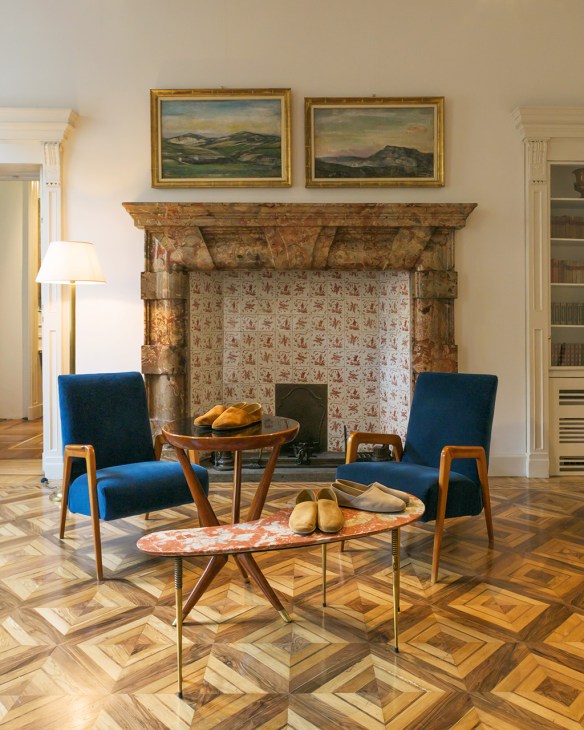
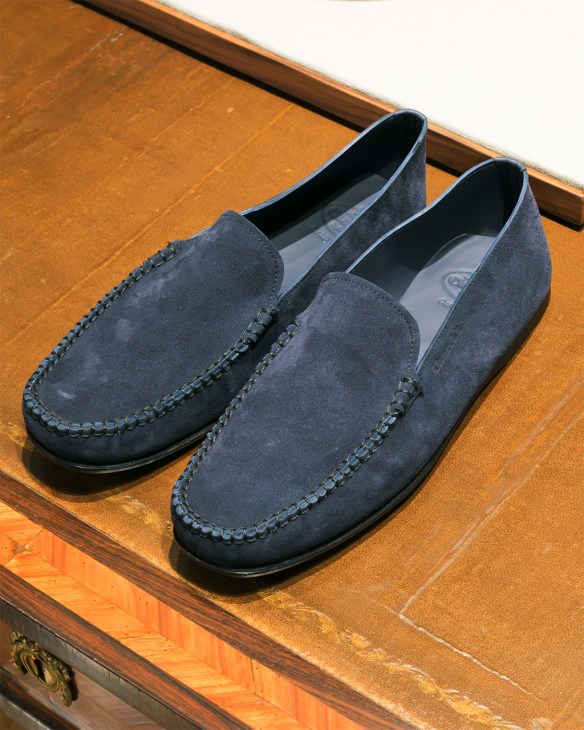
For spring/summer 2027, British shoe brand Church’s is seeking a sense of intimacy. Its presentation, “The Residence”, was a domestic framing of the Prada Group-owned house’s three men’s product families: Townhouse, Cottage and Villa. As a trio, these shoes cover a range of needs for a summer spent moving from a city to a countryside escape, from daytime to more formal evening events. Collection standouts include the Thirsk brogue, with its discreetly perforated leather, as well as the more relaxed profiles of the Tilford loafer and the Jason slipper.
Alongside next season’s novelties, vintage shoes from the brand’s 150-plus-year archive were on display to create a dialogue between past styles and how they’ve evolved to meet modern needs. It was a fitting touch as the British house is currently formalising its rich history through its Church’s Chapters project, which includes an installation currently being shown at its Northampton headquarters.
church-footwear.com
9.
Thom Browne
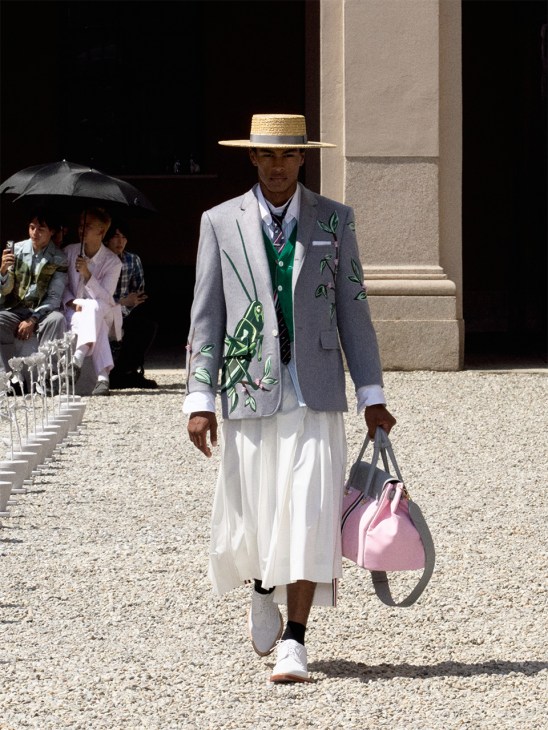
Thom Browne made his name with signature gray suits – the trousers are always two or three inches above the ankles, the jackets’ sleeves are intentionally short and often feature four horizontal white stripes. But more recently, under the stewardship of the Zegna group, the designer has been broadening his scope. For his spring/summer 2027 menswear collection, presented in Milan for the first time, he offered variations of his famous suits (some were updated with kilts and bermuda trousers) but also added to the look: elegant straw hats, weekender bags in sturdy canvas, workwear-inspired jackets and bright green trench coats. He added a sense of romance and whimsy – something often missing from most menswear presentations – with bee and floral motifs that were embroidered on outerwear and accessories.
As the brand continues to expand internationally, Browne has been able to strike a rare balance: staying true to his original vision and experimental spirit while also introducing new items and speaking to a wider audience. Gildo Zegna, who acquired a majority stake in the New York label in 2018, will no doubt be pleased.
thombrowne.com
10.
Giorgio Armani
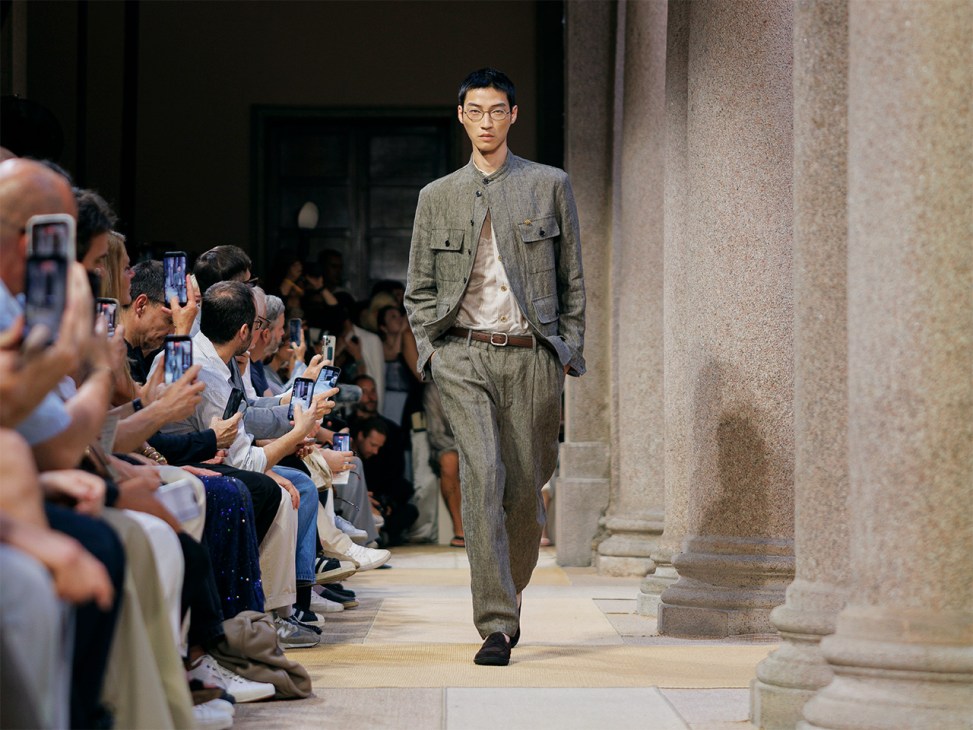
Giorgio Armani closed this season’s Milan Fashion Week Men’s with a show at Palazzo Orsini in Brera. As usual the label hasn’t followed popular trends, which have lately been favouring extra-slim silhouettes and brighter colour palettes, and instead doubling down instead on the signatures that the late Giorgio Armani relied on for so many years. A neutral palette of navy, gray and earthy hues paired with collarless jackets and lightweight silk trousers that evoke a sense of Mediterranean ease. There were also more playful touches in the form of accessories, from brooches on suit lapels to woven bucket hats that added a more laid-back feeling to the summer ensembles. The collection was pure Armani – a testament to the late designer’s clear vision for sunny Mediterranean living, having spent many of his summers in perfectly cut shorts and airy linens at his homes in St Tropez and Pantelleria.
Leo Dell’Orco and Silvana Armani have been steering the brand with grace since Armani’s passing last year, yet the question that remains is: how long until the need for a more definitive leader with a vision of their own becomes necessary?
giorgioarmani.com