Issues
Style Directory
Easy does it
James Coward, Canada

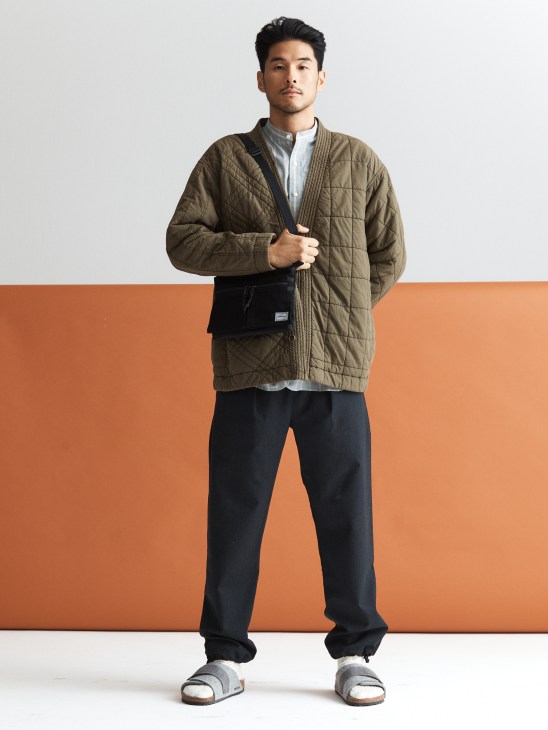
Patrick Bull, Daniel Garrod and Aaron Gray run James Coward, a menswear label which, despite its name, is confident when reimagining familiar workwear styles. For the Vancouver-based brand, the focus is on fresh proportions and functional details. Fabric comes first; after sourcing the finest linen from Belgium or deadstock fabrics from Japan, the founders allow the materials to guide the design. Extra-wide armholes and boxy silhouettes add to the comfort.
Teaming up with the right retailers, such as Canada’s Neighbour and Tokyo’s Maidens Shop, was essential to make the business work. “We plan on continuing to find shops that share our sensibilities and have their own, distinct perspectives on how to present our pieces,” says Gray.
james-coward.com
Made to measure
Graye, Singapore
When husband and wife Calvin Sim and Xie Qian Qian founded their unisex label Graye in 2016, they used their own home as a workspace and showroom. After a string of successful pop-ups and shops across Singapore, they have now opened a new flagship in Tiong Bahru that includes a studio where the designers can be seen at work.
True to its name, Graye’s colour palette is dominated by neutral hues. It focuses on sharp twists on Asian classics, such as a buttoned linen kimono top, a cotton kimono coat and the high-collared Shan shirt, inspired by Qing dynasty robes. “I’m inspired by cultural elements but I like to tone them down and make them suitable for everyday wear,” says Xie. The duo use environmentally responsible materials – their best-selling item, a double jersey knit T-shirt, is made from regenerated cotton waste fibres.


Singapore’s warm weather means that designers here are less beholden to the demands of seasonal fashion and Sim and Xie tend to refresh their shop floor with small drops of four or five pieces at a time. They also offer a bespoke service, which ranges from small modifications to custom shirts, trousers and suit sets. “We want to realise our customers’ vision by co-creating designs that they might have in mind,” says Xie.
grayestudio.com
Dream team
Daniel W Fletcher 3 Huntsman, UK

When young UK designer Daniel W Fletcher took up Huntsman’s offer of a collaboration, his aim was to marry his take on contemporary tailoring with the traditions and know-how of the Savile Row stalwart. The result is an autumn capsule made entirely in the UK that features nine bespoke suits and 12 ready-to-wear pieces, such as tailored flares and tuxedo coats. The inspiration came from Huntsman’s rich archives, including an original pair of breeches from the 1800s, which Fletcher was quick to single out.
“We’re used to working at a fast pace, whereas on Savile Row it can take up to six months to have a suit fitted,” says Fletcher, who worked with Campbell Carey, Huntsman’s creative director to tweak the proportions of traditional silhouettes and add a fresh perspective to what a Savile Row suit might look like. The two designers also added striking white topstitching throughout the edges of belted evening coats and double-breasted jackets. “We got to the final fit and a couple of the pieces were too black so we made a feature out of it,” says Carey, who wanted the collection to feel androgynous. “Nowadays it’s the fit that changes, not the design,” says Fletcher.
Carey was drawn to Fletcher’s ability to modernise silhouettes through subtle tweaks – sharper shoulders, wider cuffs or tighter waistlines. “It was good for our tailors to get their teeth into something contemporary,” he says. “Huntsman has the gentlemen’s club-like exterior but inside it’s vibrant and dynamic.”
huntsmansavilerow.com; danielwfletcher.com
Well-made essentials
Solid Homme, South Korea
Long before the South Korean wave took the world by storm, fashion pioneer Woo Young Mi was attracting international audiences all on her own, travelling to Paris since 2002 to showcase her label, Wooyoungmi. Now her menswear line, Solid Homme, which has been helping South Korean men look sharp for more than 30 years, is enjoying international momentum of its own, with its first show at Paris Fashion Week taking place last year. Wholesale partners such as Le Bon Marché in Paris and Club 21 in Thailand are also on board.


Solid Homme is famous for being one of the first labels in the country to propose, in the late 1980s, that men use fashion to express their identity. Known for its clean cuts, geometric shapes and flair for juxtaposing casual and formal wear, Woo’s designs were a welcome departure from a market limited to traditional suiting and workwear. Fast forward to today and Woo still knows how to make a statement. Her latest collection, presented in Paris’s Palais de Tokyo, received critical acclaim for its use of vintage fabric and reworking of familiar styles, from aprons to school uniforms. Her smart suede jackets, layered over slim suits, make for a great modern-day office uniform.
solidhomme.com


Cause-led clothing
Thebe Magugu, South Africa

Johannesburg-based Thebe Magugu was quick to make a mark with his eponymous fashion label, catching the attention of big names from Christian Dior to Adidas for collaborations with him. Here, he talks to Monocle about his artistic process.
Tell us why you used a colossal laundry bag for your first show in London?
Dunusa, downtown from Johannesburg, is where the US and Europe dump secondhand garments. It inverts that trickle-down theory that says fashion starts at the top and makes its way down the classes, ending up in places like Dunusa. I sourced the pieces in Dunusa instead, collected them in a laundry bag and pushed them back up into a luxury space.
Why are you drawn to strong graphics?
I love using humorous graphics on a luxurious, silk garment. One seemingly abstract pattern might really just be an enlarged image of fish and chips.
Do you feel pressure to continue tackling bigger social or political issues?
We will often explore topics like the levels of corruption in South Africa. However, while one collection might be cerebral, another can be light-hearted. It’s a balancing act.
thebemagugu.com
Subcontinental shifts
Itoh, India

Amit Babbar, the New Delhi-based fashion designer and founder of menswear label Itoh, draws inspiration from his hometown when it comes to blending modernity and the ancient world. Since launching in 2018, the brand has been releasing capsule collections featuring minimal silhouettes – think summer jackets, long shirts and drawstring trousers in earthy hues. Almost everything is made from natural, handwoven fabrics such as wool, linen, cotton and silk which stand out for their rich textures – the result of close collaborations with weavers and artisans in West Bengal, who are equally committed to conserving India’s artisanal heritage. “The core idea behind Itoh is to maintain the relevance of the handloom and explore craft,” says Babbar. “These are processes that are struggling to survive in the current global economy because of how time-consuming they are. That’s why we only release small collections, to give our artisans time and flexibility to create the weaves.”
Babbar has the same approach when laying out his business’s international expansion plans, working with a handful of retailers such as Barbershop in South Korea or Takashimaya in Japan, who share the same enthusiasm for slow fashion.
itoh.in
Fedora frenzy
Fernández y Roche, Spain

Spanish hatmakers Fernández y Roche have been handcrafting hats and caps since 1885 in their Seville factory. Using techniques that date back more than 100 years, the brand creates fedoras, panamas and trilbies from felt and straw, while its signature flat caps are made using cotton and linen weaves. The label’s rich history has also caught the eye of Christian Dior’s master milliner Stephen Jones, who collaborated with its team of artisans on a range of wide-brimmed fedoras, presented during the French house’s most recent Cruise show in Seville. We recommend one of their classic wool- felt fedoras in chocolate brown or beige to update your autumn wardrobe.
fernandezyroche.com
Simple pleasures
Egrey, Brazil
Egrey is fast becoming a mainstay in São Paulo’s fashion scene, with two shops, one in the city’s renowned Iguatemi shopping centre and another in the leafy neighbourhood of Jardins. Behind its success is founder Eduardo Toldi, a former architecture student whose Lebanese-Italian heritage reflects, in many ways, the city’s immigration history. “We used to eat kibbeh and pasta on the same table,” he says.
Toldi felt that São Paulo was missing a brand that specialised in minimalist design and muted colours. “In Brazil we have lots of colourful, regional references but São Paulo is such a cosmopolitan city, that it needed a brand like ours, inspired by neutral tones,” he says. Toldi often references modernist Brazilian architecture in his work, aiming to capture the same timelessness and fluidity associated with Oscar Niemeyer’s masterpieces.


When looking to the future, he is happy to keep the brand local. “I have a loyal customer base in the city and there is growth in the shops,” says the designer. He is equally happy to stray away from fashion’s trend cycles. “Our designs are only slightly updated with a new colour here and there,” he adds. His independent spirit is a great example of how to operate a fashion label on your own terms.
egrey.com.br
Uniform vision
Pottery, South Korea


South Korean menswear label Pottery was created by Kim Geonwoo with a singular mission: redefine uniforms. If conventional uniforms used to be signifiers of a group or community you belonged to, Kim says that today’s dress represents the lifestyles that we choose to espouse. Within just a few years, Pottery has become one of South Korea’s most sought-after menswear brands – so much so that its flagship shop in Seoul’s upmarket Hannam area is undergoing an expansion. The trick – and its motto – has been to provide “organised comfort”, meaning clothing that makes people feel at ease and, simultaneously, smart enough to go to work in. A noteworthy asterisk is Pottery’s popularity with those aged under 35, a demographic that has been quick to reject the athleisure wave of the pandemic, seeking well-made wardrobe classics to wear to work.
“There’s so much joy in growing up with a brand you love and [letting it influence] your sartorial tastes,” says Kim.
ptry.co.kr
Seamless design
Teclor, Japan

The Japan Apparel Fashion Industry Council created J Quality to highlight the work of some of the country’s best small and medium-sized manufacturers at international fairs, such as Florence’s Pitti Immagine Uomo. We have our eye on Santei, a manufacturer in Gifu that makes the stylish factory brand Teclor. Santei has been manufacturing suits for more than 60 years and is best known for mixing traditional tailoring with new fabrics and technology. Its speciality is seamless garments, such as this smart coat, which is made from a soft yet technical silk-and-polyester fabric and comes in unisex sizes. Its collar is made with a stretchy, wrinkle-free fabric called PolyFlex. Technical innovations aside, these are wardrobe staples that look great and age even better.
jquality.jp; teclor.jp
Hangout spot
Colbo, USA
Walk past Colbo in Manhattan’s Lower East Side and it will look more like a social club than a clothing shop, with locals lounging on the outdoor benches and chatting over iced coffees. The boutique, which was opened by Tal Silberstein, stocks clothing, coffee and other knickknacks – and was designed as a gathering spot from the get-go.


On the counter, rows of records for sale sit next to a record player that’s constantly spinning with Fela Kuti and the like. “Music is very important to us,” says Silberstein, who previously worked at Public Records in Brooklyn. “The idea was to create this white box that we can change around all the time.” Beyond his vintage selection, the retailer also supplies clothing from some 15 brands, including New Delhi-based Karu Research and Amsterdam-based Camiel Fortgens. “Most aren’t commercially known,” says Silberstein, who selected designers he knows or has worked with, such as Israeli-born Hed Mayner. On weekends, the space often hosts pop-ups with local DJs and nearby businesses, such as Parcelle Wine, driving the neighbourhood element even further.
colbo.nyc
House of wax
Southern Field Industries, Japan

Manabu Okada never meant to be in the fashion business. Before starting his bag and leather goods brand, Southern Field Industries, he was working for his father, producing equestrian products that were used at racetracks and training centres across Japan. “It was a busy factory,” he says. “I thought I’d be inheriting this thriving business.” But 12 or so years after he joined, the company folded. Undeterred, Okada decided to set up his own company and find new ways to work with the same suppliers that his father had dealt with.


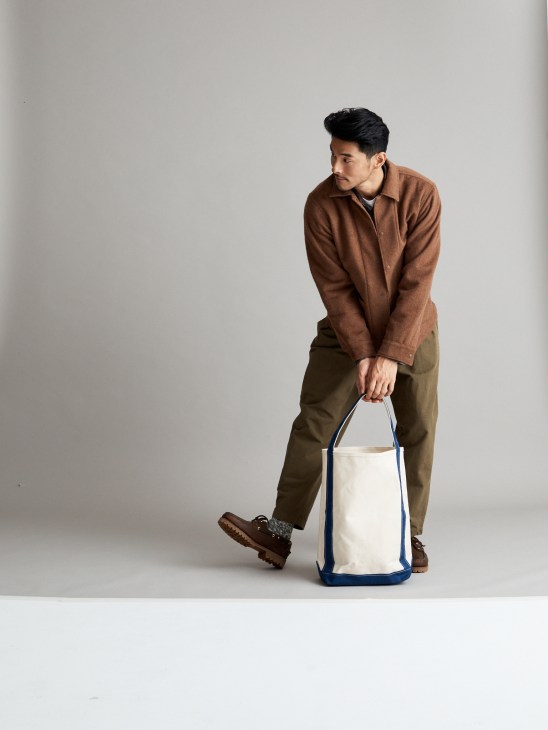
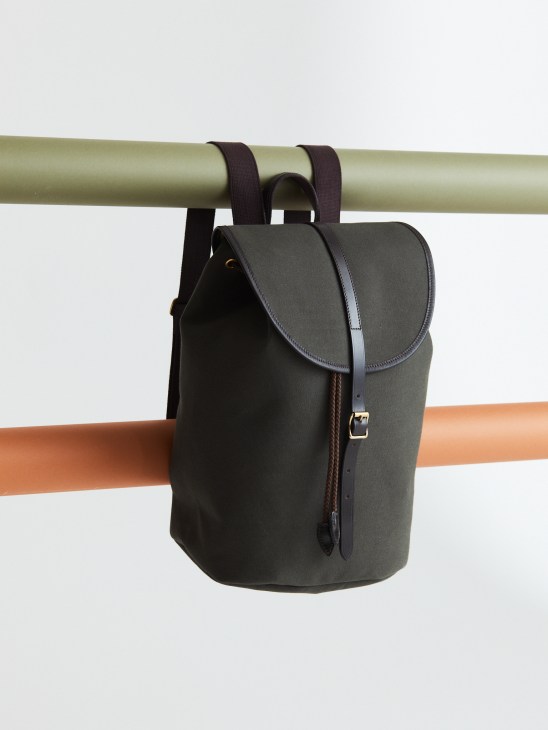
The brand’s name is an homage to Nanbata (“Southern Field”), where his father’s business was located. But Okada moved his company to another part of rural Saitama and started by designing equestrian goods, as well as bags, boots and saddle cases, with a small team that included his wife, Keiko, and two staff members. The positive reaction to the bags encouraged Okada to design a new tote to sell on Etsy – and the business transformed from there. Today the company specialises in tote bags, backpacks, duffle bags and other small leather goods. The materials used are mainly waxed canvas, sourced in Kurashiki in Okayama, with leather dyed in Tochigi. “We try to keep the number of items and process as minimal as possible,” says Okada. “Efficiency is important not just for production but also for achieving a durable and beautiful design.” The couple sell bags nline platform and in shops in Japan, Sydney, Paris and Vancouver. “We are grateful that our products receive love from so many different people.”
southernfieldindustries.com


Up close and personal
Saman Amel, Sweden

Growing up in Sweden, Saman Amel wanted to be a footballer or a fashion designer. His passion for menswear prevailed and he created his first designs while still in high school, with childhood friend Dag Granath stepping in as his model. In 2015 the duo launched the Saman Amel label, specialising in made-to-measure tailoring. Their Stockholm atelier quickly accrued a loyal clientele. “We have clients who come in with jackets that we made six or seven years ago,” says Granath. “They’re still great pieces that can be adjusted to evolving tastes or body types.”
This year the label launched a broader ready-to-wear range and its pieces have become available beyond its atelier. Amel and Granath also designed their first retail collaboration, a breezy capsule collection of linen and silk pieces for online retailer Matches Fashion, and opened an outlet in London department store Harrods. Designed by Swedish architecture firm Halleroed, it stocks the brand’s ready-to- wear garments, including tuxedo jackets and trousers cut from cashmere. “We always start with the materials,” says Granath.
One of the pair’s biggest influences when designing their new range was Swedish Grace, a 1920s design movement that sought to find a balance between handcraft and machine-produced items. “Design from this period was clean, elegant and toned down, with an extreme focus on materials,” says Granath, citing pioneers such as Carl Malmsten. The brand aspires to a similar level of elegance, blending classic tailoring with more fashion-forward details – an approach that it has chosen to retain even as it brings larger ready-to-wear collections to the mix. “Bespoke remains our core business model but, as the brand grows, we need to reach new clients and having the right retail partners helps,” says Granath.
samanamel.com
Heavy duty
Luxfort, USA

Luxfort grew out of a simple a-ha moment: co-founder Nick Bower laid an apron over a hoodie and, in doing so, created a garment with plenty of pockets that is ideal for someone who works with their hands. “It was about making something functional for those who are working in gardens or as chefs,” says Bower, who spent 20 years as creative director of California streetwear brand Stüssy before founding Luxfort with his son Tristan in 2018. “The idea came from a book that I had about Japanese craftsmen.”
Working between Paris and Laguna Beach, the Bowers have created a collection of jackets and overshirts that pay homage to different crafts, from blacksmithing to baking, partly inspired by the Arts and Crafts cottages in this corner of Orange County. Painter, for instance, has a kangaroo pouch at the front for brushes, Builder is a sturdy bomber with loops to hold tools and Gardener is hooded for working in the elements with riveted canvas compartments for pointy pruners. All are heavy duty and built to last in limited numbers in Porto.
“It’s about celebrating honest work,” says Tristan. “We wanted to take American workwear and put a bit more comfort into it.” Luxfort is expanding distribution across select boutiques in Europe, with a view to doing the same in the US market. In part, the brand is a response to the ubiquity of athleisure over the past few years. “People want more storytelling and substance from a brand,” says Tristan. “It’s hard to do that with athleisure.”
luxfortusa.com
Creature comforts
Matéma, Italy

Italian label Matéma puts knitwear firmly in the spotlight with its sustainably sourced yarns. Founded by Tommaso Bilancioni two years ago, the project revolves around elegant staples, from loose sweaters to polo shirts, woven using natural materials such as linens and cottons in the company’s factory in the Marche region. “It’s a total look that is young, fresh and comfortable, and designed to be unisex,” says Bilancioni. The clothes range from striped linen tops to smartly constructed cargo trousers have caught the attention of savvy retailers including Braun in Hamburg and Italy’s Rinascente.
matema.eco
Mountain high
Venturon, France

French label Venturon has found a dedicated client base among hip urbanites, mostly in cities such as Seoul, New York and Tokyo – but its founder, Thomas Pousset, finds inspiration in a very different demographic. “We’re based in a small village in the Alps,” he says. “Many of the locals dress in the skiing and hiking gear that they have owned since the 1980s or 1990s. That’s what inspires our collections.”
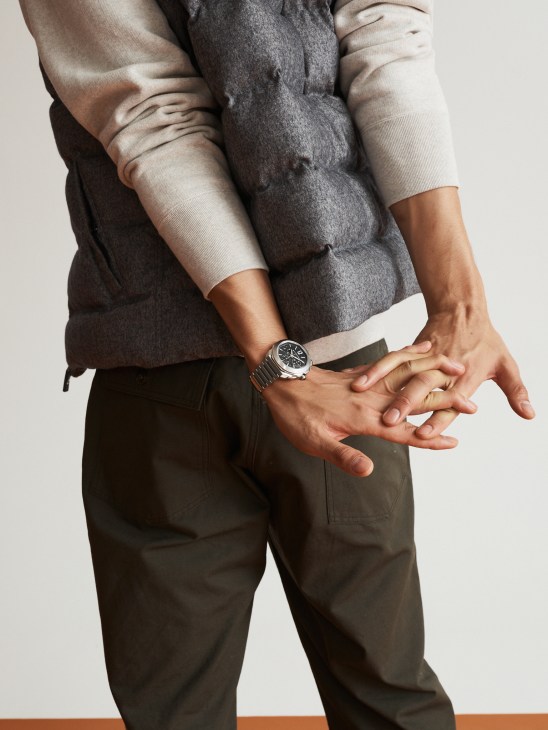
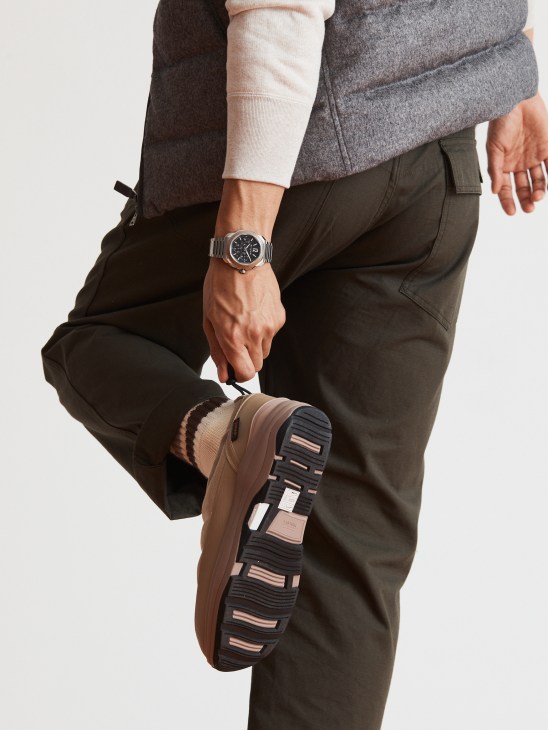
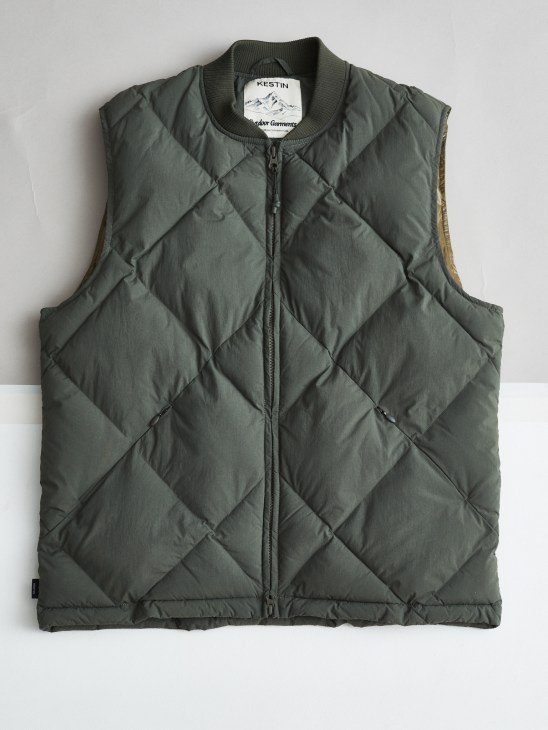
From vests with oversized pockets and drawstring jackets to utilitarian trousers, Pousset’s designs nod to the practicality and comfort of traditional alpine sportswear. By giving them sharper silhouettes and more muted colour palettes, he ensures that the items look smart and suit both the city and the slopes. “I’m passionate about mountain sports and often go hiking after work but, at one point, I realised that I had no leisure clothes that I could wear all day,” he says. “There were some brands from South Korea and Japan making what I wanted but none in France or even Europe.” In 2018 he founded Venturon and called on his father, Bruno, to support him with logistics and supervise production.
The label has 16 stockists across Asia, the US and Europe. Despite strong demand, Pousset wants to keep the size of the business manageable and retain a commitment to artisanal standards. All items are made to order in small ateliers outside Paris, Lyon and the Isère region from high-quality technical fabrics. “The materials change depending on the season but we keep coming back to the same silhouettes,” says Pousset. “You’ll always find vests in our collections, with plenty of pockets to make them practical.”
venturon.fr
Heavy duty
Seaward & Stearn, UK

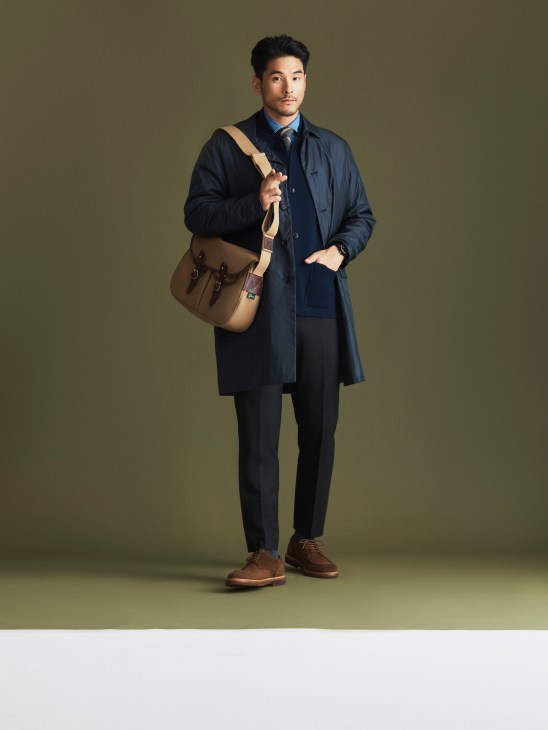
With the athleisure boom finally drawing to a close, designers have been turning to workwear to give customers smarter yet equally practical solutions. A great place to start is the chore jacket, made from sturdy fabrics that last a lifetime and featuring large pockets in which to carry all of your essentials. Based in the UK, family- run menswear label Seaward & Stearn offers an irresistible selection: its popular worker jacket is made from heavy-duty cotton and comes in an array of colours, from muted khaki to bright red and yellow. We recommend the navy number, which will be easy to layer over any autumn look.
seawardandstearn.com
Soft touch
Zegna 3 The Elder Statesman, Italy & USA

When Zegna launched its Oasi Cashmere collection, the aim was to showcase the world’s finest raw materials and to become a platform to share knowledge about reducing waste with likeminded peers. Among its first collaborators is The Elder Statesman, a Los Angeles-based label that makes luxurious cashmere loungewear and employs about 50 artisans, including knitters, dyers and embroiderers, who produce its collections.
Alessandro Sartori, Zegna’s artistic director, and Greg Chait, founder of The Elder Statesman, shared their knowledge of manufacturing practices and creative references. “We merged our shapes with The Elder Statesman’s distinctive colours and sense of spontaneity,” says Sartori. For Chait, it was an opportunity for dialogue between the cities of Milan and Los Angeles. “We sometimes feel like Zegna’s eccentric American cousins,” he says. “The partnership felt like a homecoming.”
zegna.com; elder-statesman.com
Thinking big
Art
Going Dark: The Contemporary Figure at the Edge of Visibility
Guggenheim, New York

The Guggenheim’s spiral ramp is set to become filled with mysterious figures. Going Dark brings together a group of predominantly black, female artists who depict the human body in abstracted or enigmatic ways. The reasons for obscuring faces and concealing forms vary across more than 100 works by artists including Kerry James Marshall and Doris Salcedo.
‘Going Dark’ runs from 20 October to 7 April 2024
Marisol: A Retrospective
The Montréal Museum of Fine Arts

Born in Paris to Venezuelan parents, Marisol Escobar is a forgotten star of New York pop art. In the 1960s she starred in Andy Warhol films and graced Time magazine covers. The sculptor, who died in 2016, was sidelined for her peripatetic existence and unabashed feminist interests but her work is ripe for reappraisal. — SPI
’Marisol: A Retrospective’ runs from 7 October to 21 January 2024
Books
Shame
Annie Ernaux, translated by Tanya Leslie

The first sentence of Annie Ernaux’s Shame is hard to forget: “My father tried to kill my mother one Sunday in June, in the early afternoon.” What follows is the story of a 12-year-old girl, the Nobel Prize-winning author, whose life is irrevocably changed from that moment onwards. A delicate but deeply emotive coming-of-age tale.
‘Shame’ is out now
Roman Stories
Jhumpa Lahiri, translated with Todd Portnowitz
Jhumpa Lahiri’s latest collection of short stories, originally written in Italian but translated into English by the author and Todd Portnowitz, captures the experience of living in a city and, at the same time, being separate from it. Expect Lahiri’s signature prose – simply told, full of thought – and quizzical characters who wander, watch and listen.
‘Roman Stories’ is published on 12 October
Tremor
Teju Cole

Tremor follows Tunde, a West African photographer and professor, as he reflects on his upbringing in Nigeria, his current life working at an elite American college campus and the transformative events and experiences in between.
‘Tremor’ is published on 17 October
Music
Blame It All on Love
Poolside

As the name of the project by producer, songwriter and multi-instrumentalist Jeffrey Paradise suggests, his music is cheery, sunny and could easily be dubbed “daytime disco”: these sunny, retro tracks will make you want to move. For his new album, the lo-fi aesthetic and synths take an instrumental turn that feels soulful and dreamy, and is summed up in the track “Moonlight”. Another highlight is the delightfully breezy “Float Away”.
‘Blame It All on Love’ is released on 20 October
Tension
Kylie Minogue

“Padam Padam” has been the song of the summer, with its infectious sound imitating that of a pulsing heartbeat. Tension marks a return to an icier brand of electro pop after a dalliance with disco. Another highlight is “10 Out of 10” with Dutch DJ Oliver Heldens. From November, Kylie starts a residency in Las Vegas’ Voltaire at The Venetian Resort, showcasing the tracks from her club-ready album.
‘Tension’ is released on 22 September
Photographie
Alice et Moi
Photographie is another great slice of electro pop by the Parisian singer whose oeuvre swerves from the timeless to the quotidian. In leading single “Ça me va”, she opines about love amid an apocalypse, while on “Photographies” the subject is our relationship with the digital world. If you’re looking for airy French pop this autumn, you’re in for a treat.
‘Photographie’ is released on 22 September
Film
Brother
Clement Virgo

Though set in Toronto’s 1990s hip-hop scene, this delicate, nuanced story about the bond between two brothers explores timeless themes. One summer evening an event transforms the lives of charismatic Francis (Aaron Pierre) and his timid younger brother, Michael (Lamar Johnson). Clement Virgo, who wrote, produced and directed the film, delivers a drama that surely sets its actors up for great work ahead.
‘Brother’ is released on 29 September
Strange Way of Life
Pedro Almodóvar
Spanish auteur Pedro Almodóvar’s second short work in English (following 2020’s The Human Voice) is a typically idiosyncratic western. Ethan Hawke and Pedro Pascal star as ageing gunslingers and former lovers who reconnect after decades apart. Though their passion for each other still burns, they must deal with the business that has reunited them: one must arrest the other’s son for murder. Almodóvar’s love story boldly interrogates the tropes of this most American of genres.
‘Strange Way of Life’ is released on 25 September
Smoke Sauna Sisterhood
Anna Hints
For Estonia’s Võro community, the smoke-sauna tradition is an important part of everyday life – but it’s considered so unique that it was added to Unesco’s Intangible Cultural Heritage list in 2014. This intimate, award-winning documentary by Anna Hints immerses us in its quiet rituals. Pointing the camera largely at the women listening rather than those doing the talking, Hints shares with the viewer the many private revelations that happen in this sacred space. What’s said in the sauna stays in the sauna.
‘Smoke Sauna Sisterhood’ is released on 13 October
TV
Wanted: The Escape of Carlos Ghosn
Apple TV+
Once one of the automotive industry’s most respected ceos, Nissan’s Carlos Ghosn fled from Tokyo to Lebanon in 2019 following allegations of corruption and money laundering. This four-part documentary explores whether Ghosn is a villain or a victim of a conspiracy.
‘Wanted’ is out now
The Pigeon Tunnel
Apple TV+
Nobody wrote spy thrillers quite like John le Carré, whose novels, such as The Spy Who Came in from the Cold and The Night Manager, attracted millions of readers with stories that felt firmly grounded in reality. Errol Morris’s documentary delves into the author’s life, which was enigmatic even to those who were close to him.
‘The Pigeon Tunnel’ is out on 20 October
El Conde
Netflix

Pablo Larraín’s satire gives the history of Chile a surreal twist: it presents Augusto Pinochet as a vampire grappling with the consequences of his actions and his tarnished reputation 250 years after his apparent demise. Now he is starting to face the prospect of death – but his family has other ideas.
‘El Conde’ is out now
Photography
Viviane Sassen: Art & Fashion
Maison Européenne de la Photographie, Paris

A fashion photographer who challenges the preconceptions of that descriptor, Viviane Sassen has long used collage, paint and mirrors to add a vibrant surrealist edge to her pictures. This show combines innovative commercial shoots with intimate personal work, some of which is yet to be seen.
‘Viviane Sassen: Art & Fashion’ runs from 18 October to 11 February 2024
Fine print
Publisher Gerhard Steidl is not interested in living the high life. He doesn’t own a car. He begins work at the crack of dawn seven days a week and only takes 18 days off every year. Expensive clothes are not for him either; he is rarely seen without his signature white apron. When he has to visit New York for work, he travels to and from Germany in a day so that he doesn’t have to stay the night and can sleep in his own bed. “I work in a very concentrated way,” he says. “I don’t go for dinners. I don’t make small talk.” There’s little about Steidl’s low-key lifestyle to suggest that he is one of the art world’s most high-profile figures. He honed his craft under the patronage of artist Joseph Beuys, was entrusted by Nobel Prize in Literature winner Günter Grass to publish his entire oeuvre and became the late designer Karl Lagerfeld’s go-to for all of Chanel’s print projects. Being associated with just one of these names would be impressive but all three is remarkable. While his empire has grown around him, Steidl’s monastic dedication to the art of book publishing has remained mostly unchanged.

Steidl’s home in the small German city of Göttingen is a two-minute walk from the offices of the publishing house that bears his name. What started in 1968 as a small-scale printing workshop producing exhibition posters is now one of the world’s most revered makers of art and photography books.
Steidl is the first person in the office every morning. He arrives at 05.00 and heads to the room housing the printing press soon after. This brightly lit, windowless space reverberates with a persistent pneumatic thrum as sheets of paper whip their way through a 13-metre-long, state-of-the-art offset printer. Pinned to the wall beside this vast apparatus is a small sign drawn by US artist Paul Ruscha: “Gott sei Dank fur Steidl” (“Thank God for Steidl”). It’s a reverence shared by many of the world’s greatest living artists, photographers and designers. Steidl is the only publishing house to produce all of its books on its own press and artists including Louise Bourgeois have made the pilgrimage to Göttingen to seek the master publisher’s advice.
To his legion of admirers, Steidl’s commitment to perfection is legendary. “It comes from a deep respect for the artists,” he tells Monocle. “They invest so much time, money and energy in a project. And then an idiotic publisher can come along and ruin the whole project within hours. German printers can be idiots, real idiots. They have no taste. They have no style.” By contrast, Steidl is deeply involved in every book, from selecting the paper and binding to overseeing the entire production process. He is often found working late into the evening, labouring over a minor detail of relative lithographic obscurity that less-experienced eyes might miss.


When it comes to materials, buying locally is important to Steidl. “The ink comes from a factory 100km from Göttingen,” he says. “It’s a family business. They make the inks exactly as I want them – my own composition. We get approximately 60 per cent of the paper from Germany too.” Even the printing press is German-made, a top-of-the-range model from Offenbach-based manufacturer Manroland that is capable of printing up to 18,000 sheets an hour. In fact, the press is so large that the entire street needed to be closed off when it was delivered earlier this year. Steidl’s decision to invest in the new machinery was fuelled by a concern over the future of the country’s printing-press manufacturers. “The market for printed matter is getting smaller and smaller,” he adds. “Fine art and photography books are a wonderful, beautiful niche but it’s not enough for a manufacturer of printing machines to survive. My worry was that they would stop making them and I would be left without a good tool to make books. With a new press, I am fit for the next 12 years or so.”
When discussing how the business runs, Steidl likes to talk in similes. The printing sheets are like “his children”. Buying good paper is “like picking fresh strawberries” from the farmer’s market. The office is “like a hospital” with him running round performing different surgeries and running diagnostics but, instead of a stethoscope, his apron pocket is brimming with pens. “I make at least 100 sketches every day to explain things,” he says. “Little design sketches to show the relationship of sizes and so on. Other people send emails; I make sketches.” Born in 1950 and raised in Göttingen, Steidl’s introduction to the world of printing came via his father, who worked nights cleaning the press at the local newspaper. But his fascination with print only really took hold when he visited an Andy Warhol exhibition in Köln as a teenager and became beguiled by the pop artist’s silk-screening technique. Aged just 18, Steidl set up his own print business. Steidl started out printing posters for exhibitions and it wasn’t long before he counted some of Germany’s best-known artists among his customers. The most significant of these was Beuys, who was something of a mentor to Steidl. The young publisher would go on to produce most of Beuys’ multiples and prints until the artist’s death in 1986.
Steidl made his first books in the early 1970s, starting with political non-fiction before expanding into literature and a few select art and photography titles. In 1996 he launched Steidl Publishers, his own specialised photobook imprint, which today holds the global publishing rights for everyone from Richard Serra to Jürgen Teller. Steidl produces about 120 image-heavy titles every year; his company also has a literature arm, which annually puts out about 20 books. These range from German translations of classics, such as Rudyard Kipling’s The Jungle Book and Bram Stoker’s Dracula, to contemporary fiction from an array of European novelists. This side of the business began in 1993, when Steidl convinced Nobel laureate Grass to let him print books of his etchings and lithographs. The German writer was so impressed with the results that he eventually persuaded Steidl to start publishing his literary work too.


Lagerfeld entered Steidl’s life that same year, after he won the Raymond Loewy Foundation’s Lucky Strike Designer award. Part of the prize included the chance to have a monograph printed by Steidl but the German fashion designer turned it down. “I was pissed because I wouldn’t get paid if we didn’t make the book,” says Steidl. “So I wrote to him saying, ‘If you had to make a book, what would it be?’ He replied, ‘A well-made book of my private photos.’ I sent him some test prints with all different kinds of paper. Then he called me saying, ‘OK, we are connected. We are both paper freaks.’” Steidl published Lagerfeld’s book Off the Record in 1994. As with Grass, the designer was so taken by the quality of Steidl’s work and the result of their collaboration that he put him in charge of printing everything from runway-show invites to couture catalogues for Chanel – a contract that continues to this day.
Steidl’s work is singular but he can’t do everything himself and he relies on a tight-knit team of 45 employees. There are editors, designers, photographers, bookbinders and printing technicians. He believes that keeping every part of the process in-house is crucial to the company’s continued success. “Before offset printing arrived in the 1970s, everything was letterpress and it was very specialised,” he says. “You needed a printer, a typesetter and a designer to operate it. When offset arrived, the process became very fast and hi-tech and everything except the actual printing was outsourced. The knowledge transfer was interrupted. The creative side had no understanding of what the printer was doing and the printer had no idea about what the photographer was doing. They no longer spoke the same language.” Steidl works to counteract this trend by keeping these processes under one roof as much as he can. “That’s the only way to make it better,” he says.
In a world that is increasingly reliant on remote communication, Steidl is still a firm believer in the importance of in-person visits and about 3,500 guests pass through his offices every year. He wants artists to feel the paper with their own hands and see the inks up close. “Normally, when an artist goes to a publishing house, they’ll sit down with the publisher, sign a contract and go to lunch,” he says. “They’re not welcome at the press. I try to make the production process as transparent as possible to educate the artist about it so that they can see that I’m doing the best for their project.” Creating a book with Steidl is more of a collaboration than a commission. “It’s a vertical process,” he adds. “We sit in the library on the top floor and I ask them what their vision is. Then it goes one floor down to the design department, then the image department below that and finally to the press on the ground floor.”

While the kind of books that Steidl publishes hasn’t changed drastically over the past few decades, there has been a shift in the format of his publications. “How do people consume a book?” he asks rhetorically. “In America, they order through Amazon. There are hardly any bookshops in the US any more. You have to pay for Fedex and for the packaging, which gets expensive if it’s an 8kg brick. And people are travelling a lot too. So if you go to Tokyo and visit a nice bookshop and find a beautiful little book, you buy it immediately because you can easily take it home in your suitcase. We’re fighting to make our books as small and light as possible.” Steidl believes that the days of humongous coffee-table titles are over. “The problem with those books is that you actually need a table to read them on. Sure, you can display them proudly when you invite guests round so that they think, ‘Oh! What an intellectual guy!’ But they’re really a nightmare. I want a book that I can hold in my hands and sit reading on my sofa. You can’t hold a 10kg book in your hand for two hours.” Nevertheless, Steidl admits that some books require a larger format to do justice to their contents. He cites a new Damien Hirst set as one of the biggest challenges in this regard. “We’ve been working with him for 13 years on this book called Pharmacy London. There are 10 volumes with 3,800 pages. They are housed in a crate that he has designed to look like a fridge. It’s a beautiful object.”
Artists and photographers who visit Göttingen are offered board at the Halftone Hotel, a building next to the Steidl office that the publisher bought in 1983 and transformed into six self-contained apartments. These are not your average suites, not least because they contain artworks by Steidl clients such as Ed Ruscha and Jim Dine. “Guests go for dinner together in the evenings,” says Steidl. “It builds up a kind of community. You can compare it, on a much smaller scale, to the Chelsea Hotel in New York.”
The publisher owns so much of Göttingen’s Düstere Strasse that the street is often referred to as “Steidlville”. Aside from the office and hotel, there’s the Kunsthaus Göttingen, a stark-but-striking gallery designed by Leipzig-based architecture studio Atelier ST that opened in 2021. Steidl acts as curator here, putting on exhibitions of work by the artists who he publishes. The line-up has so far included the likes of Gilles Peress and Roni Horn. Exhibits are printed at Steidl’s on-site fine art printing studio, which also produces works for some of Germany’s leading museums and galleries.


The concrete-clad Kunsthaus sits in stark contrast to its neighbour: a squat, half-timbered house that dates back to the 1300s and is also owned by Steidl. It houses the Günter Grass Archive, a publicly accessible collection of the late writer’s etchings, lithographs, drawings and texts. Across the street from here is another ancient, half- timbered property belonging to Steidl. It housed a book bindery for 260 years before the previous owner decided to sell up in 2021. The building is still being renovated but, when it opens next year, it will host bookbinding workshops for young people. The publisher’s own prototypes will be bound at the site and visitors will be allowed to observe the process too.
Düstere Strasse has one final addition on its way: The Steidl Academy. This new institution will provide grants to people who want to learn how to make and print books. It will be housed in a building designed by British architect David Chipperfield on an empty plot next to the Steidl HQ. “There will be a library and a study room – the machinery to learn,” says the publisher. “It’s really a little private university for young people to come from around the world and work for anything between a week and a year.” According to Steidl, founding an academy is the last major ambition that he is yet to achieve. “I’m getting older and I want to transfer the knowledge to the next generation.” A new guard of printmakers might be eagerly waiting to learn from this master but it remains to be seen if any will leave an impression quite like Gerhard Steidl.
Snap decisions
Steidl’s defining photobooks
Over the course of its 55-year history, Steidl Verlag has published more than 5,000 photobooks. From contemporary masters such as Juergen Teller to photojournalism pioneer Henri Cartier-Bresson and fashion photographer David Bailey, the publishing house has printed titles with many of the biggest names in the field. From this vast catalogue, Gerhard Steidl chooses five of his favourite publications marking significant moments in his printing career.
Back on solid ground
At 03.32 on 6 April 2009, a 6.3-magnitude earthquake struck the Abruzzo region of central Italy. Its epicentre was close to L’Aquila, an unassuming, picturesque medieval city with a population of some 73,000. More than 300 people lost their lives and the majority of the residents were left homeless. Once the dust had settled, the town made the decision to bank on culture, art and architecture to revive it. And it is proving to be a worthwhile experiment, thanks in part to a global roster of international benefactors and the attention of some of the world’s most powerful leaders.


“Luckily, we came out relatively unscathed,” Natalia Nurzia tells Monocle of the condition in which she found her family-run café, Fratelli Nurzia, the morning after the earthquake. “Eight months later we were the very first café in the city centre to be up and running again,” she says proudly. Today, as it was before the earthquake, Fratelli Nurzia is renowned for its chocolate-filled torrone (nougat) but even after 14 years, the Piazza Duomo on which it sits is a hodgepodge of scaffolding, cordons and construction fences.
The city has been through a lot. The buildings that didn’t totally collapse were severely damaged and the subsequent, years-long closure of large parts of the historic centre for extensive and complicated reconstruction work could easily have ravaged the heart of the city for good. The earthquake battered L’Aquila but it was the restoration that nearly destroyed it. “Seven years after the earthquake, we had to close again,” says Nurzia, describing the stop-start technical interventions needed on many of the 100,000 buildings that were damaged in the city. “That time we were closed for four years.” Nowadays, however, even a little humour is possible. “The only thing more dangerous than an earthquake is an engineer,” she says, joking, before turning to greet a customer.
Much of daily life in L’Aquila is dominated by locals but the fortunes of the city were changed for ever by a man from Milan. L’Aquila came to prominence thanks to the late media mogul and three-time Italian prime minister Silvio Berlusconi, who switched the location of the 2009 G8 summit (when Russia was still welcome) from a completed, purpose-built conference centre in Sardinia’s La Maddalena to the earthquake-hit city.


“Berlusconi’s big idea was to draw up a catalogue of restoration projects,” says Massimo Alesii, a communications specialist who moved back to his native L’Aquila from Rome after the earthquake. Still dubbed “Berlusconi’s wedding list” by many aquilani today, a slate of 44 destroyed or heavily damaged buildings was made for G8 member states and their delegations to consider restoring or helping to support. “It was clever marketing,” says Alesii, a former director of the Fondazione Adriano Olivetti and a man who knows how to secure cultural funds. The image of Barack Obama, jacket slung over his shoulder, Angela Merkel, Nicolas Sarkozy and others strolling past the cracked and crumbled edifices, couldn’t have been better publicity. But it was the Russian Federation’s Dmitry Medvedev who chose the biggest donation on Berlusconi’s list. In an act of diplomatic goodwill, Russia gave an estimated €7.2m for the reconstruction of the Palazzo Ardinghelli, which dates back to 1732, 29 years after another earthquake had levelled buildings in L’Aquila. With lavish rooms, frescoed ceilings and impressive staircases, it was one of the city’s finest Baroque gems.
Originally, the palazzo was earmarked for use by the city council, says Bartolomeo Pietromarchi, but in 2015 plans changed. “Here we had a jewel in the centre of L’Aquila, ready to be used,” he says. “It was decided that, instead of council offices, it had to be given to the public.” Pietromarchi is director of the Maxxi national museum in Rome and now of its L’Aquila offshoot, which opened in the palazzo. Despite opening in 2021 during the pandemic, the cultural centre started a bright new chapter in the story of the beleaguered city.
Maxxi L’Aquila, which focuses on the art and architecture of the 21st century, is now the city’s flagship institution. “Contemporary art is like a laboratory, especially for young people,” says Pietromarchi as he shows Monocle around the airy galleries filled with restored frescoes and polished terrazzo floors. “Different disciplines intersect to create a centre for cultural production.” When we visit, there is a joint show of work by Marisa Merz, a central figure in the Italian Arte Povera movement, and Shilpa Gupta, a contemporary Indian artist. In the piazza outside, architecture students from L’Aquila’s university are constructing a wooden pavilion set to be the centre of the museum’s summer programme. This, Pietromarchi stresses, is not about a national museum plonking a smaller offshoot somewhere off the beaten track. The relationship between Maxxi Rome and Maxxi L’Aquila is “totally reciprocal”, he says. “The buildings themselves are wonderfully different and in L’Aquila we learn how to engage with the setting in a completely new way.”


Of course, there is more to the culture of a city than a new art museum and, according to Bruno Carioti, president of the Abruzzo Symphonic Institute, L’Aquila’s music scene is worth making noise about too. Starting in the 1950s, says Carioti, the city, which is the administrative capital of the Abruzzo region, has built up a considerable amount of human capital, heavily engaged in music on an everyday, professional basis. He believes that music has had a restorative effect on the city since the earthquake. “When you have lost everything, music takes you to a different emotional place,” he says, “In those moments it completely transports you and soothes the soul. I would say that music has been crucial to rebuilding the culture of L’Aquila.” The city also hosts the B Baratelli Concert Society, The Aquilani Soloists and the Alfredo Casella Conservatory – not bad for a small city, says Carioti, who calls L’Aquila the Salzburg of Italy.
Some of the reconstruction in L’Aquila has been remarkable but it is an ongoing process. When Monocle visits, the city is bathed in bright mountain sunshine and gaps in hoardings reveal pristinely restored façades. Glowing, fresh-cut architectural details shine and a pair of bronze statues of impish male nudes graces the square outside Fratelli Nurzia. The work has been slow and expensive: some €24bn has been spent on the city since 2009 and recovery is far from complete. There is also constant risk. Earthquakes hit this part of Italy about every 300 years and residents confirm that some level of destruction and reconstruction are part of L’Aquila’s soul.
Painstaking and life-changing though the earthquake and subsequent restoration might have been, residents can, after 14 long years, finally see the outline of a new and improved city. Like Rome, L’Aquila was not built in a day. Unlike Rome, it was destroyed in a night. “The earthquake has revealed the treasures we have,” says Alesii. “The pride and love we have for our city emerged from the cracks.”
Rebuilding L’Aquila
Like Italy as a whole, L’Aquila’s relationship with Silvio Berlusconi is complicated. The case of the Palazzo Ardinghelli and the museum that came to occupy it is a clear example of the fruits of a peculiarly opportunistic and Berlusconian approach to geopolitics and fundraising.
Massimo Alesii, a journalist and public-relations specialist based in L’Aquila, is ambivalent about Berlusconi’s call to hold a G8 summit in the earthquake-hit area back in 2009. “L’Aquila was a convenient backdrop,” says Alesii. “It was great ‘optics’.” But much of the city was inaccessible, with even residents barred from entering. “I chose to decline an invite to get involved [with G8],” adds Alesii, who decided instead to work on individual restoration and social-rehabilitation projects. “I wanted to make sense of the reconstruction of my city, the social and human side of it, not just the bricks and mortar.”
While L’Aquila’s recovery couldn’t have happened so emphatically without Berlusconi’s bullish intervention, many in the city are keen to tell us that it still would have bounced back without him.
Design
Architecture – Spain
Finding balance
When architects are overseeing a renovation, it can be challenging to strike the balance between the needs to conserve and introduce contemporary features. Architect Carlos Gómez Sos’s revamp of his family’s medieval home – known as La Posada and located in a small town in the province of Huelva, southwestern Spain – was a five-year labour of love that found the necessary equilibrium.
“The house hadn’t really been modified since the 18th century but I didn’t want to demolish it,” says Gómez Sos. “Every residence has a soul and you first have to understand that soul before you can move forward. I recycled as many materials as possible and preserved traditional construction techniques and materials, particularly the exposed stonework and woodwork design.”


Gómez Sos turned to local artisans for fresh additions to the space, including raw-wood panelling, custom bookcases and new stairs. “There’s a robust tradition of carpentry in this village in Huelva, where architecture isn’t just a profession but a matter of pride,” he says. It’s appropriate, then, that the space also doubles as the architect’s studio. “For architects, work is a lifestyle, so La Posada is my reflection of this attitude towards my profession.”
Spread across three floors, the home’s defining feature is a large, newly installed window that overlooks the garden. Its construction was a delicate operation that involved cutting into an interior wall but Gómez Sos was there every step of the way. “Like the captain of the ship, if the project had gone down then I would’ve gone down with it,” he says. “Life is about finding comfort in a place – and I’ve found the place where I belong.”
On Design
Nic Monisse on…
An inspirational island
I rounded out my summer with a trip to Mallorca. While the Balearic island is home to famous architecture, there are plenty of small details that creatives can apply to their own work. Here are five design-minded takeaways:
1.
Use common sense
Getting to some of Mallorca’s beaches can require scaling cliffs but simple design additions make it possible: large eye hooks screwed into slippery rocks offer secure grips, concrete pads poured between boulders function as diving boards, and handrails made from olive trees are a steadying presence when walking down a hill. In many countries, these wouldn’t pass building codes. Sometimes applying common sense over standards is a sensible option.
2.
Details matter
The metal pit lids and manhole covers for the water infrastructure in Deià are beautiful. Finished with the town’s crest and an embossed striped pattern, they’re reminiscent of Le Corbusier’s manhole covers in Chandigarh, where cast-iron lids are engraved with a map of the city. Deià’s small detail makes potentially ugly infrastructure something to be proud of, lifting the quality of its streets.
3.
Show some restraint
Speaking of Deià, the pretty hillside village is defined by its green-shuttered, limestone houses – an architectural status quo that could be threatened by developers. Thankfully, the town council has regulations to preserve its charms. Such guidelines ensure that the character that makes the town appealing isn’t destroyed – plus, architects often work best when given a set of constraints to adhere to.
4.
Hide in plain sight
The Miró Mallorca Foundation is home to three outstanding buildings, with its flagship designed by Rafael Moneo. Sleek stone walls gently bounce light around the room… until it hits the bright-red fire extinguishers, which the Spanish architect didn’t intend to make a focal point. Can we design these so they don’t detract from the architecture? Fire-hose company Safe Crash makes cabinets that slot into the walls of buildings, hiding their products but ensuring that they’re on hand if anything goes wrong.
5.
Rethink tradition
Artesanía Tèxtil Bujosa is one of Mallorca’s oldest family-run textile workshops. It has long made curtains, bedspreads, table furnishings and upholstery for wealthy families on the island but Stefania Borras saw an opportunity: clothing. Her fashion brand, Datura, uses Bujosa for a limited-edition clothing line, Terra, which sits within her wider collection. Bujosa’s textiles have strengthened her brand’s connection with the island.
Landscape architecture – Taiwan
Beyond the sea
The southern Taiwanese city of Kaohsiung is home to one of the island-nation’s biggest ports. Despite this fact, the 100-year-old Gushan Fish Market, in the metropolis’s waterfront Gushan neighbourhood, has gone from a bustling place of commerce to a forgotten waterfront asset in a matter of decades (a booming offshore fishing trade is supposedly to blame). In a bid to reclaim some of the site’s former glory, Taiwanese design studio CM Chao Architect & Planners was tapped to lead a revitalisation that has preserved the historical memory of the market while making it suitable for contemporary needs.


To do so, the architects opted to keep the original, century-old Dutch-style brick structure at the site’s entry. “[By preserving] the original structure, the public can appreciate the history of the market as they enter,” says CM Chao, whose team connected the old entryway to a new linear building that now houses the fish market, as well as the government’s Fishery Office and the newly minted Gushan Ferry Station.
It’s a move that provides the building a purpose beyond fishy transactions and is complemented by landscaping from landscape studio Motif. The Taipei- based firm has designed a series of pathways that snake through mounds of grass that provide public servants, vendors and passengers a place to unwind on the seafront. The result? A project that sensitively taps in to the site’s history to inform its new use – and an admirable model for any city looking to breathe life into their own forgotten sites.
Urbanism – Aarau
Spanning ages
The town of Aarau in northern Switzerland is defined by the Aare river: its riverbank on the edge of its old town is a place of leisure for locals and has been the site of countless constructions spanning the river since Roman times. A newly finished bridge, defined by seamlessly constructed concrete arches, might just be the most elegant attempt yet. Designed by Basel-based architects Christ & Gantenbein, it replaces a concrete structure from 1949.

“We approached the design of the New Aare Bridge with a respect for this history and a vision for the future,” says Emanuel Christ, who co-founded Christ & Gantenbein with Christoph Gantenbein in 1998. For the new bridge, the architects drew inspiration from Aarau’s medieval architecture and the river’s natural environment to create a structure that looks traditional but has features – such as large openings beneath its deck, which offer glimpses of the waterway from riverside paths – that could only be achieved by using modern construction methods. “Together with the engineers, I think we managed to create a blend of old and new in a bridge that connects not just two sides of a river but also the past and the present,” says Christ.
The five arches partially rest on the two foundations of the old bridge, with a geometry that, according to the architects, “employs concrete sparingly”. Seamlessly linking with existing streets and promenades, the 119-metre-long structure has space for drivers, pedestrians and cyclists. The result is a structure that is impressive architecturally and is an essential civic work. Or, as Christ puts it, “The New Aare Bridge is not just a bridge – it is a piece of the urban fabric, contributing another layer to the city’s evolution.”
The art of persuasion
The full-scale invasion of Ukraine marked the failure of what was arguably the most intense period of diplomacy in Europe since 1939. Footage of Russian troops marching through the dawn shattered hopes that conversation would prevail: by April 2022, at least 394 Russian diplomats had been expelled from Western capitals, with a similar number of retaliatory expulsions. Yet the invasion also spurred a bravura push to punish Russia.

The US-led effort to impose sanctions on Moscow and arm Ukraine unified and revitalised the Western alliance. However, as the war approaches its second year and the world fractures into hostile blocs, it is hard to argue that diplomacy is winning. What is its future in a multipolar world? Are its key institutions fit for purpose? And what to do about an increasingly confrontational China? We make the case for dialogue over conflict and coercion.
1.
Talking cure
How relevant is the UN Security Council in an increasingly multipolar world?
“I thank the representative of the Russian Federation for their statement,” says Linda Thomas-Greenfield, the US ambassador to the UN, at the end of an incendiary speech by Vasily Nebenzya. It’s the 32nd anniversary of Ukraine’s independence, 18 months after Russia launched its full-scale invasion, and Thomas-Greenfield is chairing a UN Security Council briefing on the forced deportation of Ukrainian children to Russia. Most ambassadors congratulate Ukraine on the anniversary and condemn the war; Nebenzya, who has been Russia’s permanent representative to the UN since 2017, uses his allotted time to accuse the country of being controlled by a “neo-Nazi” regime.

With the US holding the 15-member Security Council’s rotating monthly presidency, Thomas-Greenfield has little choice but to let Nebenzya speak. During the debate, she announces that she is switching hats from chair to US representative and issues a stern rebuke. “Children are literally being ripped from their homes in the year 2023 by a country sitting in this very chamber – by a permanent member of this council,” she says. “This is straight out of a dystopian novel but this is not fiction. This is real life.”
In an interview with Monocle shortly after the meeting, Thomas-Greenfield acknowledges the emotional toll of such debates but says that there is value in them. “It’s emotional because it’s so horrible,” she says. “But it’s important for us to have these types of meetings so that Russia hears from all of us and the world hears about what it’s doing. I want Russia to feel our pain. I don’t think that it does but I want the country to hear it.”


Ecuador’s UN ambassador, Hernán Pérez Loose, points out that there have been almost 70 Security Council debates on Ukraine since the full-scale invasion began but the war continues. And Ukraine is not the only intractable conflict on which the Security Council is paralysed. The day before, Thomas-Greenfield presided over a meeting on Syria at which countries called for an end to the civil war and expressed their frustrations about the lack of a political solution. As in Ukraine, Russia has blocked Security Council resolutions condemning the regime of Syria’s president, Bashar al-Assad.
UN ambassadors, however, insist that there’s still a future for diplomacy here in New York. “If we want to overcome these challenges, we can only do so by talking to each other,” Pascale Baeriswyl, Switzerland’s permanent representative, tells Monocle. “Facilitating dialogue – that’s where multilateral diplomacy and the UN can still make a difference.”
When the full-scale invasion of Ukraine began on 24 February 2022, Sergiy Kyslytsya resolved not to be “too emotional”. As Ukraine’s ambassador to the UN, he knew that he would regularly encounter Russia’s delegation and it was necessary to keep a clear head. Kyslytsya says that he instructed his staff to limit how much footage of the war they watched, so that they too could maintain a certain emotional distance. In his speeches, Kyslytsya has called for Russia to be removed from the Security Council but he tells Monocle that he also believes that the country’s presence works to Ukraine’s advantage. He says that many ambassadors have “grown tired of Nebenzya’s lies”, that only a handful of UN countries identify ideologically with Russia and that if the leaders of nations in the so-called Global South had to listen to the Russian representative regularly, they too might come off the fence and back Ukraine.

Kyslytsya believes that the Security Council remains a vital tool for public diplomacy. The council forces other countries “to go on record”, making hesitant nations consider their position on the war in Ukraine. Still, he acknowledges that the conflict has created a toxic atmosphere at the UN, which reached its nadir when Russia held the council’s presidency in April. “It’s not as easy as it used to be, particularly because Russia and China now have a ‘friendship without limits’,” says Thomas-Greenfield. Yet she cites small victories when it comes to the latter country. “We know that there are limits,” she says. “We see China abstaining occasionally on resolutions.”
However egregious its violations of the UN Charter, Russia is a permanent member with veto power, so there’s no practical way to kick it off the Security Council and the other countries have no choice but to work with it. Nonetheless, Thomas-Greenfield insists that the Security Council is still a productive diplomatic institution. “I hear a lot of people complaining that it’s not working but the council is working,” she says.
Crucially, it’s the only institution in which US and Russian ambassadors have regular interactions. Even closed-door meetings aren’t always fraught. “Sometimes they’re confrontational; sometimes they’re respectful, says Thomas-Greenfield. “If I need something done, sometimes it’s easier to ask for it in a way that isn’t confrontational.”
And there are plenty of things that need to get done. Though the Security Council is deadlocked on major conflicts, it regularly approves peacekeeping missions in a dozen countries, from the Democratic Republic of Congo to Cyprus. Thomas-Greenfield cites recent resolutions on thorny issues in places including Lebanon and Haiti. Some of these are about condemning a government; others concern practical matters, such as a multinational mission to address insecurity in Haiti.


Even Ukraine’s backers say that it’s useful to focus on other countries’ priorities too. “Solidarity is a two-way street: you have to understand the problems that others have,” says Rein Tammsaar, Estonia’s UN ambassador. “This is also my message to my capital: please keep in mind that there are many conflicts in the world, other countries are experiencing horrible situations and we have to try to help them as much as possible.”
This need to show solidarity is apparent even in Russia. “Moscow doesn’t like being isolated,” says James Kariuki, the UK’s deputy ambassador to the UN. “It needs friends. So if you have a set of countries, including those in Africa, calling out a coup in Niger, the Russians will join the consensus.”
Yet diplomacy is becoming harder. After the Cold War, there was a period in which multilateral institutions and international conventions were being strengthened. “But, for more than a decade, we have been observing a trend reversal,” says Switzerland’s Baeriswyl. Countries are increasingly disrespecting international law and conflicts have intensified, exacerbated by the pandemic and climate change. That’s why rebuilding trust was a central theme of Switzerland’s Security Council presidency earlier this year. Baeriswyl says that both her country and the UN are committed to building “a new agenda for peace” in the Security Council. “The countless violations of international law, especially in Ukraine, have increased the urgency of a huge reinvestment in dialogue and trust,” she says.
With the Security Council often paralysed, diplomacy is shifting to other multilateral venues. On Ukraine, for example, the US and its allies have turned to the UN General Assembly, the body that includes all members, where 141 nations condemned the invasion in a resolution on 2 March 2022 after Russia vetoed a similar measure in the Security Council. Action has also moved to other international bodies and blocs. “Ukraine has forced the US to be more flexible in where to push global interests,” says Peter Yeo, president of the Better World Campaign and senior vice-president of the UN Foundation. “You can tee something up in the Security Council, then carry it over to other diplomatic forums.”
The UN’s secretary-general, António Guterres, has pushed for regional bodies to take the lead in resolving conflicts, such as the Economic Community of West African States, regarding the coup in Niger. He even attended the Brics (Brazil, Russia, India, China and South Africa) summit in Johannesburg in August. But Guterres draws the line when it comes to matters of global import, such as climate change and artificial intelligence, warning that the proliferation of blocs of like-minded countries could lead to fragmentation.
Rebuilding the Security Council’s credibility must start with expanding its membership, something that the UK’s Kariuki admits will be a “long game”. In the meantime, countries such as India, Nigeria, South Africa and Germany, which are currently left out of the council’s rotating membership, must have their views acknowledged. “The Security Council is an important body but we shouldn’t fetishise it,” says Kariuki.
Though almost every member nation acknowledges that the council must be expanded, nobody can agree on which countries to include and whether they should have the power of veto. Asked whether any reforms are possible, Thomas-Greenfield mentions a recent priority of her boss, Joe Biden. “We need to take into account the realities of the world today and one of those is that we have 54 countries from Africa with no permanent representation on the UN Security Council,” she says. “Fixing that is clearly accomplishable.”
Expanding the membership wouldn’t solve the problems of Russia and China blocking action or the council’s strained credibility as it struggles to enforce the UN Charter. But in times of war and global conflict, there is an argument that even a paralysed UN is essential for the future of diplomacy, simply because it remains one of the only forums in which warring nations engage with each other. Diplomacy isn’t always about immediately solving intractable issues; it’s sometimes a matter of keeping the lines of communication open.
Until someone comes up with a true alternative to UN diplomacy, there’s little choice but to find a way to make it work. “The show that Russia has put forward on several occasions has undermined the council’s credibility,” says Estonia’s Tammsaar. “But we don’t have a better global instrument at the moment.”
2.
Mind your language
The diplomats’ dictionary.
Every profession has a distinctive argot, often comprising phrases that are more or less incomprehensible to outsiders. These usually evolve so that those on the inside – whether in plumbing, landscape gardening or, indeed, journalism – can swiftly identify one another. The same is true of diplomacy, which has its own peculiar lexicon. But in this case, the dialect has developed to enable its practitioners to communicate effectively, whether with each other or with the public, without saying precisely what they mean. Consider the best-known example: when a foreign minister or ambassador stands at a lectern and reflects on the “full and frank exchange of views” that they have just conducted with their interlocutors, you can usually just about hear the venue staff sweeping up smashed crockery behind the conference-room doors. But the world turns, diplomacy adjusts and the language in which it is conducted changes. Here, we present some of the recent additions to the diplomatic dictionary.

Strategic ambiguity
The careful avoidance of declaring a position on the grounds that doing so might lead the other party to take precipitate actions and that refusing to reveal your intentions will keep a potential antagonist guessing. The most prominent example right now is the US’s attitude towards Taiwan.
Global South
The anxious designation of those nations that don’t quite belong to the wealthy, democratic West, succeeding “Third World”, “developing countries” and several other terms that affronted everybody thus classified. “Global South” also affronts every nation thus classified and will therefore last only as long as it takes for someone to come up with another term that nobody will like either.
Global middle ground
One such possible successor to “Global South” is “global middle ground”. It has so far been invoked by the likes of James Cleverly, the UK’s foreign secretary, to describe the countries that the West assumed would be right behind it in the confrontation with Russia over Ukraine but instead shrugged, unpersuaded that the conflict had anything to do with them.
Global pivotal state
A recent coinage of South Korea’s president, Yoon Suk-yeol, which might or might not catch on. A “global pivotal state” (gps – someone somewhere was dreadfully pleased with this acronym) is a country that, while perhaps not formally aligned, is nonetheless a substantial diplomatic player. It will probably appeal to Saudi Arabia, India, Nigeria and Qatar, among others.
Wolf warrior
A new Chinese term used to describe diplomats who conduct themselves with a certain brusque swagger. It is only ever used non-derisively by the diplomats in question, who enjoy the fantasy that passive-aggressive jeering on social media makes them Sun Tzu.
Hostile actors
According to a recent directive to officials from the UK Foreign, Commonwealth & Development Office, this is what we’re now supposed to call hostile states.
Rules-based international order
In theory, the sensible, orderly, collegiate arrangement by which the nations of the world trade, collaborate and settle disputes. In practice, everybody except China, Russia and perhaps a few others.
3.
Best-laid plans
In the aftermath of war, preparation is key, writes Catherine Ashton.
All conflicts end with ragged edges and the war in Ukraine will be no different. Straightening out those edges will require negotiations but what will they look like? It’s hard to imagine Volodymyr Zelensky and Vladimir Putin sitting down together. I met Putin in Minsk in August 2014 with his then Ukrainian counterpart, Petro Poroshenko, and the leaders of Kazakhstan and Belarus. We wanted to talk about the conflict in the east of Ukraine, trade and energy. It quickly became clear that there was little room for negotiation. Putin’s animosity towards Ukraine has since hardened even further and led to devastation. But however long the war lasts – and however clear-cut we hope Ukraine’s victory will be – diplomacy must be ready to sort out what happens next.
Negotiations on prisoner releases and the return of those who have fled, the removal of mines and invading forces, reparations and prosecutions, future security and borders – the list goes on, even after a clear victory. And it will be more complex if the war ends in a compromise. But long before discussions can begin, decisions must be taken about what form they will take.
There are four basic things to consider in advance. Where will the talks take place? Who will be in the room? When will they start and in what format? Finally, what is on the agenda?

I led the 2015 negotiations on Iran’s nuclear programme on behalf of the UN. We spent weeks arguing about where they should take place, ending up choosing a different location every time, from Kazakhstan to Switzerland. To avoid delays, a venue that is acceptable to everyone should be decided beforehand. Far more complex is the question of who will be in the room. Many will feel that they have a stake in the outcome but negotiations need a limited cast. The format depends on the subject and you might require separate discussions about disarmament, reparations and prisoner return. What matters most is who decides the agenda and in what order things are discussed.
Is it appropriate to consider such matters while the war in Ukraine is ongoing? The answer is yes. Failing to plan ahead risks delays when the conflict draws to a close. But international diplomacy will have to reconcile the different values that we now hold. Russia has made it clear that it rejects the rules-based international order that has largely prevailed since the end of the Cold War. It argues that democracy, human rights and freedoms can be reinterpreted or disregarded depending on the situation. And it is turning to others, such as Brazil, India, China and South Africa, to bolster its challenge to Western norms.
Among the terrible consequences of Donald Trump’s decision to leave the Iran deal in 2018 was that he undermined the results of the only time in history when all five permanent members of the UN Security Council worked successfully together over a sustained period to solve a global problem. The deal was blown up by the country long regarded by many as a guardian of the principles on which postwar international diplomacy was founded. Returning to the point where they can work together should be our goal, however hard that seems. If we want evidence of a lack of good diplomacy, look around at the world today.
Ashton served as the EU’s high representative for foreign affairs and security policy between 2009 and 2014. Her book ‘And Then What? Despatches from the Heart of 21st-Century Diplomacy’ is out now.

4.
Power games
China is becoming increasingly hawkish – but conflict isn’t inevitable, writes Joanna Chiu.
The monthlong disappearance this summer of China’s foreign minister, Qin Gang, sparked rumours of a conspiracy. A brief state-news report confirming his successor did little to quell speculation about what had happened. Under Xi Jinping’s regime, it’s unlikely that we’ll ever find out.
Xi, who came to power in 2012, has manoeuvred to rewrite the constitution to enshrine his personal philosophy and secure a mandate to rule for life. When foreign correspondents pressed a government spokeswoman about Qin’s disappearance, she said, “China’s diplomatic activities are steadily moving forward.” But what kind of diplomacy can a country conduct when even those in senior positions fear punishment?
Qin’s was only the latest sudden departure of a high-profile official. Though the stated reason is usually corruption, some of these purges are likely to have been politically motivated. Crackdowns in China and the harassment of foreigners signal that Beijing isn’t bothered by its worsening image. The trial of journalist and former Harvard fellow Dong Yuyu in July was another example of Beijing’s efforts to deter citizens from engaging with outsiders. Dong was arrested while having lunch with a Japanese diplomat.
Governments and international organisations are grappling with the risks of interacting with China. How can they engage with the country without endangering anyone? Before her arrest for “inciting subversion of state power”, my friend Sophia Huang, a feminist Chinese journalist, was preparing to study at the University of Sussex after winning the Chevening scholarship, an award from the British government intended to strengthen international relationships. The UK has yet to protest her arrest.
It wasn’t always like this. When I started working in China in 2012, foreigners could still have fairly open discussions with lower-ranking Communist Party officials. Chinese foreign ministry staff would meet with journalists in coffee shops and share their bewilderment about events abroad, such as the election of Donald Trump in the US.
In the run-up to the 2008 Olympics, Chinese diplomats sought to persuade the world that their country’s economic rise wasn’t a threat. That friendlier approach initially proved highly effective but it frustrated many Chinese citizens, who felt that they were being too deferential, according to Peter Martin, author of China’s Civilian Army. Combing through the memoirs of retired diplomats, he found that, as the country grew stronger, some believed that China should assert its interests more forcefully. The hawks appear to have won.
So, what can democracies do? Voices of moderation warn against matching Beijing’s vitriol with similar bullishness. Civil-society exchanges remain valuable and governments should heed the perspectives of the Chinese diaspora. The policy approaches that result could determine whether China and the US can peacefully coexist or we are heading towards open conflict.
Chiu is a Vancouver-based journalist and author. Her most recent book, ‘China Unbound: A New World Disorder’, is out now.
5.
Playing by the rules
Finland’s West-facing foreign minister.
Elina Valtonen took up her post as Finland’s foreign minister in June. Three weeks later she represented the country as Nato’s newest member at the military alliance’s summit in Vilnius. The 41-year-old, who secured the highest-ever number of votes in the Helsinki electoral district at the 2023 parliamentary elections, shrugs off comparisons to Finland’s former prime minister Sanna Marin. A country’s image should be more than that of a top politician, she tells Monocle. “I prefer to focus on policy issues.”
Valtonen believes in strong transatlantic relations and is a staunch Nato supporter. She represents the progressive wing of the conservative National Coalition Party and her liberal, pro-immigration views have pitted her against her coalition partners, the far-right Finns Party (PS). At the Nato summit, she made headlines after apologising on behalf of the Finnish government to her Turkish counterpart for the past inflammatory rhetoric of a PS minister. She spent much of her childhood in Bonn, where her father was posted on a diplomatic mission, and is now her country’s top diplomat. Monocle met her at Finland’s foreign ministry in Helsinki.

There’s a war in Europe, Finland has joined Nato and the risk of a global conflict is at its highest in decades. What is it like to be a foreign minister now?
It’s an interesting, challenging time. It’s also a sad time, as we have a major war on European soil. Though the world has changed, Finland’s long-term objectives have not. We want to keep our country and its neighbours safe while advancing the cause of democracy, human rights and the rule of law. Joining Nato was a logical continuation of that; it wasn’t a radical change in our policy. Finland has not been neutral since it joined the EU in 1995.
Do you believe that old-fashioned diplomacy is still relevant today?
Not only is it still relevant but the role of diplomacy is growing. A decline in violent conflict has been a consistent trend over the past few decades. It might be tempting to assume that diplomacy is a thing of the past when a member of the UN Security Council so flagrantly breaches the UN Charter, as Russia has done. But that doesn’t mean that we should do away with the rules-based international order. Without diplomacy, we would live in a world where might is right. For a small country such as Finland, that would be a horrible scenario.
How can we ensure that diplomacy trumps war in the 21st century?
Multilateral institutions such as the UN aren’t perfect. Reforming them will be an arduous task. And dictatorships such as Russia don’t respect rules anyway, so reform wouldn’t necessarily help. A more effective way would be to advance democracy in places like Russia by supporting people in civil society who are fighting for it. Countries that still believe in the power of diplomacy, rules and freedom are the ones where most people want to live. They remain the most attractive nations. Russia’s war in Ukraine has made the West more united. That is the best defence of diplomacy.
What role can diplomacy play in solving the crisis in Ukraine? Do you believe in a negotiated settlement and, if so, what should it look like?
There are glimmers of hope for a negotiated settlement involving many stakeholders but it must happen on just conditions. We’re talking not only about Russia ending the invasion and withdrawing but also about what happens after that, with regards to issues such as nuclear safety and the environment. As for what the settlement might look like, it isn’t for me to predict or prescribe. That is Ukraine’s right as a sovereign nation.
Should Russia be punished?
It must face consequences for its war crimes. We have seen that its leadership only bows to power. Russia doesn’t believe in diplomacy but we must. While isolating it politically, we still need a channel of communication in order to understand each other. We also have many practical issues to address with regards to our long land border with Russia.
What is Finland’s position in the new multipolar world?
Our position is that of the EU and Nato. The West needs to stay united and stand up for its values. Now that the rules-based international order is under attack, we need to keep supporting Ukraine tirelessly and as long as it is necessary. We also need to strengthen our military capacity so that our deterrent against a possible attack remains strong.
The biggest issues in Valtonen’s in-tray
1.
Getting Finland settled into Nato and deepening its relationship with the US.
Finland joined Nato this spring. As the alliance’s newest member country, its actions will determine how the others will perceive it. What will Finland’s role in Nato’s collective defence be? What can Nato learn from Finland, the member with the longest land border with Russia? Valtonen is also eager for Finland to continue deepening its relationship with the US. The two countries are currently negotiating a defence co-operation agreement.
2.
Long-term support for Ukraine and strengthening the European security architecture.
Valtonen believes that Ukraine deserves a peace that is both just and sustainable. Helsinki has strongly supported Ukraine throughout the invasion and has indicated that it will also support Kyiv in its EU and Nato membership bids. Valtonen argues that Europe needs to boost its military capabilities strategically and scale up its homegrown defence industry.
3.
Promoting the rules-based international order, while reaching out to the Global South.
One of Finland’s priorities is to reform the UN so that it can respond to the global challenges of the decade. Finland is also seeking to form strategic partnerships with countries in the Global South and to promote democracy and human rights, with a special focus on women’s rights.
Business
Commerce ––– Detroit
Back in gear
When Detroit’s central railway station was built in 1913, it was a marvel: designed by the architects behind New York’s Grand Central Station, it was the world’s tallest rail hub (a height achieved by the office tower constructed atop the concourse, which was a rarity for station architecture at the time). At its peak, more than 4,000 passengers passed through the beaux arts Michigan Central Station every day.

But if the station represented Detroit’s prominence in the first half of the 20th century, its closure by rail operator Amtrak in 1988, and the building’s subsequent decline, made it a prominent symbol of a broader dwindling of the city at large.
The station, part of the Michigan Central development project, will reopen on Boxing Day as a $950m (€876m) campus for Ford Motors, which bought the building in 2018 and has transformed it into a centre for business. The former concourse will be a public meeting space, housing hospitality businesses, while the offices above will be used by arts organisations and other firms in the city.
Of all the transformations underway in Detroit, the forthcoming reopening of its former central railway station is, perhaps, among the most potent – a symbol that the city’s ambitions are, once again, running full steam ahead.
Tourism ––– Balkans
Holiday blues
Just 70km separate Dubrovnik from Tivat in Montenegro on the Adriatic coast. But the two cities, and their respective countries, report dramatically contrasting summer fortunes. Euro adoption and Schengen Area accession boosted arrivals in Croatia. But neighbouring Montenegro has seen sanctions against Russia scupper holiday hopes for some of its most loyal customers.

The results offer vindication for Croatia’s push to join the single currency and scrap border controls with its EU neighbours. The country’s tax administration reports that year-on-year income from hospitality is up by about a fifth. The Croatian National Bank predicts a €1.3bn increase in tourism revenue, pushing the total to about €14.5bn.
Neighbouring Montenegro can only look on in envy. Arrivals at Tivat Airport are 40 per cent down on their 2019 peak. A ban on flights to Russia, following Montenegro’s decision to join EU sanctions, has hit hard. Before the pandemic, Russians, Belarussians and Ukrainians made up about 20 per cent of Montenegro’s visitors. Now most of those people are missing. Bad news for Budva’s beach bars but an opportunity for those seeking a more relaxing escape.
The Entrepreneurs
Laura Kramer on…
How heritage can shape a brand
Henrik Berg, founder and creative director of Morjas, is good at bringing together different worlds – something of a family trait. His men’s footwear and accessories label fuses Mediterranean and Scandinavian heritage, inspired by his grandparents’ love story, which started when his cosmopolitan Spanish grandmother met a forest-dwelling Swede. “The two worlds from which they came couldn’t have been more different,” says Berg, laughing. “My grandfather, as charming as a man can be, who enjoys wildlife, hunting and fishing; and a woman used to the hectic lifestyle of Madrid and going out in high heels. But they fell in love. And he convinced her to move to Sweden with him.”


Growing up with a foot in each country, Berg says that the contrasting lifestyles were fundamental in shaping the Morjas aesthetic, blending classic European craftsmanship – in espadrilles, penny loafers, belts and wallets – with a bold Scandi approach. It’s that perspective on provenance and timeless design that has set Morjas apart in men’s footwear since its beginnings in 2017. “A lot of brands out there that honour a timeless aesthetic sometimes become a bit boring and that’s a no-no for us,” he says. “I need to have some kind of edge that makes a jaw drop, or that makes a head turn on the street.” Since its launch, Morjas has focused on online retail. Berg sees being a direct-to-consumer brand as a win-win in terms of pricing. But the plan was always to move into physical retail. With curved wall openings, custom-designed furniture and an on-site café, Casa Morjas, the brand’s first bricks-and-mortar shop in Stockholm, is a milestone and another meeting of worlds – that of Berg and architect Victor Ingmo Magnergård.
Berg (pictured) says that it was the natural next step for the label, which always aims to make things better. “Whether that’s the product, the content or a photo shoot, we always try to tweak it to make it sharper and more exciting. That’s noticeable in the product in the way we work with materials, silhouettes and content. With the brand, with packaging, and now with the physical shop, it’s all touchpoints with a customer.”
morjas.com
To hear more from business owners on the move, listen to Monocle Radio’s weekly programme, ‘The Entrepreneurs’.
Office furniture ––– Finland
Pod squad
Research shows that many people find it increasingly difficult to be productive in open-plan offices. Concentration can evaporate when you are surrounded by constant conference calls and the gaggle of team meetings. Finnish company Framery has developed a solution that is, it says, both stylish and functional. Its office pods, made from wood, steel and glass, provide soundproofed and well-ventilated spaces for phone calls, video conferences and small team gatherings.
“We wanted to develop a pod that both works and looks good,” ceo Samu Hällfors tells Monocle. “Nobody wants ugly boxes in their offices. The pods need to fit in and make the office look better.” Framery’s instantly recognisable rounded and transparent pods are now a mainstay in offices around the world. They are used by 70 per cent of the top 100 companies globally. Out of the 200 or so players in today’s office-pod market, Framery is the clear market leader and manufactures more than 17,000 every year in its factory in Tampere.

“You would think that it’s easy to make a soundproof pod but it’s far from simple,” says Hällfors. “Without proper ventilation, it will be hot and uncomfortable. But that requires making holes, which makes soundproofing a challenge.” The pods also need to be comfortable for a worker to sit in and their design needs to be elegant and not make you feel as though you have crammed yourself into a tight space. “We solved this by having the user sit upright on a high chair with great ergonomics,” says Hällfors.
Framery won’t divulge numbers but says that its growth potential is immense. “The global office-pod market is still in a halcyon stage but in 10 years’ time most offices will have pods,” says Hällfors. Framery is now studying how to enhance its products by integrating stress sensors into the pods in order to measure and boost wellbeing. This means that users won’t only be making their colleagues happier by getting into a pod for that noisy call but themselves too.
Aviation – Global
Flight club

On 22 August, Atlantic Airways, the national airline of the Faroe Islands, flew its first-ever service to the United States. It marks a historic moment for the airline and an exciting, if uncertain, attempt at expansion for the small carrier. Top on the list of challenges is the fact that the service is being operated to and from Stewart Airport in upstate New York, a 90-minute bus ride from Manhattan. The airport has struggled to attract and keep air services, even domestically. Other issues include a lack of awareness about the Faroe Islands among Americans, and that this once-weekly flight is only scheduled to operate through to September and was launched toward the end of the peak tourist season. Just 45 passengers boarded the inaugural flight on an aircraft that can seat 174. However, the airline says that future bookings look promising and the ceo has indicated that the service will return in the summer of 2024.
For the tiny Faroe Islands, it is an interesting time – especially when it comes to managing a growing tourism industry. The passport control area at Vágar Airport is too small: if you’re not one of the first 20 off the plane, you’ll be queueing outside on the ramp in what could well be howling wind and rain. But when it comes to the Faroe Islands, that’s just the kind of adventure many come for.
Food – New York
Grub’s up

When New York’s Park Slope Food Co-op opened 50 years ago by about 10 founding members, it was at a time when such groups were cropping up across the US. In 1973, social movements were in full swing and young, idealistic shoppers wanted anti-corporate alternatives. “Out of that came co-ops,” says Ann Herpel, general co-ordinator, who has seen community-driven shops throughout the country celebrate the same milestone. Unlike many of those other retailers, though, the Park Slope Food Co-op is still managed by one of the founding members, Joe Holtz.
The cream brick building with a neon sign outside has remained a beacon even in rapidly changing Brooklyn. With almost 15,000 members today (compared to 5,000 in 2000), it has expanded into more buildings but still follows many of the same founding values. There’s a focus on organic, minimally processed foods, as well as a drive to support local businesses – takeaway sandwiches, for example, are from the nearby Court Street Grocers and tomatoes from Upstate New York. Every six weeks, members pack groceries, work on the checkouts and perform other tasks. Not only does this give them a sense of ownership but it harnesses community. At the counter, they chat as though they are among friends. “When you work next to someone in the stock room for two or three hours, you get talking,” says Herpel, who has seen friendships and even romances bloom during his time at Park Slope. “People find it meaningful.”
Images: Getty Images, Alamy
Culture
Music – New Zealand
Floating verses

New Zealand’s musicians have a literal rite of passage: solo performers and as many as six members of a band can travel for free on the Interislander ferry between the country’s North and South Islands in return for a live performance on the 210-minute, 92km trip between Wellington and Picton. Launched in 2006, the Bands on Board initiative has hosted about 5,000 gigs of a wide range of genres, from electro to indie folk. The programme was paused at the height of the coronavirus pandemic but it made a noisy return in June 2022.
“It’s a win-win,” says Walter Rushbrook, Interislander’s executive general manager. “We get to support people on a musical journey by providing them with a physical journey. And passengers enjoy listening to music that they wouldn’t otherwise be exposed to.” Venues across New Zealand benefit too: the cost of ferry tickets for bands can prevent those from one island performing on the other.
When it comes to music, New Zealand takes pride not just in big names such as Lorde and Bic Runga but also in fostering its smaller, lesser-known talent. Bands on Board considers all applications but mainly books emerging artists. Successful alumni include TV presenter and recording artist Anika Moa and Wellington-based country rock group The Warratahs.

Sets typically last for up to 90 minutes and take place on the Kaitaki ferry during the Interislander’s busiest crossings. The headline shows are held on trips from North to South Island between 08.45 and 12.15, then from Picton back to Wellington between 14.15 and 17.45. Acts aren’t scheduled for every crossing but the calendar fills up quickly. Applicants are vetted not just for their ability or potential; a family-friendly feel is a must. Bands bring their own equipment and set up on a small stage in a passenger lounge. “Things can’t be too noisy because members of the night crew sometimes sleep in the room above,” says Rushbrook. “Many performers enjoy the challenge of playing within our space and volume constraints, which can spark creativity and add something to their music.”
As Monocle boards, 294 people are travelling from Picton to Wellington, including Simon Lusby, who is preparing for his third Bands on Board gig. Based on the South Island, Lusby is a singer-songwriter and guitarist in various bands and has spent five years playing in Latin America; he is currently promoting a solo album, Possibilities. Driving his van onto the ferry and into a reserved spot beside a lift, Lusby lugs his gear to the stage, introduces himself and plays both covers and original music. Among the passengers enjoying the entertainment are parents, a couple playing cards and a man who launches into an air-guitar solo. Sisters aged about four and six twirl each other around near the stage. “Great to see you dancing!” says Lusby, unbothered by the regular loudspeaker updates about the craft’s progress.
“Heaps of people I know have done this,” says Lusby as he packs up his equipment. “Today I saved nz$200 [€109].” The loudspeaker announces our arrival. “It’s good exposure for my music,” he tells us. “Bands on Board is awesome.”
Archives – Norway
For the record

The Svalbard Global Seed Vault, the backup facility for the world’s crop diversity on the Norwegian archipelago, might soon have a noisy new neighbour with a similar objective. The Global Music Vault (gmv) project has the ambitious goal of sequestering the world’s melodies and rhythms in a repository in the remote region to ensure that they can survive anything from conflict to ecological breakdown. While protecting music might not be our most pressing concern in the event of such calamities, the gmv’s managing director, Luke Jenkinson, cites the Taliban’s crackdown on songs in Afghanistan as an example of a current threat to the world’s cultural heritage.
Working with Microsoft, he and his team have designed a robust, environmentally friendly way to store music without the use of data centres, which rely heavily on electricity to stay cool and will eventually become obsolete. The company intends to store vast quantities of musical data by laser-cutting between one and 10 terabytes into glass squares that are each about the size of a coaster and can store thousands of songs.
While the matters of precisely which music and how much of it will be included in the vault have yet to be decided, Jenkinson says that the mission should remain as open as possible to ideas. For now, his priority is to persuade the music industry about the importance of preservation. “Music has shaped us for centuries,” he says. “It’s important that we celebrate it and never lose it.”
Best in stores
Welcome to the new Monocle Retail Awards. We have a simple ambition: to put the spotlight on the shop owners, mall makers, buyers and developers who deliver best-in-class experiences and products. We champion those who understand that, done well, retail is what holds neighbourhoods together, offers fledgling brands a chance to shine, and creates moments of interaction that elevate the everyday. These are the stalwarts and pioneers that the world needs to salute.
1.
Top emerging fashion outpost
The Decorum
Bangkok
This summer saw the opening of The Decorum’s third menswear shop in Bangkok, inside Gaysorn Village, an upmarket shopping mall on retail thoroughfare Sukhumvit Road. The invite to the official party specified “formal attire” and the retailer’s smartly dressed customers didn’t disappoint. Classic tailoring has become popular here and The Decorum sits at the centre of a growing community of well-dressed men (and some women).


Over the past six years, co-founders Sirapol “Guy” Ridhiprasart and Warong “Ball” Pattharachaikul have assembled a collection of primarily Japanese and some European and US brands, seeking out quality production and reasonable price tags. Kamakura dress shirts, Echizenya trousers and Crockett & Jones loafers are paired in a way that appeals to customers of all ages, winning over teenage streetwear fans and high-fashion junkies alike.
The 40-year-old Ridhiprasart talks repeatedly about remaining in the hearts of his customers. This means employing knowledgeable staff to provide styling advice and organising regular trunk shows by new labels, such as South Korean bespoke tailor, Assisi. It also means hosting weekend barbecues at the flagship in Ari.
The Decorum began in 2017 as a side hustle. Ridhiprasart and Pattharachaikul bonded over fashion and decided to start selling Kamakura shirts from a two-storey, street-level space that was originally designed to be Ridhiprasart’s home. “Building a sustainable business is not about money or marketing, it can take time before it snowballs into something bigger,” says Ridhiprasart, who recently quit his government job at the ministry of finance to focus on his growing business.
The past few years have seen the retailer open in Singapore, launch a private label and introduce a contemporary concept store called Club Luminaries stocking US brands such as Bode and Universal Overall. Shoe sales generate half of all revenue but that percentage is shrinking as own brand sales expand.


Next year will see the launch of The Decorum’s first full head-to-toe collection, designed by Yasuto Kamoshita of United Arrows fame. “We have become quite successful so I want to move the business to the next stage,” says Ridhiprasart. More shops are planned and there’s a music bar in the mix, where sharp-dressing customers can cut a dash every night of the week.
thedecorumbkk.com
2.
Most versatile offering
Frama
Copenhagen
For many years, the headquarters and shop of Frama have been housed in a historic pharmacy in Copenhagen’s Nyboder neighbourhood, where the design brand’s furniture and homewares are showcased against 19th-century apothecary drawers.
In 2020, keen to show its wares in action, the brand opened Apotek57 – a café-bakery that instantly became one of the city’s chicest hangouts. Last year, Frama’s footprint expanded again when it took over the shopfront next door. Instead of putting it to use for more offices or retail, Frama decided to dedicate the space to pop-ups and exhibitions by other brands. “Our universe is built around relationships and community,” says Frama founder, Niels Strøyer Christophersen. “It’s nice to be able to invite other identities that we have a synergy with.”


The former butter shop features two street-level rooms linked by an arched doorway and now looks like a gallery with minimal furnishings. “It’s a kind of a blank canvas,” says Strøyer Christophersen. For the first pop-up, during Copenhagen Fashion Week, Frama hosted a Berlin-based vintage company; for the rest of the year, the calendar is mostly kept open for spontaneous collaborations with friends of the house. In this corner of Copenhagen, you can’t help but be drawn into Frama’s world.
framacph.com
3.
Best Asian expansion
Tsutaya
Kuala Lumpur
Last year, Japanese bookshop chain Tsutaya expanded into Southeast Asia with its inaugural outpost in Kuala Lumpur. Malaysian bookworms formed queues on opening day and have kept up the momentum since. Tsutaya is known for its focus on design and what Hideyuki Uemoto, CEO of Tsutaya Books Malaysia, calls its “holistic” approach to running a bookshop. Customers seeking a new cookbook can browse the shelves of the culinary section, beside which are tables offering chef’s knives and handmade dinnerware from Japan. “We can create these cosy enclaves for discovery,” says Uemoto.

The 2,880 sq m space includes a full-service café serving snacks and drinks, including dorayaki and matcha flown in from Kyoto. The mellow lighting and furnishings – dark timber, mirrored ceilings and curved corner shelves – give a quiet intimacy to the expansive space. There is a large children’s section with its own dedicated nook, in consideration of the many young families that populate the Bukit Jalil neighbourhood where Tsutaya is located. “Every Tsutaya Books caters to the neighbourhood that it serves and every shop is unique.” Malaysian illustrators and authors are featured in events and on shelves, and local artists design paper bookmarks. The Bukit Jalil outlet launched last summer but it has since proved so popular that Tsutaya is opening a second Kuala Lumpur branch at the end of 2023.
ccc-my.com
4.
Australia’s top literary outpost
Readings
Melbourne
Melbourne’s independent bookshop chain Readings has served the city for more than 50 years. Customers have embraced the flagship shop in Carlton, an inner-city suburb near the University of Melbourne, with such a passion that a decision a few years ago to revamp the interiors divided opinion. “Some customers didn’t like the renovation,” says Joe Rubbo, Readings’ managing director. “The bookshop has become enmeshed in Carlton’s vibrant community and it’s really become a product of its place.”

Rubbo has been in the top job for just a few weeks – a rare passing-of-the-baton at this Melbourne institution. His father, Mark, previously helmed the shop for almost half a century. Established in 1969 by Ross and Dot Reading with Peter Reid, Mark Rubbo, a local record vendor at the time, took over in 1976. Under his stewardship, Readings grew from a single shop to eight addresses across Melbourne.
Joe has also taken charge of the events programme, with up to 400 talks, readings and book launches held every year. “Dad is still hanging around, which is good,” says Joe. “However, I’ve been working in the business for 20 years so I feel pretty comfortable.”
readings.com.au
5.
America’s leading bookshop
McNally Jackson
New York
Book recommendations at McNally Jackson range from “Debut novels by people over 50” to, more memorably, “Our favourite smut”, where Lady Chatterley’s Lover shares a shelf with Brontez Purnell’s 100 Boyfriends. “To bring people in, you need to have a mix of books that are both familiar and unfamiliar,” says founder Sarah McNally (pictured at the new Rockefeller Center branch), who now has five across New York. The tables of novels and non-fiction feel put together by a very well-read person. “I choose everything; all the books, all the stationery,” says McNally, whose focus remains on building an extensive backlist of some 60,000 titles per outpost.

Growth, McNally explains, has always happened gently and serendipitously. “The US booksellers who seem to succeed – whether it’s a chain or just a single shop – always come out of the intersection of a love of books, neighbourhoods and people,” she says. And that’s why she has our vote.
mcnallyjackson.com
6.
Top vending-machine maker
Tao Bin
Bangkok
Inside Tao Bin’s gleaming factory on the outskirts of Bangkok, welders and laser cutters are making parts for the company’s state-of-the-art vending machines. Adorned with a touch screen and Tao Bin’s distinctive flying-turtle logo, the machines have become a sensation since they began appearing across the Thai capital, selling almost 50 million cups of various drinks in 2022 – the first full year of operations. Though that figure could double by the end of 2023, it’s Tao Bin’s profitability that’s pushing the right buttons.


Standard vending machines dispense a small selection of cans and bottles. This model only generates a tiny profit on each sale, whereas Tao Bin’s overall margin is more than 20 per cent. The young company is shaking up an old industry by cramming 40-odd ingredients inside each machine and mixing a variety of drinks while customers wait, from hot coffee to iced yuzu lemonade. “We use every centimetre inside,” says CEO Watanya Amatanon. Soda is one of its proudest technical achievements. “We took a lot of time perfecting the fizziness,” she says.
Tao Bin is the creation of Watanya and her father, Pongchai Amatanon, an engineer and avid inventor. Forth Corporation, a successful technology group founded by Pongchai in the 1980s, manufactures everything from street lights to electric-vehicle charging stations. He decided to enter the food and beverage industry in 2015 and, though vending machines seemed like a natural fit, the business struggled with problems caused by imported hardware. Eventually the company decided to do everything in-house, designing its own coffee vending machine, completed in 2021.
When Watanya returned home from a technology job in the US, the machine was christened “Tao Bin”. The 33-year-old computer scientist became CEO earlier this year. “Our data scientists are using machine learning to make the menu more efficient,” she says. Her husband, Thomas Morrison, is chief technology officer. Morrison oversees a team of mechanical engineers and 3D printers on the R&D floor, where Tao Bin’s next-generation vending machine is under development.


The biggest challenge is to keep customers coming back. “The one thing I have discovered about the f&b industry is that consumers get bored easily,” says Watanya. “We need to keep the product exciting with new drinks and promotions.” A loyalty game is the newest addition. Customers get to feed an on-screen pet while waiting for their drinks. Prototype two of the vending machine, which is now nearing completion, will carry foam drinks and bubble tea, and there is already a machine that serves as a bartender at private parties.
International markets, such as Malaysia and Australia, now beckon. And Watanya is working on Tao Bin’s next project: cooked food. Having seen what goes into the drinks machines, existing vendors will soon feel the heat.
tao-bin.com
7.
Asia’s top print-media outlet
Thambi Magazine Store
Singapore
Thambi Magazine Store in Singapore’s Holland Village area is a family affair. It started in the 1940s with the current owner’s grandfather selling newspapers to British soldiers. His son joined the business in the 1950s and opened a newsstand inside a mamak food stall, later expanding to magazines. Thambi now stocks almost 1,000 titles from around the world. It’s run by Sam Thambi, who transformed the stall into a fully fledged magazine shop. He grew up helping his father in the shop during the school holidays.

“I came in very reluctantly as I didn’t like the long hours,” he says, laughing. “But I fell in love with it.” The street-level shop is doorless and open, and racks of magazines and newspapers line the pavement, creating a tunnel of print where customers can shelter from the sun and peruse periodicals. Last year, Thambi sublet part of the space to a tiny café to encourage patrons to linger and enjoy a cup of coffee while they browse.
211 Holland Avenue, #01-K4
8.
Europe’s best newsstand
Le Kiosque de Paris
Paris
Located in front of La Grande Épicerie de Paris, the delightful emporium annexed to Le Bon Marché department store at Rue de Sèvres, Le Kiosque de Paris has an unrivalled selection of French and international titles. Brothers Nicolas and Médéric Bogo are in charge of the kiosk, which was previously owned by their great-grandparents, grandparents and parents. In fact, the kiosk was created even before the construction of La Grande Épicerie itself.
“Because of readers’ growing disinterest in the printed press, it was necessary to renew our offer,” says Médéric of the newsstand’s varied inventory. “I decided to develop our international selection and picked some great independent journals, which help to attract younger customers.”

The best-sellers are lifestyle and homestyle titles. Even though the international selection is unique, the offer of local titles is comprehensive too, ranging from the new L’Étiquette Femme and Le Magazine Dubo, a quarterly about art, design and living well, to more traditional staples such as Paris Match, Le Monde and Le Figaro. With its handpicked selection of titles, Le Kiosque de Paris certainly does stand out from the crowd.
36 Rue de Sèvres
9.
The top magazine store
Casa Magazines
New York
Casa Magazines is inextricable from New York’s cultural life; even the columns of magazines stacked on the floor resemble the city’s skyscrapers. This apparent chaos belies a tight operation. It’s run by a three-man team of owner Mohammed Ahmed, manager Syed Khalid “Ali” Wasim and Maria “Happy” David, who stock 3,000 titles. The lifeblood of their business is fielding requests from clientele for niche fashion magazines and periodicals.

Ahmed took over the business in 1994 and, while many newsstands have closed, Casa has stayed successful, in part because it’s at a crossroads for the West Village’s fashion and design industries. On any given day, you can find, perusing the stacks, a stylist or an up-and-coming art director. “Print is the only business that’s never going to die,” says Wasim, who believes that there’s a nostalgia for ink on paper. “The first time people come to Casa, they take a deep breath and say, ‘My God, it smells so good!’”
22 8th Avenue
10.
Most considered market makeover
Hakaniemi Market Hall
Helsinki
Helsinki’s Hakaniemi Market Hall has reopened following a six-year revamp that saw the iconic 1914 market hall restored to its original look and feel. The second-oldest of the city’s three historic market halls, its return has been met with great enthusiasm. “We had 60,000 visitors in the first week and I’ve had nothing but positive feedback,” says Peggy Bauer, CEO of Helsingin Kaupunkitilat, a publicly owned company that runs the city’s market halls.
The market hall features old favourites including butcher Böf, fishmonger Ekströmin Kalapuoti, cheesemaker Lentävä Lehmä and an assortment of bakeries, grocers, cafés and restaurants. Among the 50 or so vendors there are newcomers such as Kuurnan Kasvispuoti, an organic vegetable shop run by Kuurna, one of Helsinki’s most-loved neighbourhood bistros. “When the opportunity presented itself, we didn’t hesitate,” says co-owner Tom Hansen. “We want people to enjoy the same high-quality produce that we use in our restaurant.” Another addition is restaurant Kirsikka, which serves easy-going local food such as Baltic herring nuggets and vendace roe linguine.


Hakaniemi’s secret ingredient is that it sells more than just food. On the second floor, vendors tout a versatile selection of household items from wooden booths. Here you can find everything from handmade cooking utensils to hats. “This is a place where you want to linger, have a cup of coffee and a cinnamon bun, meet friends and chat to the vendors about recipes,” says Bauer. The €40m price tag for the revamp, twice what was budgeted, met with little opposition, according to Bauer. “Helsinki recognises that the historic market halls are a big part of the city’s identity and culture.”
hakaniemenkauppahalli.fi
11.
Sharpest in-store experience
Nonfiction
Seoul

We’ve long admired South Korean fragrance brand Nonfiction and a recent foray to the Hannam-dong branch in Seoul reminded us why. On a busy Saturday, the shop was buzzing and the upbeat staff were well-dressed. The uniform has some seasonal tweaks but the core look, in a flattering pale blue, is as comfortable and practical as the products: soft chambray shirts, cotton trousers and an apron with pen-sized inserts to load vials of Nonfiction’s fragrances.
Founded by its creative director Haeyoung Cha in 2019, Nonfiction has a strong aesthetic that is clean but never clinical. “It is important to me that our customers feel a sense of warmth when they walk into our shops,” she says. Her staff deserve a nod for their fresh turnout. Cha works with a strong team and collaborates with like-minded artists; she isn’t bothered about celebrity campaigns or relying on market research to tune into the zeitgeist.


As for the scents, we favour For Rest, an enveloping mix of hinoki, frankincense, Turkish rose, yuzu and nutmeg. Newcomer Open Arms blends bitter orange with woody notes – a smart choice for autumn.
nonfiction-beauty.com
12.
America’s most-focused mall
NorthPark Center
Dallas

As malls across the US shutter and others struggle to stay relevant, it’s worth going back to the source for inspiration. NorthPark Center in Dallas set a new standard for shopping when it opened in 1965, in part for the crisp modernism of the architecture but also the museum-quality artworks by Rodin and Matisse dotted throughout, from the collection of the owners, the Nasher-Haemisegger family.
“Customers expect a fully engaging, almost immersive experience as part of their shopping journey,” says Nancy Nasher, daughter of the founders, who today runs the mall and augments its art collection with her husband, David Haemisegger. She might call NorthPark a “shopping museum” but it has kept pace with the times and remains one of the US’s top-performing retail outposts; its 235 shops rang up more than $1.3bn (€1.2bn) of annual sales last year.
northparkcenter.com
13.
Most-considered retail designer
David Montalba
Los Angeles
David Montalba explains that he’s just turned down a job to design multiple shops for one of the world’s most-hyped “shapewear” brands. “We want to do things that are transformational,” says the architect, sitting in the garden of his home in Santa Monica, Los Angeles. “We’re trying to make spaces for living that just happen to be transactional.”
Headquartered between LA and Lausanne, Montalba Architects’ retail projects often mix a warm California modernism found in mid-century homes with a European’s exacting sense for materials. Though it has projects around the world, the firm is best known for its work in LA, a city that has space to experiment with retail design. For instance, Montalba worked with luxury grocer Erewhon to create a proper neighbourhood gathering spot in Santa Monica and has designed West Coast outposts for fashion brands Isabel Marant and The Row, which opened in 2014 and enclosed the boutique around a light-filled courtyard and swimming pool straight out of a Hockney painting.


“Humans tend to gravitate towards natural light so it can help to frame the procession through a building,” says Montalba. “It’s also about layering and being able to see through several spaces. You can see some of that in my home too; we try to bring that idea into everything we do.”
He’s currently working on a large retail project, comprising multiple luxury brands in a single space. Depth and authenticity in retail, Montalba believes, mean making a shop feel rooted in its locale. “Brands have to recognise that there needs to be a dna to the place,” he says.
montalbaarchitects.com
14.
Best new concept
Graphpaper Tokyo
Tokyo
Takayuki Minami is such a tireless creative force in Tokyo’s retail world that he makes it look effortless. For his latest opening, Graphpaper Tokyo, the fashion designer and creative director has created a mini development that incorporates a restaurant (Yose), art gallery, record shop (Vektor Shop), coffee stand and clothes shop (for his label Graphpaper). Yose offers a changing food menu, devised with some of Minami’s favourite places from around Japan. He sourced the ukiyo-e woodblock prints from an Osaka collector and came up with the merchandise. Vektor Shop, which mixes music from home and overseas, contains vintage Sony cassette players, modern versions by French brand We Are Rewind and Vektor Shop merch.
Upstairs is Graphpaper, Minami’s made-in-Japan standard wear, which is “simple but not boring”. Shirts in crisp cotton can be made to measure using Thomas Mason fabrics. Some items are designed specifically for men and women but Minami says that the gender gap is closing. “Japanese men are buying women’s pieces and vice versa.” Also on sale is furniture by the late designer Shigeru Uchida, whose work deserves more attention.
The Graphpaper building is an appealingly understated Tokyo vintage that is too often overlooked. “I didn’t want Graphpaper to be a shiny new addition to the neighbourhood,” says Minami. “I wanted it to look like it had always been here.” Minami placed his new shop in the Sangubashi neighbourhood near Shinjuku, just as it seems to be attracting other interesting tenants. “I didn’t know that at the time,” he says, laughing. We should all be so lucky to have such a good nose for the next big thing.
graphpaper-tokyo.com
15.
Best shoe shop
John Lobb
Paris
Celebrated British shoemaker John Lobb opened its first bespoke boutique in 1866 in London. Only three years later, its first international outpost opened in Paris. Of course, plenty has changed since then: the business was sold to French luxury house Hermès in 1976 and today John Lobb shops are widely known for offering the best-quality products and a luxury retail experience that few others can compete with. The house’s expert craftspeople abide by a 190-step manufacturing process, while its in-store services were designed to reflect this commitment to handcraft. Bespoke shoes are available and requesting alterations to the brand’s existing models is another option. You can access this level of service while enjoying the shops’ elegant wood-panelled interiors, a reflection of the brand’s knack for minimalism.
johnlobb.com
16.
Best new specialist retailer
Tekla
Copenhagen
Tekla is no newcomer to the world of textiles – the Copenhagen-based brand has, since 2017, been producing a fine collection of made-in-Portugal bed linen, blankets, towels and pyjamas. But it’s the opening of the brand’s first flagship shop that has earned it the best newcomer gong.
“We fell in love with this spot because we could see how beautiful we could make it feel by adding just a few simple elements,” says the firm’s co-founder and managing director, Kristoffer Juhl (see page 204). The shop’s bespoke plywood units, art deco-inspired Karlskrona lighting and simple steel rails show off the label’s cosy collection. “We wanted to create a universe that people find engaging,” adds Juhl. “To do this, we realised that we could only have a few products on display and that the service element was key.” The result? Inspiring interiors and a team always ready to celebrate the customer.
teklafabrics.com
17.
Best design shop
Chanintr Craft
Bangkok
Chanintr Craft in Bangkok is not just a multi-brand furniture showroom selling Wishbone chairs from Carl Hansen & Søn and wooden tables by Conde House; nor, for that matter, is it merely a pleasant, hidden-away café at the north end of Thong Lo, a residential area popular with expats. This purpose-built temple of calm in the chaotic Thai capital is the culmination of more than 25 years of industry experience and commitment to beautiful design by founder Chanintr Sirisant. “People tend to think that doing a showroom is as simple as throwing some furniture into a white box,” Sirisant tells Monocle while sitting at a Karimoku Case Study dining table on the top floor of Chanintr Craft.
Sirisant has been importing furniture to Thailand since the mid-1990s. He currently has multiple showrooms across Bangkok and acts as exclusive agent for the likes of Minotti, Liaigre and Bulthaup through his main company, Chanintr, which employs some 250 staff. Chanintr Craft, however, is his first standalone space, which he’s built from the ground up. The result is a pair of interlinked, four-storey buildings that wrap around an inner courtyard. Initially intended to be a renovation, the project morphed into a $5m (€4.6m) new build.
Customers enter Chanintr Craft through a covered, ground-floor car park. This multipurpose shelter from Bangkok’s intense sun and rain provides a glimpse of the internal sun-lit courtyard and the café beyond. “Furniture showrooms can be very quiet and still,” says Sirisant. “The café is the heart of the whole thing. It allows people to feel engaged with the lifestyle that we are presenting and experience it for themselves.”
chanintr.com
18.
Top (indy) department store
Hirshleifers
Manhasset, Long Island
Luring shoppers from Manhattan to Long Island might sound like a tall order but Hirshleifers has been doing just that for more than 60 years. “People come here looking for that special piece,” says co-owner Shelley Hirshleifer. The family-run business began as a furrier in Brooklyn in 1910 before moving, as a department store, in the 1960s. Today it is an institution of speciality retail with collections of high-end men’s aand womenswear from more than 150 brands, such as Loewe, Thom Browne and Chanel.
Inside the glass-fronted store, each brand has its own space and identity; Moncler’s boutique, for instance, pops with shiny red and orange walls. The store is run by sisters Shelley, Caryn and Lori, who cruise around chatting to staff and customers as they go. “Family is at the centre here, for better or worse,” says Lori.
Maintaining close ties with clients is crucial and staff will often reach out when a well-suited item comes in. While some customers leave with big shopping bags, others are there to take in a refreshed section or stop at the in-store Youngs Farm market and the café. “You never know who’s going to buy a pastry and a Chanel bag at the same time,” says Lori.
hirshleifers.com
19.
Freshest fashion buyers
Marc Llorens & Olivier Salette
Rendez-Vous, Toulouse
Neither Marc Llorens nor Olivier Salette set out to run their own shop. Llorens began his career as a stylist and creative director in Paris, working for Irié and Lacoste. In need of a break, he moved to Toulouse where he met Salette, a local merchandiser for Ralph Lauren. Together they opened Rendez-Vous, as much a creative hangout as it is a fashion boutique, in the city’s charming Carmes district.
The shelves of Rendez-Vous are usually stocked with breezy linen shirts and suits by French label Casey Casey, perfectly tailored trousers by London-based Studio Nicholson and workwear by Japanese labels Auralee and Comoli. Limited distribution is often the common denominator. “We deliberately stock small volumes because the idea isn’t for our customers to all dress the same way,” says Salette.
The boutique’s partnerships can stem from a customer recommendation, a summer trip to Florence or an inspiring exchange with a designer in Milan, Tokyo or South Tyrol. At a time when fashion buying is becoming less personal and more data-driven, Salette and Llorens stand out for following their instincts and leaving room for spontaneity.
rendez-vous-store.com
20.
Best independent supermarket
Apolónia
Algarve
When Avelino and Célia Apolónia opened a tuck shop next to Célia’s mother’s house in 1983, they couldn’t have imagined that they would be overseeing a chain of niche luxury supermarkets in southern Portugal with their sons, Paulo and Eduardo, 40 years later. But this is not an ordinary grocery shop. “There are some items on the shelves that we only stock because a customer asked for it,” says Paulo. This personalised ethos has always been at the core of the family business.
After living in Canada for more than a decade, where he worked in catering, Avelino returned to Portugal to set up shop and was eager to fill his shelves with the products that he had grown accustomed to finding in North America. “I used to drive to Lisbon every two weeks to pick up things for the shop that you couldn’t find anywhere else in the country,” he says.
The aisles are carefully considered, from the clean lines of the signage to the colourful organisation of the items on the shelves. “The design approach was intentional,” says Eduardo. “We’re a modern brand but true to traditional family values.” The two sons went to university and worked in other industries for a while but, as Apolónia grew from a small enterprise into a bigger operation, they decided to join the family business. Today the brand has three outposts (Almancil, Lagoa and Galé), its own pharmacy, an in-shop newsagent and a café.
Plans are in the works to set up an outpost outside the Algarve. “It’s important to keep the family values that have guided us until now,” says Paulo. “We are not competing with every other supermarket. There’s a reason why we’re different and that’s what we’re betting on.”
apolonia.com
21.
Lifetime achievement award
Carla Sozzani
Milan
When Carla Sozzani put down roots in Corso Como in the early 1990s, there was nothing but a grocer’s shop down the street in this overlooked part of Milan, north of the city centre. She opened a gallery space that would exhibit the works of the artists and photographers with whom she had fallen in love as Italian Elle‘s founding editor in chief and, later, director of special editions for Vogue Italia.
This artistic approach has continued to inform every decision that she has made as 10 Corso Como has grown into a fashion boutique selling the wares of progressive designers such as Comme des Garçons and Maison Margiela, a bookshop dedicated to art and design, and a café serving simple Italian dishes in the shop’s leafy courtyard. Sozzani arguably created the first concept shop.
Since then 10 Corso Como has become known worldwide, and the experience of walking through the boutique’s doors to grab an espresso with friends, buy a Karakter lamb or a Comme des Garcons blazer feels as modern and relevant as ever. This is testament to Sozzani’s initial vision and lifelong commitment to championing the boutique experience, at a time when many of her peers were choosing to shut shop and luxury brands were taking over the high streets with their own flagship shops. More than three decades since converting that old garage into a gallery, 10 Corso Como remains a prime retail destination and any design or fashion enthusiast would agree that Sozzani’s mission to champion boutique shopping has been well and truly accomplished.
10corsocomo.com
22.
Best shop reboot
The Conran Shop
Tokyo
Almost 30 years since The Conran Shop opened its first outlet in Japan, it was high time for a reboot. Its new Tokyo flagship in Daikanyama has been given an uncluttered interior by architect Keiji Ashizawa, who has reconfigured the space and introduced natural materials and paper screens from Kyoto. Tea master Shinya Sakurai has opened an elegant tea room in the basement; the product roster, meanwhile, has been refreshed under CEO Shinichiro Nakahara.
The latter has been a key player in Tokyo’s interiors scene for the past 20 years but he credits Terence Conran for helping to shape his design outlook. “He always used three keywords, ‘plain’, ‘simple’ and ‘useful’, which resonate deeply in Japan,” he says. “It was important to apply these values to the country’s Conran Shops.”
The reboot is part of a wider strategy by the brand’s CEO, Peter Jenkins, with a new logo and an acknowledgement that the shops should adapt to the needs of their locale. When Nakahara joined, the Japanese outposts contained few products from the country or the wider region; accordingly, he has put the spotlight on east Asia’s crafts, techniques and designers. This approach differs from shop to shop. In Fukuoka, The Conran Shop offers a complete lifestyle experience; in Shinjuku, it is pitched at professionals’ living spaces. The Daikanyama flagship celebrates Asian design and craft: customers will find Japanese brands Karimoku and Ariake, Podium furniture from Thailand and Nonfiction fragrances from South Korea.
Nakahara brings his own talent to the shops but keeps the founder’s ideas in mind. “Conran’s work is very special,” he says. “I still aspire to be like him.”
conranshop.jp
23.
Best DIY department
The BHV Marais
Paris
The bhv Marais, formerly known as le Bazar de l’Hotel de Ville, is one of the oldest department stores in Paris, offering a one-stop shop for everything from fashion to homeware. Opened in 1856, it was dubbed “the best market in all of Paris” and quickly became much more than a shopping destination. It has long been a source of inspiration and a meeting place for Parisians from all walks of life.
But of its eight floors it is in the basement, dedicated to bricolage (DIY), that the bhv has built its strongest reputation. After the liberation of Paris in 1944, the 4,000 sq m space was revamped with what was then the biggest home-improvement section in Europe. Known as “Paris’s toolbox”, it stocks every diy item imaginable. Navigating this rabbit warren is admittedly not easy but the shop’s highly trained staff are never far away and are ready to give you specialist advice on everything from plumbing to furniture refurbishment.
bhv.fr
24.
Best in-store service
Jogging
Marseille
These days, retail service is often reduced to a matter of speedy deliveries but what creates true loyalty is a great in-store experience. For former photographer Olivier Amsellem, simple moments make all the difference. In 2014 he opened Jogging, a stylish multibrand boutique that also operates a restaurant, grocery shop and places to stay.
Amsellem’s aim is to bring people together over eclectic food and a love of contemporary fashion and design. Friendly staff are on hand to guide you through the shirts by designers such as Simon Porte Jacquemus, art books and vintage design objects in the boutique or talk to you about the artworks exhibited on its walls. As a partner of Marseille’s contemporary art fair, Jogging has put on shows with artists such as Sara Sadik and Thomas Mailaender.
Amsellem wants to offer visitors to the sunny French city a flavour of local life – hence the Jogging épicerie and restaurant, selling fresh produce and serving hearty dishes by chef Lilly Gratzfeld. He also has rooms for rent to accommodate customers seeking to immerse themselves fully in his modernist design universe.
joggingjogging.com
25.
Top one-stop shop
H Beauty & Youth
Tokyo
If you find yourself in the unfortunate position of losing your suitcase or simply want to nail Tokyo’s high-low fashion style, we suggest that you head straight to H Beauty & Youth in the Japanese capital’s Aoyama neighbourhood for a one-stop restock. An arm of the country’s United Arrows fashion empire, this spacious shop for both men and women is perfect for those seeking clothes that will update their wardrobe without leaving them looking like a fashion victim.
You’ll find an ever-changing array of imported labels, some given a gentle collaboration twist or a limited-edition colour. The shop’s tireless team of buyers has done the hard work, ruthlessly editing and making sense of brands from around the world. Nightwear, grooming products, swimsuits and sports attire are all covered and there’s a vintage section with plenty of denim. As a reward at the end, there’s a branch of Daikanyama restaurant Pizza Slice below.
united-arrows.co.jp
Pride and prejudice
Kenya’s LGBT+ people had cause for celebration earlier this year. In February the country’s supreme court issued a landmark ruling affirming their right to associate. For almost a decade, the National Gay and Lesbian Human Rights Commission (NGLHRC) had fought for the right to register as an organisation under Kenyan law. But the joy that came with the decision was short-lived. “The judgement was a step in the right direction but it created turmoil,” Imani Kimiri, the NGLHRC’s head of legal affairs, tells monocle. While the judiciary had followed the principles of the rule of law, the two other branches of government, the executive and the legislature, reacted with outright hostility. Kenya’s president, William Ruto, criticised the ruling and members of parliament began to discuss legislation to counter it, while calling on the supreme court to review its decision. Since then parliament has drawn up the Family Protection Bill, which proposes a ban on activities that “promote homosexuality”.

According to Kimiri, politicians are stoking homophobia to distract Kenyans from issues such as corruption and inflation. Ruto is facing a foreign-debt crisis that has forced his government to delay payments to public servants. The Kenyan shilling has been sliding against the dollar, increasing the cost of servicing the country’s debt, which stands at about €65bn. Meanwhile, the opposition has been calling for weekly demonstrations to protest against the rising cost of living. It is in this context that homophobia has reared its ugly head again.
Across Kenya’s western border, things have taken an even more sinister turn. In May, Uganda passed a law that includes life imprisonment for anyone convicted of homosexuality. Volker Türk, the UN’s high commissioner for human rights, described the legislation as “probably among the worst of its kind in the world”. Frank Mugisha, executive director of rights group Sexual Minorities Uganda, sees a pattern emerging. “Politicians have been handed a silver bullet to use for their failures,” he tells monocle. Gay, lesbian and transgender people are facing “blackmail and extortion by law-enforcement officials”, he says.
While Europe has reacted to rising homophobia in East Africa by pursuing “silent diplomacy”, the US has acted more decisively. In May it imposed travel restrictions on Ugandan officials and issued a travel warning for US citizens who identify as lgbt1. In August the World Bank announced that it will halt new loans to Kampala; soon afterwards, the Ugandan shilling plunged.
Kimiri wants similar action to be taken against Kenya. “Don’t put money in people’s pockets,” she says, pointing to the importance of the country’s €1.9bn tourism industry. Kimiri and Mugisha also want foreign governments to target the finances of outside actors, such as US evangelical churches, which have been accused of sponsoring homophobia here. Mugisha also says that African countries that have put in place progressive rights and protections for lgbt1 people, such as South Africa, should play a more active role. He has received death threats and has considered fleeing Uganda but has stayed out of a sense of responsibility to his compatriots.
Kimiri tells monocle that the nglhrc is betting on advocacy to halt the rise of homophobia in Kenya. “When the courts are progressing, we have to ensure that society is not left behind,” she says. People are risking their lives in the region. The rest of the world must not abandon East Africans to fight for progress alone.