Issues
Great Danes
The Danish mission on Sloane Street in central London – a combined embassy and official residence that opened in 1977 and was designed by Danish master architect Arne Jacobsen – is one of the more prominent diplomatic outposts in the British capital.
“The structure attracts a lot of attention,” says ambassador Lars Thuesen, of the bold and boxy late-modernist design. “When I tell people where I work, they say, ‘Oh, the very modern building.’ Everybody knows it, which is remarkable. It’s a showpiece for Denmark.”
And it’s the perfect setting for the work that Thuesen, the Danish government’s only official representative in the UK, and his team do. Their objective is to champion the values of Denmark and those shared with the mission’s host country.
Defence is among the priorities. With attaché major general Jan Kazimierz Toft, Jacobsen meets ministers and government departments to develop bilateral military strategies.
“For generations, we have had very, very close co-operation with the UK when it comes to foreign and security policy,” says Thuesen.
Trade, industry and business interests are near the top of the list too, with Thuesen supporting his entrepreneurial compatriots through a network that he runs with the 25 largest Danish companies in the UK. “I meet with them every second month and arrange a guest of honour – usually a British minister,” he says. “It is extremely helpful as they can’t get these kinds of meetings on their own.”
These are some of the 3,000 people welcomed through the official residence’s doors each year. And much like he relies on Toft for military advice, Thuesen turns to a host of people – from his chef to his counsellor of commercial affairs – to run such events successfully.
It’s a reminder that to build bilateral relations effectively, a nation needs more than just a skilled diplomat and a smart building. A team of staff with an in-depth knowledge of soft and hard power is key too.
“These people build the foundation for my work,” says Thuesen. “I couldn’t do anything without them.”
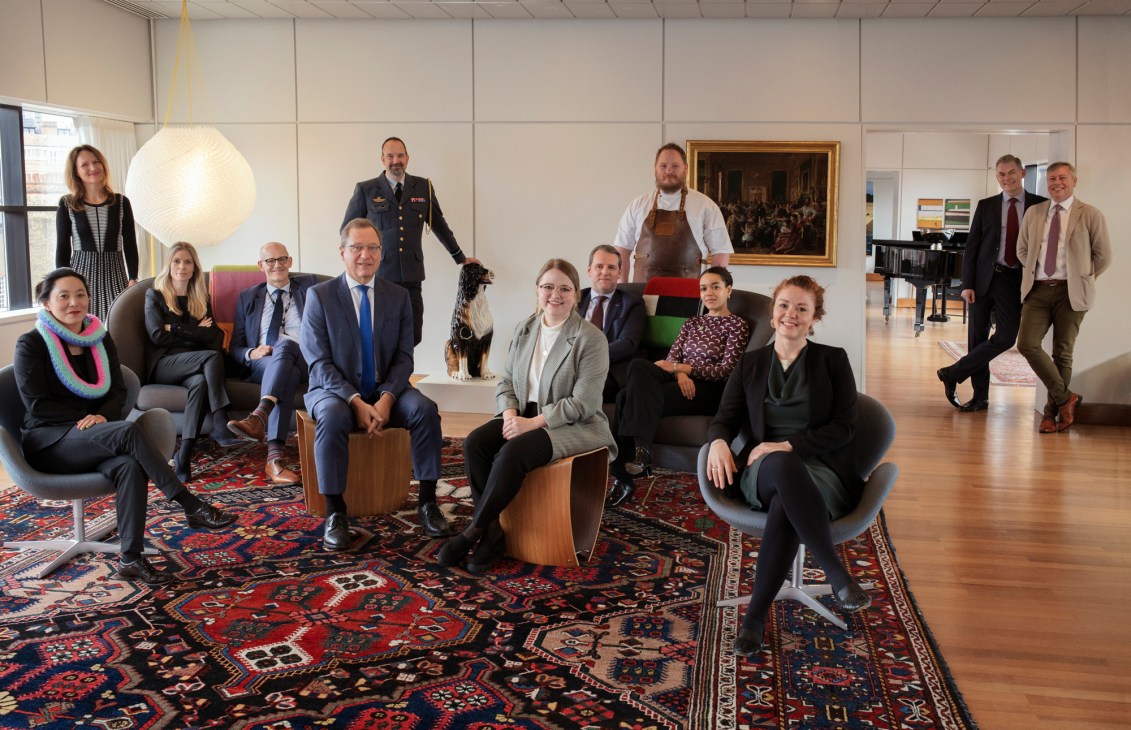
The Cabinet
(From left to right)
Nete Svane Flying visa officer “Assists all missions with visas.”
Lone Britt Christensen Cultural attaché “Works for the Danish arts.”
Anne Dorothea Bruun Aubry Deputy head of mission “Second in command.”
Esben Egede Rasmussen Minister counsellor for agriculture, food and fisheries “Supports the Danish food and primary sectors.”
Jan Kazimierz Toft Defence attaché “Handles military affairs.”
Lars Thuesen
A career diplomat, Thuesen has previously served as ambassador to Spain and Andorra and as state secretary at the ministry of foreign affairs in Denmark. He took the chance of heading the London mission in 2017. As for a highlight in that time? “Our prime minister couldn’t make the celebrations in Portsmouth for the 75th anniversary of D-Day. I stepped in and had lunch with Macron, May, Merkel, Trump and Trudeau.”
Charlotte Owen Principal energy policy adviser “Shares Danish expertise on green transitions.”
Dennis Blicher Consul “Works with visas and passports, and offers consular assistance.”
Rasmus á Rógvi Rasmussen Residence chef “Crucial to all of our dinners and receptions.”
Fafaya Katrine Dewornu Mogensen Intern, public diplomacy and culture “Interns play a key part in the embassy.”
Rikke Huque-Iversen Executive assistant to the ambassador “Takes care of managing the ambassadorial calendar.”
Jakob Holm Press attaché “Shares important stories about Denmark with the British population.”
Morten Viktor Ranieri-Svendsen Counsellor, commercial affairs “Assists Danish businesses in the UK.”
How Park Hae-soo’s rise reflects the global reach of South Korean culture
When the word hallyu became a household term in South Korea, Park Hae-soo, the actor who plays the calculating Cho Sang-woo in Squid Game, had just graduated from high school and was preparing to be a theatre major. “That was the early 2000s,” he says from the theatre stalls of Seoul’s LG Arts Center, where he has performed many times. “I was probably working at a barbecue or sushi restaurant, turning meat or rolling udon noodles.”
Hallyu, or “Korean wave”, refers to the global popularity of the nation’s culture. K-pop band BTS, Oscar-winning film Parasite, Netflix show Squid Game and more have captivated many in recent years. But for South Koreans, hallyu has been decades in the making (see here) “In the 2000s I saw Korean dramas beginning to ride the wave, spreading globally,” says Park. “I remember performing in Seoul’s Myeongdong Theatre; there were always tourists in the area buying K-contents, including K-beauty products.”
Park was born in 1981, during the military dictatorship. He recalls watching South Korean films and dramas on an old, clunky TV at home with his parents. “It protruded in the back, like an alien’s head, and the dial to change the channel was always falling out.” He grew up loving films such as Christmas in August and City of the Rising Sun, which stars Lee Jung-jae, Park’s idol and the man who plays the central protagonist of Squid Game.
Park was six years old when South Korea became a formal democracy, which opened up new possibilities for cultural expression in a freer political climate. By the time Hae-soo was at that barbecue restaurant, South Korean culture – from TV dramas to music – was already gaining huge popularity in Asia, mainly China and Japan.
Despite its popularity – and being surrounded by it – Park remembers being unfazed by the buzz of the Korean wave. By 2007 he had debuted as a theatre actor in a play called Mr Lobby and would go on to perform in major productions such as A Streetcar Named Desire and Frankenstein. “I wasn’t interested in hallyu,” he says. “I was interested in doing my job, acting. Becoming an international actor wasn’t really at the forefront of my mind.”
But now that’s exactly what he is, thanks to Squid Game, one of the most successful shows in streaming history, generating almost $900m (€790m) for its distributor Netflix. On one hand, this success points to the growing reach of South Korean soft power: last year, content exports were estimated to be about $10bn (€8.8bn). On the other hand, South Korean soft power is buttressed by the international reach of streaming platforms such as Netflix and Youtube. “The South Korean entertainment industry has been blooming for decades,” says Park. “The difference is that now there are more distribution routes out of the country.” Indeed, Kakao Entertainment Corp, the parent company of the actor’s agency, is working with global brands such as Apple TV and Disney+ to export South Korean content, including webtoons (digital comics).
But Park’s priority isn’t to become a global actor; it is to become a great one. “I fell in love with Squid Game because I saw the people in the story,” he says. “I’m interested in people. I’m interested in the power of culture. I want to remain true to the process of acting. The results will come if I continue to work hard.”
Streaming platforms and hallyu aside, Park believes that a story resonates when it can dig into the fundamental desires and natures of what makes us human, beyond national borders. “In a way, Squid Game is the most South Korean story: the setting, the characters, the children’s games featured in the show,” he says. “But it has a common denominator for people around the world: the sense of anger, loneliness and the longing to be comforted.”

The CV
1981: Born in Seoul
2007: Makes his professional stage debut in the play Mr Lobby, soon after graduating from Dankook University
2012: First TV role in historical drama God of War
2014: Film debut in The Pirates
2020: Wins best new actor prize at the Chunsa Film Art Awards for his role in By Quantum Physics: A Nightlife Venture
2021: Squid Game is released internationally by Netflix, becoming a global hit
Inside Track
There are few means of travel more satisfying than a cross-country train trip with snappy connections. Naturally, it’s extremely unsatisfying when such a pleasure is ruined by the words “signal box malfunction” blaring out of your carriage’s PA system, while your train slows to a stop. And it’s such situations that have got the goat of a passionate group of Zürich-based railway enthusiasts involved with the Swiss Railway Operation Laboratory. Their ambition is to ensure that Switzerland’s entire rail network remains, well, on track, with smooth connections. How? By inviting the country’s operators to play with what looks like an enormous toy train set, which Monocle visited on a crisp winter’s day.
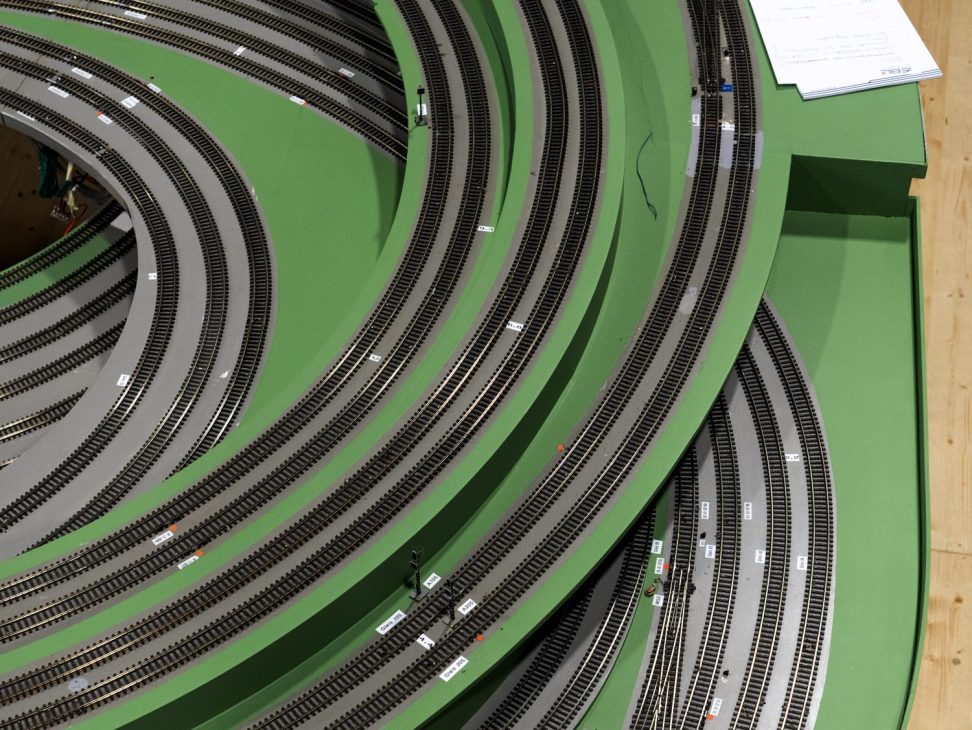
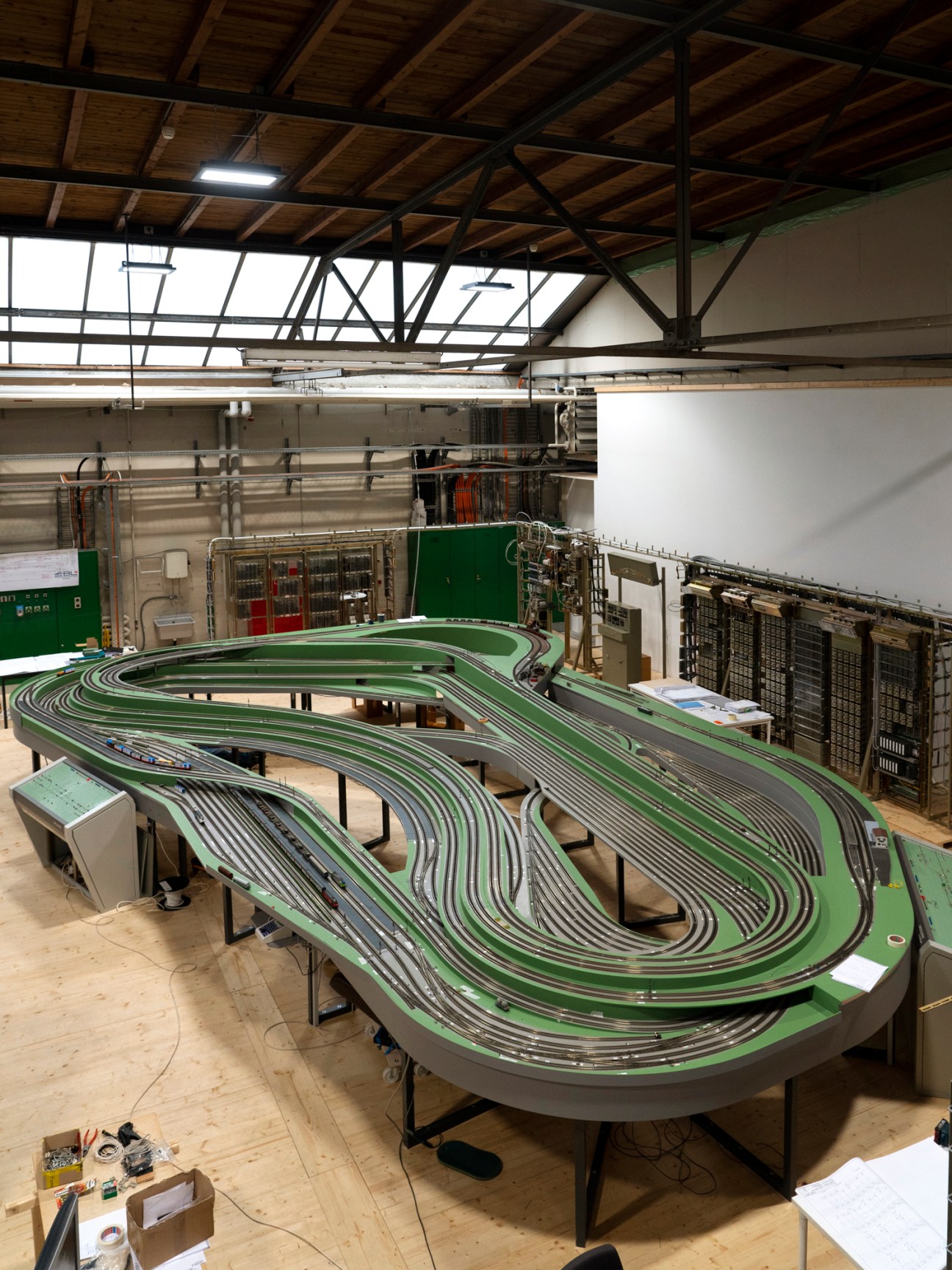
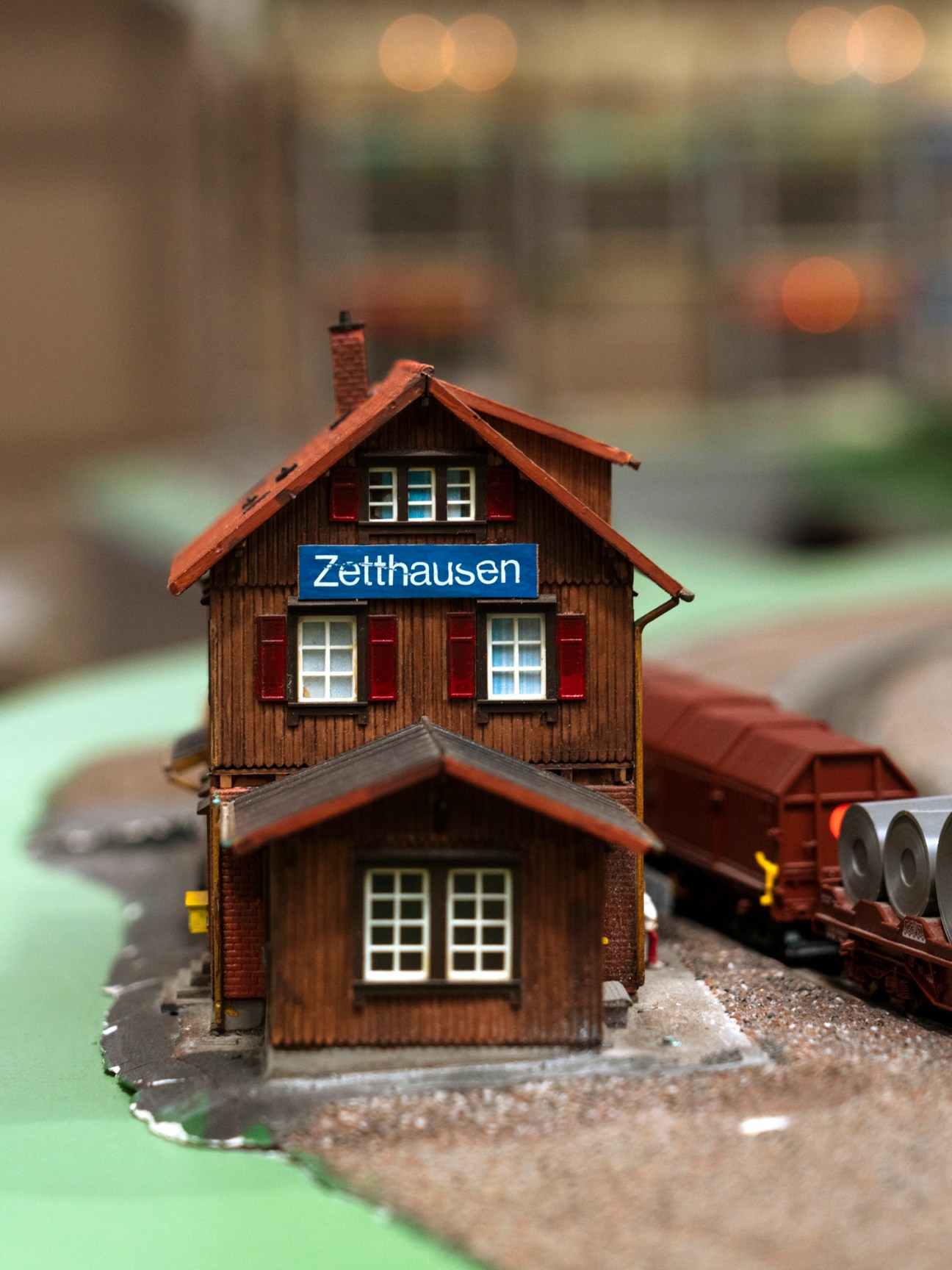
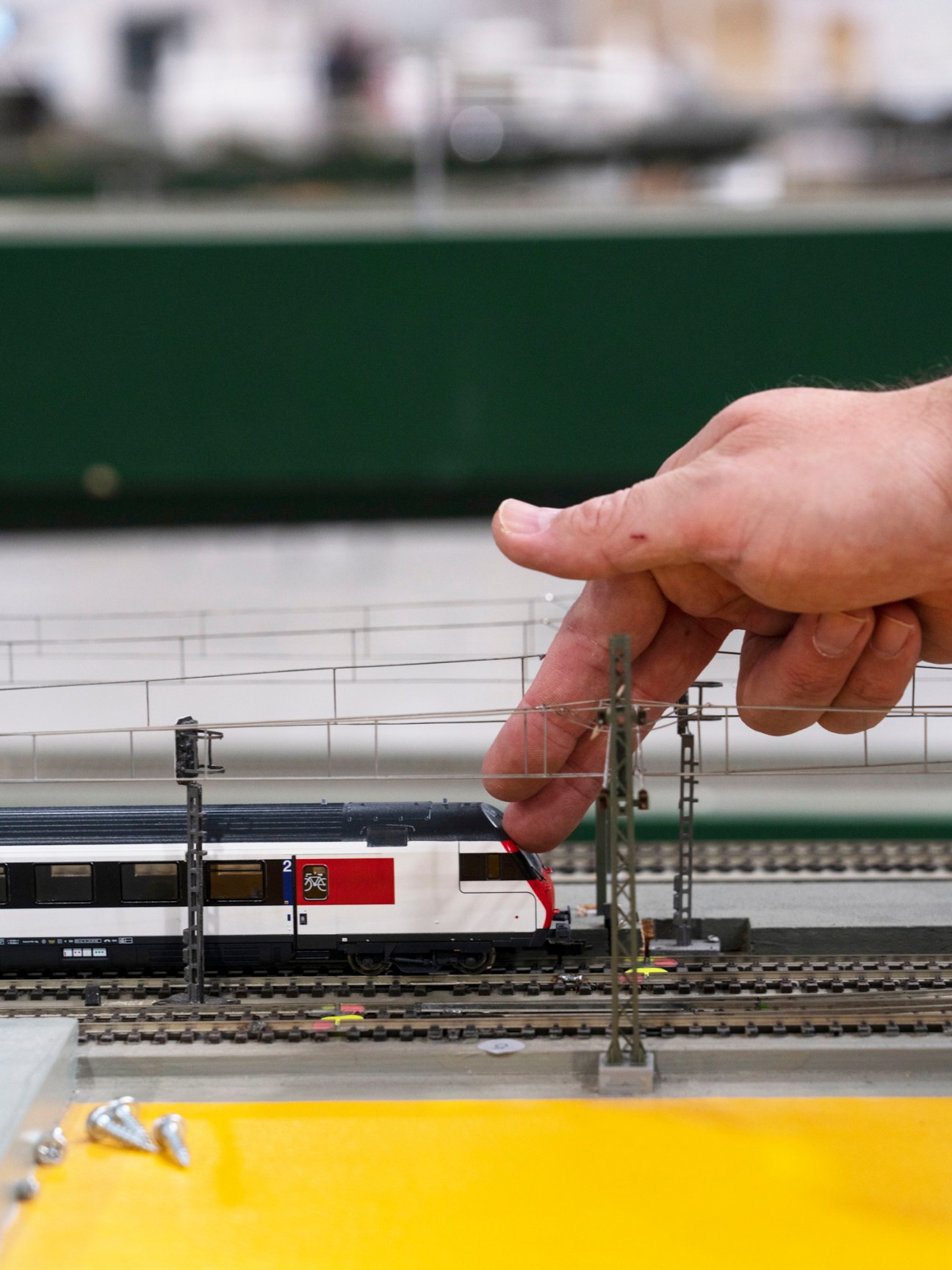
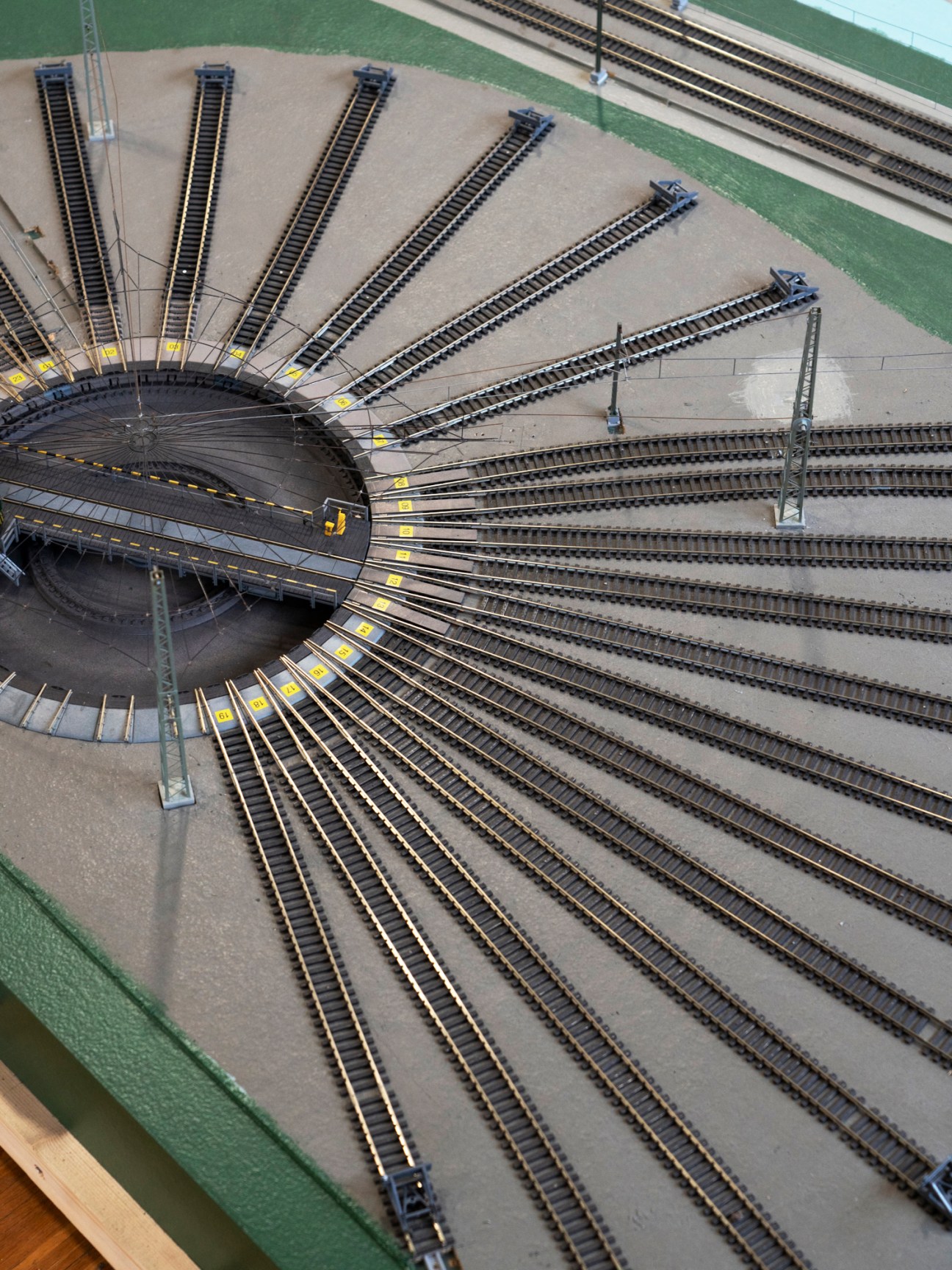
In a hangar on a military airfield in Dubendorf, a short train ride from Zürich, we’re greeted on arrival by one of the lab’s co-founders, Marc Pingoud, and chairman Peter Gysel. They started the operation in 2021, when they won the bid to buy the Swiss Federal Institute of Technology’s on-campus railway simulation model. But far from simply being a bigger version of the tiny trains a locomotive enthusiast might be gifted on their eighth (or 28th) birthday, the laboratory’s two huge “sets” are hooked up to hundreds of real, full-sized switches and levers. These controls, which are still used by railway operators today, are connected to small-scale miniature tracks, trains and stations. They operate with the accuracy of a proper system but at a fraction of the speed. Naturally, they’re set in a miniature Swiss landscape, with cows, farmers and trees.
It’s a combination that attracts train engineers, signalling experts and conductors into the laboratory for ongoing training. Here, they can simulate real-world situations with the model trains, such as delays caused by a train stuck at a station, and use real-world controls to practise getting the miniature system moving at full capacity again. Following a briefing from Pingoud, I’m prepared to try it out myself.
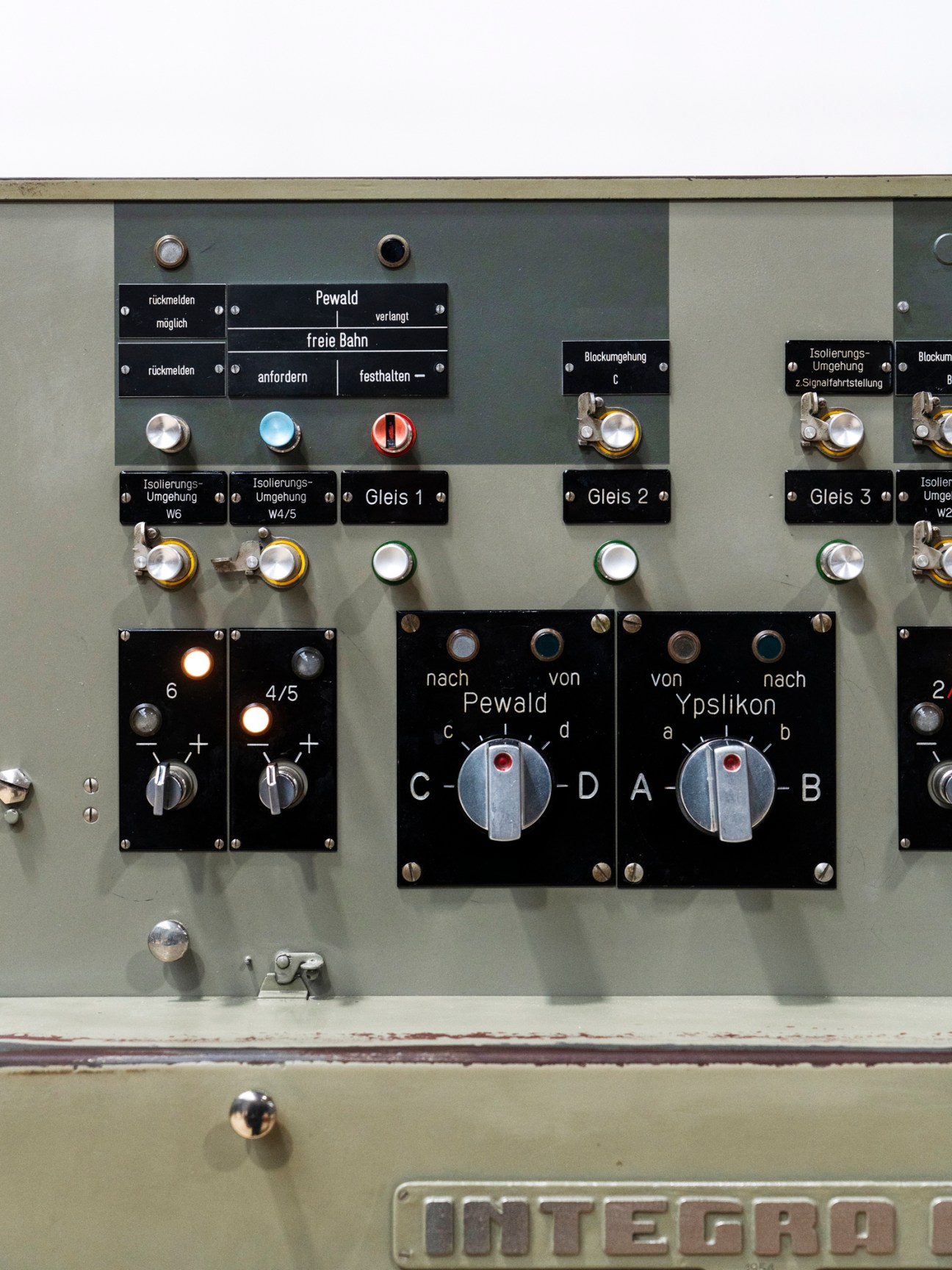
“You still find this sort of 1960s switchboard used in many European signalling stations,” says Pingoud. He then talks me through the moves I need to make to set a train in motion. I lock and release a series of levers and I’m rewarded with a green light that sees “Intercity 10” enter the charming fictional Teestadt Station. Another round of pulling, pushing and releasing of levers and we have an on-time departure towards Ypslikon Station.
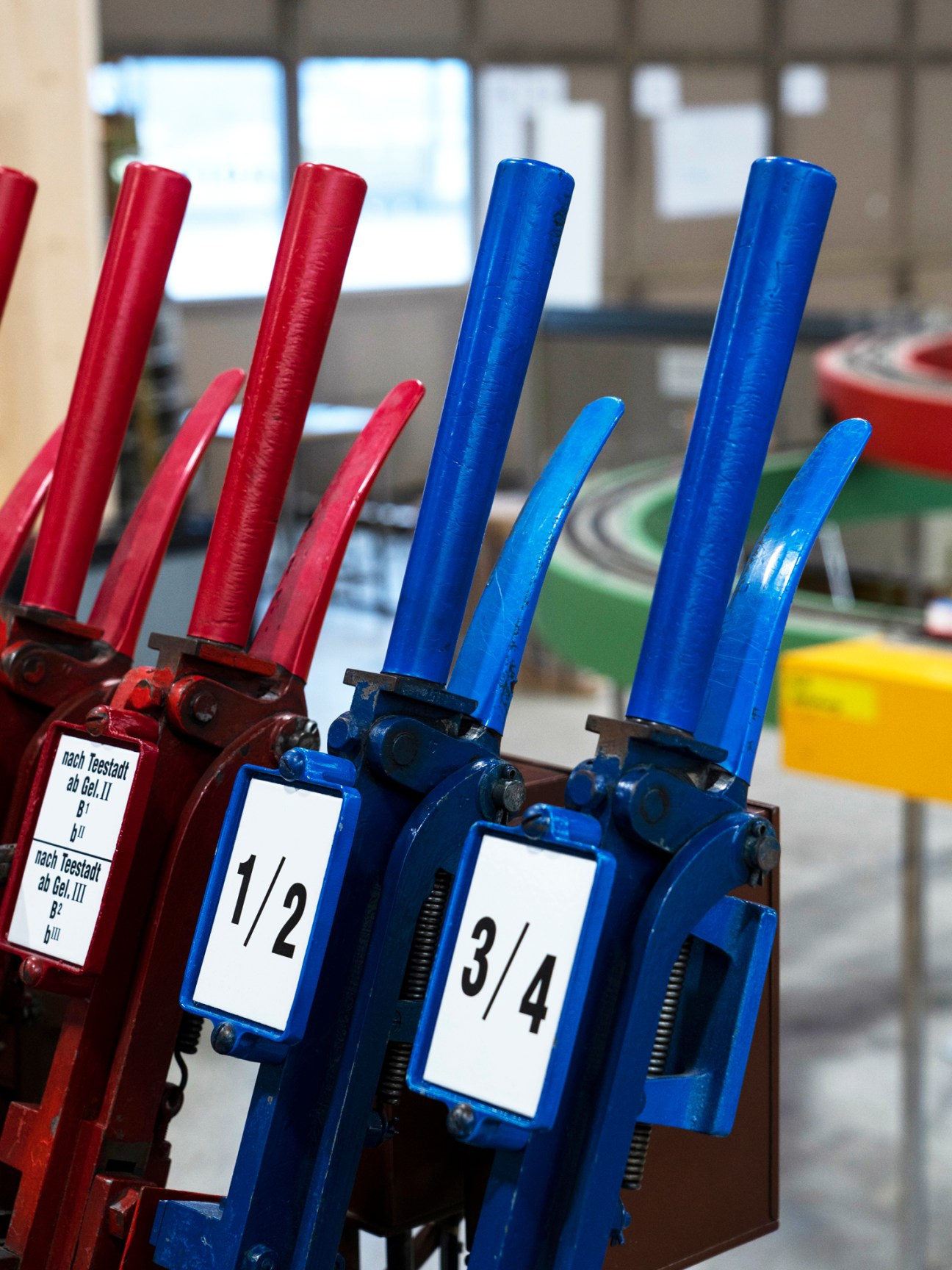
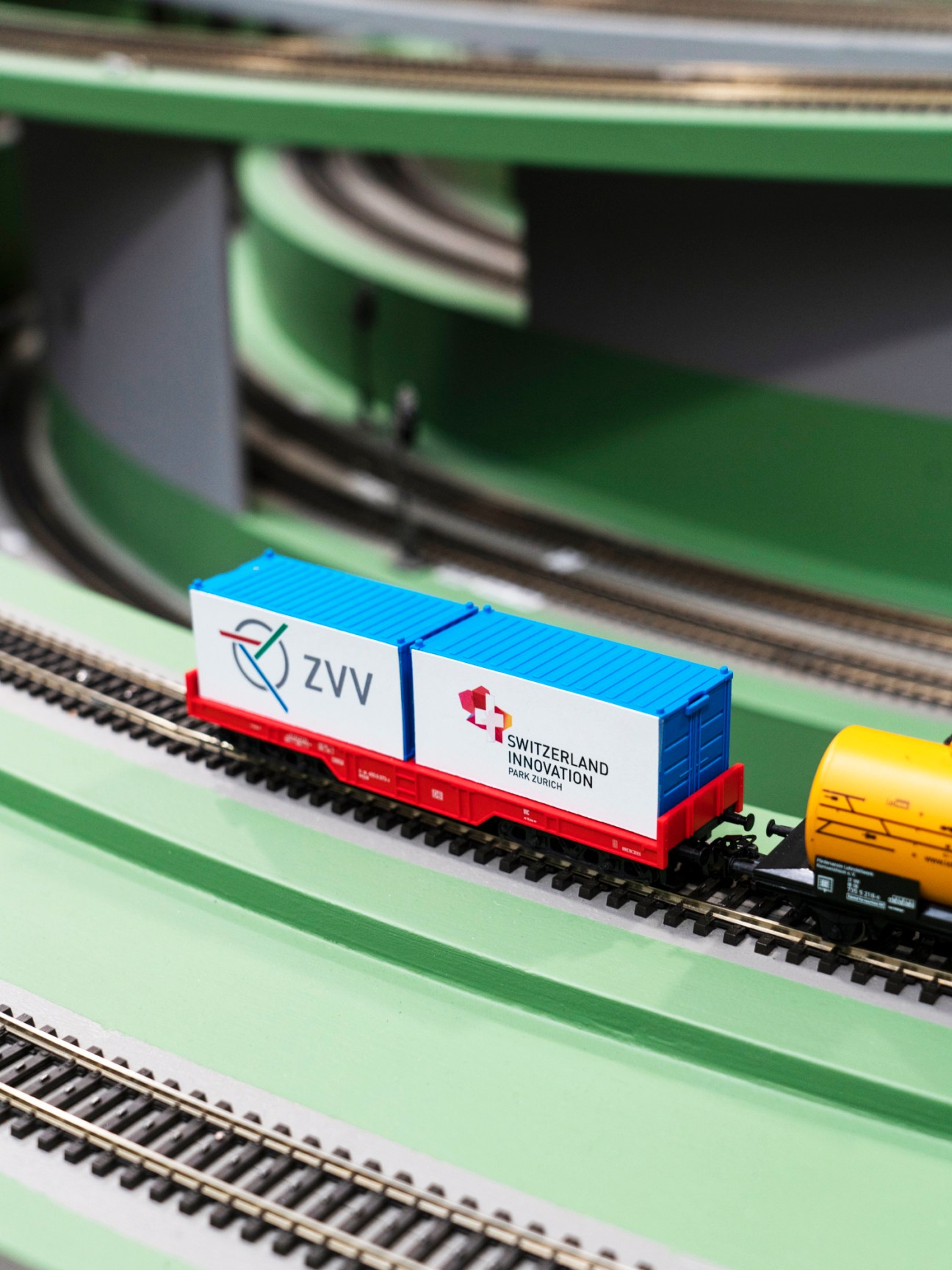
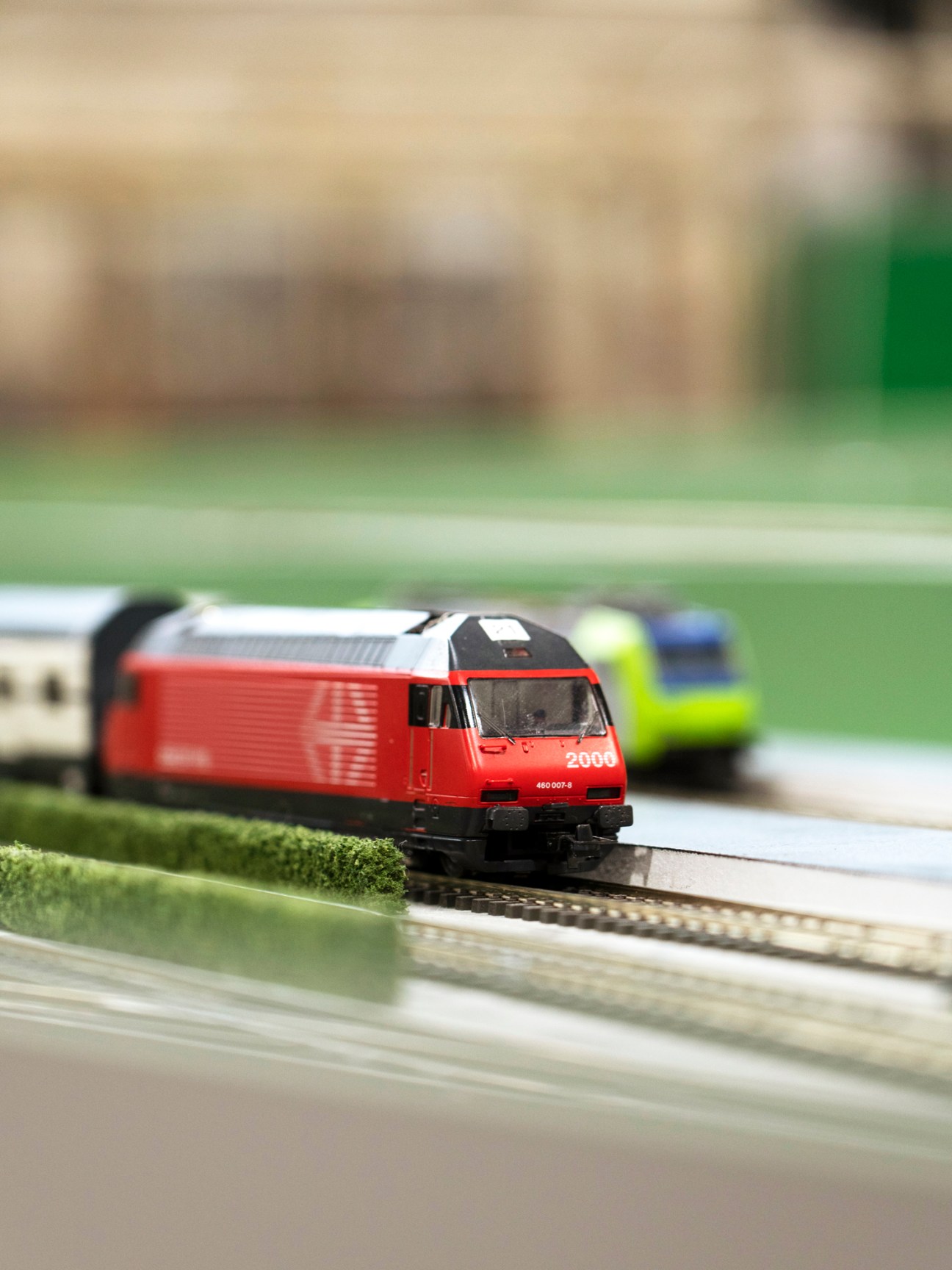
We move on to another decade, which consists of a wall with computer monitors. It shows intricate digital visualisations of a train network, along with hundreds more green and red lights. “This corresponds in functionality with modern railway control rooms,” says Pingoud, proudly pointing to the computer terminal before setting me to work. It’s a system that requires far less muscle mass to set things in motion but I’m forced to flick a number of switches in a precise order. All this is taking place while a team of technicians and volunteers are soldering and screwing together another, even larger test track. “We’re installing the most up-to-date relays and a system that simulates satellite tracking as well,” says Pingoud. “The goal is to be able to test every possible scenario, from signal failures to train delays, while staying current with future developments.”
Such developments ensure access to the latest training technology, maintaining Switzerland’s status as the most efficient train network for passenger punctuality in Europe. Boarding an sbb back to Zürich, I don’t expect delays. But should there be, I’d be happy to step in and flick a few switches to help us arrive on time.
The Opener
How to live: Where to next?
The list
Getting back on the road but can’t decide on the destination? Tyler Brûlé has a few pointers.
Now that you’re all set to get back on the road, where are you heading? Who are you going to sleep with? (I’m talking hotels, silly.) And how are you going to get there? We’ve sent out a few expedition parties to check in on some old classics and sample some new additions.
1.
Denmark’s prime minister Mette Frederiksen might want to achieve climate neutrality for aviation but her government should stay on the ground. Having announced targets for civil aviation, it seems she overlooked state rail operator dsb. Rather than focusing on battery-powered aircraft, it would be better to improve the nation’s intercity services, with help from Stadler’s Smile high-speed trains, perhaps, and interiors by Copenhagen-based oeo Studio.
2.
If you’re getting back to long-haul jaunts, Finnair has a range of new cabin interiors rolling out across its a350 fleet (see here). And Helsinki-Vantaa Airport is putting the finish touches to passenger-flow improvements.
3.
The Château Voltaire hotel in Paris is the right scale, has a delightfully dinky bar and an attentive team at the front desk.
4.
But if you’re making your way up to the Engadine, Brücke 49 in Vals is the perfect pit stop. There’s a rumour circulating that Monocle might be hosting an anniversary party up in St Moritz. Keep an eye on the postbox.
5.
If you’ve already done enough Miami this winter, why not a bit of opportunity-spotting in and around Dallas? We might bump into you at Highland Park Village.
Correspondent’s view
Berlin
High art
When I moved to Berlin in the early 2000s, the main building at Tempelhof was still a functioning airport terminal. The imposing structure, famous for hosting Berlin airlift missions in the 1940s, now hosts exhibitions and, since its operational closure in 2008, has attracted both fascination and, recently, controversy.
In June 2021, an art exhibition called Diversity United opened, touting European democracy with 400 large-scale works by art stars such as Gerhard Richter and Olafur Eliasson. It was mostly a critical hit and Walter Smerling, curator and head of Bonn-based cultural non-profit Stiftung für Kunst und Kultur, took the show on the road to Paris and Moscow. But Smerling’s second Tempelhof show, a retrospective of French artist Bernar Venet, has been less favourably received. The reason? Stiftung für Kunst und Kultur is planning on turning part of the building into its own long-term gallery and calling it the misleading name “Kunsthalle”, a term typically associated with public, non-profit galleries. Sponsors of the plan include German property developers, which has prompted critics to campaign for a boycott of the venue.
Tempelhof has seen a lot of history. Why not tailor its next phase to better suit Berlin’s art scene with more democratic exhibitions, community initiatives and much-needed artists’ studios? Decades ago, Tempelhof helped to save Berlin’s citizens; now might be the time for citizens to save Tempelhof.
All change please
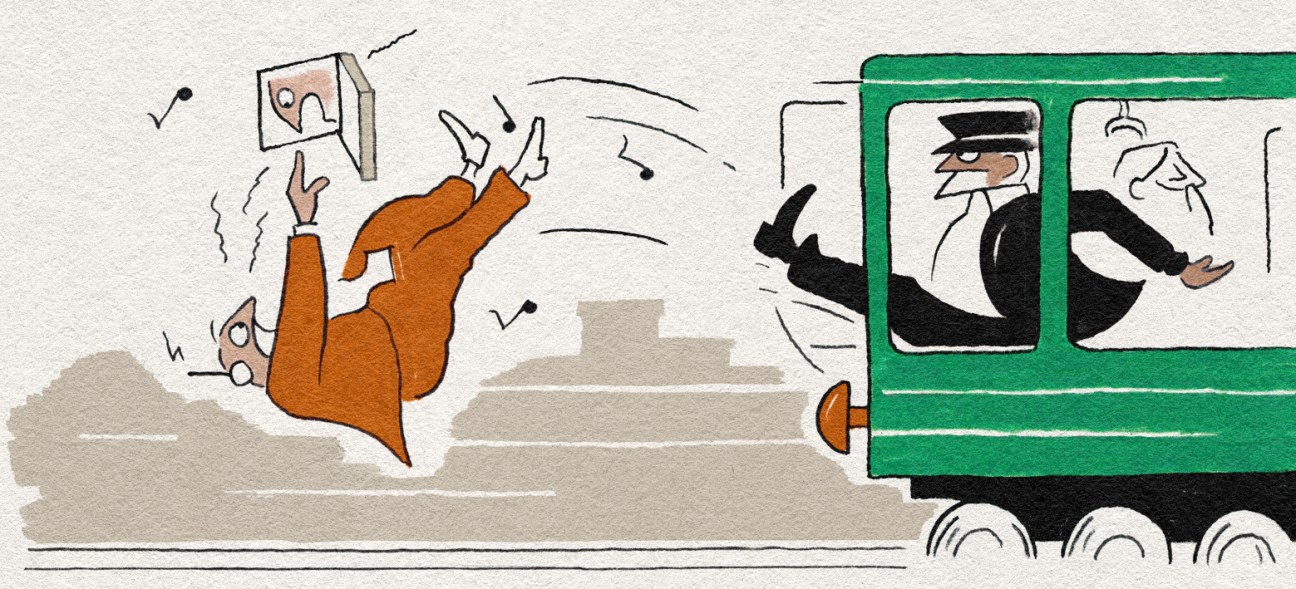
In the UK, train travel has long been rendered nigh-on unendurable by a ceaseless cacophony of superfluous announcements. Thankfully, the Department for Transport has announced that it will remove its self-described “Tannoy spam”. Even if this is the kind of frantic tinkering often associated with floundering governments desperate for the tiniest of victories (and it is), it will do. It must now be hoped that this crackdown on noise proceeds to its logical conclusion: the empowering of conductors to seize and fling out the window any phones being used to play music and films without headphones, followed, ideally, by their owners.
Loose laws
After a Bugatti owner hit 259mph (417kmph) on the autobahn, Germany is again debating whether to remove unlimited-speed sections on its motorways. With this in mind, here are three other countries that, for now, are offering their citizens some unexpected leeway.
1.
Psychedelics
Czech Republic
A dream for those looking to relive these substances’ 1960s heyday. Here, you can be in possession of 40 magic mushrooms and five tabs of lsd.
2.
Internet
Iceland
The country routinely tops internet-freedom polls. Unlike in China or Iran, you rarely need to hop over a firewall.
3.
Public holidays
Iran
They might not have unfettered internet access but Iranians certainly do have lots of paid days off: a world-leading 27.
Reporting from…
Monocle’s HQ and bureaux span cities across the world. Here’s the view from the ground, from a curious new woolly pet in Zürich to Los Angeles’s best new neighbourhood.
Zürich
Pet sounds
If you peer over a garden fence in Zürich, you might just see an alpaca grazing. A farm for the camelids has recently opened in the city, and courses for keeping alpacas are booming in the countryside. Surprised? Don’t be: both the Swiss and alpacas love alpine altitudes.
London
Lighting the way
London’s self-appointed “gasketeers” have successfully halted Westminster council’s plans to replace 300 of the city’s gas-powered lamps with led lights. Their argument? That the “Dickensian glow” is a major part of the city’s history. We think it’s a bright idea too.
Toronto
Master stroke
New gallery spaces are on the way at the Art Gallery of Ontario. The expansion will add much more room for exhibitions in the current, Frank Gehry-designed complex. It means that, as Canada opens back up to the world, Toronto will be primed to welcome art enthusiasts.
Los Angeles
Grand vinyl
The streets around Hollywood’s Selma and Wilcox avenues have a clutch of new rooftop bars and restaurants, enticing Angelenos to a long-overlooked corner of town. Still, the developer’s name for this area-on-the-up, the Vinyl District, has yet to catch on.
Hong Kong
Petty cash
Hong Kong’s leadership “election” takes place at the end of March and whoever becomes chief executive will need to buy a piggy bank. Carrie Lam pockets almost hk$5.2m (€586,000) a year but since the US sanctioned her in 2020, not even Chinese banks will take her money.
Tokyo
Room to breathe
Tokyoites are relieved that Yoyogi Park is coming back into its own, months after parts of it were fenced off for (cancelled) Olympics screenings. With the orange barricades almost all gone, picnickers, joggers and dogs can once again stretch their legs.
The interrogator
Virginie Efira
Belgium
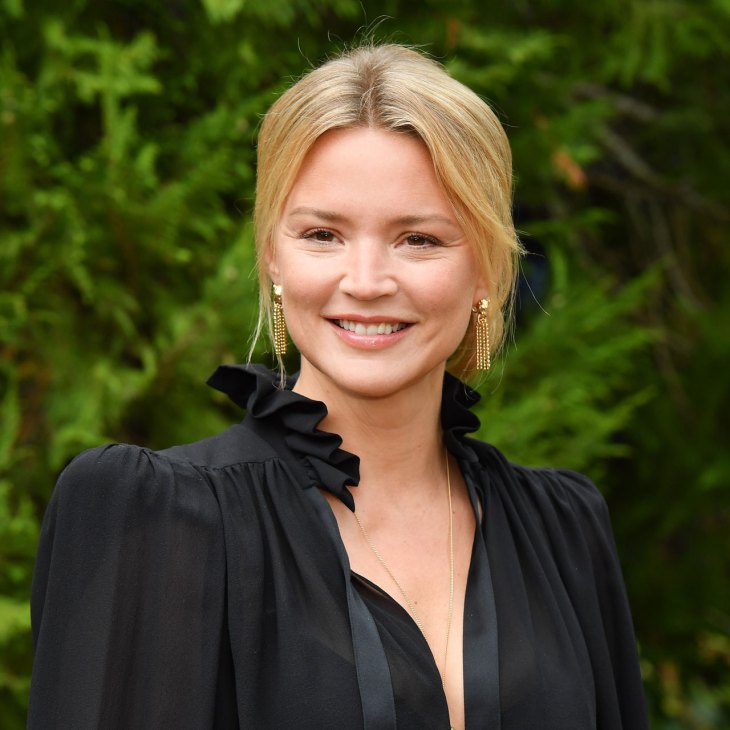
Belgian actress Virginie Efira is a Magritte award-winner (the top gong for her nation’s film industry) who attracts great box-office numbers while regularly gracing the covers of France’s leading fashion magazines. Add to this her recent nomination for best actress at this year’s César awards and 2022 is shaping up to be her biggest yet. Here, she tells us about the role that put her on the shortlist: her portrayal of a 17th-century lesbian nun in Dutch film-maker Paul Verhoeven’s Benedetta.
This part was written for you. Can you tell us what it feels like to have a top film-maker tailor their work to you?
It’s a strange feeling because I’m a big fan of his. I first discovered Verhoeven’s films when I saw Basic Instinct. After that, I saw all his American movies. And then I discovered his Dutch films. He’s one of the best directors alive. So when I worked on his film Elle in 2015, I was just hoping that we could have a conversation. It was all good on set and I worked there for 10 days. But one or two months later, I ran into Verhoeven at a hotel and he didn’t recognise me, so I thought I hadn’t impressed him at all. That’s why, when he told me that he had written a film for me, I didn’t understand.
How did you prepare for the role?
When I asked him how to prepare, Verhoeven just told me, “You know what you must do.” But in the film, I do things like come back from the dead. I can’t say I’ve ever done that before. As a result, I ended up creating my own character development, and Verhoeven accepted everything.
You’ve also starred in comedies and there’s some dark humour in this film. Did your previous roles inform your process?
I like comedy and when it’s good, it can really be incredible. But in France it’s the easiest genre to fund and finance, so some films aren’t very well-researched. I’ve made some bad and some good examples. I don’t know if these helped me in this specific project but Verhoeven certainly has a good sense of humour.
Now that you seem to be at the peak of your powers, what first inspired you to become an actor?
I’ve always wanted to act but I was scared early in my career because playing a character is so sacred. I also related to the idea that you don’t want to belong to any club that would have someone like you as a member. In both cases, I realised that it’s OK to fail.
‘Benedetta’ is now showing in Europe and the US; its UK release will be in April.
Now boarding at gate K9…
In what regular readers will recognise as one of our favourite news topics – pets on planes – Star Flyer will become the first Japanese airline to allow dogs and cats inside its aircraft cabins, starting in spring. Dreams (or nightmares, depending on your persuasion) of a cabin filled with curious pups may, however, be premature. Among stipulations, furry fliers must stay in carry-cases and, in service of other passengers’ nostrils, sport an animal-friendly nappy. Unlike previously reported schemes, this is one that might actually fly – the only hitch is a dent to Fido’s ego.
Prong move
Like most countries, Australia has recently suffered heavy disruption to its supply chains. But it is unusual in having toyed with child labour as a remedy: prime minister Scott Morrison has raised the prospect of permitting 16-year-olds to operate forklifts.
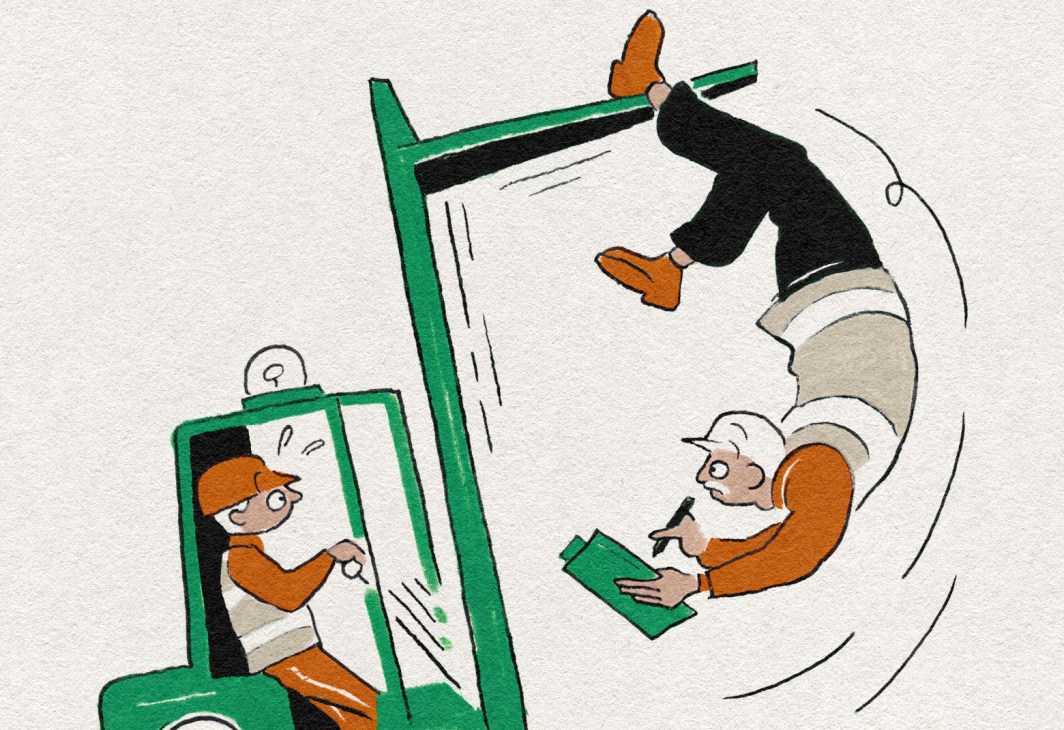
There would doubtless have been enthusiastic take-up by potential drivers; teenagers rarely require asking twice if they’d like a go on dangerous machinery. However, the potential for havoc was swiftly and brusquely pointed out by state governments and trade unions, and the plan has been shelved – hopefully by a trained and licensed professional.
If there is one lesson that the pandemic should have taught us all – but especially those who govern us – it is that manual labour is not necessarily unskilled; often, indeed, it is quite the opposite.
Images: Getty Images
Looking back, looking good
Milestone birthdays make you pause, reflect and wonder, “What next?” Or get drunk and decide to have a facelift. It’s a similar story at Monocle as we celebrate our 15th anniversary on newsstands (the facelift happened a little while ago with our redesign last October).
In recent weeks we have gone back to where it all began by revisiting our first issue (although finding a copy at Midori House takes some detective work – rather a lot of them seem to have been “liberated”). Returning to our roots has been, in part, to remind ourselves why the magazine was needed in 2007, to recall the proverbial gap in the market that our founder Tyler Brûlé spotted for a global news briefing that celebrated the power of print, and to reaffirm the principles and ideas that shaped Monocle‘s foundation: to focus on opportunity, value craft, avoid following the mob, tell different stories and ignore the celebrity circus. But there was another reason that we wanted to open the premier issue again; had the themes and debates that we had considered so pertinent back then stayed relevant?

While the world has spun and changed, our first issue actually still looks fresh and the stories that we featured are as topical as ever: China’s role in Africa, the need to keep manufacturing alive even in service economies, the value of good media, the debate over Japan’s pacifist constitution, how we can travel better. But how had the narratives of these reports moved on since 2007? And what had happened to some of the extraordinary people we featured?
That’s why, as part of a special anniversary section in this issue, we have revisited these stories and asked a simple question, “What happened next?” You’ll find out (see here) as we catch up with a former TV anchor still reporting on the things that she cares about, a radio host who has had to flee his home, a feline-themed wine brand that’s proved to be no gimmick and an all-American shoe company that’s short on staff but big on orders.
In another favourite story from the anniversary line-up we track down some of the team who helped launch Monocle but who later headed off on other career paths. It turns out that besides being a media brand, Monocle is not a bad college of life and finishing school. The old crew is now spread around the world; all have interesting lives. We asked them for a memory of their time at Monocle and many come back to the same things – the insane hard work that goes into a launch, the fun, the camaraderie. It’s also great to see how so many are still friends and at this point will be for life.
In the past two years too many people have lost sight of why an office can be great. And one of those benefits is this very thing; the forging of friendships, finding people who will have your back, creating networks that will last. I see it with the incredible interns that we have now, how they soon switch from new arrivals to working as a team, making contacts. Tyler and I also first met through work, back in the 1980s. Many of the people who write for Monocle today are journalists with whom I have worked for years. And new names get added all the time. We all need networks.
But it’s not all looking back. Just a few weeks ago we appointed a new US editor, Christopher Lord, who is based in Los Angeles, and in this issue you can already see the benefits of having a good reporter on the ground. He has travelled to Salt Lake City to look at its rise as a hotbed of entrepreneurialism and technology start-ups (see here) and he’s also been to Kingston, Jamaica, to visit the International Seabed Authority that’s set to move from obscurity to global significance as the world seeks rare minerals in the oceans’ wildest depths (see here) – he’s clearly keen to expand his new title’s geographical remit. Our Europe editor at large, Ed Stocker, has also been crossing into new territory with his report on the architectural renaissance occurring in Accra and the work of David Adjaye (see here).
It’s as busy and dynamic as ever at Monocle. We are still putting journalists on trains and planes, sending great photographers out on assignment – you can meet some of our favourites in this month’s Expo (see here). I hope that whoever is editor in chief in 15 years’ time will look back at this issue, see stories that still resonate and perhaps ask themselves, “I wonder what happened next?”
And, finally, please feel free to send comments, ideas and anything else to [email protected]. Thanks for all of your support.
Funny business
For graphic designers, creating work that is funny is rarely part of their brief. The industry floods social-media channels with profile-raising work that’s supposed to push boundaries and provoke a client and audience’s imagination by “interrogating the brief” (as art directors tend to preach). So surely injecting some humour into a project might evoke surprise and make a campaign more memorable? Or maybe not. “Graphic designers are mostly men who take themselves too seriously,” says one (female) graphic designer when asked why so few projects are laugh-out-loud funny or even designed to raise a smile.
To dispel the notion that a lack of design humour is entirely down to men being boring, it’s worth noting that, actually, graphic designers are not predominantly male. The gender ratio, according to US industry bodies, is about 60 per cent female to 40 per cent male. But the scales are tipped in favour of the boys when looking at holders of the top jobs in the field. Perhaps the biggest problem is that adding humour into the creative equation today often comes at too big a risk.

Lufthansa
Otl Aicher, Germany
1974-1975
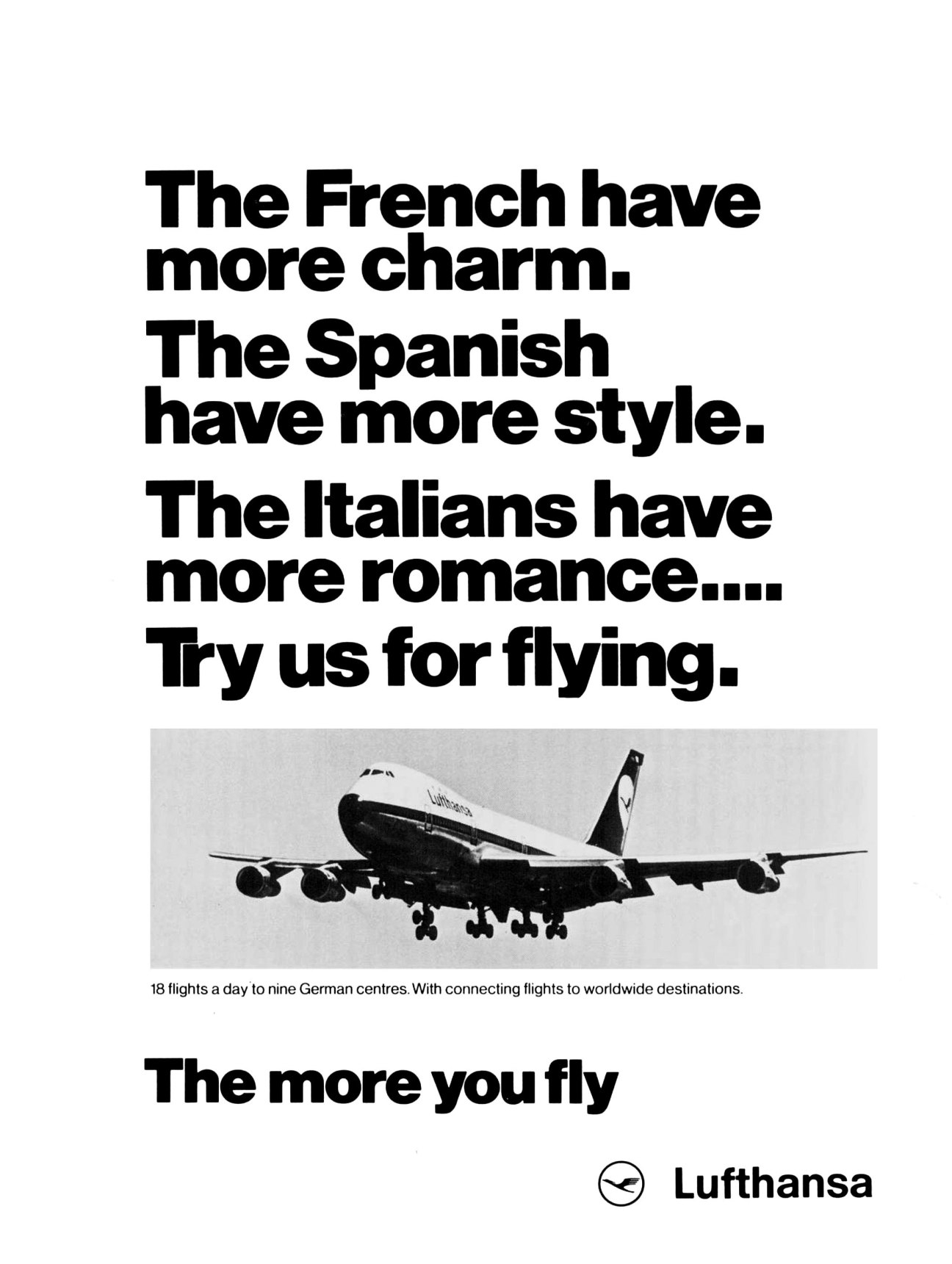
It’s fair to say that art directors got away with more cheekiness back in the day but that’s not to say that everything they created was crass. The compelling campaigns and witty copywriting that went into the marketing of German national carrier Lufthansa defined the brand against its competitors in the 1970s. It’s noteworthy for bold typography, clean graphics and willingness to make fun of itself – and its home nation.
“Historically, the best design was ideas-based and clever but a lot of that is gone; humour is gone,” says Rob Duncan, a UK-born, San Francisco-based creative director with global firm Mucho. He credits witty London designers of the 1960s and 1970s, such as Alan Fletcher and Bob Gill, co-founders of the now-global firm Pentagram, for producing the daring type of design we don’t see enough of these days and that still inspires his own output.
For Duncan, good design is visual work featuring “a brilliant idea that is amazingly crafted”. This might once have been executed with a provocative tagline, a cheeky image or an illustration poking fun at the audience. But these are now rarities. “We live in a society where we need to be careful with what we say in the office so we don’t offend anybody,” he says. “How can you create work that surprises or even shocks?”
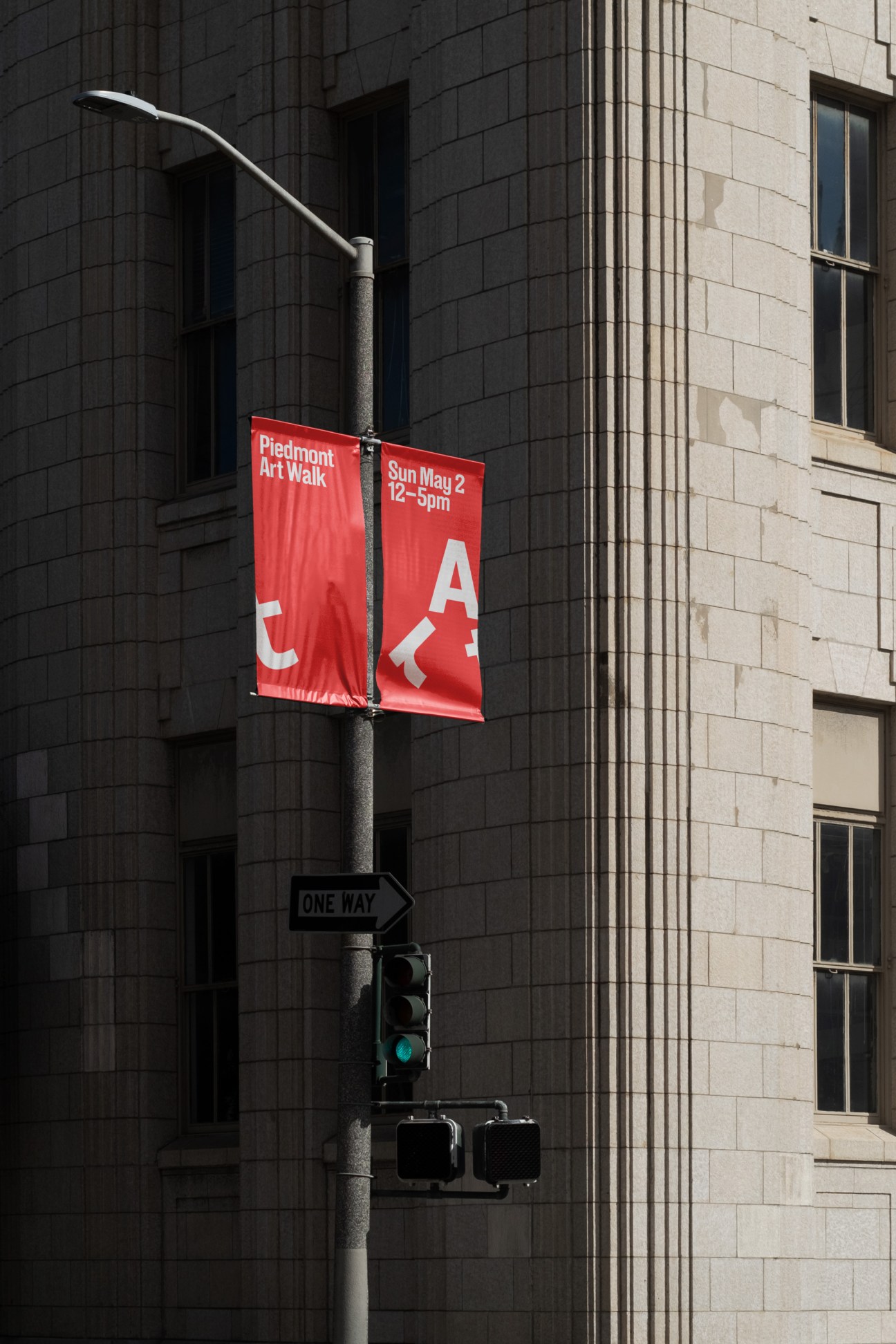
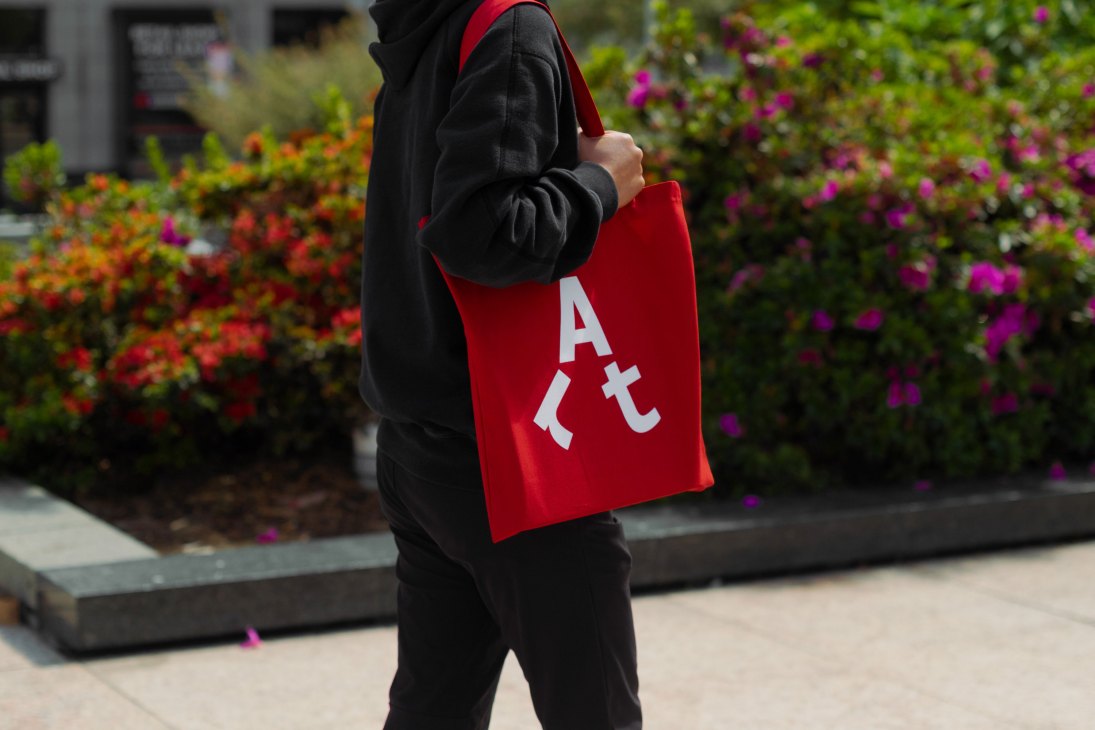
Duncan jokes that his design team is the only one on America’s west coast – a place where technology brands with soulless visual identities tend to thrive – that strives for smiles whenever possible in its work. A case in point is its concept for Piedmont Art Walk, where a “funny little character”, a cute mascot made up of the letters A, R and T, marches merrily across outdoor advertising and event signage. “It’s always about raising that smile but raising it to certain degrees depending on the audience,” says Duncan. “For our recent rebrand of Visa, even though they’re a very corporate, serious company, we saw the opportunity for an intelligent and clever solution, where the wit was about making people say ‘aha’, not making them laugh out loud.”
For German graphic designer Mirko Borsche, who is founder of Munich-based studio Bureau Borsche and one of the world’s top names in creative branding with a client list that includes Balenciaga and Inter Milan football team, funniness is synonymous with intelligence. “Humour is one of the most intelligent ways to communicate,” says Borsche. “If you think about classic Pixar films, they use this kind of ‘in-between’ humour to make both kids and adults laugh; it’s extremely clever.” Borsche is known for the humour in his design output, though not all of it is family friendly. He recalls a time when he and one of his interns planted numerous hidden jokes – and doodles of penises – into youth magazine Jetzt, a title that his firm was producing for German newspaper Süddeutsche Zeitung. Names of illustrators making reference to a certain part of the male anatomy were invented and snuck into the publication too. “Even though the title was talking about sexual subjects to its audience, the editors still had a problem showing a naked person or a penis,” he says.
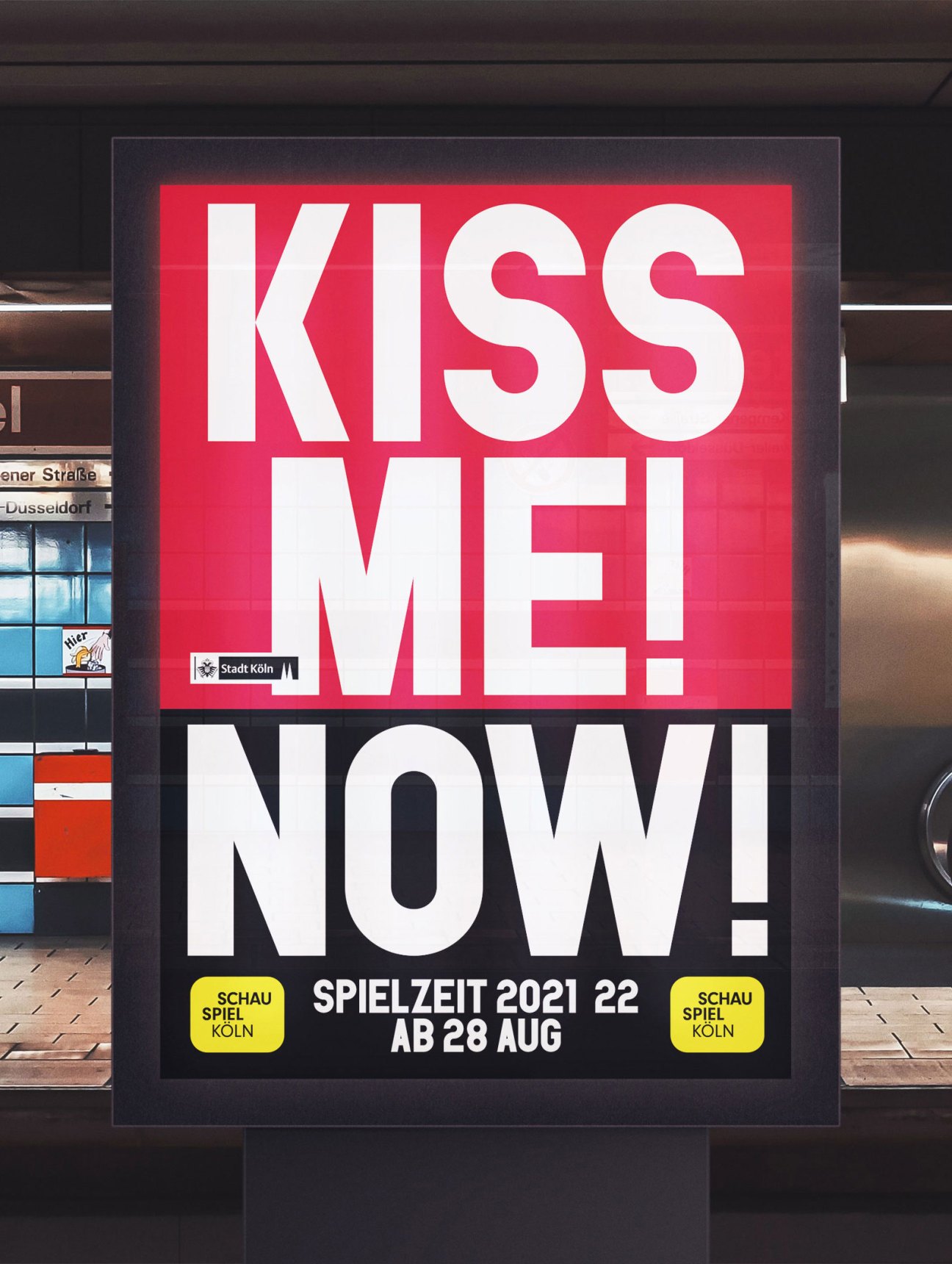
Schauspiel Köln
Herburg Weiland, Germany
2021
Sometimes big, bold typography is all a designer needs to command people’s attention and simultaneously raise a smile. This simple message from the Schauspiel Köln theatre had all the more impact during a pandemic, when kissing in public became a touch more taboo.
Lemonland Media Lab
Bureau Borsche, Germany
2018
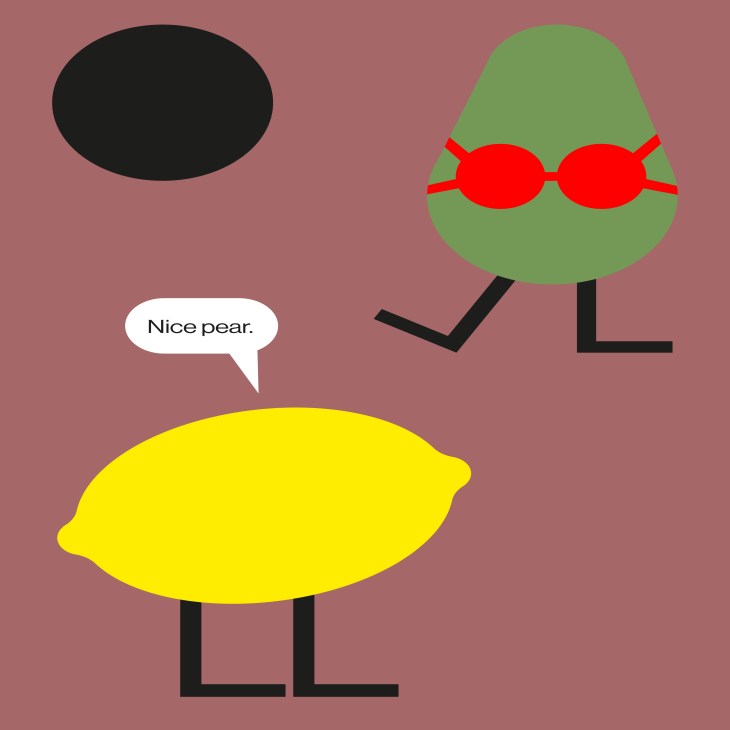

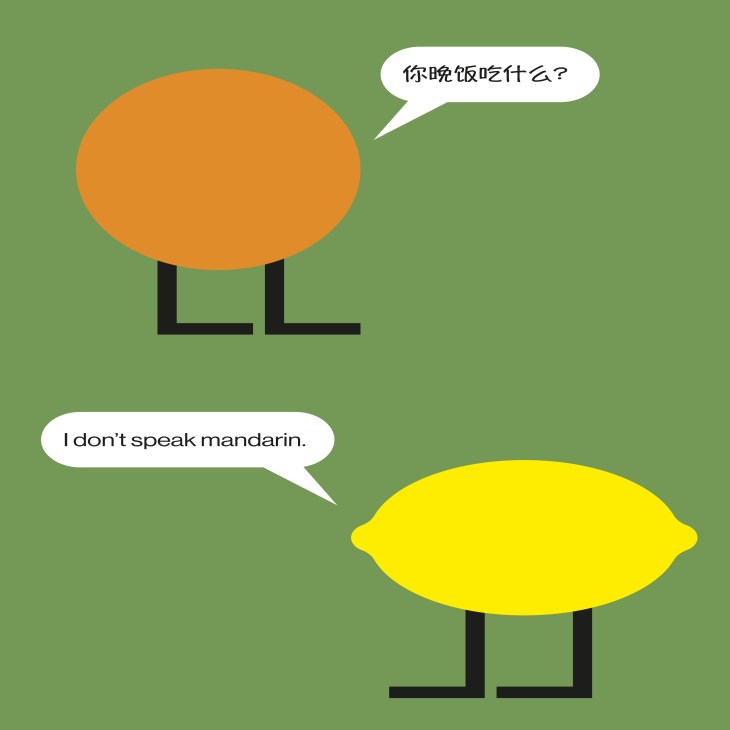
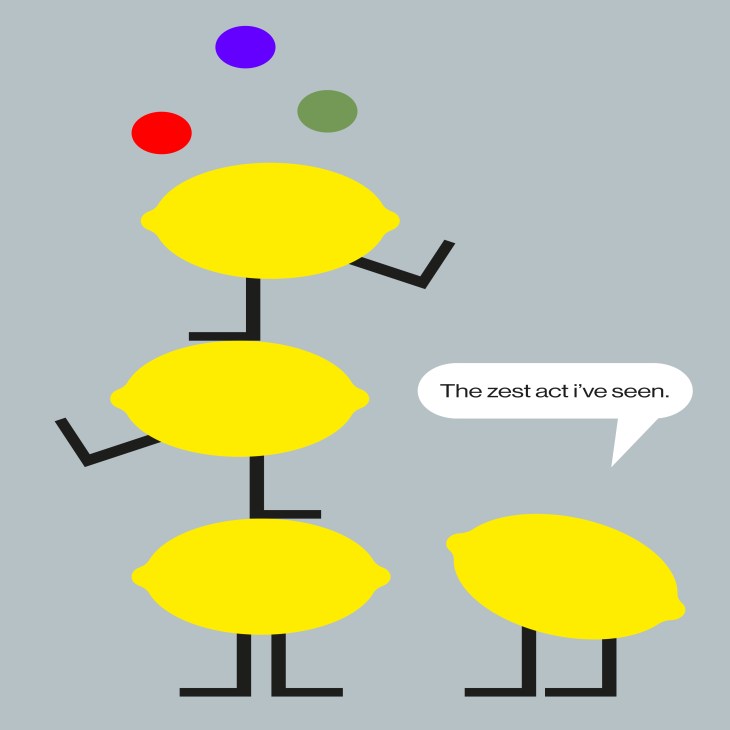


This illustrated campaign for Luxembourg’s Lemonland Media Lab by Bureau Borsche doesn’t just reference the citrus fruit in question across the tongue-in-cheek campaign. Look closely and you’ll see that each of the characters’ legs is a letter L, in a reference to the company’s name.
While magazine work allows Borsche some room for pushing the humour envelope, he says that injecting laughs into commercial projects is trickier. “Humour is very subjective,” he says. “And you’re always walking a very fine line when you’re using it.” The designer counts a project for Luxembourg publisher Lemonland Media Lab as an example of how funny graphics can not only create persuasive advertising but also positively affect the client’s company culture. Bureau Borsche’s campaign used illustrations of fruit characters, including a lemon, making bad jokes to one another. “The work helped the new company to determine its tone of voice, which allowed them to think and act in a more humorous direction with their clients and with each other,” says Borsche.
While it’s easier for an acclaimed designer to go toe to toe with an editor or to win over a client by drawing on humour, for those entering the industry, banking on being funny is tough. “Humour is something so personal,” says Meret Mächler, a final-year student at Zürich’s University of the Arts and a practising graphic designer. “So it’s difficult to apply it to design and hope that everyone laughs along with you.”
Piedmont Art Walk
Mucho, USA
2021
Understanding the audience is key in selecting the right tone for the execution of any graphic design. For a family event such as the Piedmont Art Walk, Mucho knew that it could have a bit of fun with the art direction. With this in mind, the studio came up with this smart and simply designed mascot that conveyed a message while raising a smile at the same time.
Filmpodium
Meret Mächler, Switzerland
2020
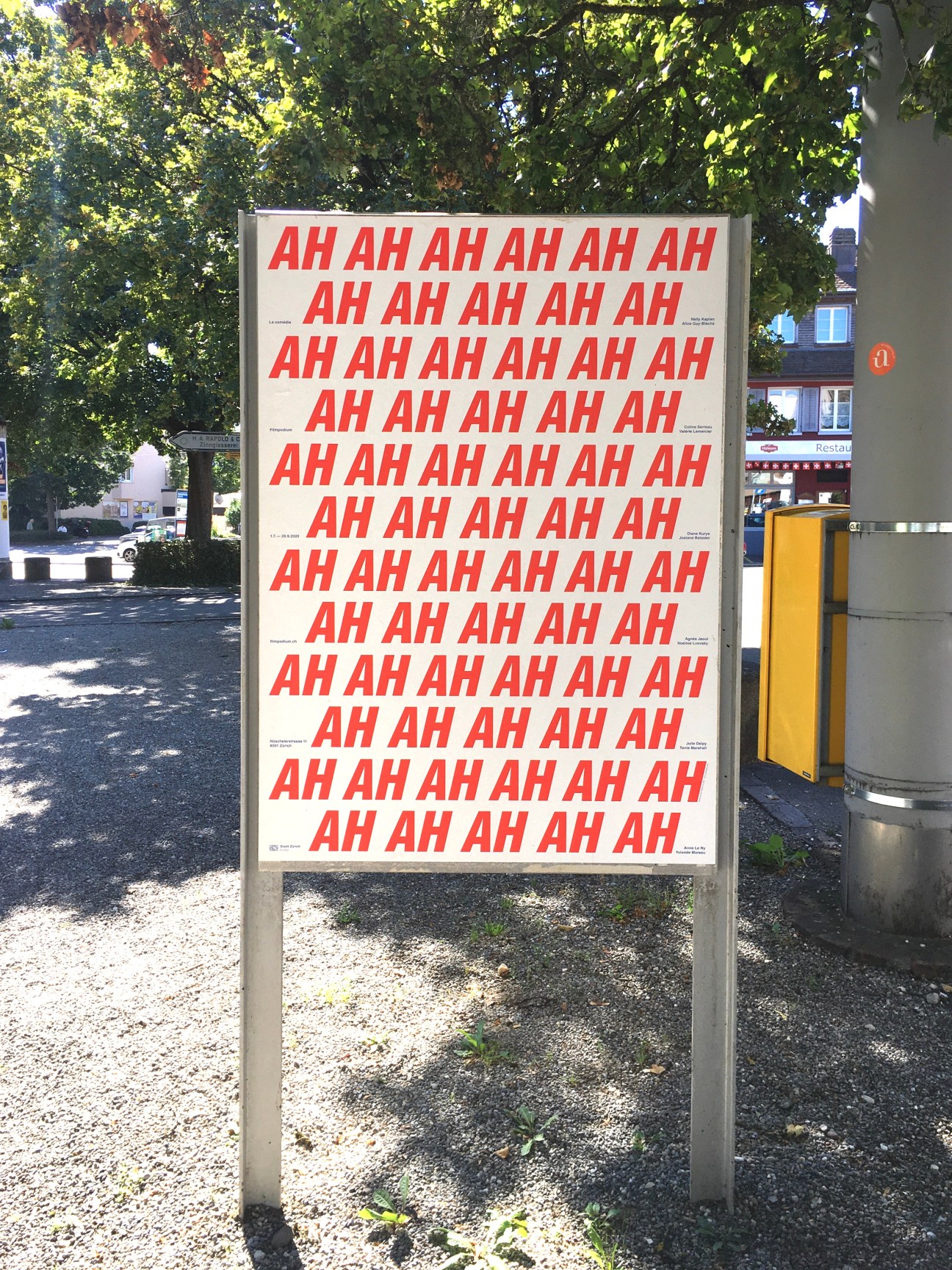
Designed for Filmpodium, an arthouse cinema in Zürich, this clever poster design was created by student Meret Mächler while she was studying at Zürich University of the Arts. Plastered with laughter, the striking design was used to draw attention to a French comedy-film festival.
Last year, works displayed on Zürich’s famous poster boards provided laughs – literally – thanks to a competition she won to promote a French comedy film festival through witty graphic design. In a cool orange, the text “ah ah” (apparently the French equivalent of “ha ha”) was repeated en masse across posters filling these billboards. It was a simple solution that quickly lightened the mood of passersby while drawing interest in what all this laughing text was promoting.
Mächler says that she is becoming more comfortable projecting a sense of humour – a trait that she values in herself – into her work. She also sees a bigger opportunity for her generation to design with jest at the core of its output. “Irony might be the phenomenon of my generation of designers,” she says. “At least, this is what I am experiencing among my peers. We are a little stuck visually. There is not much newness being created. There is a lot of sampling and remixing but there is nothing entirely fresh any more. The only thing that is left is comment. We are characterised by uncertainty due to various global crises and there is a general feeling of apathy that is reflected in contemporary graphic design,” she says. “We use irony to comment on our environment.” But she adds that this commentary is where the fun begins.
Alongside the rise of meme culture, she says that young designers are increasingly making fun of conventional design tropes, for example by using frowned-upon fonts such as Comic Sans. “That’s how we want to use type,” says Mächler. “We will use Comic Sans again because it is different and because it’s not ‘considered’.”
Loewe
M/M Paris, France
2021

As the pandemic forced fashion shows to cancel, brands turned to digital marketing and design to get their messages across. This print publication stood out for its wit and impeccable delivery, highlighting Loewe’s collection off the runway in an engaging manner.
News & Coffee
Tiago Majuelos, Spain
2020
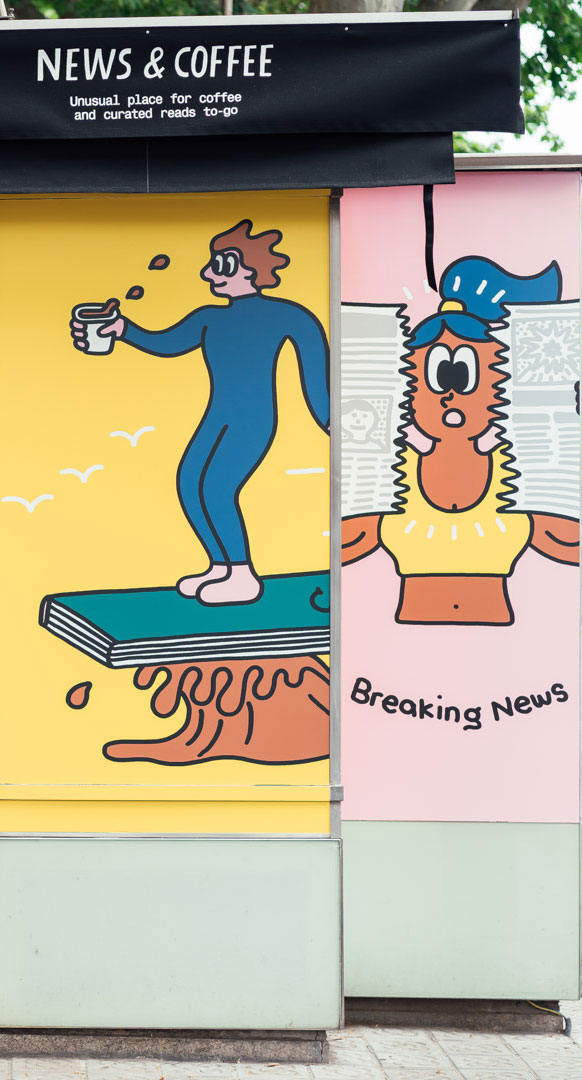
Illustration is a clever way to add humour to a message, a tactic deployed with panache by the team behind News & Coffee. Championing Spain’s creative industry, the company works with a different illustrator for every new kiosk that it opens. We’re particularly fond of the way they depict breaking news.
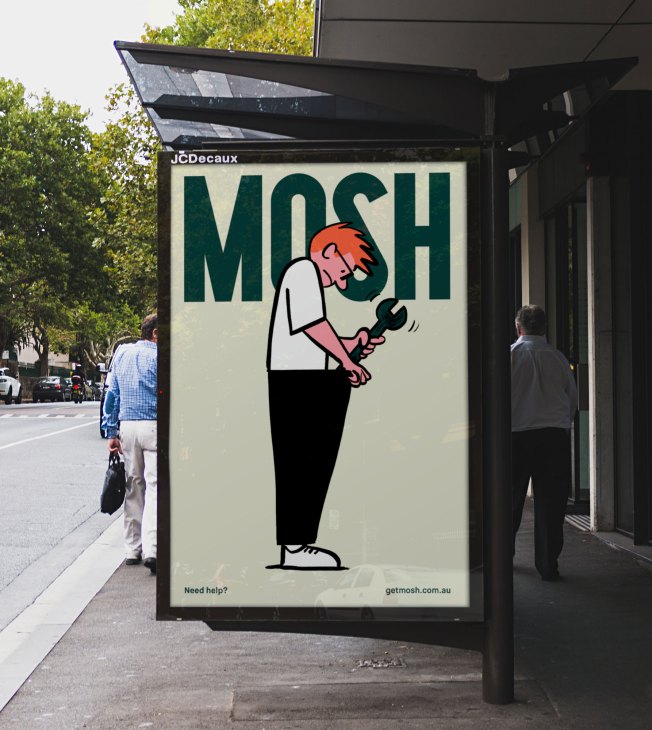
Mosh
Universal Favourite, Australia
2020
Oli Ozden, design director at Sydney studio Universal Favourite, says that Australian audiences are easier for designers to have a laugh with, due to the nation’s tendency to show affection by making fun of one another. But deploying comedy on a campaign about men’s health issues still requires sensitivity, which the firm employed deftly on this job.

Feeling a bit sunnier about the future of humour in the design industry, our journey winds to an end on the streets of Spain – in Barcelona, to be precise. This is where the News & Coffee newsstand franchise, founded by Pablo Pardo, has deployed amusing design to great effect. The business is a clever concept that has transformed run-down kiosks in the beachside city into coffee and magazine shops. To draw the attention of its target clientele, the team asked illustrators to create caricature versions of local characters from each of the neighbourhoods where it was launching kiosks to adorn the newsstands. While the results weren’t always flattering to their subjects, the work has ingratiated the new kiosks with residents.
“We took a risk with a bold, cheeky tone of voice but knew that as long as the drawings made people smile and not feel insulted, then it would work,” says Gautier Robial, News & Coffee’s bright managing director. “And it did. The people of the neighbourhood saw it as an homage to them. It empowered them and we thought, ‘Let’s just keep going’. We helped grow an entire franchise model across Spain using this funny tone of voice.”
Area of expertise
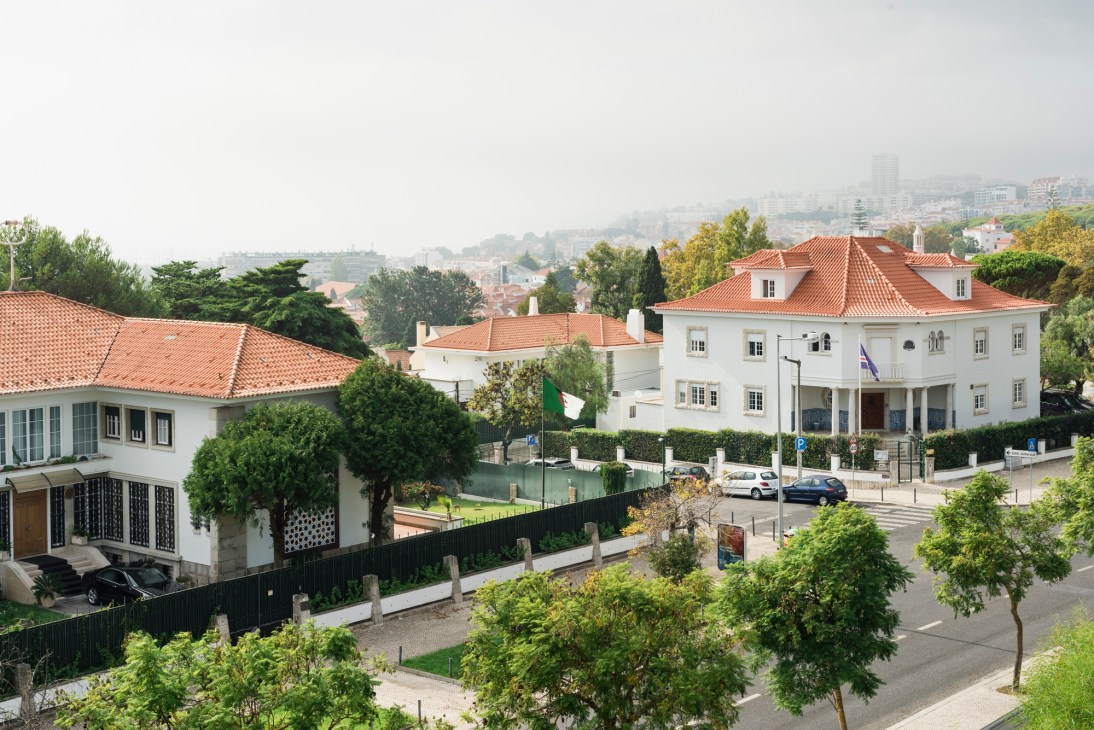
Lisbon’s hillside Restelo neighbourhood is hemmed in by Parque Florestal de Monsanto (an urban forest that’s nearly three times the size of New York’s Central Park), the river Tagus and the district of Belém. It’s a prime position that over the past 90 years has helped to entrench Restelo, a 15-minute drive from the heart of the city, as one of the Portuguese capital’s most desirable and liveable enclaves.
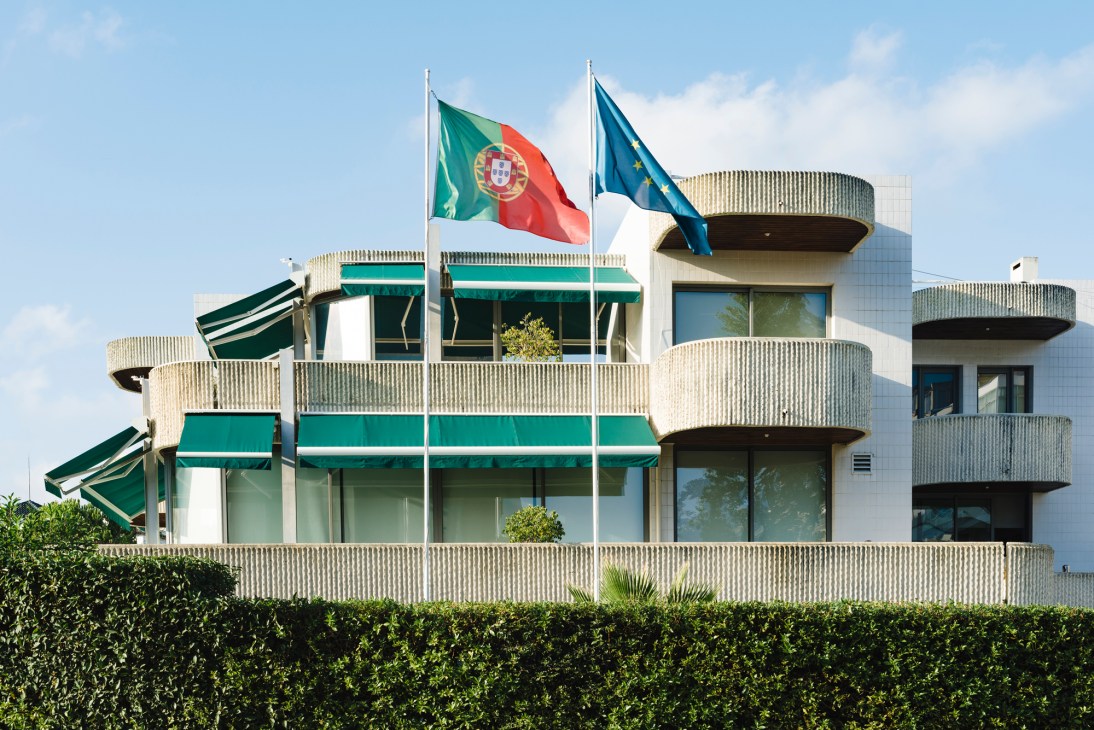
Far from being a happy accident, the neighbourhood’s development is the result of the grand vision of Duarte Pacheco. As Portugal’s minister for public works in 1932, Pacheco decided that Lisbon was too compact and needed to spread into surrounding farmland to give the city a sense of monumentality befitting its role as the capital of the Portuguese empire. To achieve this, he sent a young, unknown Portuguese architect, João Guilherme Faria da Costa, to Paris to study urban planning. The intention was that Faria da Costa, inspired by his continental studies, would be able to plan an innovative, world-class neighbourhood for 36,000 people upon his return. And that’s exactly what he did.
Drawing on the principles of the garden city movement, Faria da Costa laid out a suburb that would allow for villas with grand gardens and a network of verdant public spaces. It was an ambition best captured in the first stage of his plan, developed from 1938 to 1948, that used the area’s incline to make the river appear as a “stage” – Restelo’s streets make their way down the hillside, creating the effect of an amphitheatre.

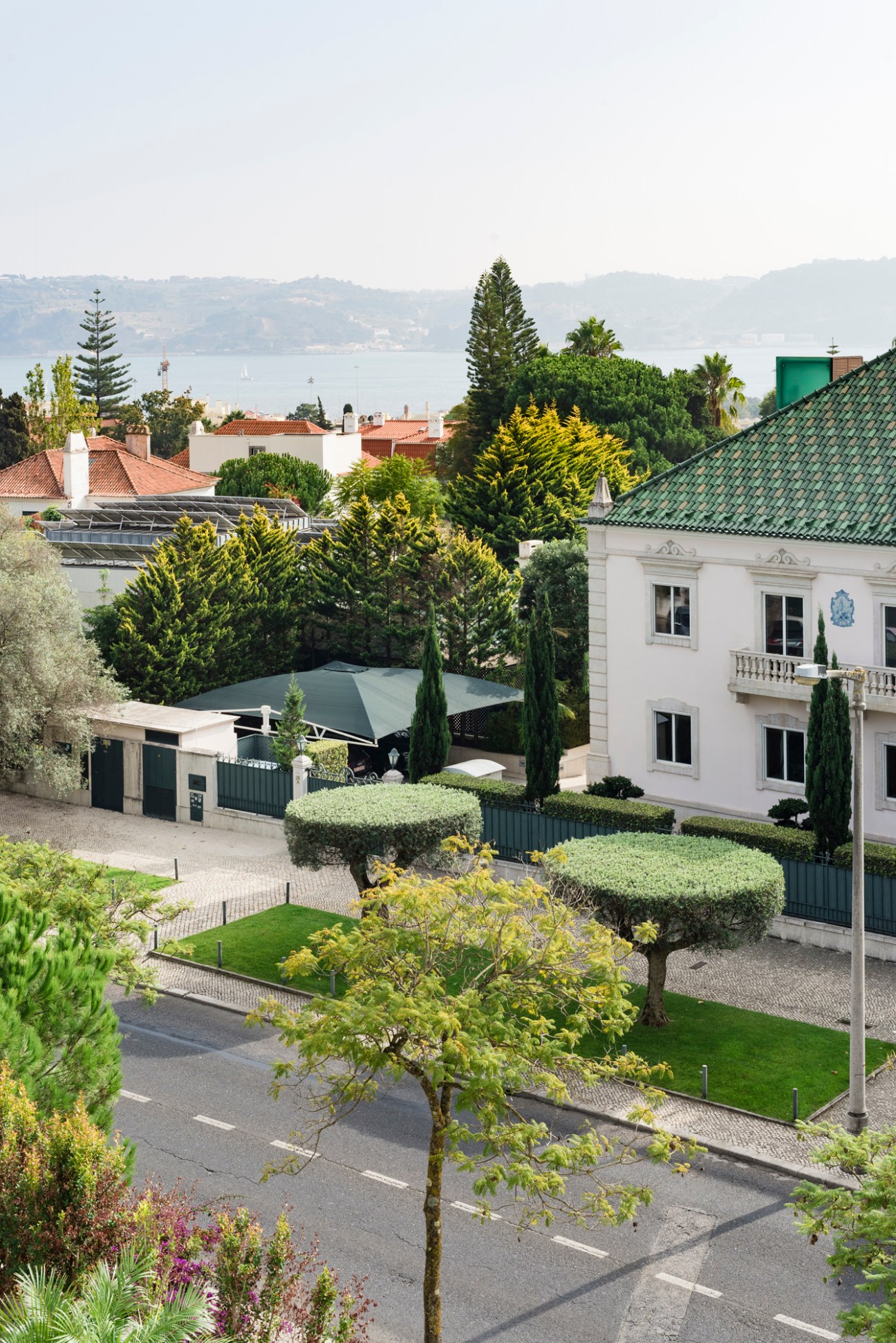
“The idea was to build single-family homes into the slope, surrounded by gardens, offering a nice view of the Tagus,” says Patrícia Bento d’Almeida, an architect and researcher at the University Institute of Lisbon. Her grandfather, Joaquim Bento d’Almeida, designed some 50 houses in the area. “It was a place for families who wanted to be near Lisbon but surrounded by fresh air, with a nice view and their own gardens,” she says.
The concept sold itself; by the late 1940s, lots in Restelo were going under the hammer at highly competitive auctions. And Faria da Costa’s urban plan attracted those who had equally visionary ideas about how they wanted to live. “The people who first moved here were those with financial resources, intellectuals, politicians, lawyers and artists,” says Bento D’Almeida, while driving us around the neighbourhood. “Some were open-minded enough to say to the architect, ‘Explore what a modern house can be.’”
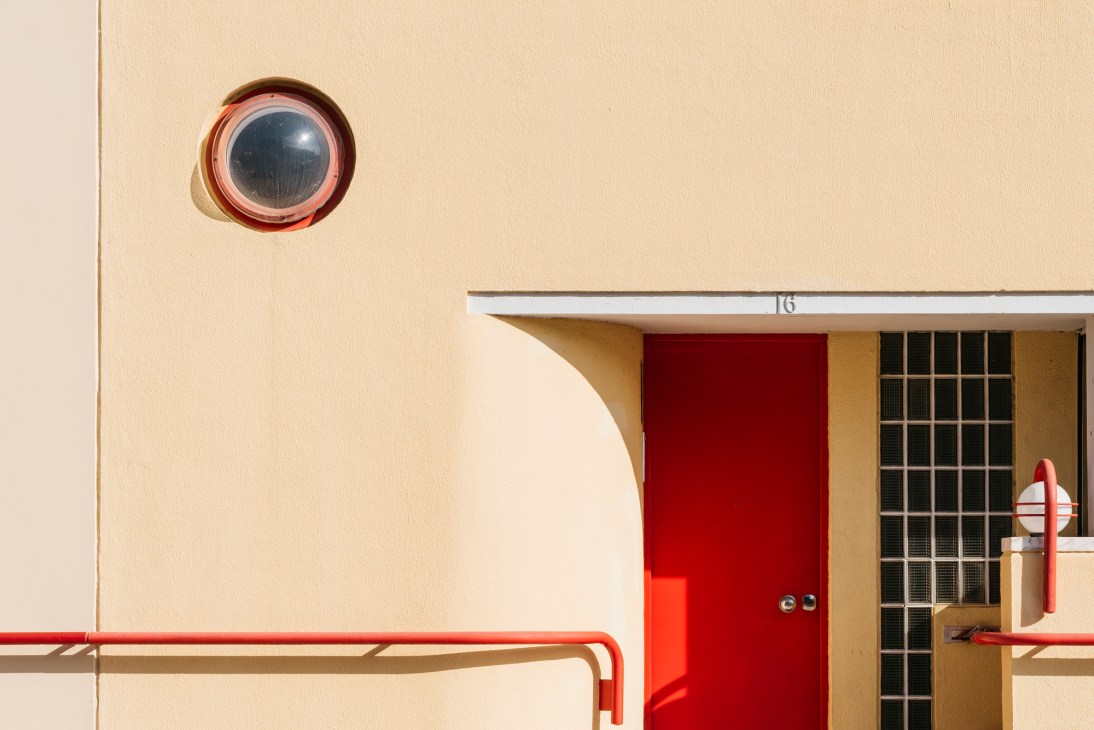
As a result, architects working in 1950s Restelo were given free rein to imbue the latest ideas into their structures. Homes were built to modernist ideals: horizontal lines, flat roofs and a clean aesthetic that embedded houses into the landscape, while large windows brought dramatic views of the gardens and river into houses. Portuguese crafts were incorporated into many projects too.
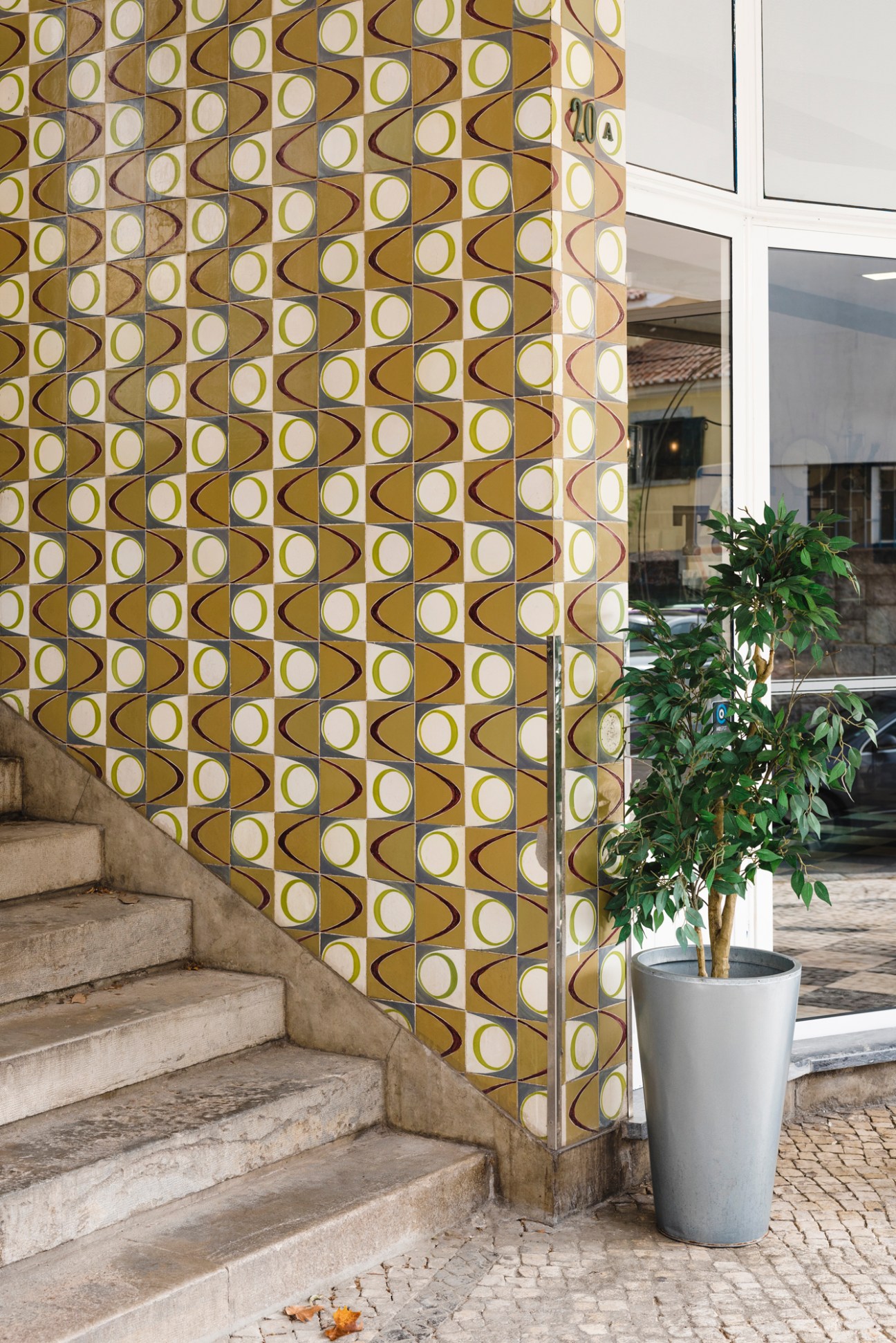
“Some of the architects worked with artists to create buildings where sculpture, paintings and ceramics were integrated into the architecture,” says Bento D’Almeida. For proof, she points to her grandfather’s work on Praça de Goa 6, developed in partnership with Victor Palla. Built for a naval officer, the home has a nautical theme with its gangway-style entry and tiles that are hand-painted with a wavy blue pattern. There’s also a rooftop garden inspired by Brazilian architecture. “Considering the Portuguese panorama of that time, they were really experimental and modern features for a house,” says D’Almeida, while surveying her grandfather’s handiwork from the street.
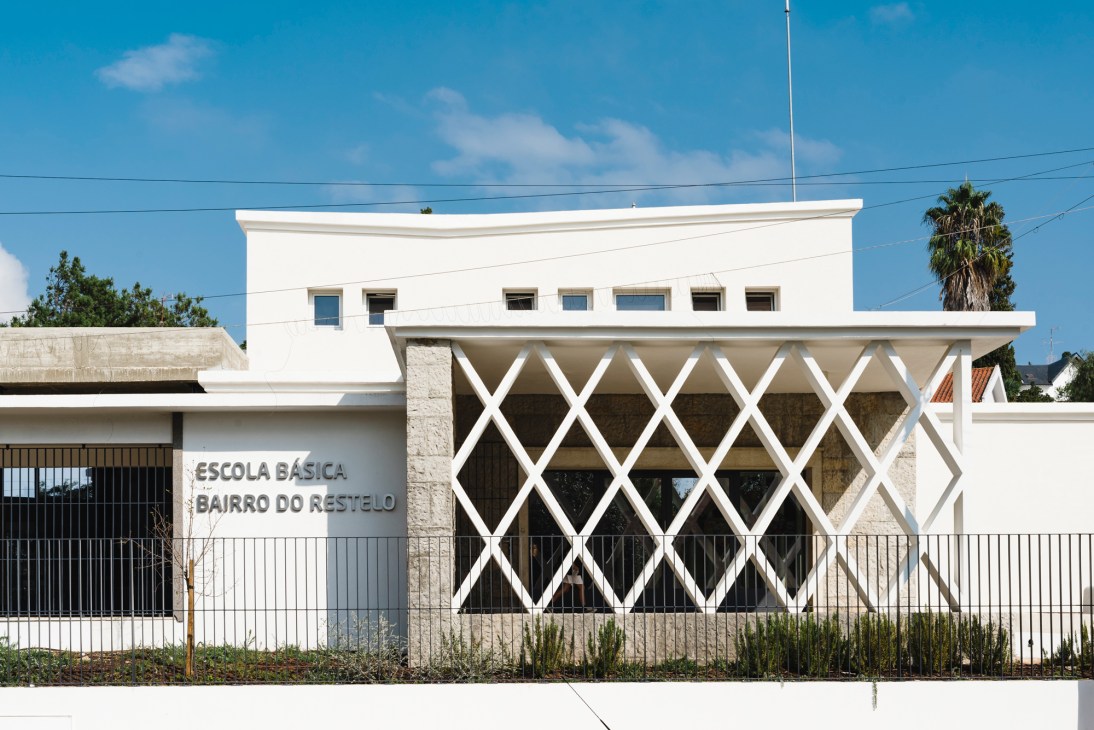
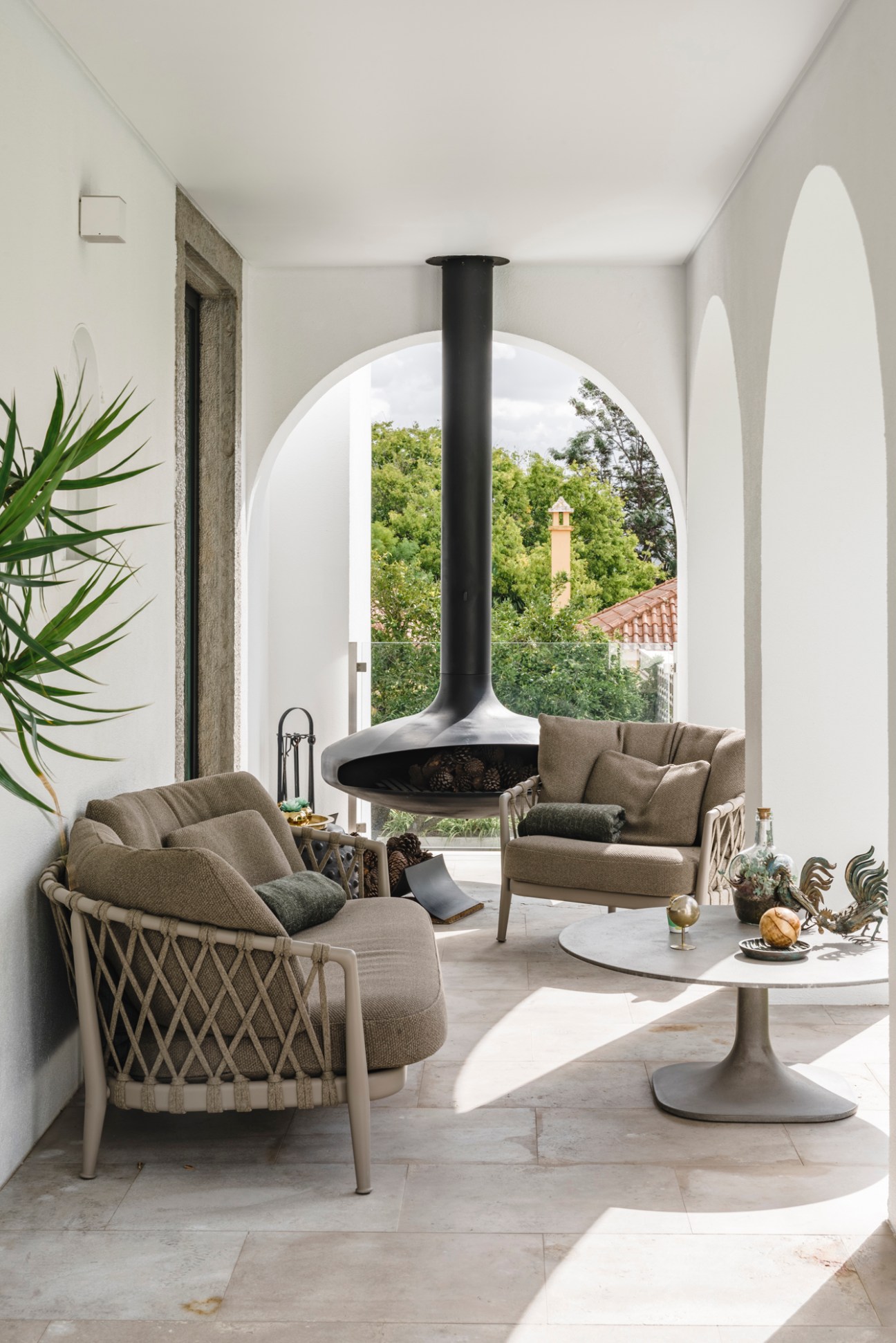
Today the building, like so many of the grand homes in the area, has been repurposed: Praça de Goa 6 is now a school, while other houses have become embassies and ambassadorial residences. And though these homes are significant, the neighbourhood also houses some important modernist commercial buildings.
Of note is Rua das Lojas, the first open-air shopping mall in Portugal, which features four buildings on a lush garden-lined street. Designed by Raul Chorão Ramalho and opened in 1954, its pilotis create the appearance of floating structures sitting above sunny terraces, onto which spill boutiques, cafés and pastry shops. These include Careca, home to Lisbon’s most famous croissant. The entry to every establishment is enhanced by bespoke hand-painted tiles.
“The design of Rua das Lojas is almost like heaven,” says António Costa Lima, one of a number of contemporary architects operating in Restelo and whose new work remains sensitive to the high ideals of the neighbourhood’s pioneering practitioners.
“Every time I have a project in Restelo, I try to maintain its image by emphasising the gardens and reflecting the pattern of the existing houses on the street,” says Costa Lima. His approach is embodied in projects such as Avenida do Restelo, a contemporary three-storey building, similar in scale to the original single-family homes in the area but housing three apartments.
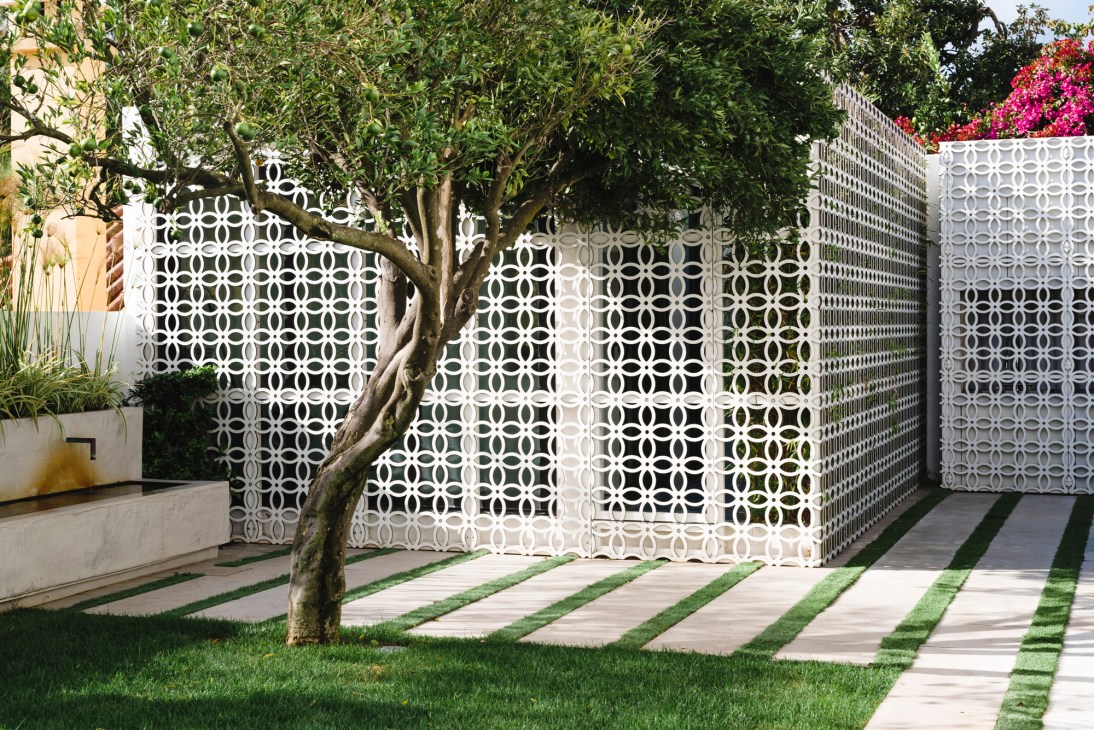
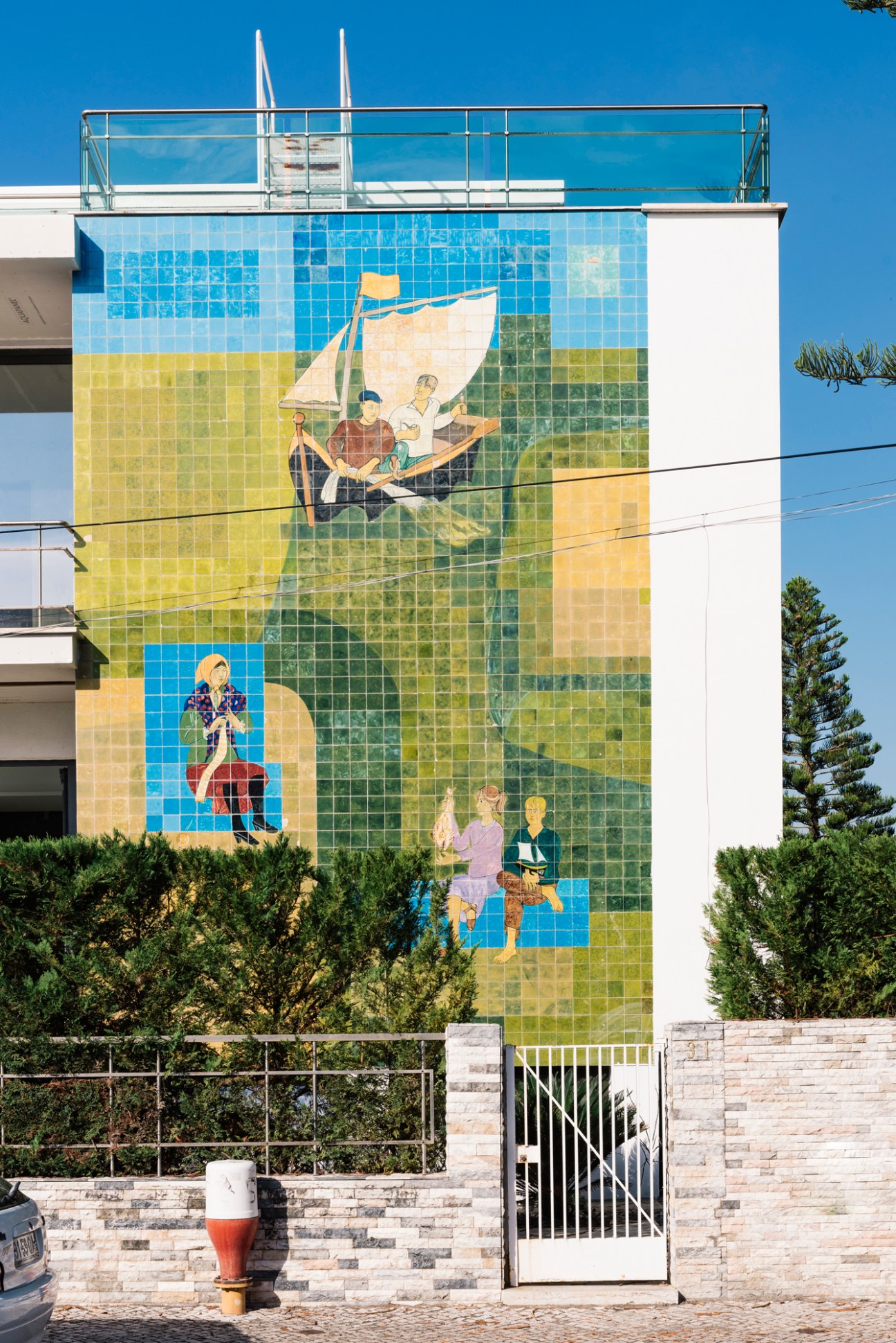
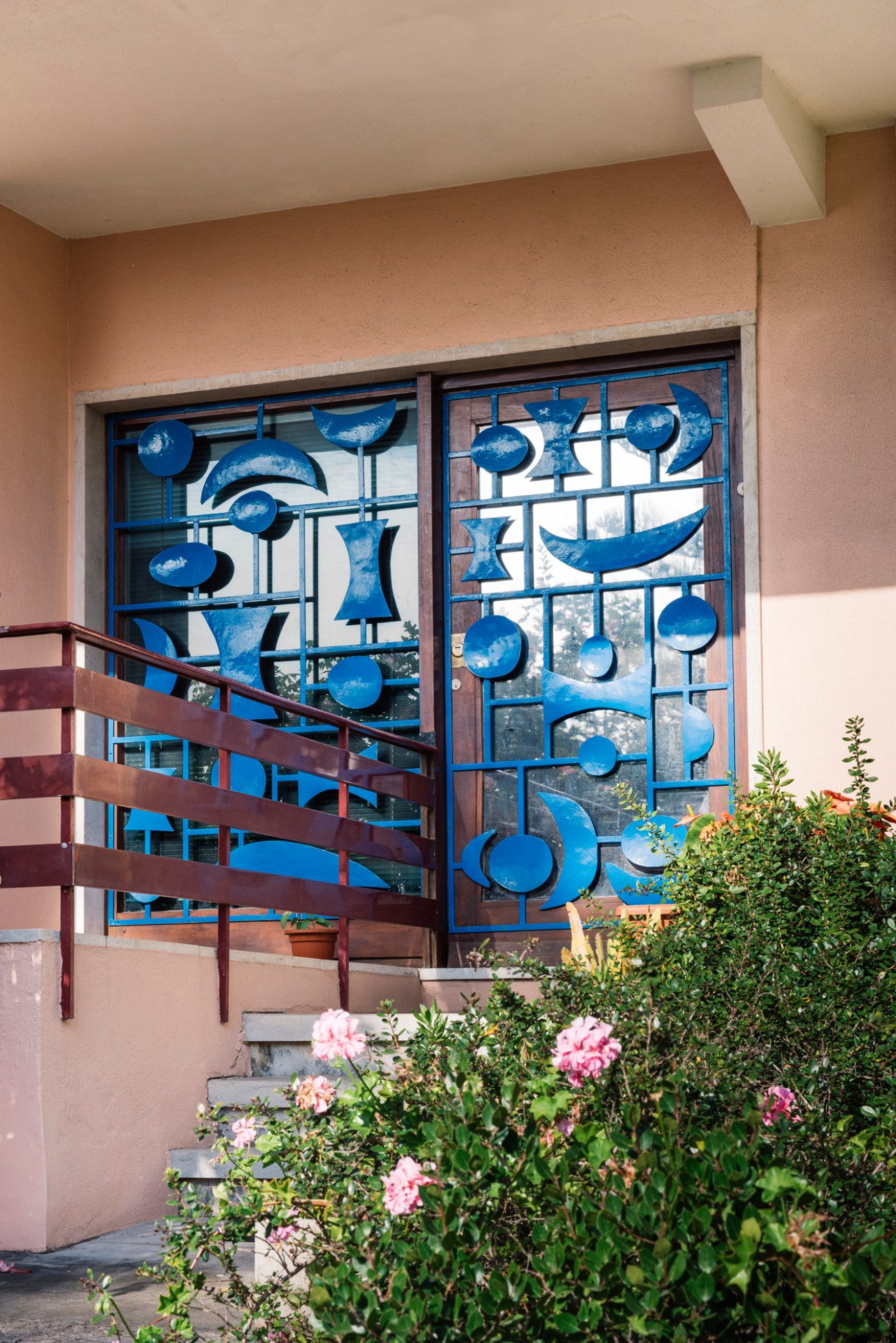
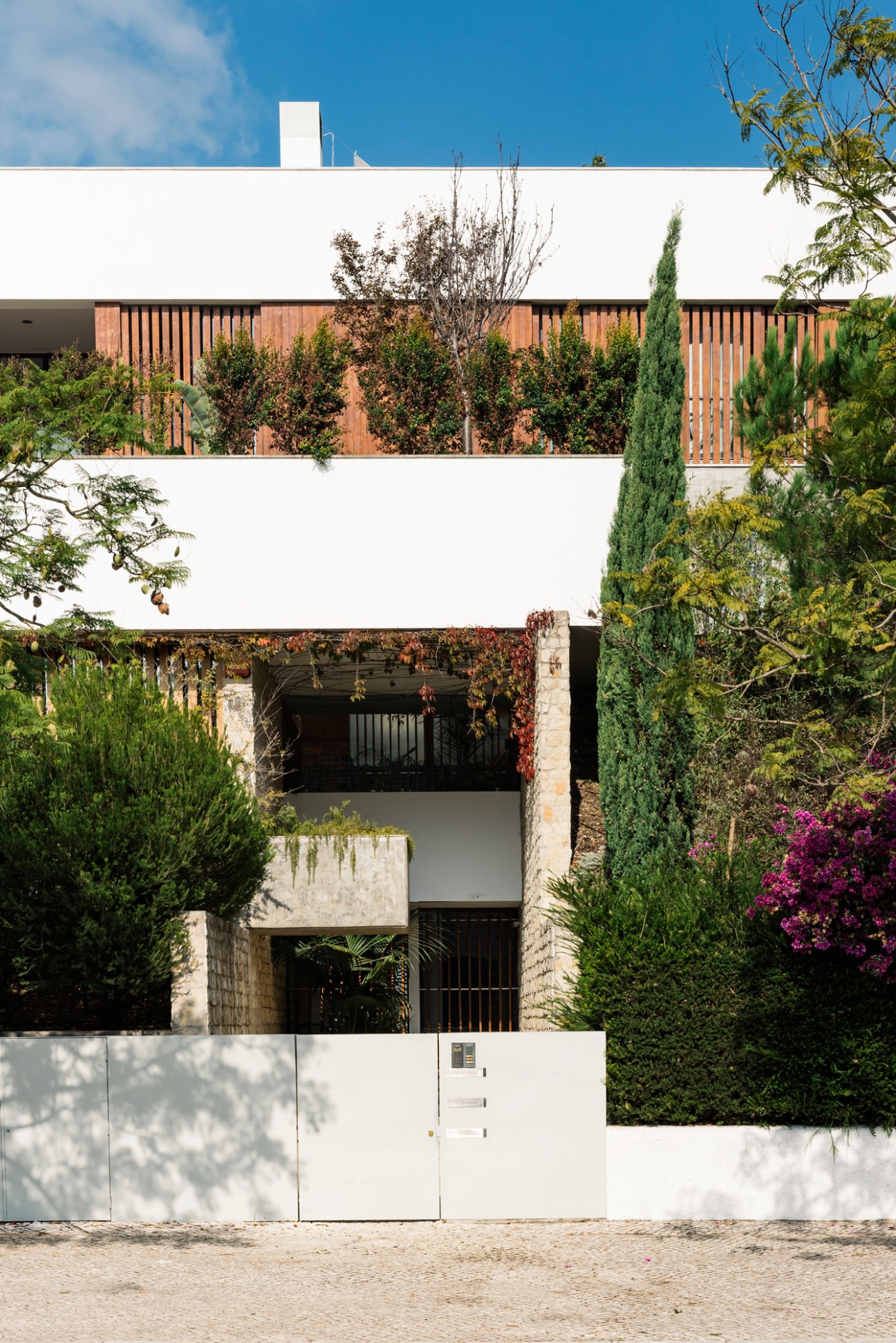
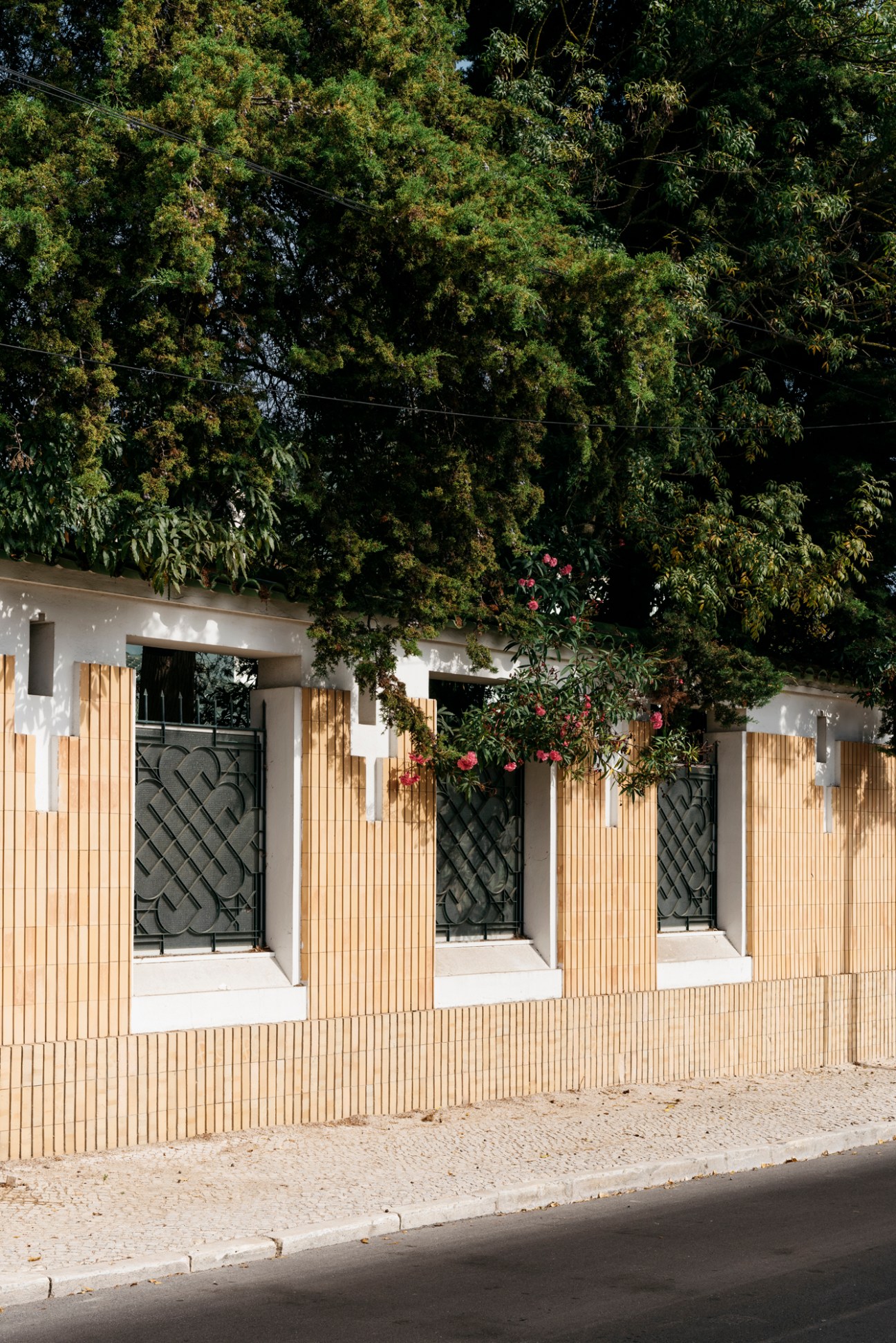
Here, the horizontal and vertical lines found throughout the neighbourhood’s 1950s housing stock are reflected in a series of concrete platforms, broken up by windows and timber screens. It’s a work that was, much like those of Costa Lima’s predecessors, made possible by clients who were open to modernist principles. The owners, Adelaide and Luis Castaño, say that the appeal of living in the area remains much the same as it must have done in the 1950s.
“We have the best of both worlds,” says Adelaide. “We are living in the city but in a neighbourhood that is peaceful, near the river and has plenty of gardens.”
Restelo is a reminder of what a good suburb could and should be. It’s a place where an urban plan complements the rhythms of the landscape it sits in, and whose residents are willing to commission architects to design bold, breathtaking homes and gardens.
Simple pleasures
Tatu lamp
André Ricard for Santa & Cole, Spain
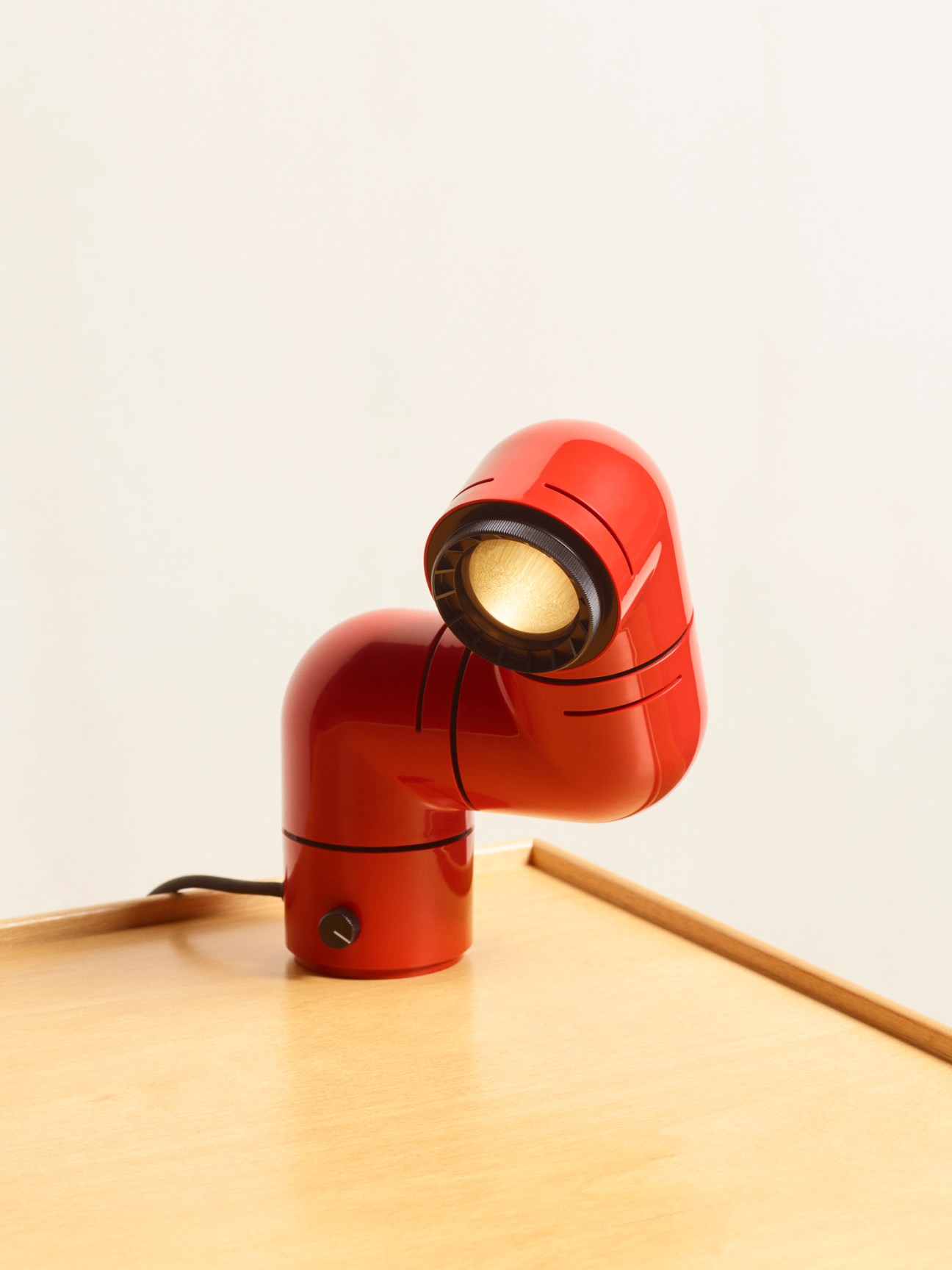
The Tatu lamp, introduced in 1972, consists of three sections that rotate, making it easy to direct the light as needed. The nifty design, which makes bedside reading a breeze, is also adorably cute. Its name is taken from a Latin-American term for the shell-backed armadillo. Updated by Santa & Cole, it’s now possible to adjust the brightness and width of the lamp’s beam.
santacole.com
Middleweight sofa
Michael Anastassiades for Karakter, Denmark
The first upholstered furniture collection by industrial designer Michael Anastassiades, the Middleweight is an elegant sofa series that includes this two-seater, which is light in form and sturdy on its feet. Set on a slender steel frame, its plump, luxurious cushions call out for long hours of lounging. There is also an armchair, three-seater and pouf to complete the collection.
karakter-copenhagen.com

Aalto tea trolley 901 anniversary edition
Artek, Finland
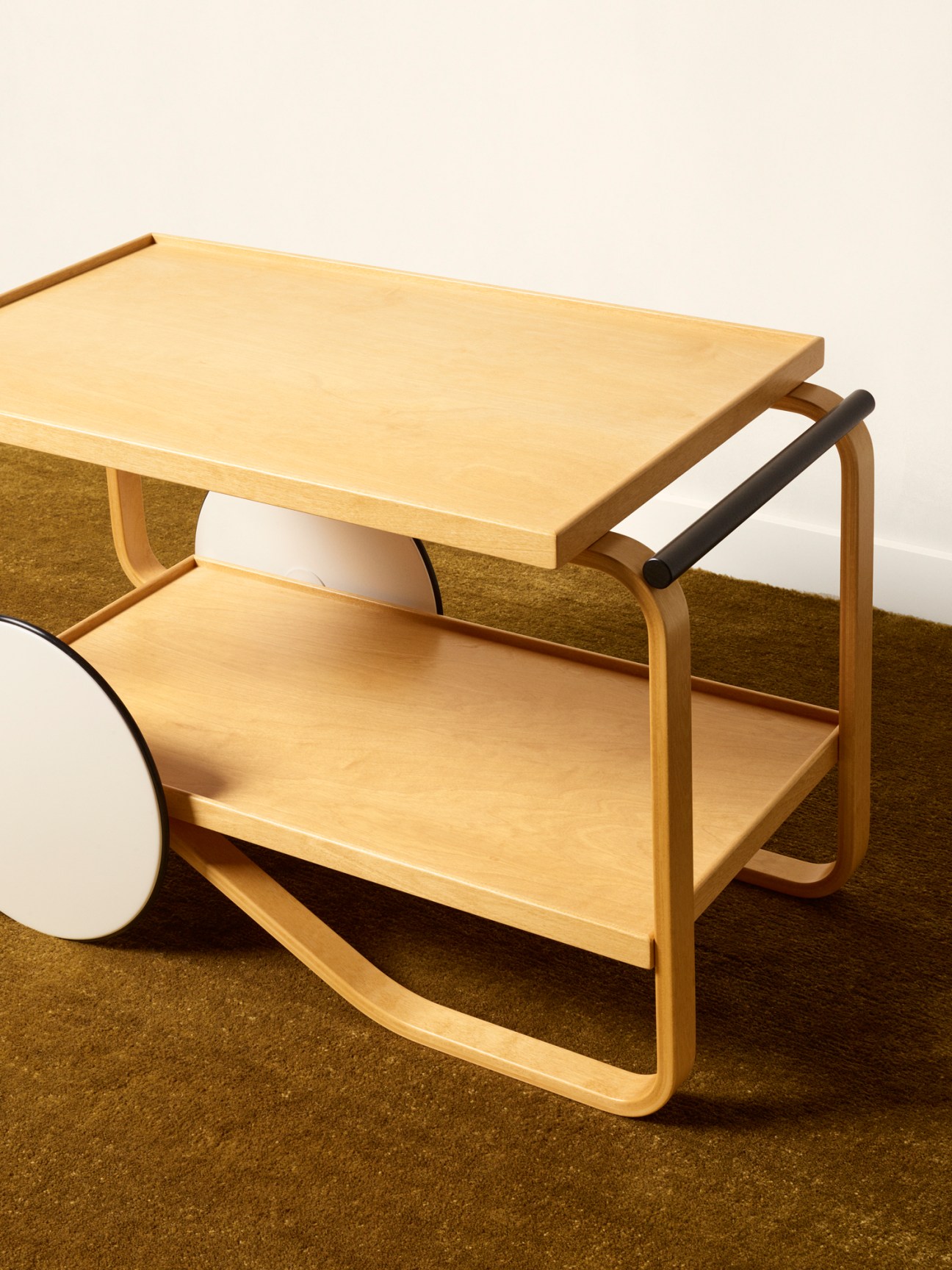
To mark its 25th anniversary, London design shop Twentytwentyone asked Finnish furniture firm Artek to revive an early version of Alvar Aalto’s 1936 tea trolley, which was originally inspired by British tea culture. This graceful reissue is made from natural birch and finished with a honey-hued lacquer. Its lightweight wheels allow for ease of movement.
artek.fi
Alter mirror
Industrial Facility for Vaarnii, Finland
Vaarnii celebrates natural materials and craftsmanship. Designed by Industrial Facility’s Sam Hecht and Kim Colin, the Alter mirror has an angled frame made from Finnish pinewood and copper-tinted glass.
vaarnii.com

10 Years Later collection
SCP for Ishinomaki Laboratory, UK
London furniture-maker and retailer SCP collaborated with Japan’s Ishinomaki Laboratory last year to mark a decade since the Tohoku earthquake. They commissioned British designers to create various pieces for the home using a limited material palette of timber, cut to standard sizes; outstanding examples include this pair of sculptural side tables, I and O, made from western red cedar by Livia Lauber, and a classic bench designed by Matthew Hilton.
scp.co.uk

Loop table
Barber Osgerby for Isokon Plus, UK
The beauty of the birch-veneer Loop table, one of the first designs by London duo Edward Barber and Jay Osgerby, is in its simplicity: storage space is formed by a loop and split by two panels that double as legs. Produced in London by Isokon Plus, this special edition, which marks the table’s 25th anniversary, comes in a shade of blue that references the designers’ original drawings.
barberosgerby.com

T1 stackable chair
Maruni, Japan
The stackable chair is a new addition to Jasper Morrison’s T1 line for Japanese manufacturer Maruni. Featuring an elegant seat and curved backrest that contrasts with thin metal legs, the chair, which comes in solid maple, oak or ash, smartly marries utility with deft design.
maruni.com

Performance bonus
Ace up the sleeve
Palmes, Denmark
Danish menswear brand Palmes aims to fill wardrobes with sharp, sporty clothes and democratise tennis. As a teenager, founder Nikolaj Hansson was a skateboarder who found the middle-class world of tennis, with its Wimbledon whites and country-club image, unapproachable. “I never felt that tennis could be for me,” says Hansson, who worked in various creative roles at top Danish design and fashion brands before launching his label last year. “I had this preconceived notion of tennis being elitist and exclusive but then I started playing and fell in love with it,” he says. “I wanted to pass this feeling on to more people. Tennis can and should be for everyone.” As well as being a vehicle for meaningful exercise, the sport was a great way for Hansson to socialise. This combination fuelled his desire to create a menswear brand that reflected both sport and urban living.
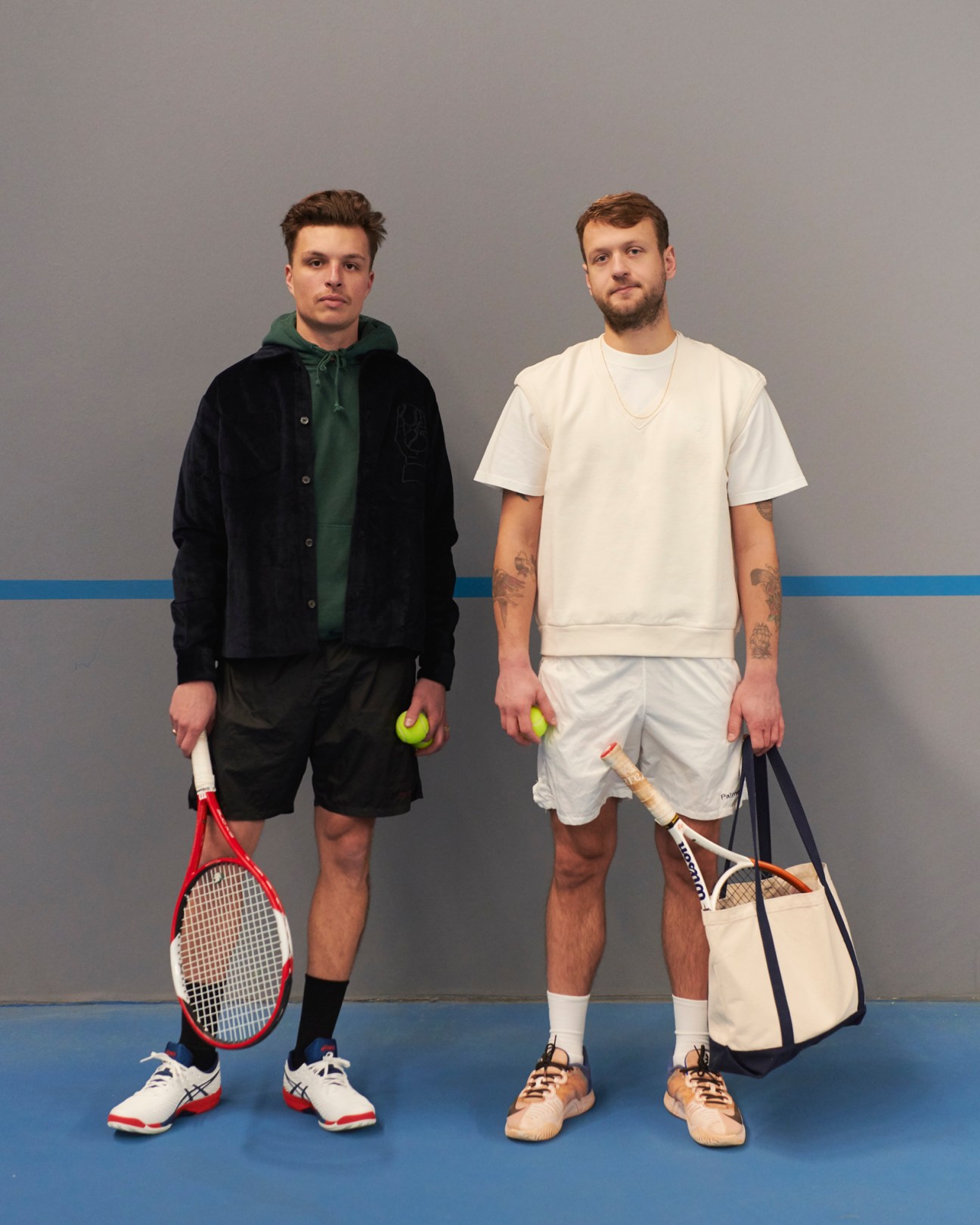
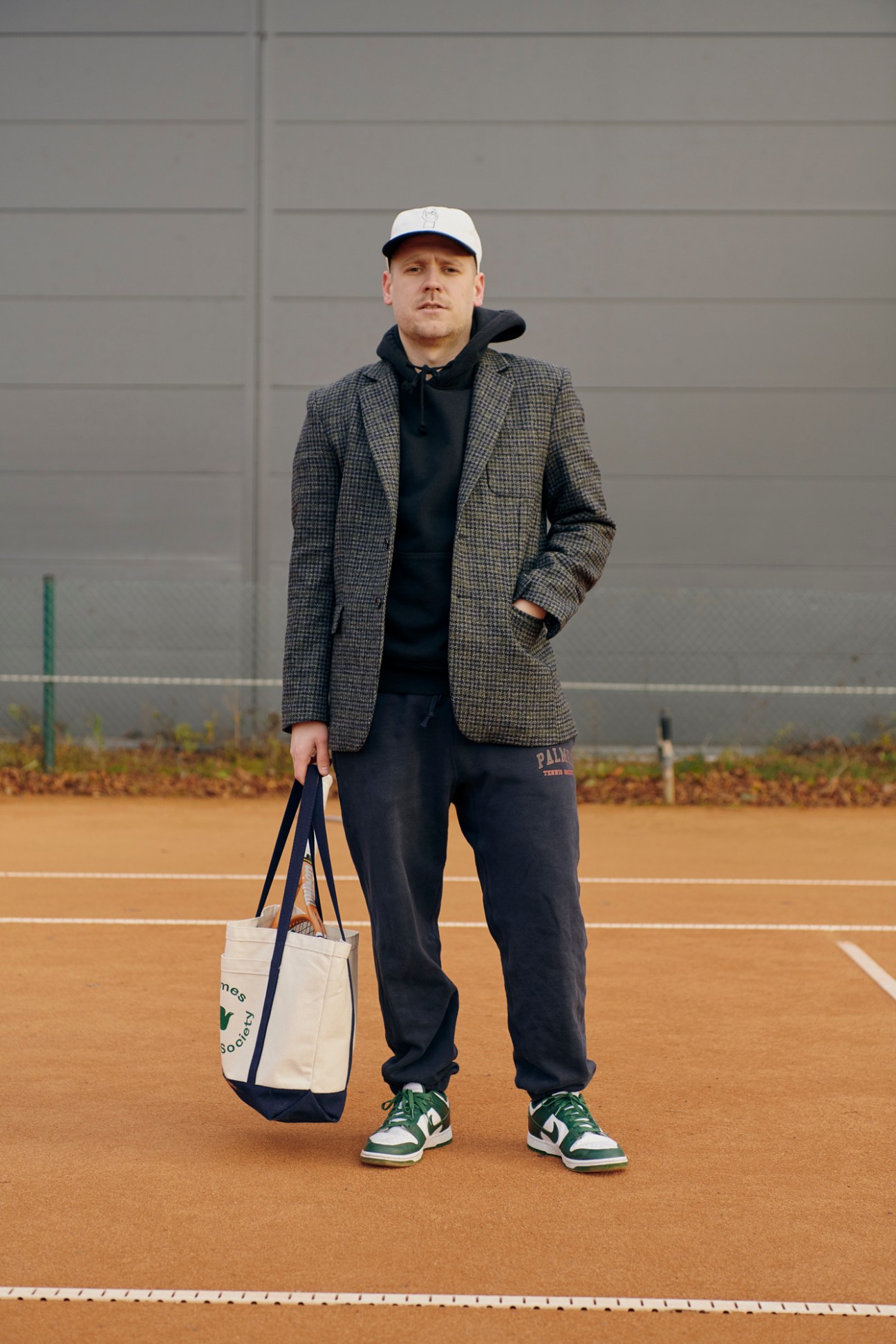
Palmes now offers a refreshing alternative to the heritage tennis brands with their clubhouse logos and popped collars. Its clothes are designed to work both on and off the court. Its shorts, for example, have pockets that are big enough to hold three tennis balls or a mobile phone and a bunch of keys for an after-match bar hop. Prints and logos are more egalitarian- collegiate than public school too. “We came up with the name Palmes Tennis Society, which appears on sweats and T-shirts, to deliberately avoid using the word ‘club’,” he says. “A club requires membership, whereas ‘society’ evokes a sense of belonging.”
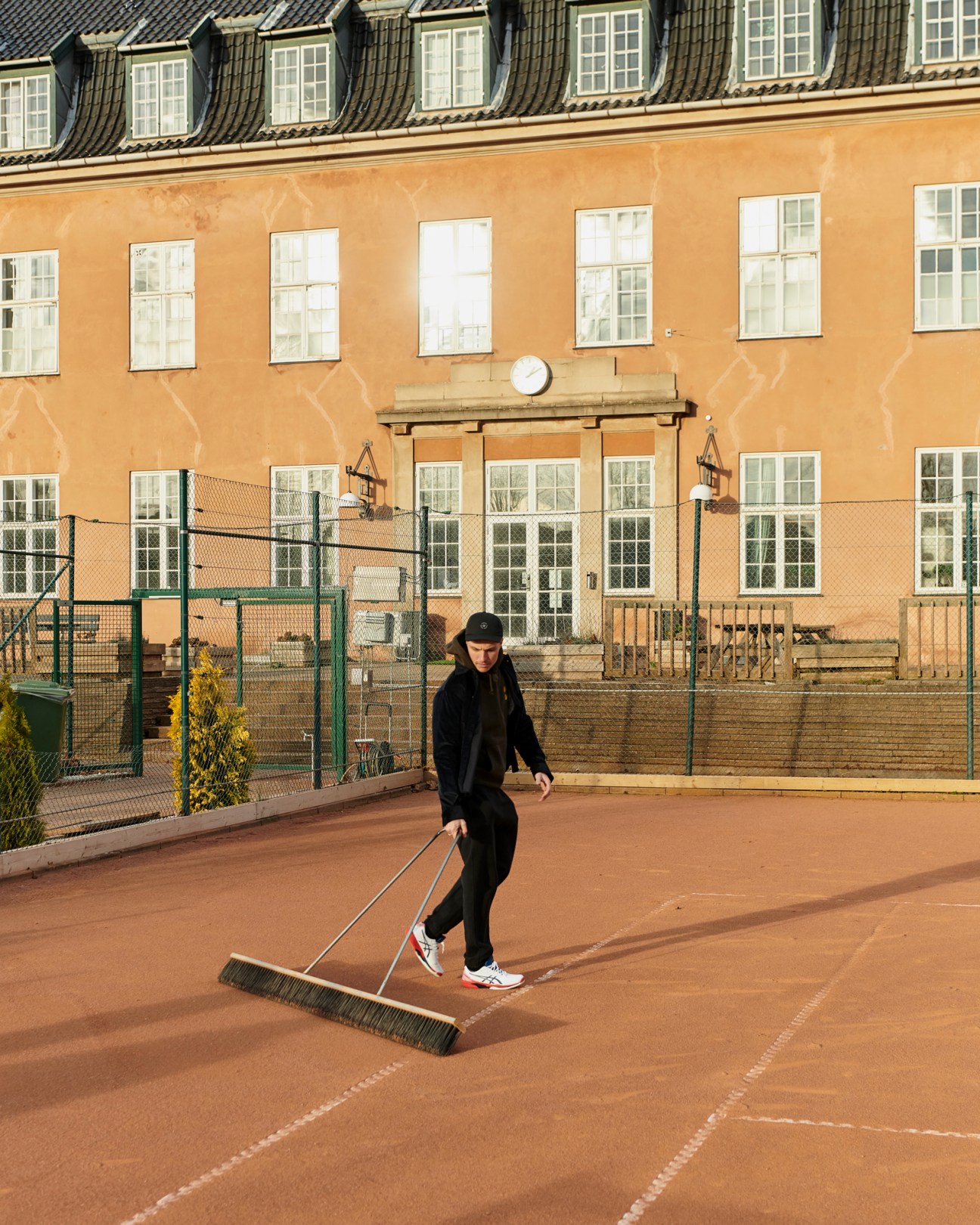
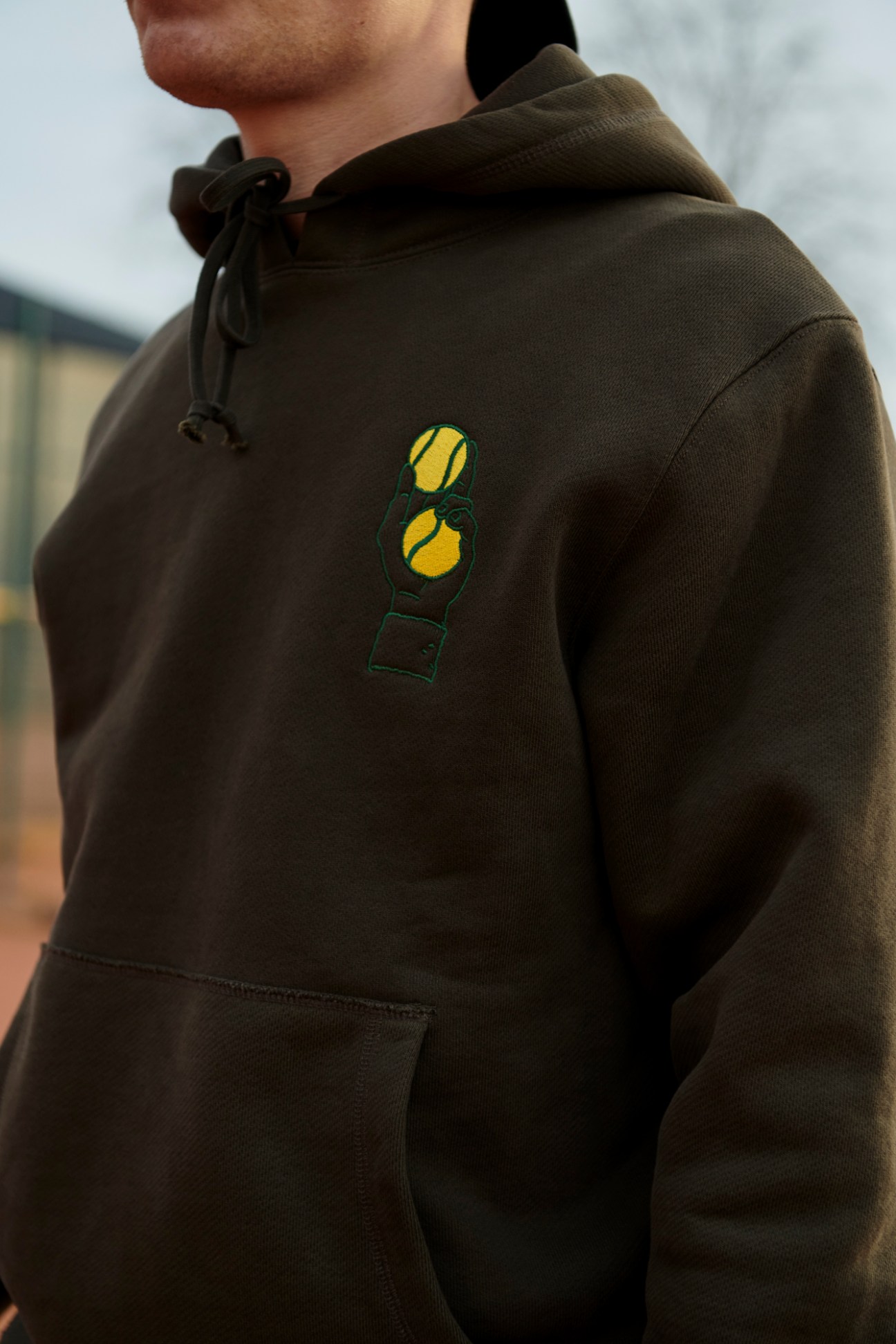
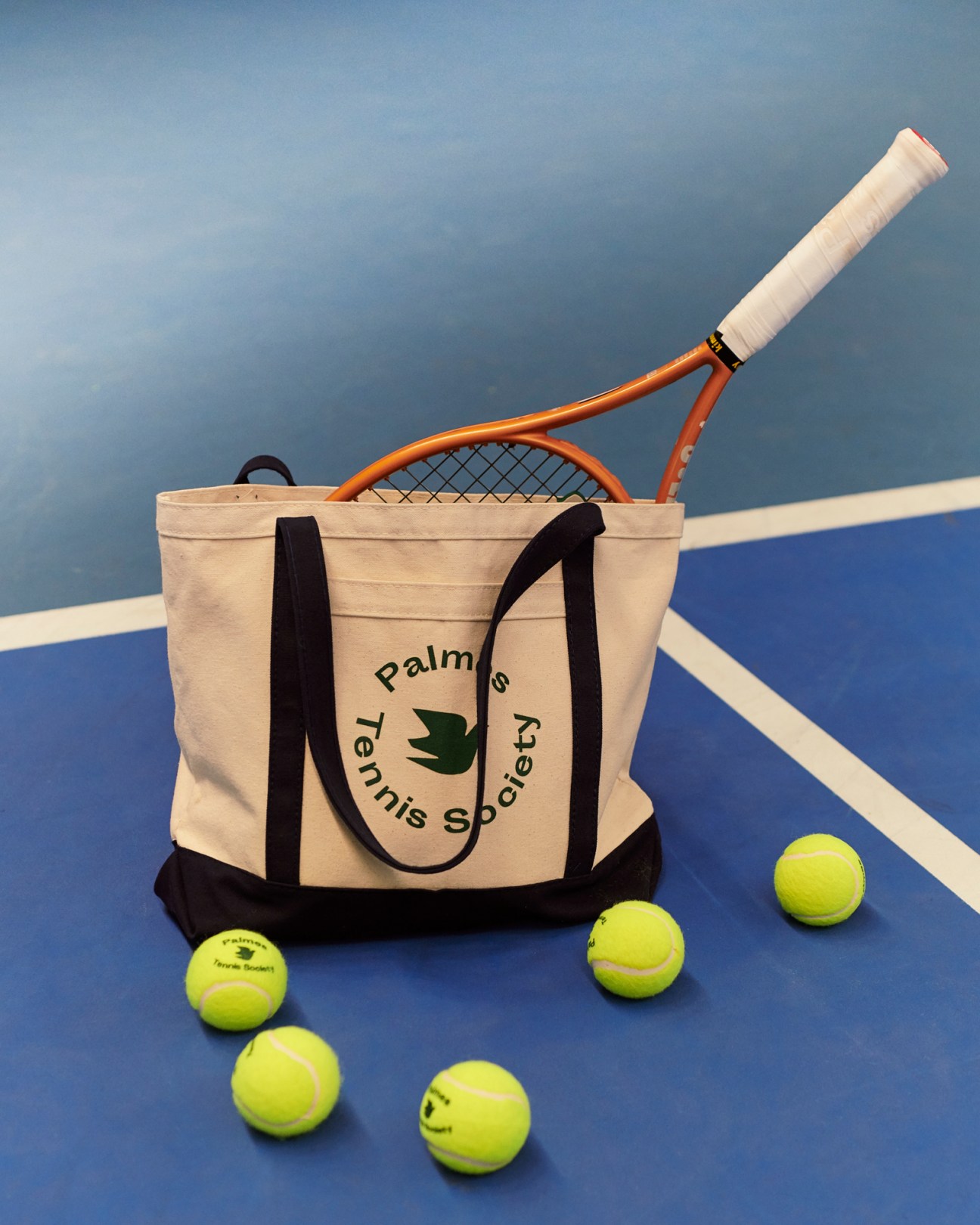
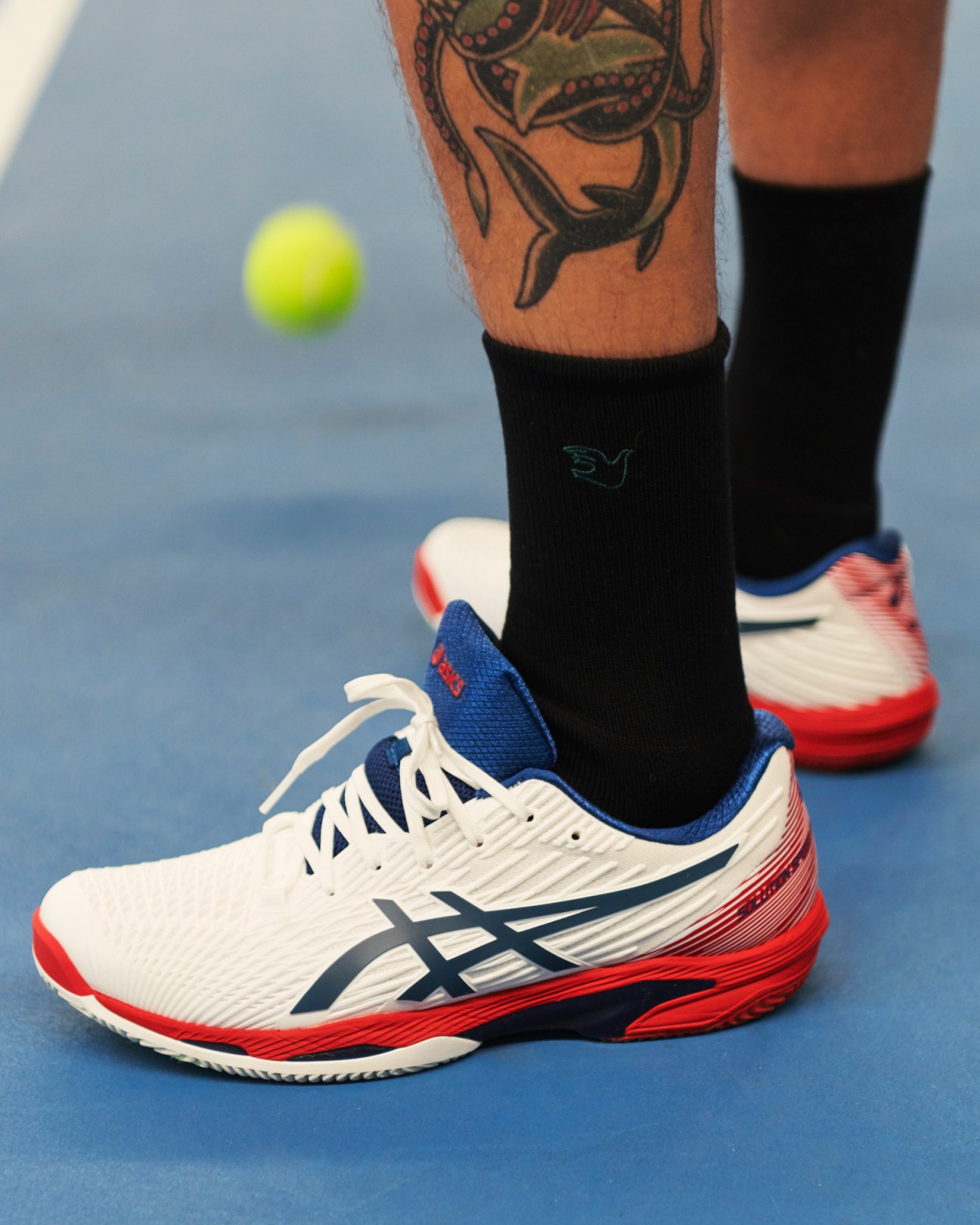
The same determination to bring a streetwise attitude to the sport is found in the label’s marketing strategy. Hansson eschews the usual model of sponsorship of professional players. “We admire them to the skies and love watching their matches,” he says. “But Palmes is about making tennis for everyone.”
The brand’s offerings now go beyond tennis wear and include pieces such as a chequered British-wool sports coat and a hooped rugby shirt inspired by the one donned by Kirsten Dunst in the film Wimbledon. Hansson wants to see these clothes being worn by creatives. “It might be people who excel within the fields of art, design, architecture or food; people who genuinely have fun playing the game of tennis,” he says. And though it remains to be seen whether we will see tennis lawns replacing basketball courts on downtown street corners, success has been immediate for Palmes. A year in, its global stockists include Browns in London, Kasina in Seoul and Kapok in Hong Kong.
palmes.co
Five steps to success
Global
Making it in the world of sportswear and performance clothing isn’t easy but these tips from players at the top of their game should help rookie brands to get off on the right foot.
1.
Collaborate correctly
In 2019 a small UK-based sportswear brand called Castore did the seemingly impossible for a relatively new business: its offering caught the eye of top tennis player Andy Murray, who became a brand ambassador. Not only did Murray wear Castore on the court but he also became a shareholder, helping to accelerate the company’s growth.
2.
Form a community
Rapha Performance Roadwear is known as much for its cycling gear as it is for the worldwide community it has fostered. The Rapha tribe came together thanks to the brand’s Rapha Cycling Club app that helps like-minded cyclists collectively organise events, rides and clubs.
3.
Celebrate your heritage
Founded as a small family business in the Austrian town of Kitzbühel, Frauenschuh is today a global skiwear and fashion company that continues to reflect its Alpine roots in its marketing, production and company spirit.
4.
Practise what you preach
Specialising in outdoor performance clothing, Patagonia has become a benchmark for brands across the fashion industry because of its sustainability policies and social awareness. Importantly, 87 per cent of the company’s clothing lines use recycled materials.
5.
Invest in smart storytelling
Australian-based cycling brand Attaquer (“attack” in French) has worked hard to shake up how sports firms advertise their products. By featuring inspiring stories on its website about its brand ambassadors – such US para-cyclist Hannah Raymond – Attaquer appeals to a diverse range of customers.
Worth its weight
Omorpho, USA
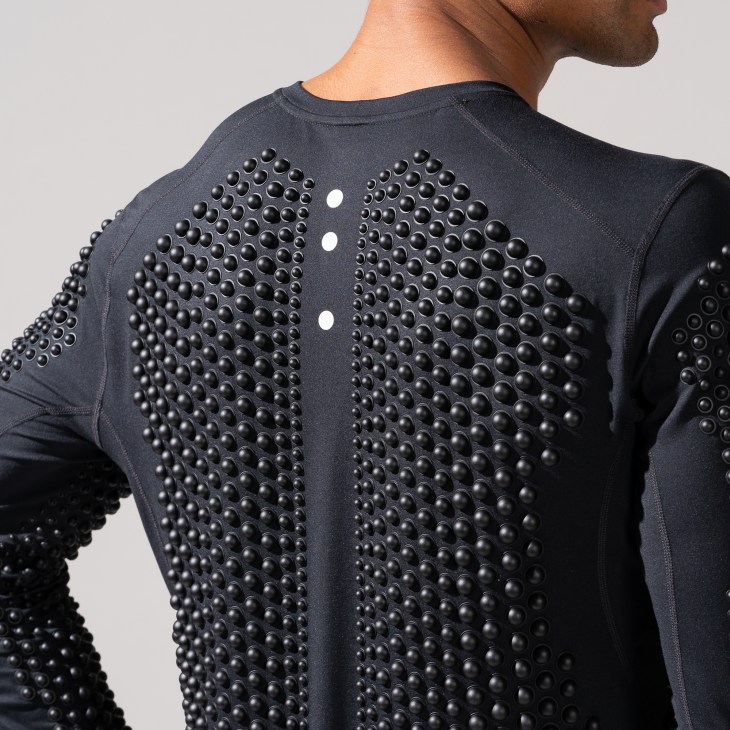
Brought to market by former executives of Nike and ad agency tbwa, Omorpho is challenging the notion that it takes lighter sportswear to boost physical training. Co-founder Stefan Olander and his team of 17 launched the Portland-based brand in late 2021, merging scientific research and design innovation. Omorpho’s sportswear incorporates strategically distributed spherical weights across the garments to make training a touch tougher.
“Though weighted sportswear had been in circulation, no one had figured out how to do it elegantly without placing too much load in one area of the body,” says Olander. He adds that products such as weighted vests had been used to help athletes boost their vertical leap or improve their acceleration but the options were ugly and had many limitations. Omorpho’s offering, which binds much better to the body, has the appearance of activewear but is laden with bubble-like weights that distribute the load evenly and maximise a user’s range of motion.
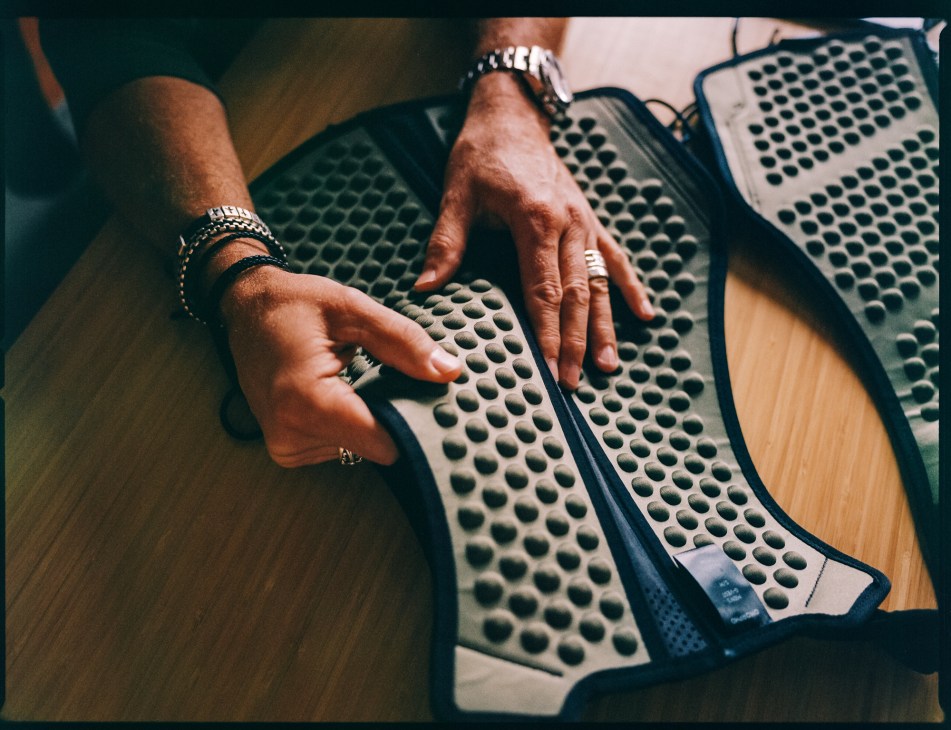
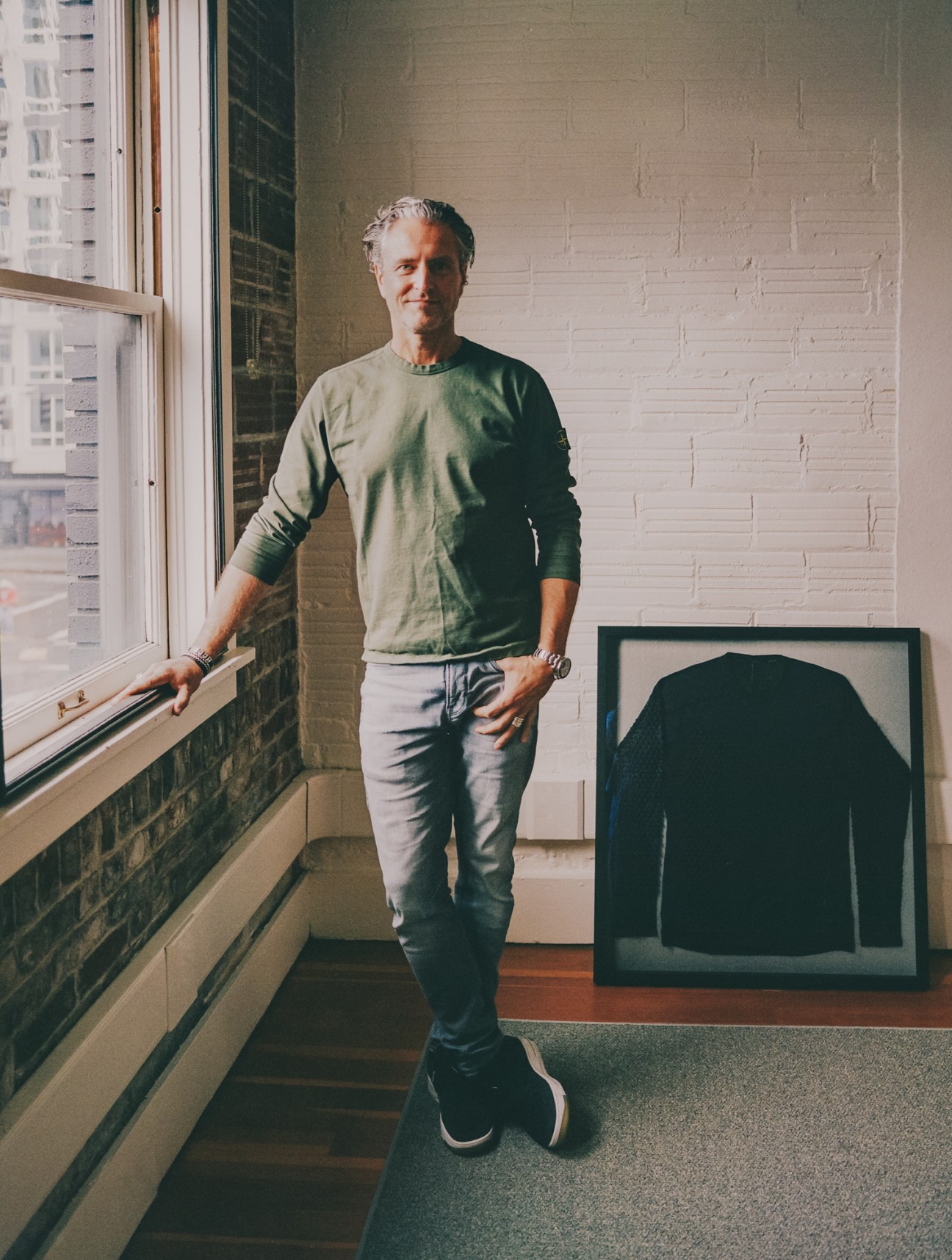
To create clothing that offers this flexibility, with a sporty sense of style to boot, Olander and business partner Ben Williams enlisted designer Natalie Candrian. “Designing a product on paper is one thing but to actually create it requires entirely different skills,” says Candrian, whose CV includes working alongside tennis star Maria Sharapova to develop Nike clothing. “When Stefan asked me to make a functional but beautiful prototype, I told him we could do it but we would create 10 ugly ones first.”
Candrian and scientist Erin Feser undertook a production process involving meticulous testing and athletic research. The resulting clothing will clearly benefit athletes but it was also created with more ordinary consumers in mind. The items are constructed with premium performance fabrics that provide comfort and elasticity while allowing for maximum range of motion. “The way that I approach designing sportswear is that form always follows function,” says Candrian, showing monocle the brand’s 12 products, which include a pair of sleek undershorts adding 500g of weight and a 900g long-sleeved top that is suitable for tennis players, boxers and yogis alike. “The garment has to move in harmony with the body while in motion.”
One of the key lessons in developing Omorpho’s products was that wearers didn’t need to add a huge amount of weight to enhance their performance. “Weighted sportswear is usually heavy and bulky but we discovered that you can get significant benefits by adding just 1 to 5 per cent of body weight,” says Feser, who helped the team coin and patent the term Microload, the concept behind the clothing. “Microload is a way of doing resistance training differently. We ensured that the body would carry the weights correctly and we dispersed them in specific patterns to follow large muscle groups,” she says.
Olander adds that his team’s combined years of industry experience mean that Omorpho has avoided many of the hurdles that nascent sportswear brands face. “We’re not just a start-up that had a wild idea and tried to figure it out,” he says. After finalising a $5m (€4.4m) round of early funding, Olander used the capital to build inventory, create a digital sales platform and add staff. “That we were able to raise a large amount in our seed round is a testament to the fact that this is a powerful idea,” he says.
omorpho.fit
Affirmative action
Hanken, Portugal
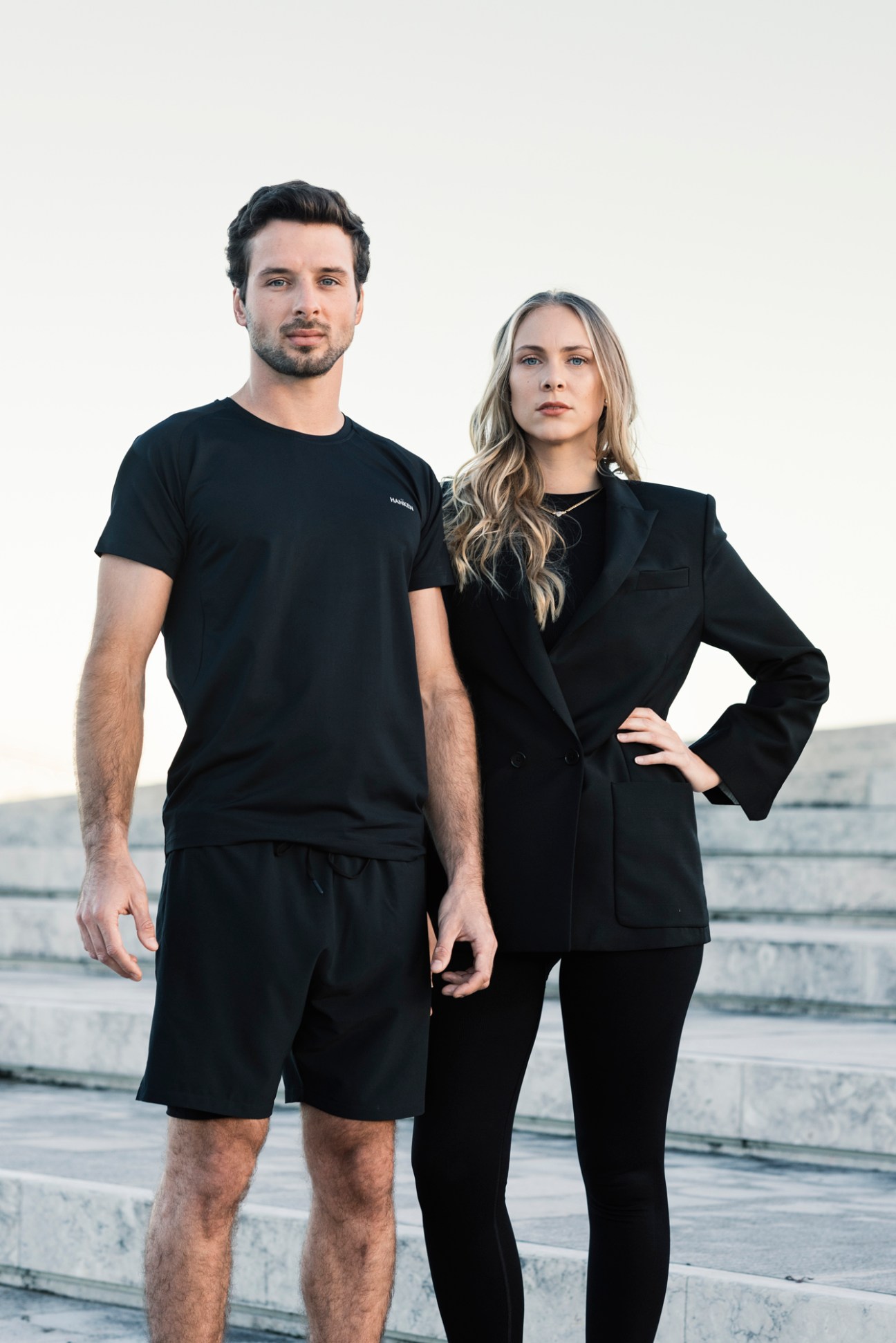
The past two years have been something of a whirlwind for Maria Hansen and Pedro Stürken. The couple met in Australia in 2019 and moved back to their home country of Portugal when the pandemic struck. They spent the lockdown in a coastal town near Lisbon and used the time to think up ways to combine their shared love of sports and an enthusiasm for sustainability in a business venture. In 2021 the pair welcomed not only their first child but also their new activewear brand, Hanken.
“We had both been living in Bondi Beach, where we were doing a lot of surfing and pilates,” says Hansen. “So we were constantly in activewear. It’s much more common there to wear gym clothes outside the studio.” The couple were so impressed by the wealth of stylish and sustainable brands available in Australia that they began to wonder why Europe didn’t have the same. “We started to think about what we can do better,” says Stürken. “We wanted to deliver high-quality designs that were made in Portugal.”
When it came to finding manufacturers on home soil, Hansen’s background in fashion and product development proved more than useful. “I already had contacts at several factories so it wasn’t hard to find what we needed,” she says. “And there is no better place to manufacture than Portugal, which has an amazing craft heritage and really good materials.” Combining quality production with sustainable fabrics is the core mission of the brand, as evidenced in its Seamless collection. The womenswear line is made from a breathable and lightweight upcycled polyamide, a textile that takes an overused performance material that does not biodegrade and gives it a second life.
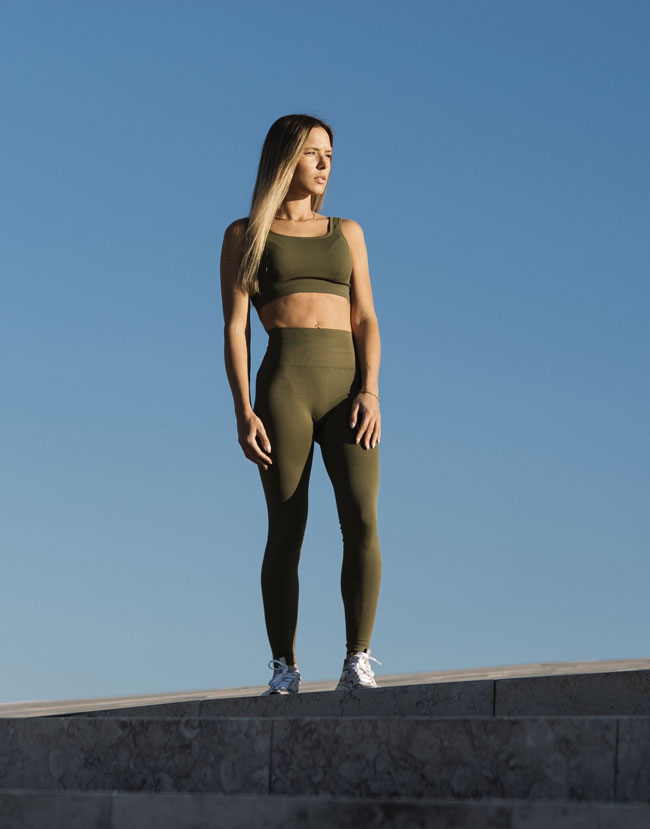
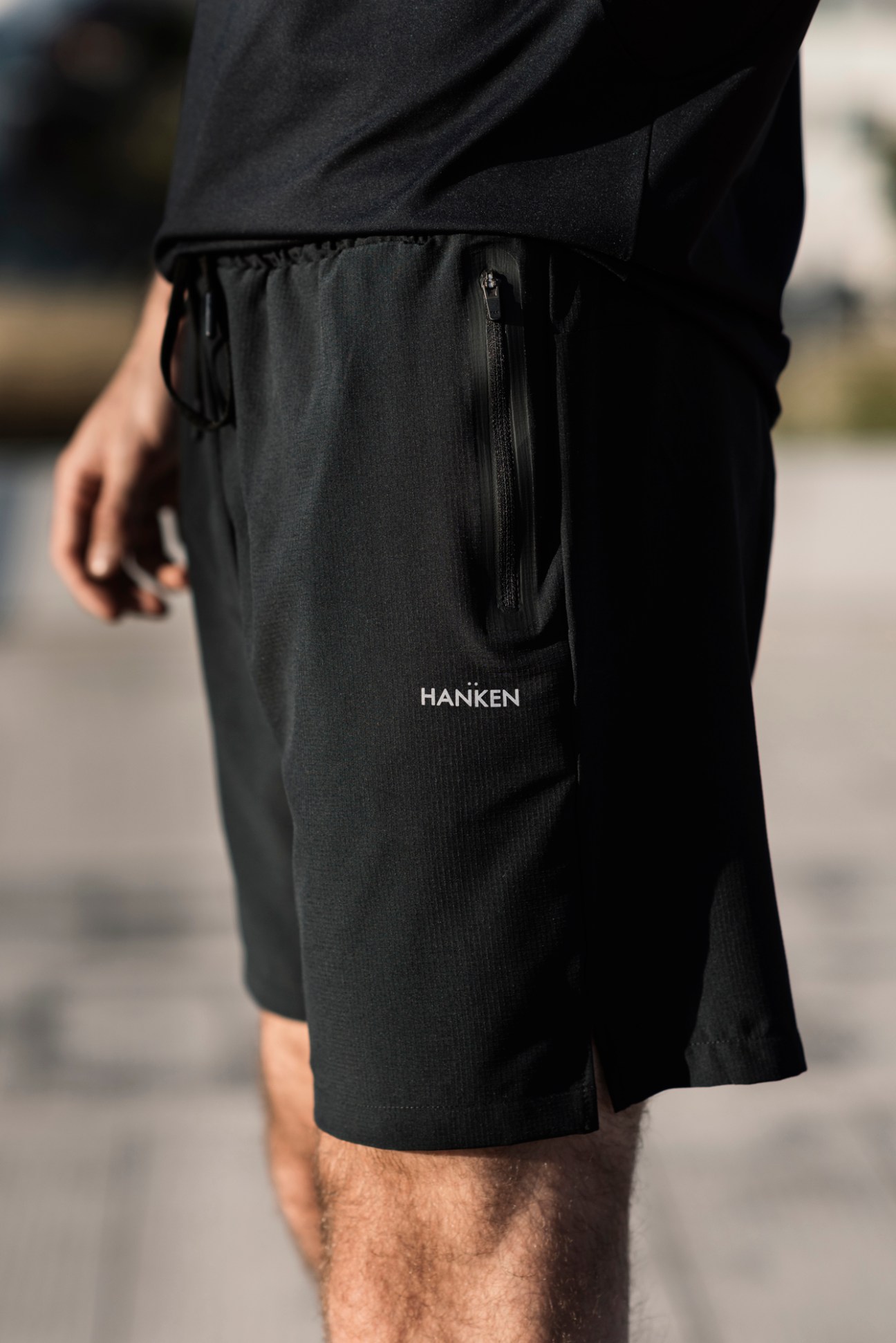
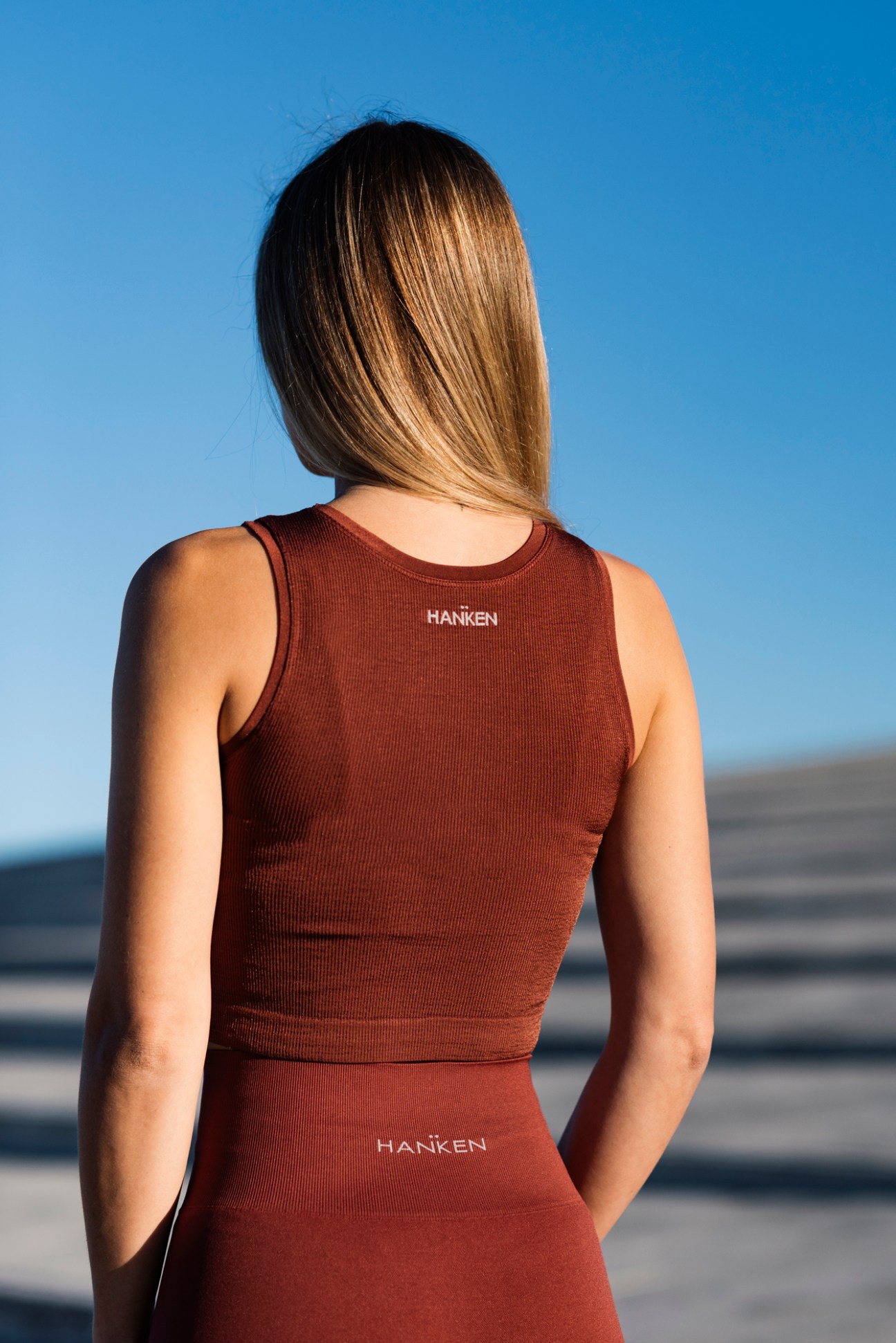
The only snag for Hanken in creating products such as this has been sourcing the right textiles. “There’s so much demand for sustainable materials and everyone is using the same suppliers,” says Hansen. The couple are sticking to their guns, however, and are unwilling to compromise their sustainable credentials for the sake of a quick turnaround. “We take our time and make sure that we’re as sustainable as possible without forgoing the quality of our products.”
In terms of quality control, Hansen and Stürken, with a close network of sporty friends, rigorously test every new model. Pieces then go into full-scale production, using as much sustainable fabric as possible, and are sold globally through the brand’s e-commerce platform. They add that their Portuguese-made leggings, shorts, T-shirts and crop tops are designed for customers to wear beyond the gym. “We want people to understand that wearing active gear from studio to street is practical and comfortable – and can be quite cool,” says Hansen.
hankenactive.com
Fit for purpose
Veilance, Canada
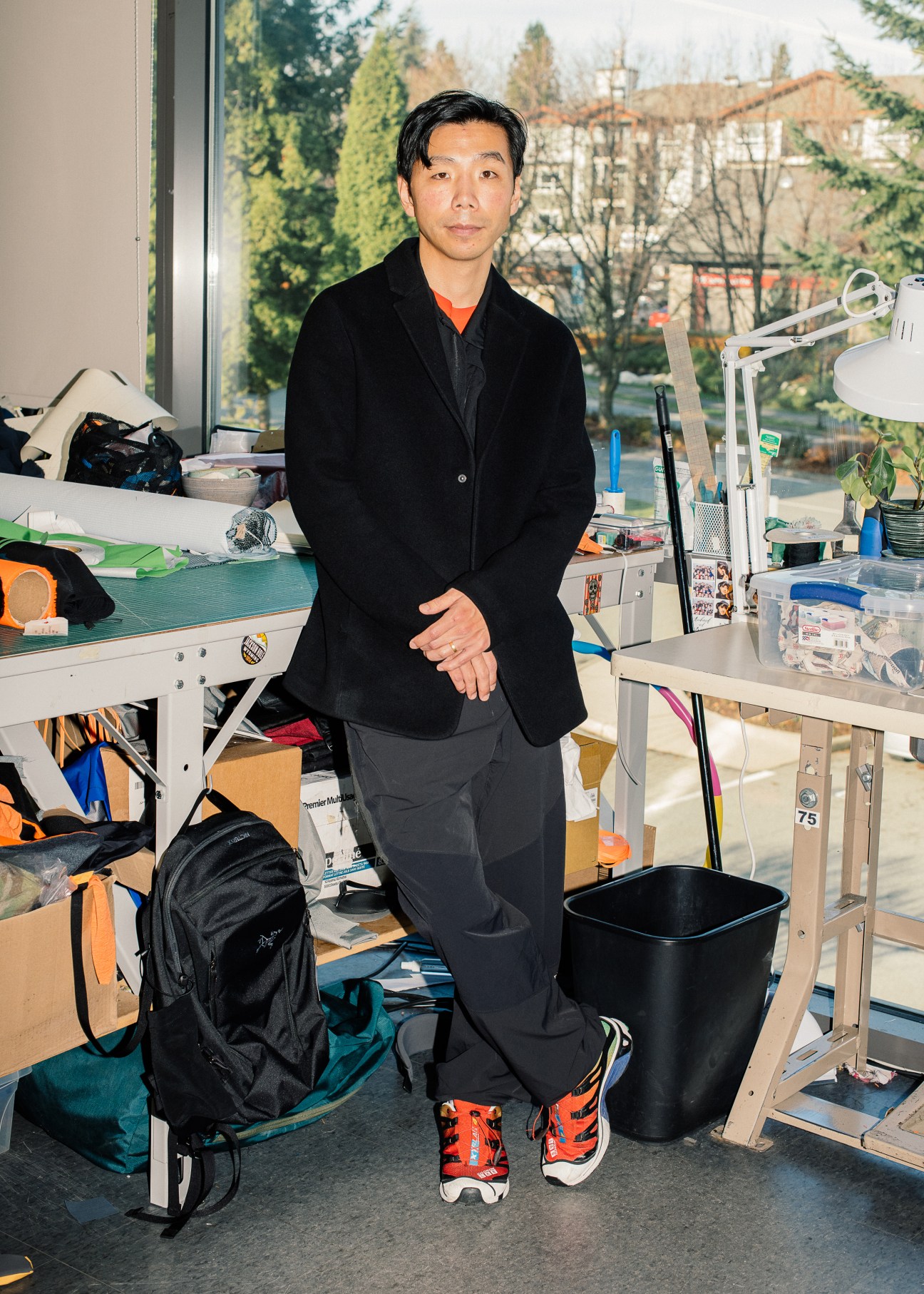
For almost seven years, Taka Kasuga has helmed Veilance, a brand that was spun off from Arc’teryx. Making use of the same cutting-edge materials as the Canadian sportswear giant’s skiing gear, alongside materials specific to Veilance, Kasuga designs clothing to be worn off the slopes in urban settings. His pieces include clean-looking monochrome parkas and impeccably tailored suits made from ultra-light, weather-resistant fabric. For an indication of the brand’s style credentials, it’s useful to know that the senior design director cut his teeth at revered fashion label Comme des Garçons. From his base in Vancouver, the Japanese-born designer talked to monocle about his work fusing high fashion with high performance.
How would you describe the difference between Arc’teryx and Veilance?
We work on the same design floor and share a lot in terms of material technology. But Arc’teryx makes clothes for mountain sports, while Veilance takes these technologies and applies them to urban life. In the mountains clothes can be purely about performance but in a city you have to factor in the cultural context and everyday situations. When we’re choosing a technical fabric, we think just as much about how it looks and feels.
How does your approach differ from that of a typical fashion brand?
For the women’s line we started by drawing with pen on paper and draping fabrics on a dress form. Clothes should always be beautiful. But very quickly we start thinking about ergonomics, freedom of movement and protection from the elements. I think of Veilance clothes almost like cars: you have to test and experience them. After a few days, you realise that you’re no longer afraid of rain or snow, of getting cold or wet, and you start doing things that you wouldn’t have done before.
What technical innovations are you most excited about?
Things are getting lighter while maintaining durability so people can go faster and further. This has been a trend in outdoor clothes and sports equipment for a long time and that philosophy can be applied to fashion as well, which is definitely interesting for me.
Is Veilance more of a performance-wear brand or a fashion label?
It makes no sense to draw a line between the two. People want to get outside more and be more active in their daily lives. In your closet there might be outdoor clothes, workout clothes and everyday clothes, but what if one product can do all three? If it looks good and works well, that’s all you need.
veilance.com
Weave just begun
Before you took that new wool jumper home from the shop, it had probably already been on a long, bewildering journey. After being shorn from sheep in Australia or New Zealand, the wool might have been spun into yarn in Thailand, woven into various elements in Albania, then sewn together in Italy. After all of this, that lovely jumper might have landed in a shop in New York, Seoul and London. Often not even those involved in this journey have an overview of the whole process. “The average piece of clothing has been on three continents,” says Borre Akkersdijk, the 36-year-old co-founder of textile studio and fashion brand Byborre. “That’s more than most people travel to in their lives.”
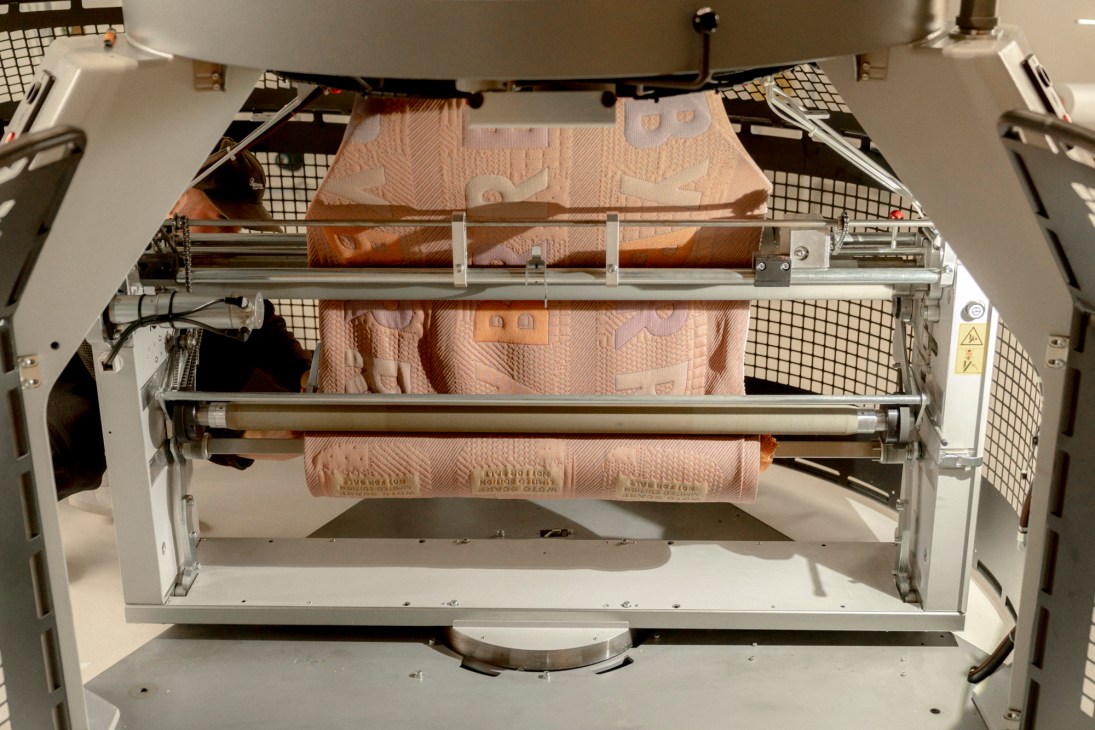
Dutch designer Akkersdijk is determined to upend the modus operandi of the textile industry. His Amsterdam-based team works directly with suppliers to develop new yarns and production methods, and to test designs on the seven industrial-grade knitting machines in its office. Byborre has become known for its collections of sculptural athleisure pieces that are made from high-performance materials, with durable, breathable and temperature-regulating properties, as well as for its fully transparent supply chain. But the bulk of the business, founded in 2015 by Akkersdijk and Arnoud Haverlag, has taken place behind the scenes. The studio has developed everything from bespoke knits for Nike and Adidas to upholstery for bmw cars and fabrics for Parisian haute-couture dresses.
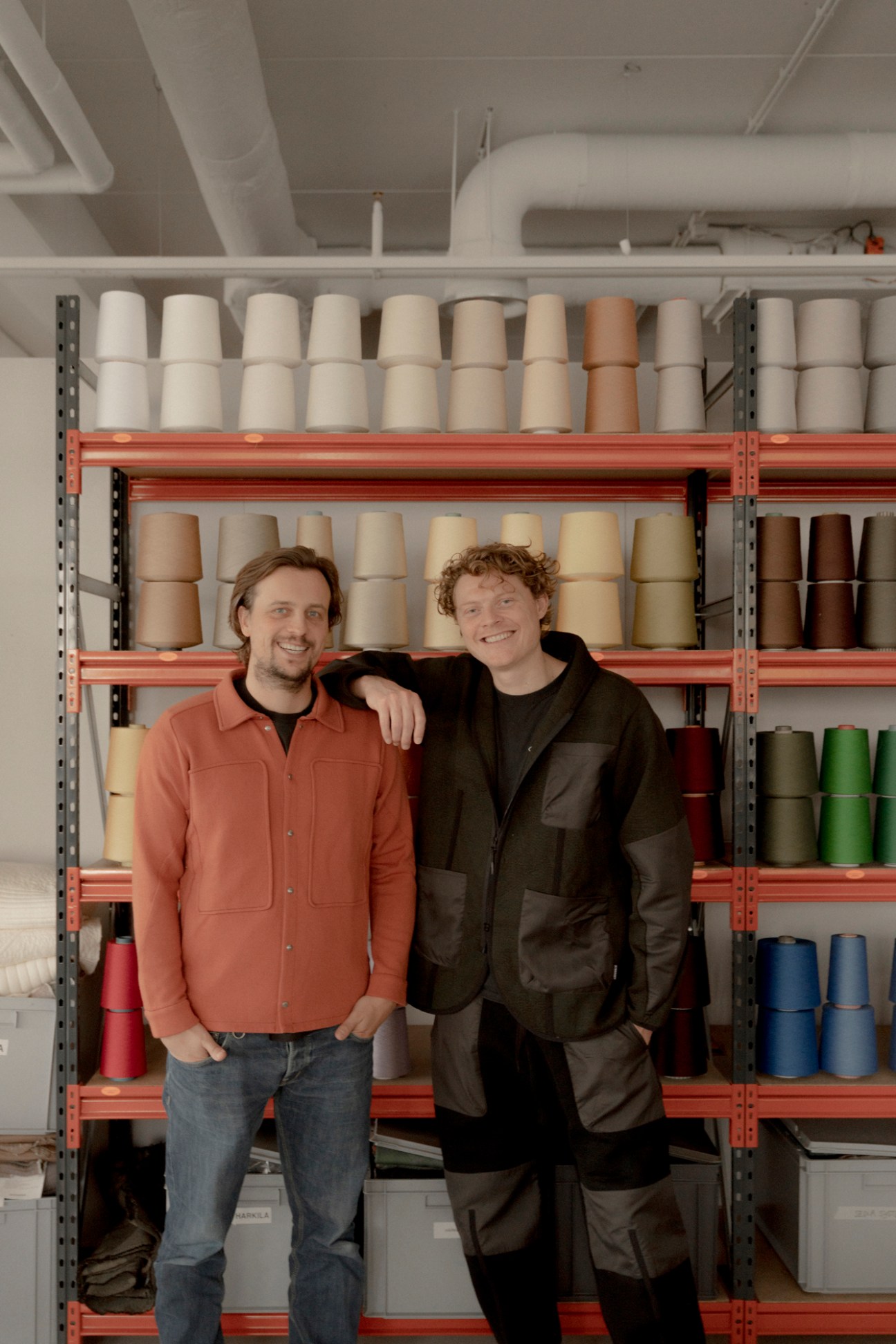
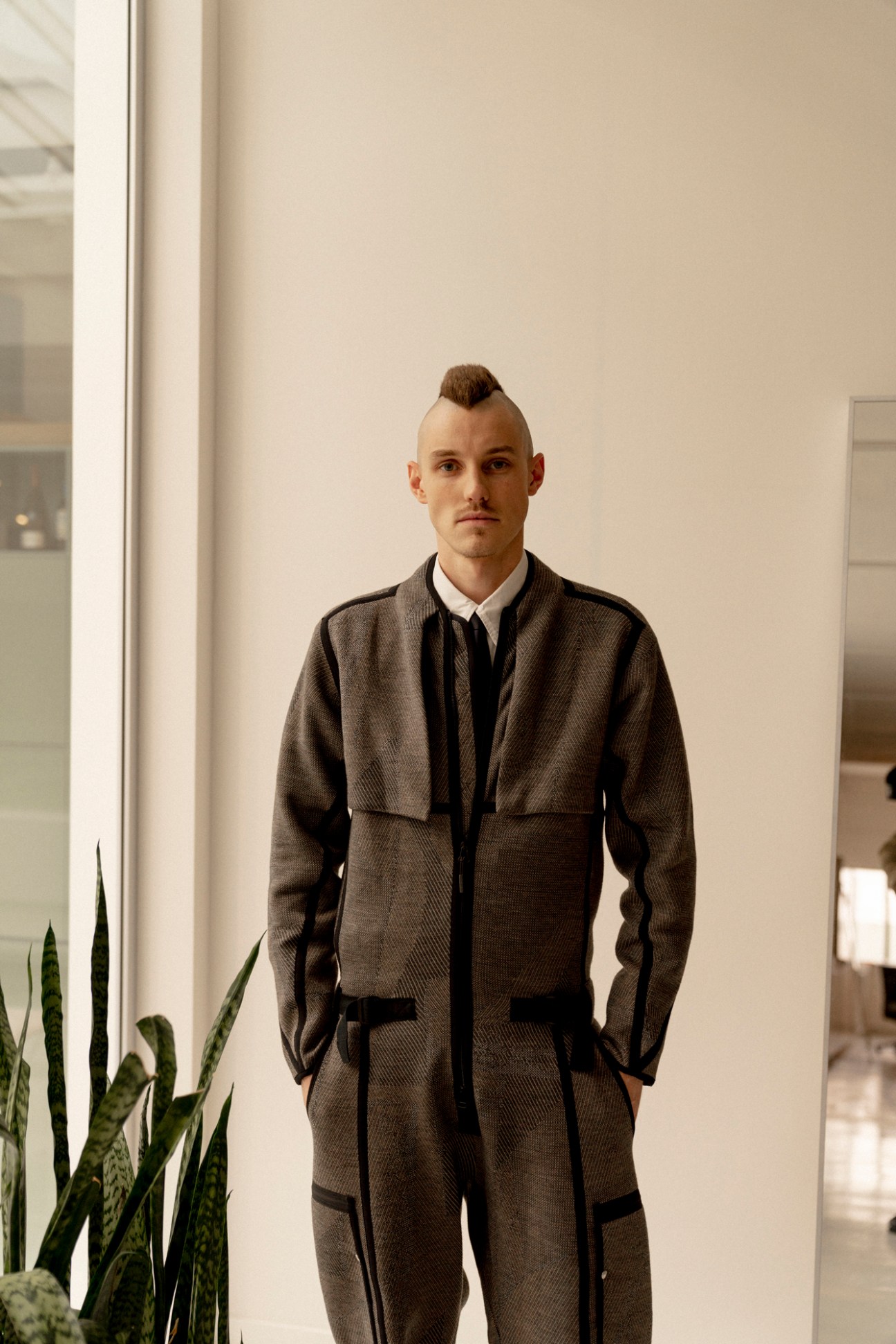
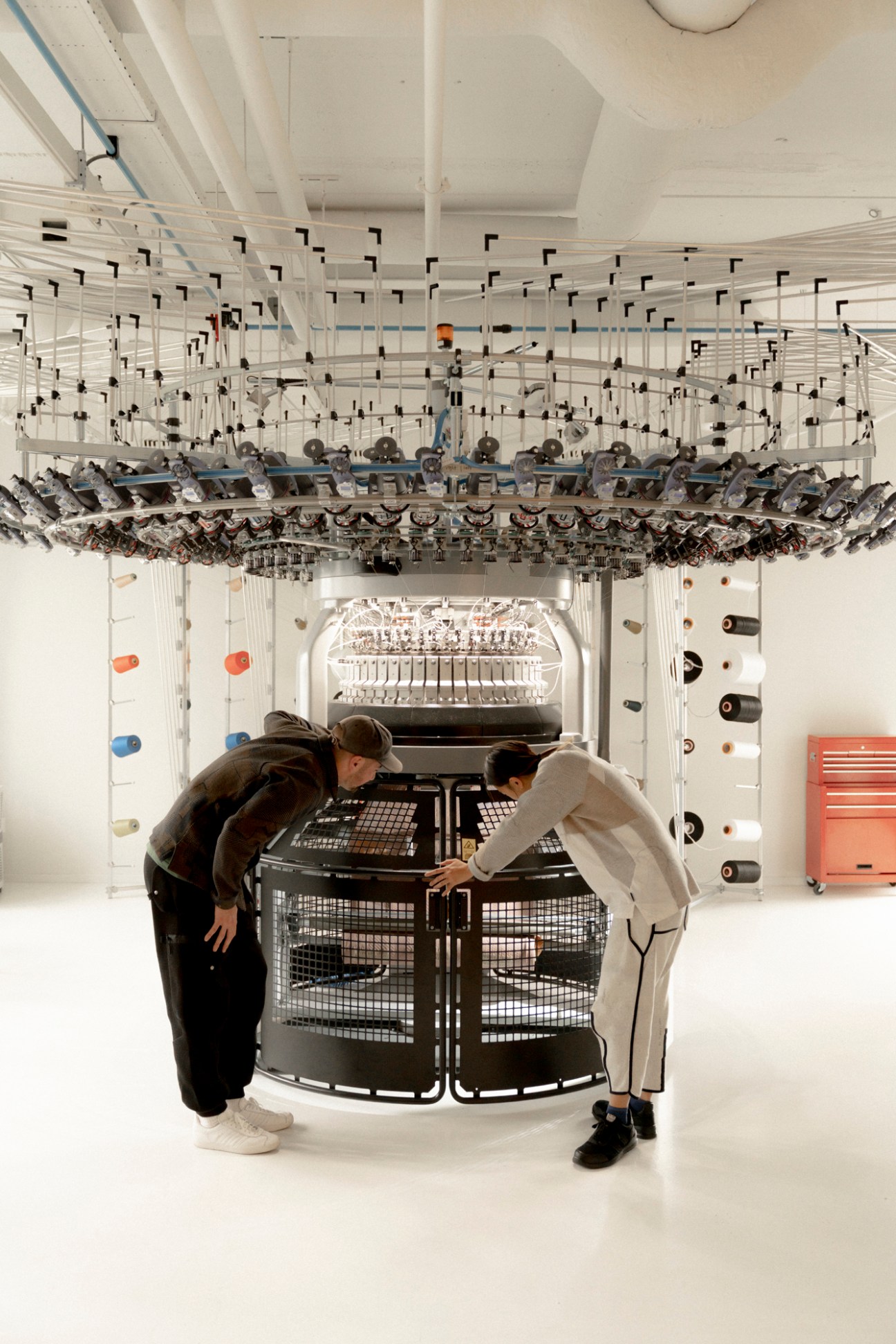
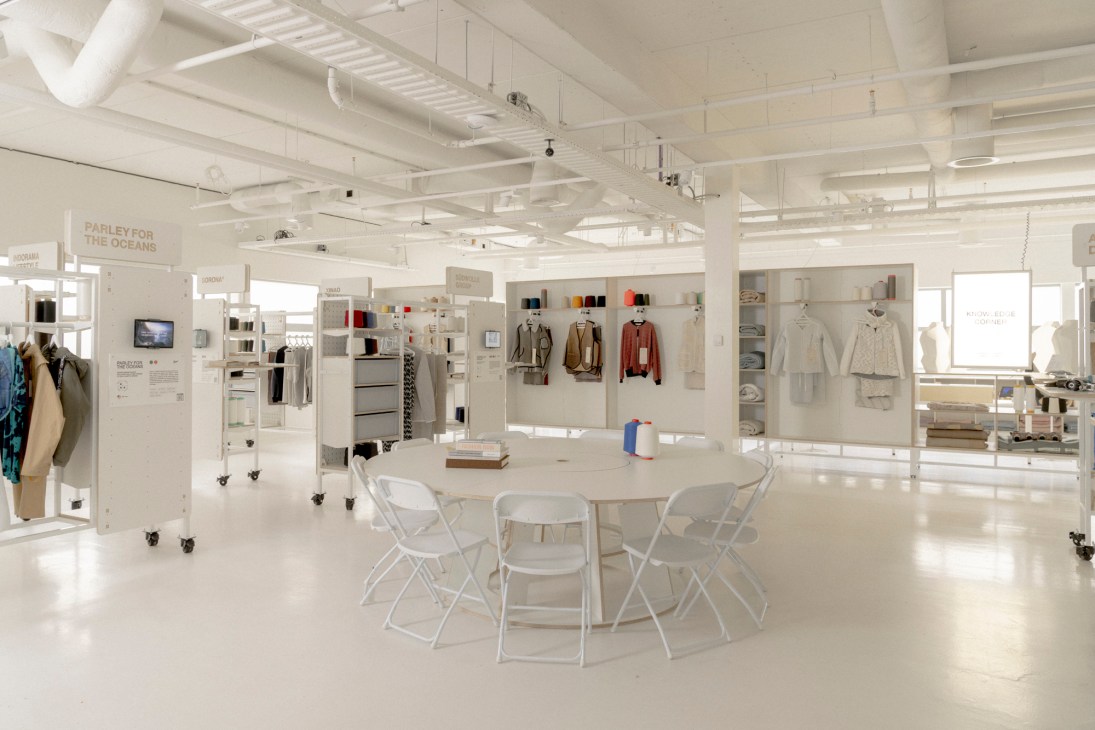
Now, Byborre has launched a showroom and a design platform that aim to foster fresh thinking and transparency in the industry. “Textile innovation has always been at the centre of what we do,” says Akkersdijk. “We want to open up our ecosystem to everyone.” The designer is showing Monocle around The Window of Textile Opportunities (Woto), which is a new, glass-walled showroom housed on the ground floor of Byborre’s Amsterdam headquarters. Woto brings together many of Byborre’s long-time partners in one room, including knitting-machine makers Santoni and Mayer & Cie, packaging conglomerate Avery Dennison and nine of the world’s leading fibre and yarn brands. Alongside stands showcasing the companies’ newest products, there are ample meeting rooms and workspaces, which can be booked for free by design students and companies. Anyone curious can apply for a guided tour.
“Hopefully we can encourage brands to create products that have less environmental impact – and are more interesting”
“Woto gives us the opportunity to learn what all of these players across our industry independently bring to the table,” says Rebecca Kelley, European head of product marketing at The Woolmark Company. The non-profit organisation, which represents Australia’s wool farmers, has had a working relationship with Byborre since 2011; the companies have collaborated closely over the past five years to develop new materials with the natural fibre. “Hopefully we can encourage brands to create products that have less environmental impact – and are more interesting,” says Kelley.
Visitors to Woto are invited to try their hand at Byborre’s approach. Computer-equipped workspaces at the back of the room allow them to trial Byborre Create, an innovative digital design tool that lets them fully customise and produce textiles, using a range of materials that include moisture-wicking fine merino wool. Samples are created on machines in the office’s knitting lab, which is spread across the ground and first floors. The textile can then go directly into production at the closest Byborre partner factory. The software was named best product in the 2021 Dutch Design Awards and it is easy to see why. It opens the door for independent designers to employ industry-leading manufacturers, while making the design process quicker and less wasteful too. Byborre has also partnered with institutions including New York’s Parsons School of Design and the London College of Fashion. “I have students who come in here to try it out and at the end of the day they all talk about working in the textile industry,” says Akkersdijk.
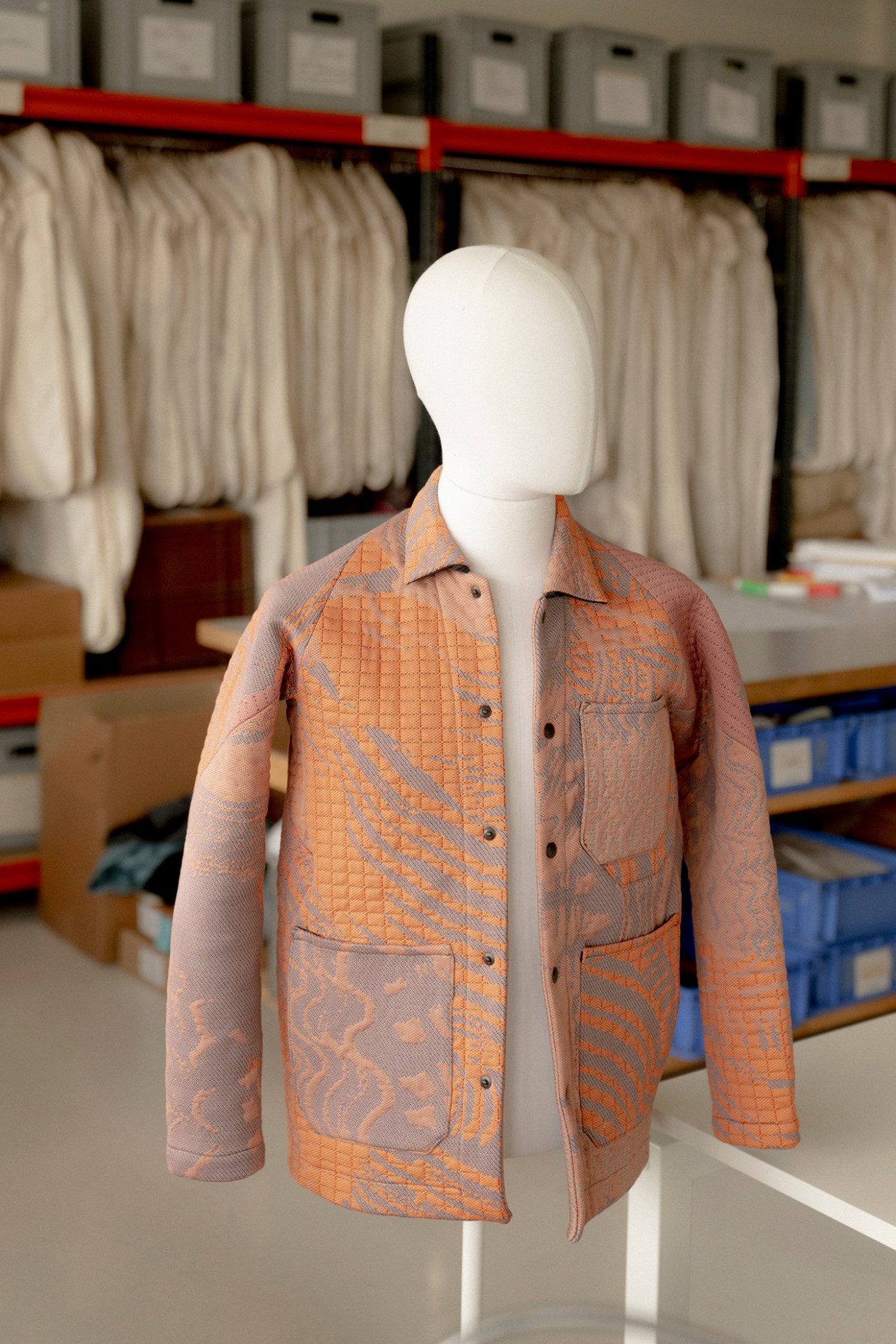
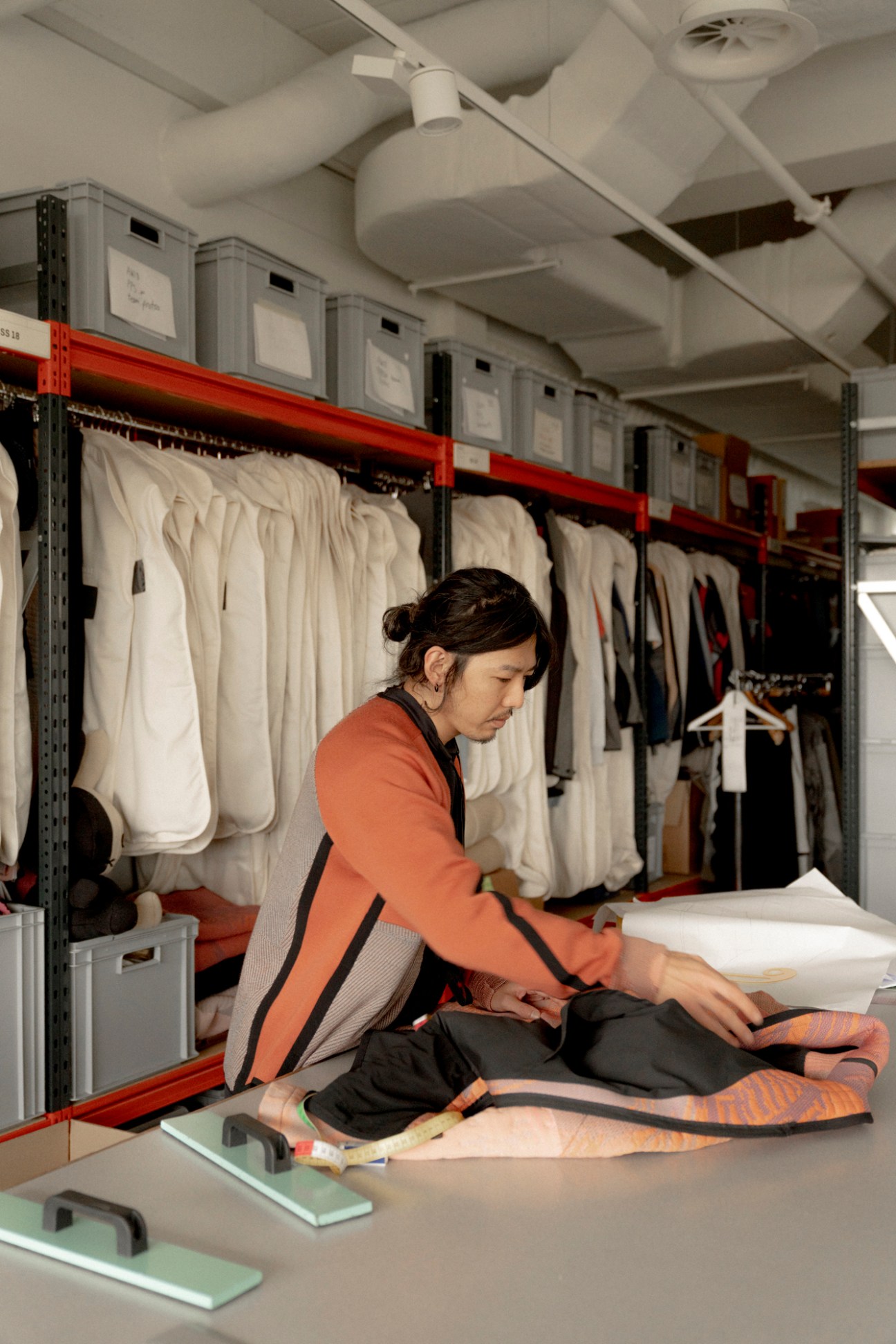
But it’s not only design students who find inspiration from the space. Some of the most established companies in the industry are just as enthusiastic. “This way of connecting different entities is unique for our business,” says Wolfgang Müller, sales director at Mayer & Cie. A large share of the world’s textiles is knitted on the German company’s circular machines but it is normally only in direct contact with the factories that purchase them. Through a presence at Woto, Müller explains that Mayer & Cie can exchange ideas with players across the industry, from yarn suppliers to product designers.
Akkersdijk has realised that, as well as seeking to create innovative materials and educating eager young designers, the industry could also reap benefits from more co-ordination. The designer recounts assembling all of the Woto showroom’s partners on an introductory conference call. “We had universities, three different machine manufacturers and the largest wool and polyester suppliers in the world,” he says. “And all the ceos were saying the same thing, which is that they want to be more sustainable and transparent. I realised that the fact that we are bringing these companies together to work towards the same goal, that is already really powerful.”